
Written By: Don Dodi
Fact Checked By: Kristen Brown
Reviewed By: Diego Rosenberg
In the nighttime: you just don’t have to tackle the DARKNESS; but the low light conditions can actually reduce your ability to see in clear way and that makes the roads more dangerous.
Yes, it is true that at night there is less crowded, but is is actually really risky to drive on the night.
To support that thing: there’s studies from the organizations such as: NHTSA shows that although fewer vehicles are on the road at night, but the rate of fatal accidents is significantly higher than compared to daytime driving as well.
And, mainly human vision becomes much weaker in low light: as our depth perception, color recognition and peripheral vision also reduces in the dark.
Along with this, there’s glare from the oncoming headlights that can temporarily blind the drivers for a few seconds, which is enough to cause some serious accidents.
Now, with this guide you’ll learn How to Drive Safely at Night, so that you can actually use the proper techniques and be more aware during that time.
Why is Driving at Night More Dangerous?
Driving at night is more hazardous than driving during the day because several risk factors converge simultaneously, diminishing a driver’s ability to see, react and make safe decisions.
This occurs because human vision relies heavily on light; when light levels are low, the brain receives less clear information regarding the road ahead.
Furthermore, due to the body’s natural sleep-wake cycle, drivers are more prone to fatigue, which slows down reaction times and the speed at which decisions are made.
Roads also become less visible, as many areas lack adequate street lighting, making it difficult to spot sudden hazards such as animals, disabled vehicles, or pedestrians.
Additionally, there is a higher likelihood of facing other drivers who are under the influence of alcohol or are too fatigued to drive safely.
Collectively, these factors transform night driving into a scenario where even minor errors can quickly escalate into serious accidents; this is why exercising extra caution, remaining fully alert and employing proper driving techniques are absolutely essential.
1. Reduced Visibility
Reduced visibility is the primary reason why driving at night is so risky, as human eyes are unable to perceive objects as clearly in the darkness of night as they can in daylight.
At night, your field of vision narrows significantly; this means that you typically can see only what falls directly within the beam of your headlights, while keeping an eye on the edges of the road becomes considerably more difficult.
Essential elements such as road signs, lane markings, pedestrians, cyclists and animals often remain unnoticed until they are in very close proximity, leaving you with very little time to react.
At night, colors appear muted, which can make warning signs and traffic signals less distinct.
In low-light conditions, even familiar roads can look different and disorienting.
Due to this issue of reduced visibility, drivers often have to rely heavily on guesswork and split-second decisions, thereby increasing the likelihood of errors.
Therefore, drivers should reduce their speed and maintain full concentration to compensate for their diminished visual acuity.
2. Headlight Glare
Headlight glare is another major hazard when driving at night and it can severely impair your vision, even if only momentarily.
When an oncoming vehicle approaches with bright headlights, particularly if they are on high beams or are misaligned, it can create such intense glare that it becomes difficult to see the road ahead.
This glare can induce a condition known as “temporary blindness,” in which it takes several seconds for your eyes to recover and return to normal vision after being exposed to the intense light.
Even a momentary lapse in vision can be enough to overlook a pedestrian, a sharp curve, or an obstruction on the road.
Older drivers are at an even greater risk from this glare, as it takes their eyes longer to recover and return to a normal state.
Dirty windshields and mirrors can further exacerbate this problem by scattering light and creating additional visual obstructions.
As headlight glare is a very common issue during night driving, drivers must understand how to properly manage it to avoid hazardous situations.
3. Driver Fatigue and Drowsiness
One of the most serious, and often underestimated, hazards associated with driving at night is driver fatigue.
The human body naturally follows a “sleep-wake cycle,” known as the “circadian rhythm”; it is precisely because of this cycle that people tend to feel more tired and less alert during the night.
This means that even if you feel perfectly fine at the start of your journey, your alertness can diminish rapidly as you continue to drive.
Fatigue slows down reaction times, impairs concentration and negatively affects decision-making abilities, making it even more difficult to react to sudden changes on the road.
In more dangerous instances, drivers may experience “microsleeps”, brief, involuntary lapses into sleep that last only a few seconds, of which the driver remains completely unaware.
During these moments, the driver has absolutely no awareness of the road ahead, which can easily lead to accidents.
Long journeys, a lack of adequate rest and driving after a full day of work, all of these factors can exacerbate this problem.
As fatigue sets in gradually, many drivers fail to realize just how dangerous the situation has become, and by the time they do realize it, it is often too late.
4. Drivers Under the Influence
At night, the likelihood of facing drivers who are not in a fit state to operate a vehicle is significantly higher; this substantially increases the overall danger on the road.
The inability to drive properly may stem from alcohol, narcotics, extreme fatigue, or even distraction, all factors that compromise a driver’s ability to safely control their vehicle.
According to data from the Centers for Disease Control and Prevention, the majority of alcohol-related accidents occur at night, particularly during the late hours.
Impaired drivers may exhibit slowed reaction times, compromised decision-making skills and difficulty maintaining their lane, rendering their behavior unpredictable and hazardous to others.
They may disregard traffic laws, drive at unsafe speeds, or fail to notice other vehicles and pedestrians.
This creates a situation where, even if you are driving cautiously, you may still be placed in jeopardy due to the actions of another driver.
For this reason, it becomes even more imperative to remain vigilant and maintain a safe distance from other vehicles when driving at night.
Know, Pre-Driving Safety Checklist
Proper preparation before driving at night is the most effective way to minimize risks on the road and ensure your safety.
Many accidents that occur during night driving are not solely caused by external conditions, but also by minor issues that could have been resolved before the journey even began.
According to guidelines from the National Highway Traffic Safety Administration, performing a basic inspection of your vehicle significantly reduces the likelihood of mechanical breakdowns and accidents.
At night, minor issues such as: dim headlights, dirty mirrors, or underinflated tires, become even more hazardous, as visibility is already compromised in the dark.
Spending a few minutes inspecting your vehicle, properly adjusting your mirrors and planning your route can significantly enhance your control, situational awareness and confidence while driving.
This preparation ensures that your vehicle functions correctly and that you are fully equipped to handle the challenges associated with driving in low-light conditions.
1. Inspect Your Vehicle
Inspecting your vehicle before driving at night is crucial, as your safety depends largely on the proper functioning of your vehicle’s components.
Your headlights, taillights and turn signals must be in good working order so that you can clearly see the road ahead and, just as importantly, so that other drivers can see you.
If your headlights are even slightly dim, you may be unable to spot obstacles in time to react safely.
A clean windshield and mirrors are equally essential, as dirt, dust, or smudges can scatter light, making it difficult to see clearly specially when facing the glare of oncoming headlights.
You should also check your tire pressure; If tire pressure is too low or too high, the vehicle’s grip on the road is compromised, thereby increasing the risk of an accident.
Brakes must be in good working order, as the increased reaction time required at night can result in the vehicle taking longer to come to a complete stop.
A well-maintained vehicle offers you superior control and minimizes the likelihood of facing sudden mechanical failures while driving.
2. Adjust Your Mirrors Correctly
Properly adjusted mirrors play a crucial role in ensuring safe night driving, as they enable you to remain aware of your surroundings without straining your eyes.
Utilizing the ‘anti-glare’ or ‘night mode’ setting on your rearview mirror reduces the intensity of bright headlights from vehicles approaching from behind, making it easier to maintain focus on the road ahead.
Side mirrors should be adjusted to minimize ‘blind spots’ (areas around the vehicle that are not visible in the mirrors), allowing you to spot approaching vehicles without having to turn your neck excessively.
If mirrors are not adjusted correctly, gaps may remain in your field of vision; this situation can prove hazardous when changing lanes or reacting to other vehicles.
At night, when visibility is already reduced, obtaining a clear and expansive view through your mirrors becomes even more critical.
Taking a moment to properly adjust them before you start driving can help prevent confusion and significantly enhance your overall situational awareness on the road.
3. Keep Windshield and Lights Clean
An simple yet highly effective method for improving visibility at night is to keep your windshield and lights clean.
Dust, water residue and smudges on the windshield can reflect and scatter light from headlights, streetlights and other sources, making it difficult to see clearly.
This effect is further intensified when driving in areas with bright lighting or heavy traffic.
It is essential to clean both the interior and exterior surfaces of the windshield, as grime on either side can compromise visibility.
Similarly, headlights and taillights should be kept clean to ensure maximum illumination and to guarantee that your vehicle remains visible to other road users.
Even a thin layer of dirt can diminish the effectiveness of your lights.
Regular cleaning improves visibility, reduces glare and allows you to identify road markings, pedestrians and obstacles with greater ease.
4. Plan Your Route in Advance
Mapping out your route before driving at night can make your journey safer and less stressful.
Choosing well-lit and familiar roads simplifies navigation, thereby reducing the likelihood of getting lost or making sudden, impulsive decisions.
Well-lit roads help you see clearly and identify potential hazards ahead of time, while familiar routes reduce the mental strain associated with navigating directions.
It is also crucial to avoid high-risk or poorly maintained areas where road conditions may be poor or lighting may be inadequate.
Dealing with sudden obstacles such as: potholes, animals, or sharp turns, is significantly more difficult at night, particularly on unfamiliar roads.
By planning ahead, you can focus more on safe driving rather than worrying about where to go; this boosts your confidence and minimizes risk.
Know, Important Techniques for Night Driving
Driving safely at night involves more than just turning on your headlights, as low-light conditions alter your visibility, depth perception and reaction time.
If applied correctly, a few simple techniques can significantly reduce the risk of accidents and boost your confidence on the road.
According to advice from organizations such as the National Highway Traffic Safety Administration, good driving habits such as: controlling your speed, maintaining a safe following distance and remaining fully alert, are the key to preventing accidents in the dark of night.
At night, rather than relying on quick reflexes, you should place greater emphasis on careful observation and controlled driving, as your ability to identify potential hazards is already diminished.
By adhering to the proper techniques, you can compensate for these limitations and drive more safely in low-light conditions.
1. Use Headlights Correctly
The proper use of headlights is one of the most critical skills for night driving, as they serve as your primary source of visibility.
In most situations, low beams should be used, particularly when other vehicles are nearby, as they provide sufficient illumination without causing glare in the eyes of other drivers.
High beams should be reserved for dark, deserted roads where there is no oncoming traffic, as they allow you to see much further ahead.
However, when another vehicle approaches, you must immediately switch back to low beams to avoid blinding the other driver with the intense light.
Failure to do so can create hazardous situations, as the glare can impair the vision of both drivers.
Using your headlights correctly not only helps you see clearly but also ensures that those around you can drive safely as well.
2. Maintain a Safe Speed
Maintaining a safe speed at night is crucial, as your ability to see and react is limited compared to driving during the day.
You should always determine your speed based on how far ahead you can see clearly.
The principle of “driving within your line of sight” dictates that you must be able to bring your vehicle to a complete stop within the distance illuminated by your headlights.
If you are driving too fast, you will not have sufficient time to react to obstacles such as pedestrians, animals, or sudden curves in the road.
Driving at a slower speed provides you with more time to process information and make safer decisions.
Even if the road appears empty, it is essential to avoid speeding, as identifying hidden hazards can be quite difficult at night.
3. Maintain a Greater Distance from the Vehicle Ahead
When driving at night, maintaining a greater distance from the vehicle ahead is vital, as reacting often takes longer in low-light conditions.
At night, judging the speed and distance of other vehicles is difficult, which increases the likelihood of misjudgment.
By increasing the gap between your vehicle and the one in front, you allow yourself more time to react should that vehicle suddenly apply its brakes or change direction.
This extra space acts as a safety buffer, thereby reducing the risk of a collision.
Fatigue and reduced visibility can further slow down your reaction time, making this practice even more essential.
Maintaining a greater distance from the vehicle ahead gives you better control over your vehicle and ensures that you are prepared for sudden situations.
4. Pay Attention to Road Markings
When driving at night, road markings serve as invaluable guides, helping you stay within your lane and understand the direction of the road.
Lane lines, edge lines and reflective markers are designed to remain visible even in low-light conditions, thereby serving as reliable visual cues.
Rather than focusing directly on the bright headlights of oncoming vehicles, which can cause glare and eye strain, it is safer to shift your gaze slightly toward the edge of the road and follow the lane markings.
This allows you to maintain the correct direction without straining your eyes.
By keeping your full attention focused on the road markings, you stay centered within your lane and avoid drifting, a common hazard when driving at night.
5. Keep Your Eyes Moving Constantly
Constantly scanning your surroundings is an essential habit that heightens your awareness and helps you identify potential hazards in advance.
Rather than fixing your gaze on a single spot, you should continuously shift your eyes across the road ahead, the road shoulders and your mirrors.
This enables you to spot potential hazards such as: pedestrians, animals, cyclists, or parked vehicles, before they pose an immediate threat.
At night, many hazards emerge suddenly and remain invisible until the very last moment; therefore, continuously scanning your surroundings provides you with more time to react.
Shifting your gaze also minimizes the effects of glare and prevents your eyes from becoming fixated or fatigued.
This simple technique enhances your alertness and helps you remain fully aware of your immediate environment while driving.
How to Manage Headlight Glare
Headlight glare is one of the most common and dangerous problems drivers face at night, as it directly impacts how clearly you can see the road.
When the intense beams from oncoming vehicles or cars traveling behind you shine directly into your eyes, it reduces contrast and makes it difficult to identify objects.
For several seconds after exposure to bright light, your eyes may struggle to readjust to the darkness, potentially slowing down your reaction time.
Safety guidelines from the National Highway Traffic Safety Administration (NHTSA) indicate that even brief moments of reduced visibility can increase the risk of accidents, particularly at high speeds.
Glare becomes even more intense if your windshield or mirrors are dirty, or if headlights are excessively bright or improperly aimed.
As this issue cannot always be avoided, learning how to effectively manage glare is crucial for safe night driving.
With the right techniques and a few simple adjustments, you can protect your eyes and maintain better control over your vehicle.
1. Techniques for Minimizing the Effects of Glare
Minimizing the effects of glare begins with knowing where to focus your gaze when confronted by bright oncoming headlights.
Rather than looking directly into the approaching light, it is safer to shift your gaze slightly toward the left side of your lane.
This allows you to avoid the most intense glare while still keeping an eye on the road ahead.
By using road-edge lines or lane markings as a guide, you can continue driving in the correct direction without having to look directly into the glare.
This technique is simple yet highly effective, as it shields your eyes from direct light while simultaneously helping you stay within your lane.
It also reduces eye strain, allowing you to regain clear vision quickly once the oncoming vehicle has passed.
By adopting this habit, you can significantly improve your ability to safely handle bright lights.
2. Adjusting Rearview Mirrors
Another crucial step in managing glare is properly adjusting your rearview mirrors, particularly when the glare originates from vehicles traveling behind you.
Most modern mirrors feature a ‘Night Mode’ or ‘Anti-Glare’ setting, which reduces the intensity of the light reaching your eyes.
Switching to this mode alters the angle of light reflection, making the light appear less intense and less distracting.
This allows you to monitor the traffic behind you without any interruption or momentary blurring of vision.
If you do not utilize this feature, the bright headlights of approaching vehicles can cause discomfort and diminish your ability to focus on the road ahead.
This small adjustment, whether made before you start driving or while you are already on the road, as it can make your night driving significantly more comfortable and safe.
3. Keep the Windshield Clean
Keeping your windshield clean is essential, as dirt, dust and smudges can significantly amplify glare.
When light strikes a dirty surface, instead of passing clearly through it, it scatters in various directions, creating a hazy or blurred effect.
This makes it difficult to identify objects and intensifies the glare emanating from headlights and streetlights.
It is crucial to regularly clean both the inner and outer surfaces of the windshield, as dirt accumulation on either side can impair visibility.
At night, even minor smudges or streaks can have a significant impact.
A clean windshield allows light to pass through properly, providing you with a clearer and sharper view of the road.
This simple habit can significantly reduce glare and enhance your driving safety.
How to Avoid Drowsy Driving
Driving while drowsy at night constitutes one of the most serious hazards, as it directly impairs your ability to think clearly, react quickly and maintain control over your vehicle.
The human body follows a natural sleep-wake cycle, causing individuals to feel more fatigued and less alert during nighttime hours, particularly after a full day of work or activity.
According to the Centers for Disease Control and Prevention (CDC), fatigue can slow down reaction times and diminish alertness to a degree comparable to alcohol intoxication.
This implies that a fatigued driver may overlook critical road signs, react too slowly, or make poor decisions while on the road.
One of the most dangerous consequences of fatigue is a “microsleep”, brief, involuntary lapses into sleep lasting just a few seconds, which can be sufficient to trigger a serious accident.
Avoiding drowsy driving requires an awareness of early warning signs, the adoption of simple habits to maintain alertness and the ability to recognize when it is no longer safe to continue driving.
1. Recognizing Warning Signs
Recognizing the early signs of drowsiness is crucial, as fatigue often sets in gradually; consequently, many drivers fail to realize just how tired they are until the situation becomes dangerous.
Frequent yawning and blinking are common indicators that your body is struggling to stay awake.
You may also experience difficulty keeping your eyes open or maintaining a clear focus on the road ahead.
Another warning sign is drifting out of your lane or missing road signs and turns, which suggests that your attention is wandering.
Some drivers cannot even recall the events of the last few minutes of driving, a clear indication of diminished awareness.
These warning signs should never be ignored, as they serve as a clear signal that your mind is no longer fully alert.
Recognizing these symptoms early allows you to take action before the situation becomes dangerous.
2. Tips for Staying Alert
Driving at night requires simple yet effective habits that help your body remain active and focused.
Taking regular breaks, ideally every two hours, gives your mind and body a chance to rest and recover from continuous driving.
Even a short break can boost alertness and reduce fatigue.
Staying hydrated is also crucial, as dehydration can make you feel more tired and less focused.
Drinking water helps maintain energy levels and ensures that your body continues to function properly.
Avoiding heavy meals before or during night driving is another beneficial step, as overeating can induce drowsiness and slow down your reaction time.
Fresh air, light stretching during breaks and maintaining mental focus on the road can also help keep you alert.
These small measures can make a significant difference in keeping you awake and focused.
3. When to Stop Driving
Knowing when to stop driving is one of the most critical decisions for your safety, as continuing to drive despite fatigue can be extremely dangerous.
If you persist in driving while feeling excessively tired, your reaction time and awareness of your surroundings will gradually diminish, thereby increasing the risk of accidents.
When warning signs appear such as: heavy eyelids, frequent yawning, or difficulty staying within your lane, it is a clear indication that you must stop driving immediately.
Taking a break, catching a brief nap, or, if possible, switching drivers is always a safer option than attempting to keep driving.
Many accidents occur because drivers underestimate the dangers of fatigue and believe they can push through it while driving.
In reality, the only effective way to combat drowsiness is to rest.
The decision to pull over and rest ensures that you can safely continue your journey without endangering yourself or others.
Know, Special Considerations for Night Driving
Driving at night becomes even more challenging when weather or road conditions are poor, as darkness reduces visibility and diminishes vehicle control.
Driving in various environments such as: in fog, rain, or on rural highways, presents specific hazards that require specialized driving techniques.
According to safety guidelines from the National Highway Traffic Safety Administration, many accidents occurring at night are not solely caused by the darkness itself, but rather because drivers fail to adapt their driving style to changing conditions.
In fog and rain, lighting behaves differently, road surfaces become slippery and identifying sudden hazards in dimly lit areas becomes extremely difficult.
Understanding how to react in these situations, by remaining calm and maintaining control of the vehicle, as it can significantly reduce the likelihood of accidents and help ensure your safety throughout your entire journey.
1. Driving in Fog at Night
Driving in fog at night is particularly hazardous because fog severely obstructs visibility and scatters light, making it difficult to see clearly.
When headlight beams penetrate the fog, the light reflects back toward the driver, creating an intense, hazy glare that can further impair visibility.
For this reason, it is crucial to use low beams or fog lights, as they are designed to project light downward and minimize the light (glare) reflecting back toward the driver.
The use of high beams should be avoided; rather than aiding visibility, they actually intensify the glare and exacerbate the situation.
In foggy conditions, it is crucial to drive slowly and pay close attention to road markings to ensure that you remain correctly positioned within your lane.
Sudden maneuvers or driving at high speeds can be dangerous, as obstacles may appear very abruptly.
Staying calm, reducing your speed and utilizing appropriate lighting can help you navigate safely through the fog.
2. Driving in the Rain at Night
Driving in the rain at night presents a combination of difficulties that make driving even more challenging and hazardous.
The presence of water on the road reduces tire traction, increasing the likelihood of skidding or losing control of the vehicle; additionally, raindrops on the windshield and headlight glare obstruct visibility.
Headlights from other vehicles can reflect off the wet road surface, creating a blinding glare that makes it difficult to distinguish lane markings or spot obstacles.
For all these reasons, it is essential to drive at a reduced speed to ensure that you have sufficient time to react to sudden changes.
It is vital that your windshield wipers are functioning properly to maintain clear visibility, as even a small amount of water can obscure your view.
Maintaining steady and firm control of the vehicle, and avoiding sudden braking or sharp turns, as it can help prevent accidents during rainy weather.
When rain and darkness coincide, the best way to stay safe is to drive cautiously and calmly.
3. Driving on Rural Roads and Highways at Night
Compared to driving in the city, driving on rural roads and highways at night presents a distinct set of challenges; this is primarily due to limited lighting and a scarcity of visual reference points in the surrounding environment.
In many rural areas, streetlights are either scarce or entirely absent, making it difficult to clearly see the road ahead and identify potential hazards in advance.
One of the greatest dangers in these regions involves animals crossing the road, an occurrence that often happens suddenly and without any warning.
Due to reduced visibility, drivers traveling at high speeds may not have sufficient time to react.
Highways can also be hazardous at night, as vehicles often travel at higher speeds there and the lack of lighting can make it difficult to accurately judge distances and speeds.
Under these conditions, remaining vigilant, using headlights correctly and maintaining a safe speed are absolutely essential.
Paying attention to road signs and being prepared for sudden obstacles can help you drive more safely on both rural roads and highways at night.
Know, Safety Tips for Different Drivers
Driving at night affects different drivers in different ways, as various factors such as: experience, age and driving habits, influence how well an individual handles low-light conditions.
Some drivers may experience vision-related difficulties, while others may face issues such as fatigue or a lack of confidence.
Understanding these differences is crucial, as a one-size-fits-all approach to driving does not work for everyone.
According to guidelines from the National Highway Traffic Safety Administration (NHTSA), adjusting your driving habits based on your personal capabilities and circumstances can significantly enhance safety.
By taking simple, practical steps tailored to your specific situation, you can mitigate risks and feel more at ease when driving at night.
Whether you are a new driver, an elderly driver, or embarking on a long-distance journey, adopting the right approach ensures that you remain alert, confident and safe on the road.
1. New Drivers
New drivers often find driving at night more challenging, as they are still in the process of learning to judge distances, control speed and react to changing road conditions.
In the dark, these challenges are further compounded by reduced visibility and the glare from headlights.
Practicing in areas with light traffic is highly beneficial, as it allows new drivers to focus on refining their basic skills without being overwhelmed by heavy traffic.
It is essential to build confidence gradually; venturing onto congested roads too soon can heighten stress levels and increase the likelihood of making mistakes.
Through regular practice, drivers can improve their ability to read road signs, maintain their lane position and react effectively to unexpected situations.
By taking small steps and gaining experience over time, new drivers can feel more comfortable and secure when driving at night.
2. Elderly Drivers
Elderly drivers may face additional challenges when driving at night, as their eyesight naturally undergoes changes with age.
Seeing clearly in low-light conditions can be difficult and sensitivity to the glare of headlights often increases.
It is essential to undergo regular eye examinations to ensure that your vision is adequate for safe driving; glasses or contact lenses should be used if necessary.
Many elderly drivers also benefit from avoiding late-night driving, particularly during those hours when visibility is at its lowest and the likelihood of fatigue is highest.
Risks can be mitigated by driving during the early evening hours rather than late at night.
By understanding their limitations and making a few simple adjustments, older drivers can continue to drive while keeping both themselves and others safe on the road.
3. Long-Distance Drivers
Long-distance drivers face a higher risk of fatigue specially when driving for extended periods at night.
Driving continuously for many hours can diminish alertness, slow down reaction times and increase the likelihood of falling asleep behind the wheel.
Adopting a proper rest schedule is crucial, as taking breaks at regular intervals helps the body recover and maintain focus.
Planning is essential for managing fatigue during long journeys, for instance, stopping at safe locations to rest and avoiding continuous driving without breaks.
Staying mentally active and physically refreshed helps drivers remain aware of their surroundings.
When drivers heed their limitations and prioritize rest, they can minimize the risks associated with long-distance night driving and complete their journeys more safely.
Common Mistakes to Avoid When Driving at Night
Many accidents that occur at night are not solely the result of challenging conditions, but also stem from common mistakes drivers make without fully grasping the associated risks.
At night, the margin for error narrows significantly because visibility is reduced and reaction times are often slower.
According to safety data from the National Highway Traffic Safety Administration (NHTSA), the likelihood of nighttime accidents can be substantially reduced by avoiding small yet critical errors.
While these mistakes may seem trivial during the day, they can quickly turn deadly once darkness falls.
Understanding and correcting these habits helps drivers remain more alert, maintain better control over their vehicles and react safely to sudden situations face on the road.
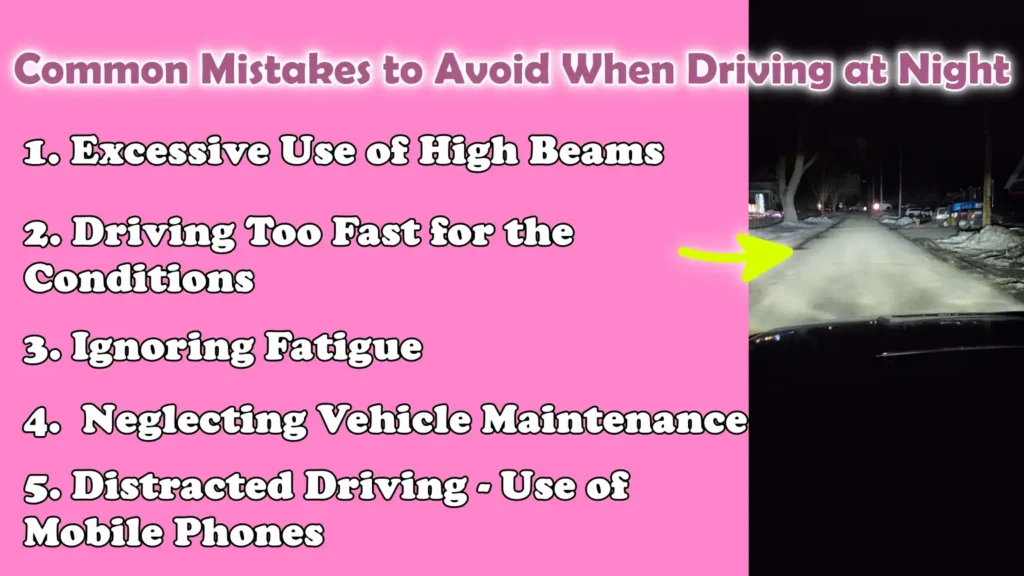
1. Excessive Use of High Beams
The overuse of high beams is a very common mistake that can pose a danger to both you and other drivers.
While high beams help you see further ahead on dark roads, they can also generate such intense glare that they temporarily blind oncoming drivers, impairing their ability to see clearly.
This momentary loss of vision can last for several seconds, which is more than enough time to cause a serious accident.
High beams should be used only when no other vehicles are nearby and they should be switched off immediately when another vehicle approaches.
Misusing them not only affects others, but in specific conditions such as fog or rain, the light can also reflect back toward you, thereby worsening visibility rather than improving it.
2. Driving Too Fast for the Conditions
Driving at excessive speeds at night is inherently dangerous because your ability to see what lies ahead is limited solely to the reach of your headlights.
If you are driving faster than your visible range allows, you may not have sufficient time to react to obstacles such as pedestrians, animals, or sudden curves.
Many drivers find it comfortable to drive at high speeds because roads often appear empty at night; however, identifying hidden hazards in low-light conditions is extremely difficult.
Driving at a slower speed gives you more time to process what you see and make safe decisions.
Adjusting your speed according to visibility conditions is one of the most effective ways to prevent accidents at night.
3. Ignoring Fatigue
Ignoring fatigue is one of the most dangerous mistakes a driver can make, particularly at night when the body naturally feels tired.
Many drivers believe they can continue driving even while drowsy; however, fatigue diminishes alertness, increases reaction time and impairs decision-making abilities.
In some cases, drivers may experience “microsleeps”, brief lapses into sleep, during which they fall asleep for a few seconds without even realizing it.
During these moments, proper control over the vehicle is lost, which can lead to serious accidents.
Recognizing the symptoms of fatigue and taking regular breaks or resting is crucial for safe driving.
4. Neglecting Vehicle Maintenance
Failing to properly maintain your vehicle can become a serious issue when driving at night, as your safety depends significantly on the condition of your car.
Dim or faulty headlights reduce your ability to see clearly, while dirty windshields and mirrors can increase glare and obscure your vision.
Worn-out tires fail to provide adequate traction on the road, a highly dangerous situation on dark roads, where identifying hazards is already difficult.
Brake issues can also increase a vehicle’s stopping distance, a factor that is already compromised due to the longer reaction times required when driving at night.
Regular maintenance ensures that your vehicle operates reliably and helps you navigate night-driving conditions with enhanced safety.
5. Distracted Driving – Use of Mobile Phones
Distracted driving at night is extremely dangerous, as driving in low-light conditions, amidst the various hazards of the night, already demands your undivided attention.
Using a mobile phone, adjusting vehicle controls, or even glancing away from the road for just a few seconds can lead to overlooking hazards and significantly delay your reaction time.
At night, when visibility is limited, even a momentary lapse in concentration can have grave consequences.
It takes time for the brain to refocus after being distracted, thereby increasing the likelihood of making errors.
For safe driving at night, it is imperative that you keep your full attention focused on the road at all times; this enables you to react swiftly to any sudden or unexpected situations.
Read More:
How to Prepare for Nighttime Emergencies
Being prepared for nighttime emergencies is crucial, as it may take longer for assistance to arrive and visibility is significantly reduced at night compared to the daytime.
When something goes wrong on a dark road such as: a vehicle breakdown or an accident, the risk of further hazards increases because other drivers may not be able to spot you in time.
The National Highway Traffic Safety Administration advises that with proper preparation, combined with taking immediate and appropriate action, a difficult situation can be prevented from escalating into a serious accident.
At night, remaining visible, staying calm and knowing exactly what to do can ensure not only your own safety but also the safety of others on the road.
A few simple measures such as: carrying essential supplies, moving to a safe location and alerting others, as it can make a significant difference in handling an emergency safely and effectively.
1. Carry an Emergency Kit
Keeping an emergency kit in your vehicle is a simple yet vital step in ensuring safety while driving at night, as it empowers you to face unexpected situations with confidence.
A flashlight is essential; if your vehicle breaks down or you need to inspect something, it helps you see clearly in the dark.
A first-aid kit is indispensable for treating minor injuries until professional medical assistance arrives.
A reflective triangle or warning sign helps make your vehicle visible to other drivers from a distance, thereby reducing the risk of a collision.
Given the reduced visibility at night, these items play a critical role in keeping you safe and alerting others to your presence.
Keeping these basic tools ready at all times ensures that you are never caught unprepared in a difficult situation.
2. What to Do If Your Vehicle Breaks Down
If your vehicle breaks down at night, it is crucial to take the right steps immediately to ensure your safety.
The very first step should be to move your vehicle to a safe location, if possible such as: the side of the road or an area away from moving traffic.
This reduces the risk of other vehicles colliding with yours.
It is also vital to switch on your emergency lights (hazard lights) immediately, as this alerts other drivers that your vehicle is not functioning normally.
If it is safe to do so, remaining inside your vehicle can offer you protection, specially on busy roads.
At night, other drivers may not spot a stationary vehicle until they are very close to it; therefore, it is essential to ensure that you remain visible and avoid making any sudden movements on the road.
By staying calm and taking precautionary measures, one can effectively mitigate the potential hazards associated with a vehicle breakdown.
3. Dealing with Accidents at Night
Handling an accident at night requires extra caution, as the darkness makes it difficult for others to clearly perceive exactly what has occurred.
Safety must always be the top priority; this means ensuring, if possible, that you and anyone else involved in the accident are out of immediate danger.
Visibility is paramount; therefore, hazard lights should be activated and reflective warning signs should be placed to alert approaching drivers.
This helps prevent secondary accidents.
It is also essential to remain vigilant and aware of your surroundings, as traffic may still be moving nearby.
Contacting emergency services as soon as possible ensures that assistance arrives promptly and the situation can be managed effectively.
By remaining calm and following these steps, the risks associated with nighttime accidents can be minimized, thereby ensuring a safe resolution to the situation.
Know, The Advanced Safety Technologies
Modern vehicles are now equipped with advanced safety technologies that make driving at night safer and easier by helping drivers see better and react more quickly.
These systems are designed to augment human vision and decision-making capabilities, particularly in low-light conditions where natural visibility is limited.
According to data from the National Highway Traffic Safety Administration (NHTSA), driver assistance technologies can significantly reduce the risk of accidents by alerting drivers to hazards and, in some instances, by taking automatic action.
While these systems cannot serve as a substitute for cautious driving, they act as an additional layer of safety by enhancing awareness and minimizing human error.
Understanding how these technologies function can help drivers utilize them effectively and gain greater confidence when driving at night.
Also, there’s study that shows that about 27.5% of the vehicles resulted in crashes at nighttime, compared to only 12% during the day in controlled testing conditions, so it is found out that there’s reduced visibility and delayed reaction times were the key reasons behind this increase, which makes it harder for drivers to detect the hazards in time.[¹]
1. Night Vision Systems
Night vision systems are designed to extend visibility beyond the range of standard headlights, enabling drivers to detect objects that would typically remain hidden in the dark.
These systems employ specialized cameras, often based on infrared technology, to identify heat signatures or movement emanating from objects such as pedestrians, animals, or vehicles traveling ahead.
This information is then displayed on a screen inside the vehicle, providing the driver with a clearer view of the road in low-light conditions.
This feature can be particularly beneficial on dark roads where street lighting is sparse.
By highlighting potential hazards in advance, night vision systems provide drivers with additional time to react and avoid accidents.
Although not all vehicles are equipped with this feature, it serves as a powerful tool for enhancing safety when driving at night.
2. Adaptive Headlights
Adaptive headlights are designed to enhance visibility by adjusting the direction and intensity of the light based on the vehicle’s speed.
As the car turns, these headlights pivot in the same direction, helping to illuminate curves and corners that would otherwise remain in darkness.
This makes it easier to see the road ahead and detect obstacles while driving on winding roads.
Some adaptive systems also automatically adjust brightness based on traffic conditions, thereby reducing glare for other drivers while maintaining clear visibility for the driver.
By providing enhanced illumination precisely where it is needed, adaptive headlights help drivers maintain control and confidence, particularly during the challenging conditions of night driving.
3. Driver Assistance Features
Driver assistance features include systems such as lane assist, automatic emergency braking and warning alerts, all designed to enhance safety by aiding the driver’s actions.
Lane assist systems help keep the vehicle within its lane, either by issuing warnings or by making subtle steering corrections, particularly when the vehicle begins to drift out of its lane.
Automatic braking systems can detect potential collisions and automatically apply the brakes if the driver fails to react in time.
Alert systems can warn drivers about obstacles, nearby vehicles, or signs of driver fatigue.
These features are particularly useful at night, when visibility is reduced and reaction times may be slower.
By continuously monitoring the surrounding environment and providing assistance when necessary, these technologies help minimize the potential for human error and make night driving safer overall.
Legal Rules and Laws
Understanding the legal rules and laws associated with driving at night is crucial, as these regulations are designed to ensure the safety of everyone on the road.
Many accidents occur not merely due to low visibility or fatigue, but also because drivers disregard basic traffic regulations.
Authorities such as: the Ministry of Road Transport and Highways, establish clear rules regarding vehicle lighting, speed limits and safe driving practices to mitigate risks, particularly during nighttime hours.
These laws are grounded in research and data derived from actual accidents, demonstrating that the proper use of lights, controlled speeds and responsible driving can significantly prevent mishaps.
Adhering to these regulations not only helps you avoid fines but also contributes to creating a safer environment for all road users.
Being aware of and respecting these rules is an essential component of responsible night driving.
1. Laws Regarding Headlight Usage
Under regulations governing headlight usage, drivers are required to keep their headlights switched on during conditions of reduced visibility, including at night, to ensure they can see clearly and remain visible to others.
In most jurisdictions, keeping headlights illuminated from sunset to sunrise, or whenever visibility is poor, is mandatory.
Drivers should use ‘low beams’ when driving in traffic or approaching other vehicles, whereas ‘high beams’ are permitted only on dark, unlit roads where they will not dazzle the eyes of other drivers.
The misuse of high beams can result in fines, as it may temporarily blind other drivers and create hazardous situations.
The proper use of headlights enhances visibility, reduces the likelihood of accidents and helps maintain safe coordination between vehicles on the road.
2. Nighttime Speed Limits
Nighttime speed limits are often identical to daytime limits; however, drivers are expected to adjust their speed according to current road and visibility conditions.
Even if the posted speed limit permits higher speeds, driving too fast at night can be unsafe, as you may not be able to spot hazards in time.
Law enforcement agencies expect drivers to adhere to the principle of “safe speed”, that is, driving at a speed that allows for complete control of the vehicle within the visible distance ahead.
In certain areas, special speed restrictions may apply in poorly lit zones, residential neighborhoods, or on roads with a high risk of accidents.
Adhering to speed regulations and adjusting your speed to suit current conditions helps minimize the likelihood of accidents and ensures safe travel during the night.
3. DUI and Fatigue-Related Regulations
Driving under the influence of alcohol or narcotics is strictly prohibited and laws regarding DUI are rigorously enforced, particularly at night, when such incidents occur more frequently.
Alcohol and drugs slow down reaction times, impair cognitive function and compromise physical coordination, making driving extremely dangerous.
In addition to laws concerning driving under the influence (DUI), there is growing awareness, and an increase in regulations, regarding driving while fatigued, particularly for commercial and long-distance drivers.
To prevent accidents caused by fatigue, regulations may limit driving hours and mandate taking breaks for rest.
Although driving while fatigued may not always carry direct penalties comparable to a DUI offense, it is nonetheless considered a serious threat to safety.
Drivers are expected to take personal responsibility for maintaining their alertness and to refrain from driving when they feel excessively fatigued.
Adhering to these rules helps save lives and ensures that roads remain safe for everyone.
Conclusion – How to Drive Safely at Night
So, whenever the sun goes down, then the road does not become more dangerous on its own: but it becomes more dependent on how carefully you need to drive.
Reduced visibility, headlight glare, fatigue and sudden obstacles, all combine to make driving at night more challenging, even for experienced drivers.
However, the good news is that with the right knowledge and good habits, most of these hazards can be effectively managed.
A few simple measures such as: proper headlight usage, maintaining speed control, keeping a safe distance and remaining alert, as it can collectively make a significant difference in ensuring complete safety.
Keeping your vehicle in good condition, understanding road conditions and knowing when to take a break are all equally crucial for avoiding accidents.
Modern technology and safety systems have also made driving at night safer; however, these are truly effective only when accompanied by cautious and responsible driving behavior.
Laws and regulations are established to guide drivers and mitigate risks, but it is consistent adherence to them that ultimately saves lives.
Now, that’s all from this guide from this guide on How to Drive Safely at Night, so that you can comment for more information below.
Frequently Asked Questions
Q1: Why is driving at night more dangerous than driving during the day?
Answer: Driving at night is primarily more dangerous because visibility is significantly reduced and the human eye is unable to perceive objects as clearly in the dark. Essential visual capabilities such as: judging distance, distinguishing colors and identifying surrounding objects, are impaired, making it difficult to spot road signs, pedestrians and obstacles in time. Furthermore, the glare from the headlights of oncoming vehicles can temporarily diminish your vision and the body’s natural sleep-wake cycle often leads to increased fatigue during nighttime hours. Additionally, there is a higher likelihood of facing drivers who are under the influence of alcohol or who are themselves fatigued. All these factors combine to heighten the risk of accidents, even if the volume of traffic on the road is relatively low at that time.
Q2: What is the safest speed for driving at night?
Answer: The safest speed at night involves more than just adhering to the posted speed limit; rather, you must adjust your speed based on how far ahead you can clearly see. You should always drive at a speed that allows you to bring your vehicle to a complete stop within the distance illuminated by your headlights. If visibility is further compromised due to darkness, fog, or rain, you should reduce your speed even more. Driving too fast at night reduces your reaction time, making it difficult to avoid sudden obstacles such as: animals, pedestrians, or sharp, unexpected turns.
Q3: When should I use my high beams and when should I use my low beams?
Answer: In most situations, you should use your low beams specially when other vehicles are nearby or when you are driving in urban areas. High beams are useful on dark, unlit roads where there is no oncoming traffic, as they allow you to see further ahead. However, when another vehicle is approaching you, or when you are driving directly behind another vehicle, you should immediately switch to your low beams. Using high beams at the wrong time can dazzle other drivers and create dangerous situations for everyone on the road.
Q4: How can I reduce the glare from oncoming headlights?
Answer: To avoid glare, you should avoid looking directly at the headlights of oncoming vehicles. Instead, shift your gaze slightly to the left side of your lane and use the road markings as a guide. This helps you stay within your lane while also protecting your eyes from the glare. Keeping your windshield clean also helps reduce glare, as dust and smudges scatter light, making the situation worse. Using the ‘night mode’ on your rearview mirror can also help reduce glare from the headlights of vehicles traveling behind you.
Q5: What are the signs of drowsy driving?
Answer: Common symptoms of drowsy driving include frequent yawning, heavy eyelids, difficulty keeping your eyes open and trouble focusing on the road. You may also drift out of your lane, miss road signs, or be unable to recall the last few minutes of your drive. These symptoms indicate that your alertness is diminishing and that it is no longer safe to continue driving. Ignoring these warning signs can lead to serious accidents.
Q6: What should I do if I start feeling sleepy while driving at night?
Answer: If you start feeling sleepy while driving, the safest option is to stop driving as soon as possible. You should find a safe place to pull over and take a short rest or a nap. Driving while fatigued can be extremely dangerous, as your reaction time slows down and you may even doze off for a few seconds without realizing it. Taking a break, getting some fresh air and staying hydrated can be helpful, but getting adequate rest remains the most effective solution.
References:
[1] Shedding light on safety: Comparing the crash likelihood and speed at impact of pedestrian crash avoidance systems across day and night conditions
https://www.sciencedirect.com/science/article/pii/S002243752500194X

Guys, I’m a car audio enthusiast and customization expert and I love clear sound and clean installation. Plus, I have spent years helping people build their dream audio setups. And whenever I’m working on cars, I probably listen to music and thinks about the next big upgrade.