

Written By: Don Dodi
Fact Checked By: Kristen Brown
Reviewed By: Diego Rosenberg
You will actually feel a lot of difference if you properly adjust your clutch pedal height as it can make it way more smooth, that even leads to the truly effortless driving and neglect that frustrating, grinding gear changes as well.
Yes, it is true that the height of clutch pedal is really crucial setting but it is overlooked in so many ways, but without a doubt important setting in a manual transmission vehicle.
As it literally determines how far the pedal sits above the brake pedal and that directly affects how smoothly the clutch engages and disengages.
Basically understand this, that whenever the clutch pedal height is set too high, then it can make shifting gears uncomfortable and that causes premature wear on the clutch components as well.
And on the other hand, if the pedal which is too low then it may lead to the incomplete clutch disengagement, then that resulting in grinding gears or you can face difficulty even in basic things like: changing gears.
Additionally, most of the manufacturers specify that exact clutch pedal height and free play range, which is typically around 5 to 7 inches from the floor to the top of the pedal, yes the car model also depends in this matter.
Now, with this guide you’ll know everything that How to Adjust Clutch Pedal Height so that you can easily ensure clutch operates in the most efficient way, that prevents hydraulic stress in the master and slave cylinders as well, plus that actually provides a comfortable and smooth driving experience.
Tools
| Tool / Material | Purpose / Description | Helpful Tip for Use |
|---|---|---|
| Wrench or Socket Set | Used to loosen or tighten the bolt and nut that hold the clutch pedal adjustment screw or lock nut. | Choose the right size wrench that fits snugly to prevent the bolts from rounding. A ratchet socket set can make the job faster. |
| Screwdriver | The pedal helps to adjust the stopper bolts or remove any panels under the dashboard if necessary. | A Phillips or flat-head screwdriver is usually sufficient. Use a screwdriver with a long handle for better reach. |
| Tape Measure or Ruler | It is used to measure the height of the clutch pedal from the floorboard to the top of the pedal. | For accurate measurements, ensure the vehicle is on a level surface. Keep the measuring tape straight and level. |
| Flashlight | This helps you see clearly under the dashboard where the clutch pedal assembly and adjustment nut are located. | A small LED flashlight or headlamp works best because it keeps your hands free while you work. |
| Repair Manual (Vehicle-Specific) | Provides the correct clutch pedal height and free play specifications for your car model. | Always consult your vehicle’s service manual before making adjustments. If you don’t have one, most manuals are available online or from the manufacturer. |
| Work Gloves (Optional) | Protects your hands from sharp edges or hot surfaces when working under the dashboard. | Use thin, flexible gloves so you can easily grip even small tools. |
| Safety Glasses (Optional) | Protects your eyes from dust or debris when working under the dashboard. | This is specially useful if you are working in a tight or dirty area. |
How to Prepare Vehicle and Ensure Safety to Adjust Clutch Pedal Height
Before adjusting the clutch pedal height, it’s crucial to follow basic safety steps to ensure your safety and the safety of your vehicle.
Safety precautions help prevent sudden movements, electrical shocks, or accidental damage while working under the dashboard.
Many drivers skip these steps, which can lead to injuries or even minor electrical short circuits if tools come into contact with wires or metal components.
1. Park the Vehicle on a Level Surface
Always begin by parking your vehicle on a flat and level surface.
This ensures the vehicle remains stable and doesn’t roll while you’re working on it.
A level surface also provides you with a comfortable and stable position to access the clutch pedal area.
Working on an uneven surface can cause your vehicle to move unexpectedly, which can be dangerous when your feet or tools are under the dashboard.
2. Engage the Parking Brake
After parking the vehicle, fully engage the parking brake.
This locks the rear wheels and prevents the vehicle from moving even slightly.
There might be some movement in the vehicle when you press or release the clutch pedal during the adjustment, so keeping the parking brake engaged provides maximum stability.
For added safety, you can also place wheel chocks behind the tires if you are working on an incline.
3. Turn Off the Engine
Before starting any work, ensure the engine is completely turned off.
Adjusting the clutch pedal height while the engine is running can be very risky, as moving parts in the engine and transmission system can cause injuries if accidentally activated.
Turning off the engine not only keeps you safe but also prevents pressure on the clutch hydraulics during the adjustment, giving you a more accurate feel of the pedal movement.
4. Disconnect the battery if necessary
If you need to work near electrical connectors, sensors, or wiring in the clutch pedal area, always disconnect the negative battery terminal first.
This will prevent accidental short circuits or sparks if a tool touches a live wire or metal contact point.
Disconnecting the battery is also a good practice when working under the dashboard, as many vehicles have electronic clutch position sensors that can be damaged if tampered with while the power is on.
How to Locate the Clutch Pedal Assembly
Before making any adjustments, the first practical step is to locate the clutch pedal assembly.
The clutch pedal assembly is located inside the vehicle’s cabin, directly beneath the dashboard on the driver’s side.
It’s the set of parts that connect your clutch pedal to the hydraulic or cable system that engages and disengages the clutch.
This area can sometimes be cramped or dark, so using a flashlight will make it easier to clearly see all the components.
When you look carefully under the dashboard, you will typically see three pedals in most manual transmission cars – the accelerator, brake and clutch.
The clutch pedal is the leftmost one.
It’s usually larger and has a thicker arm because it’s connected to the clutch mechanism via a hydraulic master cylinder or cable system.
1. Pedal Stopper Bolt
The pedal stopper bolt is a small but crucial component located above the clutch pedal arm.
It acts as a physical stop that limits how high the clutch pedal can rise when released.
Adjusting this bolt directly changes the clutch pedal height.
Turning the stopper bolt clockwise will raise the pedal slightly and turning it anti-clockwise will lower it.
The stopper bolt also ensures that the clutch switch or cruise control switch operates correctly when the pedal is released.
If the stopper is not properly adjusted, the clutch pedal may remain too high or fail to trigger the clutch switch, leading to starting difficulties or incorrect readings in the electronic system.
2. Lock Nut
The lock nut, located near the pedal stopper bolt or on the pushrod, secures the adjustment settings in place once you have set the desired height.
The purpose of this is to prevent the adjustment bolt or pushrod from moving due to vibrations or pedal pressure while driving.
You should always loosen the lock nut before making any height adjustments and then tighten it securely to hold the new position.
If this nut is left loose, the pedal height can gradually change over time, potentially causing problems with clutch engagement or premature wear of clutch components.
3. Pushrod Connecting to the Master Cylinder
The pushrod is a thin metal rod located behind the clutch pedal.
It connects the pedal arm to the clutch master cylinder, which is part of the hydraulic system that controls clutch operation.
When you press the clutch pedal, the pushrod pushes fluid through the master cylinder, creating pressure on the slave cylinder, which in turn moves the clutch release bearing.
This sequence disengages the clutch and allows for smooth gear changes.
The pushrod often has an adjustment nut or bolt at its end that allows you to fine-tune both the pedal height and free play.
Adjusting the pushrod too far in or out can alter the clutch engagement point, so it should be set correctly according to the vehicle manufacturer’s specifications.
How to Measure the Current Pedal Height
Understanding the clutch pedal height is one of the most crucial steps before making any adjustments.
This helps determine if your clutch pedal is too high or too low compared to the manufacturer’s recommendations.
The clutch pedal height affects not only how comfortably you can drive but also how efficiently the clutch system operates.
When the pedal is higher than normal, it can cause discomfort during long drives and increase stress on the clutch components.
When it’s too low, the clutch may not fully disengage, leading to grinding noises or difficulty shifting gears.
Accurately measuring this height allows you to make precise adjustments that ensure smooth and reliable clutch operation.
1. How to Prepare for Measurement
Before you begin measuring, ensure the car is parked on a completely flat and level surface.
This ensures your measurement is accurate and not affected by the vehicle’s tilt.
Sit in the driver’s seat and ensure the clutch pedal is not depressed.
Using a good flashlight can help you see clearly under the dashboard, specially in a dark interior.
Having the right tools ready – primarily a tape measure or ruler – will make this process much easier and quicker.
2. How to Measure the Clutch Pedal Height
Take your tape measure and place the starting end flat on the floorboard directly below the clutch pedal.
Then, measure straight up to the top surface of the clutch pedal pad where your foot typically rests.
Ensure the tape measure remains straight, not at an angle, to get an accurate reading.
The distance between the floor and the top of the clutch pedal is your clutch pedal height.
Most modern passenger cars typically have a clutch pedal height between 5 and 7 inches (approximately 125 to 175 millimeters), but this can vary depending on the make and model.
Some high-performance or heavy-duty vehicles may have slightly different pedal heights due to their clutch design or hydraulic system setup.
3. Why Comparing to Manufacturer Specifications is Crucial
After taking your measurement, it’s essential to compare it to the official clutch pedal height specified in your vehicle’s service or repair manual.
Each manufacturer sets this value to ensure proper clutch engagement, hydraulic balance and overall driving comfort.
If your clutch pedal height is significantly higher or lower than this specified value, it can lead to several problems.
A pedal that is too high can cause premature wear on the clutch release bearing and pressure plate.
If the pedal is too low, the clutch may not fully disengage, resulting in difficulty shifting gears and potential damage to the transmission over time.
By comparing your measured value to the factory specifications, you can accurately determine how much adjustment is needed.
4. The Importance of Accurate Measurement
Accurately measuring the clutch pedal height eliminates guesswork and ensures precise adjustments.
Even a small difference of a few millimeters can significantly impact how the clutch feels and operates.
Precise measurement helps maintain the correct amount of hydraulic pressure in the clutch system, facilitates smoother gear changes and prevents unnecessary strain on the master and slave cylinders.
It also improves overall driving comfort, making the pedal feel more natural and balanced.
This step serves as the foundation for all subsequent adjustments and ensures the clutch system operates as intended by the manufacturer.
How to Loose the Lock Nut
Before adjusting the clutch pedal height, you must first loosen the lock nut that secures the adjustment components in place.
The lock nut is a small but crucial part of the clutch pedal assembly.
It prevents the adjustment bolt or pushrod from moving due to vibrations or pressure while the clutch pedal is being used.
Without loosening it, you won’t be able to properly raise or lower the clutch pedal height.
Understanding where the lock nut is located and how to properly loosen it will allow you to make safe and effective adjustments without damaging any part of the clutch system.
1. Where the Lock Nut is Located
The lock nut is typically located near the upper part of the clutch pedal arm, where the pedal connects to the clutch master cylinder pushrod.
In most vehicles, this location is behind the clutch pedal, under the dashboard on the driver’s side.
The lock nut is threaded onto the adjustment rod or bolt that controls the pedal height and free play.
It is usually made of steel and can be identified by its hexagonal shape.
Because this area can be somewhat cramped or dark, using a flashlight will help you see it clearly.
If you have difficulty seeing the nut directly due to limited space under the dashboard, using a small mirror is also a good idea.
2. How to Loosen the Lock Nut
Once you have located the lock nut, the next step is to loosen it with the correct tool.
A standard open-end wrench or a small socket wrench is usually the best option.
Before turning the nut, make sure the wrench fits properly to avoid rounding the corners.
Gently turn the nut anti-clockwise until it turns freely.
You don’t need to remove it completely; just loosen it enough so that the adjustment bolt or pushrod can be easily rotated.
On some vehicles, you may need to hold the adjustment bolt with a second wrench to prevent it from turning while loosening the lock nut.
If the nut is seized due to dirt or corrosion, applying a small amount of penetrating lubricant will make the process easier and prevent damage to the threads.
3. Why Loosening the Lock Nut is Important
The lock nut is what keeps your clutch pedal adjustment stable during everyday driving.
Over time, the clutch pedal is constantly moving and vibrating, which can cause loose bolts to shift out of place.
By loosening the lock nut first, you allow the adjustment parts to move freely while setting the correct pedal height.
Once you’ve completed the adjustment, tightening the lock nut again will secure everything in place, ensuring the height remains consistent and the clutch continues to function correctly.
Skipping this step or not loosening it properly can lead to poor pedal response or even damage to the adjustment threads.
4. Caution and Preparation Tips
Always ensure the car is turned off and safely parked before working near the clutch pedal assembly.
As you’ll be working in a confined space, it’s helpful to be comfortable and use good lighting.
If the lock nut is difficult to access, try adjusting your seat position for better access or lie on your back with your legs outside the car.
Keeping your tools organized and within reach can also make the process easier.
Taking your time with this step will prevent stripped bolts, cross-threading, or unnecessary wear and tear on the adjustment hardware, all of which are crucial for an accurate and long-lasting clutch pedal height adjustment.
How to Adjust Clutch Pedal Height – Easy Method
After loosening the lock nut, the next step is to adjust the actual height of the clutch pedal.
This process involves rotating the adjustment bolt or pushrod to change how high or low the pedal sits relative to the floor.
Properly adjusting the clutch pedal height is a crucial part of maintaining correct clutch operation as it determines how much your foot travels to engage or disengage the clutch.
When the height is correctly set, you’ll experience smooth gear changes, comfortable pedal movement and a longer clutch life.
When it’s too high, the clutch may engage too quickly or feel tight; when too low, it can lead to incomplete disengagement, causing grinding gears or clutch drag.
1. Locating the Adjustment Mechanism
The adjustment mechanism can be found under the dashboard, near the upper part of the clutch pedal arm.
In most vehicles, it consists of an adjustment bolt or a threaded pushrod connected to the clutch master cylinder.
The bolt or rod allows for fine-tuning the pedal height and free play.
The pushrod moves the piston inside the master cylinder when the clutch pedal is pressed, so even a small adjustment can affect how the clutch engages.
In some vehicles, the adjustment may be built directly into the pedal arm, while in others it may be on the master cylinder itself.
Always identify the correct part before rotating anything to avoid damaging unrelated components.
2. How to Adjust the Pedal Height
To raise or lower the clutch pedal, rotate the adjustment bolt or pushrod using your hand or a wrench, depending on the design.
Turning the adjustment clockwise typically increases the pedal height, while turning it anti-clockwise usually decreases it.
However, this direction may vary slightly from one vehicle model to another, so it’s essential to confirm the correct rotation direction in your vehicle’s repair manual.
Turn the adjustment in small increments—approximately one full turn at a time—and recheck the height after each adjustment.
Because the clutch system is sensitive, even a few millimeters of change can make a significant difference in the pedal feel and engagement point.
After making an adjustment, depress and release the clutch pedal several times to ensure the movement is smooth and the pedal returns correctly to its original resting position.
3. Measure Again and Compare to Specifications
After each small adjustment, remeasure the clutch pedal height using a tape measure or ruler.
Measure from the floorboard directly below the pedal to the top surface of the clutch pedal pad.
Compare this new measurement to the specifications provided in your vehicle’s service manual.
Most cars require the clutch pedal height to be within a specific range, typically around 5 to 7 inches from the floor.
If your measurement is still outside the manufacturer’s specifications, continue adjusting in small increments until the correct height is achieved.
Keeping the height within the recommended limits ensures that the clutch fully engages and prevents unnecessary stress on the master and slave cylinders.
4. Why Correct Pedal Height is Important
Setting the clutch pedal height correctly maintains the proper hydraulic pressure and mechanical balance within the clutch system.
If the pedal is too high, the clutch may engage too quickly, making driving difficult and potentially causing premature wear on the clutch release bearing and pressure plate.
If the pedal is too low, the clutch may drag, making gear changes difficult and potentially damaging the transmission over time.
The correct height ensures that the clutch fully disengages when shifting gears, resulting in smoother operation and greater comfort for the driver.
It also prevents excessive strain on the pedal return spring and keeps the clutch system properly aligned for long-term reliability.
How to Adjust the Clutch Pedal Free Play – If Truly Necessary
After adjusting the clutch pedal height, it’s crucial to check and, if necessary, adjust the clutch pedal free play.
“Free play” refers to the slight movement in the pedal before it engages the clutch mechanism.
It’s the distance the pedal travels without resistance before you feel any pressure.
Adjusting the clutch pedal height often alters this free play because both are connected to the same pushrod and master cylinder system.
If the free play becomes too little, the clutch may remain partially engaged, leading to premature wear.
If the free play becomes too much, the clutch will not fully disengage, resulting in difficulty shifting gears or grinding noises.
Therefore, maintaining the free play within the manufacturer’s specified range is essential for proper clutch function and longevity.
1. Why Clutch Pedal Free Play is Important
Clutch pedal free play is a critical component of how the clutch system maintains proper balance and pressure.
The free play ensures that when the pedal is not depressed, the clutch release bearing is not in constant contact with the pressure plate.
This small gap allows the clutch components to rest when not in use, preventing continuous friction and unnecessary wear.
Without sufficient free play, the clutch release bearing may remain slightly engaged, generating heat and friction that can cause the clutch to slip even when the pedal is released.
Conversely, excessive free play means the clutch will not fully disengage when you depress the pedal, making smooth gear changes difficult.
This imbalance can eventually lead to damage to the transmission’s synchronizers or cause jarring during gear shifts.
2. How to Measure Clutch Pedal Free Play
To accurately measure clutch pedal free play, sit in the driver’s seat and gently press down on the clutch pedal with your hand.
Note how far the pedal moves before you feel any resistance.
This initial loose movement is the free play.
You can measure this distance with a small ruler or tape measure, typically by observing how far the pedal travels from its resting position to the point where resistance begins.
In most vehicles, the ideal free play is approximately half an inch to one inch, or about 10 to 25 millimeters.
However, this range may vary slightly depending on the manufacturer’s design, so always consult your vehicle’s service manual for the correct specifications.
Correct free play ensures that the clutch system engages and disengages smoothly without any unnecessary pressure.
3. How to Adjust Free Play
If your measured free play is outside the specified range, you can adjust it using the same push rod and lock nut that control the clutch pedal height.
The push rod connects the pedal arm to the master cylinder and determines how far the clutch engages when the pedal is pressed.
To increase free play, rotate the push rod anti-clockwise, which shortens its length and allows the pedal to move more freely before engaging.
To decrease free play, rotate the push rod clockwise, which lengthens it and reduces the initial loose movement.
When adjusting, make small turns and check the pedal movement after each adjustment to avoid over-adjusting.
Once the correct free play is achieved, hold the push rod in place and tighten the lock nut securely to maintain the setting.
Press the clutch pedal several times to ensure it moves smoothly and returns properly to its resting position.
4. Testing the Adjustment
After completing the adjustment, carefully test the operation of the clutch pedal.
Press the pedal several times and note how it feels under your foot.
The movement should be smooth and consistent, with a small amount of free play at the top before resistance is felt.
Start the vehicle and check that the clutch engages and disengages cleanly without any grinding noises or slipping.
If the clutch still feels tight, stiff, or loose, you may need to fine-tune the push rod until it feels right.
Always remember that both the pedal height and free play affect each other, so sometimes a slight readjustment of the height may be necessary after setting the free play.
How to Tight the Lock Nut
Once you have adjusted the clutch pedal height and free play, the next and crucial step is to properly tighten the lock nut.
The lock nut’s primary function is to securely hold the pushrod or adjustment bolt in its new position, preventing the settings from changing during driving.
Even minor vibrations from the engine, road, or clutch movement can gradually loosen a loose nut, altering the pedal height or free play.
Tightening the lock nut ensures that your carefully set adjustments remain stable and that the clutch pedal feel and operation remain consistent over time.
This simple yet essential step guarantees that the clutch system maintains the correct pressure and engagement exactly as you have adjusted it.
1. Why Tightening the Lock Nut is Important
The lock nut acts as a mechanical safety feature that prevents unwanted movement of the adjustment parts.
When the clutch pedal is used, the pushrod and adjustment bolt are subjected to constant pressure due to the hydraulic pressure generated inside the clutch master cylinder.
If the lock nut is left loose, vibrations from the pedal or constant pressure can cause the threads on the adjustment rod to gradually rotate, altering the clutch height and free play.
Over time, this can lead to improper clutch disengagement, poor pedal response, or premature wear of the clutch disc and pressure plate.
Tightening the lock nut provides stability to the adjustment mechanism and ensures that your settings remain exactly as intended by the manufacturer.
2. How to Properly Tighten the Lock Nut
To tighten the lock nut, first ensure that the pedal height and free play are perfectly set according to the specifications provided in your vehicle’s manual.
Hold the pushrod or adjustment bolt steady with one wrench to prevent it from rotating and tighten the lock nut clockwise with another wrench until it is snug.
Be careful not to overtighten it, as excessive force can damage the threads or make future adjustments difficult.
The goal is to tighten it enough so that it doesn’t loosen during normal pedal use, but not so tight that it puts undue stress on the metal components.
After tightening the nut, depress the clutch pedal several times to ensure the movement is smooth and that no parts are binding or making unusual noises.
This confirms that the lock nut is securely holding the adjustment in place.
3. Final Check After Tightening
After tightening the lock nut, carefully inspect the pushrod and adjustment area to ensure everything is properly seated and aligned.
Look for any signs of thread damage, loose parts, or unusual movement when depressing the pedal.
If you notice that the pedal height or feel has changed after tightening, you may need to slightly adjust and re-tighten the nut.
It’s also a good idea to re-check the clutch pedal height measurement after tightening the nut, as tightening can sometimes slightly alter the setting.
Once confirmed, your adjustment is complete and the clutch pedal should now have a smooth, consistent movement that matches the factory specifications.
Read More:
How to Test the Pedal Operation
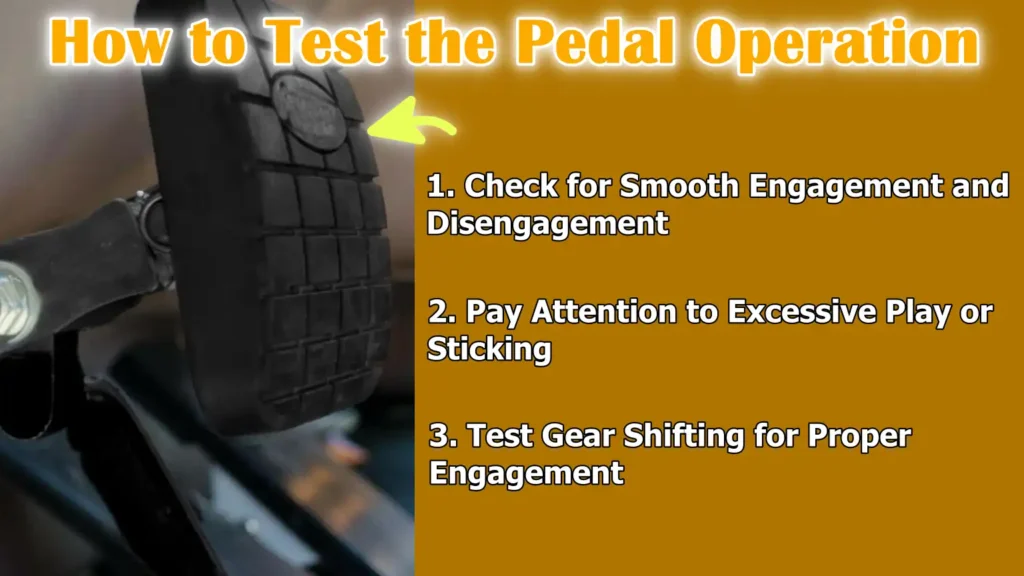
Once the clutch pedal height and free play have been adjusted and the lock nut is properly tightened, the next crucial step is to test the pedal operation.
This testing phase ensures that all the adjustments you’ve made are functioning correctly and that the clutch system is responding as it should.
First, with the engine off, depress the clutch pedal several times.
The pedal should move smoothly without any binding, sticking, or uneven resistance.
The pedal movement should feel consistent throughout its travel, with a slight amount of free play at the top and then a firm and predictable resistance as the clutch begins to disengage.
This smooth movement indicates that all the adjustment components, including the pushrod, lock nut and pedal stopper, are properly aligned and secured.
1. Check for Smooth Engagement and Disengagement
After confirming that the pedal movement feels correct, start the vehicle and observe how the clutch behaves under actual operating conditions.
With the engine running, fully depress the clutch pedal to the floor and slowly shift through the gears.
Each gear should engage and disengage smoothly without any grinding, sticking, or hesitation.
If you hear a grinding noise when shifting into first or reverse gear, it may indicate that the clutch is not fully disengaging, suggesting that a slight adjustment to the pedal height or free play is needed.
On the other hand, if the clutch engages too quickly or the pedal feels spongy, it could be due to excessive free play or air in the hydraulic system.
Testing the pedal while the vehicle is running allows you to identify and correct these minor but crucial performance issues before normal driving.
2. Pay Attention to Excessive Play or Sticking
During testing, pay close attention to the amount of free play and the overall feel of the pedal.
There should be a small amount of free play at the top of the pedal’s movement, typically around half an inch, depending on the vehicle’s design.
This play allows for smooth engagement without constantly applying pressure to the clutch release bearing.
If the pedal feels too loose or travels too far before resistance is felt, the free play may need to be reduced.
Conversely, if the pedal feels too tight or has no free play at all, the clutch may be partially engaged in its resting position, leading to premature wear of the clutch components.
Maintaining the correct balance between ease of movement and firmness ensures reliable clutch performance and component longevity.
3. Test Gear Shifting for Proper Engagement
With a properly adjusted clutch, gear changes should be smooth, precise and effortless.
When the clutch pedal is fully depressed, you should be able to shift into any gear without any resistance or grinding noises.
As you slowly release the pedal, the clutch should re-engage smoothly, allowing the car to move forward or backward without any jerking.
This test should first be performed with the car stationary and then repeated during a short drive.
Shifting through all gears, including reverse, helps verify that the clutch is engaging at the correct point in the pedal travel and that there are no issues such as clutch drag or incomplete disengagement.
Smooth gear transitions confirm that both the pedal height and free play adjustments are correctly set.
How to Tune and Verify the Clutch Pedal Working
After completing the initial adjustments and testing the clutch pedal operation, fine-tuning and verification are essential to ensure the clutch system functions perfectly under real driving conditions.
Even if the pedal feels correct during stationary testing, the true test of your adjustments comes when the car is driven for a short distance.
During this time, clutch components such as the master cylinder, pushrod and release bearing may settle slightly into their new positions, potentially causing minor changes in pedal height or free play.
Fine-tuning helps you correct any minor deviations that occur after this initial settling period.
This process maintains long-term consistency in clutch performance and prevents problems such as clutch slippage, hard shifting, or uneven wear on the clutch plate.
As well as, it is true that every car model has a factory clutch-pedal height and free-play specification, as you can see 197.5 to 207.5 mm is cited for Toyota and that’s why you should always check for the specific vehicle manual first before going for adjusting it.[¹]
1. Evaluating Pedal Feel and Shifting Response
Once you’ve driven the car for a few minutes, pay attention to how the clutch pedal feels and how easily the gears engage.
A properly adjusted clutch should have a pedal that feels light yet firm, allowing you to depress it easily without excessive force.
The clutch should begin to engage approximately halfway through the pedal’s travel, neither too high nor too low.
If the engagement point feels too high, it indicates that the pedal height is set too high or there is insufficient free play.
Conversely, if the clutch engages too close to the floor, it means the pedal height is too low or there is too much free play in the system.
Fine-tuning helps you find the precise engagement point that provides both comfort and control during gear shifts.
2. Making Minor Adjustments After Driving
If, after the test drive, you find that shifting is slightly rough, slow, or inconsistent, minor adjustments can make a significant difference.
First, double-check the pedal height using a measuring tape or ruler, measuring from the floor to the top of the pedal.
Compare this measurement to the specifications provided in your vehicle’s repair manual.
If the height is slightly low or high, adjust the pushrod or pedal stopper as needed.
Reconfirm that the free play at the top of the pedal movement falls within the recommended range, as incorrect free play can lead to constant clutch pressure or incomplete disengagement.
After fine-tuning, depress the clutch several times and shift through all the gears again to verify the smoothness and accuracy of the movement.
3. Rechecking Height and Free Play for Accuracy
After fine-tuning, it’s crucial to recheck both the pedal height and free play to ensure your clutch system remains balanced and reliable.
The pedal height determines where the clutch engages, while the free play affects how pressure is transmitted through the hydraulic system.
When both are within factory specifications, the clutch system provides smooth engagement, reduced mechanical wear and improved driving comfort.
Even a slight discrepancy can lead to premature clutch wear, poor fuel efficiency and difficulty shifting gears, specially in stop-and-go traffic.
Properly rechecking confirms that the clutch system is working in harmony and that no undue stress is being placed on the internal components.
Conclusion – How to Adjust Clutch Pedal Height
Yes, it is true that a even a small adjustment of your clutch pedal height makes the big different as it can make gear shift smooth and precise pedal response as well.
Plus, a properly adjusted clutch pedal ensures smooth gear shifting, consistent clutch engagement and reduced stress on internal parts such as the clutch disc, release bearing and pressure plate.
By carefully setting the pedal height and verifying the free play, you help your clutch system operate exactly as the manufacturer intended.
This not only makes the driving experience more comfortable but also extends the lifespan of crucial components and prevents costly repairs in the future.
Testing, fine-tuning and verifying the pedal’s operation after adjustment are equally important steps.
These ensure that the clutch system maintains consistent hydraulic pressure and responds predictably under varying driving conditions.
When the pedal height is too high or too low, it can lead to problems such as clutch drag, hard shifting, or premature wear of the master and slave cylinders.
However, with the right tools, patience and attention to detail, any car owner can successfully complete this process without professional assistance.
Regularly checking your clutch pedal height should be part of your vehicle’s preventative maintenance routine.
Over time, natural wear and tear in the hydraulic components or linkage system can gradually alter the pedal position, leading to subtle changes in performance that most drivers overlook.
Timely detection and correction prevent these minor changes from escalating into major problems.
A well-adjusted clutch not only improves safety and control but also makes every drive smoother and more responsive.
Not only this, you can ask questions and queries related to this guide in the comment below.
Frequently Asked Questions
Q1. What is clutch pedal height and why is it important?
Answer: Clutch pedal height refers to the distance between the top of the clutch pedal and the floor of your vehicle. It determines how far the pedal needs to be pressed before the clutch fully engages or disengages. This height is crucial because it directly affects how smoothly your car shifts gears. If the height is too high, the clutch may engage too late, making driving difficult and potentially causing premature wear on clutch components. If it’s too low, the clutch may not fully disengage, resulting in difficulty shifting gears or grinding noises. Maintaining the correct pedal height ensures smooth operation, improved comfort and a longer clutch lifespan.
Q2. How do I know if my clutch pedal height is incorrect?
Answer: You can usually feel it while driving. If your clutch pedal feels unusually high or low, or if you hear grinding noises when shifting gears, it’s an indication that the height is incorrect. Another sign is when the clutch engages very close to the floor or very near the top of the pedal’s travel. You might also feel uneven resistance or stiffness when pressing the pedal. These subtle signs often mean that the clutch pedal height or free play needs adjustment for proper operation.
Q3. Can I adjust the clutch pedal height myself?
Answer: Yes, in most vehicles with mechanical or hydraulic clutch linkages, you can adjust the clutch pedal height yourself using some basic tools such as a wrench, screwdriver and measuring tape. The process typically involves loosening a lock nut, rotating an adjustment bolt or pushrod to raise or lower the pedal and then tightening the nut again. However, you should always consult your vehicle’s repair manual for the correct specifications as each car model has a different ideal height. With care and attention, this is a task that most car owners can perform at home.
Q4. What happens if I don’t adjust the clutch pedal height correctly?
Answer: If the clutch pedal height is not adjusted correctly, it can lead to several problems. Too much height can cause clutch slip, where the clutch doesn’t fully engage and the engine revs without transferring full power to the wheels. Too little height can make it difficult to fully disengage the clutch, resulting in difficulty shifting gears and potential damage to the transmission. Over time, incorrect adjustment can also put excessive strain on the clutch master or slave cylinder, potentially leading to leaks or failure. Proper adjustment ensures your clutch operates smoothly and reliably without damaging any associated components.
References:
[1] CLUTCH PEDAL INSPECTION
https://lc100e.github.io/pdf/rm/rm616e/m_cl_0002.pdf

Guys, I’m a car audio enthusiast and customization expert and I love clear sound and clean installation. Plus, I have spent years helping people build their dream audio setups. And whenever I’m working on cars, I probably listen to music and thinks about the next big upgrade.