
Written By: Don Dodi
Fact Checked By: Kristen Brown
Reviewed By: Diego Rosenberg
Did you know that: even when your car is parked and locked, there’s small electrical systems that remains active and that leads to the parasitic battery drain that can slowly weakens a healthy battery and still doesn’t shows any visible signs until you know the starter is not working anymore.
Because, now-a-days vehicles are designed in a way to take small amount of power even when you totally switched off the vehicle, in terms of keeping the systems such as: clock, alarm, radio memory and control modules working.
But, the main thing is that whenever some component fails or an simply electrical device continues to consume power abnormally, then it can slowly drains out the battery over the period of hours or days.
Plus, there’s a automotive electrical system studies that shows that the healthy vehicle typically has a parasitic draw of 30 to 50 milliamps; so if the range if above that then it can shorten the battery life in a significant way.
Yes, there could be issues such as: stuck relays, faulty switches, interior lights remains on or just poorly installed accessories such as: dash cams and alarms systems that are the major contributors in that drain.
So, this is the guide about How to Check Parasitic Battery Drain, so that yo can easily identify the hidden electrical problems early and avoid any unnecessary battery replacement as well.
What is Parasitic Battery Drain?
1. Definition of Parasitic Draw in Vehicles
Parasitic battery drain, also known as parasitic draw, occurs when a vehicle’s battery loses power even when the vehicle is turned off.
This happens because certain electrical components continue to draw power when they shouldn’t.
While a small amount of battery usage is normal, parasitic drain means an unusually high amount of power is being drawn, which can slowly discharge the battery and prevent the vehicle from starting.
2. The Difference Between Normal Standby Power Consumption and Abnormal Drain
All modern vehicles consume a small amount of power even when turned off.
This is called standby power and it’s necessary to maintain systems such as the clock, security alarm, radio memory, keyless entry and engine control module.
Normal standby power is typically between 30 and 50 milliamperes, which doesn’t harm the battery.
Abnormal drain, on the other hand, is significantly higher and is caused by faulty components, lights left on, stuck relays, or improperly installed accessories.
Unlike normal standby draw, abnormal drain can completely drain the battery in just a few hours or days.
3. How Modern Vehicles Consume Power Even When Turned Off
Modern cars are designed with numerous electronic systems that remain active even after the ignition is turned off.
These include onboard computers, sensors, anti-theft systems, infotainment memory and sometimes connected accessories like dash cams or GPS devices.
While these systems consume very little power under normal circumstances, a single faulty component or improperly installed aftermarket accessory can draw a significant amount of power.
This hidden consumption is what causes parasitic battery drain and it often goes unnoticed until the battery is completely discharged, resulting in a sudden inability to start the vehicle.
Understand, The Common Causes of Parasitic Battery Drain
1. Interior, Trunk, or Glove Box Lights Remaining On
One of the most common causes of parasitic battery drain is when interior lights, trunk lights, or glove box lights remain on even after the car is turned off.
Even a small bulb left on for hours can slowly drain the battery.
Many cars have door switches that automatically turn these lights off, but if a switch malfunctions or gets stuck, the light remains on, silently drawing power from the battery.
This problem often goes unnoticed until the next time the car is started.
2. Faulty Relays and Stuck Switches
Relays and switches control the flow of electricity to various systems in a car.
When a relay fails or a switch gets stuck in the “on” position, it can allow a continuous flow of power even when the vehicle is off.
For example, a stuck relay in the fuel pump or cooling fan circuit can draw hundreds of milliamperes of power, far exceeding normal standby levels, leading to rapid battery drain.
Faulty relays and switches are often hidden culprits that are difficult to diagnose without proper testing.
3. Aftermarket Accessories – Dash Cams, Alarms, Stereo Systems
Aftermarket electrical accessories such as dash cams, car alarms, stereo amplifiers and GPS trackers are convenient, but if they are not properly installed or remain active even when the car is off, they can cause significant parasitic drain.
For example, some dash cams are designed to record even when the car is parked, drawing more power than the battery can safely supply.
Improperly wired alarms and stereo systems can also continuously draw power, slowly weakening the battery.
4. Faulty Control Modules or Sensors
Modern vehicles have numerous control modules and sensors that manage engine performance, safety systems and comfort features.
If a control module or sensor malfunctions, it may fail to enter sleep mode when the vehicle is turned off, resulting in a continuous power draw.
Examples include the body control module, engine control unit, or parking sensors.
While each module typically consumes a small amount of power, a faulty module can draw hundreds of milliamperes, leading to a slow but steady drain on the battery.
5. Corroded or Damaged Wiring
Wiring problems are another common cause of parasitic battery drain.
Corrosion, broken wires, or damaged insulation can create unintended connections that allow electricity to leak continuously.
These leaks can occur anywhere in the vehicle’s wiring system, such as near the battery, under the hood, or behind the dashboard.
Faulty wiring not only drains the battery but can also pose a fire hazard if left unaddressed.
Proper inspection and maintenance of the vehicle’s wiring system are crucial to prevent this type of battery drain.
Tools
| Tool | Purpose and Details |
|---|---|
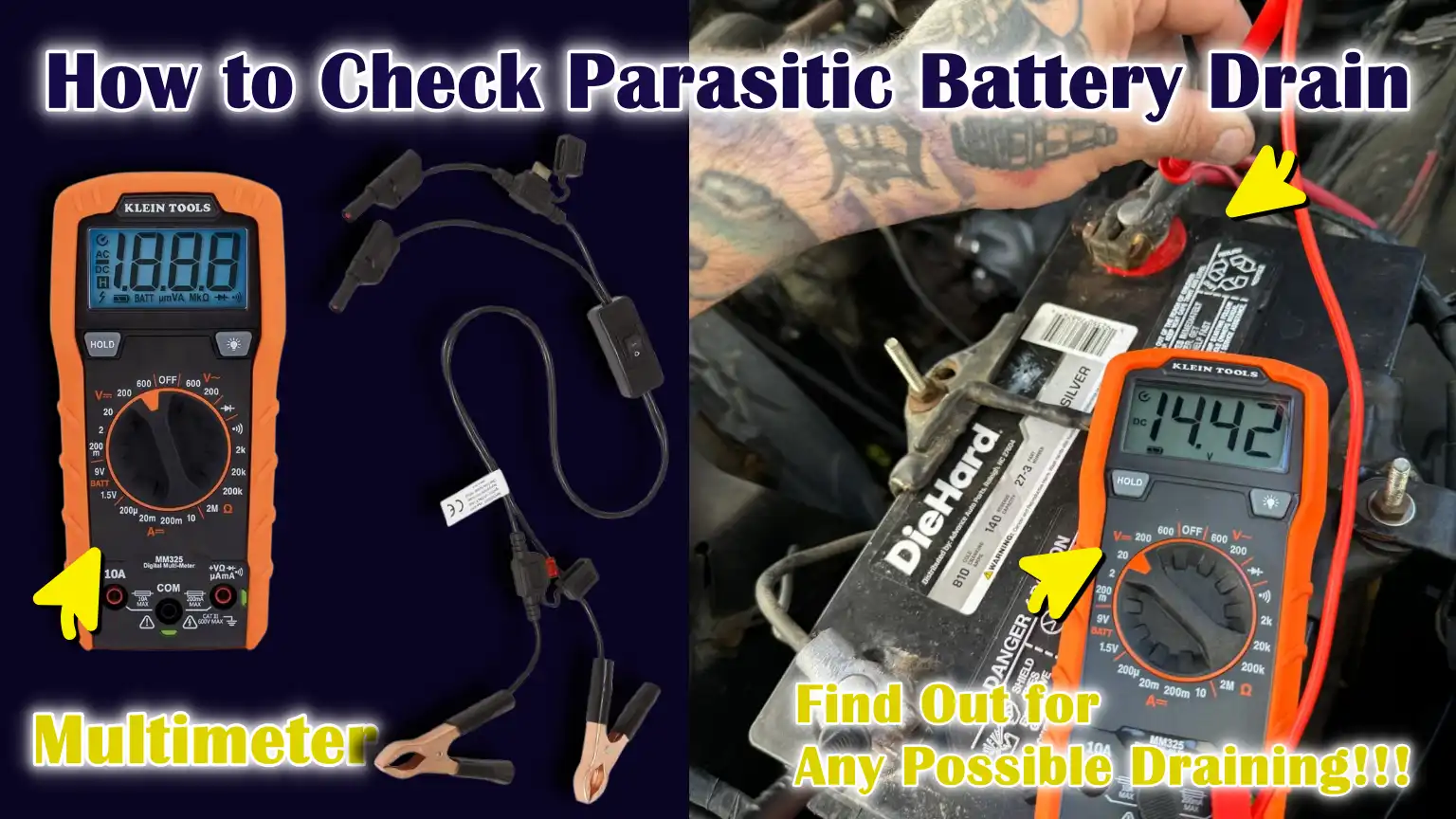
| Digital Multimeter | A multimeter is used to measure electricity in the car battery circuit. Choose one with amp reading capability to check how much current is being drawn. It helps find if the battery is losing power when the car is off. |
| Wrenches or Socket Set | These tools are used to safely disconnect the battery terminals and remove any components if needed. They ensure that you can work on the battery without damaging the bolts or connections. |
| Fuse Puller or Needle-Nose Pliers | This tool is used during testing to remove fuses one by one to determine which circuit is causing the power drain. It allows for easy and safe handling of small fuses without bending or breaking them. |
| Safety Gloves and Eye Protection | Gloves and goggles protect you from sparks, battery acid, or sudden short circuits. They ensure safety when working with electrical parts. |
How to Ensure Safety Before Testing for Parasitic Battery Drain
1. Why You Shouldn’t Start the Car During Testing
When checking for parasitic battery drain, it’s crucial not to start the car.
Starting the engine causes a surge of current in the electrical system, which can damage the multimeter or lead to inaccurate readings.
This test is designed to measure small currents when the car is completely off, so turning on the ignition will interfere with the results and could even cause sparks, which can be dangerous if there are problems with the battery or wiring.
2. Protecting Vehicle Electronics
Modern vehicles contain numerous sensitive electronic systems, including the engine control module, infotainment system, sensors and security alarms.
Improperly connecting tools or shorting wires can cause permanent damage to these systems.
To protect the electronics, always use a digital multimeter correctly, avoid bridging terminals with metal tools and ensure all connections are secure before beginning any measurements.
Proper use minimizes the risk of costly repairs.
3. Ensuring Doors, Hood and Trunk Remain Closed
It’s essential to keep all doors, the hood and the trunk closed during testing.
Many vehicles are designed to activate interior lights or warning systems when doors or the trunk are open, leading to increased current draw and inaccurate readings.
Keeping all entry points closed ensures that only parasitic drain caused by faulty circuits or accessories is measured, resulting in accurate and reliable results.
4. Allowing the Vehicle to Enter “Sleep Mode”
Most modern cars have a sleep mode that shuts down control modules and electronics after a period of inactivity, typically 20 to 30 minutes after the car is locked.
Allowing the vehicle to enter sleep mode before testing is important because measuring current before the modules have fully shut down can result in higher readings, which are normal and not indicative of parasitic drain.
Waiting ensures that the test accurately reflects the actual battery drain caused by abnormal power usage.
How to Check Parasitic Battery Drain – Easy & Fast
1. Turning Off the Vehicle and Removing the Key
The first step in checking for a parasitic battery drain is to ensure the vehicle is completely shut off.
Remove the key from the ignition and make sure all lights, climate control and electronic systems are off.
This is crucial because any active system can give false readings or make it difficult to pinpoint the true source of the drain.
Waiting a few minutes after turning off the car allows some electronics to power down and prepares the vehicle for accurate testing.
2. Disconnecting the Negative Battery Terminal
Next, carefully disconnect the negative battery terminal using a wrench or socket set.
This isolates the battery from the car’s electrical system and ensures safe testing.
Disconnecting the negative terminal prevents accidental short circuits and protects both the multimeter and the vehicle’s electronics.
Always handle battery terminals with caution to avoid sparks or contact with metal tools.
3. Connecting the Multimeter in Series
After removing the negative terminal, the multimeter should be connected in series between the negative battery post and the disconnected cable.
This setup allows the meter to measure the flow of current from the battery to the vehicle’s circuits.
Connecting the multimeter in series is essential because it ensures the measurement reflects the total current draw from all systems, helping to identify any abnormal parasitic drain.
4. Setting the Multimeter to the Correct Amperage Range
Before taking any readings, adjust the multimeter to the correct amperage range, typically 10 amps or a lower milliamp setting depending on the expected draw.
Using the correct setting prevents damage to the multimeter and ensures accurate measurements.
Many multimeters have separate ports or settings for high and low current, so it’s important to carefully follow the manufacturer’s instructions.
5. Reading and Recording the Current Draw
Finally, observe the reading on the multimeter to determine the battery’s current draw.
A typical vehicle’s parasitic draw is usually between 30 and 50 milliamperes.
If the reading is higher, it indicates an abnormal drain, which could be caused by a faulty circuit, light, relay, or aftermarket accessory.
Carefully record the reading, as this information is crucial for identifying which circuit or component is causing the drain.
Checking the reading again after making any adjustments helps confirm that the problem has been resolved.
Now, Understand What’s the Normal vs Abnormal Battery Drain Readings
1. Commonly Accepted Parasitic Draw Values
A normal parasitic battery drain is a small amount of current that a car uses even when it’s turned off to maintain essential systems like the clock, security alarm and control modules.
For most vehicles, this draw is typically between 30 and 50 milliamperes, which is low enough that it doesn’t significantly impact battery life over several days.
Knowing this range is crucial because it sets a baseline for what electrical activity is considered normal in a parked vehicle.
2. What Readings Indicate a Problem
Readings that exceed the normal range of 30 to 50 milliamperes usually indicate an abnormal parasitic drain.
For example, a reading above 100 milliamperes can slowly discharge the battery overnight, while a reading above 500 milliamperes can drain the battery in just a few hours.
Such high current draws are often caused by faulty relays, lights left on, malfunctioning control modules, or improperly installed aftermarket accessories.
Identifying readings above the normal value allows car owners to pinpoint and fix the source before the battery is permanently damaged.
3. How Readings Differ in Older vs Modern Vehicles
Older vehicles typically have fewer electronic systems, so their normal parasitic draw is often lower, sometimes less than 30 milliamperes.
However, modern vehicles have numerous control modules, infotainment systems, sensors and connected accessories that slightly increase the normal draw, sometimes reaching 50 milliamperes or more.
Understanding this difference is important when interpreting readings, as what might seem high for an older car could be normal for a newer model.
A proper understanding ensures that small, harmless electrical usage is not mistaken for a serious battery drain problem.
How to Find the Source of a Parasitic Drain
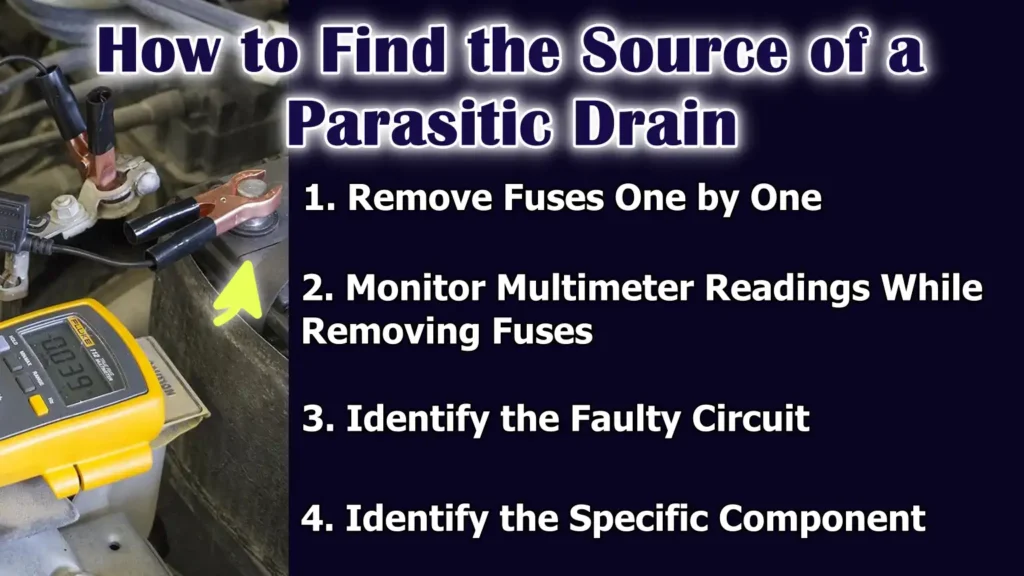
1. Remove Fuses One by One
Once a high parasitic draw is confirmed, the next step is to identify the specific circuit causing the drain.
This can be done by carefully removing fuses one by one from the vehicle’s fuse box.
Each fuse controls a specific electrical system, such as interior lights, the radio, or the engine module.
Systematically removing fuses allows you to isolate the circuit responsible for the excessive current draw.
It’s crucial to always use a fuse puller or needle-nose pliers to avoid damaging the fuses or the fuse box.
2. Monitor Multimeter Readings While Removing Fuses
While removing fuses, the multimeter remains connected in series between the battery and the disconnected terminal.
As each fuse is removed, the multimeter reading is observed for any changes.
A drop in current indicates that the fuse you just removed controls the circuit causing the parasitic drain.
If the reading doesn’t change, the drain is not coming from that circuit.
This step-by-step process ensures accurate identification of the problematic circuit without guesswork or unnecessary trial and error.
3. Identify the Faulty Circuit
Once the circuit causing the drain is identified, the next step is to determine which system or component within that circuit is responsible.
The identified circuit may contain multiple components, such as lights, relays, control modules, or aftermarket devices.
Understanding which circuit is faulty narrows down the troubleshooting area, saving time and preventing potential damage to other systems.
Consulting circuit layout documentation or the vehicle’s service manual can help pinpoint the exact source of the problem.
4. Identify the Specific Component
After identifying the faulty circuit, each component within that circuit should be tested individually to pinpoint the exact source of the drain.
This may involve checking relays, switches, lights, sensors, or aftermarket accessories.
Testing each component ensures that only the defective part is repaired or replaced, avoiding unnecessary work on functioning systems.
Accurate identification of the specific component prevents future parasitic drain problems and helps maintain the longevity and reliability of the vehicle’s battery.
How to Test Individual Components and Circuits
As well as, there’s academic research on the parasitic battery drain in ECU networks that shows that some of the modern vehicles actually suffers from the battery drain problems, which because of the accessories, lights and from the core electronic control unit communications as well that fails to enter a low-power sleep state, so this shows that it is really important to diagnose the parasitic draw in newer car as that may require advanced tools and software knowledge as well.[¹]
1. Checking for Stuck Relays
Relays are small electrical switches that control the flow of power to larger systems like fuel pumps, cooling fans, or lights.
A relay can get stuck in the “on” position, causing a continuous power drain even when the vehicle is turned off.
Testing relays involves removing them from their sockets and using a multimeter to check for continuity or proper switching function.
Replacing a faulty relay often quickly resolves battery drain issues and prevents the battery from weakening over time.
2. Checking Lights and Switches
Interior lights, trunk lights, glove box lights and exterior lights can be common sources of battery drain if they are accidentally left on.
The switches controlling these lights can malfunction or get stuck in the “on” position.
During testing, each light and its corresponding switch should be checked to ensure they turn off completely when the doors are closed or the vehicle is turned off.
Repairing faulty switches or replacing burnt-out bulbs restores normal battery performance.
3. Testing Aftermarket Electrical Accessories
Aftermarket devices such as dash cams, alarms, stereo amplifiers and GPS trackers are convenient, but they can be a hidden source of drain if they remain active even when the car is off.
Each accessory should be disconnected for a period of time and the multimeter reading checked again.
If the battery drain decreases after removing a device, it indicates that the accessory is drawing excessive power.
Proper wiring, installation, or the use of a dedicated switched power source can prevent future battery drain problems.
4. Evaluating Control Modules and Wiring
Modern vehicles have numerous control modules and sensors that remain partially active even when the vehicle is off.
A malfunctioning module, such as the body control module or engine control unit, can draw excessive power.
Wiring problems, including faulty, damaged, or short-circuited wires, can also cause a constant drain on the battery.
Testing involves checking individual modules and inspecting the wiring for signs of wear, corrosion, or damage.
Repairing or replacing faulty modules and wiring restores the proper electrical balance and prevents unnecessary battery drain.
How to Fix Parasitic Battery Drain
1. Repairing or Replacing Faulty Components
The most straightforward way to fix parasitic battery drain is to repair or replace the components that are drawing excessive power.
This can include stuck relays, faulty switches, burnt-out bulbs, or malfunctioning sensors.
Replacing these parts restores proper electrical flow and prevents unnecessary current draw when the vehicle is off.
Regular inspections and timely replacement of worn-out components can prevent recurring battery drain and extend battery life.
2. Proper Wiring of Accessories
Aftermarket accessories such as dash cams, alarms and stereo systems can cause parasitic drain if not installed correctly.
Proper rewiring involves connecting these devices to a switched power source that only supplies power when the ignition is on.
This ensures that the accessories do not continuously draw power when the car is parked.
Correct installation and wiring not only prevent battery drain but also protect the accessories and the vehicle’s electronics from potential damage.
3. Updating or Resetting Electronic Modules
Modern vehicles rely on numerous electronic control modules that manage critical systems such as engine performance, safety and comfort features.
Sometimes, a module may fail to enter sleep mode correctly, leading to a continuous battery drain.
Updating the vehicle’s software or resetting the module often resolves these issues.
This process ensures that the electronics function as intended, minimizing unnecessary power consumption and maintaining battery health.
4. When Replacement is the Best Solution
In some cases, a damaged component or system cannot be effectively repaired and replacement is the safest and most reliable solution.
For example, severely damaged wiring, irreparable faulty relays, or malfunctioning control modules may require new parts.
Replacing these components ensures that parasitic drain is eliminated, the vehicle operates safely and the battery maintains its full capacity.
Knowing when to repair and when to replace is crucial for saving time, avoiding recurring failures and preventing further battery problems.
So, When You Should Consult With the Professional Mechanic
1. Situations Requiring Advanced Diagnostic Tools
Some parasitic battery drain issues are complex and require specialized diagnostic tools that go beyond a standard multimeter.
Advanced scan tools can monitor current draw in real time, identify faulty control modules and analyze integrated circuits within the vehicle’s computer system.
If the drain involves multiple systems, intermittent electrical faults, or complex electronic modules, professional equipment is often necessary to accurately pinpoint the source without causing further problems.
2. Risks of DIY Testing on Modern Vehicles
Modern vehicles have complex electronic systems that are sensitive to voltage fluctuations, short circuits and improper handling.
Attempting DIY testing without the proper knowledge can inadvertently damage expensive modules, sensors, or wiring.
Even minor mistakes, such as incorrectly connecting a multimeter or removing the wrong fuse, can trigger error codes, disable safety features, or exacerbate the drain.
Professional technicians are trained to safely handle these systems, minimizing the risk of costly mistakes and ensuring effective diagnosis and repair.
3. Cost Comparison: DIY vs Professional Diagnosis
Diagnosing a parasitic battery drain yourself can save on labor costs, but it requires an investment in tools and time and carries the risk of damaging the vehicle if done incorrectly.
Professional diagnosis may have a higher upfront cost, but it provides faster, more accurate results, ensures proper repairs and protects expensive electronic components.
For complex or persistent drains, paying for professional service is often more cost-effective in the long run, as it avoids repeated battery replacements, additional repairs and prolonged vehicle downtime.
Read More:
How to Prevent Parasitic Battery Drain in the Future
1. Proper Installation of Accessories
One of the main causes of parasitic battery drain is improperly installed aftermarket accessories such as dash cams, alarms, stereo systems and GPS devices.
Ensuring these devices are connected to a switched power source that only draws power when the ignition is on prevents unnecessary battery drain when the vehicle is parked.
Utilizing professional installation or carefully following manufacturer instructions significantly reduces the risk of hidden electrical problems.
2. Routine Battery and Electrical System Checks
Regular checks of the battery and electrical system can catch minor issues before they escalate.
Performing battery voltage tests, checking for corrosion on the terminals and periodically monitoring for parasitic draw can help detect abnormal drains early.
Preventive checks allow car owners to address faulty wiring, worn relays, or malfunctioning modules before the battery loses its capacity or fails unexpectedly.
3. Safe Parking Habits for Extended Parking Periods
When a vehicle is left parked for extended periods, it is more susceptible to parasitic battery drain.
Turning off all lights, ensuring doors and the trunk are fully closed and disconnecting the battery or using a battery maintainer for long-term storage helps preserve battery life.
Safe parking habits prevent unnecessary power consumption and reduce the likelihood of facing a dead battery.
4. The Importance of Regular Vehicle Maintenance
Regular vehicle maintenance, including servicing the electrical system, replacing worn components and performing software updates on modern control modules, is crucial for preventing parasitic battery drain.
A well-maintained vehicle is less likely to experience unexpected battery problems because all the circuits function correctly, the relays and switches operate reliably and the battery remains fully charged.
Consistent maintenance ensures dependable vehicle performance and extends battery life, saving both time and money.
Conclusion – How to Check Parasitic Battery Drain
So, if the battery that fails unexpectedly then it is the big warning sign, that also becomes really inconvenience and tend to have some hidden electrical drains that needs to be cure, otherwise it can lead to the parasitic drain.
Even a good battery can lose its charge over time if a minor electrical fault or accessory continues to draw power even when the car is switched off.
So, you need to check them at regular time interval for any unusual power drains, identifying faulty circuits and addressing the root causes can prevent sudden battery failure, reduce repair costs and extend the lifespan of both the battery and the vehicle’s electronics.
And, by being proactive and attentive to your vehicle’s electrical health, you not only protect your battery but also improve your car’s overall safety and performance.
Now, that’s it from this one and you can comment down for more information.
Frequently Asked Questions
Q1. What is parasitic battery drain in a car?
Answer: Parasitic battery drain occurs when a car’s battery loses power even when the vehicle is turned off. Modern cars have certain electrical components, such as the clock, alarm and sensors, that continuously draw a small amount of power. This is normal. However, if a component or accessory draws too much power, it will gradually drain the battery, preventing the car from starting.
Q2. How do I know if my car has a parasitic battery drain?
Answer: Signs of parasitic battery drain include the car not starting after being parked for a few hours or days, dim lights, a clicking sound when trying to start the car, or needing frequent jump-starts. If your battery is healthy and fully charged but still drains quickly, it usually means something in the vehicle is drawing power when it shouldn’t be.
Q3. What causes parasitic battery drain?
Answer: Common causes include interior, trunk, or glove box lights being left on, faulty relays or switches, improperly installed aftermarket accessories such as dash cams and alarms, faulty control modules or sensors and damaged or broken wiring. Even a small electrical fault can slowly drain the battery over time.
Q4. Can I check for parasitic battery drain myself?
Answer: Yes, you can check for parasitic drain using a digital multimeter with amperage reading capabilities, but caution is necessary. The vehicle must be turned off and the negative battery terminal disconnected. You then connect the multimeter in series and measure the current draw. A high reading indicates a problem. While it’s possible to do this yourself, modern vehicles have complex electronics, so mistakes can cause damage.
Q5. What is a normal parasitic battery drain reading?
Answer: In modern cars, a normal parasitic draw is typically between 30 and 50 milliamperes. Older vehicles may have slightly lower normal readings. If the reading is higher than this range, it means a component is drawing too much power, which is abnormal and needs to be located and fixed.
Q6. How do I find out which component is causing the drain?
Answer: To diagnose the problem, you first measure the total current draw with a multimeter. Then you remove fuses one by one and observe the change in the reading. When removing a fuse causes a significant drop in current, the drain is coming from that circuit. From there, you test individual components such as relays, switches, lights, or accessories to pinpoint the exact source.
Q7. How can I fix a parasitic battery drain?
Answer: Fixing a parasitic drain involves repairing or replacing the faulty component, properly wiring accessories so they don’t draw power when the car is off, updating or resetting control modules if they aren’t entering sleep mode, or replacing faulty wiring or electronics. In some cases, replacing a module or relay is the best solution to prevent further battery drain.
Q8. Can aftermarket accessories cause parasitic battery drain?
Answer: Yes, accessories like dash cams, alarms, stereo systems, or GPS trackers can cause battery drain if they are constantly connected to a power source. To prevent this, they should be connected to a switched power source that only provides power when the car is on, or they should be completely turned off when the vehicle is parked.
References:
[1] Parasitic Battery Drain Problems and AUTOSAR Acceptance Testing
https://www.researchgate.net/publication/324990729_Parasitic_Battery_Drain_Problems_and_AUTOSAR_Acceptance_Testing

Guys, I’m a car audio enthusiast and customization expert and I love clear sound and clean installation. Plus, I have spent years helping people build their dream audio setups. And whenever I’m working on cars, I probably listen to music and thinks about the next big upgrade.