 Skip to content
Written By: Don Dodi
Fact Checked By: Kristen Brown
Reviewed By: Diego Rosenberg
You have to listen to this light, as your airbag warning light is not just a ordinary one that can be ignored without any precautions, as it is literally giving you direct message that your car has detected a safety problem that should be fixed.
Because, modern airbags are engineered to deploy within about 20 to 30 milliseconds after struct to the serious impact, that actually helps to prevent the risk of severe head and chest injuries.
Also, according to the NHTSA the frontal airbags have saved tends of thousands of lives in the United States since they became a standard equipment in the passenger vehicles in the late 1990s.
Not only this, the airbag system works together with seat belts, crash sensors, seat belt pretensioners and an electronic control module that actually constantly checks for any possible faults every time you start your vehicle.
So, if the warning light stays on, then it usually means that the system has now detected a problem such as: loose connector, faulty sensor, weak battery or damaged clock spring.
Even, in many cases, the airbags may not even deploy in proper way until the issue is fixed, so in this guide we have shown you How to Fix Airbag Warning Light, so that you can protect yourself and your vehicle system in every way.
Now, At First Understand About the Airbag (SRS) System
1. What is the Supplemental Restraint System (SRS)?
The Supplemental Restraint System, commonly referred to as the SRS, is the part of your vehicle that controls airbags and associated safety devices.
It’s called “supplemental” because it’s designed to work in conjunction with seat belts, not replace them.
Seat belts hold your body in place, while airbags help absorb the impact on your head, chest and upper body during a crash.
The SRS system uses electronic sensors and a control unit to detect sudden decelerations during a collision.
If the force reaches a certain level, the system deploys the airbags within a few seconds, usually around 20 to 30 milliseconds.
This very fast action helps reduce the risk of serious injuries, specially head and chest injuries.
If the airbag warning light comes on, it means the SRS has detected a fault that could prevent it from deploying properly.
2. Key Components of the System
The SRS system is made up of several key components that work together.
These include the individual airbags located around the vehicle, crash and impact sensors that detect sudden force, seat belt pretensioners that tighten the belts during a crash, a clock spring inside the steering column, an SRS control module that acts as the brain of the system and a passenger occupancy sensor that detects whether someone is sitting in the front seat.
Each component has a specific function and even a minor problem with one can trigger the airbag warning light.
Because the system relies on precise electrical signals, loose wiring, low battery voltage, or even a faulty connector can affect its functionality.
Airbags – Front, Side, Curtain, Knee
Modern vehicles may have several types of airbags.
Front airbags are located in the steering wheel and dashboard and are designed to protect the driver and front passenger in a frontal collision.
Side airbags are typically located in the seats or doors and protect the chest and torso in a side collision.
Curtain airbags are located in the roof lining and deploy to protect the head in a side collision or rollover.
Some vehicles also have knee airbags, which help protect the lower body and reduce leg injuries.
These airbags are carefully designed to inflate and deflate quickly to reduce the risk of injury.
The exact number and type of airbags depends on the vehicle’s design and safety rating.
Crash Sensors and Impact Sensors
Crash sensors, also called impact sensors, are devices that detect sudden, slow, or high-speed collisions.
They are typically located on the front, sides and sometimes rear of the vehicle.
These sensors continuously monitor how quickly the vehicle is decelerating.
In a severe collision, they send signals to the SRS control module within milliseconds.
The system then determines whether to deploy specific airbags based on the direction and force of the impact.
If a sensor is damaged, misplaced, or disconnected, the system may not function properly, which is why a faulty sensor is a common cause of the airbag warning light.
Seat Belt Pretensioners
Seat belt pretensioners are devices built into the seat belt system that instantly tighten the belts during a collision.
When the SRS detects a collision, the pretensioners tighten the seat belts.
This helps minimize forward movement and keeps the occupant in the correct position to maximize airbag protection.
By eliminating slack in the belt, pretensioners reduce the risk of collision with the steering wheel, dashboard, or windshield.
Because the pretensioners are connected to the SRS system, a problem with them may also trigger the airbag warning light.
Clock Spring – Steering Column
The clock spring is a small but essential component located inside the steering column, behind the steering wheel.
It is a spiral-shaped electrical connector that allows power and signals to pass between the vehicle’s wiring and the steering wheel, allowing the wheel to turn smoothly.
The driver’s airbag, horn and steering wheel controls all rely on a clock spring.
If the clock spring is worn or broken, it can interfere with the airbag’s electrical connections.
Common signs of a bad clock spring include the horn or steering wheel buttons not working, as well as the airbag warning light coming on.
SRS Control Module – Airbag ECU
The SRS control module, often called the airbag electronic control unit or ECU, is the brain of the entire airbag system.
It receives information from crash sensors and other connected components.
It continuously monitors the system for malfunctions and stores any error codes it receives.
In the event of a collision, it determines which airbags to deploy and activates them at the appropriate time.
The control module also performs regular self-checks every time the vehicle is started.
If it detects a problem, it turns on the airbag warning light to alert the driver.
Passenger Occupancy Sensor
The passenger occupancy sensor is typically located in the front passenger seat.
Its function is to detect whether someone is occupying the seat and sometimes to estimate their weight.
This helps the system decide whether to activate the front passenger airbag during a crash.
For example, if the seat is empty or a small child is visible, the system may deploy the passenger airbag to prevent injury.
If this sensor malfunctions or is miscalibrated, the airbag warning light may illuminate and the passenger airbag may not function properly.
3. How the System Performs a Self-Check at Startup
Every time you turn the key or press the start button, the SRS system runs an automatic self-check.
During this process, the control module checks all sensors, wiring connections, airbags and associated components to ensure they are functioning properly.
This is why the airbag warning light typically comes on for a few seconds and then turns off when you start the vehicle.
If the light remains on or flashes, it means the system has detected a fault.
This built-in self-test is designed to give you advance warning so you can fix the problem before an accident occurs.
Understanding how this self-check works helps drivers recognize that the airbag warning light isn’t random, but a serious safety alert that should always be taken seriously.
Understand, About the Common Causes of the Airbag Warning Light
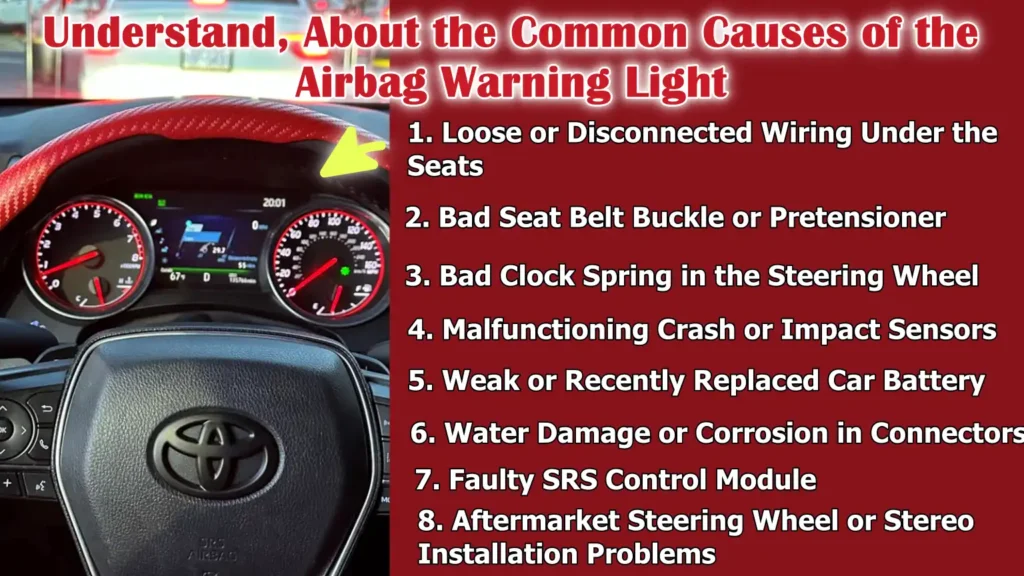
1. Loose or Disconnected Wiring Under the Seats
One of the most common causes of the airbag warning light coming on is loose or disconnected wiring under the front seats.
Many vehicles have airbag connectors and seat belt pretensioner wires under the driver and passenger seats.
When seats are repeatedly moved back and forth, the wiring can become displaced, stretched, or slightly loose over time.
Even a slight fault in the electrical connection can cause the supplemental restraint system to detect a fault.
This system is very sensitive because airbags rely on precise electrical signals to deploy properly.
If the connection is not stable, the system may disable the airbags as a safety measure and trigger the warning light.
Carefully checking and securing these connectors often resolves the problem, but to minimize risk, always disconnect the battery before touching any SRS wiring.
2. Bad Seat Belt Buckle or Pretensioner
The airbag system works in conjunction with the seat belt system, specifically the seat belt buckle sensor and pretensioner.
The buckle sensor tells the vehicle whether the seat belt is buckled.
During a collision, the pretensioner immediately tightens the belt to protect the occupant.
If the buckle sensor malfunctions or there is an electrical fault in the pretensioner, the airbag system may not function properly.
Because these parts are connected to the SRS control module, any problems with them may cause the airbag warning light to illuminate.
Signs of trouble may include the seat belt warning light flashing or strange noises from the belt mechanism.
Because the pretensioner, like the airbag, contains a small explosive charge, repairs must be done with caution and often require professional service.
3. Bad Clock Spring in the Steering Wheel
The clock spring is a spiral-shaped electrical connector located behind the steering wheel.
It allows the steering wheel to rotate while keeping the electrical connections to the driver’s airbag, horn and steering wheel controls active.
Over time, the ribbon inside the clock spring can wear out or break due to the constant rotation.
When this happens, the electrical connection to the airbag can be lost, causing the warning light to remain on.
Drivers may also notice that the horn or steering wheel buttons stop working at the same time.
Because the driver’s airbag is mounted in the steering wheel, a bad clock spring is a serious problem that needs to be repaired quickly to fully deploy the airbag.
4. Malfunctioning Crash or Impact Sensors
Crash sensors, also called impact sensors, detect sudden vehicle deceleration during a collision.
These sensors are typically located on the front, side, or inside of the vehicle.
They continuously monitor how quickly the vehicle decelerates.
If a sensor becomes damaged, misaligned, or electrically faulty, it may send incorrect information to the SRS control module.
The system may then trigger a warning light to indicate that it cannot ensure proper deployment.
In some cases, even minor accidents, potholes, or strong vibrations can damage the sensors.
Because these sensors are essential for crash detection, replacing a bad sensor is essential to maintaining proper safety.
5. Weak or Recently Replaced Car Battery
The airbag system relies on stable electrical power.
A weak battery, low voltage, or a recently disconnected battery can sometimes trigger the airbag warning light.
When the battery voltage drops too low, the SRS control module may store a fault code.
Even after installing a new battery, the warning light may remain on until the stored code is cleared with a diagnostic scanner.
Modern vehicles are very sensitive to voltage changes and a sudden power loss can interrupt the system’s self-check process.
Ensuring that the battery and charging system are functioning properly is the first step in diagnosing an airbag light.
6. Water Damage or Corrosion in Connectors
Water entering the vehicle can cause serious electrical problems, including problems with the airbag system.
Leaking door seals, sunroofs, or flooded windows can allow moisture in.
When water reaches wiring connectors, it can cause corrosion, disrupting electrical signals.
Corroded connectors can disrupt the circuits that help the SRS control module detect a malfunction.
Even minor corrosion or dirt on the terminals can trigger the warning light.
Checking the connectors for moisture damage and cleaning or replacing corroded parts can often restore the system to proper operation.
7. Faulty SRS Control Module
The SRS control module, sometimes called the airbag electronic control unit, acts as the brain of the airbag system.
It receives signals from sensors, monitors system health and determines when to deploy the airbags.
If the control module itself malfunctions due to an electrical problem, a collision, or an internal malfunction, it can trigger the warning light.
In some cases, when the airbags deploy after a collision, the module may need to be reset or replaced because it stores crash data and may lock itself.
Because this component controls the entire system, professional tools and programming equipment are usually required to diagnose and replace it.
8. Aftermarket Steering Wheel or Stereo Installation Problems
Installing aftermarket parts, such as custom steering wheels, stereo systems, alarm systems, or remote starters, can sometimes cause problems with the airbag system.
During installation, wires can be accidentally disconnected, damaged, or reconnected incorrectly.
Removing the factory steering wheel without properly installing the airbag components can also trigger the warning light.
Because the airbag system uses a specific wiring circuit and connectors, even minor modification errors can cause a malfunction.
If the warning light appears after installing new accessories, it’s important to check the associated wiring and ensure proper installation.
Is It Safe to Drive with the Airbag Light On?
1. Understanding what the warning light actually means
When the airbag warning light comes on, it means the supplemental restraint system has detected a fault and cannot confirm whether the system will function properly in a crash.
This light isn’t just a minor electrical warning; it’s directly connected to one of your vehicle’s most important safety systems.
Every time you start your car, the system performs a self-check.
If it detects a problem with the sensors, wiring, airbags, or control module, it turns on the light to alert you.
This light being on means you’re driving and you’re not entirely confident that your airbags will function as designed.
2. Possible Consequences in an Accident
In a collision, airbags are designed to work in conjunction with seat belts to reduce the impact on your body.
Airbags inflate in approximately 20 to 30 milliseconds, which is faster than the blink of an eye.
This rapid inflation helps protect the head, neck and chest from impacts with hard surfaces like the steering wheel, dashboard, or side doors.
If the airbag system is not functioning properly, the level of protection during an accident can be significantly reduced.
This can increase the risk of serious injuries, specially in moderate to severe accidents.
Even if the seat belt is worn properly, a malfunctioning airbag system can significantly impact the outcome of the injury.
3. Risk of Airbag Failure
When the airbag light is on, the biggest risk is that the airbags may not deploy at all during an accident.
If the system detects a fault, it can disable certain airbags to prevent them from deploying inadvertently.
For example, if a crash sensor or wiring connector is faulty, the control module may not receive accurate information about the collision.
Therefore, the airbags may not deploy when they are most needed.
This risk is specially concerning in frontal or side collisions, where airbags are designed to reduce the risk of serious head and chest injuries.
By not deploying, occupants lose a vital layer of protection.
4. The Risk of Accidental Deployment
Although less common, if there is a serious electrical fault in the system, the airbags may deploy accidentally.
Modern vehicles are designed with stringent safety measures to prevent this from happening, but faulty wiring or a faulty control module can lead to accidental airbag deployment.
Sudden airbag deployment while driving can cause distraction, loss of control, or even minor injuries from the force of the airbag deploying.
Although this situation is rare, it demonstrates that the airbag warning light should never be ignored.
5. When driving short distances may be necessary
There may be situations where driving short distances is necessary when the airbag light is on, such as taking the vehicle directly to a repair shop.
If the car appears normal and there are no other warning lights related to brake or engine safety, driving at a lower speed and with caution for a short time may reduce the risk.
However, this should only be done for a short time.
The key thing to understand is that the vehicle cannot provide complete crash protection during this time.
It is important to avoid high speeds, heavy traffic and long journeys until the problem is identified and corrected.
6. When to Stop Driving Immediately
If the airbag warning light is accompanied by other serious warning signs, such as an electrical malfunction, a burning smell, visible water damage inside the cabin, or after a recent accident, it’s safer to stop driving and seek professional help immediately.
If the light starts flashing instead of staying on, it could indicate a more serious system malfunction.
Additionally, if you experience problems like the horn not working, steering wheel controls malfunctioning, or seat belt warnings, the problem could be with a vital component like the clock spring or pretensioner.
Continuing to drive in these conditions doesn’t guarantee that the safety system will function in an emergency.
Correcting the problem as soon as possible restores full safety and ensures the vehicle’s safety systems are ready to operate when needed.
Tools
| Tool | Why to Use This |
|---|---|
| OBD2 Scanner with SRS Capability | It should support not only engine codes, but also SRS or airbag systems. It displays clear trouble codes that guide repairs. It can also clear warning lights after fixing the problem. |
| Vehicle Service Manual | It shows the exact location of parts and safety steps. It helps you clearly understand error codes. This prevents mistakes when working on airbags. |
| Basic Hand Tools – Screwdrivers and Socket Set | A socket set safely removes bolts. Screwdrivers help open covers and trim panels. Use the correct size to avoid damage. |
| Multimeter | It helps detect broken wires or weak power supplies. It checks whether the battery voltage is stable. It should be used with caution with airbag circuits. |
| Contact Cleaner | It improves the quality of electrical connections. It dries quickly and leaves no residue. It helps fix minor connection issues. |
| Safety Gloves and Eye Protection | Gloves protect against sharp edges. Safety glasses protect against dust or sparks. Always disconnect the battery before working. |
How to Fix the Airbag Warning Light – Easy Steps
1. How to Do Basic Reset
Turn the ignition on and off alternately
Some vehicles have a simple ignition reset method that can temporarily fix electronic malfunctions.
This method typically involves turning the key to the “On” position without starting the engine, waiting a few seconds for the dashboard light to appear and then turning it off.
Repeating this process several times allows the supplemental restraint system to perform its self-check.
The airbag system performs a diagnostic test every time the ignition is turned on.
If the malfunction is caused by a minor voltage fluctuation or a temporary communication error, the light may go off after this sequence.
However, this method only works if the problem is not serious or permanent.
Safely Disconnect the Battery
If the ignition reset doesn’t work, disconnecting the battery can sometimes reset some stored codes.
Before doing this, make sure the ignition is completely off and the key is removed.
To reduce electrical risks, disconnect the negative battery terminal first.
It’s important to wait at least 10 to 15 minutes before touching any parts connected to the airbag.
The airbag system has backup capacitors that store electrical energy even after the battery is disconnected.
Waiting allows this stored energy to safely discharge.
This step reduces the risk of accidentally deploying the airbag while checking wiring or connectors.
Reconnect and check if the light resets
After waiting, securely reconnect the negative battery terminal.
Start the vehicle and check the airbag warning light.
Normally, the light should illuminate for a few seconds during the system’s self-test and then turn off.
If the light remains illuminated, it means the problem is not a simple electrical fault and requires further diagnosis.
If the light turns off and stays off, the problem may be related to low voltage or a temporary battery failure.
2. How to Scan for Trouble Codes
Connect an OBD2 Scanner with SRS Support
To properly diagnose the airbag warning light, you need an OBD2 scanner that specifically supports the SRS or airbag system.
Basic code readers only check for engine-related problems and cannot access the airbag module.
Plug the scanner into the OBD2 port, which is usually located under the dashboard near the driver’s seat.
Turn on the ignition so the scanner can talk to the SRS control module.
This connection allows you to directly access fault information stored in the system.
Retrieve and Document Stored SRS Codes
Once connected, select the SRS or airbag option on the scanner.
The device will display the stored trouble codes.
These codes are usually a combination of letters and numbers that identify a specific problem, such as a sensor failure, a wiring issue, or a pretensioner problem.
It’s important to write them down or save them before clearing them.
Documenting the code helps you understand the exact cause and avoids guesswork during repairs.
Understand the Code Using the Manufacturer’s Guidelines
Each trouble code has a specific meaning depending on the vehicle manufacturer.
The vehicle’s service manual explains what each code indicates and what steps to take.
For example, one code may indicate a problem with the driver airbag circuit, while another may indicate a fault with the seat belt pretensioner.
Following the manufacturer’s guidelines ensures correct repairs and prevents unnecessary parts from being replaced.
Understanding the correctness of a repair saves time, money and improves safety.
3. How to Check Connections Under the Seat
Slide the seat forward and backward for access
Many airbag connectors are located under the front seats.
Slide the seats fully forward and backward to gain easy access underneath.
This allows you to check the wiring harnesses connected to the seat belt pretensioners and side airbags.
To reduce risk, always disconnect the battery and wait before touching these connectors.
Check the Wiring Harness and Connectors
Carefully inspect the wires and plastic connectors.
Look for loose plugs, bent pins, worn insulation, or broken wires.
Frequent seat movement can stretch or loosen connectors over time.
Even a slightly loose connection can trigger the airbag warning light, as the system is very sensitive to electrical disruptions.
Securely reconnect loose plugs
If you find a loose connector, firmly reconnect it until it clicks into place.
Ensure the wiring doesn’t pull tightly when the seat moves.
Secure the harness properly so it doesn’t slip again.
A strong connection ensures proper communication between the sensor and the control module.
Clean damaged connectors
If you notice dirt, rust, or green corrosion on the metal terminals, use electrical contact cleaner to remove the dirt.
Corrosion increases electrical resistance and can cause fault codes.
Cleaning connectors improves signal flow and sometimes
4. How to Check the Clock Spring
Symptoms of a Bad Clock Spring
The clock spring is located behind the steering wheel and maintains the electrical connection to the driver’s airbag when the wheel rotates.
Common symptoms of a malfunction include the horn not working, the steering wheel buttons not working and the airbag warning light not working.
As, the driver’s airbag relies on this connection, a bad clock spring can prevent the airbag from deploying.
When Replacement is Necessary
If diagnostic codes indicate a fault in the driver’s airbag circuit and other steering wheel functions are not working, it is usually necessary to replace it.
The clock spring is usually beyond repair and must be replaced as a unit.
Ignoring this problem could result in the driver losing airbag protection in a frontal collision.
The Importance of Professional Installation
Replacing the clock spring requires removing the steering wheel and airbag module.
This process must be performed carefully to avoid accidental opening.
Professional installation ensures proper alignment and correct reconnection of all components.
Incorrect installation can lead to further electrical failure.
5. How to Check Seat Belt Parts
Check Seat Belt Buckle Sensors
Seat belt buckle sensors tell the system whether the belt is fastened or not.
If the sensor is faulty, the SRS may detect a malfunction.
Test by fastening and unfastening the buckle while observing the warning indicator.
If the airbag light is associated with buckle problems, the sensor may need to be replaced.
Check Pretensioner Wiring
Seat belt pretensioners instantly tighten the belt during a collision.
Check the wiring connected to the pretensioners under the seat.
Loose or damaged wires can interfere with the signals sent to the SRS control module.
Because pretensioners contain small explosive charges, handle them with caution.
Replace faulty parts if necessary
If testing confirms a defect in the buckle sensor or pretensioner, they must be replaced.
These parts are part of the safety system and should not be overlooked.
Proper replacement restores full crash protection.
6. How to Check the Battery and Charging System
Test the Battery Voltage
Low battery voltage can cause the airbags to deploy.
Use a multimeter to check the battery.
A healthy battery typically reads around 12.6 volts with the engine off.
Low voltage can cause communication problems with the SRS module.
Ensure the Alternator is Working Properly
The alternator charges the battery when the engine is running.
If it malfunctions, the voltage may drop and cause system damage.
While driving, check that the charging system maintains the correct voltage level.
Clear Codes After Electrical Repairs
After fixing battery or charging issues, clear stored SRS codes using a scanner.
Start the vehicle and verify that the airbag light is off after performing a self-check.
This confirms that the electrical issue has been fixed.
7. How to Replace a Defective Sensor or Control Module
Identifying a Defective Crash Sensor
Crash sensors can be damaged by impact, corrosion, or wiring faults.
Diagnostic codes typically identify the specific location of the sensor.
Physical inspection after an accident may reveal visible damage.
Replacing the Impact Sensor
If a sensor is defective, it must be replaced with the correct part designed for the vehicle.
Sensors are calibrated for specific locations and impact sensitivity.
Proper installation ensures accurate crash detection.
Reprogramming or Replacing the SRS Module
If the SRS control module is faulty or has stored crash data after deployment, it may need to be reprogrammed or replaced.
This process often requires dealer-level tools because the module must be matched to the vehicle’s system.
Professional handling ensures that the entire airbag system functions properly and safely.
How to Reset the Airbag Light After Repair
1. Clear the Codes Using an OBD2 Scanner
After necessary repairs are completed, the airbag warning light will usually remain on until the fault codes stored in the supplemental restraint system are cleared.
This is because the SRS control module stores error codes in its memory whenever it detects a problem.
Even if the problem is fixed, the system will not automatically clear the codes in most vehicles.
To properly reset the light, connect an OBD2 scanner that supports the SRS or airbag function to the diagnostic port under the dashboard.
Turn the ignition to the “On” position without starting the engine and use the scanner to access the airbag or SRS section.
Select the option to clear or erase the stored codes.
The scanner will send a command to the control module to clear the fault memory.
This step is crucial because simply disconnecting the battery often won’t clear hard fault codes.
Using the correct scanner ensures that the system has been properly reset and is ready for a new self-check.
2. Ensure the light is off after the repair
After the code is cleared, start the vehicle and carefully observe the airbag warning light.
Under normal conditions, the light should illuminate for a few seconds during startup while the system performs its automatic self-test.
This self-test checks the sensor, wiring circuit, airbag, pretensioner and control module.
If everything is working properly, the light should go off within a few seconds and remain off.
If it remains on or flashes, it means the system has detected another fault.
Before assuming a new problem, it’s important to ensure that all electrical connectors are secure and the repair was performed correctly.
The light will remain off continuously, indicating a successful reset and a properly functioning system.
3. Test Drive and Retest the System
After confirming that the light is off, take the vehicle for a short and careful test drive.
Drive at normal speed and pay attention to the dashboard.
The SRS system monitors the circuits while the vehicle is running.
In some cases, faults may only appear when the vehicle is moving or when certain parts are active.
After the test drive, turn off the engine and restart the vehicle to ensure that the light returns upon normal startup.
If the light remains off during several start cycles, it is a sure sign that the repair was successful.
A short test drive helps confirm that the system remains stable under normal driving conditions.
4. What to Do If the Light Returns
If the airbag warning light returns after clearing the code, it means that the original problem was not completely fixed or a new fault has been found.
Reconnect the OBD2 scanner and carefully read the new codes.
Compare codes to previous codes to see if the same problem recurs.
This could indicate a loose connector, damaged wiring, or a faulty replacement part.
If the codes point to problem parts like the crash sensor or SRS control module, professional diagnosis may be necessary.
Resetting the light without fixing the underlying cause is not a good idea, as the airbag system may not function properly in a crash.
Correcting the underlying problem ensures that the vehicle’s safety systems remain fully functional and ready to rescue passengers in an emergency.
So, When You Should Go to the Professional Mechanic
1. Persistent or Troublesome SRS Codes
If the airbag warning light repeatedly illuminates even after basic wiring checks and code clearance, it’s a sure sign that the problem is more serious than a simple loose connector.
Some SRS trouble codes indicate complex electrical faults, internal control module faults, or communication problems between different vehicle systems.
Modern vehicles use advanced electronic networks where the airbag system communicates with other modules, such as the body control module and instrument cluster.
Diagnosing these problems often requires professional diagnostic tools that can read live data, perform system tests and access manufacturer-specific information.
A trained mechanic understands how to correctly interpret these codes and avoid unnecessary part replacements.
Ignoring persistent codes can cause the airbag system to become partially disabled, reducing safety during a crash.
2. Replacing the Module or Airbag
Replacing an airbag module or SRS control unit is not a simple repair.
Airbags contain small explosive-charged inflators designed to deploy within milliseconds during a crash.
If handled improperly, they can accidentally deploy, causing serious injury.
Furthermore, replacing the SRS control module often requires programming to properly communicate with the vehicle’s systems.
In many vehicles, when the airbags deploy in an accident, the control module locks up and stores crash data that must be reset or altered using specialized equipment.
Professional technicians follow strict safety procedures, properly disconnecting the battery and waiting for the stored electrical energy to discharge before proceeding.
They also ensure that replacement parts meet manufacturer standards, which are essential for proper function in a future accident.
3. Inspecting the Airbag System After an Accident
After any accident, even a minor one, the airbag system should be inspected by a professional.
Even if the airbags don’t deploy, crash sensors may be damaged or misaligned.
Wiring connectors may be loose and internal components may store fault codes that aren’t visible without a scanner.
In some cases, the airbag system may slightly detach parts like the seat belt pretensioners, which the driver may not immediately notice.
A professional inspection checks the sensors, impact module, seat belt system and control unit to ensure everything is working properly.
This inspection ensures that the vehicle is fully prepared to protect occupants in a future collision.
4. Considerations about dealerships vs independent repair shops
Choosing between a dealership and an independent repair shop depends on the type of repair needed.
Dealerships often have direct access to manufacturer software updates, factory diagnostic tools and technical service bulletins specific to your vehicle model.
This can be specially helpful for complex module programming or airbag system recalls.
Independent repair shops can offer lower labor costs and, with the proper equipment and training, can perform many airbag-related repairs.
The most important thing is to ensure that the technician is experienced with SRS systems and follows strict safety guidelines.
Airbag systems are a vital component of safety, so quality service and proper certification are more important than saving a small fortune.
Seeking professional help when needed ensures that your vehicle’s safety systems function properly when needed.
How to Avoid Problems with the Front Airbag Warning Light
1. Don’t Move the Seats Vigorously
Many problems with the airbag warning light are caused by loose wiring under the front seats.
In modern vehicles, the side airbags and seat belt pretensioners are often embedded in the seats and these components are connected to electrical plugs located underneath.
When the seats are moved back and forth rapidly or subjected to pressure from objects on the floor, the wiring can stretch, become loose, or become slightly detached.
Over time, repeated stress on these connectors can cause system malfunction.
Moving the seats slowly and gently helps prevent damage to the wiring harness.
Also, avoid placing heavy objects under the seats, as they can put pressure on the connectors and damage them.
A little care when adjusting the seats can prevent many common airbag system malfunctions.
2. Protect the interior from moisture
Moisture is the biggest enemy of any electrical system, including the airbag system.
Water can enter the cabin through leaking door seals, damaged window trim, clogged sunroof drains, or flooding.
When moisture reaches wiring connectors, it can cause corrosion, creating electrical resistance and disrupting signals.
Even a small amount of corrosion on metal terminals can trigger the airbag warning light to illuminate as the system constantly checks for the correct voltage level.
Keeping the interior dry, repairing leaks promptly and ensuring carpets are completely dry after a spill can prevent corrosion problems.
If the vehicle is exposed to heavy rain or flooding, it’s important to have the electrical system checked before problems arise.
3. Proper Battery Maintenance
The airbag system relies on stable battery voltage to function properly.
A weak or old battery can cause a voltage drop during engine start, triggering fault codes in the SRS control module.
Most healthy car batteries deliver approximately 12.6 volts when fully charged and provide higher voltage when the engine is running due to the alternator.
If the voltage drops too low, the system may register errors in communication or power supply.
Replacing an old battery before it wears out, regularly cleaning the battery terminals and ensuring the charging system is functioning properly can prevent unnecessary warning lights.
Good battery health supports all of the vehicle’s electronics, including safety systems.
4. Professional Installation of Aftermarket Accessories
Aftermarket modifications, such as new stereos, alarm systems, remote starters, or steering wheel replacements, can accidentally disrupt airbag wiring.
The airbag system uses dedicated circuits that must remain intact and properly connected.
Improper wiring or improperly removing factory parts can trigger warning lights or disable some airbags.
Professional installers know how to repair airbag circuits without disturbing them.
Choosing an experienced technician reduces the risk of accidental damage and ensures that safety systems remain fully functional even after upgrades.
5. Regular Diagnostic Scans
Even if there are no warning lights, periodic diagnostic scans can help detect problems before they become serious.
Many professional scan tools can check for stored history codes that may not yet trigger visible warning lights.
Early detection of minor faults, such as intermittent wiring or sensor malfunctions, can allow repairs to be made before the system becomes completely damaged.
Regular inspections also ensure that any software updates or manufacturer recalls related to the airbag system are addressed.
Performing a safety check provides peace of mind and helps ensure the airbag system is ready to protect passengers in the event of an accident.
Read more:
Conclusion – How to Fix Airbag Warning Light
So, in the end, you need to be sure about the proper working of the life-saving safety system rather than just removing a dashboard glowing symbol.
Also, there’s scientific analysis in MDPI that shows that the modern airbag systems has complex networks of sensors and control logic whose reliability actually affects safety performance as well, so the study shows that even seemingly minor electrical faults can significantly increase the probability of the system failure over the period of time, that’s why an airbag warning light should never be ignore, as it is often an early indicator of electrical or sensor degradation that could literally compromise crash protection as well.[¹]
Because, supplemental restraint systems are carefully designed to detect a crash within milliseconds and deploy airbags in a timely manner.
So, these systems, combined with seat belts, reduce the risk of serious head and chest injuries.
However, when the warning light remains on, the system is telling you that it can’t guarantee complete protection.
In many cases, the cause could be something as simple as loose wiring, low battery voltage, or a faulty sensor.
In other situations, the problem could involve more complex parts like a clock spring or SRS control module.
Now, that’s all from this guide and you can ask questions in the comment section below.
Frequently Asked Questions
Q1. What does the airbag warning light mean?
Answer: The airbag warning light means your vehicle’s supplemental restraint system has detected a problem. This system controls the airbags and seat belt pretensioners. When you start your car, the system performs a self-check. The light normally comes on for a few seconds and then turns off. If it stays on or flashes, it means the system has detected a fault. This could be due to loose wiring, a faulty sensor, low battery voltage, or a problem with the control module. When the light is on, the airbags may not deploy properly in a crash.
Q2. Can I drive my car with the airbag light on?
Answer: You can technically drive, but it’s not considered safe. When the airbag light is on, the system cannot guarantee that the airbags will deploy during an accident. In some cases, some airbags may be disabled. This reduces your protection in a collision. The car may drive normally, but the safety system will not fully activate. To ensure complete safety, it’s best to fix this problem as soon as possible.
Q3. What is the most common cause of the airbag warning light?
Answer: One of the most common causes is loose or disconnected wiring under the front seats. Many vehicles have airbag and seat belt connectors under the seats. Moving the seats back and forth can loosen these connections over time. Other common causes include a weak battery, a bad seat belt pretensioner, a faulty crash sensor, or a bad clock spring in the steering wheel. Common electrical problems are often the main culprit.
Q4. How do I reset the airbag warning light?
Answer: The correct way to reset the airbag warning light is to use an OBD2 scanner that supports the SRS or airbag system. After fixing the problem, connect the scanner to the vehicle’s diagnostic port and clear the stored fault codes. Permanent codes cannot be removed by simply disconnecting the battery. After the code is cleared, restart the vehicle and check if the light turns off after the self-test. If it remains off, the reset was successful.
Q5. Will disconnecting the battery turn off the airbag light?
Answer: Disconnecting the battery can reset temporary faults, specially if the problem is caused by low voltage. However, in most modern vehicles, the airbag system stores hard fault codes that do not disappear when the battery is disconnected. Clearing these codes usually requires a diagnostic scanner. Also, after disconnecting the battery, you must wait at least 10 to 15 minutes before touching any airbag components as the system stores backup power.
Q6. How much does it cost to fix the airbag warning light?
Answer: The cost depends on the cause of the problem. A simple wiring fix can cost $50 to $200. Replacing a crash sensor can cost $150 to $400. Replacing a clock spring can cost $200 to $600. If the SRS control module needs to be replaced or reprogrammed, the cost can exceed $1,000. Diagnostic fees are usually charged separately. The final cost depends on the vehicle model and labor rates in your area.
Q7. Can a bad battery cause the airbag light to come on?
Answer: Yes, a weak or failing battery can cause the airbag light to come on. The airbag system relies on stable voltage. If the battery voltage drops too low when the engine starts, the system may store a fault code. After replacing the battery, the light may remain on until the stored code is cleared by a scanner. Keeping the battery in good condition helps prevent many electronic warning lights.
References:
[1] Reliability and Service Life Analysis of Airbag Systems
https://www.mdpi.com/2227-7390/11/2/434

Guys, I’m a car audio enthusiast and customization expert and I love clear sound and clean installation. Plus, I have spent years helping people build their dream audio setups. And whenever I’m working on cars, I probably listen to music and thinks about the next big upgrade.
