
Written By: Don Dodi
Fact Checked By: Kristen Brown
Reviewed By: Diego Rosenberg
You need to be aware of the small leaks, worn seals or simple maintenance issues, as most of the time car AC systems doesn’t fall just because they are old enough to continue.
Also, when it doesn’t blowing cold air, then it can also affect the comfort, focus and even safety as well, specially it becomes really important to have fixed one otherwise the extreme heat can got your brain.
As well as, in many regions, the summer cabin temperatures literally able to rise above 49°C within the matter of minutes when a vehicle is actually parked in the sun, that really turn your car into a heat trap.
Now-a-days, automotive AC systems are actually designed for comfort, but also reduces humidity, improve air circulation and it actually helps you to keep your windows clear for better visibility.
Basically, a typical car air conditioning system works by compressing the refrigerant, that releases heat outside the vehicle and by circulating the cooled air back into the cabin.
But if, there’s even small issues such as: low refrigerant, a clogged cabin air filter, a failing compressor or an electrical fault then it ca prevent the system from producing that comfortable and relaxing cold air.
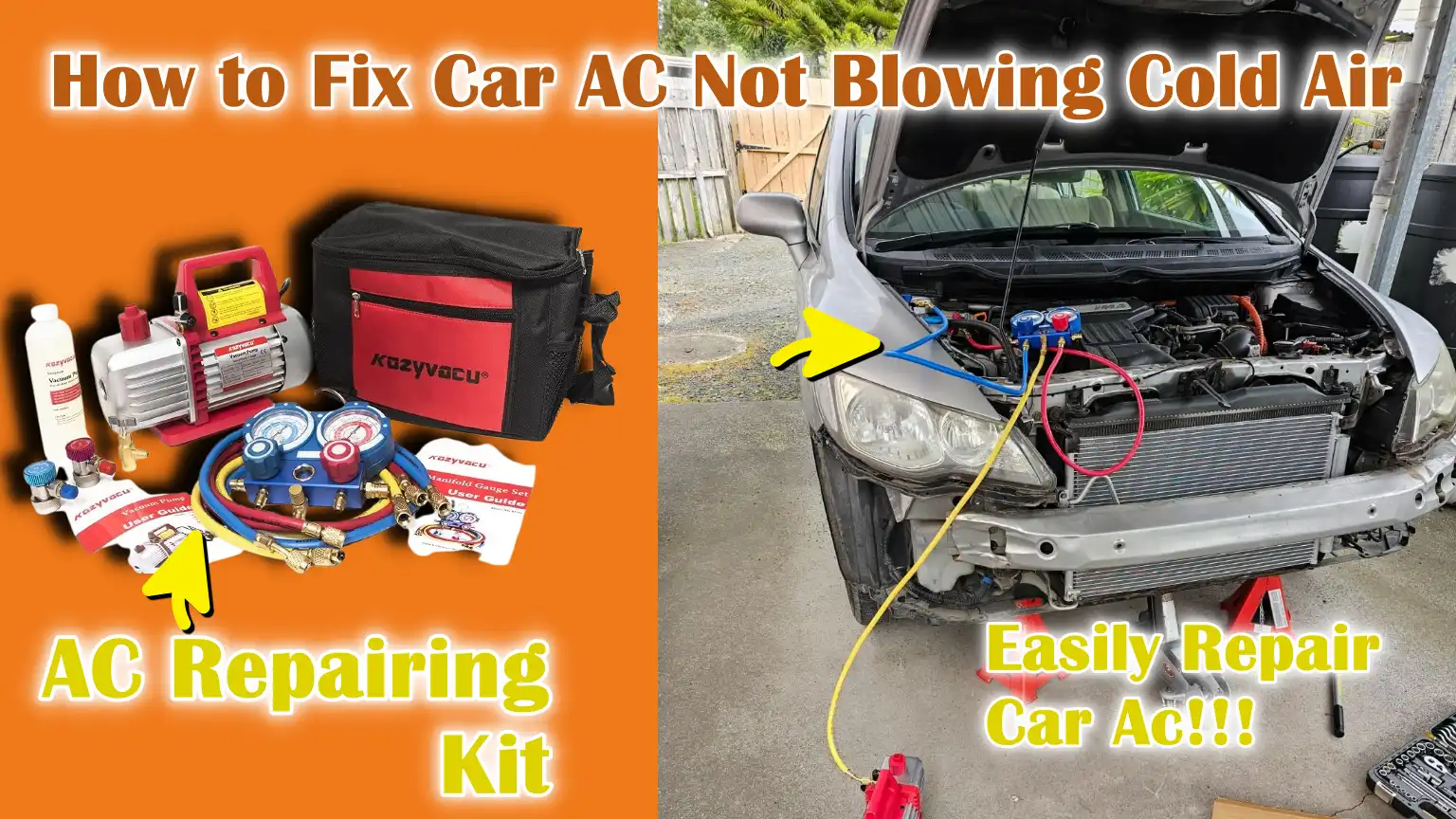
So, this is the guide that shows you How to Fix Car AC Not Blowing Cold Air, so that you can easily fix and actually understand how the system works that makes the troubleshooting much more easier.
How a Car AC System Works?
A car air conditioning system is a closed, pressurized system designed to extract heat from inside your vehicle and release it outside.
Instead of “creating cool air,” this system actually draws heat from the cabin and removes it using a special liquid called refrigerant.
Modern vehicles use carefully engineered components that work together in a continuous cycle of compression, heat extraction, expansion and vaporization.
When even one part fails or loses its efficiency, the system cannot cool properly.
Understanding how each part works makes it much easier to diagnose why your car’s AC isn’t producing cool air.
1. Basic Parts of an Automotive Air Conditioning System
An automotive AC system is made up of several specialized parts, each of which plays a specific role in heat removal.
These include the compressor, condenser, evaporator, expansion valve or orifice tube, refrigerant and pressure switch.
These parts are connected by sealed hoses and metal lines that allow refrigerant to circulate at high and low pressures.
Because the system is sealed, refrigerant should generally not decrease unless there is a leak.
Each component depends on the others to maintain the correct pressure and temperature balance for effective cooling.
1. Compressor
The compressor is often called the heart of the AC system because it pumps refrigerant throughout the system.
It is driven by a belt from the engine and is activated when the AC is turned on.
The compressor takes low-pressure refrigerant gas and converts it into high-pressure, high-temperature gas.
This pressure change is crucial because it allows the refrigerant to release heat later in the cycle.
If the compressor or its clutch fails, refrigerant will not circulate and the AC will only produce warm air.
The compressor also helps circulate oil within the system to lubricate internal parts, which is why running the AC occasionally in winter keeps it healthy.
2. Condenser
The condenser is usually located in front of the radiator, where it receives airflow from outside the vehicle.
Its job is to remove heat from the high-pressure refrigerant gas.
As air passes over the condenser fins, the hot refrigerant cools and changes from a gas to a high-pressure liquid.
This process is similar to how steam cools and turns back into water.
If the condenser becomes clogged with dirt, debris, or insects, airflow is reduced and heat cannot be properly expelled.
When heat is not properly expelled, the AC system cannot produce cool air inside the cabin.
3. Evaporator
The evaporator is located inside the dashboard area and is responsible for cooling the cabin air.
When the refrigerant reaches the evaporator, it is in a low-pressure state and ready to absorb heat.
As warm air from inside the cabin flows over the evaporator coils, the refrigerant absorbs that heat and turns back into a gas.
This heat absorption is what makes the air feel cool before it exits the vents.
The evaporator also removes moisture from the air, which is why water sometimes drips under your car when the AC is running.
If the evaporator becomes blocked or leaks, cooling performance is significantly reduced.
4. Expansion Valve/Orifice Tube
The expansion valve or orifice tube controls how much refrigerant enters the evaporator.
Its main function is to reduce the pressure of the liquid refrigerant before it reaches the evaporator.
When the pressure drops suddenly, the refrigerant becomes too cold.
This rapid cooling effect allows it to absorb heat from the cabin air efficiently.
If the expansion valve is stuck or clogged, too much or too little refrigerant can enter the evaporator.
This imbalance can cause poor cooling, uneven temperatures, or even damage the system over time.
5. Refrigerant
Refrigerant is the working fluid that transfers heat in the AC system.
It is specifically designed to change between liquid and gas at low temperatures, making it ideal for heat transfer.
Modern vehicles use R-134a or R-1234yf refrigerant, depending on the model year.
Refrigerant doesn’t “run out” like fuel; it circulates continuously in a sealed loop.
If the level is low, it means there’s a leak somewhere in the system.
Maintaining the correct refrigerant level is crucial because too little refrigerant reduces cooling, while too much can cause pressure surges and damage parts.
6. AC Pressure Switch
AC pressure switches monitor the refrigerant pressure within the system and prevent damage.
They typically consist of high-pressure and low-pressure switches.
If the pressure drops too low due to a leak, the system can shut down the compressor to prevent internal damage.
If the pressure rises too high, perhaps due to overheating or a blockage, the switch can also stop operation to prevent failure.
These safety devices ensure the system operates within a safe pressure range and help avoid costly repairs.
2. The Refrigeration Cycle Explained in a Simple Way
The refrigeration cycle in a car’s AC system runs continuously.
First, the compressor pressurizes the refrigerant gas.
Next, the condenser releases heat and turns the gas into a liquid.
Then, the expansion valve reduces the pressure of the liquid refrigerant, making it very cold.
Next, the evaporator absorbs heat from the cabin air and cools it before releasing it into the car.
Finally, the refrigerant returns to the compressor and the cycle begins again.
This continuous movement of heat from inside the car to outside keeps the cabin cool.
3. Why Every Component Is Important for Creating Cool Air
Every part of the AC system plays a vital role in creating cool air.
The compressor pressurizes the refrigerant.
The condenser removes excess heat from the system.
The expansion valve reduces the pressure to create the cooling effect.
The evaporator absorbs heat from inside the cabin.
Refrigerant circulates heat throughout the system and pressure switches protect everything else.
If any of these components fail, the entire cooling process is disrupted or halted completely.
Because the system works like a chain, even a small problem can impact overall performance, which is why proper diagnosis is essential when your car’s AC isn’t blowing cold air.
Know, Common Reasons for a Car AC Not Blowing Cold Air
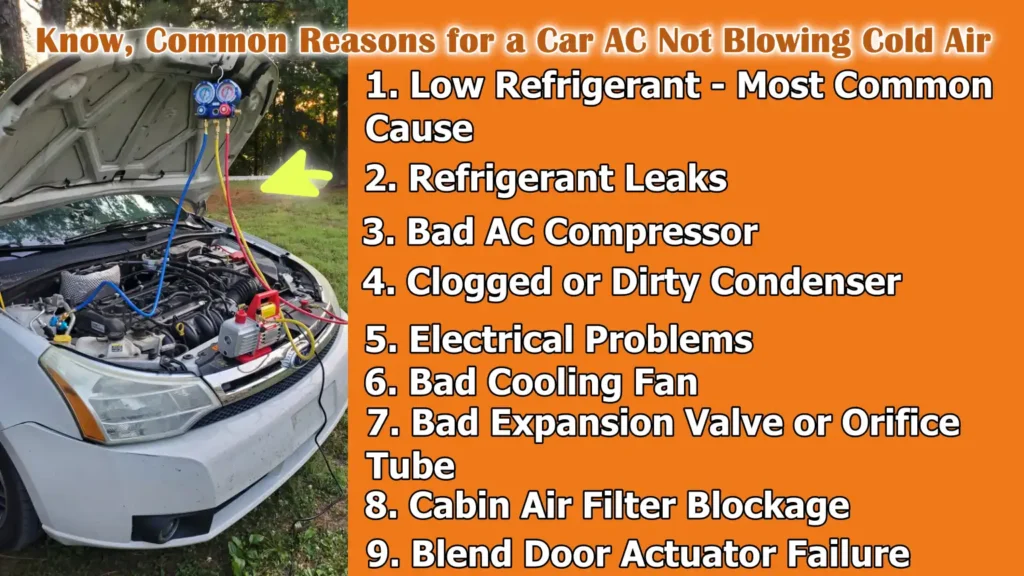
When your car AC stops blowing cold air, the problem is usually due to a few specific reasons: low refrigerant, poor airflow, a mechanical failure, or a power outage.
Modern car AC systems operate under high pressure and a precise temperature balance.
Even a minor malfunction can disrupt this balance and rapidly reduce cooling.
Because the system is sealed and pressurized, cold air depends on the correct refrigerant level, strong airflow to the cooling components and properly functioning electrical controls.
If any of these systems malfunction, the entire cooling process is weakened or stopped altogether.
Low Refrigerant – Most Common Cause
The most common reason for a car AC system not blowing cold air is low refrigerant.
Refrigerant is a special liquid that absorbs and removes heat from inside your car.
If the refrigerant level drops too low, the system can’t absorb enough heat to properly cool the air.
A properly sealed AC system shouldn’t lose refrigerant over time, so if the level is low, it means there’s a leak somewhere.
1. Causes of Refrigerant Loss
Refrigerant loss is usually caused by small leaks in hoses, seals, metal lines, or connection points.
Over time, the constant heat and vibration from the engine can cause rubber parts to shrink, crack, or dry out.
Service valves may also become slightly loose.
In older vehicles, small cracks may develop in the metal lines.
Even a very small hole can slowly leak refrigerant over months.
2. Signs of Low Refrigerant
Common signs include warm air coming from the vents, the AC taking longer than usual to cool, the compressor turning on and off frequently, or a slight hissing sound.
Sometimes you may notice an oily residue around AC fittings because refrigerant carries oil with it.
If ignored, low refrigerant can cause the compressor to overheat and fail quickly.
3. How Leaks Occur
Leaks occur because AC systems operate under high pressure and extreme temperature changes.
Parts expand and contract daily.
Road vibrations also put pressure on connections.
Over the years, these conditions weaken seals and joints, leading to gradual leaks that reduce cooling performance.
Refrigerant Leaks
Refrigerant leaks are a common cause of poor cooling and should be addressed before adding more refrigerant.
Simply recharging the system without fixing the leak will only provide temporary cooling.
1. Bad Hoses or Seals
Rubber hoses can break or weaken over time.
Seals at connection points may become flat or broken, specially in hot weather.
Once worn, they can no longer hold pressure properly.
2. Bad O-rings
O-rings are small rubber rings that seal AC line connections.
They are constantly exposed to heat and pressure.
Over time, they shrink or harden, causing refrigerant to slowly leak.
3. Corrosion in the Condenser
The condenser is located at the front of the car and is exposed to rain, salt, dirt and small stones.
Road salt and moisture can cause corrosion, leading to small holes.
Even pin-sized holes can slowly leak refrigerant.
4. The Importance of Leak Locating
It’s crucial to locate the exact location of the leak.
Professional mechanics often use UV dye or electronic leak detectors to locate the problem.
If not repaired properly, the same problem will return after every recharge.
Bad AC Compressor
The compressor is the heart of the AC system as it pumps refrigerant through the system.
If it fails, the entire cooling process comes to a halt.
1. Symptoms of a Bad Compressor
These symptoms include hot air even when the AC is on, strange noises, a burning smell, or the compressor not running at all.
In severe cases, the system may suddenly stop working.
2. Compressor Clutch Failure
When you turn on the AC, the clutch connects the compressor to the engine belt.
If the clutch fails, refrigerant will not circulate.
This could be due to an electrical fault, worn clutch parts, or low refrigerant pressure.
3. Noisy Operation
Screaming, squealing, or rattling noises can be a sign of internal damage.
Lack of lubrication, which is usually caused by low refrigerant, can damage internal bearings and moving parts.
Clogged or Dirty Condenser
The condenser extracts heat from the refrigerant.
If it cannot remove heat properly, cooling performance drops rapidly.
1. Airflow Obstruction
Leaves, dirt, plastic bags and insects can block airflow past the condenser fins.
When airflow is blocked, heat remains trapped within the refrigerant.
2. Refrigerant Overheating
If heat cannot escape, the refrigerant temperature remains high, preventing proper cooling inside the cabin.
3. Effect of Debris and Road Grime
Road grime can bend the condenser fins and reduce efficiency.
In dusty or high-traffic areas, dirt accumulation can significantly reduce cooling performance.
Electrical Problems
Today’s AC systems rely heavily on electrical components.
A small electrical problem can bring the entire system to a halt.
1. Blown Fuse
If an AC fuse blows, power to the compressor or control system will be cut off.
This can cause cooling to stop completely.
2. Bad Relay
The relay sends electrical power to the compressor.
If it fails, the compressor may not start even if the AC switch is pressed.
3. Bad Wiring
Loose, corroded, or broken wires can disrupt the signal between the sensor and the control module.
Electrical problems can cause the system to suddenly fail.
4. Bad Pressure Switch
Pressure switches protect the system.
They shut down the compressor if the pressure becomes too high or too low.
A bad switch can cause it to malfunction.
Bad Cooling Fan
When the car isn’t moving fast, the cooling fan helps pump air into the condenser.
1. Radiator Fan Defect
If the fan motor fails, airflow over the condenser becomes weak.
This often causes the AC to blow hot air when parked in traffic.
2. Bad Airflow Over the Condenser
Without proper airflow, heat cannot escape from the system.
This increases pressure and reduces cooling efficiency.
Bad Expansion Valve or Orifice Tube
This part controls the flow of refrigerant into the evaporator.
1. Reduced Refrigerant Flow
If it becomes clogged, not enough refrigerant enters the evaporator.
Cooling is affected because heat cannot be absorbed properly.
2. Inconsistent Cooling
You may notice temperature differences between vents.
Improper refrigerant control can cause some vents to feel colder than others.
Cabin Air Filter Blockage
The cabin air filter cleans the air coming into the cabin before it is released.
1. Reduced Airflow
If the filter becomes clogged with dust or debris, airflow is reduced.
Even if the AC system is working, less air reaches the vents.
2. Poor AC Performance
Low airflow can cause poor cooling.
Replacing the filter is easy and often immediately restores proper airflow.
Blend Door Actuator Failure
The blend door controls how much warm or cool air enters the cabin.
1. Stuck Temperature Door
If the door is stuck in a hot spot, warm air will continue to flow even when the AC is on.
2. Mixing of hot air with cold air
If the actuator motor fails, hot air can mix with cold air, reducing cooling power.
This problem may seem like low refrigerant, but it’s actually a problem with the airflow control inside the dashboard.
Tools
| Tool Name | Usage |
|---|---|
| AC Manifold Gauge Set | This tool checks high and low pressure in your AC system. It helps you see if the refrigerant level is too low or too high. Accurate pressure readings eliminate guesswork and prevent damage when diagnosing cooling problems. |
| Refrigerant Recharge Kit | This kit is used to add refrigerant back to the system when the level is low. It usually includes a hose and a pressure gauge for safe filling. It should only be used after checking for leaks so that a temporary repair can be made. |
| UV Leak Detection Kit | This kit helps find small refrigerant leaks that are difficult to see. A special dye is injected into the system and a UV light shows where the refrigerant is leaking. This helps you fix the exact leak instead of replacing parts thoughtlessly. |
| Multimeter | A multimeter checks the electrical power, voltage and resistance in an AC circuit. It helps test fuses, relays, switches and compressor clutch power supplies. These tools are essential for safely diagnosing hidden electrical faults. |
| Basic Hand Tools | These include screwdrivers, socket sets, pliers and wrench sets. They are needed for removing covers, tightening fittings and replacing small AC parts. These common tools are often needed for easy mechanical access. |
| Safety Gloves and Glasses | Protect your hands and eyes when working on AC systems. The refrigerant can be very cold and can cause skin burns or eye injuries. Safety gear reduces the risk of accidents during inspection or recharging. |
How to Fix Car AC Not Blowing Cold Air – Simple & Easily Doable
If your car’s AC isn’t blowing cold air, follow a logical, step-by-step approach.
Modern AC systems rely on correct settings, proper airflow, proper refrigerant pressure and working electrical components.
Skipping steps can lead to a misdiagnosis and costly costs.
By checking the simple things first and performing a more technical inspection, you can safely and accurately identify the real problem.
How to Check the AC Settings
Before assuming a mechanical fault, always check the basic settings inside the car.
Many cooling problems are caused by simple control issues rather than faulty parts.
1. Ensure the AC is on properly
Ensure the AC button is actually activated and the indicator light is on.
In many vehicles, the fan may run without the AC compressor on, providing air circulation but no cool air.
Also, make sure the engine is running, as most compressors only operate when the engine is on.
2. Verify the Temperature Setting
Check that the temperature dial or digital control is set to the coldest position.
Sometimes the system may mistakenly be set to warm or mid-range.
In automatic climate control systems, ensure the temperature setting is lower than the cabin temperature so the system knows to cool.
3. Check the Recirculation Mode
Recirculation mode draws air from inside the cabin rather than warm air from outside.
If fresh air mode is selected on a very hot day, the system has to work harder to cool the incoming air.
Turning on recirculation often immediately improves cooling performance.
How to Check the Cabin Air Filter
A blocked cabin air filter can reduce airflow and make the AC feel weak, even if the cooling system is working properly.
1. How to Find It
In most vehicles, the cabin air filter is located behind the glove box or under the dashboard.
Some vehicles place it under the hood near the windshield.
The owner’s manual usually indicates its exact location.
2. When to Change It
If the filter appears dirty or clogged with dust, leaves, or debris, it should be replaced.
Most manufacturers recommend replacing it every 12,000 to 15,000 miles, but dusty areas may require an earlier replacement.
A clean filter improves airflow and cooling efficiency.
How to Check the Refrigerant Level
Proper refrigerant pressure is essential for producing cool air.
Low pressure means poor cooling and incorrect pressure can damage the compressor.
1. Using a Pressure Gauge
Attach a low-pressure gauge to the service port with an “L” cap.
Start the engine and set the AC to maximum cooling.
The gauge will show the system pressure when running.
2. Understanding Pressure Readings
Normal low-side pressure usually falls within a specific range depending on the outside temperature.
If the reading is much lower than the stated reading, the refrigerant may be low.
If the pressure is too high or low, it could indicate a blockage or compressor problem.
3. When to Recharge
Recharge only when the pressure is clearly low and no major leaks are visible.
If the refrigerant level drops again after recharging, a leak is likely present and needs to be repaired.
How to Recharge the AC System – If Low
If low refrigerant is the only problem, recharging may restore cooling.
1. Safety Precautions
Always wear protective gloves and eye protection.
Refrigerant is very cold and can burn skin.
Never overfill the system, as too much refrigerant can increase pressure and damage parts.
2. Correct Refrigerant Type
Check the label under your vehicle’s hood to confirm the correct refrigerant type, usually R-134a or R-1234yf.
Using the wrong type can damage seals and reduce system performance.
3. Step-by-Step Recharge Process
Connect the recharge hose only to the low-pressure port.
Start the engine and turn the AC on to maximum cooling.
Add refrigerant slowly, watching the pressure gauge.
Stop filling when the pressure reaches the set limit.
Carefully disconnect and test the cooling performance.
How to Check for Refrigerant Leaks
If the refrigerant was low, it’s important to locate the leak to avoid repeated malfunctions.
1. Using UV Dye
Add UV dye to the system and run the AC for several minutes.
Use the UV light to inspect the hoses, fittings, condenser and compressor.
Bright spots indicate leaks.
2. Inspecting Hoses and Fittings
Look for oil residue around hose connections and metal joints.
Refrigerant contains oil, so leaks often leave wet or greasy marks.
3. When to Replace Parts
Replace hoses, seals, or the condenser if they are cracked or rusted.
Replacing small seals is inexpensive, but larger leaking parts require proper repair before recharging.
How to Test the AC Compressor
The compressor must be functioning properly to circulate refrigerant.
1. Check Clutch Engagement
With the engine running and the AC on, observe the compressor pulley.
The outer clutch plate should engage and rotate.
If it doesn’t move, there may be an electrical or pressure problem.
2. Listen for Strange Noises
Noises like grinding, creaking, or knocking may indicate internal damage.
A loud noise often means that bearings or internal components are worn out.
3. Electrical Testing
Use a multimeter to check the voltage at the compressor clutch connector.
If power isn’t reaching the compressor, check the relays, fuses and wiring connections.
How to Check Fuses and Relays
Electrical supply problems can prevent the AC from working properly.
1. Locate the Fuse Box
The fuse box is usually located under the dashboard or in the engine compartment.
The cover diagram shows the fuse locations.
2. Identify the AC Fuses
Find the fuse labeled AC or Compressor.
Carefully remove it and look for a broken metal strip inside.
3. Replace the Fuse If It’s Blown
If the fuse is blown, replace it with a fuse with the same amperage rating.
If it blows again, further electrical diagnostics will be required.
How to Check the Condenser and Cooling Fan
Proper airflow is essential for heat removal.
1. Clean Out Debris
Check for leaves, dirt and insects in front of the condenser.
Clean gently with low-pressure water to avoid bending the fins.
2. Test Fan Operation
Start the engine and turn on the AC.
The cooling fan should start.
If they don’t rotate, the system may overheat and blow hot air, specially when the vehicle is idling.
How to Check for Blend Door Problems
Sometimes the cooling system works properly, but hot air is being drawn in due to the airflow control inside the dashboard.
1. Signs of a Bad Actuator
Clicking sounds behind the dashboard or frequent temperature changes often indicate a bad blend door actuator.
2. Temporary Fix vs Replacement
In some cases, resetting the climate control system may provide a temporary fix.
However, to permanently fix the mixing of hot and cold air, the bad actuator usually needs to be replaced.
When You Should Consult to the Professional Mechanic
Many minor AC problems can be fixed at home, but some require professional tools, certified handling and technical experience.
Car air conditioning systems operate at high pressure and use refrigerant, which must be handled with care.
Attempting complex repairs without proper knowledge can damage expensive parts or pose a safety hazard.
If the problem involves a major leak, compressor failure, serious electrical fault, or complete system failure, it is safer and often more cost-effective to consult a trained mechanic.
Professional repair ensures proper pressure balance, proper refrigerant handling and long-term system reliability.
1. Major Refrigerant Leak
If your AC stops cooling again soon after recharging, there is a possibility of a major refrigerant leak.
Major leaks are often caused by a broken condenser, worn metal lines, or poor seals.
These repairs may require part replacement and pressure testing equipment to ensure the system is completely sealed.
Driving with a major leak can cause the compressor to run without proper lubrication, which can increase wear and tear and lead to costly damage.
A professional mechanic can use advanced leak detection tools, pressure testing and proper sealing methods to safely repair the system.
2. Compressor Replacement
Replacing an AC compressor is not a simple bolt-on repair.
The compressor is connected to the engine belt system and contains pressurized refrigerant and oil.
When the compressor wears out internally, metal particles can spread into the AC lines, damaging other parts.
In such cases, the system often requires flushing, filter replacement and sometimes a new expansion device.
Improper installation can quickly damage a new compressor.
Because this repair involves refrigerant recovery, correct torque settings, oil balancing and pressure testing, professional service is recommended.
3. Electrical Diagnostics
Modern vehicles use sensors, control modules, relays and pressure switches to manage AC operation.
When electrical faults occur, they may not be visible without scan tools or advanced testing equipment.
Problems like a faulty climate control module, faulty wiring inside the dashboard, or sensor communication issues require proper diagnostic procedures.
Guessing or replacing parts without testing can be a waste of money and may not even solve the problem.
A professional mechanic can quickly and safely determine the exact fault using a diagnostic scanner and wiring diagrams.
4. Need for System Vacuum and Recharge
Whenever the AC system is opened for repair, air and moisture enter the lines.
Moisture inside the system can freeze and block the flow of refrigerant or cause corrosion.
After major repairs, the system should be evacuated using a vacuum pump to completely remove air and moisture.
This process typically takes 30 minutes or more and must reach a deep vacuum level to be effective.
Only after proper evacuation should the correct factory-specified amount of refrigerant be added using calibrated equipment.
This correct recharge ensures optimal cooling performance and protects system components.
5. EPA Regulations on Refrigerant Handling
Refrigerants used in vehicles are regulated because they can harm the environment if released into the atmosphere.
In the United States, the Environmental Protection Agency requires certified handling and recovery of refrigerant to prevent illegal venting.
Professional repair shops use recovery machines that safely capture and recycle refrigerant.
Improper use not only risks environmental damage but can also result in legal penalties in some areas.
Consulting a certified mechanic ensures that refrigerant is handled responsibly and repairs are performed in accordance with environmental safety standards.
How Much It Is Gonna Spend In Repair
Understanding repair costs helps you make informed decisions before spending money on your car’s AC system.
The total cost depends on the underlying problem, your vehicle’s type, labor rates in your area and whether original or aftermarket parts are used.
Minor maintenance issues are generally inexpensive, while major component failures can increase costs because AC systems operate under pressure and require specialized tools.
Knowing the average price range and its implications can help you plan appropriately and avoid paying more for unnecessary repairs.
1. Refrigerant Recharge Costs
A basic refrigerant recharge is generally the most affordable AC service.
In many areas, a professional recharge can cost between $100 and $250, depending on the type of refrigerant and labor rates.
Vehicles using newer refrigerants, such as R-1234yf, often cost more because the refrigerant itself is more expensive.
A simple recharge involves checking the system pressure and adding the correct amount of refrigerant.
However, if the system is low due to a leak, cooling may only last for a short time.
Recharging without fixing the leak can result in repeated service costs.
2. Leak Repair Cost
The cost of leak repair varies greatly depending on the location of the leak.
Replacing a small rubber seal or O-ring can cost $150 to $400, including labor.
If the condenser is leaking, it can cost $400 to $900 to replace it, as this part is located in the front of the vehicle and requires more labor to remove.
Evaporator leaks are often more expensive, sometimes reaching $900 to $1,500, as some of the dashboard may need to be removed.
The sooner a leak is repaired, the less chance there is of compressor failure, which helps control the overall cost.
3. Compressor Replacement Cost
Compressor replacement is typically one of the most expensive AC repairs.
Depending on the vehicle model and the quality of the parts, the total cost often ranges from $800 to $1,800.
Luxury vehicles and larger engines can cost even more.
This repair often involves replacing the receiver-drier or accumulator and sometimes flushing the system to remove debris.
If a faulty compressor spreads metal debris throughout the system, more parts may need to be replaced.
Proper installation and filling with the correct refrigerant are crucial to prevent recurring problems.
4. Electrical Repair Cost
Electrical AC repairs can vary depending on the complexity of the problem.
Replacing a blown fuse can cost very little, often less than $50 if done professionally.
Replacing a faulty relay can cost between $100 and $300, including labor.
More complex problems, such as faulty wiring, a bad sensor, or a climate control module, can cost between $300 and $1,000.
Advanced diagnostic time increases labor costs because technicians must carefully trace electrical signals to determine the root cause.
5. DIY vs Professional Comparison
Doing minor AC work yourself can reduce costs, specially for simple repairs like replacing the cabin air filter or checking fuses.
DIY refrigerant recharge kits can cost between $40 and $80, but improper refilling can damage the system and increase future expenses.
Professional service costs more initially but includes proper pressure testing, leak detection, vacuum emptying and accurate refrigerant measurement.
For minor maintenance, DIY may be practical, but for major leaks, compressor failures, or electrical diagnostics, professional repair often saves money in the long run by preventing recurring problems and costly mistakes.
Read More:
How to Maintain Car AC & Prevent Them from Malfunction
As well as, there’s research that shows that the significant portion of the energy loss in automotive air conditioning systems actually happens inside the compressor and expansion valve due to the internal friction and because of heat transfer inefficiencies. That clearly means that even small mechanical wear or refrigerant imbalance can literally reduce the cooling performance over the time, so whenever your car AC stops blowing cold air, then it can be result of the gradual efficiency loss caused by the poor maintenance, low refrigerant levels or component aging as well, rather than sudden failure, so this scientific evidence shows that how important it is to have regular inspections & proper refrigerant charging as well.[¹]
Preventative maintenance is the best way to keep your car’s AC system working properly for many years.
A vehicle’s air conditioning system operates under high pressure and constant temperature changes, making wear and tear common over time.
Simple routine care can prevent costly repairs, improve cooling performance and extend the life of major components like the compressor and condenser.
Many ACs fail not because of sudden failures, but because minor maintenance steps are neglected.
By adopting a few simple habits, you can reduce pressure on the system and keep cool air flowing reliably.
1. Run the AC Regularly
Even during the colder months, running your AC system regularly helps maintain internal lubrication.
The refrigerant in the system contains oil that lubricates the compressor and seals.
If the AC is not used for long periods, the seals can dry out and shrink, increasing the risk of refrigerant leaks.
Running the system for about ten to fifteen minutes at least once a week keeps the internal components moving and helps maintain proper seal condition.
This simple step reduces the risk of compressor failure and slow refrigerant loss.
2. Change the Cabin Air Filter Regularly
The cabin air filter protects the evaporator and maintains a strong flow of air inside the vehicle.
Over time, it accumulates dust, pollen, dirt and debris.
A clogged filter restricts airflow, reducing cooling efficiency and causing the blower motor to work harder.
Most manufacturers recommend replacing the cabin air filter every 12,000 to 15,000 miles, but it may need to be replaced earlier in dusty areas.
A clean filter improves air quality, increases cooling power and reduces strain on the AC system.
3. Keep the Condenser Clean
The condenser is located at the front of the vehicle and is responsible for removing heat from the refrigerant.
Due to its location, it can accumulate dirt, leaves, insects and road debris.
When airflow is blocked through the condenser fins, heat cannot be properly expelled, increasing system pressure and reducing cooling capacity.
Gently rinsing the condenser with low-pressure water and removing visible dirt helps maintain proper airflow.
Avoid using high-pressure sprays, as this can bend the delicate fins and reduce performance.
4. Annual AC System Inspection
Having an AC system inspection once a year can detect minor problems before they become costly repairs.
During an inspection, a technician checks refrigerant pressure, looks for early signs of leaks, tests compressor operation and ensures that cooling fans are working properly.
Early detection of even a small leak can prevent compressor damage and costly replacement.
Regular inspections also confirm that refrigerant levels are correct and the system is operating within safe pressure limits.
5. Avoid Overcharging the Refrigerant
Adding too much refrigerant can be just as harmful as adding too little.
Overcharging increases internal pressure, which can strain hoses, seals and the compressor.
Excessive pressure can reduce cooling performance and cause premature component failure.
Always follow the manufacturer’s specifications for refrigerant volume, which are usually listed on a label under the hood.
Using the correct pressure gauge and filling slowly helps avoid overcharging.
Maintaining the correct refrigerant balance keeps the system efficient and prevents unnecessary stress on expensive parts.
Conclusion – How to Fix Car AC Not Blowing Cold Air
Having continuous cold air is comes from the proper system that protects comfort, focus and long-term vehicle health as well.
The important thing to remember is that the air conditioner doesn’t “create cool air,” but rather removes heat from inside your vehicle.
When refrigerant levels drop, airflow is obstructed, electrical components fail, or mechanical components malfunction, the heat removal process is weakened or stopped altogether.
Most AC problems are minor, such as a slow refrigerant leak, a dirty cabin air filter, or blocked condenser airflow and they gradually reduce cooling performance, leading to larger and more costly damage.
Understanding how the system works is a huge advantage.
When you understand the roles of the compressor, condenser, evaporator, expansion device and pressure switch, you can logically determine the cause instead of hastily replacing parts.
Simple checks like verifying AC settings, inspecting the cabin air filter, checking refrigerant pressure and checking fuses can often fix the problem without professional help.
However, major leaks, compressor failures, serious electrical faults and complete system drains require a trained technician and the right equipment for a safe and proper repair.
Now, that’s it from this one and now you can ask related questions in the comment section below.
Frequently Asked Questions
Q1. Why is my car’s AC blowing hot air instead of cold air?
Answer: When your car’s AC blows hot air, it means the system isn’t venting heat properly. The most common cause is low refrigerant, the liquid that absorbs heat from inside your car. If a leak causes the refrigerant level to drop, the air won’t cool properly. Other possible causes include a faulty compressor that isn’t pumping refrigerant, a clogged condenser that can’t release heat, electrical problems that prevent the compressor from starting, or a stuck blend door that’s mixing hot air with cold air. In many cases, the problem starts small and worsens over time, so early detection helps avoid costly repairs.
Q2. Can I drive my car if the AC isn’t blowing cold air?
Answer: Yes, you can usually drive your car if the AC isn’t working, as the air conditioning system is separate from the engine’s main mechanical operation. However, driving without AC in extreme heat can cause cabin discomfort and driver fatigue. In some cases, if the AC problem is related to the cooling fan or an electrical fault, it can impact engine cooling performance. It’s also important to avoid driving if the AC system is too low on refrigerant, as this could damage the compressor. If you hear strange noises or see warning lights, it’s best to have the car inspected.
Q3. How long does car AC refrigerant last?
Answer: Refrigerant doesn’t “run out” like fuel. In a properly sealed AC system, refrigerant can last for years without needing a replacement. If the refrigerant level drops, it means there’s a leak somewhere in the system. Small leaks can take months or even years to cause a decrease in cooling. Regular inspections can help detect slow leaks early. If your car needs frequent recharging, it’s a sure sign it needs repair rather than just another refill.
Q4. How do I know if my AC compressor is bad?
Answer: A bad compressor often shows clear warning signs. You may hear grinding, squealing, or rattling noises when the AC is on. The compressor clutch may not engage, meaning it won’t spin when you turn it on. Hot air coming from the vents, even when the refrigerant level is correct, can also be a sign of compressor problems. In severe cases, the system may suddenly stop cooling. Because the compressor is the main part that circulates the refrigerant, a malfunction usually results in complete cooling failure.
Q5. Why does my AC work while driving but not when idling?
Answer: If your AC cools properly while driving but overheats when parked, the problem is often related to airflow over the condenser. When driving at high speeds, natural air flows from the front of the car and cools the condenser. When idling, the system relies on an electric cooling fan to circulate air. If the cooling fan isn’t working properly, the condenser can’t remove heat and the refrigerant remains too hot to properly cool the cabin. Checking the fan’s operation can often fix this problem.
Q6. Is it safe to recharge your car’s AC at home?
Answer: Recharging your AC at home can be safe if done carefully and correctly. You should use the correct type of refrigerant recommended for your vehicle and avoid overfilling the system. Overcharging can increase pressure and damage parts. It’s also important to wear safety gloves and eye protection, as the refrigerant is very cold and can cause injury. However, if there’s a leak or deeper mechanical problem, a simple recharge may only provide temporary relief. If the problem persists, professional service is recommended.
Q7. Why is my car’s AC cooling weakly but not heating fully?
Answer: Weak cooling often occurs when the refrigerant is slightly low but not completely empty. It can also be caused by a clogged cabin air filter that restricts airflow, a dirty condenser that reduces heat release, or a slightly blocked expansion valve that reduces refrigerant flow. In some cases, the blend door inside the dashboard cannot fully direct air from the evaporator. Weak cooling usually means the system is still working, but not at full capacity.
Question 8. How often should I have my car’s AC system serviced?
Answer: It’s a good idea to have your AC system inspected at least once a year, specially before summer. Regular inspections help check refrigerant pressure, test compressor operation and detect small leaks early. It’s also recommended to change the cabin air filter every 12,000 to 15,000 miles. Regularly operating the AC throughout the year keeps the seals lubricated and prevents them from drying out. Taking preventative measures reduces the risk of unexpected breakdowns and costly repairs.
References:
[1] Air Conditioning Systems in Vehicles: Approaches and Challenges
https://www.mdpi.com/2071-1050/17/12/5257

Guys, I’m a car audio enthusiast and customization expert and I love clear sound and clean installation. Plus, I have spent years helping people build their dream audio setups. And whenever I’m working on cars, I probably listen to music and thinks about the next big upgrade.