
Written By: Don Dodi
Fact Checked By: Kristen Brown
Reviewed By: Diego Rosenberg
Basically, a car alarm that keeps going off is usually an electrical signal problem, not a real security threat that you can’t fix.
Literally, car alarms are designed to protect your vehicle from any possible theft, but if they keep going off without any real threat, then they quickly become really stressful and frustrating instead of peace of mind.
That’s why, you need to understand that modern vehicles uses electronic security systems which is controlled by the car’s central computer, which is often connected to the door sensors, hood switches, trunk latches, shock sensors and the main battery as well.
So, even there’s a small voltage drop in the battery, a weak key fob battery, corroded wiring or just a misaligned door switch can send a false signal the alarm system.
And, in many causes, the random alarm triggers are not caused by attempted theft but by the electrical instability or worn out components.
Not only this, there could be temperature changes, moisture inside the connectors and aging parts that can also interfere with the sensor readings.
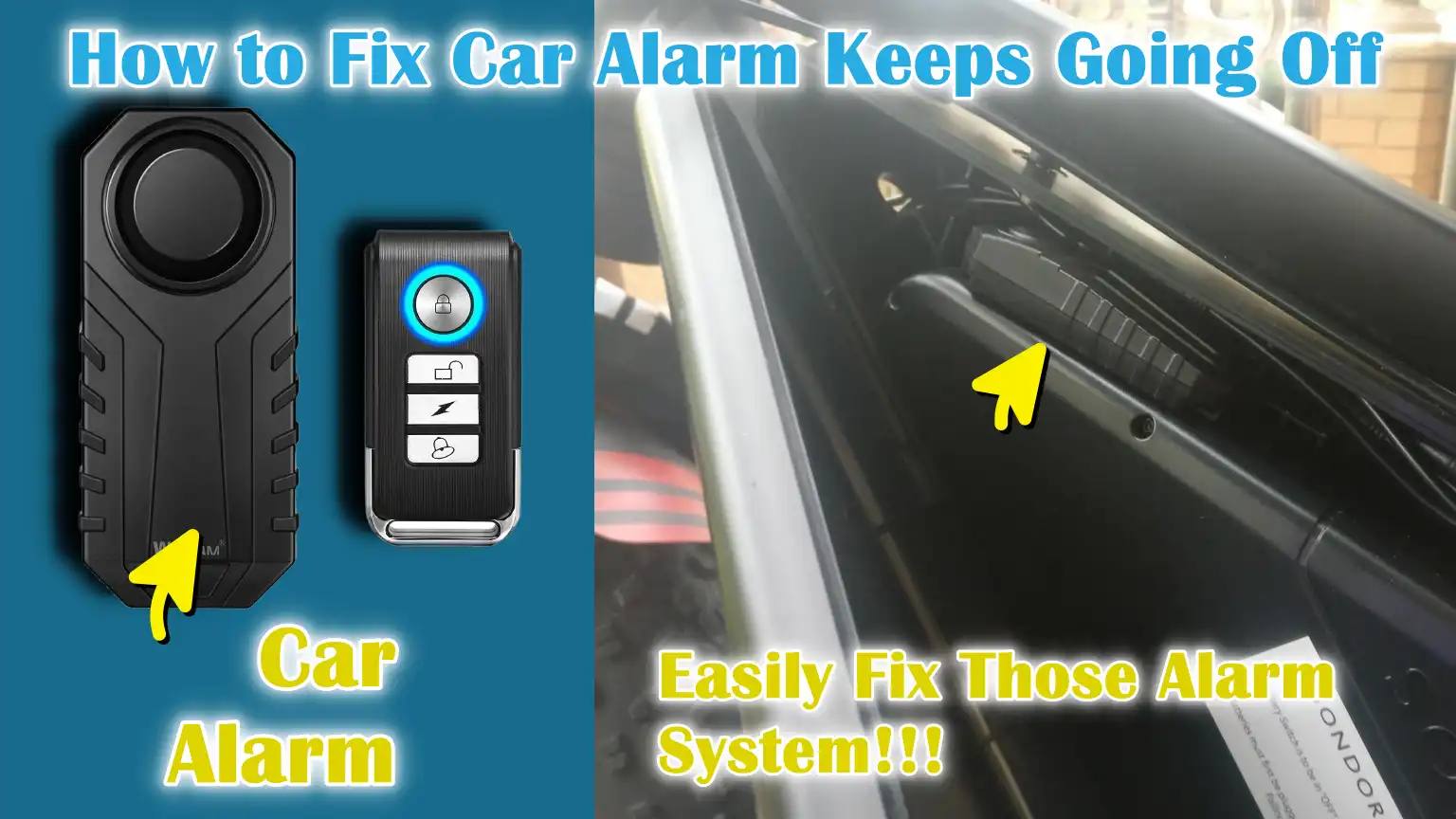
This is exactly why, we have come up with this guide on How to Fix Car Alarm Keeps Going Off, so that you can understand how these system works, as it helps you to diagnose the problem in correct way.
Now, At First Understand About Car Alarm Systems
1. Types of Car Alarms
Factory-Installed Alarms
Factory-installed alarms are installed directly into the vehicle by the manufacturer and are fully integrated with the car’s main electrical system and onboard computer.
This makes them highly reliable, as they are designed specifically for that particular model, utilizing original sensors such as door switches, hood latches and ignition monitoring systems.
These alarms generally operate seamlessly and with very few errors, as their wiring, software and component compatibility undergo rigorous testing before the car is sold.
They also have a lower probability of sounding false alarms, unless there is a genuine underlying issue such as: a weak battery, a faulty sensor, or an electrical malfunction.
Because these alarms are embedded within the vehicle’s internal architecture, diagnosing problems often requires examining the car’s core systems rather than relying solely on external troubleshooting methods.
Aftermarket Alarms
Aftermarket alarms are installed separately after the car has been purchased.
They are often chosen for specific features, such as remote start capabilities, smartphone connectivity, GPS tracking and sensors with adjustable sensitivity.
While these systems can offer enhanced security and greater flexibility, their performance depends heavily on the quality of the installation.
If the wiring is not executed correctly, or if poor-quality components are used, issues such as sudden false alarms or system malfunctions may arise.
Because these alarms are spliced into the vehicle’s existing electrical system, even a slightly loose connection or a minor fluctuation in voltage can confuse the system and trigger a false alert.
To effectively resolve issues associated with aftermarket alarms, it is crucial to prioritize both the quality of the installation process and the reliability of the brand.
2. Specific Components
Sensors: Door, Hood, Trunk, Shock, Motion
Sensors constitute the most critical component of any car alarm system, as they detect changes and transmit signals whenever an anomaly occurs.
Door, hood and trunk sensors function by monitoring whether these specific components are open or closed.
If any of these components are improperly installed or have become defective, they may transmit erroneous signals.
Shock sensors detect vibrations or impacts affecting the vehicle such as: during an attempted forced entry or a forceful collision with an external object.
If the sensitivity of these sensors is set too high, they may trigger false alarms.
Motion sensors, typically found in advanced systems, detect movement occurring within the vehicle’s interior.
These sensors can be triggered by factors such as moving objects or fluctuations in airflow.
To prevent false alarms, it is essential that all these sensors remain clean, are correctly positioned and are functioning properly.
Control Module or ECU: Signal Processing
The control module, also referred to as the ECU, serves as the system’s central processing unit.
It receives signals from all sensors and determines whether current conditions are normal or if a threat is present.
By analyzing data in real-time, it functions as the “brain” of the alarm system.
If it detects a discrepancy, it immediately issues a command to trigger the alarm.
However, if the ECU receives unstable or erroneous signals, often caused by electrical faults, it may mistakenly interpret them as a threat.
Recurring false alarms can stem from issues such as moisture ingress in the module, malfunctions in internal components, or software glitches.
As this component governs the entire system, even a minor defect within it can have a significant impact on the overall operation of the alarm.
Siren or Horn: Alerting the Owner and Others
The siren or horn serves as the output device of the alarm system.
Whenever a threat is detected, it emits a loud sound to alert the vehicle owner and people in the vicinity.
It is designed to instantly grab people’s attention, thereby startling potential thieves and immediately drawing the attention of bystanders to the situation.
In most vehicles, the alarm utilizes the vehicle’s existing horn, whereas some systems feature a dedicated, separate siren unit.
If the system triggers a false alarm, the siren will sound even in the absence of any actual threat; this can cause significant nuisance and, ultimately, drain the vehicle’s battery.
Ensuring that the siren activates only upon receiving a valid signal is crucial for the proper functioning of the system.
Key Fob or Remote: Arm, Disarm and Override
With the help of a key fob or remote control, any user can easily control the alarm system, arming or disarming it, simply by pressing a button.
This device transmits wireless signals to the control module, thereby locking or unlocking the car and managing the alarm system.
In many systems, the remote can also be used to reset the alarm if a malfunction occurs.
If the key fob’s battery is low or depleted, it may transmit erroneous signals; this can confuse the system and, at times, cause the alarm to sound erratically.
Keeping the remote in good condition and periodically replacing its battery is a simple yet essential measure to prevent such issues.
3. How False Alarms Occur
Electrical Issues
Electrical issues are among the most common causes of recurring car alarms, even in the absence of any genuine threat.
These problems may include unstable voltage, improper grounding, or minor interruptions in the flow of electrical current.
As the alarm system relies on precise electrical signals, even a slight irregularity can lead the control module to perceive a potential threat.
Issues such as corrosion on terminals, loose connections, or moisture within the wiring can trigger these irregularities and result in false alarms.
Faulty Sensors
Defective or worn-out sensors frequently transmit incorrect signals to the control module, causing the alarm to sound unnecessarily.
For instance, if a door sensor fails to properly detect that a door has been closed, it may behave as though the door is being opened, even if, in reality, the door is securely shut.
Similarly, if a shock sensor is overly sensitive or has become defective, it may react to minor disturbances such as: passing vehicles or gusts of wind, and trigger the alarm.
Over time, due to constant use, dirt accumulation, or environmental factors, sensors can wear out, rendering them unreliable.
Low Battery Voltage
When a car’s battery is weak, the alarm system may behave erratically, as it requires a stable voltage supply to function correctly.
When the battery voltage drops, particularly in cold weather or after the car has been left idle for an extended period, the control module may misinterpret signals received from the sensors.
Consequently, the alarm may sound unexpectedly, even if the vehicle remains completely secure.
Low voltage can also impact other electronic systems within the car; therefore, it is crucial to check for this issue when troubleshooting the problem.
Wiring Issues
Wiring-related problems such as: broken wires, loose terminals, or exposed wiring, can disrupt the flow of electrical signals within the alarm system.
These issues often arise due to wear and tear, exposure to heat, or damage caused by rodents gnawing on the wires.
Faulty connections or loose wiring can result in intermittent signals, confusing the control module and causing the alarm to trigger suddenly.
It is essential to thoroughly inspect the wiring and connectors, as even a minor fault in the wiring can compromise the functionality of the entire system.
How to Ensure Safety By Following Precautions Before Diagnosis
1. Disconnect the Battery Only When Necessary
When working on an alarm system, it sometimes becomes necessary to disconnect the car’s battery; however, this should be done only when absolutely essential, as doing so can reset critical vehicle settings such as: the clock, radio codes and the onboard computer’s memory.
In modern vehicles, the battery is connected to numerous electronic systems and a sudden interruption in the power supply can lead to temporary malfunctions or necessitate reprogramming.
It is best to disconnect the battery only when dealing with situations involving wiring-related issues, exposed wiring, or when the alarm is sounding continuously and cannot be silenced.
Before disconnecting, ensure that the ignition is switched off and that you are familiar with the correct procedure for reconnecting it, as improper handling can cause sparks or damage delicate electronic components.
2. Wear Insulated Gloves When Inspecting Wiring
When inspecting wires and electrical components, wearing insulated gloves is a simple yet essential safety precaution; it helps protect you from sudden electric shocks and prevents direct contact with live circuits.
Although vehicle electrical systems typically operate at low voltages, there remains a risk of burns or component damage caused by sudden sparks or short circuits.
Insulated gloves also help prevent moisture or grease from your hands from reaching connectors, thereby avoiding issues related to electrical contact.
This simple precaution enhances the overall safety of the diagnostic process and minimizes the risk of creating new problems while attempting to repair the alarm system.
3. Keep the Key Fob Handy for Resetting
It is essential to keep the key fob or remote control close by during the diagnostic process, as this allows you to immediately arm, disarm, or reset the alarm system in the event of a sudden malfunction.
Many alarm systems are designed to respond instantly to the key fob; in some cases, this is the quickest way to silence a sounding alarm without having to disconnect the battery.
A properly functioning key fob also helps you determine whether the issue lies with the remote itself or with the internal system.
If the alarm responds normally to the remote, it can aid in pinpointing the source of the problem; conversely, delayed or weak responses may indicate a low key fob battery or a signal-related issue.
4. Avoid Using Sharp Tools on Sensors or Wiring
Using sharp tools on sensors or wiring can easily damage delicate components and create new problems within the alarm system.
Although sensors and wires are designed with protective covers, careless handling can result in cuts or punctures, potentially exposing wires, causing short circuits, or sending erroneous signals to the control module.
Even a minor nick in the insulation can allow moisture or dirt to enter, leading to corrosion over time.
It is always advisable to use the appropriate tools specifically designed for electrical work and to handle all components with care.
Working cautiously not only ensures your own safety but also guarantees that the system remains reliable following the repairs.
How to Do Initial Checks
1. Check for Obvious Causes
Doors, Hood, or Trunk Not Fully Closed
One of the most common, and often overlooked, reasons for a car alarm repeatedly going off is that a door, the hood, or the trunk is not fully closed or properly latched.
Car alarm systems rely on small switches located within these components to ensure they are securely shut.
If even one of these switches fails to make full contact, the system may interpret this as an attempted intrusion and trigger the alarm.
This can occur due to doors not being shut firmly enough, faulty latches, accumulated dirt or debris, or even minor fluctuations in air pressure.
Carefully checking each door, ensuring they are shut firmly, and verifying that the hood and trunk are fully closed will often resolve this issue immediately, without the need for any further repairs.
Loose or Faulty Key Fob
A loose, worn-out, or malfunctioning key fob can send weak or erroneous signals to the car’s alarm system, causing it to behave erratically.
If the remote’s buttons are stuck, accidentally pressed, or damaged, the system may receive repetitive or conflicting commands.
A weak battery inside the key fob can also diminish signal strength, leading to delays in communication with the vehicle or preventing the signal from registering at all.
Checking the condition of the key fob, replacing its battery if necessary and ensuring that the buttons are functioning smoothly can help identify and resolve this simple yet critical issue.
2. Battery Health
Low Car Battery Can Trigger False Alarms
Car alarm systems rely on a stable power supply; When the battery becomes weak, the system may begin to malfunction.
Low voltage can confuse the control module, causing it to erroneously detect a problem such as: an attempted intrusion, even when no such incident is occurring.
This often happens when the car is left unused for extended periods or during cold weather, when battery performance naturally diminishes.
In such situations, the alarm may sound randomly because the system is not receiving a consistent flow of power.
It is crucial to check the battery’s condition at the very outset of troubleshooting, as this is a very common and easily rectifiable cause of false alarms.
Replace the Battery if Voltage is Low
If the battery voltage is found to be low, replacing the battery is often the most effective method for preventing false alarms and restoring the system to proper working order.
A healthy car battery should provide a stable voltage, ensuring that all electronic systems, including the alarm, function correctly.
You can determine whether the battery is still in good condition by using a voltmeter or by having it tested at a service center.
If the battery is old or unable to hold a charge effectively, replacing it not only resolves the alarm issue but also enhances the vehicle’s overall reliability and helps prevent future electrical problems.
3. Aftermarket Alarm Reset
Follow the Procedure Outlined in the Owner’s Manual
For vehicles equipped with aftermarket alarm systems, resetting the system according to the owner’s manual is an essential step in resolving issues related to false alarms.
Each alarm brand may have a specific reset procedure such as: turning the ignition on and off in a particular sequence, or simultaneously pressing specific buttons on the remote control.
Adhering to the correct procedure ensures that the system reverts to its default settings and that any minor glitches or technical malfunctions are resolved.
Skipping the reset process or attempting to perform it haphazardly may fail to resolve the issue, and in some cases, could even exacerbate the problem; therefore, it is always best to follow the manufacturer’s instructions precisely.
Try Locking and Unlocking with the Key
Using the physical key to lock and unlock the car is a simple yet effective method for resetting or stabilizing the alarm system, particularly when the remote control is not functioning correctly.
This method interacts directly with the vehicle’s locking mechanism and can sometimes resolve minor electronic glitches.
In many vehicles, manually unlocking the door can also deactivate the alarm if it has suddenly started sounding.
This step helps quickly identify whether the issue lies with the remote control or with the car’s internal alarm system and it often helps restore the system to proper working order without the need for any specialized tools or repairs.
How to Check The Sensors
1. Door and Trunk Switches
Check for Corrosion or Misalignment
Door and trunk switches are small yet critical components of a car alarm system, as they signal to the system whether the vehicle is securely closed or being opened.
Over time, exposure to moisture, dust, or weather elements can cause these switches to corrode, preventing proper electrical contact.
Misalignment can also occur if a door or trunk is not closing correctly; in such instances, the switch may remain slightly open, even if it appears closed from the outside.
When this happens, the alarm system may interpret this condition as an attempted intrusion and trigger a false alarm.
By carefully inspecting these switches, cleaning off any accumulated dust or corrosion and ensuring proper alignment, you can restore accurate signaling and prevent unnecessary alarms.
Check for Continuity Using a Multimeter
Testing door and trunk switches with a multimeter is a reliable method for verifying whether they are functioning correctly.
A continuity test determines whether the electrical circuit is completed when the switch is depressed or closed.
A properly functioning switch will show a distinct change in the reading when activated, whereas a faulty switch will show no change or yield inconsistent results.
This type of diagnostic check helps uncover hidden issues that may not be visible to the naked eye.
By utilizing a multimeter, you can perform a precise diagnosis rather than relying on guesswork; this saves time and prevents the unnecessary replacement of components that are still in good working condition.
2. Shock or Impact Sensors
Adjust Sensitivity – If Possible
Shock or impact sensors are designed to detect vibrations or forceful impacts to the vehicle such as: someone attempting to break a window or forcibly open a door.
However, if the sensitivity level is set too high, the sensor may react to minor disturbances, such as passing trucks, loud noises, or even strong winds.
Many alarm systems allow you to adjust this sensitivity so that it responds only to more forceful and significant impacts.
Slightly lowering the sensitivity reduces the likelihood of false alarms while maintaining security.
Proper adjustment is crucial; if the sensor is too sensitive, it may trigger false alarms repeatedly, whereas if it is not sensitive enough, it may fail to detect genuine threats.
Check for Loose Mounts or Wiring
For a shock sensor to function correctly, it must be firmly mounted in place, as its ability to detect vibrations depends on its stable positioning.
If the sensor becomes loose or its wiring is not properly connected, it may send erroneous or erratic signals to the control module.
Loose wires can also cause intermittent connections, confusing the system and triggering sudden, unexpected alarms.
Checking the sensor’s mounting points and ensuring that all wires are securely connected helps ensure the sensor functions correctly and prevents unnecessary alerts.
3. Motion or Tilt Sensors
Ensure that No Heavy Objects are Shifting Around Inside the Car
In more modern alarm systems, motion or tilt sensors are utilized to detect movement inside the vehicle or changes in its orientation (such as during towing or lifting).
However, these sensors can sometimes react to normal internal movements, for instance, when the vehicle is parked on uneven terrain and a heavy object shifts from its position.
Objects left inside the car may shift slightly due to temperature fluctuations or external vibrations, potentially triggering the alarm.
Ensuring that the car’s interior remains stable, and that no heavy objects are left unsecured, helps prevent false alarms triggered by these sensors.
Calibrate or Temporarily Disable for Diagnostic Purposes
Calibrating motion or tilt sensors is an effective way to ensure they operate within the correct parameters and do not react to normal conditions.
Many systems feature a recalibration function, allowing the sensors to adapt to the vehicle’s current orientation and environment.
If false alarms persist, temporarily disabling these sensors can help determine whether they are the root cause of the problem.
This diagnostic step is highly useful, as it isolates the sensors from the rest of the system, making it easier to identify whether they require adjustment, repair, or replacement.
How to Check the Alarm Wiring
1. Look for Damaged Wires
Damage Caused by Rats or Squirrels
Creatures such as rats and squirrels often gnaw through a car’s wiring, as the insulation material used in the wiring attracts them, particularly when the vehicle remains parked in one spot for an extended period.
When wires are gnawed, their protective layer is compromised, exposing the internal metal conductor or causing the wire to sever completely.
This can disrupt the flow of electrical signals or render connections unstable, thereby confusing the alarm system.
Consequently, the system may receive erroneous signals, triggering a “false alarm” without any genuine cause.
Carefully inspecting areas such as the engine bay, beneath the dashboard and near the battery can help in quickly identifying signs of damage caused by rats or squirrels, thereby preventing future electrical issues.
Worn or Exposed Wires
Worn or exposed wires are another common cause of alarm-related problems, as they can weaken or destabilize electrical signals.
Over time, factors such as heat, vibration and general wear and tear can degrade the insulation surrounding the wires, causing it to crack or peel away.
When wires become exposed, they may come into contact with other metal components of the car or other wires, resulting in signal interference or a “short circuit.”
This can cause the alarm system to behave unpredictably, potentially triggering it to sound off suddenly at any moment.
Identifying and repairing faulty wiring, whether by properly re-insulating it or by replacing damaged sections, helps maintain a stable flow of signals and ensures that the system functions correctly.
2. Check Grounding Points
Grounding points are critical components of any car’s electrical system, as they provide a stable path for electricity to return to the battery.
If a ground connection becomes loose or corroded, it can cause voltage fluctuations throughout the entire system and lead to unstable signals.
The alarm control module relies on stable grounding to correctly interpret inputs received from sensors; consequently, any interruption in the grounding circuit can trigger the alarm unnecessarily.
Corrosion on metal surfaces often appears as a white or green powdery substance, while loose connections will not sit firmly in place.
Cleaning and tightening these grounding points can significantly improve system stability and reduce instances of the alarm sounding without cause.
3. Check for Short Circuits
A “short circuit” occurs when electrical current deviates from its intended path and flows through an alternative (incorrect) route, often due to faulty insulation or direct contact between exposed wires.
This can generate excessive heat, resulting in visible signs such as melted plastic, burn marks, or a strong burning odor near the alarm module or wiring harness.
These signs indicate a serious electrical fault that can disrupt the normal operation of the alarm system and cause it to trigger inadvertently.
It is crucial to address short circuits immediately, as they not only affect the alarm system but can also damage other electronic components within the vehicle.
Proper inspection and repair ensure that the system continues to function safely and reliably.
4. Check Connectors
Electrical connectors link various components of a wiring system and facilitate the exchange of signals between them.
Over time, dust, moisture, or corrosion may accumulate on these connectors, potentially degrading the quality of the electrical connections.
This can result in weak or intermittent signals, which may confuse the alarm system and trigger false alerts.
Disconnecting and then reconnecting a connector cleans its contact points and restores the proper flow of signals.
In some cases, lightly cleaning the connectors before reconnecting them can further enhance the system’s performance.
Ensuring that all connectors are secure and clean is a simple yet highly effective method for resolving wiring-related issues within an alarm system.
How to Check the Alarm Module
1. How to Reset
Remove the Fuse or Disconnect the Car Battery for a Few Minutes
Resetting the alarm module is often the easiest and most effective way to resolve minor glitches or malfunctions within the system.
To do this, you can either remove the fuse associated with the alarm system or disconnect the car battery for a few minutes; this cuts off power to the control module, allowing it to shut down completely.
When the system’s power is interrupted, it clears out minor errors, unstable signals and memory glitches that may have accumulated over time.
This method is particularly useful when the alarm suddenly begins to malfunction, yet no external damage is visible.
It is crucial to perform this task with caution; ensure that the ignition is turned off before disconnecting the battery to prevent damage to any electrical components during the process.
Reconnect the Battery and Test the Alarm
After waiting a few minutes, reconnecting the battery or reinserting the fuse restores power to the alarm module, allowing it to restart with a clean slate.
Once the system is back online, it is essential to test the alarm to determine whether the issue has been resolved.
This involves locking and unlocking the car, checking to see if the alarm triggers unexpectedly and verifying that all sensors are functioning correctly.
A successful reset often stabilizes the system and eliminates false alarms caused by minor glitches.
If the problem persists even after the reset, it indicates a more significant internal issue that requires further investigation.
2. Check the Module for Moisture Damage
The intrusion of moisture or water into the alarm module is a common, yet often overlooked, cause of false alarms.
Control modules contain highly sensitive electronic circuitry, which can be adversely affected by even minute amounts of water.
Moisture can create unintended electrical pathways within the module, leading to the processing of erroneous signals and the spontaneous triggering of the alarm.
Symptoms of water damage may include corrosion, a musty odor caused by dampness, or visible water marks around the module.
Such damage typically results from leaks, excessive humidity, or improper sealing of the vehicle’s interior components.
Identifying and rectifying the source of the moisture, as well as drying out or replacing the damaged module, is crucial for restoring the system to proper working order.
3. Software or Firmware-Related Issues
Modern alarm systems, particularly those installed as aftermarket additions, often rely on software or firmware to govern their operations.
Over time, software glitches (bugs) or incorrect configuration settings can cause the system to behave erratically, including the triggering of false alarms.
In such instances, updating the firmware or reprogramming the system can resolve these issues by correcting errors and enhancing system stability.
Some systems may also lose their settings due to disconnected battery terminals or power interruptions; in such cases, strictly following the manufacturer’s instructions to reprogram the system becomes mandatory.
Ensuring that the software is up-to-date and correctly configured helps the alarm module process signals accurately, thereby minimizing the likelihood of recurring false alarms.
Read More:
How to Do Post-Repair Testing
Not only this, car alarm system actually plays a very important role in vehicle security, even there’s research about it that clearly supports their effectiveness, as studies shows that the vehicles which are equipped with alarms and other security features are far less likely to be targeted by the thieves. So, that’s literally gives you edge from the unwanted theft and that’s why you need to maintain a properly functioning alarm system which is very important, as even small faults that cause false alarms can unfortunately reduces the reliability and overall effectiveness as well.[¹]
1. Close All Doors, the Hood and the Trunk and Lock the Car
After completing any repairs or adjustments, the first step is to ensure that the vehicle is completely secured, exactly as it would be during normal use.
All doors, the hood and the trunk must be properly closed and securely latched so that every sensor can register the correct “closed” signal.
Even a slightly ajar component can yield false readings and compromise the accuracy of the test results.
Locking the car activates the alarm system and places it in monitoring mode; this is essential for verifying whether the system is functioning correctly.
This step establishes the proper environment for initiating the process, ensuring that the test accurately reflects real-world operational conditions.
2. Arm the Alarm and Monitor the Vehicle for 15 to 30 Minutes
Once the car is locked and the alarm is armed, it is crucial to monitor the vehicle, without disturbing it, for at least 15 to 30 minutes.
This waiting period helps confirm whether the previous issue of the alarm triggering spontaneously has been resolved.
False alarms often occur after a delay, caused by voltage fluctuations, sensor malfunctions, or wiring faults, meaning that immediate results are not always reliable indicators.
During this monitoring period, the system should remain silent and stable.
If the alarm does not trigger on its own, it is a strong indication that the repairs have successfully mitigated or completely resolved the problem.
3. Test Each Sensor
Slightly Open a Door or The Trunk
Testing the door and trunk sensors ensures that they are functioning correctly following the repairs.
This procedure should be performed while the alarm is armed; simply open each door or the trunk slightly to trigger the sensors.
A properly functioning system should immediately detect any change in status and sound the alarm.
This demonstrates that the sensors are sending the correct signals to the control module.
If a door or the trunk is opened and the alarm does not sound, it may indicate that a sensor is still faulty or is not properly connected.
Tap On the Car’s Body Near the Shock Sensor
The shock sensor can be tested by gently tapping on the car’s body at the location where the sensor is installed.
This simulates the type of disturbance that would occur if someone attempted to tamper with the vehicle.
The alarm should only sound if the impact reaches a certain threshold, which depends on the sensor’s sensitivity settings.
If the alarm triggers too easily, even in response to a very light tap, the sensitivity setting may be too high.
Conversely, if it does not react at all, the sensor may require adjustment or further inspection.
This test ensures that the sensor maintains an appropriate balance between avoiding false alarms and detecting genuine threats.
4. Ensure That The Alarm Responds Only to Valid Triggers
The ultimate objective of this test is to verify that the alarm system activates only when there is a genuine and valid reason such as: an unauthorized attempt to access the vehicle or the application of physical force.
A properly functioning system should remain silent under normal conditions such as: during windy weather, minor vibrations, or the movement of nearby pedestrians.
At the same time, it should react immediately and distinctly to actual threats.
Achieving this balance confirms that the sensors, wiring and control module are all working together effectively.
This step is significant because it ensures long-term reliability and prevents the recurrence of problems such as frequent false alarms.
How to Perform Preventive Measures To Ensure Proper Working
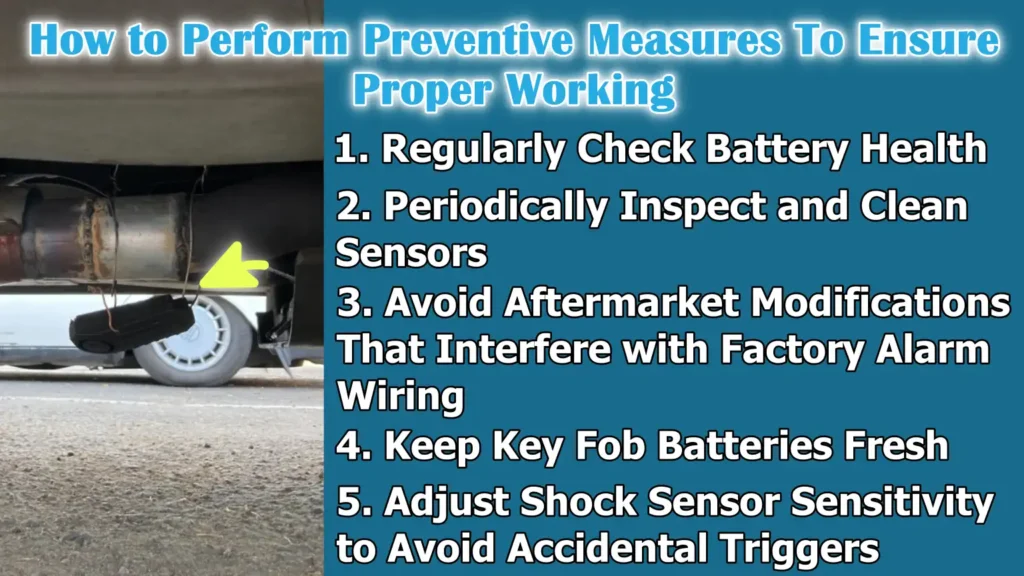
1. Regularly Check Battery Health
A healthy car battery is crucial for the proper functioning of the car’s alarm system, as all sensors and control modules rely on a stable voltage supply.
Over time, a battery naturally loses its ability to hold a charge and even a slight drop in voltage can trigger sudden malfunctions within the alarm system.
Regularly checking the battery using a voltmeter, or having it tested at a service center, helps detect signs of weakness early on.
Keeping the battery terminals clean and tight also ensures proper electrical flow.
Timely replacement of an aging battery not only prevents false alarms but also improves the overall reliability of the vehicle’s electrical system.
2. Periodically Inspect and Clean Sensors
Sensors are constantly exposed to dust, moisture, temperature fluctuations and general wear and tear, all of which can impact their performance over time.
The accumulation of dirt or even slight corrosion on door switches, hood latches, or other sensors can interfere with proper signal transmission.
Periodic inspection and light cleaning help maintain proper contact and alignment, ensuring that the alarm system receives accurate information.
Regular sensor maintenance reduces the likelihood of false alarms and helps the system respond only to genuine security threats.
3. Avoid Aftermarket Modifications That Interfere with Factory Alarm Wiring
While adding extra features to your car can be beneficial, improperly executed aftermarket modifications can interfere with the original alarm system’s wiring and lead to unexpected issues.
Poorly installed accessories can lead to loose connections, voltage imbalances, or signal interference, potentially confusing the control module.
Factory alarm systems are meticulously designed to function with specific wiring and components; therefore, making modifications without proper knowledge can jeopardize the system’s reliability.
Avoiding unnecessary alterations, or ensuring professional installation, helps maintain stable operation and prevents false alarms.
4. Keep Key Fob Batteries Fresh
The key fob plays a crucial role in controlling the alarm system and it is essential that its battery remains in good condition to transmit a clear and consistent signal.
A weak key fob battery can result in delayed responses, incomplete commands, or signal interruptions, all of which can negatively impact the alarm system’s performance.
Replacing the key fob battery at regular intervals is a simple and inexpensive measure that helps prevent communication-related issues.
Keeping the remote in proper working order ensures that the alarm system can be easily armed, disarmed and reset.
5. Adjust Shock Sensor Sensitivity to Avoid Accidental Triggers
Shock sensors are designed to detect physical impacts; however, if their sensitivity is set too high, they may react to normal environmental factors such as passing vehicles, vibrations, or strong winds.
Adjusting the sensitivity to a balanced level ensures that the system responds only to significant disturbances while ignoring minor ones.
Proper calibration helps minimize unnecessary alarm activations without compromising security.
Periodically checking and adjusting this setting, particularly after repairs or environmental changes, can significantly enhance the reliability of the alarm system.
Conclusion – How to Fix Car Alarm Keeps Going Off
It is again true that most of the time alarm problems start with something small and that can be easily fixed with the right understand and now you have that knowledge as well.
In most instances, this does not signify an actual security breach, but rather a minor technical glitch such as: low battery voltage, a misaligned sensor, faulty wiring, or an unstable electrical signal.
Modern car alarm systems are highly sensitive; consequently, they may react to minor issues as if a genuine threat were present.
Understanding the operational mechanics of each system component, from sensors to control modules, makes it significantly easier to pinpoint the root cause of the problem, rather than relying solely on guesswork or replacing parts unnecessarily.
By adopting a systematic, step-by-step diagnostic approach, beginning with simple checks such as door alignment and battery condition and progressing to more in-depth examinations of sensors, wiring and the alarm module, most issues can be resolved effectively.
Regular maintenance such as: keeping sensors clean, ensuring secure wiring connections and promptly replacing a weak battery, plays a crucial role in preventing false alarms.
Now, you can ask all the related questions in the comment box below.
Frequently Asked Questions
Q1. Why does my car alarm keep going off by itself?
Answer: A car alarm typically goes off on its own because the system is receiving erroneous or unstable signals. This can be caused by a weak car battery, faulty door or hood sensors, loose wiring, or an overly sensitive shock sensor. Modern alarm systems are designed to react very quickly; therefore, even a slight fluctuation in power or a minor sensor malfunction can trigger them. In most cases, this does not indicate a genuine security threat, but rather a minor glitch within the system that requires inspection and repair.
Q2. Can a low battery trigger a car alarm?
Answer: Yes, a low car battery is one of the most common causes of false alarms. When the battery voltage drops, the alarm system does not receive a stable power supply, which can confuse the control module. Consequently, the system may interpret this as a problem or an attempted intrusion and trigger the alarm. Replacing or recharging the battery often resolves this issue and improves the overall performance of the vehicle’s electronics.
Q3. How can I stop my car alarm from going off at night?
Answer: To prevent your car alarm from going off at night, you should first check a few simple things, such as ensuring that all doors, the hood and the trunk are securely closed. Next, check the condition of the car battery and the key fob (remote) battery. If the problem persists, inspect the sensors and wiring for any faults. In some cases, temporarily reducing the sensitivity of the shock sensor or resetting the alarm system can help prevent nighttime disturbances.
Q4. Can a faulty key fob trigger the alarm?
Answer: Yes, a faulty or weak key fob can transmit incorrect or weak signals to the car, potentially causing the alarm system to behave unpredictably. If the buttons are stuck or the battery is low, the signal may not be clear, which can confuse the system. Taking a few simple steps such as: replacing the key fob’s battery and inspecting its condition, as it can resolve this issue in many cases.
Q5. How can I reset my car’s alarm system?
Answer: You can reset your car’s alarm system by disconnecting the battery for a few minutes or by removing the alarm fuse; this depends on the specific make and model of your vehicle. Once reconnected, the system powers back up and any minor glitches are resolved. In some cars, simply locking and unlocking the vehicle using the key or key fob can also reset the system. Always follow the instructions provided in your owner’s manual for the correct reset procedure.
Q6. Can weather conditions affect a car alarm?
Answer: Yes, weather conditions can affect a car’s alarm system. Cold temperatures can reduce battery performance, while heat can impact wiring and electronic components. Rain or moisture can seep into sensors or connectors, leading to corrosion or causing them to transmit false signals. If the system already has minor internal faults, these environmental factors can trigger the alarm unnecessarily.
Q7. Which sensor causes the most false alarms?
Answer: The sensors located on the doors, hood and trunk are the most common culprits behind false alarms, as they are frequently used and tend to wear out over time. If these sensors become misaligned or dirty, they can send incorrect signals to the system. Shock sensors are also a common cause; If set to a very high sensitivity level, they may trigger in response to minor disturbances, such as passing vehicles or strong gusts of wind.
Q8. Is it safe to disconnect the car battery to turn off the alarm?
Answer: Disconnecting the battery may indeed silence the alarm, but this should only be done when absolutely necessary and with great caution. While doing so will reset the system, it may also erase certain vehicle settings. Always ensure the ignition is turned off before disconnecting the battery and reconnect it properly to avoid electrical issues.
Q9. When should I take my car to a professional?
Answer: If the alarm continues to sound even after checking the battery, sensors and wiring, you should seek professional assistance. Furthermore, if the issue involves complex wiring or a factory-installed system connected to the car’s main computer, it is best to have it repaired by a specialist. Professionals possess the necessary tools and expertise to safely and accurately diagnose deeper underlying problems.
Q10. How can I prevent my car alarm from going off unnecessarily?
Answer: Preventing false alarms primarily requires regular maintenance. Keeping the battery in good condition, cleaning the sensors, inspecting the wiring and replacing the key fob battery in a timely manner can make a significant difference. Avoiding low-quality aftermarket installations and properly adjusting sensor sensitivity also helps ensure that the system remains stable and reliable.
References:
[1] The effectiveness of car security devices and their role in the crime drop
https://www.researchgate.net/publication/239771148_The_effectiveness_of_car_security_devices_and_their_role_in_the_crime_drop

Guys, I’m a car audio enthusiast and customization expert and I love clear sound and clean installation. Plus, I have spent years helping people build their dream audio setups. And whenever I’m working on cars, I probably listen to music and thinks about the next big upgrade.