
Written By: Don Dodi
Fact Checked By: Kristen Brown
Reviewed By: Diego Rosenberg
Literally, coolant keeps your engine from overheating problems; that’s why even if a tiny leak can trigger the warning light on your dashboard and you should pay attention to it.
And, this light usually turns on whenever your engine’s coolant level touches low point or the coolant temperature is too high and if there is a malfunction in the cooling system as well.
Along with this, Coolant: is also known as an antifreeze, that literally plays a crucial role that keeps your vehicle’s engine at a safe operating temperature by absorbing any excessive heat and prevents from overheating problems as well.
Also, there’s automotive studies that shows that, overheating is literally one of the leading causes of engine failure and that can lead to costly repairs as well.
Not only this, now-a-days vehicles heavily relies on a sealed cooling system with a radiator, hoses, water pump, thermostat and temperature sensors and even a small leak or malfunction in any of these components literally can lead in the triggering of coolant warning light.
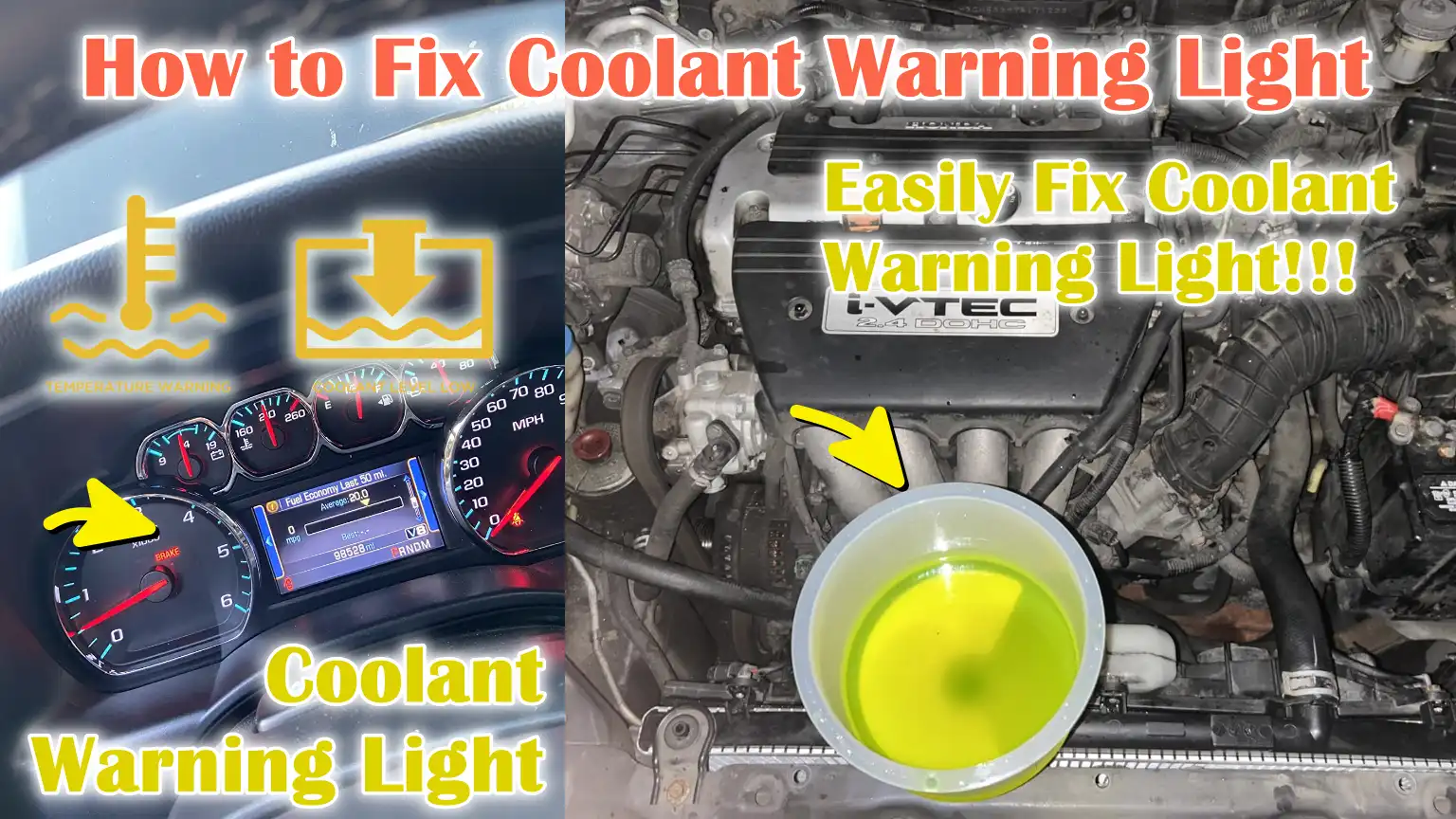
That’s why, we have come up with this proper guide on How to Fix Coolant Warning Light, so that you can safely address the issue and extend the engine’s lifespan, as well as prevent breakdowns on the journey.
Understand About the Coolant Warning Light
The coolant warning light is one of the most important alerts on your vehicle’s dashboard because it’s directly related to engine safety.
Every internal combustion engine generates a lot of heat during operation, often reaching temperatures exceeding 200 degrees Fahrenheit.
The cooling system controls this heat by circulating coolant through the engine and radiator, where the heat is released into the air.
If this system fails, excessive heat can cause the engine’s metal parts to expand, warp, or break.
This can damage the head gasket, cylinder head and even the engine block.
Damage caused by overheating can cost hundreds or thousands of dollars to repair.
The coolant warning light is designed to alert drivers before serious damage occurs.
Understanding what the symbol looks like, what triggers it and how it differs from a temperature gauge helps drivers take quick and informed action.
1. What the Symbol Looks Like
Thermometer in Liquid Icon
The most common coolant warning symbol resembles a thermometer placed within waves representing liquid.
This icon clearly indicates that the engine temperature is too high or that there is a problem with the coolant.
In many vehicles, this symbol flashes red when the engine is overheating.
A red light usually means that you should stop driving as soon as it is safe.
In some vehicles, this symbol flashes blue even when the engine is still cold after starting, which is normal and disappears when the engine warms up.
The thermometer icon is simple but very important because it directly indicates the heat level inside the engine.
Temperature Gauge Symbol
Some vehicles use a temperature gauge instead of a simple warning light.
This gauge resembles a small dial with a needle that rotates between “C” for cold and “H” for hot.
Under normal conditions, the needle remains near the center.
If the needle moves toward the “H” side, it means the engine is overheating.
This gradual movement warns drivers before serious overheating occurs.
Unlike a simple flashing light, the gauge provides continuous temperature information while driving.
Text-Based Warnings Such as “Check Coolant”
Modern vehicles with digital dashboards may display clear text messages such as “Check Coolant,” “Low Coolant Level,” or “Engine Overheating.” These messages eliminate confusion by explaining the problem in simple terms.
Text warnings are specially helpful for new drivers who may not recognize dashboard symbols.
These alerts are often accompanied by a warning sound to immediately attract attention.
When you see this message, it’s important to have the cooling system checked as soon as possible.
2. Why the Coolant Warning Light Illuminates
Low Coolant Level
Low coolant levels are one of the most common causes of a warning light.
Small leaks, evaporation over time, or lack of regular maintenance can cause the coolant level to drop.
If there’s not enough coolant in the system, it can’t absorb and transfer heat properly.
This causes the engine temperature to rise rapidly.
Most vehicles have a coolant tank with minimum and maximum markings and a level sensor detects when the coolant level drops below a safe limit.
Engine Overheating
Engine overheating occurs when the cooling system can’t dissipate heat quickly enough.
This can be caused by heavy traffic, towing heavy loads, hot weather, or mechanical failure.
When the engine temperature exceeds the safe operating limit, which is typically between 230 and 250 degrees Fahrenheit, the vehicle’s computer triggers a warning light.
Continuous driving in this condition can cause serious engine damage within minutes.
Bad Coolant Temperature Sensor
The coolant temperature sensor measures engine heat and sends information to the vehicle’s computer.
If this sensor malfunctions or sends incorrect readings, the warning light may illuminate even when the engine temperature is normal.
A bad sensor can also lead to incorrect adjustments to the fuel mixture, affecting engine performance and fuel efficiency.
Cooling System Pressure Problems
The cooling system operates under pressure to increase the boiling point of the coolant and improve efficiency.
The radiator cap helps maintain this pressure.
If the cap is damaged or there is a leak in the hose or radiator, pressure drops.
When pressure drops, the coolant can boil at a lower temperature, causing overheating and triggering the warning light.
Electrical or Wiring Problems
Modern vehicles rely heavily on sensors and electronic signals.
Bad wiring, loose connections, or blown fuses can disrupt the signal between the sensors and the vehicle’s computer.
This can cause the coolant warning light to come on even when there is no mechanical problem.
Electrical problems should be carefully inspected as they can be difficult to diagnose without the proper tools.
3. Differences Between a Coolant Light and a Temperature Gauge
Warning Light vs Rising Temperature Needle
A coolant warning light typically illuminates when a problem has already reached a critical level.
It serves as an emergency alert.
A temperature gauge, on the other hand, allows you to monitor gradual changes.
If you see the needle slowly moving toward the hot zone, you can take action before the warning light activates.
This makes the gauge a preventative tool, while a warning light is often an urgent alert.
Steady Light vs Flashing Light
A steady coolant warning light typically indicates a common problem, such as low coolant or overheating.
A flashing or flashing light often indicates a more serious or rapidly worsening problem.
Some manufacturers use a flashing light to indicate serious overheating, which requires immediate vehicle repair.
If the light is flashing and you notice steam, a strange smell, or a loss of power, it’s safest to stop the vehicle and turn off the engine to avoid damage.
What are The Common Causes of the Coolant Warning Light
The coolant warning light comes on when the cooling system can’t keep the engine at a safe temperature or when the system detects an abnormal condition.
Modern engines are designed to operate within a specific temperature range, typically between 195 and 220 degrees Fahrenheit.
When temperatures exceed this range or the coolant level drops below the required level, sensors send a signal to the vehicle’s computer, which triggers the warning light.
The cooling system operates as a sealed and pressurized system consisting of a radiator, water pump, thermostat, hoses, radiator cap, heater core and temperature sensor.
If any of these parts malfunction or leak, the system cannot properly remove heat from the engine.
Understanding the most common causes helps drivers identify problems early and prevent serious engine damage, such as warped cylinder heads or blown head gaskets.
1. Low Coolant Level
A low coolant level is one of the most common reasons for a warning light to appear.
Coolant is essential because it absorbs heat from the engine and carries it to the radiator, where it mixes with air.
If the coolant level in the tank drops below the minimum mark, there may not be enough fluid to circulate properly in the engine.
When this happens, the engine temperature can rise rapidly, specially during long drives or in hot weather.
Many vehicles have level sensors inside the tank that detect when the coolant has dropped below a safe limit.
Evaporation Over Time
Although the cooling system is sealed, small amounts of coolant can slowly evaporate over several months or years.
Small amounts of fluid may escape as steam, specially if the radiator cap is not completely sealed.
Over time, this gradual loss can lower the coolant level enough to trigger a warning light.
That’s why manufacturers recommend checking the coolant level during regular maintenance, even if no leaks are visible.
Minor Leaks in the System
Minor leaks are very common and often go undetected initially.
Rubber hoses can weaken with age and develop small cracks.
Hose clamps can become slightly loose.
Gaskets can gradually wear out.
Even a small leak can allow coolant to slowly leak out over weeks or months.
The driver may notice a small puddle under the car or a sweet smell coming from the engine bay, as coolant has a sweet odor.
If ignored, small leaks can quickly become larger and cause overheating.
2. Coolant Leaks
Coolant leaks are a direct cause of overheating because they reduce the amount of fluid available to regulate engine temperature.
When coolant escapes the system, air can enter, creating air pockets that prevent proper circulation.
This impedes heat transfer and can lead to inconsistent engine temperatures.
Leaks can occur in many different parts of the cooling system.
Radiator Damage
The radiator is responsible for releasing heat from the coolant into the outside air.
It consists of thin metal fins and tubes that can become worn due to road debris, rust, or age.
A broken radiator or a rusted core can allow coolant to escape.
If the coolant is not replaced in a timely manner, corrosion is more likely to occur, as old coolant loses its protective additives.
Radiator leaks often appear as visible droplets or a white or greenish residue around the radiator.
Cracked Hoses
Cooling system hoses carry coolant between the engine, radiator and heater core.
These hoses are made of rubber and are exposed to high heat and pressure.
Over time, rubber weakens and can tear or swell.
A cracked hose can suddenly burst, causing coolant to escape rapidly.
Even small cracks on the surface can cause a gradual leak.
Regularly inspecting the hose for softening, bulging, or cracks can prevent sudden failures.
Water Pump Failure
The water pump circulates coolant through the engine and radiator.
It is usually driven by a belt attached to the engine.
If the water pump seal is damaged, coolant may leak through a small hole called a weep hole.
A faulty water pump can cause a grinding noise or cause the engine to overheat even when the coolant level appears normal.
Without proper circulation, heat builds up rapidly inside the engine.
Heater Core Leak
The heater core is a small radiator located inside the dashboard that provides warm air to the cabin.
It is connected to the cooling system.
If the heater core leaks, coolant can drip inside the vehicle, often causing a sweet smell or fogging on the windshield.
A leaking heater core can cause the coolant level to drop and a warning light to come on.
3. Bad Thermostat
The thermostat controls the flow of coolant between the engine and the radiator.
It remains closed when the engine is cold so it can warm up quickly.
Once the engine reaches operating temperature, the thermostat opens to circulate coolant.
If the thermostat fails, it can cause serious temperature-related problems.
Overheating Due to a Stuck Thermostat
If the thermostat is stuck, coolant cannot flow to the radiator.
This means that heat remains trapped inside the engine.
As a result, the temperature rises rapidly and the coolant warning light comes on.
Continuous driving in this condition can lead to severe overheating within a few minutes.
Temperature Fluctuations Due to a Stuck Thermostat
If the thermostat is stuck open, coolant continues to flow even when the engine is cold.
This prevents the engine from reaching its proper operating temperature.
The temperature gauge may fluctuate suddenly.
While this condition doesn’t always lead to overheating, it can reduce fuel efficiency and engine performance and still trigger a warning alert.
4. Coolant Temperature Sensor Malfunction
The coolant temperature sensor measures engine temperature and sends data to the vehicle’s computer.
This information controls the warning light, cooling fan and fuel mixture.
If the sensor malfunctions, it may provide inaccurate information.
Incorrect Readings
A malfunctioning sensor may falsely report that the engine is overheating when it isn’t.
This can cause the coolant warning light to illuminate unnecessarily.
Furthermore, it may fail to report actual overheating, which is even more dangerous.
Drivers may notice strange gauge readings or poor engine performance.
Electrical Sensor Malfunction
The sensor relies on electrical signals.
Bad wiring, corrosion in connectors, or loose connections can interfere with these signals.
Electrical problems can cause the warning light to flicker or flash.
Diagnosing an electrical fault often requires scanning the vehicle with a diagnostic tool to check for error codes.
5. Radiator Cap Failure
The radiator cap plays a vital role in maintaining pressure within the cooling system.
Most cooling systems operate under pressure, typically between 13 and 16 psi, which increases the coolant’s boiling point.
When pressure is maintained, the coolant can absorb more heat without boiling.
Loss of System Pressure
If the radiator cap seal is worn or damaged, pressure can escape.
Without the proper pressure, the cooling system doesn’t function properly.
Coolant may leak more frequently or overflow from the tank.
Low pressure can lead to rapid overheating.
Coolant Boiling at Low Temperatures
When system pressure is low, the coolant’s boiling point decreases.
This means the coolant may begin to boil at a lower temperature than normal.
Boiling coolant creates steam pockets inside the engine, reducing cooling capacity and causing temperatures to rise rapidly.
This condition can trigger a warning light and, if not corrected immediately, can cause serious engine damage.
What are the Safety Precautions You Need to Take Before You Begin
Before attempting to fix a coolant warning light, safety should always be a priority because the cooling system operates under high temperatures and high pressure.
When the engine is running, the coolant’s temperature can exceed 200 degrees Fahrenheit and the system is sealed under pressure to increase the coolant’s boiling point.
This pressure allows the coolant to absorb more heat without boiling, but it also means that improperly opening the system can cause serious burns.
Hot coolant can be forcefully ejected and cause skin injuries in seconds.
Many vehicle maintenance-related injuries occur because people underestimate how hot and pressurized the cooling system can be.
Taking simple but important safety steps can prevent burns, slip hazards and accidental injuries.
Understanding and following these precautions ensures that you can safely and confidently inspect or repair the cooling system.
1. Never open the radiator cap when the engine is hot
The radiator cap seals the cooling system and keeps it pressurized.
When the engine is hot, the coolant inside is also very hot and pressurized.
If you open the radiator cap while the engine is hot, the sudden release of pressure could cause the coolant to boil and release steam.
This could cause serious burns to your hands, face and arms.
Even if the temperature gauge shows normal levels, the coolant could still be hot enough to cause injury.
It’s important to understand that pressure remains in the cooling system even after the engine is turned off.
Never attempt to remove the radiator cap immediately after driving.
When the cooling system is hot, always treat it as hot.
2. Let the engine cool completely
After turning off the engine, allow it sufficient time to cool completely before checking the coolant level or opening any parts of the system.
In most cases, it’s safest to wait at least 30 to 60 minutes, depending on how long the vehicle has been running and how hot it is outside.
You can carefully feel the upper radiator hose without touching the metal parts to see if it has cooled down, but if it feels hot, avoid direct contact.
Letting the engine cool down not only prevents burns but also gives you a more accurate reading of the coolant level.
Coolant expands when heated and contracts when cooled, so checking the engine while it’s hot can result in inaccurate readings.
3. Wear Gloves and Eye Protection
Protective gloves and safety glasses are essential for staying safe at work.
Coolant contains chemicals like ethylene glycol or propylene glycol, which can irritate the skin and eyes.
If coolant gets into your eyes, it can cause severe burns and require medical attention.
Gloves protect your hands from chemicals and sharp engine parts.
Eye protection protects you from accidental splashes or debris.
Wearing the right protection reduces the risk of injury and allows you to work more confidently and safely around the engine.
4. Park the Vehicle on Level Ground
Parking your vehicle on flat, level ground provides an accurate reading of the coolant level.
When the car is parked on a slope, the coolant inside the tank can slide to one side, leading to an inaccurate estimate of the fluid level.
Level ground also prevents the vehicle from rolling suddenly while working under the hood.
Always engage the parking brake to keep the vehicle safe.
Stability is essential, as sudden movements can cause accidents, specially when handling tools or working near hot parts.
5. Keep Children and Pets Away
Coolant has a sweet scent and taste, which can be attractive to children and pets.
However, it is highly toxic if swallowed and can cause serious health problems.
Even small amounts of ethylene glycol can be dangerous.
Spilled coolant should be cleaned up immediately to avoid accidental contact or ingestion.
When performing maintenance, ensure children and pets are kept a safe distance from the vehicle and any liquids.
This simple precaution can prevent accidental poisoning and distraction while you can focus on a safe repair.
How to Fix Coolant Warning Light – Clear Steps
Careful inspection and a step-by-step approach are essential to fixing a coolant warning light, as the cooling system directly protects your engine from damage caused by overheating.
Most engines operate safely between 195 and 220 degrees Fahrenheit.
If temperatures exceed this range, aluminum and metal engine parts can expand excessively, causing them to warp or damage gaskets.
The coolant system includes the radiator, thermostat, water pump, hoses, radiator cap and sensors and even a minor malfunction can trigger the warning light.
Following the steps below one by one helps you safely and accurately identify the underlying cause.
1. Let the Engine Cool Down
1. Why It’s Important
Letting the engine cool down is crucial because heating puts pressure on the cooling system.
When the engine is running, the coolant temperature can exceed 200 degrees Fahrenheit and pressure builds up inside the radiator.
This pressure raises the coolant’s boiling point, preventing it from boiling during normal operation.
If you open the radiator cap while the engine is hot, the sudden release of pressure can cause hot coolant and steam to spray outward.
This can cause severe skin burns within seconds.
Allowing the engine to cool can prevent injury and ensure a safe inspection.
2. How Long to Wait
In most cases, you should wait at least 30 to 60 minutes after turning off the engine.
If the vehicle has been running for a long time or has overheated, it is safer to wait longer.
The upper radiator hose should feel completely cool before checking the coolant level.
Waiting allows the coolant to return to its normal level, giving you a more accurate reading.
2. How to Check the Coolant Level
1. Locate the Coolant Reservoir
The coolant reservoir is usually a translucent plastic tank near the radiator or on the side of the engine bay.
It is connected to the radiator by a hose.
Most reservoir caps have warning labels printed on them.
2. Identify the Minimum and Maximum Marks
Minimum and maximum lines are clearly marked on the side of the reservoir tank.
These marks indicate the coolant’s safe operating range.
If the coolant level drops below the minimum line, the system may not have enough fluid to properly cool the engine.
3. Proper Checking
Make sure the car is parked on level ground and the engine is completely cool.
Check the fluid level by looking at the side of the reservoir.
Do not open the cap unless necessary.
If the fluid looks dirty, rusty, or cloudy, it could be a sign of contamination or old coolant.
Read More:
3. How to Add Coolant – If Low
1. Use Coolant from the Coolant Manufacturer
Always use the coolant type specified in your vehicle’s owner’s manual.
Different vehicles require specific coolant formulas, such as ethylene glycol-based or long-life organic acid technology coolant.
Using the wrong type can reduce corrosion protection and damage internal parts.
2. Do not mix different types of coolant
Mixing different types of coolant can cause a chemical reaction, forming a sludge or gel inside the system.
This can block the radiator passages and reduce cooling capacity.
If you are unsure about the current coolant level in the system, consult the manual or a professional mechanic.
3. Correct Filling Method
Add coolant slowly until it reaches the maximum mark.
Do not overfill.
Tighten the cap securely.
Overfilling the engine can cause coolant to expand and overflow.
Read More:
4. How to Check for Leaks
1. Check Underneath the Vehicle
Look for water puddles or wet spots under the vehicle.
Coolant is often green, orange, pink, or yellow, depending on the type of coolant used.
It may also have a sweet smell.
2. Check Hoses and Clamps
Check all rubber hoses for cracks, swelling, or loose clamps.
Hoses carry coolant between parts and small cracks can slowly leak liquid over time.
3. Check the Radiator and Water Pump
Check for rust, wet spots, or white marks on the radiator.
Check around the water pump area for signs of leakage.
A bad water pump can also cause strange noises.
Read More:
How to Check the Radiator Cap
1. Signs of Wear or Damage
The radiator cap has a spring-loaded seal that maintains system pressure.
If the rubber seal appears torn, weak, or worn, it may not be maintaining pressure properly.
2. When to Replace
If the cap is damaged or has exceeded the stated service interval, replacing it is inexpensive and can prevent pressure-related overheating problems.
Read More:
How to Test the Thermostat
1. Symptoms of a Thermostat Failure
If the engine overheats quickly after starting, the thermostat may be stuck closed.
If the engine takes too long to warm up or the temperature fluctuates, it may be stuck open.
2. When to Replace
Thermostats are fairly inexpensive and are usually replaced once a defect is confirmed.
If overheating persists and no leaks are visible, it is recommended to replace it.
How to Check the Coolant Temperature Sensor
1. Signs of a Bad Sensor
Irregular temperature gauge readings, a warning light without overheating, or poor engine performance may indicate a bad sensor.
2. Use a Diagnostic Scan Tool
An OBD-II scanner can read error codes stored in the vehicle’s computer.
Codes related to engine temperature or sensor malfunctions help confirm whether the sensor needs to be replaced.
How to Reset the Coolant Warning Light
1. Restart the Vehicle
After correcting the problem, restart the engine and allow it to return to normal operating temperature.
In many cases, the warning light will turn off automatically.
2. Use an OBD-II scanner if necessary.
If the light remains on, use a diagnostic scanner to clear the stored trouble codes.
This resets the vehicle’s computer system.
3. When the light turns off automatically.
If the coolant level was simply low and there are no other problems, the light may turn off automatically after driving for a while and conditions may return to normal.
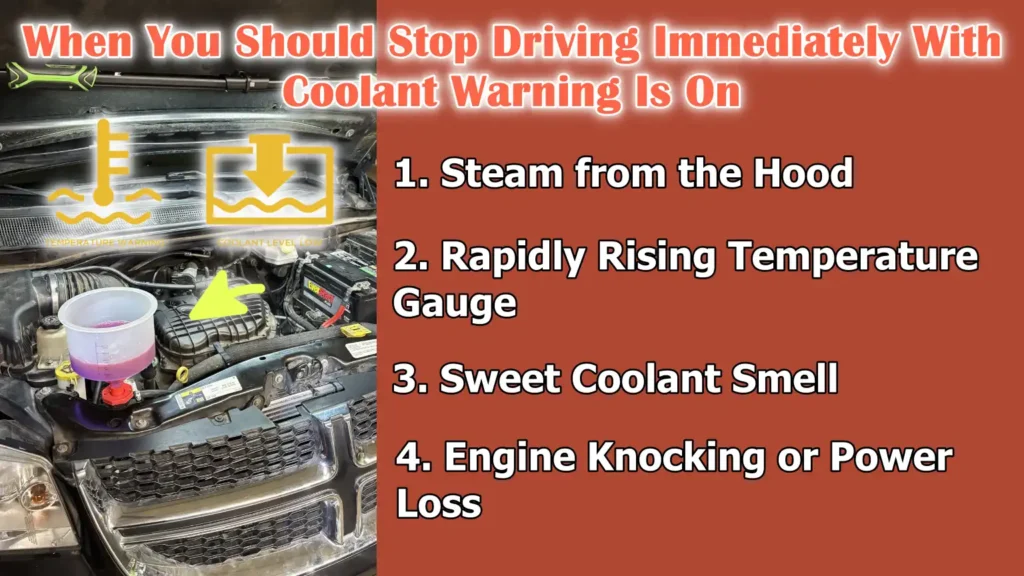
When You Should Stop Driving Immediately With Coolant Warning Is On
Knowing when to stop driving can prevent serious engine damage and costly repairs.
Even a few minutes of overheating can cause serious internal damage because metal parts expand under extreme heat.
When engine temperatures exceed safe limits, parts like the head gasket, cylinder head and pistons can warp or break.
In many modern vehicles, overheating can occur quickly, specially when driving on the highway or in heavy traffic.
The coolant warning light is an early warning, but some visible and physical signs indicate a serious condition.
If you notice any of these, the safest course of action is to stop the vehicle as soon as possible, turn off the engine and let it cool completely before investigating the problem.
1. Steam from the Hood
Steam coming from under the hood is one of the most obvious signs of severe overheating.
Steam typically forms when coolant begins to boil and turns into steam due to excessive heat.
When coolant boils, it loses its ability to absorb heat effectively, causing the engine temperature to rise even faster.
Steam can appear as white smoke and be accompanied by a strong odor.
This often means that coolant has leaked onto hot engine parts or is escaping from the radiator or hoses.
Continuing to drive while steam is visible can cause premature engine damage.
The safest course of action is to stop the vehicle immediately and turn off the engine to prevent further heat buildup.
2. Rapidly Rising Temperature Gauge
If you notice the temperature gauge needle rapidly rising toward the hot or “H” mark, it means the engine temperature is exceeding its normal operating range.
A sudden increase in temperature could be caused by a lack of coolant, a faulty thermostat, or a bad water pump.
Normal engine temperatures usually remain in the middle of the gauge.
If the needle rises rapidly and doesn’t stabilize, it means the cooling system isn’t properly controlling heat.
Driving even a short distance while the gauge is in the red zone can cause serious damage.
Pull over safely and turn off the engine as soon as possible.
3. Sweet Coolant Smell
Coolant has a distinctive sweet smell because it contains chemicals like ethylene glycol or propylene glycol.
If you notice a strong sweet smell while driving, it could be a sign of a coolant leak.
This smell may enter the cabin through air vents or be felt outside the vehicle.
A coolant leak reduces the amount of fluid available to cool the engine, which can lead to rapid overheating.
In some cases, the leak may be in the heater core, causing fogging on the inside of the windshield.
If you smell a strong coolant smell and the warning light is on, it’s wise to stop driving and have the system checked before damage occurs.
4. Engine Knocking or Power Loss
Engine knocking, pinging noises, or sudden power loss may indicate that overheating is already affecting engine performance.
When the engine overheats, fuel cannot burn properly inside the cylinders, causing knocking.
Excessive heat can also reduce lubrication efficiency, increasing friction between moving parts.
Power loss may occur because the engine computer limits performance to prevent further damage to the engine.
These symptoms indicate that internal components may already be under stress.
Continuing to drive in this condition could lead to serious mechanical failure.
The safest decision is to stop the vehicle immediately and allow it to cool down.
When You Should Consult to Professional Mechanic
Many coolant warning light problems can be checked at home, but some cases require professional diagnosis and repair.
Modern vehicles have complex cooling systems with sensors, electronic controls, pressure-sensitive parts and pathways inside the engine that are not visible from the outside.
If a problem persists after basic checks like topping up coolant or checking hoses, it could be a sign of a deeper mechanical issue.
Driving without fixing a cooling system problem can cause serious engine damage, often far more expensive than the initial professional repair.
A certified mechanic has specialized tools like pressure testers, diagnostic scanners and leak detection equipment that can accurately identify hidden problems.
Knowing when to seek expert help protects both your safety and your vehicle’s long-term reliability.
1. Continuous Warning Light
If the coolant warning light remains on even after checking and refilling the coolant to the correct level, it’s a sure sign that the problem isn’t just low fluid.
A continuously burning warning light could mean a faulty temperature sensor, a bad thermostat, a faulty radiator cap, or an electrical problem in the system.
In modern vehicles, the engine control unit continuously monitors temperature data.
If it receives a reading outside the safe range, it will keep the warning light on.
If the warning light doesn’t go off, internal problems may worsen over time.
A professional mechanic can connect a diagnostic scanner to read the stored error codes and determine the exact cause.
2. Continuous Coolant Loss
If you have to add coolant frequently, this could be a sign of a persistent leak.
A properly functioning cooling system shouldn’t experience regular coolant loss because it’s sealed and pressurized.
Persistent coolant loss can be caused by a leaking radiator, broken hoses, a faulty water pump, a bad heater core, or even leaks inside the engine.
Small external leaks may not always release clean water, as coolant can evaporate when dripping onto hot engine parts.
Internal leaks are more serious because coolant can mix with engine oil or enter the combustion chamber.
A mechanic can perform a pressure test to check for leaks and determine whether the problem is external or internal.
3. Suspect Internal Damage
If the engine overheats, there’s a risk of internal damage.
Overheating can warp the cylinder head or cause the head gasket to fail.
When this happens, coolant and engine oil can mix, reducing lubrication and causing engine wear.
You may notice a milky, oily appearance on the dipstick or under the oil cap, which is a sign of coolant contamination.
A loss of compression, rough running, or strange engine noises can also indicate internal damage.
These problems require professional tools and expertise to properly repair.
Continuing to drive with internal damage can lead to complete engine failure.
4. White Smoke from the Exhaust
White smoke from the exhaust pipe can be a serious warning sign, specially if it is thick and persistent.
While a small amount of white vapor in cold weather is normal condensation, heavy white smoke after the engine warms up may indicate that coolant is leaking into the combustion chamber.
This is usually caused by a blown head gasket or cracked engine parts.
When coolant burns inside the engine, it produces white smoke and can cause a sweet smell from the exhaust.
This condition can worsen quickly and cause serious engine damage.
If you notice persistent white smoke due to coolant failure or overheating, you should stop driving and seek professional repair immediately.
How to Prevent & Maintain Coolant
Not only this, there is thermal engineering research available that shows that the effectiveness of the coolant circulation combined with the airflow over the radiator directly determines whether an engine can safely manage the heat or not, as disrupted coolant flow or blocked airflow has been shown scientifically that raises the engine temperatures in rapid way, that’s why it shows you need to give proper attention to coolant warning light as it is really important for your engine and performance as well.[¹]
Preventive maintenance is the most effective way to avoid coolant warning lights, overheating and costly engine repairs.
The cooling system is designed to regulate engine temperature every time you drive and minor issues can become major problems if ignored.
Engines operate under extreme heat and pressure and the cooling system must function optimally to prevent overexpansion of metal parts.
When regular maintenance is performed, the system remains clean, properly pressurized and leak-free.
This not only protects the engine but also improves fuel efficiency, performance and overall reliability.
Simple routine checks can prevent breakdowns and extend your vehicle’s life by many years.
1. Regular Coolant Checks
Checking the coolant level regularly is one of the easiest and most important maintenance tasks.
Most manufacturers recommend checking the coolant at least once a month and before long trips.
The coolant reservoir usually has clear minimum and maximum markings, making it easy to see if the fluid level is correct.
If the coolant drops below the minimum mark, the engine may not receive adequate cooling protection.
Regular checks can help you catch minor leaks before they become serious problems.
Checking the coolant’s color and condition is also helpful.
Clean coolant is usually bright green, orange, pink, or yellow, depending on its type.
If it appears rusty, cloudy, or dirty, it may need to be replaced.
2. Scheduled Coolant Flush
Over time, coolant loses its protective properties.
Coolant contains additives that prevent rust, corrosion and scale from forming inside the radiator and engine passages.
Over the years, these additives break down, reducing the coolant’s ability to protect metal surfaces.
Most vehicles require a coolant flush every two to five years, or between 30,000 and 100,000 miles, depending on the manufacturer’s recommendation.
A coolant flush removes old fluid and dirt, then replaces it with new coolant.
This process restores protection against corrosion, improves heat transfer and reduces the risk of overheating.
Following the service schedule provided in your owner’s manual ensures engine longevity.
3. Check Hoses and Belts
The cooling system’s hoses and belts play a vital role in circulation.
Rubber hoses carry coolant between the engine, radiator and heater core.
Over time, heat and pressure can cause hoses to harden, crack, or swell.
Checking hoses for soft spots, visible cracks, or leaks helps prevent unexpected failures.
Belts, specially those driving the water pump, should be in good condition.
A worn or loose belt can slip or break, completely stopping coolant circulation.
Regular inspections during oil changes or routine service reduce the risk of unexpected failures.
4. Replace the Thermostat Periodically
The thermostat controls coolant flow and helps the engine reach and maintain the correct operating temperature.
Although thermostats are designed to last for many years, they can fail due to age or wear.
A clogged thermostat can lead to rapid overheating, while a loose thermostat can reduce fuel efficiency and cause temperature fluctuations.
Some mechanics recommend replacing the thermostat as a precaution during major cooling system services, specially if the vehicle has high mileage.
Replacing this small and relatively inexpensive component can prevent larger and more costly problems later.
5. Use the Correct Coolant Type
Using the correct coolant type is crucial, as different vehicles require specific formulas.
Coolants vary in chemical composition, including traditional green coolants and long-lasting organic acid technology formulas.
Mixing different types of coolants can reduce corrosion protection and create sludge that can clog radiator passages.
Always consult your owner’s manual to confirm the correct coolant specifications for your vehicle.
Using the correct coolant ensures optimal heat transfer, prevents internal components from rusting and maintains the correct boiling and freezing points.
This simple step plays a vital role in preventing the coolant warning light and keeping the engine running safely.
Conclusion – How to Fix Coolant Warning Light
It is true that your engine works under the extreme heat every time you drive; and that’s why the coolant system is literally silent protector, as it actually keeps it at the normal temperature.
The cooling system plays a vital role in maintaining a safe engine temperature, often managing heat levels exceeding 200 degrees Fahrenheit whenever you drive.
And, without proper cooling, engine parts can expand excessively, warp metal parts and cause serious damage such as head gasket failure.
This warning is specially important because of how quickly overheating can progress.
In many cases, just a few minutes of driving with an overheated engine can result in costly repairs that could have been prevented with immediate action.
When you understand the causes behind the coolant warning light puts you in control.
Low coolant levels, leaks, thermostat failure, sensor failure and low pressure are common problems that can often be quickly identified with a simple check.
So, that’s all about this guide and let us know if you still have confusion about this guide.
Frequently Asked Questions
Q1. What does the coolant warning light mean?
Answer: The coolant warning light means that your engine’s cooling system has detected a problem. In most cases, it indicates that the engine temperature is too high or the coolant level is too low. Coolant is a liquid that absorbs heat from the engine and carries it to the radiator, where it is then released. If there is not enough coolant or the system is not functioning properly, the engine can overheat. This warning light is designed to alert you and prevent serious damage to your engine.
Q2. Can I drive with the coolant warning light on?
Answer: It depends on the situation, but in most cases, you should not drive for long. If the light has just come on and the temperature gauge is still normal, you can carefully drive a short distance to a safe place. However, if the temperature gauge is in the red zone, steam is coming from the hood, or the engine sounds weak, you should stop immediately. Driving with an overheating engine can damage the head gasket, warp engine parts and require expensive repairs.
Q3. Why does the coolant warning light come on?
Answer: The most common cause is low coolant levels. This can be caused by minor leaks, evaporation over time, or lack of maintenance. Other causes include a bad thermostat, a faulty radiator, a bad water pump, a faulty temperature sensor, or a bad radiator cap. Electrical problems can also cause the light to come on, even if the cooling system is functioning properly. The warning light comes on when sensors detect poor temperature levels or abnormal coolant conditions.
Q4. How do I check my coolant level safely?
Answer: First, make sure the engine is completely cool. Never open the radiator cap when the engine is hot, as the system is under pressure and hot coolant may splash out. Locate the coolant reservoir, which is usually a clear plastic tank near the radiator. Check the fluid level according to the minimum and maximum markings on the side. If the level is below the minimum line, you may need to add coolant. Always park the vehicle on level ground before checking.
Q5. What if my engine overheats?
Answer: When the engine overheats, the internal metal parts expand excessively. This can damage the head gasket, allowing coolant and engine oil to mix. This can also warp the cylinder head or damage the pistons and valves. In severe cases, the engine may seize completely and stop working. Overheating is one of the main causes of engine failure, so the coolant warning light should never be ignored.
Q6. How often should the coolant be changed?
Answer: Most manufacturers recommend changing the coolant every two to five years or between 30,000 and 100,000 miles, depending on the vehicle and the type of coolant. Over time, coolant loses its protective chemicals that prevent rust and corrosion inside the engine. Old coolant may not handle heat as well as new coolant. Checking your owner’s manual for the recommended schedule helps ensure the cooling system remains in good condition.
Q7. Why does my coolant level drop frequently?
Answer: If your coolant level drops frequently, there’s likely a leak somewhere in the system. This could be caused by a broken hose, a bad radiator, a leaking water pump, or a bad heater core. In more serious cases, a blown head gasket can cause a coolant leak inside the engine. Frequent coolant leaks should be checked by a mechanic, as driving with low coolant can cause frequent overheating.
Q8. What does white smoke from the exhaust mean?
Answer: White smoke from the exhaust, specially when the engine is hot, may indicate that coolant is leaking into the combustion chamber. This is usually caused by a blown head gasket or a broken engine part. When coolant burns inside the engine, it produces thick white smoke and may smell sweet. This is a serious condition that requires immediate professional repair.
Q9. Why is my coolant warning light on but the engine isn’t overheating?
Answer: Sometimes, the warning light is caused by a faulty temperature sensor or an electrical problem rather than actual overheating. The sensor may be sending incorrect information to the vehicle’s computer. In other cases, the coolant level may be slightly low, but the temperature isn’t yet rising. If the engine temperature gauge is normal but the light remains on, it’s best to have the system checked with a diagnostic scanner.
References:
[1] A review on air flow and coolant flow circuit in vehicles’ cooling system
https://www.sciencedirect.com/science/article/abs/pii/S0017931012005297

Guys, I’m a car audio enthusiast and customization expert and I love clear sound and clean installation. Plus, I have spent years helping people build their dream audio setups. And whenever I’m working on cars, I probably listen to music and thinks about the next big upgrade.