
Written By: Don Dodi
Fact Checked By: Kristen Brown
Reviewed By: Diego Rosenberg
You need to understand this basic need for your car engine: as it only run safely only within a small temperature range, so whenever it crosses that limit even once then it can actually cause huge damage.
And, surprisingly it is most common and serious problems which vehicle have to face, as modern can engines normally operates between the 90°C to 105°C, so even a short period of time it gets above this range then it can begin to damage the important components of your vehicle.
Also, there’s data from American Automobile Association: that shows that the cooling system failures are among the leading causes of roadside breakdowns, specifically during the hot weather.
Additionally, whenever an engine overheats, then the extreme heat can warp metallic parts, crack the engine block, damage the pistons and even it can cause a blown head gasket as well: and repairing these things can cost thousand of dollars.
Yes, there are simple and common problems are available that can be the cause of your vehicle’s engine overheating problem such as: low coolant, a leaking hose, a stuck thermostat or a failing radiator fan as well.
Basically, the cooling system works by circulating the coolant through the engine that absorbs the heat and release it through the radiator, so if any of the part of this system fails: then literally heat builds up in quick fashion.
That’s why, we have come up with this guide on How to Fix Engine Overheating, so that you can follow easy steps and save tons of money and protect your vehicle’s engine as well.
How the Engine Cooling System Works
Whenever fuel burns inside the cylinders, the engine generates a lot of heat.
In fact, normal gasoline engines operate safely between approximately 195°F and 220°F (90°C to 105°C).
If temperatures rise too high, metal parts can expand, warp, or break.
The cooling system is designed to control this heat, circulating coolant throughout the engine, carrying away heat and releasing it into the air.
This system is made up of many essential parts that work together constantly while the engine is running.
When even one component fails, heat builds up rapidly and can lead to overheating.
Understanding how each part works makes it easier to detect problems early and prevent serious engine damage.
1. The Role of Coolant/Antifreeze
Coolant, often called antifreeze, is a special liquid that flows through the passages inside the engine block and cylinder head, absorbing heat.
It’s typically a mixture of water and ethylene glycol or propylene glycol.
This mixture raises the liquid’s boiling point and lowers its freezing point, which means it protects the engine in both hot and cold weather.
Clean water boils at 212°F (100°C), but a proper 50/50 coolant mix can withstand much higher temperatures without boiling.
Coolant also contains additives that prevent rust and corrosion inside the radiator and engine.
If the coolant level drops too low or becomes dirty and old, it can’t conduct heat properly, increasing the risk of overheating.
2. Function of the Radiator
The radiator is the part that releases heat from the coolant into the outside air.
After the coolant absorbs heat from the engine, it passes into the radiator, which is made of thin metal tubes and fins.
As the air passes through these fins, heat is transferred from the coolant to the air.
This process lowers the coolant’s temperature before it returns to the engine to absorb more heat.
If the radiator is clogged with dirt, debris, or rust, it cannot cool the liquid properly.
A damaged or leaking radiator also reduces cooling performance and can quickly raise the engine temperature above safe limits.
3. Importance of the Thermostat
The thermostat is a small but essential valve located between the engine and the radiator.
Its function is to control when coolant enters the radiator.
When the engine is cold, the thermostat remains closed so that the engine can quickly warm up to its normal operating temperature.
Once the engine reaches the correct temperature, the thermostat opens and allows coolant to flow into the radiator for cooling.
If the thermostat is closed, coolant cannot circulate properly and the engine can overheat within minutes.
If it remains open, the engine may run too cold, which can reduce fuel efficiency and performance.
4. Water Pump Operation
The water pump is responsible for moving coolant throughout the cooling system.
It is usually driven by a belt attached to the engine.
As the engine runs, the pump pushes coolant through the engine block, cylinder head, radiator and heater core in a continuous cycle.
Without proper circulation, heat will remain trapped in one area and cause rapid overheating.
If the water pump malfunctions due to worn bearings, leaks, or a broken impeller, coolant flow slows or stops completely.
Common symptoms of a bad water pump include coolant leaks near the front of the engine, noise, or overheating at high speeds.
5. Purpose of the Radiator Fan
The radiator fan helps push and pull air through the radiator, specially when the vehicle isn’t moving fast enough to create natural airflow.
When driving at highway speeds, air flows naturally through the radiator.
However, in traffic or at idle, the fan becomes necessary.
Modern vehicles use electric fans that automatically turn on when the engine temperature rises.
If the fan motor, relay, or temperature switch fails, airflow is reduced and heat cannot be properly expelled.
This often leads to overheating during slow driving or when stopped at traffic lights.
6. Coolant Reservoir Tank
The coolant reservoir tank, also called the expansion tank, stores excess coolant and helps manage pressure changes as the engine heats up and cools down.
As the coolant’s temperature rises, it expands and flows into the reservoir.
When the engine cools down, the coolant returns to the radiator.
This keeps the system full and prevents air from entering.
Maintaining the correct level in the reservoir is crucial, as low levels often indicate a leak or evaporation problem.
The easiest way to monitor the health of the cooling system is to check the reservoir regularly.
7. Temperature Sensor and Dashboard Warning Light
The temperature sensor measures engine heat and sends this information to the vehicle’s computer and dashboard gauges.
If the engine temperature rises above the normal range, a warning light may illuminate or the gauge may enter the red zone.
This is an early warning that something is wrong with the cooling system.
Ignoring this warning can cause serious engine damage, including a blown head gasket or a cracked engine block.
The sensor itself can sometimes malfunction, causing inaccurate readings, but in most cases, a rising temperature indicator should be taken seriously and checked immediately to avoid costly repairs.
What are the Common Causes of Engine Overheating
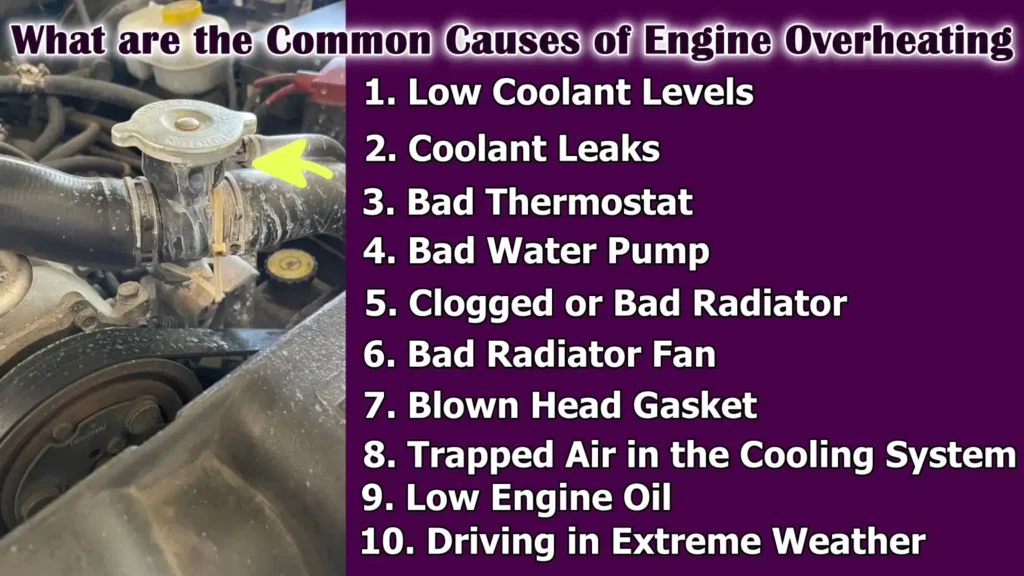
Engine overheating typically occurs when heat builds up faster than the cooling system can remove it.
A normal engine operates safely within a narrow temperature range and when that balance is disrupted, metal parts expand beyond safe limits.
This can warp cylinder heads, warp pistons, or even crack the engine block.
Most overheating problems begin with minor issues that, if caught early, can be easily fixed.
Understanding common causes helps you recognize warning signs quickly and avoid costly repairs.
1. Low Coolant Levels
Low coolant levels are one of the most common causes of engine overheating.
Coolant carries heat away from the engine, so if there’s too little of it in the system, heat cannot be removed properly.
Even a slight drop below the recommended level can reduce cooling efficiency.
Coolant levels can drop due to slow leaks, evaporation over time, or poor maintenance.
Regularly checking the coolant reservoir when the engine is cold is a simple yet very effective way to prevent overheating.
Read More:
2. Coolant Leaks
Coolant leaks reduce the amount of fluid available to regulate engine temperature.
Leaks can occur in hoses, hose connections, the radiator, the water pump, or even inside the engine.
You may notice puddles of water under the vehicle, a sweet smell, or wet spots near engine parts.
Small leaks may not seem serious at first, but they often worsen over time.
If coolant continues to disappear, the engine will eventually overheat because there won’t be enough fluid to absorb and dissipate heat.
Read More:
3. Bad Thermostat
The thermostat controls the flow of coolant between the engine and the radiator.
If it becomes clogged, coolant cannot reach the radiator for cooling.
This can cause the engine temperature to rise rapidly, sometimes within minutes of starting the vehicle.
A stuck thermostat is often responsible for sudden overheating even when the coolant level is full.
Replacing a faulty thermostat is usually less expensive than the damage that can occur if left unattended.
4. Bad Water Pump
The water pump continuously cycles coolant through the engine and radiator.
If the pump fails, coolant circulation slows or stops completely.
Without proper flow, heat accumulates in the engine block.
Signs of a bad water pump may include coolant leaks at the front of the engine, strange noises, or overheating that worsens as the engine speeds increase.
As the pump is belt-driven in most vehicles, a broken or loose belt can also reduce coolant circulation.
5. Clogged or Bad Radiator
The radiator removes heat from the coolant by transferring it to the outside air.
Over time, dirt, insects and debris can block airflow through the radiator fins.
Rust or scale buildup inside the radiator can restrict coolant flow.
A worn or leaking radiator also reduces its ability to cool efficiently.
When heat cannot be removed properly, the coolant’s temperature rises, increasing the risk of overheating, specially during long drives or hot weather.
6. Bad Radiator Fan
The radiator fan helps keep the engine cool when the vehicle is moving slowly or at a standstill.
At highway speeds, air flows through the radiator automatically, but in traffic or at idle, the fan becomes necessary.
If the fan motor, relay, or temperature switch malfunctions, airflow is significantly reduced.
This often causes the engine to overheat in traffic, but returns to normal temperature when driving at higher speeds.
Radiator fan problems are common in older vehicles or cars with electrical problems.
7. Blown Head Gasket
A blown head gasket is a serious engine problem that can be caused or exacerbated by overheating.
The head gasket seals the space between the engine block and cylinder head, keeping coolant, oil and combustion gases separate.
If it becomes damaged, coolant can leak into the engine cylinders or mix with the engine oil.
This reduces cooling efficiency and increases engine temperature.
Common symptoms include white smoke from the exhaust, milky engine oil and continuous coolant loss without any visible leaks.
Repairing a blown head gasket is usually expensive and requires professional work.
8. Trapped Air in the Cooling System
Air pockets within the cooling system can prevent the smooth flow of coolant.
When air becomes trapped during a coolant change or due to a leak, it creates gaps where coolant cannot circulate properly.
This reduces heat transfer and can cause temperature spikes.
Properly bleeding the cooling system after adding coolant removes trapped air and restores normal circulation.
Even a small amount of air can significantly reduce cooling efficiency.
9. Low Engine Oil
Engine oil reduces friction between moving parts and also helps dissipate some of the heat.
When the oil level is low, internal parts rub together more, generating more heat.
This excess heat increases the overall engine temperature and forces the cooling system to work harder.
Low oil doesn’t directly control coolant temperature, but it does put pressure on the engine and can cause overheating.
Regularly checking the oil level helps prevent both overheating and internal failures.
10. Driving in Extreme Weather
Extreme weather can push the cooling system to its limits.
In very hot weather, the outside air is already hot, reducing the radiator’s ability to remove heat.
Heavy traffic, carrying heavy loads, climbing steep hills, or using air conditioning for long periods also increase stress on the engine.
In these situations, even minor deficiencies in the cooling system can cause overheating.
Ensuring that the cooling system is properly maintained is specially important in areas with high temperatures or harsh driving conditions.
Know, The Warning Signs of Engine Overheating
Engine overheating rarely occurs without warning.
In most cases, there are clear signs before serious damage occurs.
Engines are designed to operate within a specific temperature range and when that limit is exceeded, parts expand excessively.
This can warp metal, damage seals and reduce engine power.
Recognizing these early warning signs is crucial, as even a short drive in extreme heat can turn a minor repair into a major engine rebuild.
Understanding the meaning of these signs helps you take immediate action and avoid costly damage.
1. Temperature Gauge Moving into the Red Zone
The temperature gauge on your dashboard is a key indicator of engine health.
Under normal conditions, the needle remains near the center of the gauge.
If it begins to move toward the red zone, or “H” mark, it means the engine is overheating.
Modern vehicles are designed to alert drivers immediately, so a rising gauge should never be ignored.
If the needle reaches the red zone, the engine temperature is above the safe operating range and internal components may already be under stress.
At this stage, stopping the vehicle safely and shutting off the engine can prevent serious damage.
2. Steam from the Hood
Steam coming out from under the hood is a sure sign that the engine is overheating.
This usually occurs when the coolant becomes so hot that it boils and turns into steam.
The steam may look like smoke, but it is actually hot coolant that turns into steam when exposed to air.
This often means there is a leak, a faulty radiator cap, or the coolant temperature has reached too high.
If you see steam, you should stop driving immediately and let the engine cool before opening the hood.
Opening the radiator cap when the engine is hot can cause serious burns because the system is under pressure.
3. Coolant Smell Inside or Outside the Vehicle
Coolant has a distinctive sweet odor because it contains chemicals like ethylene glycol or propylene glycol.
If you notice a sweet odor inside the cabin or around the vehicle, it could indicate a coolant leak.
The leak could be in a hose, radiator, heater core, or engine gasket.
Even small leaks can reduce coolant levels over time and increase the risk of overheating.
If the odor persists, specially with a rising temperature gauge, it should be investigated immediately to prevent further coolant loss and engine damage.
4. Knocking Sounds from the Engine
Overheating can change the way fuel burns inside the engine.
When temperatures get too high, the fuel may not burn properly, causing knocking or pinging sounds.
These sounds are often described as a slight tapping or rattling sound coming from the engine.
Excessive heat also reduces the effectiveness of oil, increasing friction between moving parts.
This increased friction can cause strange noises and further increase engine temperature.
Knocking noises accompanied by high temperature readings should be taken as a serious warning that the engine is under stress.
5. Decreased Engine Performance
An overheating engine often loses power.
Modern vehicles are designed with protective systems that can reduce engine performance if temperatures rise too high.
This is sometimes called “limp mode,” which limits speed and power to prevent further damage.
You may experience slow acceleration, rough running, or hesitation while driving.
Excessive heat affects combustion efficiency and sensors may adjust engine timing and fuel delivery.
Decreased performance isn’t just a nuisance; it’s often a protective response to prevent internal engine failure.
6. The Check Engine Light Illuminates
The Check Engine light can come on for a variety of reasons, but overheating is a possible culprit.
Temperature sensors monitor engine heat and send data to the vehicle’s computer.
If the system detects abnormal temperatures, it may trigger a warning light on the dashboard.
In some vehicles, a separate temperature warning light may also appear.
Although the Check Engine light alone doesn’t always indicate overheating, it should be taken seriously when it appears alongside other symptoms, such as rising gauges or steam.
Using a diagnostic scanner can help determine whether the problem is related to the cooling system or another engine component.
What To Do Immediately If The Engine Overheats
When the engine overheats, taking quick and appropriate action can prevent serious damage.
Modern engines are made with aluminum parts, which are lightweight and efficient, but aluminum can deteriorate more quickly in extreme heat than older cast iron engines.
Even driving in the red temperature zone for a few minutes can damage the head gasket, pistons, or cylinder head.
Acting calmly and taking appropriate action can keep both you and your engine safe.
The goal is to reduce heat, prevent pressure buildup and prevent further internal damage.
1. Park safely on the side of the road
As soon as you see the temperature gauge rise into the red zone or see steam coming from under the hood, safely reduce speed and park on the side of the road.
Continuing to drive keeps the engine warm, which can worsen the problem.
Turn off the air conditioning immediately, as this puts more strain on the engine.
If necessary, turning on the heater at full power while driving to a safe stopping point can help temporarily remove heat from the engine.
Always choose a safe place away from traffic to avoid accidents while dealing with this problem.
2. Turn off the Engine
When you stop in a safe place, turn off the engine completely.
This stops the combustion process, which is the main source of heat.
Idling the engine during overheating will cause the temperature to rise.
Turning it off allows the heat to dissipate and gradually decrease.
In some cases, leaving the ignition in the accessory position may keep the radiator fan running if it is electric, but the engine itself should remain off.
This step alone can prevent serious mechanical damage.
3. Don’t Open the Radiator Cap Immediately
Never open the radiator cap immediately after the engine overheats.
The cooling system operates under pressure and when temperatures are high, coolant can reach well above its normal boiling point.
Opening the cap too quickly can release hot, pressurized steam and boiling coolant, which can cause serious burns.
Even if steam is visible, the safest approach is to wait until the engine has cooled considerably.
Open the radiator cap only when the engine feels cool to the touch.
4. Let the Engine Cool
Let the engine cool for at least 20 to 30 minutes before checking anything under the hood.
In extreme heat, this may take longer.
Metal parts retain heat, so heat dissipates quickly.
Opening the hood carefully can help dissipate heat faster, but avoid touching engine parts directly.
Complete cooling reduces pressure in the system and reduces the risk of injury while inspecting parts.
Being patient at this stage can prevent further damage to both you and the vehicle.
5. Check the Coolant Level
After the engine has cooled, check the coolant level in the reservoir tank.
Most vehicles have a transparent coolant reservoir with minimum and maximum level markings.
If the coolant level is below the minimum line, it could be causing overheating.
If you keep extra coolant or clean water for emergencies, you can slowly add it to the reservoir.
However, adding coolant to a still-hot engine can cause thermal shock, so do this only after the system has cooled down.
A low coolant level often indicates a leak, which should be repaired before driving long distances again.
6. Look for Visible Leaks
Carefully examine the area under the vehicle and around the engine for visible leaks.
Look for pits, leaks, broken hoses, or cracks in the radiator.
Coolant is often bright green, orange, pink, or yellow, depending on the type used.
A leaking hose, loose clamp, or a faulty radiator can quickly deplete coolant and cause repeated overheating.
If you notice a major leak, it’s unsafe to drive as the engine could overheat again within minutes.
7. Call Roadside Assistance If Necessary
If the engine continues to overheat after refilling the coolant, if you notice a major leak, or if you notice signs of serious damage such as white smoke coming from the exhaust, it’s safest to call roadside assistance or a professional towing service.
Driving an overheating engine even for a short distance can require costly repairs such as a blown head gasket or cracked engine block.
A professional inspection ensures that the underlying cause is properly identified and corrected before the vehicle can be driven again.
Acting responsibly at this stage can save thousands in future repair costs and prevent dangerous breakdowns on the road.
How to Fix Engine Overheating – Easy Method
Fixing engine overheating requires careful and systematic approach.
Engines generate a lot of heat during combustion and the cooling system must continuously remove this heat to maintain a safe operating temperature, which is typically between 195°F and 220°F.
When overheating occurs, it’s important to check each major cooling component step-by-step rather than guessing.
Many overheating problems are caused by minor issues such as low coolant, trapped air, or worn parts.
Following the correct sequence of checks helps you pinpoint the root cause and avoid unnecessary repairs.
How to Check the Coolant Level
Low coolant is one of the most common causes of overheating because coolant is responsible for absorbing and transferring heat from the engine.
1. Locate the Coolant Reservoir
The coolant reservoir is usually a semi-transparent plastic tank near the radiator.
It has markings labeled “MIN” and “MAX” to indicate the correct fluid level.
To avoid burns, always check the tank when the engine is completely cool.
The tank allows you to check the coolant level without opening the radiator cap, which maintains pressure in the system during operation.
If the coolant is below the minimum mark, it indicates fluid loss that needs to be addressed.
2. Correct Coolant Mixture Ratio
Most vehicles require a 50/50 mixture of coolant and distilled water.
This ratio increases the liquid’s boiling point and lowers its freezing point.
The correct mixture prevents the coolant from boiling over in high heat and protects internal components from corrosion.
Using only water reduces boiling protection, while using pure antifreeze reduces heat transfer efficiency.
Always consult your vehicle manufacturer for the correct coolant type and mixture.
3. How to Refill Coolant Safely
After the engine has cooled, slowly add coolant to the tank until it reaches the maximum line.
Pour slowly to avoid air bubbles.
If you must open the radiator cap, ensure the engine is completely cool and slowly turn the cap to release any remaining pressure.
After refilling, start the engine and monitor the temperature gauge to ensure normal operation.
If the coolant level drops rapidly again, there may be a leak that needs further investigation.
How to Check for Coolant Leaks
Leaks reduce coolant volume and reduce the system’s ability to handle heat.
Even small leaks can cause repeated overheating over time.
1. Checking Hoses and Clamps
Check all coolant hoses for cracks, swelling, soft spots, or loose clamps.
Hoses carry hot coolant between the engine and radiator, so they must remain strong and sealed.
Loose clamps or broken hoses can cause coolant to leak slowly or burst suddenly under pressure.
Check for weak spots by gently squeezing the hoses when the engine is cold.
Replacing worn hoses is cheaper than repairing engine damage.
2. Checking the Radiator
Look for rust, bent fins, or wet spots on the radiator surface.
Internal blockages caused by rust or debris can reduce coolant flow and heat transfer.
If the radiator is clogged, the coolant cannot remove heat properly.
To improve cooling efficiency, carefully clean out any dirt and debris that may be obstructing airflow.
3. Check for water puddles under the vehicle
After parking, check for colored puddles of water under the vehicle.
Coolant often appears green, orange, pink, or yellow, depending on its type.
Continuous dripping indicates an active leak that must be repaired before driving again.
Ignoring a visible leak will cause repeated overheating.
How to Test the Thermostat
The thermostat controls when coolant is supplied to the radiator.
If it fails, temperature control becomes unstable.
1. Symptoms of a Stuck Thermostat
A stuck thermostat prevents coolant from reaching the radiator, leading to rapid overheating within minutes.
The upper radiator hose may remain cold as the engine temperature rises.
If it remains open, the engine may take longer to warm up and reduce fuel efficiency.
Rapid temperature fluctuations are also common symptoms of thermostat failure.
2. How to Replace a Bad Thermostat
Replacing a thermostat involves draining some coolant, removing the thermostat housing and installing a new unit with a new gasket.
It’s important to install it in the correct orientation.
After replacement, refill the coolant and bleed the system to remove air.
Thermostats are fairly inexpensive and timely replacement can prevent major engine damage.
How to Check the Radiator and Cooling Fan
Proper airflow and coolant flow through the radiator are essential for temperature control.
1. How to Check for Radiator Blockages
Look for dirt, leaves, or debris blocking airflow in front of the radiator.
Clean gently with low-pressure water to avoid damaging the fins.
A radiator flush may be required to remove internal blockages.
Low heat transfer efficiency often causes overheating during long drives or hot weather.
2. Testing the Electric Cooling Fan
Start the engine and allow it to reach operating temperature while observing the fan.
In most vehicles, the electric fan should activate automatically when the temperature rises.
If it doesn’t activate, check the fuse, relay, temperature sensor and wiring connections.
A faulty fan often causes overheating in traffic, but not at highway speeds.
3. Replacing a Bad Fan Motor
If the fan motor is faulty, it must be replaced.
For safety, disconnect the battery before removing it.
Installing a new motor maintains proper airflow during idle and slow driving.
Without a fan, the vehicle overheats quickly when parked.
How to Check the Water Pump
The water pump circulates coolant throughout the engine and radiator.
Without regular circulation, heat cannot be distributed and removed evenly.
1. Signs of a Water Pump Failure
Common signs include coolant leaking from the front of the engine, gurgling or grinding noises and overheating that worsens with increasing engine speed.
In some cases, steam may be emitted even when the coolant level is correct.
A faulty pump cannot maintain proper flow, causing hot spots inside the engine.
2. When to Replace
If the pump seal leaks or the internal impeller is damaged, it must be replaced.
To reduce labor costs, many vehicles replace the water pump along with the timing belt.
Continuing to drive with a faulty pump can cause severe overheating and internal engine damage.
How to Bleed the Cooling System
Air trapped in the cooling system prevents proper circulation of coolant and reduces its heat transfer efficiency.
1. Why Air Pockets Cause Overheating
Air cannot absorb heat like liquid coolant.
When air pockets form inside the engine or radiator, certain areas overheat because coolant cannot reach them properly.
This often occurs after a coolant change or due to a leak.
2. Proper Bleeding Procedure
After refilling the coolant, remove the radiator cap if directed by the manufacturer and start the engine.
Allow the engine to warm up to release any trapped air bubbles.
Some vehicles have special bleed valves that need to be opened during this process.
Continue adding coolant as needed until air bubbles no longer appear.
Proper bleeding ensures proper circulation and prevents sudden temperature spikes.
How to Check the Engine Oil Level
Engine oil not only reduces friction but also helps conduct heat away from moving parts.
1. How Low Oil Contributes to Overheating
Low oil levels increase friction between engine parts.
Increased friction generates more heat, which puts pressure on the cooling system.
Over time, this excess heat can exceed the engine’s safe operating temperature.
If the oil is old or worn out, its effectiveness is also reduced.
2. Correct Oil Type and Refill Procedure
When the engine is cool and parked on level ground, check the oil level with the dipstick.
If the oil level is below the recommended mark, add the correct grade recommended by the manufacturer.
Using the wrong oil type can reduce lubrication and heat control efficiency.
Regular oil changes maintain the correct viscosity and improve overall engine temperature management.
Learn, Advanced engine Overheating Repair Method – When DIY Repairs Aren’t Enough
Sometimes engine overheating can’t be resolved with simple checks like refilling coolant or replacing hoses.
When overheating persists or there’s serious internal damage, advanced repairs may be necessary.
Modern engines are built with tight tolerances, aluminum parts and complex electronic systems, meaning that improper repairs can cause further damage.
Advanced cooling system malfunctions often involve internal engine components or larger components that require specialized tools and technical knowledge.
Understanding these repairs helps you recognize when a problem goes beyond basic maintenance and requires professional attention.
1. Replacing the Head Gasket
The head gasket seals the space between the engine block and the cylinder head.
Its function is to keep coolant, engine oil and combustion gases separate.
When an engine overheats, the excessive heat can damage the cylinder head or weaken the gasket material.
A blown head gasket can cause coolant to leak into the combustion chamber or mix with the engine oil.
Common symptoms include white smoke from the exhaust, milky oil on the dipstick, bubbles in the radiator and continuous coolant loss without a leak.
Replacing a head gasket is a complex repair because it requires removing the cylinder head, checking for warping, carefully cleaning the surfaces and installing a new gasket with precise torque specifications.
If not done correctly, the engine may overheat or lose compression.
This repair is laborious and often expensive, but neglecting it can lead to complete engine failure.
2. Radiator Replacement
If the radiator is severely clogged, rusted, cracked, or otherwise damaged, it becomes necessary to replace it.
Over time, rust, mineral deposits and debris can build up inside the radiator tubes, reducing coolant flow and heat transfer.
External damage from accidents or road debris can also reduce efficiency.
When flushing doesn’t adequately restore cooling performance, installing a new radiator can remove all the heat.
Replacing a radiator involves draining the coolant, disconnecting hoses, removing mounting brackets and sometimes removing surrounding parts.
After installation, the cooling system must be refilled and properly bled to remove air pockets.
A new radiator ensures good temperature control and prevents recurring overheating problems.
3. Replacing the Water Pump
The water pump is essential for circulating coolant throughout the engine.
If the bearings inside it are worn, seals fail, or the impeller is damaged, coolant flow can weaken or stop completely.
This causes temperatures to rise rapidly, specially at high engine speeds.
A water pump failure can also cause coolant to leak from a small drain hole, called a weep hole, which is designed to indicate a seal failure.
Replacing a water pump often requires removing the drive belt and, in many vehicles, parts of the timing system.
Due to its complexity, this repair requires careful alignment and proper torque setting.
Installing a new pump restores proper coolant circulation and helps prevent hot spots within the engine.
4. Sensor or Electrical System Problems
Modern vehicles rely on electronic sensors to monitor engine temperature and control the cooling fan.
A faulty temperature sensor can send incorrect signals to the engine control unit, causing the cooling fan to turn on too late or not at all.
Electrical problems, such as blown fuses, faulty relays, bad wiring, or a faulty fan control module, can also prevent proper cooling operation.
In some cases, the engine may not actually be overheating, but a faulty sensor may be causing false readings on the dashboard.
Diagnosing an electrical problem usually requires a scan tool to read diagnostic trouble codes and test sensor values.
Accurate diagnosis is crucial because replacing parts without identifying the root cause can waste time and money.
5. When to Consult a Professional Mechanic
If overheating persists after basic troubleshooting, or if there are signs of internal engine damage, such as knocking noises, strong smoke, coolant mixing with oil, or frequent coolant leaks, it’s time to consult a professional mechanic.
Advanced repairs require specialized tools, precise measurements and technical knowledge of the engine system.
Professional mechanics can perform pressure tests, combustion leak tests and electronic diagnostics to determine the exact cause of overheating.
Continuing to drive while overheating can cause permanent engine damage, including cracked cylinder heads or seized pistons.
Seeking timely expert help not only protects your engine but can also reduce overall repair costs by preventing further damage.
Know, Estimated Engine Overheating Repair Cost
The cost of fixing engine overheating can vary greatly depending on the underlying cause, vehicle type, engine size, labor rates in your area and how quickly the problem is fixed.
Minor issues like low coolant are inexpensive to fix, while major engine damage can cost thousands.
The most important way to control repair costs is to take immediate action, as damage caused by overheating worsens quickly.
Modern engines use aluminum parts and tight engineering tolerances, which means that prolonged overheating can lead to expensive repairs.
Understanding the typical cost range for common fixes helps you plan appropriately and avoid unnecessary expenses.
1. Coolant Refill Cost
A simple coolant refill is usually the least expensive solution.
Its cost depends primarily on the type of coolant your vehicle requires.
Standard coolant is usually a fair price per gallon and most vehicles require several liters for a full refill.
If a coolant flush is required to remove old or damaged fluid, the cost increases as the system must be drained, cleaned and refilled with new coolant.
Although this is one of the cheapest repairs, ignoring low coolant can lead to severe overheating and significant costs.
Regular coolant checks are a small investment that can prevent major engine damage.
2. Thermostat Replacement Cost
Replacing a faulty thermostat is generally considered an inexpensive repair compared to other parts in the cooling system.
The thermostat itself is a small part, but labor costs depend on its location in the engine.
In many vehicles, it is easily accessible and can be replaced quickly.
However, in some engines, more parts must be removed to access it, increasing labor time.
Even though the thermostat is inexpensive, a stuck-closed thermostat can quickly cause overheating, potentially damaging the head gasket or cylinder head.
Replacing it promptly can prevent more serious and costly problems.
3. Radiator Repair or Replacement Cost
The cost of radiator repair depends on whether the problem is minor or serious.
Small leaks can sometimes be fixed, but internal corrosion or major cracks usually require the entire radiator to be replaced.
The cost of a new radiator depends on the vehicle’s size, design and whether it is made of aluminum or other materials.
Labor costs increase if surrounding parts, such as fans or brackets, need to be removed.
Although replacing the radiator may be more expensive than a simple cooling repair, it improves heat transfer and can prevent engine damage from repeated overheating.
4. Head Gasket Repair Cost
Head gasket repair is one of the most expensive repairs related to overheating.
This is because replacing the head gasket requires removing the cylinder head, checking for warping, cleaning the mating surfaces and refitting everything with precise torque settings.
In some cases, if the cylinder head has warped due to heat, it may require machining.
Labor is the largest component of this repair cost, as it requires many hours of work.
If overheating has caused further internal damage, such as cracks in the head or piston damage, the cost can increase even more.
Addressing overheating quickly greatly reduces the risk of it reaching this stage.
5. Labor Cost Considerations
Labor costs vary depending on location, vehicle brand and engine design.
Some engines are designed for easy access to cooling system parts, while others require the removal of several parts before repairs can begin.
Labor is often charged by the hour and more complex repairs, such as replacing a water pump or head gasket, can take significantly longer.
Labor rates may also be higher for vehicles with larger engines or advanced systems.
Choosing a qualified and experienced mechanic ensures that the problem is correctly diagnosed the first time, avoiding paying for unnecessary parts or repeated repairs.
Investing in a proper diagnosis and timely repair often saves money in the long run by preventing engine damage from overheating.
Read More:
How to Prevent Engine Overheating
Also, according to the Internal Combustion Engine Cooling entry on the Wikipedia, it shows that the engine cooling systems are really important as the internal combustion engines actually produces far more waste heat than the mechanical energy, which is why if the heat is not properly removed, then it becomes critical engine parts to suffer several things such as: damage could happen, oil can break down and components such as cylinder heads or pistons may fail as well, that’s why it is really important to maintaining an effective cooling system, as it is literally the fundamental to avoid engine from being overheated.[¹]
Preventing engine overheating is always easier and much cheaper than repairing engine damage.
Whenever fuel burns inside the cylinders, the engine generates a lot of heat and the cooling system must constantly remove that heat to keep the temperature within the safe operating range of approximately 195°F to 220°F.
When maintenance is neglected, minor problems gradually reduce cooling efficiency until overheating occurs.
Simple routine checks and proper maintenance can significantly extend engine life, improve fuel efficiency and reduce the risk of unexpected roadside breakdowns.
The focus of prevention is keeping the coolant clean, maintaining proper circulation and ensuring that all cooling components function properly.
1. Regular Coolant Flush Schedule
Coolant doesn’t last forever.
Over time, the chemical additives that prevent rust and corrosion break down.
As coolant ages, it can become acidic and lose its ability to protect the metal parts inside the engine and radiator.
Most manufacturers recommend flushing and replacing the coolant every 2 to 5 years, depending on the vehicle and type of coolant.
A coolant flush removes old fluid, rust particles and dirt that can block flow.
Fresh coolant promotes proper heat transfer and prevents corrosion within the system.
Following the recommended schedule greatly reduces the risk of blockages and overheating.
2. Regular Cooling System Inspection
Regular inspection of the cooling system helps detect problems before they become serious.
During the inspection, check the coolant level, look for leaks, inspect the radiator cap and check the condition of hoses and clamps.
Pressure testing the system can also reveal hidden leaks that are not visible during a simple visual check.
Early detection of minor problems, such as small leaks or weak hoses, can prevent sudden coolant loss while driving.
Regular inspections provide peace of mind and ensure the cooling system is operating at full efficiency.
3. Checking Hoses and Belts
Cooling system hoses carry hot coolant between the engine and radiator and belts drive parts like the water pump in many vehicles.
Over time, rubber hoses can crack, harden, or swell from exposure to heat.
Belts can become loose, worn, or frayed.
A damaged hose can burst under pressure, causing coolant to escape rapidly and overheat.
A worn belt can slip, reducing water pump performance and reducing coolant circulation.
Checking hoses for weakness, cracks, or leaks and ensuring belts are tight and in good condition helps prevent unexpected failures.
4. Monitoring the Temperature Gauge
The temperature gauge on the dashboard is an early warning system.
Under normal driving conditions, the needle should remain near the center of the gauge.
If you notice it gradually rising above normal, it could be a sign of poor cooling performance.
Paying attention to small changes in temperature can help you take action before the engine overheats.
Ignoring a rising gauge can cause serious engine damage.
Regularly monitoring it, specially during long trips or hot weather, is a simple but effective preventative measure.
5. Using the Correct Coolant Type
Not all coolants are the same.
Different vehicles require specific coolant formulations designed to protect certain metals and materials inside the engine.
Using the wrong type of coolant can reduce corrosion protection and cause chemical reactions that can lead to sludge or deposits.
Always follow the manufacturer’s recommendations for coolant type and mixture ratio, which is typically a 50/50 mix of coolant and distilled water.
Using the correct coolant ensures optimal heat transfer, proper boiling protection and long-term system reliability.
6. Avoid driving in extreme heat with heavy loads
Driving in extreme heat with heavy loads puts more strain on the engine and cooling system.
Towing a heavy trailer, climbing steep hills, or carrying heavy loads can increase engine workload and heat.
In extreme heat, the outside air is already hot, reducing the radiator’s ability to effectively remove heat.
When possible, avoid pushing the vehicle beyond normal limits in high temperatures.
Taking breaks during long journeys, reducing speed and ensuring the cooling system is in top condition before difficult driving conditions can significantly reduce the risk of overheating.
Conclusion – How to Fix Engine Overheating
Yes, now you have clear understood that protecting your vehicle’s engine from being overheated is not that complicated, but you need to keep attention, have proper knowledge and care it time-to-time.
Every time your engine runs, the constant burning of fuel generates a lot of heat and without a properly functioning cooling system, that heat can quickly damage vital metal parts.
Modern engines are made with lightweight aluminum components, which improves fuel efficiency and performance, but they are also more sensitive to extreme temperatures.
Even minor overheating can warp the cylinder head, damage the head gasket, reduce engine compression and require costly repairs.
The good news is that most overheating problems start with minor, manageable issues, such as low coolant, weak hoses, a stuck thermostat, or a faulty radiator fan.
These are problems that can often be detected quickly with regular inspections and simple maintenance.
Monitoring the temperature gauge, checking the coolant level, using the correct type of coolant and promptly repairing leaks can prevent major engine damage.
Taking preventative measures not only protects your engine but also improves your vehicle’s reliability, fuel efficiency and long-term value.
So, that’s it from this guide and you can ask related questions in the comment box below.
Frequently Asked Questions
Q1. What temperature is considered overheating for a car engine?
Answer: Most modern car engines operate safely between 195°F and 220°F, which is approximately 90°C to 105°C. If the temperature exceeds this normal range and enters the red zone on the dashboard gauge, the engine is considered overheating. At very high temperatures, metal parts inside the engine begin to expand excessively. This can damage seals, warp the cylinder head and weaken the head gasket. Even if the engine doesn’t stop immediately, driving at very high temperatures can cause long-term damage.
Q2. Can I drive my car if it’s overheating?
Answer: It’s unsafe to continue driving an overheating car. Even driving for a short distance can cause serious engine damage. When the temperature gauge reaches the red zone or steam comes out from under the hood, you should safely stop the vehicle and turn off the engine. Continuing to drive will cause the engine to overheat, which could blow the head gasket, crack the engine block, or even cause the engine to seize. It’s better to stop quickly than risk a very expensive repair.
Q3. What is the most common cause of engine overheating?
Answer: One of the most common causes is low coolant levels. Coolant absorbs heat from the engine and releases it through the radiator. If the coolant level drops too low due to leaks, evaporation, or poor maintenance, the system cannot properly regulate the temperature. Other common causes include a faulty thermostat, a broken water pump, a clogged radiator, or a faulty radiator fan. Many overheating problems start small and only become serious if ignored.
Q4. How long does it take for an engine to cool down after overheating?
Answer: In most cases, it takes at least 20 to 30 minutes for the engine to cool enough to be safely inspected. In very hot weather, it may take longer. You should never open the radiator cap when the engine is hot because the cooling system is under pressure. Opening it too quickly could release boiling coolant and steam, which could cause serious burns. Always wait until the engine feels cool to the touch before checking the coolant level.
Q5. Why is my car overheating even though the coolant is full?
Answer: If the coolant is full but the engine is still overheating, the problem may be related to poor circulation or airflow. A stuck thermostat can restrict coolant flow to the radiator. A faulty water pump can prevent coolant from flowing properly through the system. A clogged radiator can reduce heat transfer. A faulty radiator fan can cause overheating when the vehicle is idling or running slowly. In some cases, trapped air in the cooling system can also prevent proper heat removal.
Q6. Can low engine oil cause overheating?
Answer: Yes, low engine oil can cause overheating. Engine oil reduces friction between moving parts and helps dissipate some of the heat. When the oil level is low, parts rub together more, generating more heat. This excess heat increases the load on the cooling system. Although oil is not the primary cooling fluid, it plays an important supporting role. Keeping the oil level at the correct level helps maintain engine temperature and reduces wear.
Q7. What are the early warning signs of engine overheating?
Answer: Early warning signs include the temperature gauge rising above normal, excessively warm air coming from the heater, a sweet smell from the coolant, or the cooling fan running more frequently than normal. You may also notice a decrease in engine power or strange knocking noises. Paying attention to these early signs can help you fix minor problems before they turn into major engine damage.
References:
[1] Internal combustion engine cooling
https://en.wikipedia.org/wiki/Internal_combustion_engine_cooling

Guys, I’m a car audio enthusiast and customization expert and I love clear sound and clean installation. Plus, I have spent years helping people build their dream audio setups. And whenever I’m working on cars, I probably listen to music and thinks about the next big upgrade.