
Written By: Don Dodi
Fact Checked By: Kristen Brown
Reviewed By: Diego Rosenberg
You can see, your vehicle’s engine is overheated in the slow-moving traffic, as it can be the sign of radiator fan is not turning on when it should be.
As, modern car engines actually operates at the extremely high temperatures, which is often between 195°F and 220°F, so you need to maintain this temperature range because it is important for having high performance, fuel efficiency and engine longevity as well.
That’s where, the radiator fan comes in play, as it literally pulls or pushes the air through the radiator to remove the excess heat from the coolant before it cycles back into the engine.
And, whenever the radiator fan stops working, then it is obvious that heat cannot dissipate properly, specially during the idling or slow traffic as well, which can quickly lead to the overheating problems.
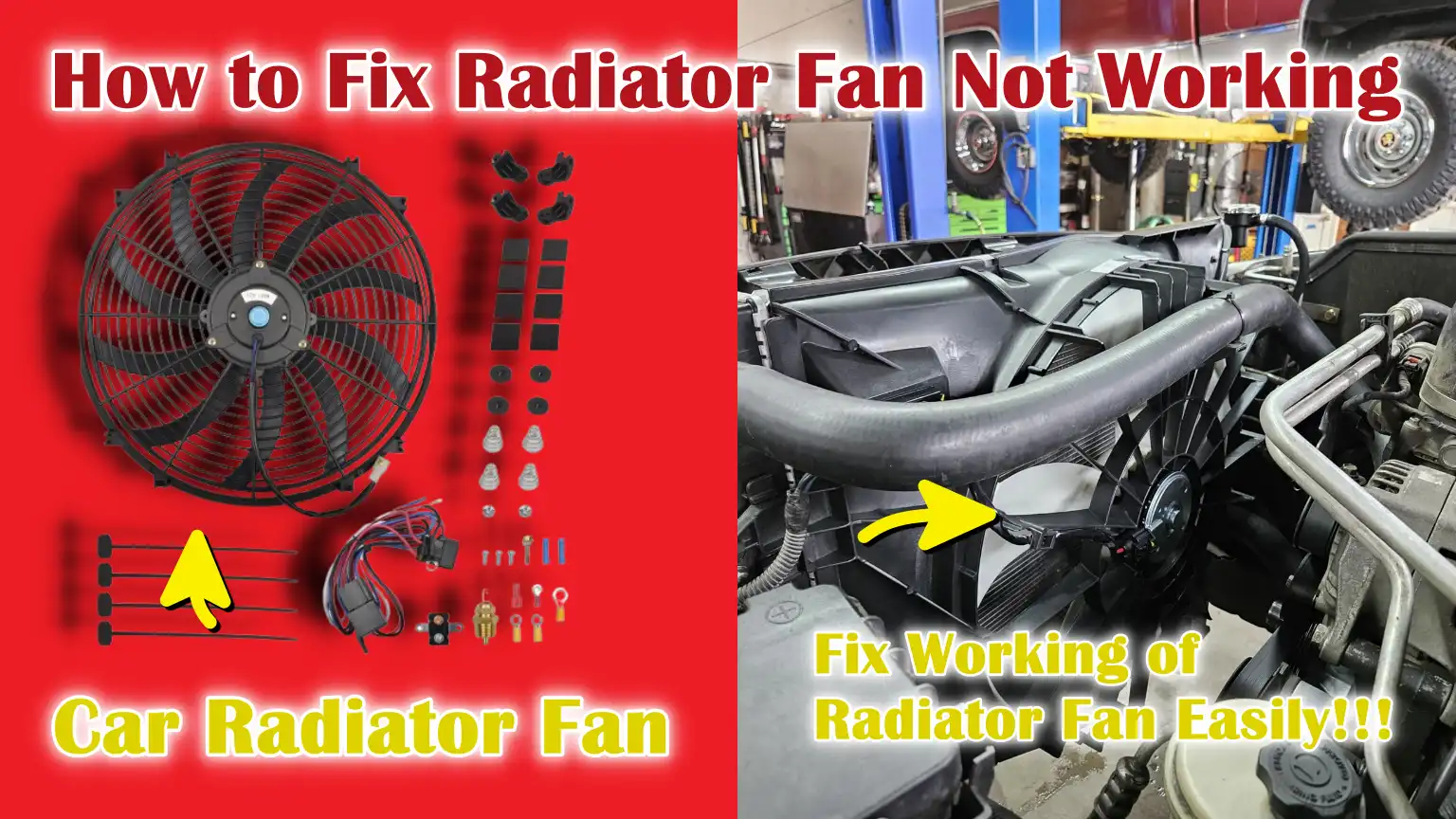
That’s why, we have come up with this guide on How to Fix Radiator Fan Not Working, so that you can fix those radiator fan problems in simple way: as it could be because of the blown fuse, bad relay, temperature sensor failure or could be worn-out motor as well.
What Does a Radiator Fan Do?
The radiator fan is an essential part of your vehicle’s cooling system that helps keep the engine at a safe and stable temperature.
Most gasoline engines are designed to operate best between approximately 195°F and 220°F which is 90°C and 105°C.
If the engine overheats, metal parts can expand beyond their limits, which can dilute the engine oil and cause serious damage such as a blown head gasket or warped cylinder head.
The radiator fan prevents this by improving airflow through the radiator, specially when the vehicle isn’t moving fast enough to create natural airflow.
Without a working radiator fan, heat builds up quickly, specially in traffic, at long stoplights, or when the air conditioner is on.
Understanding how this fan works helps you understand why even a minor electrical fault can cause overheating problems.
1. Role in Engine Cooling
Whenever fuel burns inside the cylinder, the engine generates heat.
Internal combustion engines convert only a portion of the fuel energy into motion and most of it becomes heat.
The cooling system is designed to remove this excess heat so that the engine doesn’t overheat.
Coolant flows through the passages inside the engine block and cylinder head, absorbing heat as it circulates.
The hot coolant then enters the radiator, where it releases that heat into the surrounding air.
The radiator fan helps draw or push air across the radiator fins, cooling the hot coolant and returning it to the engine.
This continuous cycle maintains engine temperature and prevents overheating.
2. How the Radiator and Coolant System Work
The radiator, coolant, water pump, thermostat and radiator fan all work together as a system.
The water pump pushes the coolant through the engine.
The thermostat controls when coolant is allowed into the radiator, which typically opens when the engine reaches normal operating temperature.
When hot coolant enters the radiator, it flows through thin metal tubes surrounded by cooling fins.
The radiator fan increases airflow over these fins, removing heat from the coolant.
This process is specially important when the vehicle is stationary or moving slowly, as natural airflow through the grille is reduced.
After cooling, the coolant returns to the engine to absorb more heat and the cycle repeats.
3. Difference Between Mechanical and Electric Radiator Fans
There are two main types of radiator fans: mechanical and electric.
Mechanical fans are usually connected directly to the engine and rotate using a belt connected to the crankshaft.
They often have a fan clutch that allows the fan to rotate faster when the engine is hot and slower when cooling needs are low.
Electric radiator fans, common in modern vehicles, use an electric motor instead of engine power.
They are controlled by sensors and only turn on when needed.
Electric fans are generally more efficient because they reduce engine load compared to a continuously rotating mechanical fan, improving fuel economy.
4. When should the radiator fan run?
The radiator fan doesn’t run all the time.
In most vehicles, it turns on when the engine coolant temperature reaches a preset level, often around 200°F to 230°F, depending on the manufacturer’s design.
It may also turn on when the air conditioning system is activated, as the AC condenser needs airflow to remove heat.
If the temperature returns to normal, the fan automatically turns off.
This on-off cycle helps maintain a healthy engine temperature while saving energy.
5. How Modern Vehicles Control Radiator Fan Operation
Modern vehicles use sensors and electronic control systems to properly manage radiator fan operation.
A coolant temperature sensor monitors engine temperature and sends a signal to the engine control module, often called the ECU.
The ECU then sends power through a relay or fan control module to determine when to activate the radiator fan.
Some vehicles have dual fans or multi-speed fans that operate at different speeds depending on cooling needs.
This electronic control improves fuel efficiency, reduces noise and ensures the engine remains within its ideal temperature range.
If any of these components, such as the sensor, relay, or motor, fails, the radiator fan will not be able to turn on when needed, which can lead to rapid overheating.
Know Common Signs Your Radiator Fan Isn’t Working
The radiator fan plays a direct role in controlling engine temperature, specially when your vehicle isn’t running fast enough to create natural airflow through the radiator.
When the fan stops working, heat builds up rapidly and the cooling system can’t remove it properly.
Recognizing these warning signs early can prevent serious engine damage, costly repairs and unexpected failures.
Below are the most important and crucial signs that your radiator fan isn’t working properly.
1. Engine Overheating During Idling
The most obvious sign of a radiator fan failure is engine overheating during idling.
When your car is parked with the engine running or waiting at a long traffic light, very little air passes through the radiator.
At this time, the radiator fan should be on and drawing air through the cooling fins to remove heat from the coolant.
If the fan doesn’t turn on, the coolant temperature rises rapidly.
You may notice the temperature gauge rising above normal after a few minutes of idling.
If ignored, prolonged overheating can damage the head gasket, crack the cylinder head, or cause the engine oil to deteriorate rapidly.
2. Temperature Gauge Rising in Traffic
If your temperature gauge remains normal while driving at highway speeds, but rises in slow-moving traffic, this is a sure sign of a problem with the radiator fan.
At higher speeds, natural airflow enters through the front grille and cools the radiator without much help from the fan.
However, when driving in heavy traffic or in the city, airflow decreases.
The radiator fan has to compensate for this lack of air.
When it malfunctions, the engine temperature rises when the vehicle speeds decrease.
A common symptom of a bad radiator fan is that the air conditioner blows warm air while driving.
3. The air conditioner blows warm air when idling
Many vehicles use a single radiator fan to cool both the engine radiator and the air conditioning condenser.
The condenser removes heat from the AC system and requires strong airflow.
If the radiator fan isn’t working, the condenser can’t remove heat properly.
Therefore, the air conditioner may blow cool air while driving, but it may heat up when the car is idling.
This happens because the condenser overheats without proper airflow.
If you notice poor AC performance only when idling, you should have the radiator fan checked immediately.
4. The radiator fan isn’t spinning when the engine is warm
A simple but important test is to check if the radiator fan is spinning when the engine reaches normal operating temperature.
Most engines are designed to operate at approximately 195°F to 220°F.
The fan should automatically turn on when the temperature reaches a predetermined level.
If the engine is visibly warm and the fan is completely stable, this indicates a potential problem with the fan motor, fuse, relay, wiring, temperature sensor, or control module.
However, always be careful when checking the fan, as it may turn on suddenly and without warning.
5. Check Engine Light Related to the Cooling System
Modern vehicles use electronic sensors to monitor engine temperature and cooling system performance.
If the radiator fan is faulty, the engine control module may detect abnormal temperature readings and turn on the check engine light.
Diagnostic trouble codes related to the coolant temperature sensor, fan circuit, or overheating may be stored in the system.
Using an OBD2 scanner can help determine whether the problem is electrical, sensor-related, or directly related to the fan motor.
6. Coolant Burning Smell
A sweet, burning smell coming from the engine bay may be another warning sign of overheating due to a faulty radiator fan.
Coolant contains chemicals that produce a characteristic sweet smell when it overheats.
If the fan fails and the engine temperature rises above safe levels, coolant may begin to boil or leak from the overflow point.
This smell often appears before serious engine damage occurs, so it should never be ignored.
Early detection can prevent costly repairs and long-term engine damage.
Know, Common Causes of Radiator Fan Failure
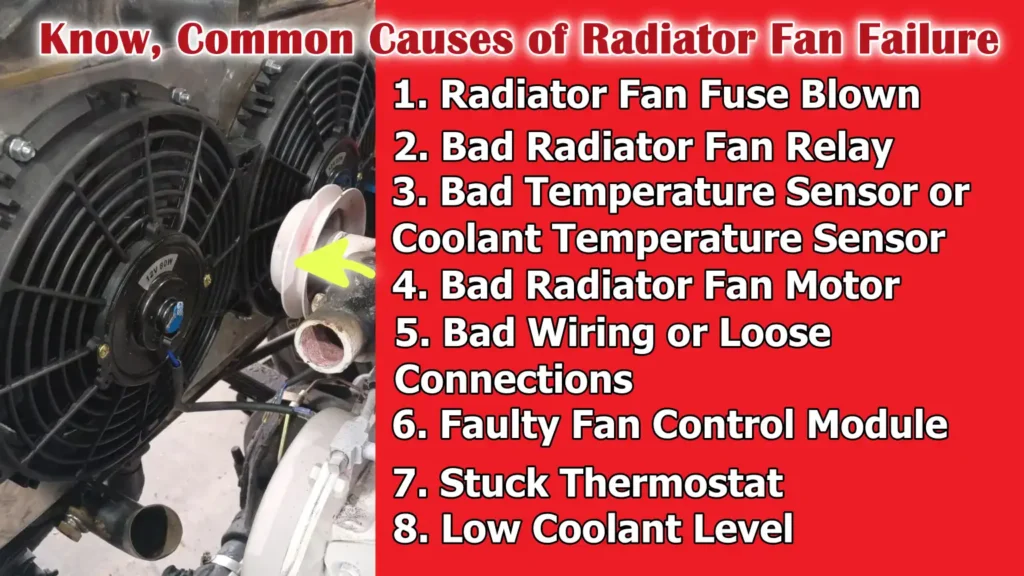
The radiator fan can stop working for a variety of reasons and most of them are related to simple electrical or cooling system problems.
The radiator fan relies on a power supply, temperature signals and proper coolant circulation to function properly.
If any of these parts fail, the fan may not start even when the engine is warm.
Understanding these common causes helps you diagnose the problem quickly and prevent serious damage to engine parts like the head gasket, cylinder head and engine oil from overheating.
1. Radiator Fan Fuse Blown
The radiator fan fuse protects the electrical circuit from overload.
If a sudden power surge or short circuit occurs, the fuse will blow, preventing damage to the wiring and fan motor.
When the fuse blows, the fan loses power and it won’t rotate at all.
A blown fuse is one of the most common and simple causes of radiator fan failure.
Replacing a fuse is inexpensive, but if it blows again quickly, it could be a sign of a deeper electrical problem, such as a shorted wire or a faulty motor.
2. Bad Radiator Fan Relay
The radiator fan relay acts as an automatic switch that sends power to the fan at the command of the engine control system.
When the engine temperature rises to a predetermined level, the relay closes the circuit and provides power to the fan motor.
If the relay is worn or internally damaged, it may not provide power even when the engine is warm.
In many cases, a faulty relay causes the fan to remain off completely.
Relays are quite inexpensive and can often be tested by replacing them with a similar relay in the fuse box.
3. Bad Temperature Sensor or Coolant Temperature Sensor
The coolant temperature sensor monitors how hot the engine is and sends this information to the engine control module.
If the sensor sends incorrect readings, the system may not activate the radiator fan at the right time.
For example, if the sensor incorrectly reports that the engine is still cold, the fan won’t start even when the engine overheats.
A faulty sensor can also trigger the Check Engine light.
Because modern vehicles rely heavily on electronic data, a faulty temperature sensor can disrupt the entire cooling control process.
4. Bad Radiator Fan Motor
The radiator fan motor rotates the fan blades to create airflow.
Over time, the motor can deteriorate due to heat, dirt buildup, or internal electrical faults.
If the motor burns out, the fan won’t rotate even when power is supplied.
One way to test the motor is to connect it directly to the battery and see if it runs.
If it doesn’t, the motor is likely faulty and needs to be replaced.
A faulty motor is a direct mechanical cause of fan failure.
5. Bad Wiring or Loose Connections
Electrical wiring connects the battery, fuses, relays, control module and fan motor.
If wires are damaged, worn, or disconnected, power may not flow properly.
Loose connectors can also disrupt power supply, specially in areas exposed to heat and vibration.
Even a small break in the circuit can prevent the fan from working.
Checking for visible damage or corrosion in the wiring is an important step in diagnosing radiator fan problems.
6. Faulty Fan Control Module
Some modern vehicles use a dedicated fan control module to manage fan speed and timing.
This module receives signals from the temperature sensor and the engine control unit and then controls how fast the fan should rotate.
If the module malfunctions, the fan may not turn on at all or may not operate at the correct speed.
Because this component controls advanced electronic functions, diagnosing it may require a scanning tool to check for error codes related to the cooling system controls.
7. Stuck Thermostat
The thermostat controls the flow of coolant between the engine and the radiator.
When the engine is cold, it remains closed to help the engine warm up quickly.
Once it reaches normal temperature, it opens to circulate coolant through the radiator.
If the thermostat is stuck closed, hot coolant cannot reach the radiator, causing rapid overheating.
In some cases, the fan may turn on but still not cool the engine properly because the coolant is not flowing properly.
8. Low Coolant Level
Coolant carries heat away from the engine and out of the radiator.
If the coolant level becomes too low due to leaks or evaporation, the cooling system cannot function properly.
Low coolant can create air pockets within the system, reducing heat transfer and preventing accurate readings from the temperature sensor.
When the system doesn’t detect the correct coolant flow, the radiator fan may not turn on properly or, even when running, may not cool the engine.
Maintaining the correct coolant level is essential for proper fan operation and overall engine safety.
Tools
| Tool | Used to |
|---|---|
| Multimeter | It helps you see if power is reaching the fan motor. You can use it to test fuses, relays and connectors. It’s very useful for safely and accurately diagnosing electrical faults. |
| OBD2 Scanner | It connects to the car’s diagnostic port under the dashboard. It displays error codes related to the temperature sensor or fan circuit. This tool helps you quickly diagnose hidden electronic problems. |
| Screwdrivers and Socket Set | These tools allow you to access the radiator fan, relay box and connectors. Different sizes may be needed depending on the vehicle. These are basic tools needed for most car repairs. |
| Fuse Puller | It prevents damage to the fuse and protects your fingers. This makes it easier to check if a fuse is blown. Many fuse boxes have a small plastic puller inside. |
| Replacement Fuse or Relay | If the old fuse is blown, replacing it can fix the problem immediately. A bad relay can prevent power from reaching the fan. Always use the correct rating to avoid electrical damage. |
| Protective Gloves and Safety Glasses | Gloves protect against sharp edges and hot parts. Safety glasses prevent dust or dirt from getting into your eyes. Personal protection is essential when working near the engine bay. |
How to Be On the Safe Side
Before diagnosing or repairing a radiator fan problem, safety must come first.
The cooling system operates under high temperatures and pressures and the engine bay contains moving parts and electrical circuits that can cause injury if handled carelessly.
Taking a few simple precautions can prevent burns, electric shocks, cuts, or sudden mechanical injuries.
Many accidents involving radiator fans occur because the fan can automatically start without warning, even when the engine appears to be off.
Taking the right safety precautions reduces the risk and ensures you can work with peace and confidence.
1. Let the Engine Cool Down Completely
Always let the engine cool down completely before touching any part of the cooling system.
When the engine is running, the coolant temperature can exceed 200°F, hot enough to cause serious burns.
Metal parts like the radiator, hoses and engine block remain hot for a long time even after the vehicle is turned off.
Waiting at least 30 to 60 minutes gives the system time to cool down.
Checking the temperature gauge on the dashboard is helpful, but you should carefully feel for heat without direct contact.
The most common cause of injury during cooling system repairs is working on a hot engine.
2. Disconnect the Battery
Disconnecting the negative battery terminal before testing or removing the radiator fan is an important safety step.
When the engine control system detects high temperatures, the electric radiator fan may automatically turn on, even if the ignition key is removed.
This sudden movement can cause serious hand injury.
By disconnecting the battery, you prevent accidental electrical activation.
It also protects sensitive electronic parts from short circuits when checking wiring, relays, or connectors.
3. Never open the radiator cap when it is hot
The cooling system is under pressure when the engine is hot.
This pressure raises the boiling point of the coolant to improve cooling efficiency.
If you open the radiator cap when the system is hot, the pressure may suddenly increase, causing boiling coolant to erupt.
This can cause severe burns to your face, hands and arms.
Always wait for the engine to cool completely before removing the cap.
Even after it cools down, open the cap slowly and carefully to safely release any remaining pressure.
4. Keep your hands away from moving parts
The engine bay contains belts, pulleys and fan blades that can move suddenly.
The radiator fan, in particular, can start rotating without warning if it is connected to power.
Never place your hands near the fan blades when the battery is connected.
Avoid wearing loose clothing, jewelry, or long hair that could get caught in moving parts.
Being mindful of your hand position at all times reduces the risk of mechanical injury.
5. Work on a flat, stable surface
Always park your vehicle on a flat, stable surface before beginning any repair.
Apply the parking brake to prevent the car from rolling.
A flat surface keeps the vehicle stable and reduces the risk of accidents when leaning on the engine bay.
If you need to lift the vehicle for any reason, use proper jack stands instead of relying solely on the jack.
Stability ensures you can focus on diagnosing the radiator fan problem without worrying about the vehicle moving.
How to Fix a Radiator Fan If It’s Not Working
Fixing a radiator fan that isn’t working requires patience, careful observation and a clear understanding of how the cooling system works.
The radiator fan relies on proper coolant flow, accurate temperature readings and a stable power supply.
If any of these systems malfunction, the fan may not turn on when the engine reaches high temperatures.
The safest and most effective way to diagnose the problem is to perform simple checks first and gradually progress to more technical inspections.
Each step is explained in detail below so you understand not only what to do, but also why.
How to Check the Coolant Level
Coolant level is the foundation of the entire cooling system.
Coolant, also known as antifreeze, absorbs heat from the engine and carries it to the radiator, where it is released.
If the coolant level is low, the system cannot dissipate heat properly.
Low coolant can also cause inaccurate temperature sensor readings, preventing the radiator fan from starting at the right time.
Before testing electrical components, always ensure there is sufficient coolant in the cooling system.
1. Check the Coolant Reservoir
Start the engine when it is completely cold.
Never check the coolant on a hot engine, as the system is pressurized and extremely hot.
Locate the coolant reservoir, which is usually a clear or semi-transparent plastic tank connected to the radiator by a small hose.
The tank will have clear markings “MIN” and “MAX” or “LOW” and “FULL.”
Check the coolant level without opening the cap first.
The fluid should be between the minimum and maximum marks.
If it’s below the minimum level, the cooling system may not have enough fluid to properly circulate heat.
Also, check the coolant’s color.
Healthy coolant is typically green, orange, pink, or blue, depending on the type.
If it appears rusty, brown, cloudy, or contains debris, this could indicate contamination or internal corrosion.
Bad coolant reduces cooling efficiency and can affect the accuracy of the temperature sensor.
Next, once the engine has completely cooled, gently open the reservoir cap.
Check for a strong chemical odor or visible dirt.
The rubber seal on the cap should be in good condition.
A bad cap seal can reduce system pressure, lowering the coolant’s boiling point and causing overheating.
2. Check for Leaks
If the coolant level is low, don’t immediately assume it’s simply evaporated.
Modern cooling systems are sealed, so low coolant usually means a leak.
Carefully inspect all visible parts of the cooling system.
Check for cracks, swelling, or soft spots in the radiator hoses.
Feel for moisture at hose connections and clamps.
Look for white or green crust on the radiator surface, which often indicates dried coolant from a small leak.
Check the ground beneath the vehicle.
Fresh coolant often leaves shiny spots, while older leaks can leave dry spots.
Also check the water pump area and near the thermostat housing.
Even a small leak can gradually reduce the coolant level over time.
Leaks are necessary because low coolant can create air pockets inside the engine.
Air does not conduct heat like liquid coolant.
When air pockets form, the temperature sensor cannot accurately detect engine heat and the radiator fan cannot turn on when needed.
Fixing leaks helps maintain temperature control and keep the fan functioning properly.
Read More:
3. Top Up If Needed
If the coolant level is slightly low and no major leaks are found, topping it up may restore cooling.
Always use the correct coolant type recommended by the vehicle manufacturer.
Mixing different types of coolant can reduce corrosion protection and damage internal parts.
Slowly add coolant to the reservoir until it reaches the maximum line.
Do not overfill, as coolant expands when heated.
After topping up, securely close the cap.
Start the engine and allow it to warm up while monitoring the temperature gauge.
If the radiator fan was not working due to low coolant, it may return to normal once the engine reaches its standard operating temperature range, which is typically between 195°F and 220°F.
Monitor the coolant level over the next few days.
If the level drops again, there is probably a leak and it should be fixed before proceeding to other diagnostic steps.
How to Check the Radiator Fan Fuse
The radiator fan fuse protects the electrical circuit from overload.
This fuse supplies power from the battery to the fan motor.
If a sudden surge or short circuit occurs, the fuse will blow, preventing damage to wires and components.
When a fuse blows, power is immediately cut off and the radiator fan will not operate at all.
Checking the fuse is one of the quickest and easiest diagnostic steps and many radiator fan failures are caused by this small but crucial part.
1. Locate the Fuse Box
Most vehicles have at least two fuse boxes.
One is usually located under the dashboard inside the cabin and the other is located near the battery in the engine compartment.
The radiator fan fuse is usually located in the engine bay fuse box because it handles a higher electrical load.
Carefully open the fuse box cover.
Inside the cover, you’ll usually find a diagram showing the location and labels of each fuse.
If the diagram isn’t clear, consult the owner’s manual.
Identifying the correct fuse location is important because removing the wrong fuse can affect other systems.
2. Identify the Radiator Fan Fuse
Look for labels such as “Cooling Fan,” “Red Fan,” or “Fan Motor.”
Some vehicles may have more than one fan fuse, specially if they use dual cooling fans.
The fuse rating is printed on the fuse, often with numbers like 20A, 30A, or 40A.
The rating indicates how much electrical current the fuse can withstand before blowing.
Remove the fuse using a fuse puller or needle-nose pliers.
Hold it up to the light and inspect the metal strip inside.
If the strip is broken, melted, or blackened, the fuse is blown.
Even if the damage appears minor, the fuse must be replaced.
3. Replace the Blown Fuse
Install a new fuse of the same amperage rating as the blown fuse.
Never install a fuse with a higher rating, as this can cause excessive current to pass through the wiring, which could damage the wiring or even cause a fire.
After replacing the fuse, start the engine and let it reach operating temperature.
Check if the radiator fan turns on.
If it does, the problem is likely due to an overload.
However, if the new fuse blows again quickly, it could indicate a more serious problem, such as a short circuit in the fan motor or a wiring fault, which should be investigated further.
How to Test the Radiator Fan Relay
The radiator fan relay acts like an automatic electrical switch.
When the engine reaches a certain temperature, the control system sends a signal to the relay, which then closes the circuit and supplies power to the fan motor.
If the relay fails internally, it may not send power, even if the fuse and motor are in good condition.
1. Replace with a relay that performs the same function
Many vehicles use the same relay for different systems, such as the horn or headlights.
If you find a different relay with the same part number in the fuse box, you can replace it temporarily.
After replacing, start the engine and let it warm up.
If the radiator fan starts working after replacement, the original relay was probably faulty.
This method is simple and doesn’t require special tools, but make sure the replacement relay matches exactly.
2. Check Relay Continuity
If you have a multimeter, you can test the relay more accurately.
Remove the relay and check for continuity between the correct terminals according to the relay diagram.
When voltage is applied to the control terminal, the internal switch should close and allow current to pass through the load terminal.
If continuity does not occur when it should, the relay has failed internally.
Relays can deteriorate over time due to frequent switching and heat.
3. Replace If Defective
If testing reveals a faulty relay, replace it with a new relay of the same specifications.
After installation, let the engine reach normal operating temperature and check that the fan turns on and off properly.
How to Test the Radiator Fan Motor
The radiator fan motor is the part that physically rotates the blades to create airflow.
If the motor fails, the fan will not rotate even when power is applied.
Over time, heat, dirt and electrical wear can damage the internal windings or bearings.
1. Direct Battery Power Test
Carefully disconnect the fan connector.
Using jumper wires, connect the fan motor directly to the battery terminal.
Connect the positive wire to the positive battery terminal and the negative wire to a ground source.
This test bypasses the vehicle’s electrical control system and sends power directly to the motor.
2. Check if the fan is spinning
If the motor is working properly, it should spin loudly and smoothly when connected directly to the battery.
Look for strange noises, such as grinding or squealing, which may indicate worn bearings.
If the fan doesn’t spin at all or operates weakly, the motor is likely bad.
3. Replace the motor if it’s bad
A motor that isn’t working needs to be replaced.
In most cases, the fan assembly is replaced as a single unit, including the motor and blades.
After installation, reconnect all wiring and test the fan’s operation under normal engine temperature conditions.
How to Check the Coolant Temperature Sensor
The coolant temperature sensor measures engine heat and sends this data to the engine control module.
If the sensor provides inaccurate readings, the system may not activate the radiator fan at the correct time.
1. Scan OBD Codes
Use an OBD2 scanner to check stored diagnostic trouble codes.
Codes related to the coolant temperature or fan circuit may indicate a faulty sensor.
The scanner can also display live temperature readings.
Compare these readings to the actual engine conditions.
If the engine feels very hot but the scanner shows a low temperature, the sensor may be faulty.
2. Check the Sensor Wiring
Check the wiring connected to the sensor.
Look for cracks, corrosion, or loose connectors.
Poor wiring can interfere with the signal and cause inaccurate readings.
3. Replace it if it sends incorrect readings
If testing reveals that the sensor is sending incorrect information, it should be replaced.
After replacement, clear any stored codes and check that the radiator fan turns on at the correct temperature range.
How to Check Wiring and Connectors
The radiator fan system relies on clean and secure electrical connections.
Poor wiring can disrupt power flow and prevent the fan from running.
1. Check for Corrosion or Worn Wires
Check the wires from the fuse box to the relay and from the relay to the fan motor.
Check for green or white corrosion, broken insulation, or exposed copper strands.
Corrosion increases electrical resistance and reduces current flow.
2. Repair Damaged Wiring
If you find damaged wires, repair them using the correct connectors or soldering methods.
Cover the repaired area with heat-shrink tubing to prevent moisture from entering.
Temporary tape repairs are not recommended for long-term reliability.
3. Ensure Connections Are Tight
Check that all connectors are fully seated and locked in place.
Loose connections can cause the fan to run intermittently, causing it to sometimes work and sometimes fail.
How to Check the Thermostat
The thermostat controls coolant flow between the engine and the radiator.
It remains closed during cold starts and opens when the engine reaches normal operating temperature.
1. Signs of a Stuck Thermostat
If the thermostat is stuck closed, coolant cannot circulate to the radiator.
This can cause rapid overheating even if the radiator fan is working properly.
Symptoms include the temperature gauge rising rapidly and the upper radiator hose remaining cold when the engine overheats.
2. When Replacement is Needed
If testing confirms that the thermostat is not opening at the correct temperature, it should be replaced.
A working thermostat ensures proper coolant flow and allows the radiator fan to function properly.
Step 8: Check the Fan Control Module – If Installed
Some modern vehicles use a fan control module to regulate fan speed and timing.
This module receives signals from the engine control unit and adjusts fan operation based on temperature and air conditioning load.
1. Symptoms of Module Failure
If the module fails, the fan may not run at all, run continuously, or operate at the wrong speed.
Diagnostic codes related to the fan control circuit may appear.
2. Replacement Considerations
Testing the control module may require advanced diagnostic tools.
If a fault is confirmed, it will need to be replaced.
After replacement, check that the fan operates properly during warm-up and when the air conditioner is running.
How to Test a Radiator Fan with a Multimeter
Testing a radiator fan with a multimeter is the most accurate way to determine why it’s not working.
A multimeter measures voltage, resistance and continuity, helping you understand whether power is reaching the fan and whether the electrical components are functioning properly.
Because most modern radiator fans are electric and controlled by sensors, relays and the engine computer, simply looking at the fan isn’t enough.
You need to ensure that the circuit is receiving power at the right time.
A proper electrical test saves you from replacing faulty parts and ensures you’re fixing the real problem.
1. Checking Voltage at the Fan Connector
First, make sure the engine is cool and the vehicle is safely parked.
If the battery was previously disconnected, reconnect it.
Set the multimeter to measure DC voltage.
Locate the electrical connector that plugs into the radiator fan motor.
Carefully disconnect it so you can test the power supply side of the connector.
Now start the engine and let it warm up to normal operating temperature, which is usually between 195°F and 220°F.
At this point, the radiator fan should receive the command to turn on.
Place the positive probe of the multimeter on the power terminal inside the connector and the negative probe on a good ground point or ground terminal in the connector.
If the system is working properly, you should see a voltage reading close to the battery voltage, which is usually around 12 volts in most vehicles.
This confirms that the fan motor is receiving power.
If you see zero volts when the engine is warm and the fan is running, there is an electrical problem somewhere before the motor, such as a fuse, relay, wiring fault, or control module problem.
2. Testing the Relay Terminals
If there is no voltage at the fan connector, the next step is to test the radiator fan relay.
Remove the relay from the fuse box.
Look for a diagram printed on the relay body, which shows the terminal numbers.
Most relays have two control terminals and two load terminals.
Set the multimeter to measure resistance or continuity.
Check the resistance at the relay coil terminal.
You should see a small resistance value, often between 40 and 120 ohms, depending on the design.
If the reading shows infinite resistance or no reading at all, the coil inside the relay is broken.
Next, check for continuity at the load terminal while applying power to the coil terminal using jumper wires.
When voltage is applied, the relay should click and continuity should be visible at the load terminal.
If there is no click or continuity, the relay is faulty and needs to be replaced.
3. Checking Continuity
Continuity testing helps you confirm that the electrical paths are complete and unbroken.
Set the multimeter to continuity mode, which usually beeps when the circuit is complete.
With the battery disconnected, test the wiring between the relay and fan motor connector.
Place one probe on the relay output terminal and the other on the corresponding fan connector terminal.
If the meter beeps or shows very low resistance, the wire is fine.
If there is no beep and the meter shows high resistance or an open circuit, the wire may be broken, corroded, or disconnected.
You should also check the ground connections.
A weak or broken ground can prevent the fan from working even if there is power.
Performing a ground continuity test ensures that electricity can complete its circuit.
4. Understanding the Results
Understanding the readings is crucial for a correct diagnosis.
If there is voltage at the fan connector but the fan does not spin, the fan motor may be faulty.
If there is no voltage at the connector but the fuse is fine, the problem could be a bad relay, bad wiring, or a bad control module.
If relay testing reveals no continuity or clicking noises, the relay should be replaced.
If all electrical components test fine but the fan does not turn on even at high temperatures, the coolant temperature sensor or control system may not be sending the correct signal.
What Can Be the Radiator Fan Repair Cost
Understanding the cost of radiator fan repair helps you plan your repair wisely and avoid overpaying.
The total cost depends on the specific part that’s faulty, the make and model of your vehicle and whether you want to fix it yourself or hire a professional mechanic.
In many cases, radiator fan problems are caused by small electrical parts that are inexpensive to replace.
However, if the fan motor or the entire fan assembly needs to be replaced, the cost can increase.
It’s important to act quickly because ignoring a faulty radiator fan can cause the engine to overheat, leading to thousands of dollars in repair costs.
Below is a detailed breakdown of common repair costs.
1. Fuse Replacement Cost
Replacing the radiator fan fuse is usually the most cost-effective method.
A standard automotive fuse typically costs very little, often between a few dollars and a half, depending on the amperage rating and brand.
As fuses are readily available in most vehicles, labor costs are minimal or zero if you replace them yourself.
This makes replacing a fuse one of the cheapest cooling system repairs.
However, if a fuse repeatedly blows, it could indicate a deeper electrical problem that requires further diagnosis and possibly a more expensive repair.
2. Relay Replacement Cost
Radiator fan relays are also quite inexpensive compared to larger parts.
A new relay often costs a small amount to a few pounds, depending on the type and quality of the vehicle.
Labor charges are usually low, as replacing a relay takes only a few minutes in most cases.
If you perform the repair yourself, you’ll only have to pay for the parts.
Relays can fail due to internal wear or heat exposure and replacing a faulty relay can restore normal fan operation without significant expense.
3. Fan Motor Replacement Cost
The radiator fan motor or the entire fan assembly is more expensive than a fuse or relay.
Costs can vary greatly depending on the vehicle, as some models use dual fans or integrated assemblies with built-in control modules.
The cost of the part can be significantly higher than smaller electrical parts.
Labor costs also increase because replacing the fan assembly may require removing the radiator shroud or other parts of the engine bay.
Although the cost is higher, replacing the faulty motor is essential, as the fan cannot function without it.
Delaying this repair can cause the engine to overheat and cause serious damage.
4. Labor Charges – DIY vs Mechanic
Choosing between self-repair and professional service significantly impacts the overall cost.
DIY repairs eliminate labor charges, which can range from medium to high depending on the shop’s rates and the difficulty of the repair.
Simple tasks like replacing a fuse or relay can usually be done by even beginners with basic tools.
More advanced repairs, such as replacing a fan motor or diagnosing control module problems, may require technical knowledge and the right equipment.
Professional mechanics charge labor by the hour and cooling system repairs can take anywhere from one to several hours, depending on how difficult the access is and how much testing is required.
5. Total Estimated Repair Range
The total cost of repairing a radiator fan can range from very little for a simple fuse replacement to quite high for replacing the fan assembly or control module.
Minor electrical repairs are often inexpensive, while replacing major parts can cost several hundred dollars including parts and labor.
Compared to repairing an overheated engine, which can cost thousands of dollars for a head gasket replacement or cylinder head repair, repairing a radiator fan is generally more affordable.
Catching problems early protects your engine and keeps repair costs under control.
When to See a Professional Mechanic Regarding Fixing the Radiator Fan
While many radiator fan problems can be diagnosed and fixed at home, in some cases, professional help is the safest and most prudent option.
Modern vehicles have advanced cooling systems that involve electrical controls, sensors, modules and computer programming.
If the problem is more than just a fuse, relay, or visible wiring, a trained mechanic has the tools and experience to properly diagnose the system.
Knowing when to stop and seek expert help can prevent serious engine damage and save money in the long run.
1. Persistent Overheating
If your engine continues to overheat even after checking the coolant level, replacing fuses, testing the relay and verifying that the fan motor is working, it’s time to see a mechanic.
Persistent overheating could mean a clogged radiator, a faulty water pump, a coolant leak, a damaged head gasket, or air trapped in the cooling system.
Engines are designed to operate within a narrow temperature range, typically around 195°F to 220°F.
Consistently exceeding this range can cause engine parts to wear out quickly.
A professional technician can detect hidden problems that may not be visible during a basic inspection by performing pressure tests, coolant flow tests and combustion gas checks.
2. Electrical System Problems
Modern vehicles rely heavily on electronic control systems.
The radiator fan can be controlled by the engine control module, fan control module, temperature sensors and even the climate control system.
Diagnosing these electronic systems often requires advanced scan tools that can read live data and perform active tests.
If your vehicle is displaying multiple warning lights, stored diagnostic trouble codes haven’t cleared, or the fan is acting strangely, such as running continuously or not at all despite good electrical readings, the problem may be related to computer programming or a module failure.
Professional mechanics have the diagnostic equipment and technical knowledge necessary to safely handle complex electrical faults.
3. Multiple Cooling System Failures
If multiple parts of the cooling system appear to be failing at the same time, such as overheating due to a coolant leak and a failed fan, the situation may be more serious than a single part failure.
For example, overheating due to excessive heat can damage sensors, wiring insulation and plastic connectors.
A stuck thermostat, a blocked radiator, or a weak water pump can also indirectly affect fan performance.
When problems occur simultaneously, it may be difficult to determine the root cause without systematic testing.
A mechanic can examine the entire cooling system as a whole unit, rather than replacing parts one by one.
4. Lack of the Right Tools
Some radiator fan tests require tools like a professional-grade multimeter, a scan tool with live data capability, a pressure tester, or a wiring diagram specific to your vehicle model.
Without these tools, it can be difficult to accurately diagnose the problem.
Attempting a repair without the proper equipment can result in incorrect part replacement, electrical damage, or injury.
Professional repair shops have the proper tools and safety equipment to perform the testing thoroughly and accurately.
When you’re short on tools, seeking help ensures a safe repair and reduces the risk of further problems.
Read More:
How to Prevent Radiator Fan Problems
Preventing radiator fan problems is much easier and cheaper than repairing engine damage caused by overheating.
The radiator fan is part of a larger cooling system that includes coolant, hoses, sensors, electrical circuits and airflow passages.
When all these parts are in good condition, the fan can operate efficiently and only when needed.
Most radiator fans gradually fail due to neglect, corrosion, overheating, or carelessness.
By performing simple maintenance, you can greatly reduce the risk of sudden overheating and costly repairs.
1. Regular Coolant Maintenance
Coolant is the lifeblood of the cooling system.
It not only absorbs heat from the engine but also protects the internal metal parts from rust and corrosion.
Over time, coolant loses its protective properties and can become acidic or become corroded by dirt.
When this happens, corrosion can form inside the radiator, around the heater core and around the temperature sensor that controls the radiator fan.
Changing the coolant at the recommended service interval, which is often every two to five years depending on the type, helps maintain proper heat transfer and sensor accuracy.
Always use the correct coolant for your vehicle, as mixing different types of coolant can reduce corrosion protection and cause deposits within the system.
Maintaining clean and properly filled coolant ensures the radiator fan receives the correct temperature signal and operates promptly.
As well as, there’s study in Scientific Reports about the modern electric radiator fans are essential for having optimized engine cooling, as they are literally responsible to provide the controlled airflow that is not dependent on the engine speed whatsoever, so this research shows that the you need to accurately manage the fan speed as it actually improves the heat dissipation and helps to maintain the stable engine temperatures under the diverse driving conditions, as it also shows that how important it is to function the radiator fan in preventing overheating and reducing the engine stress as well.[¹]
2. Periodically Check Fuses and Relays
Fuses and relays are small parts, but they play a vital role in powering the radiator fan.
Heat from the engine bay and repeated electrical cycles can weaken the relay over time.
During regular maintenance, it’s helpful to check the fuse box for signs of corrosion, loose connections, or discoloration from heat.
Checking that the radiator fan fuse is properly installed and shows no signs of melting can prevent unexpected failures.
Relays can also be tested occasionally to ensure they click properly when activated.
Early detection of a weak relay or corroded fuse terminal can prevent unexpected fan failures during hot weather or heavy traffic.
3. Cleaning the Radiator Fins
The radiator removes heat by passing air through thin metal fins.
If these fins become clogged with dirt, leaves, insects, or road debris, airflow is reduced.
Reduced airflow means the radiator fan has to work harder to maintain the engine’s optimum temperature.
Over time, this increased pressure can shorten the life of the fan motor.
Periodically inspecting the radiator front and gently cleaning debris with low-pressure water or compressed air helps maintain good airflow.
Keeping the radiator clean improves cooling efficiency and reduces strain on the fan system.
4. Monitoring the Temperature Gauge
The temperature gauge on the dashboard is one of the most important warning tools in your vehicle.
It shows whether the engine is operating within its normal temperature range.
Most engines are designed to run slightly below the gauge’s midpoint after fully warming up.
If you notice the needle rising higher than normal during idling or traffic, it could be a sign of early cooling system problems.
Paying attention to small changes in temperature behavior can help you detect radiator fan problems before they become serious.
Ignoring a gradually rising temperature often leads to sudden overheating.
5. Regular Vehicle Inspection
Regular vehicle inspections can help you detect potential cooling system problems early.
Checking for cracks in hoses, making sure connectors are tight and listening for strange noises coming from the fan area can detect problems before they become serious.
During regular service, request a cooling system inspection that includes checking the thermostat’s operation, the condition of the water pump and the radiator fan’s electrical connections.
Heat and vibration in the engine bay can loosen connectors or damage wiring over time.
Performing a preventative inspection reduces the risk of unexpected breakdowns and extends the life of both the radiator fan and the engine.
Conclusion – How to Fix Radiator Fan Not Working
To maintain the engine health, temperature control is not just for optional purpose, as it is the must to maintain thing for engine to survive at first.
And if, the radiator fan may seem like a small part in the engine bay, but it plays a vital role in protecting your engine from harmful heat.
Modern engines are designed to operate in a very narrow temperature range, typically between 195°F and 220°F.
When the radiator fan fails, heat cannot be properly expelled during idling, slow driving, or heavy traffic.
This can quickly lead to overheating, which can damage the head gasket, warp the cylinder head, thin the engine oil and shorten the engine’s overall life.
The good news is that most radiator fan problems are not difficult.
In many cases, the issue is a blown fuse, a weak relay, low coolant, a faulty temperature sensor, or bad wiring.
These problems can often be diagnosed with basic tools like a multimeter and OBD2 scanner.
Now, this is it from this guide and you can ask questions and unsolved queries in comment section below.
Frequently Asked Questions
Q1. What exactly does a radiator fan do in a car?
Answer: The radiator fan helps regulate your engine’s temperature. When your engine is running, it generates a lot of heat. Coolant absorbs this heat and carries it to the radiator. The radiator fan then pushes air through the radiator fins to remove that heat, specially when the car isn’t moving fast enough for natural airflow. Without the fan, the engine can overheat during idling, in traffic, or in hot weather. It’s an essential part of keeping the engine at a safe and stable temperature.
Q2. How do I know if my radiator fan is not working?
Answer: The most common sign is a higher-than-normal engine temperature, specially when the car is stationary or moving slowly. You may notice the temperature gauge approaching the red zone. The air conditioning can also overheat during idling because the fan helps cool the AC condenser. In some cases, you may not hear the fan running when the engine is warm. If the fan never turns on, runs continuously, or makes a loud grinding noise, it may be faulty.
Q3. Can I drive my car if the radiator fan isn’t working?
Answer: Driving with a faulty radiator fan is risky. At highway speeds, natural airflow can cool the engine well, but as soon as you stop at a traffic light or get stuck in traffic, the temperature can rise rapidly. Overheating can damage the head gasket, warp engine parts and cause serious engine damage. It’s safer to fix the problem as soon as possible rather than continue driving and risk an expensive repair.
Q4. Why does the radiator fan stop working?
Answer: A radiator fan can fail for a variety of reasons. Common causes include a blown fuse, a faulty relay, a faulty wiring, a faulty temperature sensor, or a faulty fan motor. Low coolant levels can also cause the system to misread temperature changes. In some vehicles, a problem with the engine control module can cause the fan to fail to start. Electrical problems are the most common cause, but mechanical failure of the motor can also occur over time.
Q5. How can I test if my radiator fan motor is faulty?
Answer: You can test by applying direct battery power to the fan motor using jumper wires. If the fan doesn’t spin when connected directly to the battery, the motor may be faulty. If it spins normally, the problem could be with a fuse, relay, temperature sensor, or wiring. Always be careful when working near the fan, as it can start suddenly and cause injury. If you’re unsure, it’s best to have it tested by a professional.
Q6. Why does my radiator fan keep running all the time?
Answer: If the radiator fan keeps running, it could be due to a faulty temperature sensor sending incorrect signals, a stuck relay, or shorted wiring. In some cases, a cooling system problem can cause the engine to overheat. A fan that never turns off can drain the battery and rapidly damage the motor. Proper diagnosis is essential to determine the exact cause.
Q7. Is the radiator fan connected to the air conditioner?
Answer: Yes, the radiator fan often works in conjunction with the air conditioning system. When you turn on the AC, the fan may run to help cool the condenser. If the radiator fan isn’t working, the AC won’t be able to provide cool air when the car is idling. This is because the system can’t properly remove heat without airflow. Therefore, if your AC overheats in traffic, the radiator fan may be the problem.
References:
[1] Performance prediction of electronic fan and water pump of engine cooling system based on joint simulation and machine learning
https://www.nature.com/articles/s41598-025-00313-x

Guys, I’m a car audio enthusiast and customization expert and I love clear sound and clean installation. Plus, I have spent years helping people build their dream audio setups. And whenever I’m working on cars, I probably listen to music and thinks about the next big upgrade.