
Written By: Don Dodi
Fact Checked By: Kristen Brown
Reviewed By: Diego Rosenberg
So, just learn this whenever you start your car, it is the spark plug that fire thousands of times per minutes that actually keeps the engine moving in smooth way.
As well as, spark plugs are important parts of a gasoline engine, as it literally create the tiny electrical spark that ignites the air-fuel mixture inside the each cylinder, that allows your engine to produce the power.
And, now-a-days vehicles comes with own spark plug with their each cylinder and they fire thousands of times per minutes while the engine is running.
Basically, if there’s a single faulty spark plug is available then it can actually cause the engine misfires, that reduces fuel economy, rough idling, poor acceleration and increases the exhaust emissions as well.
That’s why, we have come up with this proper guide on How to Test Spark Plugs, so that you can prevent costly engine repairs later on and improve the fuel economy as well.
Now, First We Should Understand About the Spark Plugs
Spark plugs are a small but essential part of every gasoline engine.
In a typical four-stroke gasoline engine, there’s one spark plug per cylinder and some high-performance engines may have two spark plugs per cylinder.
Their primary function is simple but crucial: they create a small, controlled electrical spark that ignites the air and fuel mixture inside the engine cylinder.
This ignition creates a small explosion that pushes the piston down, turns the crankshaft and propels the vehicle.
Without properly functioning spark plugs, the fuel inside the cylinder won’t ignite at the right time and the engine will either run poorly or fail to start at all.
Spark plugs directly impact engine power, fuel efficiency, smoothness and emissions, so regular inspection and testing are crucial.
1. Basic Functions in a Gasoline Engine
In a gasoline engine, combustion doesn’t occur automatically simply by mixing fuel and air together.
The mixture must ignite at precisely the right time and that’s the spark plug’s job.
When you turn the key or press the start button, the battery sends electricity to the ignition system.
The ignition coil boosts this low battery voltage to a very high voltage, often between 20,000 and 40,000 volts.
This high voltage travels through the ignition wire or coil pack to the spark plug.
At the right time, determined by the engine control unit, electricity jumps through a small gap at the spark plug tip, creating a spark.
This spark ignites the compressed air-fuel mixture, initiating combustion.
If the spark is weak, delayed, or uneven, the engine may misfire, stall, lose power, or consume more fuel than normal.
2. Main Parts
The spark plug may appear simple from the outside, but it’s made up of carefully designed parts that must work together under extreme conditions.
The center electrode passes through the center of the plug and carries high-voltage electricity to the nozzle where the spark is created.
This electrode is surrounded by a ceramic insulator, which prevents the electricity from dissipating before reaching the nozzle.
The insulator must handle the extreme heat and pressure inside the engine cylinder.
The spark plug has a terminal on top, which connects to the ignition coil or spark plug wire and allows electrical energy to pass through the plug.
Below, there is a ground electrode that folds over the center electrode.
The small space between the center electrode and the ground electrode is called the gap.
This gap is crucial because the spark must travel through it.
If the gap is too wide or too narrow, the spark may be weak or unreliable, leading to poor engine performance.
3. How Spark Plugs Create Combustion
Combustion within a gasoline engine occurs in a controlled and timed sequence.
First, the piston moves down and draws in a mixture of air and fuel.
The piston then moves upward, compressing this mixture into a smaller space, increasing pressure and temperature.
At the right time, near the top of this compression stroke, the spark plug fires.
The electrical spark passes through the gap between the electrodes and ignites the compressed mixture.
This creates a strong but controlled explosion that forces the piston downward with intense pressure.
This downward movement generates mechanical energy that turns the engine.
The spark plug must fire at the right time and with enough force to completely ignite the mixture.
If the spark is weak or uneven, some fuel may not ignite properly, resulting in reduced power, increased fuel consumption and increased exhaust emissions.
Proper spark plug condition ensures easy ignition, improved acceleration and a smooth engine run.
4. Lifespan Expectations
The lifespan of a spark plug depends largely on the material used in the center electrode.
Copper spark plugs are often the cheapest and offer good conductivity, but they wear out quickly because copper is soft and the electrode tip deteriorates quickly under high heat.
They typically last about 20,000 to 30,000 miles.
Platinum spark plugs have a hard platinum tip that resists corrosion better than copper, allowing them to last about 60,000 miles under normal driving conditions.
Iridium spark plugs have an even harder and more durable metal, making the electrode thinner and longer-lasting.
Because iridium is highly resistant to heat and corrosion, these spark plugs can last 80,000 to 100,000 miles or more in many modern vehicles.
Even though long-lasting plugs require replacement less frequently, they should still be checked periodically to ensure the gap is correct and the electrodes haven’t been damaged by carbon, oil, or overheating.
Regular testing helps improve fuel efficiency, engine power and long-term reliability.
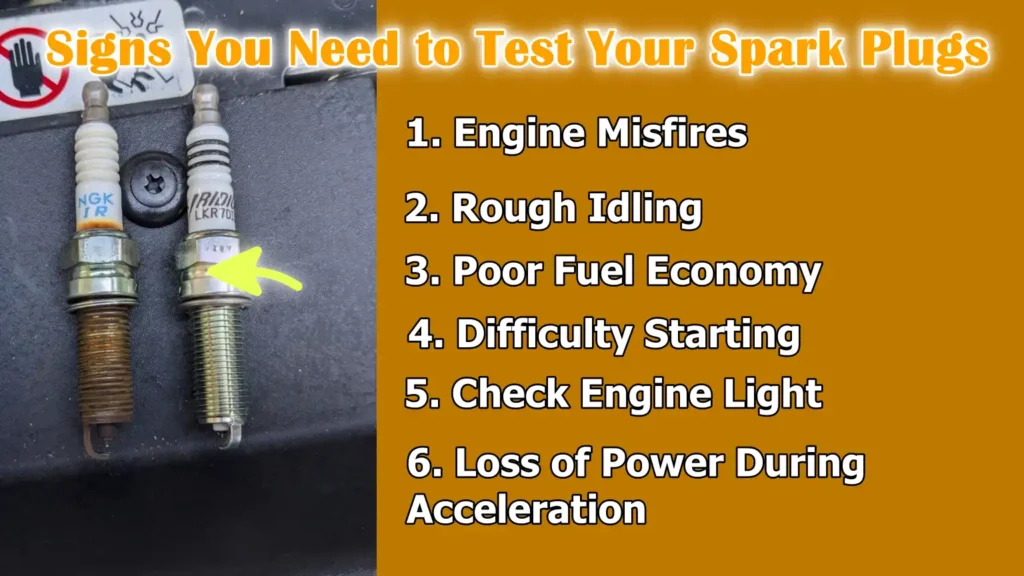
Signs You Need to Test Your Spark Plugs
Spark plugs gradually wear out because they operate under extreme heat and pressure every time the engine runs.
Inside a gasoline engine, combustion temperatures can exceed 2,500 degrees Celsius and spark plugs fire thousands of times per minute at highway speeds.
Over time, the electrodes can wear out, the gap can increase and carbon or oil can build up on the tip.
When this happens, the spark can become weak, uneven, or delayed.
Because spark plugs are directly responsible for igniting the air and fuel mixture, even minor problems can quickly impact engine performance.
Recognizing early warning signs can help you test your spark plugs before the problem becomes more serious or damages other components, such as the ignition coil or catalytic converter.
1. Engine Misfires
Engine misfires occur when the air and fuel mixture inside the cylinder doesn’t ignite properly.
This can happen when the spark plug fails to produce a strong spark at the right time.
When a misfire occurs, you may experience sudden jerks, vibrations, or hesitation while driving.
The engine may sound inconsistent, almost as if it’s running intermittently.
Misfires reduce engine power and increase exhaust emissions because unburned fuel can enter the exhaust system.
If misfires persist for a long time, they can overheat and damage the catalytic converter, which is a costly repair.
Testing the spark plugs is one of the first and most important steps in diagnosing a misfire.
2. Rough Idling
Rough idling is another common sign of a spark plug problem.
When your car is stationary but the engine is running, such as at a traffic light, it should feel smooth and stable.
If the spark plugs are worn or dirty, the combustion process may be inconsistent.
This can cause vibrations, rattles, or fluctuations in engine speed during idling.
You may notice that the engine feels unstable or sounds different than normal.
Because idle speed depends on consistent and balanced combustion in all cylinders, weak spark plugs can also cause noticeable roughness.
Testing the spark plugs can help determine if a rough idle is due to uneven ignition.
3. Poor Fuel Economy
Spark plugs that don’t ignite fuel properly can increase fuel consumption.
When combustion is incomplete or weak, the engine may compensate by injecting more fuel to maintain power.
This means you may need to fill your fuel tank more often than usual.
Even a slight decrease in combustion efficiency can reduce overall mileage over time.
In many cases, replacing worn spark plugs or properly gapping them can improve fuel economy by restoring efficient ignition.
If you notice a sudden or gradual drop in miles per gallon without changing driving habits, testing your spark plugs is a smart and inexpensive first step.
4. Difficulty Starting
If your engine struggles to start, the condition of the spark plugs may be the culprit.
During startup, the engine relies heavily on a spark to ignite the fuel mixture because the engine is cold and fuel doesn’t vaporize as easily.
Worn or defective spark plugs may not produce a strong enough spark, causing the engine to crank for longer before starting.
In more severe cases, the engine may crank but not start at all.
Starting problems are more common in cold weather, when ignition is more critical.
Testing the spark plugs can quickly determine whether the problem is due to weak ignition.
5. Check Engine Light
Modern vehicles are equipped with onboard diagnostic systems that monitor engine performance.
If the system detects misfires or irregular combustion, it may trigger the check engine light.
Spark plug problems are one of the most common causes of misfire-related diagnostic trouble codes.
When this warning light appears, it doesn’t always indicate a major malfunction, but it should never be ignored.
Using a diagnostic scanner can determine whether the problem is related to cylinder misfires, which often indicate worn or defective spark plugs.
Testing the spark plugs can help confirm the source of the warning before replacing more expensive parts.
6. Loss of Power During Acceleration
Fast acceleration requires efficient combustion in every cylinder.
If one or more spark plugs are weak, the engine may hesitate or feel sluggish when you press the accelerator.
You may experience less pulling power when cornering on the highway or climbing hills.
This is because the energy produced for complete combustion inside the cylinders is reduced.
Over time, this power loss may become more noticeable and may be accompanied by vibration or hesitation.
When you experience poor acceleration, testing the spark plugs can improve engine response and performance.
Tools
| Tool Name | Simple Details |
|---|---|
| Spark Plug Socket | It usually has a rubber insert inside to hold the plug in place. It fits a standard ratchet. Always choose the correct size for your vehicle. |
| Ratchet and Extension | An extension bar provides more length for tight spaces. This makes removal easier and safer. Turn slowly to avoid damaging the threads. |
| Gap Gauge or Feeler Gauge | The correct gap helps create a strong spark. A gap that is too wide or too narrow can cause a misfire. Always consult your vehicle’s manual for the correct gap size. |
| Multimeter – Ohmmeter Setting | Set it to ohm mode before testing. A reading that is too high or zero can indicate a fault. This helps detect hidden damage. |
| Spark Plug Tester | It connects between the plug and the ignition coil. A bright blue spark means it is in good condition. A weak or no spark means it needs to be replaced. |
| Safety Gloves and Eye Protection | Engines can overheat over long periods. Gloves prevent burns and cuts. Safety glasses protect against debris or accidental sparks. |
How to Ensure Safety First Before Testing Spark Plug
Testing spark plugs isn’t particularly difficult, but safety should always come first because you’re working around high-voltage electricity, hot engine parts and fuel vapor.
Spark plugs operate under extreme conditions and the ignition system can generate 20,000 to 40,000 volts of electricity.
Even if the current is low, touching them can cause a painful shock.
Furthermore, engine parts can remain extremely hot long after the vehicle is turned off.
Taking a few simple safety precautions before testing can prevent burns, electric shock, accidental engine damage, or even a fire.
Understanding these precautions helps ensure that your spark plug inspection is both safe and effective.
1. Turn off the engine and let it cool
Before touching any spark plugs or ignition parts, always stop the engine completely and remove the key from the ignition.
After turning off the engine, allow it to cool for at least 30 to 60 minutes.
During normal operation, combustion temperatures inside the cylinder can exceed 2,500 degrees Celsius and the metal parts surrounding the spark plug can become extremely hot.
Touching a hot cylinder head or spark plug can cause serious burns.
Furthermore, removing a spark plug from a hot aluminum cylinder head can damage the threads because the metal expands when heated.
Allowing the engine to cool reduces the risk of injury and prevents costly damage to the threads inside the engine.
2. Disconnect the battery if necessary
In many modern vehicles, specially those with coil-on-plug ignition systems, it’s a good idea to disconnect the battery’s negative terminal before testing.
This prevents sudden electrical shock and engine cranking during operation.
The ignition system can store electrical energy even after the engine is turned off.
Disconnecting the battery reduces the chance of a short circuit and protects sensitive electronic parts like the engine control unit.
If you’re using a multimeter or spark tester, disconnecting the battery can also help prevent accidental sparks that could damage tools or wiring.
3. Work in a Well-Ventilated Area
Always test the spark plug in an open or well-ventilated area.
Gasoline engines emit fuel vapors and these vapors can accumulate in enclosed spaces like small garages.
Fuel vapors are highly flammable and can easily ignite if a spark occurs.
Good airflow helps reduce the concentration of these vapors and reduces the risk of fire.
Ventilation is also important for your health, specially if the engine needs to be started briefly during some tests.
Exhaust gas contains carbon monoxide, which is colorless and odorless but can be dangerous in enclosed spaces.
Proper ventilation ensures both fire safety and protection against respiratory illnesses.
4. Avoid testing near fuel vapors
Never perform spark testing near an open fuel container, a fuel leak, or a strong gasoline odor.
Spark plug testing involves visible electrical sparks and even a small spark can ignite gasoline vapors.
If you notice a fuel leak, repair it before beginning any work on the ignition system.
Keep flammable liquids, cleaning sprays and oily clothing away from your work area.
It’s also important to avoid smoking or using open flames while working on the ignition system.
Being mindful of fuel vapors greatly reduces the risk of fire and prevents serious damage to both you and your vehicle.
How to Test Spark Plug by Doing Visual Inspection – Basic Test
The easiest and most effective way to test a spark plug is by visual inspection.
Many spark plug problems can be diagnosed by carefully observing the condition of the tip and surrounding parts.
Spark plugs operate under extreme heat and pressure and over time, they show signs of wear or engine problems.
The color and condition of the electrodes can tell you whether the engine is running normally, has too much oil, too little oil, or is burning oil.
A thorough visual inspection takes only a few minutes, but it can prevent serious engine damage and unnecessary part replacement.
1. Remove the Spark Plug Properly
Before removing the spark plug, ensure the engine is completely cool to prevent burns and thread damage.
Disconnect the ignition coil or spark plug wire by carefully pulling it straight up, not at an angle, to avoid tearing the wire.
Using a ratchet and a spark plug socket with an extension, loosen the plug by slowly turning it anti-clockwise.
Avoid applying too much force, as this can damage the threads in the cylinder head, specially on aluminum engines.
Once loose, remove the plug gently and keep it clean.
Do not drop it, as the ceramic insulator can easily break, even if the damage is not visible at first.
2. Check the condition of the electrode
The electrode is the small metal tip where the spark is generated.
Over time, this tip can wear down due to constant electrical arcing and excessive heat.
A healthy electrode should have sharp edges and a uniform shape.
If the electrode appears rounded, melted, or excessively worn, the spark may be weak or uneven.
A worn electrode also increases the spark gap, which can cause misfires and poor fuel economy.
If the center electrode is too thin or rough, it is usually recommended to replace it.
This small detail can reveal how well a plug is working.
3. Look for Carbon Buildup
Carbon buildup appears as dry, black soot around the spark plug tip.
It usually occurs when the engine is running too fast, meaning there’s too much fuel and too little air in the mixture.
Short driving trips, a clogged air filter, or a faulty fuel injector can also cause carbon buildup.
Excessive carbon buildup can block the spark and reduce ignition strength.
If the carbon buildup is light, it can be carefully cleaned off, but heavy carbon buildup means the plug needs to be replaced.
Persistent carbon buildup may also mean the engine needs further inspection.
4. Look for Oil Fouling
Oil fouling occurs when engine oil enters the combustion chamber and accumulates on the spark plug tip.
This can be caused by worn piston rings, valve seals, or other internal engine problems.
An oil-filled spark plug will appear wet, black and sometimes shiny.
Oil contamination weakens the spark and can cause frequent misfires or difficult starting.
Replacing the plug may fix the problem temporarily, but the underlying cause of the oil leak must also be addressed.
Identifying oil fouling early can help prevent more serious engine damage.
5. Check for Cracks or Damage
Carefully check the ceramic insulator and metal threads for cracks, chips, or physical damage.
Even a small crack in the ceramic can allow electricity to escape before reaching the electrodes, causing a weak or no spark.
Bad threads can prevent proper sealing, leading to a compression leak.
If the spark plug was dropped or installed incorrectly, it may show signs of impact damage.
Any visible cracks or significant damage are a clear sign that the spark plug needs to be replaced immediately to maintain proper engine performance.
6. What Different Colors Indicate
The color of the spark plug tip provides important information about the engine’s condition.
A light tan or gray-brown color usually indicates that the engine is running properly, with proper air-fuel balance and normal combustion temperature.
A black, dry plug often indicates excess fuel or carbon deposits.
A white or blistered plug may indicate that the engine is running too lean or too hot, which can increase the risk of engine damage.
An oily, wet appearance usually indicates oil entering the combustion chamber.
By understanding these color differences, you can quickly identify whether the spark plug is fine or if there is a deeper engine problem that needs attention.
How to Test Spark Plug By Checking the Spark Plug Gap
Checking the spark plug gap is one of the most important steps in spark plug testing because the size of this tiny space directly affects how well the engine runs.
The spark plug gap is the small distance between the center electrode and the ground electrode on the head of the plug.
This gap is where the electrical spark jumps to ignite the compressed air and fuel mixture.
Although the gap is typically measured in millimeters or thousandths of an inch, such as 0.7 mm to 1.1 mm depending on the engine, this small measurement has a significant impact on ignition performance.
If the gap is incorrect, the spark may be too weak or may not occur at all, leading to misfires, poor fuel economy and poor engine operation.
1. What does the spark plug gap mean?
The spark plug gap refers to the distance the electrical spark must travel between the two electrodes.
When the ignition coil sends high-voltage electricity to the spark plug, energy builds until it’s strong enough to jump this gap.
Having the correct gap provides a strong and consistent spark.
If the gap is too wide, the ignition system may struggle to generate a spark, specially under heavy engine load.
If the gap is too narrow, the spark may be short and weak, reducing combustion efficiency.
Because modern engines are carefully tuned for precise combustion timing, even slight variations in the gap size can impact performance.
2. Manufacturer Gap Specifications
Even, there’s study about advanced spark plug design that actually improve the engine behavior, as with the multi-electrode plugs reduces the vibration and noise while it increases fuel efficiency by up to 15%, also the research shows that the spark plug geometry and gap play a central role in how well the combustion spreads across the cylinder, that directly affects the fuel economy and emissions as well.[¹]
Every vehicle manufacturer provides a recommended spark plug gap specification for each engine model.
This specification is carefully designed to match the ignition system voltage, compression ratio and combustion chamber design.
The correct gap can usually be found in the owner’s manual, service manual, or on the engine information label under the hood.
Using the manufacturer’s recommended gap ensures proper ignition timing and fuel efficiency.
Installing spark plugs without checking the gap can result in performance issues, even if the plug is brand new.
Pre-gaped spark plugs may not always match your engine’s exact requirements, so it’s always wise to confirm the measurement before installation.
3. How to Measure with a Feeler Gauge
A feeler gauge is a simple and accurate tool used to measure small gaps.
It usually comes with thin metal blades of varying thicknesses, each with the measurement value marked on it.
To measure the spark plug gap, gently slide the blade of the correct thickness between the center electrode and ground electrode.
The blade should move with a slight resistance but should not feel loose or too tight.
If the blade doesn’t fit, try a thinner or thicker blade until you find the correct measurement.
Careful measurement ensures that the spark plug meets the exact specifications required for proper combustion.
Taking a few extra seconds to measure the gap can prevent many common ignition problems.
4. How to Adjust the Gap Safely
If the measured gap does not meet the manufacturer’s specifications, it must be carefully adjusted.
To increase the gap, gently bend the ground electrode outward using the appropriate gapping tool.
To decrease the gap, gently tap the ground electrode inward.
It is important to never bend the center electrode, as this could damage the spark plug.
Adjust slowly and re-measure with a feeler gauge until you reach the correct specification.
Excessive force may break the ceramic insulator or weaken the electrode.
Careful adjustment ensures safe and correct ignition performance.
5. Why Incorrect Gap Affects Performance
Incorrect spark plug gap directly affects how well the engine burns fuel.
If the gap is too wide, the ignition coil has to work harder to generate a spark, which can lead to misfires during rapid acceleration.
This can cause hesitation, rough running and a loss of power.
If the gap is too narrow, the spark cannot fully ignite the air-fuel mixture, resulting in incomplete combustion and reduced fuel efficiency.
Over time, an incorrect gap setting can increase fuel consumption, increase exhaust emissions and shorten the life of ignition components.
Maintaining the correct gap helps ensure fast combustion, smooth acceleration, reliable starting and optimal engine performance.
How to Test the Spark with a Spark Plug Tester
Testing the spark with a spark plug tester is the safest and most accurate way to check if a spark plug is firing properly.
A spark plug tester allows you to see the strength and consistency of the spark without any guesswork.
Because the ignition system can produce between 20,000 and 40,000 volts, it’s important to use the correct tool rather than simply holding the plug with a metal rod.
A proper spark test helps confirm whether the problem lies with the spark plug, ignition coil, or another part of the ignition system.
This method is simple, reliable and very helpful in diagnosing engine misfires, hard starting, or power loss.
1. How a Spark Plug Tester Works
A spark plug tester is a small device designed to safely test the strength of the ignition spark.
It connects between the spark plug and the ignition coil or spark plug wire.
When the engine is cranked or running, electrical energy flows through the tester and produces a clean spark within a small, clear window.
This window allows you to observe the spark without being exposed to high voltage.
The tester creates a controlled gap that mimics engine conditions, making it easier to assess the quality of the spark.
If the spark can cross this test gap strongly and consistently, it means the ignition system is functioning properly.
If the spark is weak or absent, further diagnosis is required.
2. Step-by-Step Connection Process
Before connecting the tester, ensure the engine is off.
First, remove the ignition coil or spark plug wire from the spark plug.
Then connect one end of the spark plug tester to the spark plug itself.
Connect the other end of the tester to the ignition coil or spark plug wire.
Ensure all connections are secure so that the electrical path is complete.
Once connected, have someone crank the engine while you observe the tester window from a safe distance.
If you’re working alone, you can use a remote starter switch, if available.
Always keep your hands away from metal parts during testing to avoid electric shock.
After testing, turn off the engine before removing the tester.
3. What a Strong Spark Looks Like
A healthy spark should appear bright blue or bluish-white.
This color indicates strong electrical energy and proper voltage delivery from the ignition system.
The spark should be steady and consistent, without flickering or skipping.
A strong blue spark indicates that the ignition coil is generating sufficient voltage and the spark plug can properly ignite the air and fuel mixture.
In most gasoline engines, a strong spark is essential for a smooth burn, easy acceleration and good fuel economy.
If you see a strong, bright spark every time you start the engine, the spark plug and ignition system are likely functioning properly.
4. Weak or No Spark Diagnosis
If the spark appears weak, yellow, orange, or flickering, it could indicate a problem.
A weak spark could be caused by a worn spark plug, the wrong gap, a bad ignition coil, a bad spark plug wire, or low battery voltage.
If there is no spark, the problem could be a bad ignition coil, a broken wire, a blown fuse, or a problem with the engine control system.
Testing each spark plug individually can help determine whether the problem is limited to just one cylinder or affecting the entire ignition system.
Early detection of a weak or missing spark can prevent further engine damage, improve performance and ensure reliable starting.
How to Test a Spark Plug with a Multimeter
Testing a spark plug with a multimeter is a simple and accurate way to check its internal condition.
Many modern spark plugs, specially resistor-type plugs, are designed with a small built-in resistor.
This resistor helps reduce electrical noise that can interfere with the vehicle’s radio, sensors and engine control unit.
Over time, this internal resistor can fail, break, or lose proper connection, causing a weak spark, misfires, or poor engine performance.
A multimeter allows you to measure electrical resistance and confirm whether the spark plug is still operating within its normal range.
This test is specially helpful when the spark plug appears fine on the outside but may have hidden damage inside.
1. Setting the Multimeter to Resistance (Ohms)
Before testing, ensure the engine is off and the spark plug is removed from the engine.
Set your multimeter to measure resistance, which is indicated by the ohms symbol.
Many digital multimeters have different resistance ranges, so choose a range that can measure at least 20,000 ohms.
Resistance is the amount of resistance to the flow of electricity inside the spark plug.
Measuring this value helps determine if the internal resistor is functioning properly.
If the multimeter is set to the wrong mode, such as voltage or current, the reading will be inaccurate.
Always double-check the settings before placing the probe on the spark plug.
2. How to Measure Resistance
To measure resistance, place one multimeter probe on the upper terminal of the spark plug where it connects to the ignition coil or spark plug wire.
Place the other probe on the center electrode at the end of the plug.
Ensure both probes have clear contact with metal surfaces for an accurate reading.
Hold the probes steady and observe the number displayed on the multimeter screen.
The reading should remain steady and not fluctuate.
If no reading is displayed or the circuit appears open, it could mean there is a break inside the spark plug.
Carefully measuring the resistance helps confirm whether electricity is flowing properly through the plug.
3. Correct Resistance Range
Most resistor-type spark plugs have a resistance value between 4,000 and 15,000 ohms, depending on the design and manufacturer.
Many common spark plugs are around 5,000 and 10,000 ohms.
It’s best to consult your vehicle’s service manual or the spark plug manufacturer’s specifications for the correct range.
If the reading falls within the stated range and remains stable, the spark plug is electrically functioning properly.
A slight difference is normal, but a very high or very low reading may indicate a problem.
If possible, always compare readings from different plugs to look for unusual differences.
4. When Resistance Indicates a Fault
If the multimeter shows very high resistance, such as over 20,000 ohms, or an open circuit reading, it often means the internal resistor is bad.
A bad resistor can weaken or completely block the electrical spark.
If the reading shows zero or near-zero resistance, it may also indicate internal damage or a short circuit.
In both cases, the spark plug should be replaced.
Even if the plug appears clean and undamaged, incorrect resistance can cause misfires, poor fuel economy, rough idling and hard starting.
Using a multimeter provides a clear and reliable way to diagnose hidden spark plug problems and ensure strong ignition performance.
How to Test Spark Plug By Engine Performance Test – In-Vehicle Test
Engine performance testing, also known as in-vehicle testing, is a practical way to check whether the spark plugs are properly distributing engine power.
Unlike bench testing methods, this test is performed while the engine is running.
This allows you to understand in real time how each cylinder is performing.
In a gasoline engine, each cylinder must fire evenly to produce smooth and balanced power.
If a spark plug fails to ignite the air-fuel mixture, that cylinder will not be able to deliver its share of power.
This imbalance can cause vibration, rough idling, slow acceleration and increased fuel consumption.
The cylinder drop test is commonly used by technicians because it directly shows whether each cylinder is actively functioning.
1. Cylinder Drop Test Method
The cylinder drop test works by temporarily disabling one cylinder at a time and observing how the engine reacts.
When a properly functioning cylinder is disabled, engine speed should drop significantly because the power source has been removed.
However, if disabling a cylinder results in little or no change in engine speed, that cylinder may already be weak or not functioning at all.
This method helps isolate a problem to a specific cylinder.
It’s specially useful when diagnosing a misfire or engine malfunction.
By comparing how the engine responds when each cylinder is disabled, you can quickly identify whether a particular cylinder has a spark plug or ignition problem.
2. How to Safely Disconnect the Ignition Coil
Before performing this test, make sure you understand your vehicle’s ignition system.
Many modern vehicles use a coil-on-plug system, in which each spark plug has its own ignition coil.
To perform the test safely, keep your hands and tools away from moving engine parts, such as belts and fans.
While the engine is idling, carefully disconnect the electrical connectors from one ignition coil at a time.
It’s important to pull only the connector and avoid damaging the wiring.
Some vehicles may require a scan tool to electronically disable the cylinder, rather than simply unplugging the connector.
Always reconnect each coil before moving on to the next.
Taking these precautions prevents electric shock and damage to sensitive electronic parts.
3. Listen for changes in RPM
As you disconnect each ignition coil one by one, listen carefully to the engine sound and, if possible, check the tachometer.
When a healthy cylinder is disabled, the engine speed should decrease and the engine should run more rough.
This occurs because the engine is losing a source of combustion power.
A drop in revolutions per minute, often referred to as RPM, confirms that the cylinder was operating normally before being disabled.
If there is no significant change in sound or RPM when the coil is disconnected, it may indicate that the cylinder was initially not firing properly.
Careful listening and observation are essential to performing this test correctly.
4. Identifying a Dead Cylinder
A dead cylinder is a cylinder that is not producing power due to improper combustion.
This can be caused by a bad spark plug, a bad ignition coil, fuel delivery problems, or compression problems.
During a cylinder drop test, if disconnecting a particular coil does not change the engine’s speed or smoothness, that cylinder may already be inactive.
Once identified, you can inspect the cylinder’s spark plug for wear, dirt, improper gap, or internal damage.
Replacing a faulty spark plug often restores normal combustion.
Early detection of a faulty cylinder helps prevent further engine damage, reduce fuel waste and improve driving performance.
Now, Let’s Understand the Test Results
After inspecting your spark plugs, measuring the gap, spark testing, or testing them with a multimeter, the next important step is to understand what the results actually mean.
A spark plug can tell you a lot about both its condition and the overall health of your engine.
Because spark plugs operate directly inside the combustion chamber, they are exposed to extreme heat, pressure, changes in fuel mixture and the possibility of oil leaks.
Color, wear patterns, deposits and electrical readings all provide information about their functioning.
Understanding these signs helps you determine whether a spark plug is good, needs cleaning, or should be replaced immediately.
Making the right decision now can improve fuel economy, restore engine smoothness and prevent more serious mechanical problems.
1. Good Spark Plug Indicators
The insulator tip of a good spark plug typically has a light tan, gray, or slightly brown color.
This color indicates that the air and fuel mixture is balanced and the combustion temperature is normal.
The electrode edges should be sharp and clean and should not appear melted or excessively worn.
The spark gap should be within the manufacturer’s specifications and the resistance reading should be within the stated range.
When tested with a spark tester, the plug should produce a bright blue or blue-white spark that appears strong and consistent.
If all these conditions are present, the spark plug is functioning properly and does not need to be replaced.
2. Signs of Fouling
Fouling occurs when debris accumulates on the spark plug tip, obstructing the spark.
This can lead to weak ignition and misfires.
Fouling can be caused by excess fuel, oil leaks, short driving trips, or the spark plug’s incorrect heat range.
A fouled plug often appears dirty or coated rather than clean and dry.
During testing, the spark may appear weak or uneven.
Fouling reduces combustion efficiency, leading to rough idling, hesitation and poor fuel economy.
Identifying fouling early can help you correct the underlying cause before repeated spark plug failures occur.
3. Symptoms of Overheating
Overheating spark plugs often exhibit white, blistering, or chalky marks on the insulator tip.
In some cases, the electrode may appear melted or severely worn.
This condition usually means the combustion chamber is running too hot.
Causes may include a lean air-fuel mixture, incorrect ignition timing, cooling system problems, or using spark plugs with the wrong heat range.
If left untreated, overheating can increase the risk of engine knocking and internal damage.
If symptoms of overheating appear, the spark plugs should be replaced and the engine condition checked to prevent further problems.
4. Oil Contamination
Oil contamination is easy to identify because the spark plug tip appears wet, black and sometimes shiny.
This condition occurs when engine oil enters the combustion chamber, often due to worn piston rings, bad valve seals, or other internal wear.
Oil on the spark plug reduces its ability to produce a strong spark and often causes misfires and difficult starts.
Cleaning or replacing the plug alone may provide a temporary improvement, but the underlying mechanical problem must be corrected to prevent oil from entering the cylinder.
Early detection of oil contamination can prevent long-term damage to the engine.
5. Carbon Deposits
Carbon deposits appear as dry, black soot that accumulates on the spark plug tip.
This usually indicates that the engine is running rich, meaning there is not enough fuel and air in the mixture.
Other possible causes include a clogged air filter, a faulty fuel injector, or frequent short trips where the engine hasn’t fully warmed up.
Light carbon deposits can sometimes be carefully cleaned, but heavy deposits usually require replacement.
Excessive carbon reduces spark strength and can lead to reduced fuel efficiency and poor engine performance.
Correcting the cause of carbon deposits helps maintain clean combustion and improved engine performance.
6. When is it appropriate to clean or replace?
If the plug is fairly new and has only light carbon deposits, cleaning the spark plug may be appropriate.
In such cases, a light cleaning with the appropriate spark plug cleaning tool may work.
However, if the electrodes are worn, melted, cracked, or heavily soiled with oil, cleaning them is not recommended.
Modern platinum and iridium spark plugs have fine electrode tips that can easily be damaged during cleaning.
In most cases, replacing a worn or damaged spark plug is safer and more reliable than trying to reuse it.
Given that spark plugs are much cheaper than engine repairs, replacing them is often the best long-term way to maintain strong ignition and smooth engine performance.
Difference Between Cleaning vs Replacing Spark Plugs
When spark plugs begin to show signs of wear or deposits, many vehicle owners wonder whether they should clean or replace them.
Spark plugs operate under extreme heat and pressure every time the engine is run and over time, the electrodes gradually wear down, while deposits can build up on the tips.
Because spark plugs directly affect fuel ignition, even a slight decrease in performance can reduce engine efficiency, increase fuel consumption and cause driving difficulties.
Understanding when to clean and replace them helps you maintain reliable engine performance and avoid recurring problems.
1. When Cleaning May Work
Cleaning spark plugs can be effective when the plugs are still in their service life and have only light carbon deposits on the tips.
This often occurs in vehicles that make short trips, where the engine hasn’t reached full operating temperature and deposits form more easily.
If the electrodes are still sharp, the ceramic insulator is not cracked and the gap can still be set to specifications, cleaning may restore a proper spark for a short time.
However, cleaning should only be considered if there is no oil buildup, no significant damage and no signs of overheating.
Spark plugs that are severely worn or dirty will not perform properly even after cleaning.
2. Cleaning Tools
Proper cleaning requires the right tools to prevent damage to the spark plug.
Spark plug cleaning tools or a soft wire brush can be used to gently remove dried carbon deposits.
Some technicians use compressed air to remove loose particles.
It is important not to sand or grind modern platinum or iridium electrodes, as their very fine tips can easily become blunt.
After cleaning, the spark plug gap should be re-measured with a feeler gauge to ensure it still meets manufacturer specifications.
Cleaning should always be done carefully to avoid cracking the ceramic insulator or bending the electrode.
3. Why Replacement Is Often Better
In many cases, replacement is a safer and more reliable option.
Spark plugs gradually wear down and constant electrical arcing can cause the electrodes to become rounded or thin.
Even if the plug appears clean, worn electrodes can reduce spark strength and burning efficiency.
Modern engines are designed to operate with precise ignition timing and worn spark plugs can increase stress on the ignition coil and other parts.
Replacing spark plugs provides a strong, consistent spark and restores optimal engine performance.
Because spark plugs are relatively inexpensive compared to other engine parts, replacing them can often prevent larger and more costly repairs in the future.
4. Cost Comparison
The cost of cleaning spark plugs is usually limited to time and basic tools, but the savings can be short-term.
Standard copper spark plugs are generally cheaper, while platinum and iridium plugs are more expensive but last significantly longer.
Although replacement requires new plugs, the improved fuel efficiency and improved engine performance often outweigh the cost over time.
Furthermore, repeatedly removing and reinstalling old spark plugs can increase the risk of thread damage.
In most cases, investing in new spark plugs provides better long-term value and reliability than attempting to clean them multiple times.
5. Recommended Replacement Time
Replacement time depends on the type of spark plug used in the engine.
Copper spark plugs typically last approximately 20,000 to 30,000 miles due to faster wear of the electrodes.
Platinum spark plugs can last approximately 60,000 miles under normal driving conditions.
Iridium spark plugs, which are made of a harder and more heat-resistant material, often last 80,000 to 100,000 miles or more.
Always follow your vehicle manufacturer’s service schedule.
Even long-life spark plugs should be periodically inspected to maintain the proper gap and condition.
Replacing spark plugs at the recommended time helps maintain fuel efficiency, reduce emissions and keep your engine running smoothly for years to come.
Read More:
Common Mistakes You Need to Avoid Doing Spark Plug Testing
Testing and servicing spark plugs may seem simple, but small mistakes can damage the engine, impair performance, or require costly repairs.
Spark plugs work inside the cylinder head, which in modern engines is often made of aluminum.
Aluminum is stronger than steel but softer, meaning the threads can easily bend if handled improperly.
Furthermore, the ignition system generates very high voltages and improper handling can cause electric shock or damage sensitive parts.
Understanding and avoiding common mistakes ensures safe work, accurate testing and long-lasting engine performance.
1. Testing on a Hot Engine
One of the most common mistakes is removing or testing spark plugs when the engine is hot.
During normal operation, combustion temperatures inside the cylinder can exceed 2,500 degrees Celsius and the metal parts surrounding the spark plug become extremely hot.
Touching these parts can cause severe burns.
More importantly, removing the spark plug from a hot aluminum cylinder head can damage the threads because metal expands when heated.
If the threads are stripped, repairs can be expensive and may require special thread inserts.
Always let the engine cool completely before checking or testing the spark plug.
2. Overtightening the Spark Plug
Overtightening the spark plug is another common mistake that can cause serious problems.
It’s important to tighten the spark plug enough to create a proper seal, but applying too much force can break the ceramic insulator or strip the threads in the cylinder head.
Bad threads can cause compression leaks or even cause the spark plug to come loose while driving.
Using a torque wrench helps apply the correct amount of force according to the manufacturer’s specifications.
Proper tightening ensures a secure seal without damaging engine parts.
3. Incorrect Gap Adjustment
Incorrectly setting the spark plug gap can reduce engine efficiency and cause misfires.
If the gap is too wide, the ignition coil has to work harder to generate a spark, which can lead to weak ignition under high loads.
If the gap is too narrow, the spark may be too small to properly ignite the air-fuel mixture.
Incorrect adjustment can also increase fuel consumption and exhaust emissions.
Always use a feeler gauge to accurately measure the gap and adjust slowly without bending the center electrode.
Following the manufacturer’s recommended gap ensures proper combustion and smooth engine operation.
4. Mixing Plug Wires
In engines that use traditional spark plug wires, mixing up the wire order can cause the engine to run improperly.
Each cylinder must fire in a specific sequence, called the firing order.
If the wires are connected to the wrong spark plugs, the engine may misfire, shake violently, or fail to start.
Incorrectly installing the wires can also cause backfiring and damage engine parts.
To avoid this mistake, remove and replace the wires one by one, or label them before removing them.
Maintaining the correct firing order is crucial for balanced engine performance.
5. Ignoring Torque Specifications
Every engine manufacturer provides specific torque values for spark plug installation.
Ignoring these specifications can cause the spark plugs to be loose or too tight.
A loose spark plug can allow gas to leak from the threads, reducing compression and causing overheating around the plug.
Overtightening can damage the plug threads or make them difficult to remove in the future.
Using a torque wrench ensures that each spark plug is installed with the correct force.
Following torque specifications protects the cylinder head, maintains proper sealing and ensures long-term safe operation of the ignition system.
When You Should Consult to the Professional
Testing and replacing spark plugs can fix many common engine problems, but there are some situations when professional diagnosis is the safest and smartest approach.
Modern vehicles are controlled by complex electronic systems that monitor ignition timing, fuel delivery, air intake and emissions.
Although spark plugs are often the cause of misfires or poor performance, they are only one part of a larger ignition and engine management system.
If problems persist even after proper testing and replacement, there may be a deeper mechanical or electrical problem.
Seeking professional help immediately can prevent further engine damage, reduce long-term repair costs and ensure a correct diagnosis using advanced tools.
1. Persistent Misfires
If the engine continues to misfire even after replacing or properly testing the spark plugs, the problem may not be limited to the plugs alone.
Persistent misfires can be caused by a bad ignition coil, a faulty fuel injector, a vacuum leak, low compression, or timing issues.
A professional technician can perform a compression test, fuel pressure test and advanced diagnostic scan to determine the exact cause.
Persistent misfires should not be ignored because unburned fuel can enter the exhaust system and damage the catalytic converter, an expensive component.
If the engine continues to shake, loses power, or repeatedly stalls, a professional inspection is recommended.
2. The Check Engine Light Remains On
If the Check Engine light remains on even after spark plug replacement or testing, the vehicle’s onboard diagnostic system has detected an ongoing problem.
Modern vehicles store diagnostic trouble codes that identify specific problems related to ignition timing, misfires, sensor readings, or fuel mixture imbalances.
A professional repair shop uses a scan tool to accurately read these codes and interpret live engine data.
Simply removing the warning light without fixing the underlying problem can lead to hidden damage.
If the warning light flashes, it usually indicates a serious misfire that requires immediate attention to prevent damage to the engine or exhaust system.
3. Ignition Coil Problems
Ignition coils are responsible for converting low battery voltage to a higher voltage to ignite the spark plugs.
If a coil fails, the spark plugs will not receive enough power to produce a strong spark.
Symptoms of a bad ignition coil often include rough idling, hesitation during acceleration, poor fuel economy and difficulty starting.
While some ignition coils can be tested with basic tools, professional technicians have specialized equipment to accurately measure coil output under load conditions.
If the coil itself is weak or damaged, replacing the spark plugs won’t solve the problem.
If spark testing reveals a weak or inconsistent spark even with a new plug, professional evaluation of the ignition coil is necessary.
4. ECU-Related Problems
The engine control unit, often referred to as the ECU, manages ignition timing, fuel injection and overall engine performance.
It constantly receives data from sensors such as the oxygen sensor, crankshaft position sensor and camshaft sensor.
If the ECU receives incorrect data or has an internal fault, misfires or poor ignition performance can occur even if the spark plugs are in good condition.
Diagnosing ECU-related problems requires advanced diagnostic equipment and technical knowledge.
In some cases, software updates or sensor replacement may be necessary.
If ignition problems persist without an obvious mechanical cause, professional diagnosis ensures that essential electronic systems are properly and safely checked.
Conclusion – How to Test Spark Plugs
Now, you have clearly understand about the importance of having the fully working and that’s why you need to check Spark Plug is worn out or not.
Spark plugs may be small parts, but they play a direct and powerful role in your engine’s starting, running, acceleration and fuel consumption.
Every time you drive, each spark plug fires thousands of times per minute to ignite the compressed air and fuel mixture inside the cylinder.
When spark plugs are clean, properly gapped and electrically sound, combustion occurs efficiently.
This results in smooth idling, faster acceleration, better fuel economy and lower exhaust emissions.
However, when spark plugs become worn, damaged, overheat, or clogged, the effects can quickly manifest as misfires, poor engine performance, hard starting and increased fuel consumption.
So, that’s all from this guide and you can ask questions in the comment.
Frequently Asked Questions
Q1. What exactly does a spark plug do in a car engine?
A spark plug creates a small but powerful electric spark that ignites the air and fuel mixture inside the engine cylinder. This ignition creates a controlled explosion that pushes the piston down and generates the power needed to run your vehicle. When the engine is running, each spark plug fires thousands of times every minute. If the spark is weak, delayed, or missing, the fuel will not burn properly and the engine will lose power, run poorly, or waste fuel. Because spark plugs directly control combustion, they are one of the most important parts of the ignition system.
Q2. How do I know if my spark plugs need testing?
If you experience rough idling, slow acceleration, engine shaking, poor fuel economy, difficulty starting the car, or a check engine light, you should consider testing your spark plugs. These symptoms often indicate an ignition problem. Even if you don’t notice obvious symptoms, spark plugs should be checked at the regular service intervals recommended by your vehicle manufacturer. Over time, electrodes wear down, deposits accumulate and the spark gap widens, reducing performance. Regular testing helps you detect these changes early, before they cause major engine problems.
Q3. How often should spark plugs be replaced?
Replacement time depends on the type of spark plug used in your vehicle. Standard copper spark plugs typically last approximately 20,000 to 30,000 miles. Platinum spark plugs can last approximately 60,000 miles, while iridium spark plugs can last 80,000 to 100,000 miles or more. However, driving conditions such as frequent short trips, heavy traffic, towing, or extreme temperatures can shorten their lifespan. It’s always best to consult your owner’s manual for accurate advice. Even long-life spark plugs should be checked periodically to ensure they’re working properly.
Q4. Can I test spark plugs at home without any special tools?
Yes, you can perform a basic spark plug test at home using simple tools. Visually, you can detect carbon deposits, oil buildup, cracks, or worn electrodes. A gap gauge can determine if the spark gap is within specifications. If the plug design allows, a multimeter can test electrical resistance. However, more serious problems may require a spark tester or diagnostic scan tool. Most vehicle owners can perform basic testing, but complex ignition or engine control problems may require professional equipment.
Q5. What does spark plug color tell me?
The color of the spark plug tip provides important information about engine health. A light tan or gray color usually means the engine is running properly and the air-fuel mixture is balanced. Black, dry soot often indicates a lean fuel mixture or a weak spark. Oily deposits can indicate worn piston rings or valve seals. A white or blister-like appearance can indicate overheating or a lean fuel mixture. Reading the color of spark plugs is a helpful diagnostic method because it reveals what’s happening inside the combustion chamber.
Q7. Is it safe to clean spark plugs instead of replacing them?
Cleaning spark plugs can sometimes improve performance if the deposits are light and the electrodes aren’t worn. However, cleaning won’t fix worn electrodes, broken ceramic insulators, or excessive gaps. If the spark plug is old or severely worn, replacing it is a safer and more reliable option. Modern spark plugs are designed for durability, but once the firing tip is significantly worn, cleaning won’t restore full performance. In most cases, spark plugs are recommended to be replaced when they are significantly worn.
Q8. Can bad spark plugs damage the engine?
Yes, driving with bad spark plugs can cause long-term damage. Frequent misfires can cause unburned fuel to enter the exhaust system, which can overheat and damage the catalytic converter. Misfires can also increase engine vibration, stress the ignition coils and reduce fuel efficiency. Over time, poor combustion can lead to carbon deposits within the engine. Fixing spark plug problems quickly helps protect both engine performance and expensive emission components.
Q9. What happens if the spark plug gap is incorrect?
If the spark plug gap is too wide, the spark can be weak or uneven, which can lead to misfires and poor engine performance. If the gap is too small, the spark cannot ignite the fuel mixture properly, reducing combustion power. Modern engines are designed with very specific gap settings to ensure proper ignition timing and fuel burn. Always adjust the gap carefully using the correct gauge and follow the manufacturer’s specifications. An incorrect gap can reduce fuel efficiency and cause performance problems.
References:
[1] Enhancing Automotive Performance: A Comparative Study of Spark Plug Electrode Configurations on Engine Behaviour and Emission Characteristics
https://www.mdpi.com/2624-8921/7/2/55

Guys, I’m a car audio enthusiast and customization expert and I love clear sound and clean installation. Plus, I have spent years helping people build their dream audio setups. And whenever I’m working on cars, I probably listen to music and thinks about the next big upgrade.