
Written By: Don Dodi
Fact Checked By: Kristen Brown
Reviewed By: Diego Rosenberg
If the vehicle is shaking when you accelerate it, then it often sign of something is not right and you need to check if it is just the small issue or big one.
Because, the acceleration literally puts extra load on the engine and transmission, that forces them to burn more fuel, that leads to creating more power and all the power transfers to the wheels in the efficient way, otherwise shaking will happen.
So, literally even if one part in this system such as: spark plug, fuel injector, motor mount, axle or tire is worn out or actually damaged, then the imbalance occurs in the form of noticeable vibrating effect.
Plus, there’s automotive service data and repair industry reports that shows that the ignition problems and the tire imbalance are among the most commonly causes behind the vehicle vibration complaints.
As well as, just take the vibration as the warning signs of the problems and learn Why Is My Car Shaking When I Accelerate, so that you can find out the actual problem to solve it later on efficiently.
Check If There’s Engine-Related Causes
When a car shakes during acceleration, the engine is often the first thing to check, as it’s responsible for generating power.
During acceleration, the engine burns more fuel and air to accelerate combustion, increasing internal pressure and movement.
If any part of the combustion or engine support system is faulty, this extra load exacerbates the imbalance.
Engine-related vibrations are usually felt through the steering wheel, floor, or seats and may be accompanied by a loss of power, strange noises, or warning lights.
Understanding how each engine component works makes it easier to identify why a particular vibration occurs when the gas pedal is pressed.
1. Worn or Bad Spark Plugs
How Spark Plugs Affect Combustion
Spark plugs are small but essential components that ignite the air-fuel mixture inside each cylinder of the engine.
Every time you press the accelerator, the engine control system injects more fuel and the spark plug must fire properly to ensure even combustion.
If the spark plug is worn, dirty, or has a weak gap, the fuel cannot ignite completely.
This incomplete combustion causes the power strokes within the engine to be uneven, leading to vibrations.
Modern engines can emit thousands of sparks per minute, so even a slight delay or weak spark can cause noticeable vibrations during acceleration.
Symptoms of Engine Misfire During Acceleration
Engine misfires occur when one or more cylinders fail to produce power properly.
This problem is exacerbated during acceleration due to the increased demand on the engine.
Common symptoms include jerking, hesitation, reduced fuel efficiency and vibrations.
The vehicle may feel as if it is struggling to accelerate.
In many cases, the Check Engine light may come on, indicating a serious misfire that should be repaired quickly to prevent damage to the catalytic converter.
Rough Idle vs Vibration Only When the Gas Pedal Is Pressed
Rough idle means the engine vibrates even when the car is not moving, usually due to a persistent combustion imbalance.
However, vibration only during acceleration means that the problem worsens when more fuel is added and the engine is subjected to more stress.
If the vibration occurs most often when the gas pedal is pressed, but improves at the same speed, there is often a problem with the spark plug or ignition.
2. Ignition Coil Problems
The Role of the Ignition Coil in Fuel Ignition
Ignition coils convert low voltage from the battery to the higher voltage needed to create a spark at the spark plug.
Without strong coil output, the spark will be weak or uneven.
Because acceleration requires faster and more frequent combustion cycles, weak ignition coils often fail under load.
This causes fuel to burn unevenly, leading to vibrations or jerks during acceleration.
2. Signs of a Weak or Bad Coil
A bad ignition coil can cause poor acceleration, backfiring, reduced engine power and difficulty starting the car.
The engine may feel smooth at low speeds, but may start to vibrate when more power is needed.
Over time, a weak coil can damage the spark plugs and increase fuel consumption because the fuel is not burning properly.
3. Check Engine Light Indicator
Most modern vehicles use sensors to detect misfires.
When ignition coils fail, the engine control module records fault codes that trigger the check engine light.
Diagnostic codes, such as cylinder-specific misfire codes, often indicate ignition system problems.
Ignoring these warnings can lead to more expensive repairs if unburned fuel damages other parts.
3. Dirty or Clogged Fuel Injectors
How Fuel Injectors Affect Engine Performance
Fuel injectors spray a thin mist of fuel into the engine cylinders at the right time.
Proper atomization of fuel is essential for smooth combustion.
If the injectors become dirty due to carbon deposits or poor-quality fuel, the spray pattern becomes uneven.
This affects how well the fuel mixes with the air and burns.
During acceleration, when more fuel is needed, limited injectors may not deliver an equal amount of fuel, causing vibration.
Different Fuel Delivery and Vibration
When one cylinder receives less fuel than another, it produces less power.
This imbalance between cylinders causes vibration.
Vibration can be felt as a slight jerk or hesitation when the accelerator is pressed.
Over time, variations in fuel delivery can also reduce fuel economy and increase engine wear.
Fuel System Cleaning Solution
Fuel injector cleaning additives can sometimes remove minor deposits and restore the correct spray pattern.
In more severe cases, professional cleaning or injector replacement may be required.
Regular maintenance and using good quality fuel can help prevent deposits and keep the engine running smoothly.
4. Clogged Fuel Filter
Reduced Fuel Flow During Acceleration
The fuel filter removes dirt and debris from gasoline before it reaches the engine.
If the filter becomes clogged, it restricts fuel flow.
At low speeds, the engine may receive just enough fuel to run normally.
However, during acceleration, the engine requires more fuel.
A clogged filter cannot deliver enough fuel quickly, causing hesitation and vibration.
Reduced Power and Hesitation
Drivers often experience delays in acceleration or feel as if the car is struggling to pick up speed.
In severe cases, the engine may stall.
Replacing a clogged fuel filter restores proper fuel pressure and helps the engine deliver smooth, consistent power.
5. Bad Engine Mounts
Purpose of Engine Mounts
Engine mounts secure the engine to the vehicle’s frame while absorbing vibrations.
They are typically made of metal and rubber.
The rubber part cushions engine movement and prevents excessive vibration from reaching the cabin.
How worn mounts cause increased vibration under load
When you accelerate, torque causes the engine to shift slightly.
Healthy mounts control this movement.
If a mount is cracked, worn, or broken, the engine may move excessively.
This excessive movement causes noticeable vibration, specially during acceleration when engine force is highest.
Visible and Physical Signs of Wear
Signs of worn engine mounts include visible cracks in the rubber, a rattling sound when changing gears and excessive engine vibration when revving.
In some cases, vibration may be mild at constant speeds but increase when accelerating after stopping.
Replacing worn mounts can restore stability and reduce vibrations felt inside the vehicle.
Check If Vibration Is Caused By Transmission Problems
The transmission is the system that transmits power from the engine to the wheels.
The engine produces power, while the transmission controls how that power is delivered at different speeds.
When you accelerate, the transmission shifts gears or adjusts torque to ensure smooth and consistent operation.
If something in this system is worn, low on fluid, or defective, power is not delivered properly.
This uneven transfer of power often results in jolts, jerks, slippage, or hesitation.
Transmission-related vibrations are typically more noticeable when the vehicle changes gears or when the engine is under load during acceleration.
Understanding how transmission parts work helps drivers recognize early warning signs and avoid costly repairs.
1. Low or Impurified Transmission Fluid
Impact on Smooth Gear Shifting
Transmission fluid plays a vital role in both automatic and manual transmissions.
It lubricates moving parts, dissipates heat and, in automatic vehicles, helps create the hydraulic pressure needed for gear shifts.
When the fluid level is low, the transmission cannot maintain the correct pressure.
This can cause delayed or rough gear shifts.
Bad fluid, which may appear dark or have a burning smell, loses its ability to properly lubricate and cool.
During acceleration, when gears shift under high pressure, bad fluid can cause vibration or hard shifting.
Maintaining the correct fluid level and replacing old fluid according to the manufacturer’s schedule helps ensure smooth performance.
Gear Slip and Shutdown
When transmission fluid is low or worn out, gears can slip.
Gear slippage means the transmission struggles to stay in the correct gear, causing sudden increases in engine speed without proper acceleration.
This can cause jerking or vibration.
Drivers may notice the engine revving higher than normal, while the car isn’t accelerating as expected.
Over time, this slippage can cause serious internal damage.
Early fluid checks and timely replacement can prevent these problems from becoming serious.
2. Worn Clutch – Manual Transmission
Symptoms of Clutch Slippage
In manual transmission vehicles, the clutch connects and disconnects the engine to the transmission when shifting gears.
The clutch disc uses friction material to capture and transfer power.
Over time, this friction material wears down.
When the clutch wears out, it can slip during acceleration.
Slippage occurs when the engine speed increases but the car doesn’t accelerate smoothly.
Drivers may notice a burning smell, difficulty climbing hills, or a decrease in acceleration power.
Vibration When Engaging the Clutch
Worn or rough clutch surfaces can cause vibration when engaging gears, specially when starting from a stop.
This vibration is sometimes referred to as clutch chatter.
This occurs because the clutch is not engaging properly, resulting in poor power transfer.
Vibration is typically most pronounced when releasing the clutch pedal.
Replacing a worn clutch can restore smooth engagement and consistent acceleration.
3. Torque Converter Problems – Automatic Transmission
Function of the Torque Converter
In automatic vehicles, the torque converter replaces the clutch.
It uses transmission fluid to transfer engine power to the transmission, allowing the vehicle to stop smoothly.
The torque converter also increases engine torque at low speeds, allowing the vehicle to accelerate smoothly from a stop.
This depends on fluid pressure and the balanced functioning of internal components.
Vibration During Acceleration
If the torque converter is worn or its internal clutch is failing, it may not lock and unlock properly.
This can cause vibration, specially during acceleration at medium speeds.
Drivers may feel the car shaking as if they are driving over small potholes, even on smooth roads.
This problem is often more noticeable when the transmission shifts into higher gears.
In some cases, poor transmission fluid can cause vibration in the torque converter.
Promptly repairing fluid problems or a faulty torque converter can ensure proper power delivery and prevent further damage to the transmission.
How to Know It Vibration Is Causing By Drivetrain and Axle Problems
The drivetrain is the system that transmits power from the transmission to the wheels.
It includes parts like the axles, CV joints, driveshafts and differential.
When you press the accelerator, engine power passes through these parts before reaching the tires.
If any part of this chain is worn, bent, or damaged, the flow of power is inconsistent.
This inconsistent performance often results in vibrations, jolts, or strange noises, specially during acceleration when torque is high.
Drivetrain problems need to be addressed immediately because they directly impact how safely and smoothly the vehicle operates.
Ignoring these problems can lead to more serious mechanical damage and, in extreme cases, even loss of control.
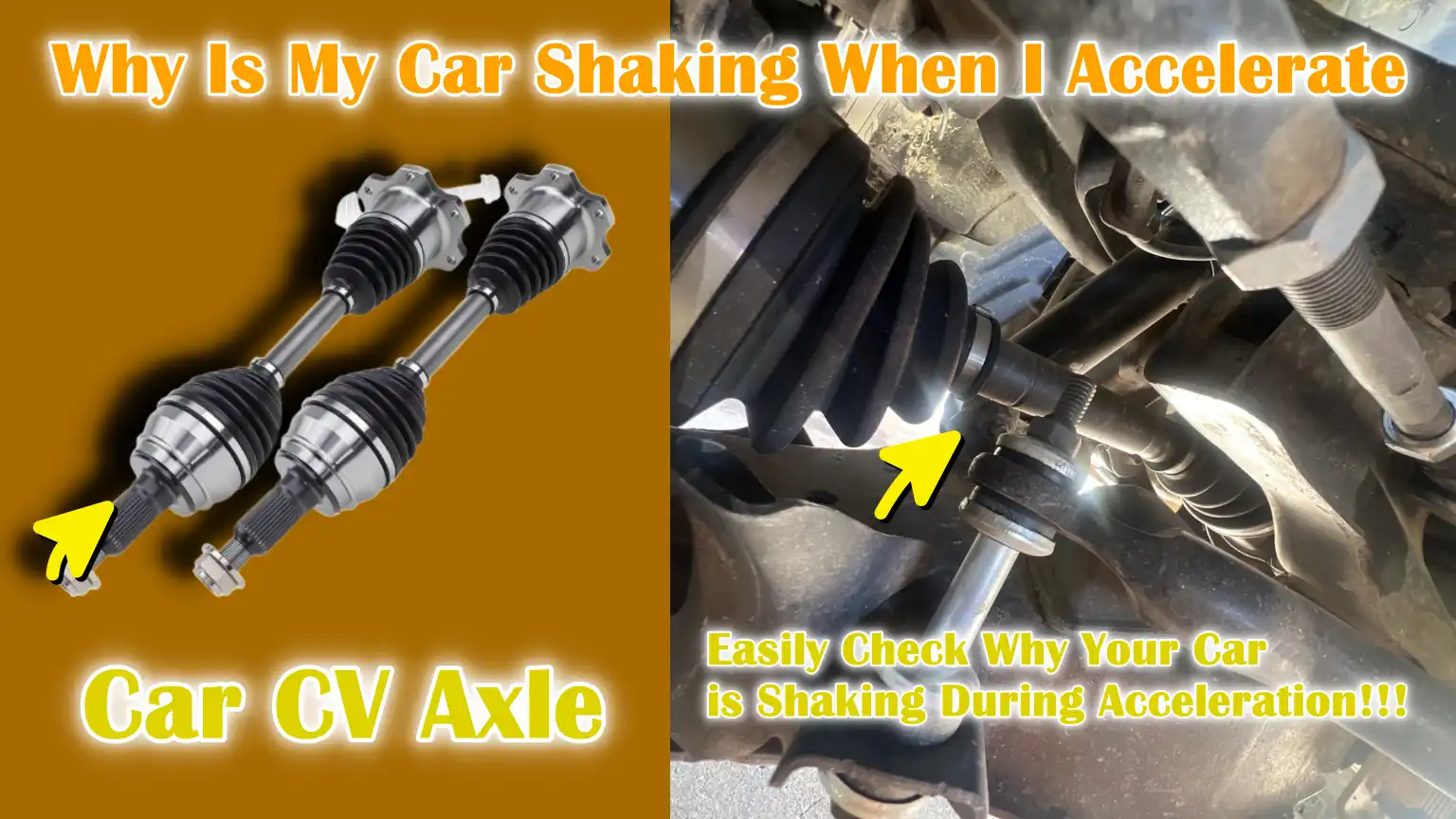
1. Worn CV Joints
Clicking Sounds and Vibrations
Constant velocity joints, commonly called CV joints, are found at the ends of the drive axles of most front-wheel-drive and many all-wheel-drive vehicles.
Their function is to smoothly transfer power, as well as allow the wheels to move up and down with the suspension and turn left or right.
CV joints are protected by grease-filled rubber boots.
If the boots become torn or cracked, grease leaks out and dirt gets inside, causing the joint to wear out faster.
A worn CV joint often makes a clicking or popping sound when turning.
As the damage progresses, vibrations may also be felt during acceleration because the joint no longer rotates smoothly under load.
Vibrations During Turning and Acceleration
The greatest stress on a CV joint occurs when you accelerate while turning.
If they are worn, vibration increases during this movement.
The driver may feel vibrations in the steering wheel or through the vehicle floor.
In severe cases, a completely worn CV joint can reduce power to the wheels.
Promptly replacing a worn CV joint or worn boot can prevent further axle damage and restore performance.
2. Bad Driveshaft
Imbalance at High Speeds
The driveshaft is a long rotating shaft that transfers power from the transmission to the differential in rear-wheel-drive and some all-wheel-drive vehicles.
To rotate smoothly at high speeds, it must be perfectly balanced.
Even a small dent, a worn universal joint, or an imbalance can cause severe vibrations.
As speed increases, the rotation becomes faster and the imbalance becomes more noticeable.
This is why many drivers experience vibrations at high speeds or during rapid acceleration.
Underbody Vibration
A bad driveshaft often causes vibrations that seem to come from beneath the vehicle, not from the steering wheel.
The vibrations can be persistent and increase with speed.
Worn universal joints connected to the driveshaft can also cause a rattling noise when shifting from park to drive or during sudden acceleration.
Repairing or replacing a bad driveshaft restores proper balance and prevents stress on other parts of the drivetrain.
3. Differential Problems
Power Distribution Problems
The differential is responsible for distributing engine power to the wheels, causing them to rotate at different speeds, specially when cornering.
Without a properly functioning differential, the wheels will stick together, causing instability.
The differential contains gears and bearings that must be properly lubricated.
If these parts wear out or the fluid level drops, power cannot be delivered smoothly.
This uneven power delivery can cause vibrations during acceleration.
Grinding or Squealing Noises
Differential problems often present with clear sounds before a sharp jolt.
Drivers may hear grinding, humming, or crackling sounds that vary with speed.
These sounds typically intensify during acceleration as more torque is applied.
If ignored, worn gears or bearings can cause serious mechanical failure.
Regularly checking the differential fluid and promptly addressing any unusual noises can ensure smooth power transfer and prevent costly damage.
How to Check If There’s Wheel and Tire Problems That Is Causing Vibration
Wheel and tire problems are one of the most common reasons a car shakes during acceleration.
Unlike engine or transmission problems, these problems are directly related to how the vehicle interacts with the road.
Tires rotate thousands of times per mile and even a small imbalance or defect can cause noticeable vibrations.
When you accelerate, the wheels rotate faster, increasing the force exerted on them.
If the tires, rims, or suspension parts are not in good condition, the vibrations become more pronounced and easier to feel.
It is important to correct these problems quickly, as they affect not only comfort but also steering control, braking performance and tire life.
1. Unbalanced Tires
Speed-Dependent Vibration
Tire balancing ensures that the weight of the tire and wheel assembly is evenly distributed around the axle.
If the weight is not uniform, the tire doesn’t rotate smoothly.
Instead, it vibrates slightly, which increases with increasing speed.
Therefore, unbalanced tires often produce vibrations that begin at medium speeds and worsen during acceleration.
The faster the wheel rotates, the greater the vibration.
Even a small difference in weight can cause noticeable vibrations because centrifugal force increases with speed.
Steering Wheel Shaking
When front tires are unbalanced, vibrations are usually felt in the steering wheel.
The driver may feel the steering wheel shaking or vibrating, specially in certain speed ranges.
If rear tires are unbalanced, vibrations may be more felt on the vehicle seats or floor.
Regular tire balancing when rotating or replacing tires helps prevent these problems and ensure smooth driving.
2. Wheels in Misalignment
Uneven Tire Wear
Wheel alignment means adjusting the angle of the wheels so that they are in the correct position according to the manufacturer’s specifications.
If the wheels are misaligned, the tires cannot make proper contact with the road.
This causes uneven tire wear, such as excessive wear on the inside or outside edges.
Driving over potholes, curbs, or uneven roads can also cause vehicle alignment to deteriorate.
Over time, uneven tire wear can cause vibration, specially during acceleration when excessive force is applied to the tires.
Pulling to One Side
A common sign of misalignment is that the vehicle pulls to one side when driving straight.
The driver may have to constantly adjust the steering wheel to keep the car centered.
During acceleration, this imbalance in wheel angle can increase vibration or instability.
Correcting wheel alignment not only reduces vibration but also improves fuel efficiency and extends tire life.
3. Damaged or Bent Rims
Causes from Potholes or Edges
Rims, also known as wheels, can become bent or damaged after hitting potholes, road debris, or edges.
Even a small bend can interfere with the tire’s smooth rotation.
This defect becomes more noticeable during acceleration as the wheel speed increases.
A bent rim causes uneven movement, causing vibration throughout the vehicle.
Visible Damage to Wheels
In some cases, rim damage can be visible to the naked eye, such as cracks, dents, or bent edges.
However, some damage is minor and requires professional inspection to detect.
Drivers may experience persistent vibrations that tire balancing cannot correct.
Repairing or replacing worn rims restores smooth rotation and improves overall vehicle stability.
4. Worn Suspension Parts
Ball Joints, Tie Rods, Control Arms
The suspension system connects the wheels to the vehicle frame and provides smooth movement over potholes.
Parts like ball joints, tie rods and control arms keep the wheels stable and properly aligned.
These parts are subjected to constant movement and stress, specially during acceleration and braking.
Over time, they can wear out or become loose.
Vibration Due to Excessive Play
When suspension parts wear out, they can develop excessive play, which means unwanted movement between the parts.
This looseness can cause the wheels to shake slightly, specially when power is applied during acceleration.
Drivers may feel vibrations in the steering wheel or hear a rattling sound when driving over potholes.
Replacing worn suspension parts restores proper wheel stability, reduces vibration and improves overall safety and control.
Check If There’s Brake System Problems That Causing Vibration
The brake system is designed to slow or stop a vehicle, but problems with this system can also cause vibrations when accelerating.
Many drivers are surprised to learn that brake parts can vibrate even when they are not actively pressing the brake pedal.
This is because brake components are constantly near the wheels.
If something is rough, stuck, or damaged, it can interfere with the smooth rotation of the wheels.
When you accelerate, the wheels spin faster, making any small malfunction more noticeable.
Brake-related vibration often affects the steering wheel and can cause strange noises or impaired driving.
1. Warped Brake Rotor
Vibration When Accelerating After Braking
Brake rotors are flat metal discs attached to each wheel.
When you press the brake pedal, the brake pads stick to these rotors, slowing the vehicle.
Over time, heat can cause rotors to become rough or slightly warped.
Braking creates high temperatures and repeated heating and cooling can cause the metal to lose its perfectly flat shape.
If the rotor surface is rough, it can cause vibrations that continue even after the brake pedal is released.
During acceleration, a rough, rotating rotor can cause vibrations, specially if it is highly warped.
Pulsation in the Steering Wheel
The most common sign of a warped front brake rotor is pulsation or shaking of the steering wheel, specially during braking.
However, if the rotor is very rough, a slight vibration may also be felt during acceleration because the wheel assembly is not rotating smoothly.
This vibration usually becomes more noticeable at higher speeds.
Re-grouting or replacing a warped rotor smooths the contact surface and eliminates vibration.
2. Sticking Brake Calipers
Feeling of Dragging
Brake calipers hold the brake pads and press them against the rotor when the brakes are applied.
After releasing the brake pedal, the calipers should release the pads completely so the wheel can rotate freely.
If the caliper is stuck due to rust, dirt, or worn internal parts, the brake pads may continue to apply slight pressure to the rotor.
This creates constant friction.
When you accelerate, this obstruction can cause vibration or drag because the wheel is not rotating smoothly.
Reduced Fuel Efficiency
Sticking brake calipers not only cause vibration but also reduce fuel efficiency.
Because the wheel is slightly stuck, the engine has to work harder to move the vehicle forward.
This increased work can increase fuel consumption and cause tires to wear poorly or brake parts to overheat.
Drivers may notice a burning smell or excessive heat near the wheel.
Repairing or replacing a worn caliper can smooth wheel movement, improve fuel efficiency and eliminate unwanted vibrations when accelerating.
Check if There’s Exhaust System Problems That Causing Vibration
The exhaust system moves harmful gases away from the engine and reduces noise, keeping the engine running smoothly.
It includes parts like the exhaust manifold, pipes, muffler, resonator and catalytic converter.
As you accelerate, the engine burns more fuel and produces more exhaust gases.
These gases should flow smoothly through the exhaust system.
If a part is loose, broken, or blocked, the flow of gases is uneven.
This can cause vibrations, rattling noises and even reduced engine power.
Because the exhaust system is located underneath the vehicle, many drivers feel vibrations or hear noises from underneath when accelerating.
Fixing exhaust problems quickly can improve engine performance and prevent further damage.
1. Loose or Broken Exhaust Parts
Rattling When Accelerating
Exhaust systems are held in place by metal brackets and rubber hangers that absorb movement and vibration.
Over time, these hangers can wear or break.
Bolts and clamps can also loosen due to heat and road vibration.
When this happens, some parts of the exhaust system can move excessively.
During acceleration, the engine produces a stronger exhaust pulse and more vibration.
This can cause loose parts to rattle or hit the vehicle’s frame.
The noise often becomes louder when the gas pedal is pressed because the exhaust flow increases.
Vibration from Underneath the Vehicle
If the exhaust pipe or muffler is not properly installed, it may vibrate under the car.
This vibration may sound as if it is coming from the floor or rear of the vehicle.
In some cases, the vibration varies with engine speed.
Because exhaust components are made of metal, they expand when heated, making loose connections more obvious after the engine warms up.
Replacing broken hangers or tightening loose parts can restore stability and prevent unnecessary jerking.
2. Clogged Catalytic Converter
Reduced Engine Performance
The catalytic converter is an essential part of the exhaust system that reduces harmful emissions by using a chemical reaction to clean exhaust gases before they leave the vehicle.
Inside the converter is a honeycomb structure coated with precious metals that help break down pollutants.
Over time, this internal structure can become clogged due to carbon deposits, engine misfires, or dirt.
When clogged, exhaust gases cannot escape easily, creating back pressure in the engine.
Because of this, the engine struggles to expel exhaust gases, leading to reduced power, slower acceleration and poor fuel efficiency.
Vibrations due to obstructed exhaust flow
When the exhaust flow is obstructed, the engine cannot breathe properly.
This obstruction is most noticeable during acceleration, when more fuel is burned and more exhaust is produced.
Poor engine performance can cause the engine to run weak, jerk, or shake.
In severe cases, if the internal structure of the catalytic converter is damaged, drivers may hear a rattling sound from within.
Replacing a clogged catalytic converter restores exhaust flow, improves engine performance and eliminates vibrations caused by excessive back pressure.
Know, How to Diagnose Because of theSymptom-Based
Understanding when and how your car shakes is one of the most effective ways to determine the underlying cause.
Different mechanical systems are activated by different driving conditions.
For example, engine problems are often exacerbated under load, while tire imbalance is exacerbated at higher speeds.
By noting the exact moment of shaking, drivers can identify potential problems before taking them to a mechanic.
This not only saves time but also avoids unnecessary repairs.
It’s important to pay attention to patterns such as speed, steering input, gear changes and where the vibrations are felt within the vehicle.
1. Shaking Only at Low Speeds
If your car shakes mostly when starting from a stop or driving at low speeds, the problem is often related to engine performance, motor mounts, or clutch components in manual vehicles.
At low speeds, the engine works harder to accelerate the vehicle from rest, producing more torque.
Weak spark plugs, ignition coils, or fuel delivery issues can cause uneven combustion.
Bad engine mounts can cause the engine to shake excessively under load, leading to vibrations when accelerating from a standstill.
If the vibrations subside after the vehicle returns to a steady speed, the cause is more likely engine-related than wheel imbalance.
2. Vibration at High Speeds
If vibrations increase with speed, specially at higher speeds than medium speeds on the highway, the problem is often related to wheel balance, tire condition, driveshaft imbalance, or alignment issues.
As the wheels rotate faster, even a slight imbalance creates greater centrifugal force.
This force increases rapidly with speed, which is why vibrations may not be noticeable at low speeds, but become more noticeable later.
Bad tires, warped rims, or worn suspension parts can also cause speed-dependent vibrations.
If the vibration is persistent and increases with speed, the wheels and drivetrain should be checked.
3. Vibration During Turns
When vibration occurs mostly during turns, the problem is often caused by CV joints, wheel bearings, or suspension components.
CV joints work most when the wheels are rotating and receiving power.
If they are worn, you may feel vibration or hear clicking noises when accelerating.
Suspension components like ball joints and tie rods also experience increased stress during turns.
If the vibration is greater when turning in one direction than the other, this can help identify which side of the vehicle may be the problem.
4. Vibration During Gear Shifts
If the vehicle shakes when changing gears, specially when accelerating, the transmission system should be checked.
In automatic vehicles, rough shifting can indicate low or poor transmission fluid or a problem with the torque converter.
In manual vehicles, vibration during gear shifting is often a sign of a worn clutch.
Gear shifting puts stress on the internal components of the transmission and if these components are worn or slipping, vibration can occur during gear changes.
Checking whether the vibration is occurring properly during shifting can help determine the cause.
5. Steering Wheel vs Whole Car Vibration
Where you feel the vibration is also an important indicator.
If the steering wheel shakes, the problem is often related to the front wheels, tires, or suspension.
Because the steering system is directly connected to the front wheels, any imbalance or damage there will transfer the vibration directly to the wheel you’re gripping.
If the vibration is felt more on the seat or floor than on the steering wheel, the problem could be with the rear wheels, driveshaft, differential, or exhaust system.
Vibrations throughout the car that feel like a general rumble could be a sign of an engine misfire or a major drivetrain imbalance.
Noting the location of the vibrations can help determine which system needs to be checked.
Warning Signs You Shouldn’t Ignore When Vehicle Shakes
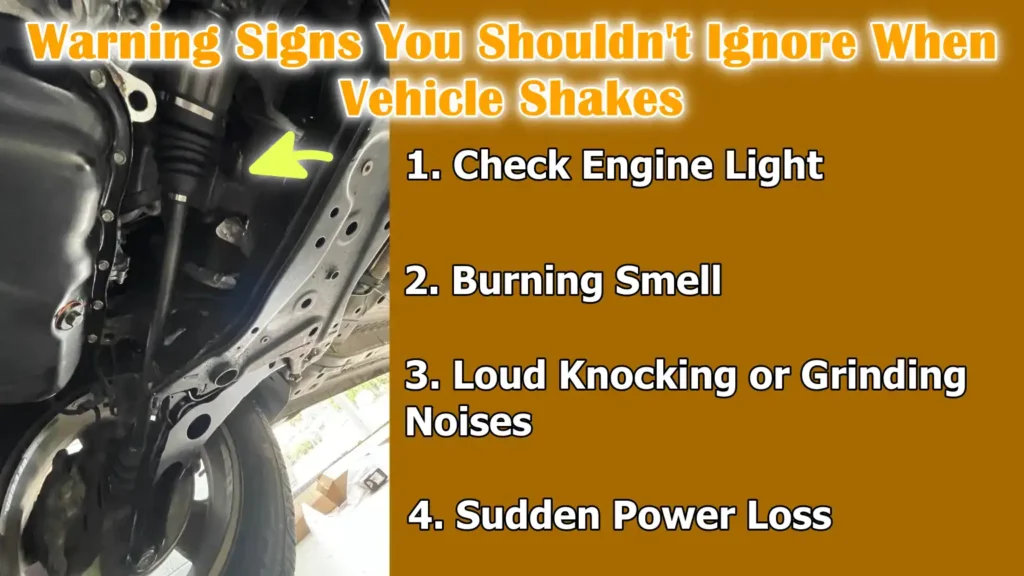
When your car shakes when accelerating, some warning signs point to a serious problem and shouldn’t be ignored.
Modern vehicles have sensors and monitoring systems that quickly detect abnormal conditions.
Ignoring these signals can increase repair costs, reduce safety and lead to breakdowns.
Paying attention to unusual lights, smells, sounds, or performance changes helps you take immediate action before minor problems escalate into major mechanical failures.
1. Check Engine Light
The check engine light is one of the most important warning signs in modern vehicles.
It is controlled by the engine control module, which monitors sensors related to fuel delivery, ignition timing, emissions and engine performance.
When the system detects a misfire, poor combustion, sensor failure, or exhaust problems, it stores a diagnostic trouble code and turns on the light.
If the light is steady, the problem may be minor but still requires attention.
If it’s flashing, it usually indicates a serious engine misfire that could damage the catalytic converter if driving continues.
A flashing light and vibration during acceleration are sure signs that the engine isn’t burning fuel properly.
Using a diagnostic scanner to read stored codes can quickly pinpoint the exact cause.
2. Burning Smell
A burning smell when accelerating should never be ignored.
Different smells can indicate different problems.
The smell of burning rubber could indicate a slipping belt or overheated parts.
The smell of burning oil could mean oil is leaking onto hot engine parts.
In manual vehicles, a strong, chemical-like smell could indicate overheated brakes or a slipping clutch.
If a brake caliper becomes stuck, it can create constant friction and heat, leading to a burning smell and vibration.
Overheated transmission fluid can also produce a burning smell and rough shifting or vibration.
Any burning smell indicates overheating and if not treated immediately, overheating can often lead to mechanical damage.
3. Loud Knocking or Grinding Noises
Odd knocking noises and vibrations are serious warning signs.
Knocking noises coming from the engine can indicate internal engine problems, such as improper combustion or worn parts.
Squealing noises coming from the wheels can indicate worn wheel bearings, brake problems, or differential damage.
These noises often become louder during acceleration because more force is applied to the affected parts.
Wear usually means that metal parts are rubbing against each other without proper lubrication.
Continuing to drive in this condition can cause serious damage and, in extreme cases, even loss of control.
4. Sudden Power Loss
A sudden loss of power while accelerating is a sure sign that something is wrong.
The engine may struggle to accelerate, hesitate, or not respond to the gas pedal.
This could be caused by fuel system problems, ignition failure, a slipping transmission, or a clogged catalytic converter.
Reduced power not only impacts performance but can also create a dangerous situation when merging onto the highway or overtaking other vehicles.
If there is a clear loss of power accompanied by vibrations, it’s important to drive less and have the vehicle inspected as soon as possible.
Read More:
How to Diagnose the Problem If There’s Any
Not only this, there’s vehicle dynamics research that shows that the acceleration creates distinct vibration patterns; and finding indicates that the vibrations become noticeable at the certain speeds due to the mechanical imbalance, this is why many drivers experiences shaking primarily when they accelerate rather than during the coasting or idling of the vehicle.[¹]
Finding out why your car shakes during acceleration requires a logical and careful approach.
Many vibration problems can be detected by noticing them and performing a simple inspection before major damage occurs.
Modern vehicles are equipped with electronic monitoring systems, making diagnosis easier than ever.
However, a mechanical inspection is still necessary because not every problem will trigger a warning light.
By visually inspecting, listening for unusual sounds, using basic diagnostic tools and knowing when professional help is needed, drivers can save time and avoid unnecessary repairs.
1. Basic Checks at Home
You can start with simple observations that don’t require advanced tools.
First, check if the vibration occurs only at certain speeds or during specific tasks like gear changes or cornering.
Inspect the tires for visible damage, uneven wear, low air pressure, or bulges in the sidewalls.
Uneven tire wear often indicates alignment or suspension problems.
Look under the vehicle for loose exhaust parts or leaking fluid.
Open the hood and check for loose engine parts or broken rubber engine mounts.
If vibrations indicate the engine is misfiring, look for rough idling or hesitation.
Also check fluid levels such as engine oil and transmission fluid, as low or dirty fluids can directly impact performance.
These simple checks can often identify obvious problems without the need for specialized equipment.
2. Use an OBD-II Scanner
Most vehicles manufactured after the mid-1990s are equipped with an on-board diagnostic system called OBD-II.
This system continuously monitors engine performance, emissions and other vital systems.
If a problem occurs, such as a misfire, a faulty sensor, or the transmission, the system stores a diagnostic trouble code.
An OBD-II scanner can be plugged into the diagnostic port, which is usually located under the dashboard.
The scanner reads the stored code and provides information about the affected system.
For example, a cylinder misfire code may point to the spark plug or ignition coil.
While a scanner may not always pinpoint the faulty part, it significantly narrows the search area.
Using this tool can eliminate guesswork and result in a more accurate repair.
3. When to See a Mechanic
If basic checks and diagnostic codes don’t clearly identify the problem, or if the vibration is excessive, it’s best to see a qualified mechanic.
Professional technicians have advanced diagnostic tools, such as scan tools with live data, compression testers and equipment to check drivetrain balance and suspension play.
If you notice a flashing warning light, a loud grinding sound, a strong burning smell, or a sudden loss of power, don’t delay a professional inspection.
Driving with a serious mechanical problem can increase damage and repair costs.
A mechanic may also conduct a road test to feel the vibration and confirm the source.
4. Estimated Repair Cost
Repair costs vary greatly depending on the cause.
Minor issues like tire balancing or alignment are usually among the least expensive fixes.
Replacing spark plugs or ignition coils is usually less expensive than major transmission or drivetrain repairs.
The cost of replacing suspension parts depends on the specific component and the labor involved.
More serious problems like torque converter failure, differential damage, or catalytic converter replacement can be significantly more expensive.
Early diagnosis often reduces costs, as minor problems can escalate if ignored.
Addressing vibrations quickly reduces the chance of damage spreading to connected systems.
How to Prevent Shaking & Maintain Your Vehicle for Steady Acceleration
The most effective way to avoid jerks and other performance problems when driving fast is through preventative maintenance.
Vehicles are made up of thousands of moving parts that operate under heat, pressure and constant motion.
Over time, normal wear and tear can cause imbalance, friction and reduced efficiency.
Regular maintenance helps keep all systems functioning properly and detects minor problems before they turn into costly repairs.
Simple routine checks and scheduled servicing can significantly extend engine life, improve fuel economy and maintain driving comfort.
Preventative care also improves safety, as many vibration-related problems are related to the steering, braking and power delivery systems.
1. Regular Tune-Ups
Regular tune-ups primarily focus on the engine’s performance systems.
This includes checking and replacing spark plugs, inspecting the ignition coil, testing the battery’s health and ensuring the correct fuel and air mixture.
Spark plugs wear out over time and, if not replaced according to manufacturer recommendations, can cause misfires.
Air filters can become clogged, reducing airflow and impacting combustion efficiency.
A clean air filter helps maintain the correct air-to-fuel ratio, keeping the engine running smoothly.
Cleaning the fuel system during scheduled service can also prevent carbon deposits from forming in the injectors.
By maintaining strong and consistent combustion, tune-ups reduce the likelihood of jerking during acceleration and help the engine deliver consistent power.
2. Tire Balancing and Rotation Schedule
Tires do not wear evenly on the road, specially if they are not rotated regularly.
Tire rotation involves rotating the tires to ensure even wear over time.
Most manufacturers recommend rotating tires every few thousand miles to maintain balance and extend tire life.
Tire balancing ensures that the weight of each wheel and tire assembly is evenly distributed.
Even slight imbalances at high speeds can cause vibrations.
Regular balancing prevents speed-related jolts and reduces stress on suspension components.
Properly inflated tires can also maintain uneven wear and improve fuel efficiency.
3. Fluid Inspection Routine
Fluids are essential for lubrication, cooling and hydraulic pressure in many vehicle systems.
Engine oil reduces friction and prevents overheating.
Transmission fluid facilitates gear shifting and protects internal components.
Differential fluid lubricates the gears that transmit power to the wheels.
Brake fluid transfers force from the brake pedal to the braking system.
Low or dirty fluid can increase friction, overheating and vibration.
Regularly checking fluid levels and replacing them according to the maintenance schedule protects internal components and keeps them functioning smoothly.
Clean fluids minimize wear and reduce the risk of sudden performance issues.
4. Suspension and Drivetrain Inspection
Suspension and drivetrain systems handle constant stress from road conditions and acceleration forces.
Parts such as ball joints, tie rods, control arms, CV joints and driveshafts should be periodically inspected for looseness, cracks, or wear.
Rubber boots and mounts should be checked for leaks or damage as they protect internal moving parts from dirt and moisture.
Early detection of worn suspension or drivetrain parts prevents vibration and maintains stable steering control.
Regular inspections also help maintain proper wheel alignment, which reduces uneven tire wear and improves overall vehicle handling.
Conclusion – Why Is My Car Shaking When I Accelerate
Now, its been clear that a car rarely shakes without a reason, so whenever it does then it often mean that you need to diagnose the problem without any delay, otherwise it can lead to the expensive fix later on.
As well as, acceleration puts the most stress on the engine, transmission, drivetrain and wheels, as all systems must work together to deliver smooth power to the road.
And, if there’s excessive pressure then it can also reveal minor problems, such as worn spark plugs, slightly unbalanced tires, low transmission fluid, or loose suspension parts.
Also, modern vehicles are designed to run smoothly under load, so vibrations often don’t occur suddenly, but rather serve as an early warning.
Now, that’s all from this guide and let us know if you still have questions.
Frequently Asked Questions
Q1. Why does my car shake when I accelerate?
Answer: A car can shake when accelerating for a variety of reasons. Engine problems, such as worn spark plugs, weak ignition coils, or clogged fuel injectors, can cause vibrations. Transmission problems, such as low fluid or a worn clutch in manual cars, can also cause vibrations. Drivetrain problems, including worn CV joints, driveshaft imbalances, or differential problems, can also cause vibrations. Wheel and tire problems, such as unbalanced tires, misaligned wheels, or damaged rims, are also common causes. Brake or exhaust system problems can also cause vibrations. In fact, any part that affects the way power is transferred to the wheels can cause vibrations.
Q2. Is it safe to drive if my car shakes when accelerating?
Answer: Driving a car that shakes when accelerating can be risky, depending on the cause. Minor problems, such as slightly unbalanced tires, may not be immediately dangerous, but they should be addressed to prevent damage. More serious issues, such as engine misfires, worn drivetrain parts, or transmission problems, can affect control, reduce power and even damage the vehicle if ignored. The safest approach is to diagnose the cause quickly, drive less until the problem is fixed and consult a mechanic if the shaking is severe, accompanied by warning lights, strange noises, or a loss of power.
Q3. Can engine problems cause shaking only when accelerating?
Answer: Yes, engine problems often occur under heavy load and when you accelerate. Worn spark plugs, bad ignition coils, or clogged fuel injectors may not cause vibrations at idle or cruising speeds. However, when the engine is forced to burn more fuel and produce more power, uneven combustion occurs, leading to vibration. Furthermore, worn engine mounts can increase vibration because they allow the engine to operate under excessive pressure.
Q4. Can tires or wheels cause vibration when accelerating?
Answer: Absolutely. Tires that are unbalanced, misaligned, or damaged can cause vibration when the wheels rotate rapidly during acceleration. A bent rim or uneven tire wear can worsen this effect. Vibration may be felt in the steering wheel for the front tires, or in the seats and floor for the rear tires. Proper tire balance, rotation and alignment are important preventative measures to avoid wheel jolts.
Q5. How can transmission problems cause my car to shake during acceleration?
Answer: Transmission problems can cause your car to shake because the transmission is responsible for transferring power from the engine to the wheels. In manual vehicles, a worn clutch can slip when shifting gears and cause jerking or vibration. In automatic vehicles, low or dirty transmission fluid or a faulty torque converter can prevent smooth power delivery. When the transmission can’t handle torque properly, acceleration becomes uneven, causing noticeable jerking or vibration.
Q6. Can the drivetrain or axles cause vibration during acceleration?
Answer: Yes, the drivetrain and axles are common sources of vibration. Worn CV joints, a bad driveshaft, or differential problems can cause vibration because these parts transfer power from the engine and transmission to the wheels. When they become worn or unbalanced, power delivery becomes uneven, leading to vibration that increases with acceleration. Drivetrain-related vibration is often accompanied by clicking, grinding, or humming sounds.
Q7. Is my car shaking when accelerating due to the brakes or exhaust system?
Answer: Sometimes, warped brake rotors or sticking brake calipers can cause vibrations even after the brake pedal is released and this can be felt when accelerating. Similarly, loose or broken exhaust parts can rattle and a clogged catalytic converter can restrict exhaust flow, causing engine problems and shaking. These problems are less common than tire or engine issues, but should be checked if other causes cannot be ruled out.
References:
[1] Analysis of the Impact of Vibrations on the Driver of a Motor Vehicle
https://www.mdpi.com/2076-3417/15/10/5510

Guys, I’m a car audio enthusiast and customization expert and I love clear sound and clean installation. Plus, I have spent years helping people build their dream audio setups. And whenever I’m working on cars, I probably listen to music and thinks about the next big upgrade.