
Written By: Don Dodi
Fact Checked By: Kristen Brown
Reviewed By: Diego Rosenberg
If you are feeling that your engine is working harder, but your car isn’t moving faster, then it is the sign of having clutch slippage or failure as well.
And, “CLUTCH SLIPPING” is actually common problems in the manual cars, specially as the vehicle ages or are driven in the heavy traffic conditions more often.
So, in simple way, clutch slipping happens when the connection between the engine and the wheels is not that strong enough, that causes the engine to rev higher without a matching increase in speed, So this issue is often linked to a worn out clutch disc, weak pressure plate or contamination from engine oil or transmission fluid.
And, there’s automotive service data: the clutch components typically last between 50,000 to 100,000 kilometers that also depends on the driving habits and poor practices such as: riding the clutch or frequent stop-and-go driving that can reduce this lifespan in significant way.
Also, you shouldn’t ignore this clutch slipping problem, otherwise it can lead to the reduced fuel efficiency, overheating and even lead to the complete clutch failure as well.
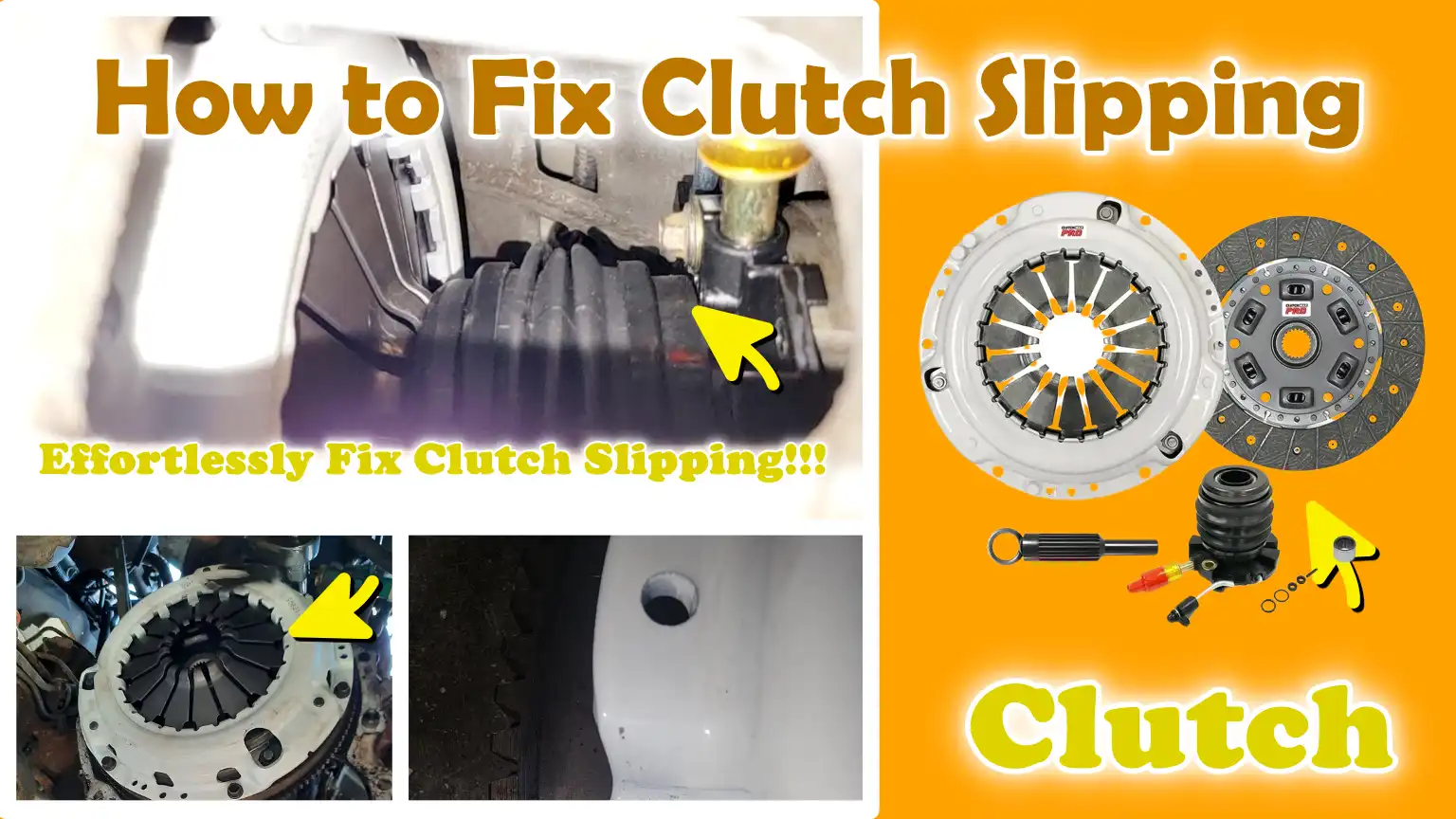
Now, in this guide you’ll learn How to Fix Clutch Slipping, so that you can easily fix and maintain the clutch effortlessly.
How the Clutch Works?
The clutch is an essential component of a manual car that connects and disconnects the engine from the transmission, allowing you to shift gears smoothly.
Its primary function is to control the flow of power from the engine to the wheels, enabling the car to start, stop and change gears without sustaining damage.
When you depress the clutch pedal, this connection is temporarily disengaged; when you release it, the flow of power resumes.
This simple mechanism helps protect the engine and gearbox from sudden shocks and esures smooth vehicle operation in various conditions such as: heavy traffic, hilly terrain and highway driving.
1. Basic Components of the Clutch System
A clutch system consists of several essential components that work in unison to efficiently transfer power.
These components must be maintained in good condition, as even minor wear or damage to any one of them can adversely affect the vehicle’s performance.
The most critical components include the clutch disc, pressure plate, flywheel and release bearing.
Each component serves a specific purpose and together, they generate the necessary friction to propel the vehicle forward.
2. The Clutch Disc
The clutch disc is a flat, circular component lined with friction-generating material, much like a brake pad.
It is situated between the flywheel and the pressure plate and serves to transfer power from the engine to the transmission.
When the clutch pedal is released, the disc presses firmly against the flywheel, thereby transmitting power.
Over time, this friction material wears down; this is one of the most common causes of clutch slippage, particularly due to prolonged use or poor driving habits.
3. The Pressure Plate
The pressure plate is a sturdy metal plate that exerts pressure to firmly clamp the clutch disc against the flywheel.
It utilizes spring tension to firmly hold the clutch disc in place, thereby transmitting power without any slippage.
When you depress the clutch pedal, the pressure plate retracts, disengaging the disc and interrupting the flow of power.
If the pressure plate weakens or becomes defective, it is unable to securely grip the disc; this causes the clutch to slip, resulting in a loss of power.
4. Flywheel
The flywheel is a heavy metal disc directly attached to the engine.
It rotates in tandem with the engine and provides a smooth surface against which the clutch disc can be pressed.
Its mass helps to maintain a consistent engine rotational speed and minimizes vibrations.
The flywheel also stores rotational energy, making it easier to set the vehicle in motion from a standstill.
If the surface of the flywheel becomes uneven or develops defects, it can reduce friction and lead to clutch-related issues.
5. Release Bearing
The release bearing, also known as the throw-out bearing, is a small yet critical component that facilitates the disengagement of the clutch when the pedal is depressed.
It exerts pressure on the pressure plate to release the clutch disc.
This mechanism allows you to shift gears smoothly without causing wear or damage to the transmission.
If the release bearing becomes worn, it may generate noise, impair proper clutch operation and make gear shifting difficult.
6. How It Works – In Simple Terms
The clutch utilizes friction to connect and disconnect the engine from the transmission.
When you lift your foot off the clutch pedal, the clutch disc becomes firmly sandwiched between the flywheel and the pressure plate, thereby transmitting power onward.
When you depress the pedal, the pressure plate retracts, disengaging the disc and thereby interrupting the transfer of power.
This simple process facilitates gear shifting and helps maintain control over the car’s speed.
7. How Power Flows from the Engine to the Transmission
Power from the engine first reaches the flywheel, which rotates continuously.
Then, when the clutch engages, the clutch disc couples with this rotating flywheel.
Power flows from the clutch disc into the transmission, which then transmits it to the wheels via the drivetrain.
This controlled transfer of power ensures that the car can move forward smoothly without any sudden jerks or damage to its internal components.
8. The Difference Between Manual and Automatic Clutches
In manual cars, the driver controls the clutch using a pedal, granting them direct control over gear shifting and the flow of power.
Automatic cars do not feature a clutch pedal, as the system utilizes a torque converter or an automatic clutch mechanism to facilitate gear changes.
Although both systems perform the same function of transferring power, manual clutches rely more heavily on driver input; consequently, they are subject to greater wear and tear if not operated correctly.
9. Why Slipping Mainly Affects Manual Cars
Clutch slipping primarily occurs in manual cars, as the clutch is operated directly by the driver.
Certain poor driving habits such as: resting one’s foot on the clutch pedal, holding the car stationary on an incline using the clutch, or shifting gears incorrectly, as it can significantly accelerate the wear and tear of the clutch disc and pressure plate.
Conversely, in automatic cars, the system is largely controlled by electronic and hydraulic mechanisms, thereby reducing the likelihood of clutch slipping.
This is why the issue of clutch slipping is more prevalent in manual vehicles, making it crucial to employ proper driving techniques to prevent it.
Know, Common Symptoms of a Slipping Clutch
A slipping clutch typically does not occur suddenly; it happens gradually and presents clear warning signs that drivers can identify in good time.
These symptoms manifest because the clutch is no longer able to generate the necessary friction to effectively transmit engine power to the wheels.
When this occurs, the engine is forced to work harder, yet the car fails to respond as it should.
Understanding these signs is crucial, as early detection can prevent major damage and reduce repair costs.
Most symptoms can be easily identified during normal driving, particularly when accelerating, shifting gears, or driving uphill.
1. Engine RPM Rises, But Speed Does Not
The most common and easily recognizable sign of a slipping clutch is when the engine speed, as indicated on the RPM gauge, rises rapidly, but the car’s actual speed does not increase in proportion.
This happens because the clutch disc fails to properly grip the flywheel, preventing the engine’s full power from reaching the wheels.
For instance, when you press the accelerator, the engine sounds louder and more strained, yet the car feels sluggish or slow.
This is a clear indication that the clutch is slipping and failing to perform its function correctly.
2. Difficulty Accelerating – Specially on Inclines
When a clutch is slipping, accelerating the car often becomes difficult, particularly when driving uphill or when the vehicle is carrying a heavy load.
Ascending an incline requires greater power; if the clutch cannot effectively transmit that power, the car may struggle, lose momentum, or feel underpowered.
You may also notice that, in order to maintain your speed, you have to press the accelerator harder than usual.
This not only diminishes the car’s performance but also places excessive strain on the engine.
3. Burning Odor – Resembling Burnt Rubber
A strong burning odor, specifically one resembling burnt rubber, is another critical warning sign of a slipping clutch.
This smell occurs when the clutch disc slips against the flywheel instead of gripping it firmly, generating excessive friction and heat.
This heat can damage clutch components and significantly reduce their lifespan.
This odor is often detected during periods of heavy vehicle usage such as: driving in heavy traffic, starting on an incline, or hauling heavy loads, and, therefore, should never be ignored.
4. Clutch Pedal Feeling Soft or Spongy
If the clutch pedal feels softer, spongier, or less responsive than usual, it could indicate a fault within the clutch system.
This condition may be caused by worn-out components, trapped air in the hydraulic system, or fluid-related issues.
A soft pedal may fail to fully engage or disengage the clutch, creating a risk of clutch slippage and reduced vehicle control while driving.
A proper pedal feel is essential for smooth gear shifting and safe vehicle operation.
5. Reduced Fuel Efficiency
A slipping clutch can also lead to reduced fuel efficiency, as the engine is forced to work harder to deliver the required performance.
As some of the engine’s power is wasted due to slippage, additional fuel is consumed to compensate for that loss.
Over time, this can lead to increased fuel costs and an overall decline in the vehicle’s performance.
Many drivers do not immediately associate poor fuel economy with clutch-related issues; yet, it remains a common, albeit hidden, symptom.
6. Delayed Engagement Upon Releasing the Clutch
Another clear symptom is a delay in clutch engagement when you release the clutch pedal.
Typically, the moment you lift your foot off the pedal, the vehicle should begin to move forward smoothly.
However, if there is a delay, or if the vehicle moves forward sluggishly, it indicates that the clutch is not gripping properly.
This can make driving feel less effortless and more unpredictable, particularly in stop-and-go traffic.
It also increases the risk of the vehicle stalling or lurching forward abruptly.
Know, Main Causes of Clutch Slippage
The primary cause of clutch slippage is typically a reduction in friction or pressure within the clutch system, which prevents the engine’s power from being properly transmitted to the transmission.
This issue can arise from gradual wear and tear, sudden mechanical failure, or improper driving habits.
Understanding the exact cause is crucial, as each specific problem requires a distinct repair approach.
Most clutch-related issues stem from heat, a loss of friction, or misuse; identifying these problems early can help you avoid costly repairs and extend the lifespan of your vehicle.
1. Worn Clutch Disc
The clutch disc is the component within the clutch system that experiences the most wear, as it is subjected to constant friction every time a gear is shifted.
Over time, the friction material on the disc becomes thin and smooth, thereby diminishing its ability to properly grip the flywheel.
This natural wear is inevitable and varies depending on driving conditions and habits.
In most cars, a clutch disc can last anywhere from 50,000 to 100,000 kilometers; however, frequent driving in heavy traffic, improper gear usage, or aggressive driving can significantly reduce its lifespan.
When the disc becomes excessively worn, it fails to generate the necessary friction, resulting in clutch slippage.
Natural Wear Over Time
As the clutch undergoes regular use, heat and friction gradually degrade the friction material present on the clutch disc.
This gradual process occurs in all vehicles and is a normal part of a vehicle’s aging process.
However, a lack of maintenance and negligent driving habits can accelerate this wear, potentially leading to issues much sooner than expected.
The Impact of High Mileage
Vehicles with high mileage are at a greater risk of experiencing clutch slippage because the clutch components have undergone prolonged use.
Continuous operation over thousands of kilometers diminishes the efficiency of the clutch disc and other parts, making clutch slippage a common issue in older vehicles.
2. Oil or Fluid Leaks
Contamination of the clutch by oil or other fluids is a serious cause of clutch slippage, as it reduces the friction necessary for the clutch to function correctly.
Even a small amount of oil on the clutch disc can create a slippery surface, preventing it from gripping the flywheel effectively.
This typically occurs due to oil or fluid leaks from components located near the engine or transmission.
Engine Oil Leaks
Engine oil can leak from seals such as: the ‘rear main seal’, and seep into the clutch housing area.
When oil gets onto the clutch disc, it creates a slippery surface that reduces friction, causing the clutch to slip immediately and negatively impacting performance.
Transmission Fluid Leaks
Transmission fluid leaks can also damage the clutch, particularly in vehicles equipped with a manual transmission.
Much like engine oil, this fluid diminishes the grip between the clutch disc and the flywheel, making it difficult for the system to transmit power efficiently.
3. Weak or Defective Pressure Plate
The pressure plate plays a crucial role; it exerts a strong spring force to firmly clamp the clutch disc against the flywheel.
If the pressure plate becomes weak, worn, or defective, it fails to apply the necessary pressure to securely hold the disc in place.
Due to this reduction in clamping force, the clutch disc begins to slip even when the clutch pedal is fully released.
Over time, due to heat, pressure and repeated use, the internal springs within the pressure plate can weaken, leading to reduced performance and potential clutch slippage.
Reduction in Clamping Force
Clamping force is essential for the proper functioning of a clutch and any reduction in this force directly impacts power transmission.
When the pressure plate fails to adequately press against the clutch disc, the mechanical link between the engine and the transmission is compromised; this results in clutch slippage and diminished vehicle acceleration.
4. Improper Clutch Adjustment
Improper clutch adjustment can also lead to clutch slippage, particularly in vehicles equipped with a manual clutch cable system.
For the clutch pedal to function correctly, it requires a specific amount of “free play” (slight looseness).
If the adjustment is too tight, the clutch may not fully engage; in such instances, the clutch continues to slip slightly even when the pedal is not depressed.
Proper adjustment ensures that the clutch engages and disengages fully and at the precise moment, thereby preventing the premature wear of clutch components.
Incorrect Pedal Free Play
Pedal “free play” refers to the slight movement in the clutch pedal that occurs just before the clutch begins to engage.
If this is not set correctly, the clutch may remain partially disengaged; this reduces friction and, over time, leads to clutch slippage.
5. Resting Your Foot on the Clutch
Resting one’s foot on the clutch is a common driving habit in which the driver keeps their foot lightly resting on the clutch pedal while driving.
This causes the clutch to remain slightly disengaged, generating continuous friction and heat.
Over time, this habit causes the clutch disc to wear out much faster than it would under normal usage.
Many drivers do this inadvertently while driving in traffic or at low speeds; however, this significantly reduces the lifespan of the clutch and increases the likelihood of clutch slippage.
Driver Habits That Cause Premature Wear
Poor driving habits such as: holding the vehicle stationary on an incline using the clutch, frequently driving with the clutch partially depressed (known as “riding the clutch”), or improper gear shifting, lead to the rapid wear of clutch components.
These habits increase heat and friction, causing the clutch system to deteriorate over time.
6. Clutch Overheating
Excessive heat is one of the clutch system’s greatest enemies.
When the clutch overheats, the friction-generating material can become glazed or damaged, thereby reducing its ability to maintain grip.
Excessive heat is typically generated when the clutch is subjected to extreme stress such as: driving in stop-and-go traffic, hauling heavy loads, or towing another vehicle.
High temperatures weaken clutch components and if left unaddressed, this can result in permanent damage to the entire clutch system.
Heavy Traffic or Towing
Driving in heavy traffic requires frequent use of the clutch, which generates excessive heat and accelerates wear.
Similarly, towing another vehicle or hauling heavy loads places additional strain on the clutch, forcing it to work harder than usual.
In both of these situations, if proper precautions are not taken, the clutch can overheat, thereby increasing the risk of clutch slippage.
Tools
| Item | Details |
|---|---|
| Basic Toolkit – Wrenches, Screwdrivers | These are the most common tools used to loosen and remove car parts. You will need them to safely loosen bolts, screws and small fittings. A good basic toolkit makes the entire repair process easier and faster. |
| Jack and Jack Stands | A car jack is used to lift the vehicle off the ground so that you can work underneath it. Jack stands are essential because they provide secure support for the vehicle once it has been lifted. Never rely solely on the jack while working underneath a car, as this is unsafe. |
| Clutch Kit – Disc, Pressure Plate, Release Bearing | This is the primary replacement set used when addressing clutch slippage issues. It includes all the key components that are subject to wear and tear and need to be replaced simultaneously. Using the complete kit improves the performance of the clutch system and extends its lifespan. |
| Brake Cleaner | Brake cleaner is used to remove dirt, oil and grease from clutch components. It helps eliminate any greasy residue that could cause the clutch to slip. Clean parts ensure better grip and make the repair process more effective. |
| Torque Wrench | A torque wrench is used to tighten bolts to the exact pressure required, no more, no less. This is crucial because bolts that are either too loose or too tight can cause damage. It helps ensure that all components are fitted correctly and securely. |
| Service Manual – Recommended | A service manual provides step-by-step instructions specific to your particular car model. It includes precise specifications, diagrams and safety precautions. Using it helps prevent errors and ensures greater accuracy throughout the repair process. |
How to Ensure Safety During Clutch Issue Fixing
Safety is the most critical aspect of any car repair, specially when you are working on major components like the clutch.
Clutch repair often involves lifting the vehicle, removing heavy parts and working near moving or electrical systems.
Without proper safety measures, there is a significant risk of personal injury or damage to the vehicle.
Many accidents during car repair occur due to minor errors such as: failing to properly lift the vehicle or forgetting to disconnect the electrical system.
By adhering to basic safety precautions, you can protect yourself, streamline the repair process and avoid costly complications.
Even if you are an experienced mechanic, it is essential to follow these safety guidelines every time you work on your vehicle.
1. Always Disconnect the Battery
Before beginning any repair work, it is absolutely essential to disconnect the car’s battery.
This prevents sudden electrical incidents such as: short circuits or sparks, which could result in personal injury or damage to the vehicle’s electrical system.
The battery powers various components throughout the entire vehicle and even a minor oversight can lead to major problems.
Disconnecting the battery ensures that working on the vehicle is completely safe, particularly when you are using metal tools in close proximity to electrical connections.
2. Use Jack Stands – Never Rely Solely on the Jack
When you lift your car, the jack is designed solely to raise the vehicle, not to support its weight for an extended period.
Hydraulic jacks can fail or lose pressure without warning, causing the car to drop suddenly.
Jack stands are specifically engineered to safely support the vehicle and maintain a stable position once it has been lifted.
Safely supporting the car on jack stands placed at the correct points provides a stable and secure environment for working.
This step is crucial, specially when you are working underneath the vehicle such as: during clutch repairs.
3. Wear Gloves and Safety Goggles
Wearing safety gear, such as gloves and safety goggles, is essential during any mechanical work.
Gloves protect your hands from sharp edges, hot surfaces and harmful chemicals like oil or cleaning agents.
Safety goggles shield your eyes from dust, dirt and small debris that may fall while working underneath the car.
These simple safety measures reduce the risk of injury and make the repair process both more comfortable and safer.
4. Work on a Level and Stable Surface
To ensure safety and stability, always perform car repairs on a level and stable surface.
Lifting a car on uneven or soft ground can cause it to shift or become unstable, thereby increasing the risk of an accident.
A solid surface such as: a concrete floor, provides superior support for both the jack and the jack stands.
Stability is paramount when working on heavy components like the transmission, as even the slightest movement could lead to a hazardous situation.
How to Fix Clutch Slipping – Easy to Follow
Fixing clutch slipping requires careful inspection, accurate diagnosis and proper repair methods to ensure the complete transfer of power from the engine to the transmission.
Depending on the severity of the problem, this process may involve anything from minor adjustments to the complete replacement of clutch components.
It is crucial to follow every step sequentially, as skipping diagnostic checks or overlooking minor issues such as: fluid leaks, as it can lead to recurring malfunctions.
A comprehensive repair not only resolves the slipping issue but also improves driving performance, fuel efficiency and the overall lifespan of the vehicle.
1. First, Identify the Problem
Before initiating any repairs, it is essential to confirm that the issue is indeed clutch slipping, rather than another underlying mechanical problem.
Accurate diagnosis helps avoid unnecessary repairs, thereby saving time, effort and money.
Understanding the condition of the clutch helps you determine whether minor repairs will suffice or if a complete clutch replacement is required.
Conduct a Road Test
The easiest way to detect clutch slipping is to perform a road test.
While driving, press the accelerator and observe whether the engine speed (RPM) rises faster than the actual speed of the vehicle.
Try driving up an incline or shifting into a higher gear at a low speed, as clutch slipping becomes more evident under load.
This test helps confirm whether the clutch is effectively transferring power.
Watch for Symptoms of Slipping
Keep an eye out for common symptoms, such as excessively high engine RPM at low speeds, difficulty accelerating, a burning odor, or a delay in the vehicle moving forward after releasing the clutch.
These symptoms clearly indicate that the clutch is failing to engage properly.
Timely identification of these signs can prevent further damage to other vehicle components.
2. Check the Clutch Fluid – Hydraulic System
In vehicles equipped with a hydraulic clutch system, the fluid plays a crucial role in clutch operation.
Low fluid levels or fluid contamination can adversely affect how the clutch engages and disengages.
Checking the fluid system is a simple yet essential step to take before undertaking any major repairs.
Check the Reservoir Level
Open the clutch fluid reservoir and ensure that the fluid level falls within the specified range.
If the fluid level is low, the clutch will not function correctly, potentially leading to clutch slippage or difficulty shifting gears.
A low level may also indicate the presence of a leak somewhere in the system or a faulty component.
Check for Leaks
Carefully inspect the areas surrounding the master cylinder, slave cylinder and the connecting lines for any signs of fluid leakage.
Even minor leaks can compromise the system’s hydraulic pressure and negatively impact clutch performance.
Addressing leaks promptly often resolves the issue without the need for extensive repairs.
3. Adjust the Clutch Cable or Pedal
In vehicles equipped with a cable-operated clutch system, proper adjustment is essential to ensure optimal performance.
Due to incorrect adjustment, the clutch may remain partially engaged; this causes it to slip and leads to premature wear.
Locate the Adjustment Point
The adjustment point is typically situated near the clutch pedal or somewhere along the length of the clutch cable.
This mechanism allows you to modify the tension and positioning of the clutch system.
Knowing the exact location enables you to perform a precise adjustment.
Set the Correct ‘Free Play’
‘Free play’ refers to the slight amount of movement in the clutch pedal that occurs just before the clutch begins to engage fully.
If the ‘free play’ is insufficient, the clutch cannot engage completely, leading to slippage.
Adjusting this to the correct level ensures proper contact is maintained between the clutch disc and the flywheel.
4. Check for Oil Contamination
Contamination by oil or other fluids is a major cause of clutch slippage, as it reduces the friction between the clutch components.
Even a small amount of oil can render the clutch surface slippery and ineffective.
Inspect the ‘Bell Housing’
The ‘bell housing’ is the enclosure where the clutch assembly is mounted.
Look inside this housing for any traces of oil or other fluids.
The presence of oil typically indicates a leak from either the engine or the transmission seals.
Repair Leaks Before Replacing the Clutch
Before installing a new clutch, it is absolutely essential to repair any oil or fluid leaks.
If these leaks are not fixed, the new clutch will also become compromised and begin to slip again.
Identifying and resolving the root cause of the problem ensures the repair is durable and long-lasting.
5. Replace the Clutch Disc
If the clutch disc is worn out, it is essential to replace it to restore proper friction and power transfer.
This is one of the most common repairs performed when clutch slippage occurs.
Remove the Transmission
To access the clutch, the transmission must be carefully removed from the engine.
This is a challenging task that requires the right tools and support, as the transmission is heavy and connected to numerous components.
Remove the Old Clutch Assembly
Once the transmission has been removed, the old clutch disc and its associated components can be taken out.
Inspect these parts for signs of wear, damage, or contamination to identify the root cause of the slippage.
Install the New Clutch Disc
Position the new clutch disc in place and align it correctly with the flywheel.
Proper alignment is crucial to ensure smooth operation and prevent future issues.
6. Replace the Pressure Plate and Release Bearing
It is always advisable to replace the pressure plate and release bearing alongside the clutch disc.
These components work in tandem; replacing only a single part can compromise performance and lead to premature system failure.
Why Simultaneous Replacement is Recommended
All clutch components tend to wear out at approximately the same rate; therefore, replacing them as a complete set ensures balanced performance.
This approach enhances reliability, minimizes the risk of future complications and ultimately saves on repair costs in the long run.
7. Refinish or Replace the Flywheel Surface
The flywheel provides the surface against which the clutch disc engages; consequently, its condition is of paramount importance.
A damaged or uneven flywheel surface can cause clutch slippage, even if a brand-new clutch disc has been installed.
When Surface Repair Is Necessary
If the flywheel surface exhibits minor wear or unevenness, it can be resurfaced to restore its smoothness.
However, if the damage is severe or cracks are present, replacing the flywheel is the better option to ensure the proper functioning of the clutch system.
8. Reassembly and Verification
Once all repairs are complete, it is essential to carefully reassemble the system and perform a thorough check to ensure that everything is functioning correctly.
Proper installation and verification are crucial to guarantee reliable, long-lasting performance.
Correct Torque Settings
All bolts and components must be tightened strictly according to the torque settings specified by the manufacturer.
This ensures that the components are securely fastened but not overtightened, as overtightening can damage or fracture the parts.
Test Drive Procedure
After reassembling the vehicle, conduct a test drive to verify that the clutch operates smoothly and that power is being transmitted correctly.
Drive the vehicle under various conditions such as: on normal roads and on slight inclines, to ensure that any issues related to clutch slippage have been completely resolved.
How to Do Temporary Repair for a Slipping Clutch
Temporary remedies for a slipping clutch can help keep the vehicle operational for a while, but they do not resolve the underlying issue.
Clutch slippage is typically caused by worn or defective components and these problems cannot be fully rectified without properly replacing the faulty parts.
However, in situations where immediate repairs are not feasible, certain adjustments to driving technique can mitigate the slippage and prevent further damage.
These methods can enable you to drive safely for a limited period; however, it is crucial to understand that these are not permanent solutions and should be employed only until proper repairs can be carried out.
1. Adjust the Clutch Pedal
Adjusting the clutch pedal can sometimes reduce slippage, particularly in vehicles equipped with a cable-operated clutch system.
If the pedal’s “free play” (slack) is either too minimal or excessive, the clutch will fail to engage fully, resulting in persistent slippage.
By adjusting the pedal to the correct “free play” setting, you allow the clutch disc to press more firmly against the flywheel, thereby improving grip.
If the issue stems from incorrect settings rather than worn components, this minor adjustment can make a significant difference.
2. Avoid Rapid Acceleration
Driving gently and refraining from sudden or rapid acceleration can help minimize clutch slippage.
When you depress the accelerator forcefully, the engine generates increased power, placing additional strain on the clutch.
If the clutch is already compromised, it will struggle to handle this load and will slip more extensively.
Accelerating smoothly and gradually reduces the stress on the clutch and helps maintain better control over the vehicle.
3. Reduce Vehicle Load
Carrying heavy loads or towing objects places excessive strain on the clutch system, thereby exacerbating the problem of clutch slippage.
Reducing the weight carried by the vehicle can alleviate pressure on the clutch and enhance its ability to transmit power effectively.
A lighter load means that less force is required to propel the vehicle forward, which helps mitigate issues related to slippage and heat accumulation within the clutch system.
Note – These Are Only Short-Term Solutions
It is crucial to remember that these measures are merely temporary and do not repair worn-out or damaged clutch components.
Continuing to drive with a slipping clutch can lead to even more severe damage such as: total clutch failure or damage to the flywheel.
These methods should be employed solely to manage the issue until proper repairs can be performed or the necessary parts can be replaced.
Neglecting this problem over the long term can result in increased repair costs and a decline in the vehicle’s overall performance.
Read More:
- How to Fix Delayed Gear Shifting
- How to Change a Gear Shift Knob
- How to Repair Gear Shifter Cable
- How to Replace a Transmission Mount
- How to Fix Jerking When Shifting Gears
Estimated, Cost of Fixing a Slipping Clutch
The cost of repairing a slipping clutch depends on the type of vehicle, the severity of the problem and whether you choose to fix it yourself or hire a professional.
A clutch system consists of several essential components such as: the clutch disc, pressure plate and release bearing; in most cases, these parts are replaced together as a complete kit.
Generally, clutch repair is considered a moderately expensive undertaking, as it involves significant costs for both parts and labor.
Understanding the cost breakdown in detail helps you plan better, avoid unnecessary expenses and select the best repair option for your specific situation.
1. Estimated Cost of DIY Repair
Repairing a clutch yourself can result in significant savings, particularly on labor costs.
However, this requires the right tools, mechanical knowledge and sufficient time to complete the job safely.
For beginners, this can be a challenging task, as removing the transmission is a complex process that demands meticulous attention to every detail.
If executed correctly, a DIY repair can substantially reduce the total cost; conversely, mistakes can lead to additional expenses.
2. Cost of Parts
The cost of clutch components varies depending on the vehicle model and the quality of the parts selected.
A standard clutch kit, which includes the clutch disc, pressure plate and release bearing, typically ranges from moderately priced to expensive, depending on the brand and durability.
In many instances, additional components such as: the flywheel or hydraulic parts, may also need to be replaced, thereby increasing the total cost.
While opting for high-quality parts may entail a higher upfront cost, it guarantees superior performance and greater longevity.
3. Cost of Professional Repair
Having a clutch repaired by a professional mechanic is more expensive, but it ensures proper installation and reliability.
The cost of professional repair covers both parts and labor and the total amount can vary depending on the complexity of the vehicle.
Modern cars with compact engine bays or advanced systems may require more time and expertise, thereby increasing the cost.
Although it is more expensive, professional repair minimizes the risk of errors and ensures superior long-term performance.
4. Labor Costs
Labor costs often constitute the largest portion of the expense involved in clutch repair.
This is because accessing the clutch requires removing the transmission, a time-consuming process that can take several hours.
Labor charges depend on the mechanic’s experience, the workshop and the complexity of the job.
In some instances, the labor cost alone may exceed the cost of the clutch components; therefore, choosing a reliable and reasonably priced service provider is crucial.
5. Factors Influencing Cost
Several factors influence the total cost of repairing a slipping clutch.
These include the type of vehicle, the location where the repair is performed and the quality of the parts used.
Understanding these factors allows you to estimate the cost more accurately and make more informed decisions.
6. Car Model
Different car models feature distinct designs, which impacts the level of difficulty involved in clutch repair.
Repairs for smaller or simpler cars are typically easier and less expensive, whereas larger vehicles or high-performance cars may require more labor and costlier parts.
The availability of spare parts also depends on the specific model, which can further influence the overall price.
7. Location
Depending on where you live, repair costs can vary significantly.
In urban areas or regions with a high cost of living, labor charges are typically higher.
While costs may be lower in smaller towns or at local workshops, it is crucial to ensure that the quality of the work is reliable and safe.
8. Quality of Parts
The quality of the parts used plays a pivotal role in both cost and performance.
Low-quality or inexpensive parts may reduce the initial outlay, but they can wear out quickly and lead to recurring issues.
High-quality or branded parts, though they may come at a higher price point, offer greater durability, superior performance and long-term reliability, ultimately proving to be a better investment over time.
How to Prevent Clutch Slippage
Preventing clutch slippage is far easier and more cost-effective than repairing the damage after it has occurred.
A clutch is designed to last for thousands of kilometers; however, its lifespan depends heavily on how the vehicle is driven and maintained.
Most clutch-related problems stem from excessive heat, friction and poor driving habits, factors that gradually diminish the clutch’s ability to engage properly.
By adopting simple driving techniques and adhering to a regular maintenance schedule, you can significantly extend the life of your clutch, save fuel and avoid expensive repair bills.
The primary objective of these preventive measures is to minimize unnecessary stress on the clutch system and ensure that all its associated components continue to function correctly.
There’s modern research that confirms that clutch slipping is highly affected by the temperature and load conditions, as heat increases during the driving, as the friction level decreases; that actually makes it harder for the clutch to transfer power in effective way.[¹]
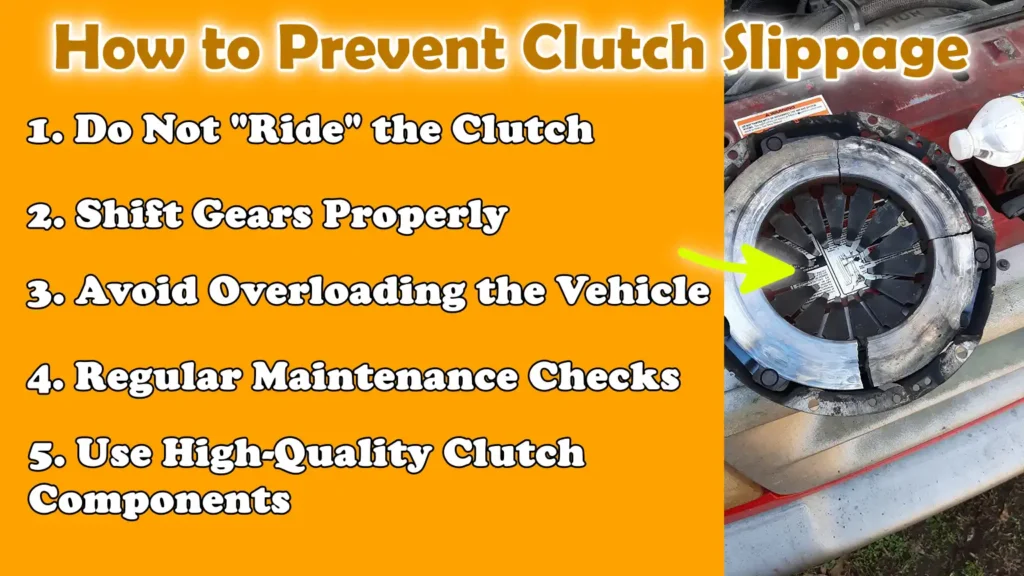
1. Do Not “Ride” the Clutch
Riding the clutch refers to resting your foot lightly on the clutch pedal while driving, even when there is no need to shift gears.
This habit causes the clutch to remain partially disengaged, generating constant friction and heat between the clutch disc and the flywheel.
Over time, this heat wears down the friction-generating material, eventually leading to clutch slippage.
Many drivers do this inadvertently while driving in heavy traffic or at low speeds; however, it is one of the leading causes of premature clutch failure.
When you are not actively shifting gears, keeping your foot completely off the clutch pedal ensures that the clutch remains fully engaged and minimizes wear and tear.
2. Shift Gears Properly
Shifting gears correctly is crucial for keeping your clutch in good condition.
Shifting gears smoothly and at the right moment reduces the strain placed on both the clutch and the transmission.
Fully depressing the clutch pedal, and then releasing it gradually, while shifting gears helps prevent sudden jerks and unnecessary friction.
Shifting gears at the correct engine speed also improves the vehicle’s performance and minimizes wear and tear.
Poor gear-shifting habits such as: not fully depressing the clutch or forcing the gear lever, as it can damage clutch components over time and increase the risk of clutch slippage.
3. Avoid Overloading the Vehicle
Carrying excessive weight in the vehicle or towing heavy loads places additional strain on the clutch system.
When a vehicle is overloaded, the clutch has to work harder to transmit power, generating excessive heat and accelerating wear.
This excessive strain can rapidly degrade the clutch’s efficiency and eventually lead to clutch slippage.
Keeping the vehicle within its specified weight limits ensures that the clutch continues to function properly, thereby enhancing the vehicle’s overall safety and performance.
4. Regular Maintenance Checks
Regular inspection and maintenance of the clutch system help identify minor issues before they escalate into serious problems.
Simple steps such as: regularly checking the clutch fluid level in the hydraulic system, inspecting for any leaks and ensuring proper clutch pedal adjustment, as it can be instrumental in preventing clutch slippage.
Regular maintenance allows for the timely detection of worn-out components, enabling their replacement before they cause sudden mechanical failure.
A well-maintained clutch system delivers optimal performance and enjoys a longer service life.
5. Use High-Quality Clutch Components
Using high-quality clutch components is absolutely essential to ensure excellent performance and reliability over the long term.
High-quality parts are manufactured from superior materials that can withstand heat and friction more effectively.
Although their initial cost may be slightly higher, they last longer and ensure smooth operation.
Low-quality parts wear out quickly and increase the likelihood of clutch slippage, resulting in the need for frequent repairs.
Investing in reliable components ensures greater durability and reduces overall maintenance costs.
When to Consult a Mechanic?
While some minor clutch issues can be resolved through simple adjustments or careful driving, there are situations where seeking professional assistance becomes essential.
The clutch system is a complex mechanical assembly that requires precise alignment, correct pressure and proper friction to function correctly.
If problems are ignored or attempts are made to fix them incorrectly, it can result in severe damage, not only to the clutch itself but also to the transmission and the engine.
Knowing when to consult a mechanic is crucial, as timely repairs can help you avoid major expenses, enhance safety and restore a smooth driving experience.
Professional mechanics possess the necessary tools, experience and expertise to accurately diagnose the root cause of the problem and resolve it effectively.
1. Excessive Slippage
If the clutch is slipping excessively, it indicates that the system is no longer capable of efficiently transmitting power from the engine to the wheels.
In such a scenario, the engine’s RPM (revolutions per minute) rises rapidly, yet the vehicle’s speed increases very little, or not at all.
Excessive slippage is often a sign that the clutch disc is severely worn out or that the pressure plate is failing.
Continuing to drive in this condition can lead to total clutch failure, rendering the vehicle completely immobile.
Such damage requires immediate attention from a mechanic to perform the necessary repairs or component replacements.
2. Persistent Burning Odor
A burning odor, reminiscent of burnt rubber, is a clear indication of excessive heat and friction within the clutch system.
If this odor persists even during normal driving conditions, it signifies that the clutch is slipping continuously and overheating significantly.
Prolonged exposure to excessive heat can damage not only the clutch disc but also the flywheel and other surrounding components.
Ignoring this warning sign can lead to increased repair costs and a reduction in the vehicle’s overall lifespan.
By inspecting the system, a mechanic can identify the root cause of the overheating and recommend an appropriate solution.
3. Difficulty Shifting Gears
If you experience difficulty while shifting gears such as: grinding noises, resistance, or a delay in engaging the gear, it could be a sign of a major issue within the clutch or transmission system.
A properly functioning clutch ensures that gear shifting is smooth and effortless.
Difficulties in shifting gears may stem from worn clutch components, faults in the hydraulic system, or improper alignment.
Resolving these issues, and preventing further damage to the gearbox, requires a thorough inspection and precise adjustments performed by a professional mechanic.
4. No Improvement After Adjustments
If you have attempted basic troubleshooting steps such as: adjusting the clutch pedal or checking fluid levels, yet the problem persists, it is a clear indication that the underlying issue is more serious.
Temporary fixes can only resolve minor issues; if no improvement is observed, it typically implies that internal components have become worn out or damaged.
In such cases, the expertise of a mechanic is required to conduct a comprehensive inspection and perform the necessary repairs or component replacements.
Ignoring the problem at this stage can result in significantly more complex and expensive repairs in the future.
Conclusion – How to Fix Clutch Slipping
Now, you have clearly know that even a small clutch problem today can turn into a major repair tomorrow, that’s why you should maintain the properly working clutch system.
Clutch slippage typically serves as an early warning sign that a component is wearing out or malfunctioning; addressing these signals promptly can help you avoid costly repairs and sudden breakdowns.
Most clutch-related issues develop gradually due to heat, friction and continuous use, meaning they can often be identified and resolved before they become severe.
By recognizing symptoms, diagnosing the root causes and employing proper repair techniques, you can restore your vehicle’s performance and ensure a smooth, efficient transfer of power from the engine to the wheels.
It is also crucial to remember that preventive maintenance plays a vital role in extending the lifespan of a clutch.
Simple habits such as: avoiding “riding the clutch” (keeping your foot constantly resting on the pedal), shifting gears correctly and avoiding overloading the vehicle, as it can significantly reduce clutch wear.
Regular maintenance checks and the use of high-quality replacement parts further enhance reliability and ensure consistent performance over the long term.
Now, you can ask related questions related to this guide about: How to Fix Clutch Slipping.
Frequently Asked Questions
Q1: What happens if I continue driving with a slipping clutch?
Answer: If you continue driving with a slipping clutch, the problem will gradually worsen as the friction material on the clutch disc continues to wear down. Over time, the clutch may completely lose its ability to transmit power, meaning your car could stop moving entirely, even while the engine is still running. This can also cause damage to other components, such as the flywheel and pressure plate, thereby increasing the total cost of repairs. Furthermore, fuel efficiency will decrease and the engine will have to work harder; this can lead to overheating and place excessive strain on the engine in the long run.
Q2: Can a slipping clutch fix itself?
Answer: A slipping clutch cannot fix itself, as it is typically caused by physical wear or damage within the clutch system. Once the friction material has worn down or components have deteriorated, they cannot spontaneously revert to their original condition. In some cases, slight improvement may be observed after adjusting the clutch pedal or addressing minor issues such as: fluid levels, but these are merely temporary solutions. To fully resolve the problem, proper repairs or a complete replacement of the clutch system is required.
Q3: How long does a car clutch last?
Answer: The lifespan of a clutch depends primarily on driving habits, road conditions and maintenance. On average, a clutch can last anywhere from 50,000 to 100,000 kilometers; however, if the car is driven in heavy traffic, used for towing, or operated with poor driving habits such as: resting one’s foot on the clutch pedal while driving, it can wear out much more rapidly. Driving smoothly, shifting gears correctly and performing regular maintenance can significantly help extend the lifespan of a clutch.
Q4: Is replacing a clutch a difficult task?
Answer: Replacing a clutch is considered a difficult and time-consuming task because the transmission must be removed to access the clutch components. This process involves handling heavy parts and requires both specialized tools and technical expertise. For experienced mechanics, this is a routine job; however, for novices, it can be challenging and potentially dangerous, if not performed correctly. For this reason, many people prefer to entrust such repairs to a professional.
Q5: Why is there a burning smell coming from my clutch?
Answer: A burning smell from the clutch is typically caused by excessive heat generated by clutch slippage. When the clutch disc fails to engage properly, it creates friction that generates heat, resulting in a smell resembling burning rubber. This often occurs when the vehicle is under heavy load such as: driving in heavy traffic, starting on an incline, or hauling heavy cargo. If this smell persists, it is a clear indication that the clutch is wearing out and requires immediate attention.
Q6: Can low clutch fluid levels cause the clutch to slip?
Answer: Yes, in vehicles equipped with a hydraulic clutch system, low clutch fluid levels can adversely affect how the clutch engages and disengages. If the fluid level is critically low or if there is a leak in the system, the necessary hydraulic pressure cannot be generated; consequently, the clutch fails to function correctly, thereby increasing the likelihood of clutch slippage. For clutch maintenance, it is crucial to regularly check the fluid level and maintain it at the correct mark; doing so can help prevent more serious mechanical issues.
Q7: Is it safe to drive for a short distance if the clutch is slipping?
Answer: If the issue is minor, it may be possible to drive for a short distance despite the clutch slipping; however, doing so for an extended period is not advisable. Even driving for a short distance can increase clutch wear and heat generation, potentially exacerbating the problem. It is best to drive slowly, avoid sudden acceleration and have the issue inspected as soon as possible. Delaying repairs can turn a minor issue into a major and costly malfunction.
References:
[1] Stochastic Modelling of Dry-Clutch Coefficient of Friction for a Wide Range of Operating Conditions
https://www.mdpi.com/2076-3417/16/3/1177

Guys, I’m a car audio enthusiast and customization expert and I love clear sound and clean installation. Plus, I have spent years helping people build their dream audio setups. And whenever I’m working on cars, I probably listen to music and thinks about the next big upgrade.