
Written By: Don Dodi
Fact Checked By: Kristen Brown
Reviewed By: Diego Rosenberg
Yes, there’s no doubt that fog silently reduces the visibility from hundreds of meters to almost zero within the minutes.
That makes fog one of the most dangerous weather conditions for drivers as in those condition it becomes extremely difficult to see the vehicles, road signs and other obstacles in time.
Also, there’s study in World Health Organization and NHTSA that shows that low-visibility conditions such as: fog contributes to the thousands of road accidents every year, specially on the highways where vehicles travel at higher speeds.
Because, fog limits the vision and distorts depth perception that makes the objects appear farther away than they actually are, that’s why it becomes more dangerous than other weather condition.
And, that often leads to the delayed reactions, sudden braking and chain collisions involves multiple vehicles.
Now, in this guide you’ll learn How to Drive Safely in Fog, so that you can learn simple and practical advice so that even in dense fog you can stay in control and make safer decisions.
Now, Let’s Understand About Fog and Its Hazards
Fog is a meteorological phenomenon that occurs when tiny water droplets remain suspended in the air near the ground.
It poses a significant hazard to drivers because it reduces visibility and hinders their ability to react quickly.
In clear weather, a driver can see several hundred meters ahead; however, in dense fog, this distance can drop to less than 50 meters, and sometimes even less than 10 meters.
This means there is very little time to react to obstacles on the road, other vehicles, or sudden changes in conditions.
What makes fog particularly dangerous is that it not only obstructs vision but also alters how the human eye perceives distance and speed; it makes objects appear farther away and slower than they actually are.
Consequently, drivers often misjudge stopping distances and react too late, thereby increasing the likelihood of accidents.
It is crucial to understand how fog forms and how it affects driving behavior, as this knowledge helps drivers make safe decisions such as: reducing speed, maintaining a greater distance from the vehicle ahead and exercising extra caution in low-visibility conditions.
1. How Fog Forms
Fog forms when the air near the ground cools to a point where the water vapor (moisture) contained within it transforms into tiny droplets; this process is known as condensation.
This typically occurs when there is a difference between the air and ground temperatures, particularly during the early morning hours, late at night, or during the winter season.
For instance, “radiation fog” forms on clear nights when the ground rapidly loses its heat, causing the layer of air immediately above it to cool down.
Conversely, “advection fog” forms when warm, moist air passes over a cold surface such as: water or cold ground, causing the air to cool and fog to develop.
“Valley fog” is common in low-lying valleys; here, cold air settles in the lower areas and traps moisture, creating a dense fog that can persist for several hours.
These various types of fog may differ in their density and duration, but they all pose similar challenges by reducing visibility while driving and making it difficult to perceive road conditions.
2. How Fog Affects Driving
Fog primarily affects driving by reducing visibility, but its impact is not limited solely to the inability to see clearly.
When visibility is poor, drivers have very little time to identify hazards on the road such as: disabled vehicles, pedestrians, or sudden sharp turns, thereby increasing the risk of sudden braking.
Fog also impairs depth perception; this means drivers may perceive the vehicle ahead of them as being further away than it actually is, leading them to drive at speeds exceeding safe limits.
Furthermore, reaction times are prolonged, as the brain requires more time to identify and interpret objects that appear blurred or indistinct, particularly in dense fog.
This delay, even if only a matter of seconds, as it can make a significant difference when driving at high speeds, as the distance required to bring the vehicle to a halt increases and the likelihood of a collision rises.
Due to the combined effect of all these factors, fog constitutes one of the most challenging conditions for safe driving.
3. The Risk of Accidents in Foggy Conditions
The risk of accidents increases significantly in foggy conditions, as many drivers simultaneously face similar challenges such as: reduced visibility and increased reaction times.
The most common and dangerous type of accident occurring in fog is a “chain collision,” also known as a “pile-up.”
In such incidents, multiple vehicles collide with one another because drivers fail to spot stopped traffic ahead of them in time.
The risk of sudden braking is also very common, as drivers may suddenly face slow-moving or stationary vehicles; by the time they react, it is often too late, resulting in a rear-end collision.
Another major hazard is the inability to accurately judge speed and distance; this leads drivers to drive too closely to the vehicle ahead (tailgating) or to drive at speeds that are excessive given the prevailing conditions.
Overall, these factors often create extremely hazardous situations, particularly on highways, where high speeds and heavy traffic significantly heighten the likelihood of serious accidents.
Understanding these dangers helps drivers exercise greater caution and adopt precautionary measures to mitigate potential risks.
How to Prepare Your Vehicle Before Driving in Fog
Preparing your vehicle before driving in fog is one of the most critical steps in ensuring safety, as even minor issues with your car can quickly escalate into major hazards in low-visibility conditions.
Fog impairs your ability to see clearly; therefore, your vehicle should assist you in maximizing your visibility while simultaneously ensuring that other drivers can spot you.
A well-prepared vehicle improves reaction times, minimizes the likelihood of sudden mechanical failures and provides you with better control over the vehicle on the road.
Many accidents in foggy conditions occur not solely due to poor visibility, but also because drivers neglect to perform basic checks on the condition of their lights, tires and windshields.
Spending a few minutes inspecting your vehicle before embarking on your journey can significantly mitigate risks and enable you to handle unexpected situations with greater safety and confidence.
1. Check Your Lights
Lights play a pivotal role when driving in fog, as they serve as the primary means by which you can see the road ahead and other drivers can detect your presence.
In foggy conditions, you should always use low-beam headlights; these project light downward, helping you see the road surface without causing excessive glare.
High-beam headlights should be avoided, as their light reflects off the tiny water droplets suspended in the fog, creating a glare that actually diminishes visibility rather than improving it.
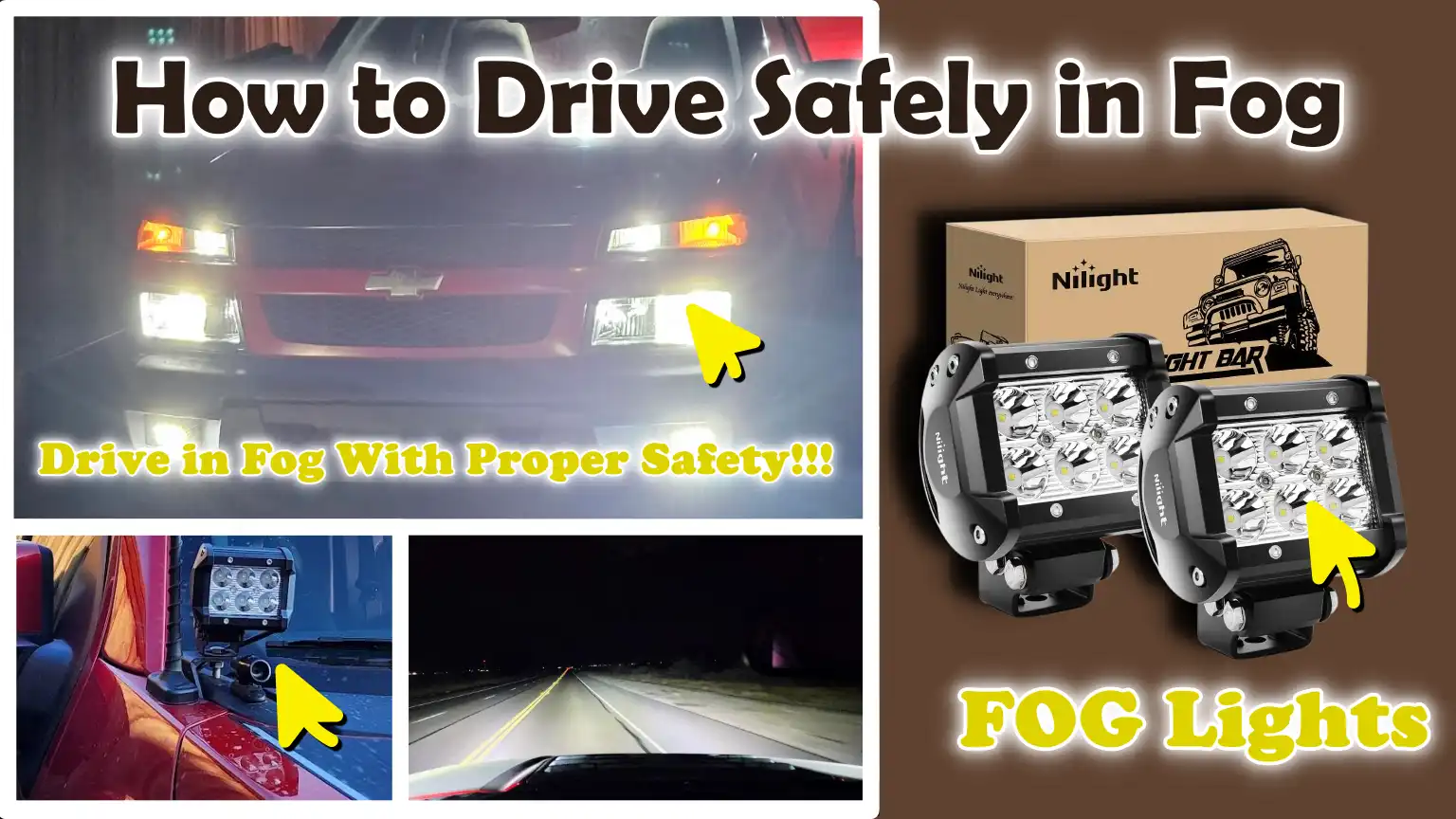
If your vehicle is equipped with fog lights, they are specifically designed to cut through fog to illuminate the path ahead and enhance short-range visibility, particularly near the road surface.
Rear fog lights are equally important, as they help drivers approaching from behind spot your vehicle more easily in dense fog.
Brake lights and turn indicators must also function correctly so that other drivers can clearly understand your driving intentions and react in a timely manner; this is crucial in low-visibility conditions.
2. Keep the Windshield Clean and in Good Condition
A clean windshield is essential for clear vision, specially in foggy conditions where visibility is already compromised.
Dirt, dust, or water spots on the glass can scatter light, making it even more difficult to see the road clearly.
Fog often causes moisture to accumulate on the interior of the windshield, creating a misty film that can further reduce visibility.
Using the vehicle’s defogger eliminates this moisture, keeping the interior of the glass clear.
Windshield wipers should be in good condition so that they can effectively remove water droplets, mist, or debris without leaving streaks.
The washer fluid reservoir should also be full and ready for use, as it helps to quickly clean the windshield whenever necessary.
Keeping the windshield clean ensures that you maintain maximum visibility, even during already challenging driving conditions.
3. Check Tires and Brakes
Tires and brakes are critical for maintaining control of the vehicle, particularly when driving in fog, where sudden stops may be required.
Good tire grip depends on the depth of the tread, which helps the tires maintain traction on the road surface and prevents skidding.
Worn-out tires reduce grip and increase stopping distances, a situation that can be particularly dangerous when visibility is low and reaction time is already limited.
Properly functioning brakes are equally essential, as they enable you to decelerate smoothly and come to a safe stop without losing control.
In foggy conditions, drivers often need to apply their brakes more cautiously and more frequently; therefore, the braking system must be in good working order.
Regular inspections of tires and brakes ensure greater stability, shorter stopping distances and overall enhanced safety.
4. Ensure Mirrors and Windows Are Clean
When driving in fog, clean mirrors and windows are crucial for maintaining full situational awareness of your surroundings.
Side mirrors and rear windows help you spot vehicles approaching from behind or from the sides, which is vital when visibility is limited.
If these surfaces are dirty, fogged up, or covered in a layer of moisture, it becomes difficult to gauge the position and movement of other vehicles.
This can make lane changes hazardous or lead to delayed reactions.
Keeping all mirrors and windows clean and clear ensures that you enjoy optimal visibility in every direction, not just straight ahead, but all around.
This comprehensive awareness helps you make safer decisions and reduces the likelihood of accidents in foggy conditions.
Know, Important Techniques for Driving in Fog
Driving in fog requires an approach distinctly different from that used in normal conditions, as visibility becomes limited and reaction time is reduced.
In clear weather, drivers rely heavily on being able to see far ahead; however, in fog, you must rely more on vehicle control, patience and maintaining a keen awareness of your immediate surroundings.
Many accidents in foggy conditions occur because drivers continue to drive at their usual speeds or use the wrong type of headlights, thereby significantly increasing the risk.
By adhering to proper driving techniques such as: using the correct headlights, maintaining speed control, keeping a safe distance and staying within your lane, you can substantially reduce the likelihood of accidents.
These techniques are not only simple but also highly effective, as they directly address the primary hazards associated with fog, namely, reduced visibility, delayed reaction times and difficulties in accurately judging distance and speed.
1. Use Low-Beam Headlights
Using the appropriate headlights in fog is one of the most critical safety measures, as it directly impacts how clearly you can see the road ahead.
In foggy conditions, high-beam headlights are dangerous because they emit an intense beam of light that reflects off the tiny water droplets suspended in the air and bounces back into your eyes; this creates a glare that further impairs visibility.
This glare can also make it difficult to clearly identify objects in your immediate vicinity.
Conversely, low-beam headlights are designed to direct light downward toward the road surface, thereby minimizing glare and allowing you to see the road surface, lane markings and surrounding vehicles much more clearly.
Using low beams allows your eyes to adapt more effectively to foggy conditions, thereby enhancing your overall ability to drive safely.
2. Maintain a Safe Speed
Maintaining a safe speed in fog is crucial, as visibility, the distance you can see ahead, is significantly reduced compared to normal conditions.
When visibility is poor, driving at normal or high speeds becomes dangerous; if an obstruction suddenly appears in your path, you may not have sufficient time to react.
Driving at a slower-than-normal speed provides you with more time to scan the road, make decisions and, if necessary, come to a safe stop.
Your speed should always be determined by how far ahead you can see; this means that the lower the visibility, the slower you should drive.
This simple adjustment helps minimize the risk of sudden braking and improves your vehicle control in unexpected situations.
3. Increase the Distance from the Vehicle Ahead
In foggy conditions, it is essential to increase the distance between your vehicle and the vehicle traveling ahead of you.
This provides you with more reaction time should the vehicle in front slow down or come to a sudden halt.
Under normal circumstances, drivers may follow the “three-second rule”; however, in fog, this gap should be extended to at least five seconds, or more, depending on the clarity of your visibility.
This extra space serves as a safety buffer and helps prevent rear-end collisions, which occur frequently during foggy weather.
It is also important to avoid sudden braking, as this can startle drivers following behind you who may not have a clear view of your vehicle.
Maintaining a safe distance from the vehicle ahead makes driving easier and reduces the likelihood of accidents caused by delayed reactions.
4. Stay in Your Lane
In foggy conditions, staying within your lane becomes more challenging, as it is difficult to discern road edges and the positions of other vehicles.
Using road markings such as: lane lines or edge lines, as visual guides can help you maintain proper positioning within your lane.
These markings often appear more clearly than distant objects and can serve as reliable reference points.
Avoiding drifting from your lane is crucial, as even a slight deviation into an adjacent lane can create hazardous situations, specially when other drivers are also contending with reduced visibility.
Keeping your vehicle steady and centered within your lane helps maintain order and minimizes confusion on the road.
5. Use Fog Lights Correctly
Fog lights are specifically designed to enhance visibility in foggy conditions; however, their effective use is essential for them to serve their purpose.
Front fog lights are typically mounted low on the vehicle and emit a wide, low beam that helps illuminate the road surface without causing excessive glare.
Rear fog lights are intensely bright and their purpose is to ensure that drivers following you can see your vehicle more clearly in dense fog.
These lights should be switched on when visibility becomes significantly reduced and turned off once conditions improve, as keeping them on in clear weather can cause glare for other drivers.
In some regions, there are legal regulations regarding when fog lights may be used; therefore, it is crucial to adhere to local traffic laws.
The proper use of fog lights enhances safety, as it aids your ability to see better and ensures that others can see you clearly.
Know, Specific Safety Tips for Driving in Fog
Driving in fog becomes particularly challenging when visibility is significantly reduced; in such situations, standard driving rules alone are insufficient to ensure safety.
Specialized safety techniques emphasize heightened awareness, hazard mitigation and empowering drivers to make better decisions, specially when they cannot rely solely on their eyesight.
In foggy conditions, drivers must not depend solely on what is visually apparent, but must also rely on road markings, sounds and careful anticipation of what lies ahead.
Many serious accidents occur because drivers follow other vehicles too closely, attempt dangerous overtaking maneuvers, or fail to adequately signal their presence.
By using road markings as a guide, avoiding unnecessary overtaking, paying attention to ambient sounds and making proper use of hazard lights, you can drive more safely in foggy conditions and minimize the risk of confusion or sudden collisions.
1. Use Road Markings as a Guide
In foggy conditions, it can be difficult to spot distant objects and vehicles; however, road markings such as: lane lines and edge lines, are typically more clearly visible because they are closer to your vehicle.
Following these markings is a safer strategy than relying on the vehicle ahead, as the lead vehicle may suddenly change speed, come to a halt, or veer out of its lane without clear warning.
Road markings provide a consistent and reliable guide, helping you stay within your lane and maintain the correct direction.
By focusing on these lines, you reduce the risk of drifting into an adjacent lane or driving off the road, common causes of accidents in low-visibility conditions.
2. Avoid Overtaking
Overtaking in fog is extremely dangerous because you cannot clearly see the road ahead or accurately judge the speed and distance of oncoming vehicles.
Even if the road appears clear, another vehicle could suddenly emerge from the fog, leaving you with very little time to react.
This can lead to severe head-on collisions, which are often fatal.
Rather than attempting to pass other vehicles, it is generally safer to remain in your lane and maintain a steady speed.
However, in specific situations where overtaking may be necessary such as: when the vehicle ahead is moving very slowly or is stationary, it must be executed with extreme caution, ensuring maximum visibility and sufficient space to complete the maneuver safely.
Avoiding unnecessary overtaking significantly reduces risk and helps maintain a more predictable flow of traffic.
3. Listen Attentively
When visibility is low, your sense of hearing becomes a crucial tool for maintaining awareness of your surroundings.
Lowering the volume of your car stereo, or turning it off entirely, helps you identify specific sounds, such as horns, approaching vehicles, emergency sirens, or the sudden braking of nearby cars.
These sounds can provide you with early warnings regarding potential hazards that you might not be able to see clearly.
Paying attention to the sounds of surrounding traffic enables you to react more quickly and make better decisions, particularly in situations where visual information is insufficient.
Utilizing both your visual and auditory senses in tandem significantly enhances your overall awareness and safety in foggy conditions.
4. Use Hazard Lights When Necessary
Hazard lights are extremely useful in foggy conditions, as they make your vehicle more easily visible to others, particularly when visibility is severely limited or when your vehicle is stopped on or near the road.
They should be activated when you are driving at a very low speed due to dense fog, or when you are compelled to stop in a hazardous location, as they serve to warn other drivers to exercise caution.
However, hazard lights should not be kept continuously active while driving at normal speeds, as this can confuse other drivers and make it difficult for them to interpret your intentions such as: whether you are planning to turn or change lanes.
The proper use of hazard lights enhances mutual understanding among drivers and helps prevent accidents caused by low visibility or misunderstandings on the road.
What to Do If Visibility Becomes Extremely Low
When fog becomes so dense that you can barely see a few meters ahead, driving can become extremely dangerous, as your ability to react to obstacles, other vehicles, or changes in the road is almost completely eliminated.
In such situations, even driving at a slow speed may not be safe, because your stopping distance could exceed the distance you are able to see ahead.
Studies conducted on driving in low-visibility conditions indicate that many serious accidents occur when drivers attempt to keep moving forward despite being unable to see clearly.
In conditions of extremely low visibility, the safest course of action is to mitigate the risk by temporarily stopping your vehicle and taking steps to ensure that your vehicle remains visible and secure.
Knowing exactly what to do in such a situation can help prevent panic, reduce confusion and avoid collisions caused by sudden or unexpected maneuvers on the road.
1. Stop Your Vehicle Safely
When visibility drops to extremely low levels, the first step is to carefully maneuver your vehicle to a safe stopping point, away from the flow of traffic.
This could be a designated parking area, the roadside shoulder, or any location where your vehicle can be positioned completely outside of the main driving lanes.
It is essential to gradually reduce your speed while maintaining control of the vehicle and using your turn signals to indicate your intended maneuver.
Stopping directly on the roadway or within a traffic lane is extremely dangerous, as other drivers may fail to spot your vehicle in time and could collide with it.
By selecting a safe and visible location to stop, you minimize the risk of being struck by passing vehicles, thereby allowing you to wait for conditions to improve without endangering yourself or others.
2. Turn on Hazard Lights
Once your vehicle is safely parked on the side of the road, it is crucial to turn on your hazard lights to ensure your vehicle remains visible to other drivers.
In dense fog, visibility can be so poor that even stationary vehicles are barely discernible; therefore, hazard lights serve as a warning signal that alerts others from a distance.
These flashing lights help drivers identify whether your vehicle is stationary or moving very slowly, allowing them to safely adjust their speed and direction.
The proper use of hazard lights is particularly important at night or in extremely dense fog, when visibility is further reduced.
3. Remain Inside the Vehicle
When visibility is severely limited, it is safer to remain inside your vehicle rather than stepping outside.
Outside the vehicle, you face a heightened risk, as other drivers may fail to spot you walking near the roadway.
Inside the vehicle, you are protected by its sturdy structure and are less exposed to passing traffic.
If, for any reason, you absolutely must exit the vehicle, do so with extreme caution, and, if possible, move well away from the road.
Staying inside the vehicle also helps you remain calm and focused, preventing you from making unsafe decisions while waiting for conditions to improve.
4. Wait for the Fog to Clear
When visibility is extremely low, waiting for the fog to clear is often the safest and most effective course of action.
Fog conditions can change over time and frequently, visibility improves after a short while as temperatures and weather patterns shift.
Patience plays a vital role in safety, as attempting to continue driving when visibility is near zero significantly increases the risk of accidents.
By waiting until you have a clear view of a safe distance ahead, you ensure that you have ample time to react to any situation on the road.
This simple decision to stop and wait can prevent serious accidents and help you safely resume your journey once conditions improve.
How to Avoid Common Mistakes When Driving in Fog
Driving in fog becomes particularly hazardous, primarily due to certain common mistakes that further reduce visibility or increase reaction times, errors that many drivers fail to recognize, yet which can have severe consequences.
As fog limits your field of vision and distorts your perception of distance and speed, even minor errors can quickly escalate into dangerous situations.
Road safety research indicates that most fog-related accidents are not caused by the fog itself, but rather by unsafe driving habits.
When drivers fail to adjust their habits, the likelihood of sudden braking, collisions and loss of vehicle control increases significantly.
Understanding and avoiding these mistakes is the most effective way to stay safe, as it enables you to remain more alert, maintain proper vehicle control and react in a timely manner to sudden situations on the road.
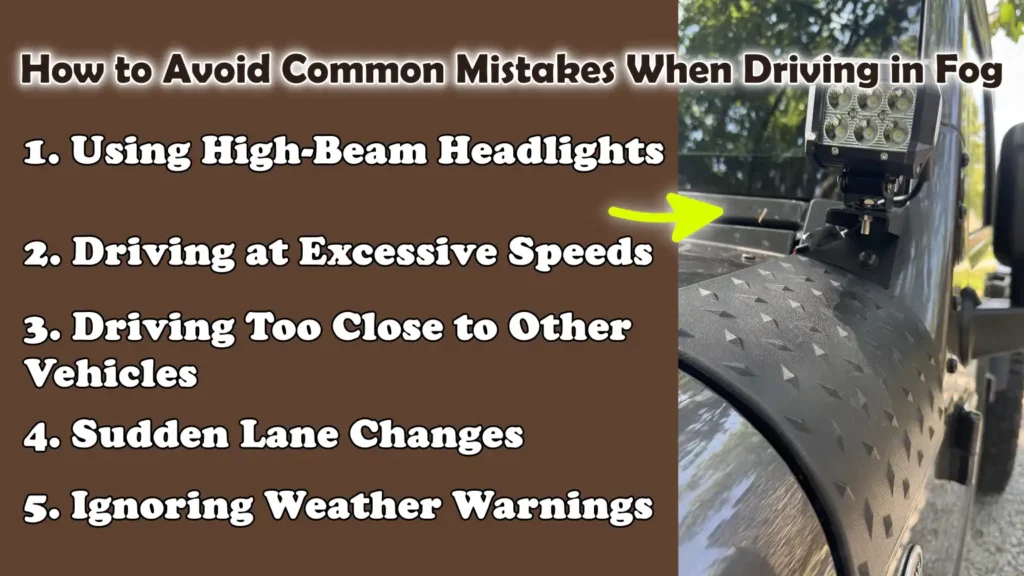
1. Using High-Beam Headlights
Drivers often use high-beam headlights under the assumption that doing so will improve visibility; however, in foggy conditions, this actually exacerbates the situation.
The intense light emitted by high beams reflects off the tiny water droplets suspended in the fog and shines directly back into the driver’s eyes, creating a blinding glare.
This glare reduces visual contrast, making it difficult to clearly distinguish the road, lane markings and surrounding vehicles.
Rather than being helpful, high beams can cause glare that blinds the driver and further heightens confusion in conditions where visibility is already compromised.
High-beam lights scatter illumination over a wide area and at a high angle, which increases light reflection within the fog.
This reflection creates a “white wall” effect; while the driver perceives intense brightness, they gain very little information regarding the road ahead.
Consequently, objects appear less distinct and become difficult to identify, leading to delayed reaction times and an increased risk of accidents.
2. Driving at Excessive Speeds
Driving at normal or high speeds in fog is one of the most dangerous mistakes one can make, as visibility is significantly reduced compared to normal conditions.
When driving at high speeds, if an obstruction suddenly appears in your path, you do not have sufficient time to react.
As stopping distance depends on both speed and reaction time, driving at high speeds makes it even more difficult to safely bring the vehicle to a halt within the visible distance.
At high speeds, even a slight delay in reaction time can significantly increase the stopping distance.
In foggy conditions, where objects are already perceived with a delay, such delays can prove to be even more perilous.
Reducing your speed allows your brain more time to process the available visual information, thereby enabling you to safely bring your vehicle to a stop should the need arise.
3. Driving Too Close to Other Vehicles
In foggy conditions, driving too close to the vehicle ahead, also known as “tailgating”, is extremely risky, as you may fail to detect when that vehicle slows down or comes to a stop.
Low visibility makes it difficult to accurately judge distances; consequently, drivers often drive too closely without fully comprehending the inherent dangers involved.
This can lead to sudden rear-end collisions.
Maintaining a greater distance between vehicles provides you with more time to react and apply the brakes with ease.
In foggy conditions, this distance should be greater than in normal circumstances, as reduced visibility necessitates more space to come to a safe stop.
Maintaining a safe distance acts as a protective buffer and significantly reduces the likelihood of accidents.
4. Sudden Lane Changes
In foggy conditions, sudden lane changes can cause confusion and increase the risk of collisions, as other drivers may be unable to clearly see your vehicle or anticipate your maneuvers.
In low-visibility situations, anticipating rapid or sudden lane changes is difficult, which can lead to side-impact collisions or hazardous situations.
Driving smoothly and remaining within your lane helps other drivers understand your position and intentions.
Predictable driving minimizes confusion and enables everyone on the road to react safely.
In foggy conditions, where visibility is already compromised, avoiding sudden lane changes is particularly crucial.
5. Ignoring Weather Warnings
Ignoring weather warnings, whether before or during a journey, is another serious mistake that can lead to drivers becoming stranded in dangerous fog.
Weather reports often provide information regarding the density, timing and affected areas of fog, thereby helping drivers plan their trips safely.
Being informed about weather conditions allows you to postpone your journey, choose safer routes, or properly prepare your vehicle.
This reduces the likelihood of getting caught in situations of extremely low visibility, enabling you to make better decisions both before and during your trip.
Read More:
- How to Drive Safely at Night
- How to Clean Car Headlights
- How to Replace a Headlight Bulb
- How to Fix Headlight System Malfunction
Know, Safety Tips for Driving on Highways in Fog
Driving on a highway in foggy conditions is significantly more dangerous than driving in urban areas, as vehicles travel at higher speeds and the distances between them change rapidly.
In foggy conditions, this combination of high speed and reduced visibility creates a scenario where drivers have very little time to react to sudden changes such as: slow-moving traffic, stalled vehicles, or accidents ahead.
Studies on road accidents indicate that many of the most severe fog-related crashes occur specifically on highways; these accidents often involve multiple vehicles, as drivers are unable to see far enough ahead to stop safely.
On highways, it is crucial to remain calm, drive in a relaxed manner and avoid making any sudden maneuvers.
Adhering to specific safety techniques designed for high-speed roadways can significantly mitigate risks and help drivers maintain control of their vehicles, even when visibility is poor.
1. Exercise Extra Caution on High-Speed Roadways
Driving in fog on high-speed roadways requires extreme caution, as the faster a vehicle travels, the longer it takes to come to a complete stop; and when visibility is low, this stopping distance becomes even more critical.
On highways, drivers often travel at such high speeds that even a delay of a few seconds in reacting can result in a serious accident.
Fog heightens the risk of multi-vehicle collisions, as the sudden stopping of one vehicle can trigger a chain reaction involving several others.
This occurs because drivers following behind are unable to spot the stopped vehicles in time to decelerate rapidly enough.
Exercising extra caution entails significantly reducing your speed, remaining vigilant at all times and being prepared for any sudden situations that may arise ahead.
2. Utilize Reflective Markers
Reflective markers installed along highways prove invaluable in foggy conditions, as they are designed to reflect the light emitted by your headlights back toward you, making them clearly visible even when the surrounding area is obscured by mist.
These markers are typically placed along lane lines, road edges and curves, serving as guides to help you maintain your correct position on the road.
In low-visibility situations, rather than straining to focus on distant objects, following these reflective markers is a safer and more reliable method for staying within your lane.
They also assist you in understanding the road’s alignment, particularly around bends or curves, where visibility is further diminished.
Using these markers as navigational aids enhances vehicle stability and significantly reduces the risk of drifting into an adjacent lane.
3. Avoid Using Cruise Control
Using cruise control in foggy conditions is not recommended, as it diminishes your direct control over the vehicle’s speed, a level of control that is absolutely essential in low-visibility situations.
Although cruise control is designed to maintain a consistent speed, road conditions in fog can change abruptly, potentially requiring you to decelerate rapidly or come to a complete stop.
When cruise control is active, a driver’s reaction time may be delayed, as the system continues to maintain its set speed until it is manually disengaged.
Driving manually allows you to instantly adjust your speed based on what you observe ahead, enabling you to react very quickly to sudden obstacles or changes in traffic flow.
By maintaining complete control over acceleration and braking, you remain safer and better prepared when driving on foggy highways.
Learn, About Technologies Aiding Driving in Fog
Modern vehicles are equipped with a variety of technologies designed to significantly enhance safety when driving in foggy conditions, particularly when visibility is low and immediate reactions are critical.
These technologies are engineered to assist the driver by providing better vehicle control, improving visibility and issuing warnings regarding potential hazards.
While they cannot serve as a substitute for cautious driving, they act as an additional layer of safety that can help prevent accidents or mitigate their severity.
In foggy conditions, where human vision and perception are limited, these systems become even more invaluable, as they can react more rapidly and consistently to specific situations.
Understanding how these technologies function and utilizing them correctly can help drivers maintain greater confidence and control on the road.
1. Anti-lock Braking System – ABS
The Anti-lock Braking System, commonly referred to as ABS, is a safety feature designed to prevent the wheels from locking up during sudden or hard braking.
When a driver applies the brakes abruptly, specially in an emergency situation, the wheels may stop rotating; this can cause the vehicle to skid and result in a loss of driver control.
ABS operates by automatically adjusting the brake pressure on each wheel, ensuring that the wheels continue to rotate even as the vehicle decelerates.
This preserves vehicle control and reduces the risk of skidding, a significant advantage in foggy conditions, where low visibility may necessitate sudden braking.
By maintaining the vehicle’s stability during braking, ABS enables the driver to steer around obstacles if necessary, thereby enhancing overall safety.
2. Fog Lamps
Fog lamps are specialized lights designed to enhance visibility in foggy conditions.
They emit a wide, low-angle beam of light close to the road surface.
Unlike standard headlights, fog lamps are mounted lower on the vehicle and project their light downward, thereby reducing the glare caused by light reflecting back from the fog.
This design minimizes blinding glare and helps drivers see road markings, road edges and nearby obstacles more clearly.
Front fog lamps improve forward visibility, while rear fog lamps help make your vehicle more visible to drivers approaching from behind.
The proper use of fog lamps can make a significant difference in how clearly you can see in dense fog, as well as how clearly other drivers can see you.
3. Advanced Driver Assistance Systems – ADAS
Advanced Driver Assistance Systems, commonly referred to as ADAS, comprise a range of technologies.
They are designed to help drivers avoid accidents and operate their vehicles more safely.
These systems utilize sensors, cameras and radar to monitor the road and surrounding traffic.
Features such as Lane Assist help keep the vehicle within its lane by making subtle steering corrections or by issuing warnings if the vehicle begins to drift out of its lane.
Forward Collision Warning systems alert the driver when there is a risk of colliding with another vehicle or object ahead, providing the driver with additional time to react.
Some systems are even capable of automatically applying the brakes in emergency situations.
In foggy conditions, when visibility is reduced, these systems provide an additional layer of awareness and assistance.
This enables drivers to identify hazards that may not be clearly visible and to react more effectively.
Know, Difference Between Driving in Fog: Night vs Day
Driving in fog can be hazardous at any time, but the level of risk depends on whether it is day or night, as lighting conditions significantly impact your ability to see and react.
Fog inherently reduces visibility by scattering light in all directions; this effect is either amplified or diminished depending on the ambient light present in your surroundings.
During the day, natural light aids in identifying shapes and movements more effectively; however, it can also create a false sense of security, making visibility appear adequate, when, in reality, it remains severely limited.
At night, the absence of natural light, combined with the presence of artificial illumination from vehicles, intensifies glare and makes it difficult to accurately judge distances.
Understanding the distinct differences between driving in fog at night versus during the day allows drivers to appropriately adjust their driving style and adopt the correct techniques to ensure safety in both scenarios.
Also, there’s study that clearly shows that simply slowing down is not always enough to stay safe in fog conditions, as many drivers still travel at the unsafe speeds for the given visibility, so it is true that it is really important of actively adjusting the speed based on how far you can see, specially on the highways where risks are way more higher than normal roads.[¹]
1. Challenges of Driving in Fog at Night
Driving in fog at night is particularly challenging because natural light is scarce, compelling drivers to rely almost entirely on headlights and other artificial sources of illumination.
Fog reflects light from headlights, streetlights and oncoming vehicles, creating a glare that can make it difficult to see clearly, even at short distances.
This glare diminishes visual contrast, the distinction between different colors or shades, meaning that objects such as other vehicles, road signs and pedestrians may not stand out clearly against the background.
Furthermore, human eyes take longer to adapt to darkness, which can further delay a driver’s reaction time.
Due to the combined effect of all these factors, nighttime fog becomes particularly hazardous, requiring drivers to exercise extra caution, drive at reduced speeds and maintain their full concentration on the road.
2. The Dangers of Daytime Fog
During the day, the presence of natural light may make fog appear less dangerous; however, it still poses serious risks that drivers often underestimate.
The presence of daylight can create a false sense of visibility, leading drivers to believe they can see much further ahead than is actually the case.
Consequently, they may drive at speeds exceeding what is safe for the prevailing conditions.
Even in daylight, fog continues to distort depth perception and makes objects appear further away than their actual distance, which can lead to delayed reactions.
Drivers may also overlook the necessity of using headlights during the day, making them less visible to other road users.
For these reasons, daytime fog becomes dangerous, particularly when drivers fail to appropriately adjust their driving habits.
3. Best Practices for Both Situations
Safe driving in fog, whether by day or by night, depends on how you adjust your driving techniques based on actual visibility rather than simply on the time of day.
Drivers should always use low-beam headlights, regardless of whether it is day or night, to improve visibility and minimize glare.
Vehicle speed should be reduced to a level commensurate with the distance you can see ahead and the following distance from the vehicle in front should be increased to allow for greater reaction time in the event of a sudden emergency.
Paying attention to road markings and avoiding sudden swerving, both of these practices are crucial for maintaining control over the vehicle, regardless of the situation.
By understanding how fog affects visibility differently during the day and at night and by consistently adopting safety measures, drivers can mitigate risks and drive more safely in all foggy conditions.
Know, Legal and Safety Guidelines
Driving in fog is not solely about one’s own safety; it also entails adhering to traffic laws designed to mitigate accidents in low-visibility conditions.
Many road authorities establish specific regulations for conditions such as fog, as reduced visibility heightens the likelihood of collisions and renders standard driving behaviors unsafe.
These guidelines help ensure that all drivers operate their vehicles in a predictable and cautious manner, a critical factor when clear visibility is compromised.
Understanding and complying with these regulations can protect you from legal penalties while simultaneously minimizing the risk of accidents.
Safe driving in fog relies on both awareness and responsibility; it requires drivers to adapt their behavior to prevailing conditions and strictly adhere to established safety protocols.
1. Traffic Regulations Regarding Fog Lights
In many regions, regulations govern the use of fog lights; due to their intense brightness, improper use can adversely affect other drivers.
These lights should be utilized only in situations where visibility is severely restricted such as: during dense fog, heavy rain, or thick mist.
The use of fog lights in clear weather is generally prohibited, as they can cause glare and distract other motorists on the road.
While front fog lights help improve visibility immediately ahead of the vehicle, rear fog lights enhance your vehicle’s visibility to oncoming traffic from behind; however, both types of lights should be switched off when they are no longer necessary.
Adherence to these regulations ensures that fog lights are utilized effectively and do not pose a hazard or cause inconvenience to other drivers.
2. Speed Regulations During Low Visibility
Speed regulations in foggy conditions are often stricter, as reduced visibility means drivers require greater time and distance to react safely.
Even if no specific lower speed limit is posted on the road, drivers are legally expected to adjust their speed according to visibility and road conditions.
This entails driving at a slower pace than usual, ensuring that you can come to a complete stop within the distance you can clearly see ahead of you.
In many regions, traffic authorities may also issue temporary speed advisories during heavy fog to mitigate the risk of accidents.
Disregarding these guidelines and driving at excessive speeds in low visibility can result in fines, penalties and a significantly higher probability of a collision.
3. The Importance of Defensive Driving
In foggy conditions, defensive driving stands as one of the most critical principles of safety, as it focuses on anticipating potential risks in advance and remaining prepared for unexpected situations.
In foggy conditions, drivers cannot rely solely on what is immediately visible to their eyes; therefore, they must assume that hidden hazards may exist on the road such as: slow-moving vehicles, stopped traffic, or obstructions.
‘Defensive driving’ involves maintaining a safe following distance, avoiding sudden maneuvers, remaining alert and being prepared to react with a calm and composed mind.
It also entails paying close attention to the signals and actions of other drivers and making necessary adjustments to one’s own driving behavior to avoid any potential collisions.
Practicing defensive driving minimizes errors, improves reaction times and fosters a safer driving environment for everyone on the road.
What to Do In Emergency Situations in Fog
Emergency situations in fog are particularly dangerous because drivers have very little time to spot and react to sudden problems on the road.
Under normal conditions, a driver might have several seconds to react to a hazard; however, in dense fog, this timeframe can shrink to a mere instant, increasing the risk of panic and poor decision-making.
Fog not only limits visibility but also affects how quickly the brain can identify and comprehend what is happening ahead.
For this reason, remaining calm and employing the correct reaction techniques becomes critically important.
Knowing how to handle sudden obstacles and how to respond in the event of an impending accident can help you avoid subsequent collisions and ensure the safety of both yourself and other drivers.
In any emergency situation, the key is to maintain control, avoid sudden maneuvers and make decisions that minimize, rather than exacerbate, the risk.
1. Handling Sudden Obstacles
When a sudden obstacle appears in the fog such as: a stalled vehicle, an animal, or debris lying on the road, the most important thing is to remain calm and avoid panicking.
Panic often leads to sudden, hard braking or abrupt steering inputs, which can result in a loss of vehicle control or skidding.
Controlled braking is the safest approach, as it allows you to gradually reduce speed while keeping the vehicle stable.
Applying the brakes smoothly and steadily helps maintain traction on the road and gives you better control over the vehicle’s direction.
If your vehicle is equipped with systems such as anti-lock brakes, this will provide even greater assistance in preventing the wheels from locking up, thereby enabling you to maintain control of the vehicle even while braking.
Keeping your hands steady on the steering wheel and, if possible, focusing on the safest path around an obstacle can help you avoid a collision.
Remaining calm and reacting in a controlled manner makes a significant difference in safely handling sudden hazards.
2. Dealing with Accidents Ahead
When you face an accident while driving in fog, the situation can be extremely dangerous, as other drivers following behind you may not spot the stationary vehicles in time.
The first step is to immediately, yet smoothly, reduce your speed so that you do not pose a sudden hazard to the vehicles following you.
Maintaining a safe distance while slowing down is crucial, as it provides you with sufficient space to come to a safe stop without colliding with the vehicles ahead.
Once your vehicle has safely slowed down or come to a halt, it is essential to activate your hazard lights to warn other drivers; these lights make your vehicle more visible in low-light or low-visibility conditions.
This helps drivers approaching from behind recognize that there is an issue ahead, signaling them to reduce their speed.
Avoid stopping too close to the accident site; maintaining a safe distance reduces the risk of further collisions and ensures that adequate space remains for emergency vehicles, should they be needed.
Acting with caution and deliberation in such situations minimizes the risk of subsequent accidents and helps maintain better control over the situation.
Some Expert Tips for Safe Driving in Fog
Driving instructors and road safety experts agree that when driving in fog, greater emphasis should be placed on vehicle control, situational awareness and proactive planning rather than merely on speed.
Their advice is grounded in real-world driving behaviors and accident patterns, which reveal that most fog-related accidents occur when drivers fail to adapt their habits to conditions of reduced visibility.
Experts emphasize that safe driving in fog requires a combination of proper techniques, calm decision-making and constant attention to one’s surroundings.
By adopting these expert tips, drivers can better understand how to react in uncertain situations, reduce driving-related stress and enhance their overall safety.
These tips focus on practical measures that help drivers stay prepared, avoid common hazards and drive with confidence in foggy conditions.
1. Advice from Driving Instructors
Driving instructors often teach that the most crucial rule for driving in fog is to adjust your speed according to your actual visibility, rather than strictly adhering to posted speed limits or relying entirely on your habitual daily driving routines.
They advise keeping both hands firmly on the steering wheel, maintaining full focus on the road ahead and avoiding distractions such as mobile phones or loud music.
Instructors also recommend using low-beam headlights at all times when driving in fog and frequently checking your mirrors to remain aware of the vehicles surrounding you.
Driving smoothly is another key principle, which entails avoiding sudden acceleration, abrupt braking, or sharp turns.
These simple yet effective habits help drivers maintain better control over their vehicles and reduce the likelihood of making errors in low-visibility conditions.
2. Defensive Driving Strategies
Experts strongly recommend defensive driving as one of the best methods for staying safe in foggy conditions.
This approach involves always anticipating the unexpected and being prepared for potential hazards that may not be immediately apparent.
In fog, drivers should assume that there may be slow-moving vehicles, stopped traffic, or obstructions ahead and adjust their driving accordingly.
Maintaining a greater distance from other vehicles, reducing speed and staying within one’s lane are all essential components of defensive driving.
It also involves keeping a keen eye on signals from other drivers such as: brake lights or turn indicators, and reacting in advance rather than waiting until the very last moment.
Defensive driving helps mitigate risks by providing drivers with more time and space to handle sudden and unexpected situations.
3. The Importance of Anticipation
Anticipation is a crucial skill that experts consider vital for safe driving, particularly in fog, as it enables drivers to prepare for situations before they actually unfold.
When visibility is poor, you cannot rely solely on what is immediately visible right in front of you; therefore, you must look ahead and anticipate potential changes in road conditions.
For instance, if you spot brake lights illuminating in the distance or notice a change in the flow of traffic, you should immediately begin to reduce your vehicle’s speed, rather than waiting until you are in close proximity to that situation.
Anticipation involves being aware of specific locations where fog is likely to be particularly dense such as: near bodies of water, in valleys, or on low-lying roads.
By remaining mentally prepared and anticipating potential risks in advance, drivers can react more quickly and avoid sudden maneuvers that could lead to accidents.
Conclusion – How to Drive Safely in Fog
Basically, in the foggy conditions: the smartest driver actually limits your vision, but with these techniques you can be more aware and controlled way as well.
Fog reduces visibility, impairs your ability to judge distances and increases reaction times; this means that if one does not modify their usual driving habits, those very habits can prove to be unsafe.
The most fundamental principles of safety are, maintaining a reduced speed, using appropriate lighting, keeping a safe distance from other vehicles and remaining calm under all circumstances.
Many accidents that occur in foggy conditions happen because drivers overestimate their visibility or react too slowly; however, by adhering to a few basic safety techniques and remaining vigilant at all times, these risks can be significantly mitigated.
Ensuring that your vehicle is properly prepared, using road markings as a guide, avoiding sudden maneuvers and exercising patience when visibility is extremely poor, these are all proven methods for staying safe.
Fog is a temporary phenomenon, yet the decisions you make while driving through it can have long-lasting consequences.
By driving cautiously, anticipating potential hazards in advance and respecting the limitations imposed by reduced visibility, you can keep yourself, your passengers and other road users safe.
Now, that’s it from this guide How to Drive Safely in Fog, also you can ask more questions below this guide.
Frequently Asked Questions
Q1: Which lights should be used when driving in fog?
Answer: When driving in fog, you should always use low-beam headlights, as they project light downwards and help you see the road more clearly without causing glare. High-beam headlights should be avoided, as their light reflects off the tiny water droplets present in the fog, making visibility difficult. If your vehicle is equipped with fog lights, you can use them in conjunction with your low beams, as they are specifically designed to illuminate objects closer to the road surface more clearly. Rear fog lights can also help other drivers identify your vehicle from behind, specially when the fog is very dense.
Q2: Why is driving in fog considered dangerous?
Answer: Driving in fog is primarily dangerous because it significantly reduces visibility and impairs your ability to accurately judge distances and speeds. You may not spot other vehicles, obstacles, or road signs until you are very close to them, leaving you with very little time to react. Fog can also make objects appear further away than they actually are, which may lead to delayed braking. All these factors increase the likelihood of accidents, particularly if drivers do not adjust their speed and driving style accordingly.
Q3: How slowly should one drive in fog?
Answer: There is no fixed speed limit for driving in fog, as the appropriate speed depends on how far ahead you can see. Generally, a good rule of thumb is to drive slowly enough that you can bring your vehicle to a complete stop within the distance you can clearly see ahead. If visibility is extremely poor, you may need to drive at a speed significantly lower than the posted speed limit. Reducing your speed gives you more time to react to sudden obstacles and allows you to maintain better control over your vehicle.
Q4: Should ‘hazard lights’ be used while driving in fog?
Answer: ‘Hazard lights’ should be used only in specific situations such as: when your vehicle is stationary or moving at a very slow speed due to extremely dense fog. These lights make your vehicle more easily visible to others. However, continuously using ‘hazard lights’ while driving at normal speeds is not advisable, as it can confuse other drivers and make it difficult for them to anticipate your next move (such as turning or changing lanes).
Q5: How much distance should be maintained from the vehicle ahead while driving in fog?
Answer: In foggy conditions, you should increase the distance between your vehicle and the vehicle ahead to at least five seconds or more; this distance will depend on how clearly you can see the road ahead. This extra space (distance) gives you more time to react if the vehicle ahead suddenly slows down or stops. Maintaining a greater distance from the vehicle ahead is the most effective way to avoid a rear-end collision in low-visibility conditions.
Q6: Is it safe to overtake another vehicle in fog?
Answer: Overtaking in fog is generally unsafe, as you can neither clearly see the road ahead nor accurately estimate the speed of oncoming vehicles. Another vehicle could suddenly emerge from the fog, creating the potential for a serious accident. Generally, it is best to stay in your lane and maintain a steady speed. Overtaking should only be considered when it is absolutely necessary and when you are completely certain that it can be executed safely.
References:
[1] Driver behaviour in fog is not only a question of degraded visibility – A simulator study
https://www.sciencedirect.com/science/article/abs/pii/S0925753517302485

Guys, I’m a car audio enthusiast and customization expert and I love clear sound and clean installation. Plus, I have spent years helping people build their dream audio setups. And whenever I’m working on cars, I probably listen to music and thinks about the next big upgrade.