
Written By: Don Dodi
Fact Checked By: Kristen Brown
Reviewed By: Diego Rosenberg
Ice literally reduces the tire grip so much that even careful drivers can lose their control with the matter of seconds.
That’s why, driving on the ice is consider one of the most dangerous situations any driver can face, as even with the small loss of traction it can lead to serious accidents.
So, whenever the roads freezes: then the friction between your tires and the surface literally drops sharply, which means your car just cannot grip, stop or turn as effectively as it does on the dry roads.
Not only this, ice can also be deceptive: specially in the form of black ice, which is nearly invisible and often catches drivers off guard as well.
This is why, you actually need to learn everything from this guide about How to Drive Safely on Ice, so that you can adapt your driving style with smooth controlled movements.
Now, Let’s Understand About the Ice Conditions
Driving safely on ice begins with a clear understanding of how various ice conditions behave on the road.
Ice is not always uniform; depending on temperature, humidity levels and location, its level of traction can vary significantly.
The primary challenge is that ice reduces the friction between your tires and the road surface, meaning your car cannot stop, turn, or accelerate as effectively as it normally would.
Many accidents occur because drivers fail to recognize the specific type of ice beneath their tires and react too late.
By learning how different ice conditions form and where they are typically found, drivers can make better decisions, adjust their speed accordingly and avoid sudden maneuvers that often carry the risk of skidding or losing control.
1. Types of Ice on Roads
Black Ice
Black ice is one of the most dangerous road conditions because it consists of a very thin, transparent layer of ice that blends seamlessly with the road surface, making it nearly impossible to detect.
It often resembles a standard wet road, deceiving drivers into believing that conditions are safe.
In reality, black ice offers almost no traction and even a slight turn or application of the brakes can cause the vehicle to skid.
This type of ice typically forms when temperatures hover around the freezing point and moisture present on the road freezes rapidly.
Because it is invisible, drivers should rely on caution, reduced speeds and smooth driving techniques rather than attempting to identify it visually.
Packed Ice
Packed ice forms when snow is compressed by passing vehicles, transforming it into a hard, icy layer.
Unlike black ice, this type of ice is generally visible, offering drivers a slight advantage in recognizing its presence.
However, it remains extremely slippery and can significantly reduce tire traction.
Vehicles may feel more stable on packed ice compared to black ice; nevertheless, sudden braking or sharp steering maneuvers can still cause the vehicle to skid.
Packed ice often accumulates on roads that have not been properly cleared, particularly in areas that experience frequent icefall and heavy traffic.
Wet Ice
Wet ice forms when a thin layer of water covers a layer of ice, a phenomenon that typically occurs when ice partially melts during the day and subsequently refreezes.
This combination renders the surface extremely slippery, as the water further reduces the friction between the tires and the ice.
Wet ice is particularly dangerous because it can almost completely eliminate tire traction, making it extremely difficult to maintain control of the vehicle.
Even minor actions such as: lightly applying the brakes or gently pressing the accelerator, as it can cause the vehicle to skid if the driver is not sufficiently cautious.
2. When and Where Ice Forms
Ice does not form just anywhere; rather, it freezes only under specific conditions and in specific locations.
Early mornings and late nights are the most common times for ice formation, as temperatures drop significantly during these hours, causing any moisture present on the road surface to freeze rapidly.
During these hours, drivers may also face reduced visibility, which further heightens the danger.
Bridges and overpasses freeze more rapidly than standard roadways because cold air circulates both above and beneath them, causing their surfaces to cool down quickly.
Consequently, these are often among the first places where ice appears, even if surrounding roads still seem safe.
Shaded areas such as: roads flanked by trees or buildings, also retain ice for longer periods; due to limited exposure to direct sunlight, these spots prevent the ice from melting.
In areas where sunlight rarely penetrates, ice can remain frozen throughout the day, particularly during the winter months, creating hidden hazards for drivers who are unaware of these conditions.
How to Be Fully Prepare Your Vehicle for Driving on Ice
Properly preparing your vehicle before driving on ice is one of the most crucial steps in ensuring safety.
Ice reduces traction (grip) to such an extent that, if the vehicle is not properly prepared, even a skilled driver can lose control of the vehicle.
A properly prepared vehicle enhances grip, stability and reliability in cold conditions.
Cold weather also affects various components of your vehicle, including the tires, battery and braking performance.
By inspecting and preparing your vehicle in advance, you minimize the likelihood of breakdowns, skidding and emergency situations.
Thorough preparation not only protects you but also instills greater confidence when driving on icey roads.
1. Tires and Traction
Tires play the most critical role when driving on ice, as they are the only part of the vehicle that comes into contact with the road.
Tires designed for winter or snow are specifically engineered with deeper tread patterns and softer rubber compounds that remain flexible even in freezing temperatures, thereby providing excellent grip on icey surfaces.
Using standard tires in cold conditions can significantly reduce traction and increase stopping distances.
Maintaining the correct tire pressure is equally important, as cold air causes tire pressure to drop, which can adversely affect the vehicle’s handling and stability.
Under-inflated or over-inflated tires reduce the contact area with the road surface, thereby increasing the risk of skidding.
Checking tread depth is also essential, as worn-out tires cannot effectively displace water or maintain proper grip on the surface, which increases the risk of skidding even at low speeds.
2. Essential Vehicle Checks
Before driving on ice, it is crucial to ensure that all of the vehicle’s major systems are functioning correctly.
The brakes must be in good condition, as stopping distances on ice are naturally longer and faulty brakes can exacerbate an already hazardous situation.
A robust battery is also essential, as cold weather diminishes battery performance, making it difficult to start the engine.
Many drivers face sudden vehicle breakdowns during the winter season solely due to a weak battery.
Properly functioning windshield wipers and defroster systems are vital for maintaining clear visibility, as ice and fog can accumulate rapidly on the glass.
Poor visibility combined with slippery roads can be extremely dangerous; therefore, keeping the windows clear is just as important as ensuring adequate tire traction.
3. Emergency Kit Essentials
Even with thorough preparation, emergencies can still arise while driving on ice; consequently, carrying an emergency kit is absolutely essential.
Should you become stranded for an extended period, warm clothing and a blanket will help protect you from the biting cold.
In the event of a nighttime breakdown or poor visibility, a flashlight equipped with fresh batteries proves invaluable.
If your vehicle gets stuck in the ice, you can improve tire traction by placing materials such as sand or kitty litter beneath the tires.
A basic first-aid kit is also crucial for treating minor injuries until professional assistance arrives.
Keeping these items in your car ensures that you are better prepared to handle unexpected situations safely and with composure.
Know, Basic Techniques for Driving on Ice
Driving on ice requires an approach entirely different from that used in normal road conditions, as tire grip is significantly reduced.
Even the slightest or most sudden maneuver can upset the vehicle’s balance and cause it to skid.
The fundamental principle of safe driving on ice is to exercise gentleness in every action, whether accelerating, braking, or maintaining speed.
Ice reduces the friction between the tires and the road to such an extent that the stopping distance required to halt the vehicle can be several times greater than usual.
This means drivers must anticipate road conditions well in advance, react promptly and avoid making any sudden changes to their speed or direction.
By employing controlled and gentle driving techniques, you can maintain the vehicle’s stability and minimize the risk of skidding or losing control.
1. Gradual Acceleration
Accelerating gradually is crucial when driving on ice, as applying too much power, or applying it too abruptly, as it can cause the tires to spin and instantly lose their grip.
When the wheels begin to spin, the vehicle may skid sideways or fail to move forward effectively.
To prevent this, the throttle (accelerator) should be applied very gently and progressively, allowing the tires sufficient time to establish traction.
This becomes even more critical when starting from a standstill or driving on an incline, where the likelihood of skidding is higher.
Sudden bursts of power must always be avoided, as they disrupt the limited traction available on icy surfaces and destabilize the vehicle.
2. Controlled Braking
Braking on ice requires extreme caution, as applying the brakes forcefully or abruptly can cause the wheels to lock up, potentially sending the vehicle into an uncontrolled skid.
Instead of abruptly and forcefully slamming the brake pedal, it should be applied gradually and steadily to allow the tires sufficient time to maintain their grip on the road.
On icy surfaces, bringing the vehicle to a complete stop takes significantly longer than usual; therefore, braking should be initiated well in advance of the normal stopping point.
Abrupt braking must always be avoided, as it compromises control and increases the risk of skidding, even if you are driving at a moderate speed.
3. Maintaining a Safe Speed
Maintaining a safe speed is one of the most critical factors when driving on ice, as excessive speed diminishes your ability to control the vehicle and react to any given situation.
On icy roads, even a minor error committed at high speed can result in a complete loss of vehicle control.
Drivers should always operate their vehicles at a speed significantly lower than normal, regardless of how empty or clear the road may appear.
Vehicle speed should also be continuously adjusted based on actual road conditions such as: the presence of ice, temperature and traffic levels.
Driving slowly provides you with more time to react to sudden situations and helps ensure that the vehicle remains stable throughout the entire journey.
How to Control Steering on Icy Roads
When driving on ice, steering control becomes extremely sensitive because the grip between your tires and the road is significantly reduced.
Even a slight or sudden adjustment to the steering can compromise tire traction and cause the vehicle to skid.
On dry roads, tires respond instantly to rapid steering inputs; however, on ice, that same action can send the vehicle sliding in an unintended direction.
This occurs because ice drastically reduces friction, making it difficult for the tires to follow your intended path.
Therefore, effective steering control does not mean turning sharply, but rather turning the steering wheel gradually, smoothly and in a controlled manner.
Drivers who remain calm and avoid abrupt steering movements find it much easier to maintain vehicle balance and control, even in challenging icy conditions.
1. Turning the Steering Wheel Gradually
Turning the steering wheel gradually is crucial for maintaining control on icy roads, as sudden or rapid steering inputs can cause the tires to instantly lose their grip.
When you turn the steering wheel too quickly, the tires are unable to establish proper traction on the slippery surface; consequently, the front end of the vehicle may slide straight ahead instead of turning.
Turning the steering wheel smoothly and gradually gives the tires time to adjust and maintain maximum contact with the road surface.
This becomes even more critical when changing lanes, navigating turns, or maneuvering to avoid obstacles.
By keeping your steering slow and steady, you minimize the risk of skidding and enhance the vehicle’s overall stability.
2. Keeping the Wheels Straight
Keeping the wheels as straight as possible is another essential technique for driving safely on ice.
Straight wheels help maintain maximum tire contact with the road surface, thereby improving traction and reducing the risk of skidding.
When the wheels are turned unnecessarily, the available traction is divided between steering and maintaining balance, making it easier to lose control of the vehicle.
Whenever possible specially while braking or driving on very slippery sections, keeping the wheels straight helps maintain the vehicle’s stability.
This simple habit can prevent unnecessary skidding and provides the driver with better control over the vehicle in challenging icey conditions.
How to Maintain a Safe Distance
When driving on ice, maintaining a safe distance is one of the most critical safety rules, as it takes significantly longer than usual to bring a vehicle to a halt.
On dry roads, tires establish a firm grip on the surface, allowing the vehicle to stop quickly; however, on icey or icy roads, a lack of friction causes the vehicle to continue sliding even after the brakes have been applied.
This significantly increases the risk of rear-end collisions, particularly if you are driving too close to the vehicle ahead.
Many drivers fail to accurately estimate the increased stopping distance required, a common oversight that frequently leads to accidents.
Maintaining a greater distance not only provides you with more reaction time but also allows you to apply the brakes gradually and safely without panicking.
A safe distance acts as a protective buffer, enabling you to maintain control over your vehicle and avoid sudden, hazardous situations.
1. Increased Stopping Distance
On icey roads, a vehicle’s stopping distance can be several times greater than on dry roads because the tires cannot establish adequate traction with the road surface.
Under normal conditions, a vehicle can come to a stop within a relatively short distance; however, on ice, applying the brakes with the same force may cause the vehicle to slide forward rather than stopping promptly.
For this reason, it is strongly advised that you maintain a distance at least six to ten times greater than the standard safe distance.
This additional space allows you to decelerate gradually without having to apply sudden, hard braking, an action that can easily cause the vehicle to skid.
By increasing your stopping distance, you create sufficient space to react calmly and safely to any sudden changes in the traffic ahead.
2. Avoiding Driving Too Closely
When driving on icey roads, it is absolutely essential to avoid driving too closely behind another vehicle (tailgating); If the vehicle ahead of you stops suddenly or loses control, driving too closely will leave you with absolutely no time to react.
Driving at close quarters often forces drivers to make sudden braking decisions, a maneuver that is extremely dangerous on ice and frequently leads to skidding or collisions.
Maintaining an appropriate distance provides you with more time to react, allowing you to adjust your speed comfortably and safely.
This also reduces driving-related stress, as you do not have to constantly worry about sudden changes in the movements of the vehicle ahead.
By maintaining a safe distance, you not only protect yourself but also contribute to creating safer driving conditions for everyone on the road.
How to Handle a Skid
Skidding is one of the most common and dangerous situations faced when driving on ice; it occurs when your tires lose their grip on the road surface.
Because ice significantly reduces friction, even a minor error such as: braking suddenly or turning the steering wheel too quickly, as it can cause the vehicle to slide out of control.
When a skid occurs, the car does not travel in the direction you intend, which can be a frightening experience for many drivers.
However, the key to safely handling a skid is to understand how it happens and, rather than panicking, to react calmly.
The right knowledge and deliberate actions can help you regain traction on the road and bring the vehicle back under control without an accident.
1. Understanding the Types of Skids
A front-wheel skid, also known as understeer, occurs when the front tires lose their grip, causing the car to continue moving in a straight line even if you are attempting to turn.
This typically happens when you enter a turn too quickly or apply the brakes suddenly on an icy surface.
In this situation, the steering wheel may turn, but the vehicle does not respond as expected.
A rear-wheel skid, also known as oversteer, occurs when the rear tires lose their grip, causing the rear end of the car to begin sliding sideways.
This often happens while accelerating or while taking a turn too quickly on a slippery surface.
Understanding the differences between these types of skids helps drivers react appropriately and prevent the situation from escalating.
2. Correcting a Skid
Correcting a skid requires calm and controlled actions rather than sudden or abrupt reactions.
The first step is to remain calm, as panic often leads to ‘over-correction,’ which can make the skid even worse.
You should gently lift your foot off the accelerator to reduce speed and allow the tires a chance to regain their grip on the road.
Furthermore, steer into the skid; this means turning the steering wheel in the direction toward which the rear of the car is sliding.
This helps to straighten the vehicle and regain control.
Sudden or forceful movements should be avoided, as smooth and gradual inputs provide the tires with a better opportunity to re-engage with the road surface.
3. What Not to Do
While taking the right steps during a skid is crucial, knowing what not to do is equally important.
Slamming on the brakes suddenly is one of the biggest mistakes, as it can cause the wheels to lock up and result in further sliding.
This also eliminates any remaining traction, making it even more difficult to regain control of the vehicle.
Sudden steering inputs are also dangerous, as they can cause the vehicle to snap abruptly in the opposite direction, potentially worsening the skid or causing the car to spin out completely.
Rapid and uncontrolled movements often exacerbate the situation; therefore, to safely recover from a skid, it is always best to remain calm, avoid impulsive actions driven by panic and maintain a calm yet controlled approach to driving.
How to Properly Use the Brakes
Using brakes correctly on icy roads is crucial, as many drivers lose control of their vehicles the moment they apply the brakes.
Due to the presence of ice, the friction between the tires and the road surface is significantly reduced; this means that if you press the brakes too hard, the wheels may lock up, causing the vehicle to slide forward rather than coming to a proper stop.
Unlike on dry roads, where hard braking brings the vehicle to an immediate halt, on icy roads, it is essential to apply brakes gently and with control to maintain the vehicle’s balance.
The method you use to apply brakes depends on whether or not your vehicle is equipped with an Anti-lock Braking System (ABS).
Understanding this distinction helps you adopt the correct technique, avoid skidding and maintain control over the vehicle even in extremely slippery conditions.
1. Anti-lock Braking System – ABS
Vehicles equipped with an Anti-lock Braking System are designed to prevent the wheels from locking up during braking, thereby preserving a degree of steering control even on slippery surfaces.
When you press the brake pedal firmly, the system automatically modulates the brake pressure multiple times per second, ensuring that the wheels continue to rotate rather than locking up.
This improves the vehicle’s stability and significantly reduces the risk of the vehicle spinning out of control.
When the ABS is active, drivers may feel a slight vibration or pulsation in the brake pedal; this is completely normal and indicates that the system is functioning correctly.
When using ABS on ice, the best approach is to maintain steady and firm pressure on the brake pedal and allow the system to do its job; there is no need to “pump” (repeatedly apply and release) the brakes.
2. Braking in Vehicles Without ABS
In vehicles not equipped with an Anti-lock Braking System (ABS), brakes must be applied with extreme caution, as there is no automatic mechanism to prevent the wheels from locking up.
If you apply the brakes too forcefully, the wheels may cease rotating entirely, leading to a loss of vehicle control and potentially causing the vehicle to slide uncontrollably on icy surfaces.
To avoid this, drivers should employ the “pumping” technique, that is, repeatedly and rhythmically pressing and releasing the brake pedal in a controlled manner.
This allows the wheels an opportunity to regain their traction on the road between each application of the brakes, thereby minimizing the risk of a full skid.
The primary objective is to gradually reduce the vehicle’s speed while ensuring that the wheels continue to rotate, as rotating wheels maintain a stronger grip on the road surface compared to locked wheels.
When driving a non-ABS vehicle on icy roads, the safest approach is to apply the brakes very gently and with complete control.
Know, Difference Between Driving on Icy Ascents and Descents
Driving on slopes on icy roads becomes extremely challenging because, due to the force of gravity, the vehicle may slide backward or accelerate forward uncontrollably.
On flat roads, the primary issue is low traction (tire grip); however, on hills, you must also manage the vehicle’s weight as it moves either against or with the force of gravity.
This makes acceleration, braking and steering control significantly more sensitive.
Many accidents on icy roads occur on slopes because drivers continue to employ the same techniques they use in normal driving conditions.
The key to staying safe is to brake gently, maintain control over your speed and avoid any sudden maneuvers that could compromise tire traction.
1. Driving Uphill
When driving uphill on icy roads, it is crucial to maintain a steady speed; if you come to a complete stop midway up the slope, getting the vehicle moving forward again can be extremely difficult.
When a vehicle stalls on an icy incline, the tires may spin, but they fail to generate the necessary traction to propel the vehicle forward.
To prevent this, drivers should approach the hill at a controlled and steady pace, allowing the vehicle to ascend smoothly without the need for sudden acceleration.
Pressing the accelerator too hard causes the wheels to spin, which actually reduces traction rather than increasing it.
Maintaining a consistent speed and shifting gears gently helps the tires retain traction, enabling the vehicle to climb safely without sliding backward.
2. Driving Downhill
Driving downhill on ice is often more hazardous than driving uphill because gravity pulls the vehicle forward, causing it to gain speed even without the accelerator being pressed.
If a driver relies too heavily on the brakes, the wheels may lock up or lose traction, causing the car to slide out of control.
Engaging a lower gear is one of the safest methods, as it allows the engine to naturally decelerate the vehicle, thereby reducing the need for hard braking.
This technique is often referred to as ‘engine braking,’ and it helps maintain superior control and stability.
Drivers should avoid excessive braking and, instead, apply light and gradual pressure only when necessary.
To drive safely on slopes on icy roads, it is essential to keep your speed low from the outset and to drive in a slow, controlled manner.
How to Ensure Visibility and Be Totally Aware
Visibility and awareness are paramount when driving on icy roads, as reduced visibility combined with diminished traction (grip on the road) significantly heightens the risk of accidents.
Even if you are driving cautiously, hazardous situations can arise if you cannot clearly see the road ahead or fail to identify potential hazards in time.
Ice is often accompanied by fog, frost, or icefall, all of which can obstruct your vision and impair your ability to react quickly.
With clear visibility, you can identify icy patches, other vehicles and road conditions well in advance, giving you ample time to adjust your speed and driving technique accordingly.
Maintaining awareness of your surroundings, including traffic behavior and changing weather conditions, ensures that you remain prepared and helps you avoid sudden, abrupt reactions that could result in a loss of vehicle control.
1. Keeping Windows Clear
Keeping all windows clear is essential for safe driving in icey conditions, as even the slightest obstruction can limit your field of vision and slow down your reaction time.
Frost, fog and ice can accumulate rapidly on windshields and windows, particularly in cold weather.
Proper use of the defroster helps clear away fog and ice from both the interior and exterior surfaces, ensuring a clear view of the road.
It is also crucial to clear all windows, including the side and rear windows, before beginning your journey, as obstructed visibility can obscure critical elements such as nearby vehicles or pedestrians.
Clear windows help you make better driving decisions and reduce the likelihood of facing sudden hazards on icy roads.
2. Proper Use of Headlights
The proper use of headlights improves both your visibility on icy roads and the ability of others to spot your vehicle.
During the winter season, keeping your headlights on, even during the day, helps other drivers identify your vehicle from a distance; this becomes even more critical when road conditions are slippery.
However, you should avoid using high beams in icey or brightly lit conditions, as the light can reflect off ice, falling iceflakes, or fog, creating glare and making it difficult to see clearly.
In such situations, low beams provide better visibility, as they minimize light reflection and reveal objects on the road more distinctly.
The proper use of headlights ensures that you can identify potential hazards ahead while also making your presence known to other drivers, thereby helping to prevent collisions.
Know, Common Mistakes to Avoid During Driving on ICE
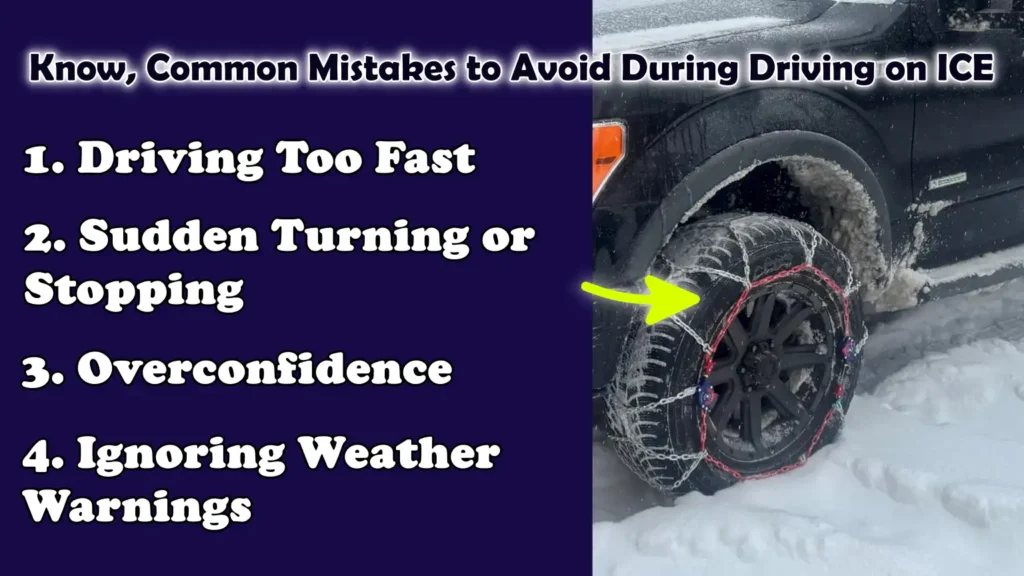
Driving on ice requires a completely different mindset; many accidents occur not due to a lack of driving skill, but rather due to small, avoidable errors.
Ice reduces tire grip to such an extent that even a minor mistake can quickly escalate into a dangerous situation.
Many drivers rely solely on their usual driving habits, failing to realize that icey roads demand slower speeds, gentler steering and heightened caution.
Avoiding common mistakes is the easiest and most effective way to stay safe, as it prevents the very situations in which you might lose control of your vehicle.
Understanding these errors helps drivers make better decisions, remain alert and drive on icey roads with greater confidence and safety.
1. Driving Too Fast
Driving too fast on ice is one of the most dangerous mistakes anyone can make, as it drastically reduces the time available to react to any potential hazards.
On icey roads, stopping distances are already significantly increased; consequently, high speeds make it even more difficult to slow down in time or come to a complete stop.
Even if the road appears clear, hidden patches of ice or ice can suddenly eliminate a speeding vehicle’s tire grip, causing the car to skid.
Driving at a slower speed allows you to maneuver the vehicle more easily, maintain better control and react safely to unexpected situations.
Reducing your speed is one of the simplest, yet most crucial, steps toward safe driving on ice.
2. Sudden Turning or Stopping
Sudden maneuvers such as: jerking the steering wheel, braking abruptly and hard, or accelerating suddenly, as it can easily cause tires to lose traction on icy roads.
Because the road surface is slippery, tires require time to establish firm contact with the road and maintain their grip.
When a driver turns or stops suddenly, the tires are unable to cope with this abrupt change, causing the vehicle to slide or skid.
Driving slowly and smoothly helps maintain the vehicle’s balance and ensures that the tires remain in contact with the road.
By avoiding sudden maneuvers, drivers can minimize the risk of losing control of their vehicle and enhance their overall safety in icy conditions.
3. Overconfidence
Overconfidence is a common mistake that places many drivers in dangerous situations on icy roads.
Some drivers believe that their experience or their vehicle’s capabilities will keep them safe; however, ice can affect any driver and any vehicle.
Even modern systems like traction control cannot fully compensate for the lack of tire grip on ice.
Underestimating icy conditions often leads to behaviors such as speeding, driving too close to other vehicles, or taking unnecessary risks.
Remaining vigilant and respecting road conditions is crucial, as it keeps drivers alert and prepared for sudden changes.
4. Ignoring Weather Warnings
Ignoring weather warnings can lead to extremely dangerous situations, as icy conditions can often be anticipated in advance.
Weather reports provide essential information regarding sub-zero temperatures, icefall and icy road conditions, enabling drivers to plan accordingly.
When drivers disregard these warnings, they may find themselves driving in unsafe conditions without adequate preparation.
This increases the likelihood of accidents, vehicle breakdowns, or getting stranded along the way.
Paying attention to weather updates helps you decide whether to postpone your trip, choose a safer route, or exercise extra caution, thereby making your entire journey much safer.
Learn, Specific Safety Tips
When driving on ice, safety entails more than just maintaining control over your vehicle; it also involves making prudent decisions both before and during your journey.
By thinking ahead, anticipating road conditions and adjusting your plans accordingly, many accidents can be avoided.
Icey conditions create unpredictable scenarios; and even if you drive cautiously, external factors such as: road quality, the behavior of other vehicles and sudden weather shifts, as it can still impact your safety.
By planning properly, remaining vigilant in traffic and knowing when it is simply unsafe to drive at all, you can significantly mitigate risks and make safer choices during challenging winter conditions.
1. Planning Your Route
A highly effective way to stay safe on icey roads is to plan your route in advance, as not all roads receive the same level of maintenance or safety treatment.
Well-maintained roads are typically cleared of ice and treated with salt or sand; this improves tire traction and reduces the likelihood of skidding.
Choosing such routes enhances your safety and makes the driving experience smoother and more secure.
Whenever possible, it is also crucial to avoid steep inclines or hilly terrain, as these areas become extremely hazardous when covered in ice.
On slopes, maintaining control over vehicle speed and tire traction becomes difficult, thereby increasing the risk of skidding.
By opting for safer, flatter routes, you can minimize many of the difficulties associated with driving on ice.
2. Driving in Traffic
Navigating through traffic on icey roads requires a heightened level of vigilance, as other drivers do not always adhere to safety regulations.
Some drivers may brake suddenly, drive at excessive speeds, or lose control of their vehicles without any warning.
Therefore, it is crucial to remain alert at all times and maintain a safe distance from other vehicles.
You should always anticipate unpredictable behavior from others and be prepared to react in a calm and composed manner.
Keeping your focus on the road and monitoring the movements of surrounding vehicles helps you anticipate potential hazards in advance.
In such situations, “defensive driving” becomes essential, as it helps you avoid accidents caused by the mistakes of others.
3. When Not to Drive
Knowing when not to drive is perhaps the most critical safety-related decision you can make.
Severe icestorms and extreme weather conditions can render roads unsafe, even for experienced drivers.
In such situations, visibility can be severely limited, tire traction may be almost entirely lost and emergency assistance could be delayed.
Driving under these circumstances significantly increases the risk of accidents and the likelihood of becoming stranded.
If weather warnings indicate hazardous icey conditions, it is often safest to postpone your trip or refrain from driving altogether.
The decision to avoid driving during adverse weather is a prudent and responsible step that can prevent serious harm.
Read More:
- How to Drive Safely in Fog
- How to Drive Safely at Night
- How to Clean Car Headlights
- How to Replace a Headlight Bulb
- How to Fix Headlight System Malfunction
What to Do in an Emergency Situation
On icy roads, emergencies can arise suddenly, and often without warning, even if you are driving cautiously.
Ice reduces traction to such an extent that vehicles can get stuck, slide, or become stranded in precarious locations.
In such situations, how you react is critical, as panic or a wrong move can exacerbate the situation.
Staying calm, thinking clearly and adopting simple safety measures can help keep both you and others safe.
Knowing in advance which steps to take enables you to react quickly and safely, thereby minimizing the risk of injury or further complications during an emergency.
Additionally, there’s official report that shows that driving on the ice is not just the risky thing, but it also requires proper preparation and awareness, as it clearly proves that reduced traction and longer stopping distances are literally the major causes of accidents; which is why drivers must always slow down, maintain good and safe distance and ensure their vehicle is fully prepared for winter conditions of their region.[¹]
1. If Your Vehicle Gets Stuck
If your vehicle gets stuck in the ice, it typically means that the tires are spinning without sufficient traction, preventing the vehicle from moving forward.
This occurs because the slippery surface of the ice fails to provide the tires with enough friction to gain a grip.
One of the most effective remedies is to place sand or other traction-enhancing materials under the tires; this creates a slightly rougher surface and improves grip.
Another helpful technique is to gently rock the vehicle back and forth; this helps the tires build momentum and may enable the vehicle to extricate itself.
It is crucial that you do not press the accelerator too hard, as this will merely cause the tires to spin faster and worsen the situation.
2. If You Lose Control
If you lose control of your vehicle on an icy surface, the most important thing is to remain calm and avoid making any impulsive, panic-driven moves.
Actions such as slamming on the brakes or jerking the steering wheel violently can cause the vehicle to slide even more uncontrollably.
Instead, you should handle the steering gently and allow the vehicle to slow down naturally.
Keeping your movements smooth helps the tires gradually regain their traction.
It is particularly important to avoid sudden braking, as locking the wheels compromises the vehicle’s ability to turn and maintain directional control.
By remaining calm and making controlled adjustments, you increase your chances of safely regaining control of the vehicle.
3. If You Get Stuck
If you get stuck on a icey road, remaining inside the vehicle is generally the safest option, as it protects you from the cold weather and passing traffic.
Extreme cold can be dangerous, so keeping yourself warm is essential.
Blankets, extra clothing, or occasionally running the heater can help maintain your body temperature.
It is also crucial to call for help as soon as possible and inform someone of your location.
Staying inside the vehicle makes it easier for rescue teams to locate you and keeps you safe from adverse weather conditions.
By remaining calm and prepared, you can stay relatively safe, even in difficult situations, until help arrives.
Conclusion – How to Drive Safely on Ice
So, now you have understood that: the safest drivers on the ice are not the fastest or the most experience, but the one who actually stay patient, be aware and be in control at every moment during driving on ice.
Ice can reduce tire grip to such an extent that even routine maneuvers such as: braking, turning, or accelerating, as it can become hazardous if not executed correctly.
Therefore, driving safely on icy roads is a combination of preparation, situational awareness and refined driving techniques.
From using the right tires and maintaining your vehicle to driving slowly, maintaining a safe distance and calmly handling a skid, every small step plays a crucial role in mitigating risks.
It is also essential to recognize that no technology or amount of experience can completely eliminate the challenges posed by ice; consequently, exercising sound judgment remains paramount.
Avoiding common mistakes, monitoring road and weather conditions and knowing when to refrain from driving altogether can prevent numerous accidents.
Ultimately, driving safely on ice means exercising patience, handling the vehicle gently and always prioritizing safety over speed or personal convenience.
So, that’s it from this guide about How to Drive Safely on Ice, if you still have confused then just comment that damn question below.
Frequently Asked Questions
Q1: Why is driving on ice so dangerous?
Answer: Driving on ice is dangerous because it significantly reduces the friction between your tires and the road surface. This means your car cannot establish a proper grip on the road, making it difficult to maneuver, turn, or accelerate. Even minor issues such as: faults in the brake assembly or other specific vehicle components, as it can lead to a loss of control. Ice can also be difficult to spot, particularly “black ice,” which often looks exactly like a normal road surface. Consequently, drivers frequently lose control of their vehicles without any warning, thereby heightening the risk of accidents.
Q2: What is the safest speed for driving on icey roads?
Answer: There is no single, fixed “safe speed” for icey roads, as it depends on various factors such as the depth of the ice on the road, visibility conditions and the specific state of the road surface. However, a general rule of thumb is to drive significantly slower than your normal speed and to further reduce your speed in accordance with the prevailing road conditions. Driving slowly provides you with more reaction time and helps you maintain control over the vehicle. On icy roads, it is always better to drive too slowly than to drive too fast.
Q3: How can I identify “black ice” on the road?
Answer: Identifying “black ice” is extremely difficult because it is transparent and blends seamlessly with the road surface. However, there are certain signs you can look out for. If the road appears glossy or slightly reflective, “black ice” may be present. It often forms during the early morning hours or late at night, particularly on bridges, in shaded areas and in locations where there is limited exposure to sunlight. If the temperature is close to the freezing point (0°C), it is safe to assume that ‘black ice’ may be present and you should drive with extreme caution.
Q4: What should I do if my car skids on the ice?
Answer: If your car begins to skid, the best course of action is to remain calm and avoid panicking. You should slowly and gently lift your foot off the accelerator to regain balance and steer the car in the direction you want it to go. Avoid braking suddenly or forcefully, as this can cause the car to skid even more. Smooth and controlled movements help the tires regain traction on the road and allow you to bring the vehicle back under your control.
Q5: Is it better to use standard brakes or ‘engine braking’ on ice?
Using ‘engine braking’ (downshifting) is generally safer on ice, specially when driving on slopes, as it allows you to gradually reduce the car’s speed without applying excessive pressure to the brakes. Hard braking can cause the wheels to lock up or lose traction with the road, leading to a skid. Using a lower gear naturally slows the engine speed, thereby maintaining better control over the vehicle. However, controlled and gentle application of standard brakes can also be used in conjunction with engine braking.
Q6: Are winter tires truly necessary for driving on ice?
Answer: Winter tires are strongly recommended because they are specifically designed for cold-weather conditions. They feature a unique tread pattern and natural rubber composition that remains flexible even at low temperatures, thereby improving traction on ice and ice. Standard tires tend to stiffen in cold weather, causing them to lose their grip easily. Although specialized safety tires cannot completely eliminate all hazards, they certainly provide a significant improvement in safety and vehicle control.
Q7: Can I drive normally if my car is equipped with ABS and traction control?
Answer: No; even if your car features modern safety systems like ABS and traction control, you should still not drive as you normally would. While these systems help enhance safety, they cannot fully resolve the fundamental issue of reduced traction on ice. You must still drive slowly, execute turns gently and maintain a safe following distance. Relying too heavily on technology can lead to overconfidence in your driving abilities, potentially encouraging you to adopt risky driving behaviors.
Q8: When should I completely avoid driving on ice?
Answer: You should avoid driving when conditions are extremely hazardous such as: during a severe blizzard, heavy freezing rain, or when roads have not yet been cleared or treated. If visibility is severely limited, or if weather advisories recommend against traveling, it is safer to stay off the roads entirely. In such extreme circumstances, even experienced drivers may find it difficult to maintain control of their vehicles; therefore, refraining from travel is the best decision.
References:
[1] Winter Weather Driving Tips
https://www.nhtsa.gov/winter-driving-tips

Guys, I’m a car audio enthusiast and customization expert and I love clear sound and clean installation. Plus, I have spent years helping people build their dream audio setups. And whenever I’m working on cars, I probably listen to music and thinks about the next big upgrade.