
Written By: Don Dodi
Fact Checked By: Kristen Brown
Reviewed By: Diego Rosenberg
Literally, a simple flick of a switch can prevent from some serious road accidents.
And, turn signals also known as “INDICATORS” or “BLINKERS”, so these are actually most basic yet really important safety features in any vehicle.
As, they are literally designed to clearly communicate your driving intentions such as: if you are turning, changing lanes or merging: so that other road users can react in time and be safe during whole journey.
Not only this, despite of having simple action, many drivers either signal too late, forget to signal or actually relies only on their vehicle movement, which again creates confusion and actually increases the accident risk, because clear communication is must to avoid accidents.
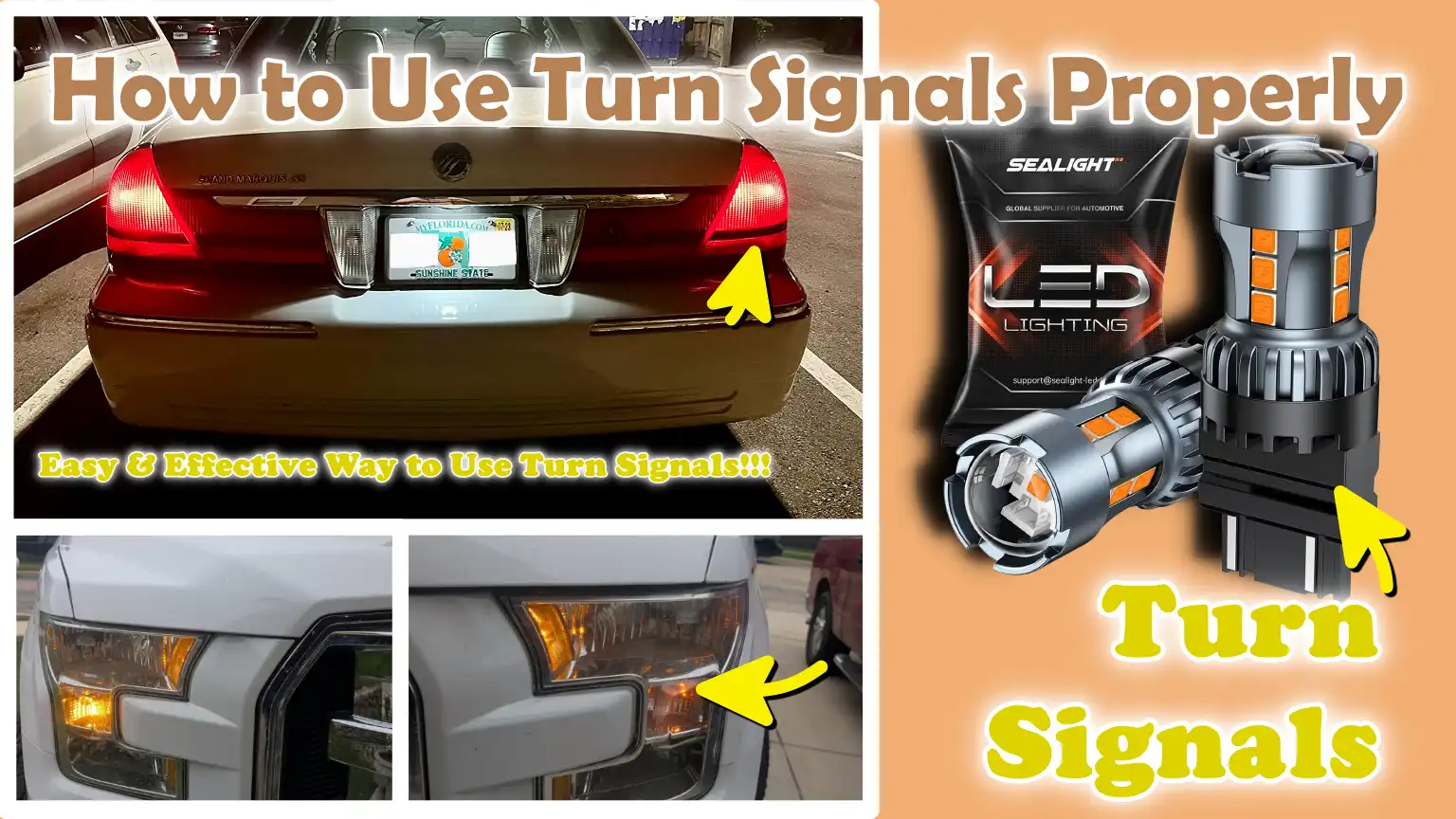
Now, that’s the guide that shows How to Use Turn Signals Properly so that you can actually improve your communication with other driving fellows and reduce the risk.
Know, About The Importance of Using Turn Signals
Using turn signals is one of the simplest, yet most effective habits that directly enhances driving safety and road harmony.
Turn signals are designed to allow you to clearly communicate your intentions to other drivers, motorcyclists and pedestrians before you turn or maneuver your vehicle.
This advance notice provides others with precious time to react, adjust their speed, or safely alter their position.
Research on road safety, along with guidelines from organizations such as the National Highway Traffic Safety Administration, consistently emphasize that failing to signal is a major cause of preventable accidents, particularly when changing lanes or making turns.
When drivers fail to signal, it creates uncertainty; and uncertain drivers are more prone to making sudden or unsafe decisions.
The proper use of indicators makes driving behavior predictable, which is one of the fundamental pillars of accident prevention.
In everyday driving, whether on busy highways or in narrow city streets, the correct use of turn signals is not merely about complying with regulations; it is also about mitigating risks, heightening awareness and making the roads safer for everyone.
1. Enhancing Road Safety
Enhancing road safety is the primary benefit of using turn signals correctly.
When you signal in advance, other drivers immediately grasp your intentions, thereby reducing confusion and preventing panic-driven reactions.
For instance, if you suddenly slow down to make a turn without signaling, the driver following you may not have sufficient time to react, thereby increasing the risk of a rear-end collision.
Similarly, when changing lanes without signaling, drivers in adjacent lanes are unable to anticipate your maneuvers, which can lead to dangerous side-impact collisions.
Providing clear and timely signals allows other road users to prepare in advance, easily adjust their speed and maintain a safe distance.
This simple act minimizes the need for guesswork and fosters a safer driving environment, one where traffic movements are predictable rather than startling.
2. Legal Requirements
Using turn signals is not merely a good habit; in most countries and regions, it is also a legal requirement.
Traffic laws explicitly mandate that drivers must signal when making turns, changing lanes, merging into traffic, or pulling over to the side of the road.
These regulations are established because signaling is crucial for maintaining order and safety on the roads.
Failure to use indicators correctly can result in fines, penalties, or even points deducted from your driving record, depending on local regulations.
In some instances, if an accident occurs and it is determined that a driver failed to signal, this can have significant repercussions regarding insurance claims and legal liability.
Adhering to signaling regulations demonstrates that you are a responsible driver who respects both traffic laws and the safety of others on the road.
3. Improving Traffic Flow
The proper use of turn signals plays a pivotal role in improving overall traffic flow and reducing unnecessary congestion.
When drivers signal their intentions in advance, it enables others to maneuver smoothly, rather than having to constantly guess the other driver’s next move and react abruptly.
For instance, if a driver signals before changing lanes, nearby vehicles may slow down slightly or make room, making the lane change easier and safer.
When drivers fail to signal, others are forced to brake suddenly or swerve, which can trigger a chain reaction of slowing traffic and congestion.
Consistent signaling maintains a smooth flow of vehicles, reduces instances of sudden stops and makes driving more efficient, particularly in heavy traffic conditions.
Over time, such predictable behavior reduces stress and delays, making the driving experience more orderly for everyone on the road.
Now, Let’s Understand About The Turn Signal Controls
To use turn signal controls correctly and confidently while driving, it is essential to understand how they function.
Turn signals are designed for simplicity, allowing drivers to operate them without diverting their attention from the road.
Nevertheless, many drivers misuse them because they do not fully grasp how these controls operate across different vehicles.
These controls are integrated into your car’s electrical system; they activate both the exterior lights on the vehicle and the corresponding indicators located on the dashboard.
Their primary purpose is to provide clear and advance notice of your intended maneuvers.
Once you understand the location of these controls, the mechanics of the various signal types and the meaning of the dashboard indicators, you can utilize them more effectively and avoid common errors such as: signaling too late or inadvertently leaving a signal engaged.
This knowledge enables you to react more quickly, drive with greater ease and maintain better control in real-world driving situations.
1. Location of the Turn Signal Lever
The turn signal lever is typically mounted on the steering column, often on the left side in many vehicles, and is positioned so that you can easily reach it with your fingers while keeping both hands on the steering wheel.
This placement allows you to signal quickly without losing control of the vehicle.
However, its exact location and design may vary depending on the specific vehicle model and manufacturer.
In some cars, particularly older models or designs intended for specific regional markets, the lever may be positioned differently or integrated with other controls, such as those for the headlights and windshield wipers.
Modern vehicles are designed in such a way that these controls are easily accessible, making it effortless for the driver to signal without having to look down or become distracted.
It is crucial to know the exact location of the lever in your vehicle, as well as how it feels to the touch, because the quick and accurate use of this control provides timely information to other road users.
2. Types of Turn Signals
Different vehicles feature different types of turn signal systems and understanding these various forms helps you utilize them correctly in every situation.
Although their fundamental purpose remains the same, namely, to communicate your driving intentions, there may be slight variations in how the signals actually function.
Some systems require manual operation, while others incorporate automatic features designed to simplify the driving experience.
Learning how each type of system operates helps you avoid confusion and ensures that your signals are used correctly whenever you drive.
Manual Turn Signals
Manual turn signals are typically found in older vehicles or simpler systems, where the driver must manually cancel the signal after completing a turn or changing lanes.
In this type of system, the lever remains in the selected position until the driver manually returns it to the neutral (center) position.
If the driver forgets to cancel it, the signal continues to flash, which can confuse other drivers and potentially create unsafe situations.
This type of system demands greater attention and awareness, as the driver must remember to cancel the signal at the appropriate moment.
Understanding this mechanism helps prevent errors and ensures clear communication on the road.
Self-Canceling Turn Signals
Self-canceling turn signals are widely used in modern vehicles and are designed to automatically switch off once the steering wheel returns to its neutral position after a turn.
This system minimizes the likelihood of accidentally leaving a turn signal on and makes driving more convenient.
It operates through a mechanical or electronic connection between the steering wheel and the signal lever, which detects when a turn has been completed.
However, in certain situations such as: during slight turns or lane changes, the signal may not cancel automatically; therefore, the driver should still verify its status and manually switch it off if necessary.
Understanding how this system functions helps you rely on it appropriately while remaining vigilant.
Lane Change Signals – Tap Signals
Lane change signals, also known as “tap signals”, are a feature found in many modern vehicles that allows the driver to lightly tap the signal lever without fully engaging it.
This action causes the signal to flash repeatedly for a brief duration (typically three to five times), making it ideal for quick lane changes.
This feature is particularly useful on highways, where there is a need to provide a brief and clear indication without keeping the signal engaged for an extended period.
It helps drivers quickly communicate their intentions while maintaining their focus on their speed and traffic conditions.
Knowing how to properly utilize this feature makes the lane-changing process smoother and more efficient.
3. Dashboard Indicator Symbols
The indicator symbols located on the dashboard constitute an essential component of the turn signal system, as they provide information to the driver through both visual and auditory cues.
When you activate a turn signal, a flashing arrow symbol appears on the dashboard, pointing either to the left or to the right; this indicates which signal is currently active.
Accompanying this visual cue, there is typically an audible “clicking” sound that synchronizes with the flashing rhythm of the signal lights.
This sound is designed to serve as a reminder to the driver that the signal is active, even if they are not looking directly at the dashboard.
If the clicking sound becomes noticeably faster than usual, it often signifies a malfunction such as: a burnt-out bulb.
Understanding these signals helps you quickly determine whether your indicators are functioning correctly, thereby ensuring that your communication with other drivers remains clear and reliable.
Understand, When to Use Turn Signals
Knowing exactly when to use turn signals is crucial for safe and predictable driving.
Turn signals should be used whenever you intend to make a change to your vehicle’s direction, position, or speed that could affect other road users.
The primary purpose of signaling is to inform others of your next move before you execute it, thereby giving them ample time to react calmly and safely.
Many accidents occur not because drivers make an incorrect maneuver, but because they execute a maneuver without providing any warning.
Proper signaling eliminates this uncertainty and facilitates the smooth flow of traffic.
Whether you are driving on busy city streets, on a highway, or in a parking lot, using turn signals at the appropriate time ensures that your actions are clearly understood by others, thereby reducing the risk of confusion, sudden braking and hazardous situations.
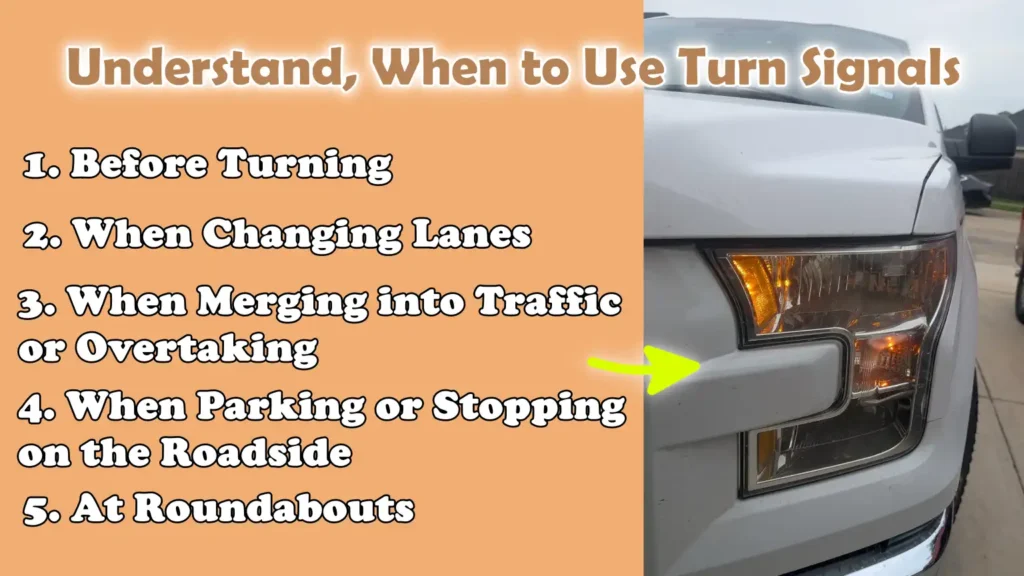
1. Before Turning
You should always use a turn signal before making any turn, as turning is one of the most common scenarios where accidents occur.
At intersections, signaling in advance gives drivers behind and around you the opportunity to understand your intentions and adjust their speed or position accordingly.
Without signaling, vehicles following you may continue at their current speed, significantly increasing the risk of a rear-end collision when you suddenly slow down to make a turn.
Similarly, when entering or exiting a roadway (such as a driveway, side street, or main road), signaling alerts other drivers and pedestrians to your movements.
Providing this advance notice is particularly important in areas with heavy traffic or limited visibility; In such locations, sudden turns can easily lead to hazardous situations.
2. When Changing Lanes
Using turn signals while changing lanes is crucial for maintaining safety, particularly on highways and busy city streets.
Changing lanes involves moving into a space where another vehicle may already be present or passing in close proximity; therefore, signaling provides others with the time to slow down or make room.
On high-speed roadways, the importance of signaling is even greater, as vehicles travel at high speeds, leaving very little time for others to react.
Failure to signal correctly prevents other drivers from anticipating your maneuvers, thereby creating a risk of side-impact collisions or a sudden loss of vehicle control.
Signaling before changing lanes ensures that your actions are predictable and provides everyone around you with sufficient time to react safely.
3. When Merging into Traffic or Overtaking
Turn signals should always be used when merging into traffic or overtaking another vehicle, as these actions directly impact the movement of other drivers.
When merging into the flow of traffic from a ramp or side road, signaling indicates your intention to join the traffic stream, giving other drivers time to reduce their speed and maintain a safe distance.
When overtaking, both before moving into the adjacent lane and again before returning to your original lane, signaling ensures that surrounding drivers can clearly understand your maneuvers.
This reduces the likelihood of sudden braking within the lane or unexpected collisions.
In these situations, proper signaling makes the entire process smoother, safer and more controlled.
4. When Parking or Stopping on the Roadside
Using turn signals is crucial even when parking or stopping your vehicle on the roadside, as these maneuvers often require you to slow down and deviate from the normal flow of traffic.
When parallel parking, signaling alerts drivers following you that you are about to stop and enter a parking space, giving them time to slow down or pass you safely.
Similarly, when pulling over to the side of the road, signaling informs other drivers that you are exiting the lane, thereby preventing confusion and reducing the risk of collisions.
Without proper signaling, these actions can appear sudden and unexpected, increasing the likelihood of accidents, particularly on busy or narrow roads.
5. At Roundabouts
Using turn signals correctly at roundabouts is essential for maintaining a smooth and safe flow of traffic.
When entering a roundabout, whether or not you signal depends on the direction of your intended destination; however, it is absolutely vital to signal clearly when exiting the roundabout.
Signaling before exiting a roundabout alerts other drivers waiting to enter that you are leaving, allowing them to proceed safely without hesitation.
Failure to signal correctly can lead drivers to misinterpret your intentions, causing them to either wait unnecessarily or enter the roundabout at an inappropriate time.
How to Use Turn Signals Correctly
Using turn signals correctly involves more than just switching them on; it requires using them at the right time, in the proper manner and with full awareness of your surroundings.
The purpose of turn signals is to provide advance notice of your next move to other road users; however, they are effective only when used proactively, clearly and consistently.
Many drivers make the mistake of signaling at the very last moment or activating their indicators without first checking their surroundings; this diminishes the effectiveness of the signal and creates a risk of accidents.
The proper use of turn signals encompasses correct timing, coordination with steering control, awareness of surrounding vehicles and deactivating the signal once the maneuver is complete.
When all these guidelines are followed correctly, signaling becomes an invaluable tool that fosters mutual understanding, eliminates confusion and makes driving on the road easier and safer for everyone.
1. The Right Time to Signal
Timing is one of the most critical aspects of using turn signals correctly, as it determines how much time other drivers have to react.
A good general rule of thumb is to signal at least three to five seconds before turning, changing lanes, or merging into another lane.
During this interval, drivers following behind you or traveling alongside you can spot your signal, understand your intentions and safely adjust their speed or position accordingly.
If you signal too late, you fail to provide adequate advance warning to others; this may force other drivers to brake suddenly or take hasty evasive actions, thereby increasing the risk of an accident.
At higher speeds such as: on a highway, you may need to signal even earlier, as vehicles cover greater distances in shorter periods of time.
In slow-moving traffic, signaling slightly late may still be effective; however, signaling well in advance is always the safer approach.
Signaling at the appropriate time ensures that your actions are predictable and provides everyone with ample time to react calmly.
2. Correct Hand Positioning
Maintaining the correct hand position while using turn signals is crucial for ensuring that you retain full control over the vehicle.
The signal lever is designed for easy operation, meaning you do not need to completely remove your hands from the steering wheel to use it.
A safe practice is to keep at least one hand firmly on the steering wheel while using your fingers to operate the signal lever.
Doing so allows you to signal without compromising your steering control or balance.
Removing both hands from the steering wheel to activate a signal, or making sudden, abrupt movements, as it can lead to a loss of vehicle control, particularly when driving at high speeds or in heavy traffic.
Proper hand positioning ensures that you can signal with ease while maintaining continuous control over the vehicle, a fundamental requirement for safe driving.
3. Checking Mirrors and Blind Spots
Using turn signals alone is not sufficient to guarantee safety; therefore, checking your mirrors and blind spots before executing any maneuver is an essential step.
Turn signals merely communicate your intentions to others; however, they do not guarantee that the path ahead is clear.
Before turning or changing lanes, you must check your rearview and side mirrors to ascertain the position of surrounding vehicles.
Furthermore, you should briefly check your blind spots, that is, those areas not visible in your mirrors, to ensure that no car, motorcycle, or cyclist is hidden from your view.
Relying solely on your turn signals can create a false sense of security, potentially leading to hazardous situations.
The combination of proper visual checks and signaling ensures that your intended maneuver is not only communicated to others but is also safe to execute.
4. Disengaging Signals After Use
Turning off your turn signal after completing a maneuver is just as important as turning it on.
If the signal remains active after a turn or lane change, it can mislead other drivers, causing them to believe you are about to perform another maneuver.
This misunderstanding can lead to unnecessary braking, hesitation, or even accidents if others react to a signal that is no longer relevant.
In many modern vehicles, turn signals disengage automatically after a turn; however, this does not always happen, particularly during slight turns or lane changes.
Therefore, it is essential to check the indicator on your dashboard to ensure that the signal has been switched off once it is no longer needed.
Properly disengaging your signals maintains clear communication and helps prevent misunderstandings on the road.
How to Use Turn Signals Properly – Beginner Friendly Guide
Using turn signals correctly becomes significantly easier when you adopt a clear and consistent step-by-step approach in actual driving situations.
The objective is not merely to switch on the indicator, but to integrate the act of signaling with scanning your surroundings, controlling your speed and maneuvering the vehicle smoothly.
Every action on the road should be planned a few seconds in advance so that other drivers are not caught off guard by your movements.
A proper sequence ensures that your intentions are clearly communicated to others, that you have fully assessed your surroundings and that your vehicle proceeds safely without any abrupt changes.
Whenever you turn, change lanes, or merge into traffic, adhering to a fixed routine makes your driving behavior predictable.
This significantly reduces the risk of accidents and enhances overall road safety.
1. Turning Left
When turning left, the first step is to check your mirrors to assess the position and speed of vehicles traveling behind and around you.
This helps you determine whether it is safe to slow down and prepare for the turn.
After checking, you should activate your left turn signal at least a few seconds before turning so that your intentions are clearly understood by others.
As you approach the turning point, reduce your speed gradually and in a controlled manner, rather than applying the brakes abruptly.
Position your vehicle correctly within your lane to avoid causing any obstruction or confusion to other drivers.
Finally, execute the turn smoothly while maintaining full control over the steering wheel.
This entire sequence ensures that your maneuver is safe, clear and easily understood by others.
2. Turning Right
When turning right, it is crucial to follow a specific sequence to avoid confusion and ensure safety.
You should begin signaling well in advance so that drivers following you are aware that you are preparing to turn.
On congested roads, where sudden deceleration poses a risk of rear-end collisions, early signaling is particularly important.
After signaling, position your vehicle correctly toward the right side of your lane; avoid drifting within the lane or encroaching upon the adjacent lane.
Proper lane positioning in this manner creates a clear path for your turn and prevents unnecessary disruption to the flow of traffic.
As you approach the turning point, gently reduce your speed and execute the turn while maintaining full control of the vehicle.
Keeping your actions consistent and predictable makes it easier for other drivers to react safely.
3. Changing Lanes
Changing lanes safely depends largely on proper signaling and maintaining full awareness of your surroundings.
First, activate your turn signal to alert other drivers that you intend to move into the adjacent lane.
After signaling, check your mirrors and then perform a “shoulder check” (looking over your shoulder) to verify your “blind spots”, areas not visible in the mirrors, as some vehicles may not appear in the reflections.
Change lanes only when you are absolutely certain that the intended lane is clear.
Lane changes should be executed smoothly and gradually; avoid sudden steering inputs or abrupt acceleration.
Signaling correctly, both before and while changing lanes, provides surrounding drivers with ample time to adjust their speed or position, thereby ensuring that the maneuver is executed in a safe and orderly manner.
4. Merging into Traffic
Merging into traffic requires precise timing and clear signaling, as you are entering a stream of vehicles that are already in motion.
First and foremost, signal your intention to merge so that drivers already traveling in the traffic flow are made aware of your presence.
Furthermore, match your speed to that of the traffic you are entering; doing so eliminates the need for sudden braking or abrupt acceleration.
Identify a safe gap between vehicles and ease smoothly into that space, without forcing any other driver to react suddenly.
Maintain a consistent and controlled speed while keeping a vigilant watch on the vehicles surrounding you.
The proper use of turn signals when merging fosters cooperation among drivers, making the entire process safer and smoother for everyone involved.
Know, The Common Mistakes to Avoid During Drive
Although using turn signals is a simple task, many drivers still make common mistakes that diminish their effectiveness and increase the risk of accidents.
These errors often stem from ingrained habits, a lack of knowledge, or a failure to understand how to apply signals correctly in real-world driving situations.
The primary purpose of turn signals is to communicate one’s intentions clearly and in advance; however, when misused, they can create confusion rather than providing clear information.
Avoiding these mistakes is just as crucial as mastering the correct technique, as incorrect signaling can mislead other drivers, trigger sudden reactions and create hazardous conditions on the road.
By recognizing and correcting these common errors, you can make your driving more predictable, safer and smoother for everyone around you.
1. Signaling Too Late
Signaling too late is one of the most common mistakes drivers make and it completely defeats the very purpose of using turn signals.
When you activate your signal just moments before turning or changing lanes, other drivers do not have sufficient time to interpret your intentions or react safely.
This increases the risk of sudden braking, confusion, or even collisions, particularly in high-speed traffic.
Proper signaling should always be done a few seconds in advance, allowing others ample time to adjust their speed or position.
Signaling late transforms a helpful warning into a last-minute alert, one that is often insufficient to prevent dangerous situations.
2. Not Signaling at All
Failing to use turn signals whatsoever is a serious error and is considered one of the leading causes of preventable road accidents.
When drivers fail to signal, they leave others to guess their next move, creating uncertainty and increasing the likelihood of poor decision-making.
For instance, a driver might assume that a vehicle will continue traveling straight; however, if that vehicle suddenly turns without signaling, a collision could occur.
Signaling is a fundamental responsibility that ensures clear communication on the road.
Neglecting this duty is not only a violation of traffic laws but also endangers everyone involved, including the very driver who failed to signal.
3. Leaving Signals On
Leaving a turn signal on even after completing a turn or lane change is another common mistake that can confuse other drivers.
When a signal continues to flash without any corresponding action, it conveys misinformation, leading others to believe that you are about to turn or change lanes again.
This confusion can cause drivers to slow down unnecessarily, hesitate, or react incorrectly, thereby disrupting the flow of traffic.
In some instances, accidents may even occur if other drivers act based on an erroneous signal.
Always check your dashboard indicators to ensure that your signal has switched off after you have completed your maneuver.
4. Signaling Without Checking Surroundings
Using a turn signal without first checking your mirrors and blind spots (areas not directly visible) creates a false sense of security and can be extremely dangerous.
Some drivers assume that once they signal, other vehicles will automatically yield space for them; however, this is not always the case.
Turn signals merely communicate your intentions to others; they do not guarantee that the path ahead is clear.
If you change lanes or make a turn without checking your surroundings, you may obstruct the path of another vehicle, potentially leading to a collision.
Safe driving requires both communication and observation; therefore, before executing any maneuver, you must signal your intentions while simultaneously thoroughly checking your surroundings.
5. Using Hazard Lights Instead of Turn Signals
Using hazard lights instead of turn signals when turning or changing lanes is considered a misuse of these lights, which can cause serious confusion on the road.
Hazard lights are designed to indicate that a vehicle is stopped, disabled, or facing an emergency situation, not to signal a change in direction.
When drivers use hazard lights while turning or changing lanes, other road users are unable to determine which direction the vehicle intends to take.
This lack of clear communication can lead to unsafe decisions and increase the risk of accidents.
It is essential to use turn signals specifically for changing direction and to reserve hazard lights solely for emergency or warning situations, that is, when the vehicle is not operating under normal conditions.
Special Situations and Best Practices in Those Situations
In certain specific driving scenarios, the correct use of turn signals becomes even more critical, situations where visibility, speed and traffic conditions can heighten the risk of danger.
In such circumstances, drivers must be extra cautious, highly vigilant and consistent in their signaling habits.
Turn signals are not merely a routine formality; they are an essential component of defensive driving, particularly when conditions are challenging.
Whether you are stuck in heavy traffic, traveling at high speeds, or facing reduced visibility due to adverse weather or darkness, proper signaling minimizes uncertainty and ensures clear communication.
Adapting your signaling technique to suit the prevailing conditions ensures that other road users can understand your intentions in a timely manner, thereby making the driving experience safer and smoother for everyone.
1. Driving in Heavy Traffic
Driving in heavy traffic demands heightened concentration and early signaling, as vehicles are in close proximity to one another, leaving very little time for reaction.
In such congested environments, even a slight delay in signaling can cause confusion and force other drivers to brake abruptly.
By signaling slightly earlier than usual, you provide surrounding drivers with ample time to interpret your intentions and adjust their positions gradually.
This helps prevent sudden stops and significantly reduces the likelihood of minor collisions, incidents that frequently occur in congested areas.
Furthermore, clear and early signaling helps maintain a steady flow of traffic, as drivers are able to anticipate upcoming maneuvers rather than having to react at the very last moment.
2. Driving on Highways
Vehicles travel at higher speeds on highways, which means that distances are covered very rapidly and the time available for reaction is significantly reduced.
For this reason, it is crucial to activate your turn signal well in advance before taking any action such as: changing lanes or merging into another lane.
On a highway, signaling early provides drivers behind and alongside you with ample time to understand your intentions and react safely, without having to brake or swerve suddenly.
At high speeds, even a minor error can lead to a serious accident; therefore, signaling clearly and at the right moment becomes even more critical.
Maintaining consistency in your signaling habits on the highway makes your driving behavior predictable, which is absolutely essential for safety in a high-speed environment.
3. Driving at Night or in Adverse Weather
Driving at night or in adverse weather conditions such as: rain, fog, or dust, reduces visibility, making the use of turn signals even more imperative.
In low-visibility situations, other drivers may be unable to clearly see your vehicle or anticipate your next move without the aid of proper signals.
Using your indicators correctly and in a timely manner makes your vehicle more easily visible and clearly conveys your intentions, thereby giving other drivers more time to react.
In such conditions, it is also vital to ensure that your signal lights are clean and functioning properly, as dirt or malfunctions can diminish their brightness.
The proper use of turn signals in low-visibility situations (whether due to fog or darkness) significantly enhances safety, as it minimizes confusion and keeps drivers informed of one another’s intended actions.
4. Motorcycles and Hand Signals
Motorcycles also rely on turn signals; however, in certain situations, riders may utilize hand signals as an alternative means of communication.
Hand signals prove particularly useful when a motorcycle’s indicator lights are malfunctioning or when enhanced visibility is required amidst heavy traffic.
These signals involve the use of specific hand movements to indicate the intended direction of a turn or the intention to stop, thereby clearly conveying the rider’s intentions to other road users.
Although modern motorcycles are equipped with electronic indicators, understanding hand signals adds an extra layer of safety and communication.
This practice underscores the immense importance of providing clear signals, whether through lights or physical gestures, as it ensures that all road users can effectively anticipate and comprehend one another’s next moves.
Read More:
- How to Fix Turn Signals on a Car
- How to Check Blind Spot While Driving
- How to Use Mirrors When Driving
- How to Use ABS Brakes Properly
- How to Brake Safely on Steep Roads
- How to Drive Uphill Safely
- How to Drive Safely in Strong Winds
- How to Prevent Aquaplaning
How to Maintain Turn Signal Properly Working
Turn signals can only ensure your safety if they are functioning correctly; therefore, their regular maintenance is crucial.
Many drivers focus on the act of using their signals but often neglect to verify whether they are actually visible or performing as intended.
Turn signal systems rely on bulbs or LED lights, wiring and the vehicle’s electrical system; even a minor fault in any of these components can compromise their effectiveness.
A dim or malfunctioning signal can mislead other drivers or fail to clearly convey your intentions, thereby increasing the risk of accidents.
Proper maintenance ensures that your signals remain bright, clear and reliable under all driving conditions.
Taking a few simple steps to inspect and care for your indicators can make a significant difference in safety, specially when driving at night or in adverse weather, when visibility is already limited.
Plus, there’s even study that clearly shows that the drivers tend to signal more when they feel at risk such as: on the busy roads or when other vehicles are nearby, also you need to know that inconsistent use of turn signals actually creates uncertainty for other road users, that’s why it is really important to use signals every time: not just in the high-risk situations but all the time whenever you wanted to communicate your intentions so that you can maintain predictable and safe driving behavior.[¹]
1. Regular Inspection of Indicator Lights
Regularly checking your indicator lights is one of the simplest yet most essential maintenance habits you can adopt.
You should make it a routine to activate your turn signals and visually verify that the lights, on both the front and rear of the vehicle, are illuminating properly.
This inspection helps you identify potential issues before they evolve into major safety hazards on the road.
Sometimes, it is helpful to ask someone to stand outside the vehicle to confirm that all signals are functioning correctly; alternatively, you can perform this check yourself by observing the reflections cast on windows or walls.
Regular inspections ensure that your signals remain bright enough to be easily visible to other drivers and that there are no hidden faults within the system.
2. Replacing Defective Bulbs
It is crucial to replace defective bulbs immediately, as even a single faulty signal light can impair visibility and cause confusion.
A common indication of a defective bulb is that the corresponding indicator on the dashboard begins to flash faster than usual; this often signifies that one of the bulbs is no longer functioning.
In some instances, the light may cease working entirely, rendering the signal on one side of the vehicle invisible.
Driving with a defective bulb can be hazardous and in many jurisdictions, it may even result in a fine.
Replacing the bulb immediately upon detecting the issue ensures that your signals remain effective and that your intentions are clearly communicated to everyone else on the road.
3. Keeping Lenses Clean
Maintaining clean signal light lenses is essential, as dirt, dust and mud can diminish the brightness and visibility of your indicators.
Over time, road grime and exposure to the elements can cause a film to accumulate on the lenses, obstructing the light and making your signals difficult to recognize, particularly during the day or in adverse weather conditions.
Regularly cleaning the lenses with a soft cloth helps preserve their clarity and ensures that the light shines brightly.
With clean lenses, your signals remain visible from a greater distance, providing other drivers with ample time to react safely.
This simple step enhances overall visibility and adds an extra layer of safety to your driving.
Safety Tips for Effective Communication
Effective communication on the road involves more than just using turn signals; it means ensuring that your intentions are clearly understood by everyone around you.
Driving is an activity where every action impacts others; therefore, clear and timely communication reduces confusion and helps prevent accidents.
Turn signals are the primary means of conveying your intentions, but they are most effective when used in conjunction with situational awareness, consistency and proper planning.
Many road accidents occur because drivers give mixed signals, make assumptions, or make sudden decisions without warning.
By adopting a few simple yet essential communication habits, you can make your driving more predictable, reduce stress for other road users and create a safer environment for everyone, whether they are drivers, pedestrians, or cyclists.
1. Supplement Signals with Eye Contact
Establishing eye contact alongside using turn signals adds an extra layer of clarity to your communication, particularly when interacting with pedestrians and cyclists, who do not always rely solely on vehicle signals.
Making eye contact helps ensure that the other person has seen you and understood your intentions.
For instance, when turning at an intersection or junction, making brief eye contact with a pedestrian confirms that you are both aware of each other’s movements, thereby reducing the risk of sudden maneuvers or misunderstandings.
This practice is particularly beneficial in congested areas, where relying solely on signals may not be sufficient due to distractions or limited visibility.
Utilizing both visual signals and interpersonal communication strengthens interaction and, overall, enhances the level of safety.
2. Use Signals Consistently
The consistent use of turn signals is crucial for establishing predictable driving habits.
Every time you turn, change lanes, or merge into another lane, signaling allows other drivers to anticipate your movements in advance, and to rely on them.
Consistent signaling reduces confusion by creating a clear pattern of movements that others can easily understand.
Sporadic signaling such as: using an indicator one moment but not the next, creates uncertainty and forces other drivers to guess your next move.
Over time, consistent signaling fosters a safer driving environment where vehicles move smoothly and harmoniously.
This habit not only protects you but also makes the road a more organized and less stressful place for everyone.
3. Avoid Last-Minute Decisions
Avoiding last-minute decisions is a critical element of safe and effective communication while driving.
Making sudden turns without proper signaling, rapidly changing lanes, or abruptly stopping can startle other drivers and create hazardous situations.
Planning your movements in advance gives you the opportunity to signal ahead of time, assess your surroundings and execute your maneuvers smoothly.
For instance, if you know you need to make a turn or change lanes ahead, preparing in advance provides you with ample time to clearly communicate your intentions and proceed safely.
Driving thoughtfully and systematically reduces the need to take sudden actions, making your behavior more predictable and giving others ample time to react without becoming flustered or confused.
Conclusion – How to Use Turn Signals Properly
So, this is clear that having crystal clear communication during drive is what actually the key to safe driving that literally have capabilities of prevent a serious accident before it happens.
Every time you drive, you become part of a system where clear communication is paramount and turn signals serve as your primary means of conveying your intentions to others.
When used properly, they provide other drivers, cyclists and pedestrians with the necessary time to react safely, thereby reducing the risk of confusion, sudden braking and collisions.
Many accidents do not occur due to a lack of driving skill, but rather because drivers’ actions are not clearly or timely communicated to others.
Proper signaling resolves this issue by making your maneuvers easier to anticipate and understand.
Throughout this comprehensive guide, it becomes clear that the effective use of turn signals extends beyond merely switching them on; it involves using them at the appropriate moment, integrating their use with checking mirrors and monitoring surrounding conditions and ensuring that they are always functioning correctly.
Small habits such as: signaling in advance, checking blind spots (areas of the vehicle not visible in the mirrors) and canceling signals after use, may seem trivial, yet they play a pivotal role in preventing accidents and improving traffic flow.
These habits also foster trust among drivers, as consistent and clear signaling enables everyone to anticipate one another’s actions.
In real-world driving scenarios, particularly in heavy traffic, on highways, or in conditions with reduced visibility, proper signaling becomes even more critical.
It helps maintain order, alleviate stress and facilitate the smooth movement of vehicles.
By making signaling an essential part of your daily driving routine, you not only adhere to traffic regulations but also contribute to creating a safer and more orderly road environment.
Now, that’s all from this guide about How to Use Turn Signals Properly, also you can ask related questions below this guide.
Frequently Asked Questions
Q1. Why is using turn signals so important while driving?
Answer: Using turn signals is crucial because it helps you clearly communicate your intentions to others on the road. When you signal before turning, changing lanes, or merging into another lane, you give other drivers, cyclists and pedestrians ample time to understand what you are about to do. This reduces confusion and helps prevent sudden reactions such as: abrupt braking or swerving, which are often primary causes of accidents. Turn signals make your driving predictable; and predictable driving is one of the key factors in keeping roads safe for everyone.
Q2. When should I activate my turn signal before making a maneuver?
Answer: You should activate your turn signal at least three to five seconds before performing any maneuver such as: turning or changing lanes. This gives other drivers sufficient time to spot your signal and safely adjust their speed or position. If you signal too late, it fails to provide adequate warning and can create dangerous situations. When driving on highways or at high speeds, signaling well in advance is even more prudent, as vehicles are moving faster and require more time to react.
Q3. Is it still necessary to use turn signals even when no one else is around?
Answer: Yes, using turn signals is always a good habit, even if you feel that no one else is around. There may be vehicles, cyclists, or pedestrians present whom you do not immediately notice. Consistently using your signals builds a strong habit, ensuring that you never forget to signal, no matter how busy or challenging the driving conditions may be. Safe driving means being prepared at all times, not just when traffic is visible.
Q4. Can I rely solely on my turn signals without checking my mirrors or blind spots?
Answer: No, turn signals alone are not sufficient to ensure safety. They merely communicate your intentions to others; they do not guarantee that the path ahead is clear. Before making any maneuver, you must check your mirrors and blind spots to ensure that no other vehicles are in your path. Combining proper visual checks with signaling is the safest approach and helps prevent collisions.
Q5. What happens if I forget to turn off my turn signal?
Answer: If you forget to turn off your signal, it can confuse other drivers, as they may assume you are about to execute another maneuver. If others react to a signal that is no longer accurate, it can lead to unnecessary braking, hesitation, or even accidents. In many modern vehicles, turn signals automatically switch off once a turn is completed. However, you should always keep an eye on your dashboard to ensure that the signal has indeed turned off when it is no longer needed.
Q6. Why is my turn signal flashing faster than usual?
Answer: If your turn signal is flashing faster than normal, it indicates that one of the indicator bulbs is not functioning correctly. This is a common warning sign in many vehicles. When a bulb burns out, the system alters the flashing rate to alert the driver. It is crucial to fix this issue as soon as possible, as a malfunctioning signal reduces visibility and prevents other road users from accurately understanding your intentions.
Q7. Is using a turn signal legally required?
Answer: Yes, in most jurisdictions, using a turn signal is a legal requirement under traffic laws. Drivers are required to signal before turning, changing lanes, merging into traffic, or pulling over to the side of the road. Failure to use signals properly may result in fines, penalties, or points being deducted from your driving record. These laws are designed to ensure that all drivers can communicate clearly with one another and adhere to safe driving practices.
Q8. Should I still use a turn signal when traffic is heavy?
Answer: Yes, using a turn signal becomes even more critical when traffic is heavy. In congested areas, vehicles are in close proximity to one another and there is very little time to react. Signaling in advance helps other drivers anticipate your next move, thereby reducing the likelihood of sudden braking or minor collisions. This ensures that traffic continues to flow smoothly and prevents unnecessary delays.
References:
[1] Characteristics of turn signal use at intersections in baseline naturalistic driving
https://www.sciencedirect.com/science/article/abs/pii/S0001457514003029

Guys, I’m a car audio enthusiast and customization expert and I love clear sound and clean installation. Plus, I have spent years helping people build their dream audio setups. And whenever I’m working on cars, I probably listen to music and thinks about the next big upgrade.