
Written By: Don Dodi
Fact Checked By: Kristen Brown
Reviewed By: Diego Rosenberg
So, it is true that rain actually reduces the visibility and the traction as well, both are “SCARY” as hell.
And, aquaplaning is also known as Hydroplaning, as it is a serious driving risk that occurs whenever a layer of water builds up between your car’s tires and the road surface, that causes the tires to lose the direct contact with the road.
Also, when this happens, then your vehicle can suddenly lose the grip, that makes the steering, braking and accelerating much harder or even impossible for a few moments.
Plus, there’s even studies and road safety experts that explains that aquaplaning can begin at the speeds as low as 50 to 60 km/h if the water depth is high and the tires are worn out.
Moreover, the main reason behind this is the simple: tires are actually designed to push water away through their tread grooves, but when there is too much water or the tread is too shallow as well, also the water cannot escape fast enough.
Basically, it creates a thin film that lifts the tires off the road, which is similar to the how a boat floats on water, so in this guide you’ll learn How to Prevent Aquaplaning so that you can improve your safety and stay in control even during the heavy rain as well.
Now, At First You Need to Understand About the Causes of Aquaplaning
Aquaplaning occurs when your tires are unable to maintain direct contact with the road surface because a layer of water accumulates beneath them.
This loss of contact eliminates the grip necessary for effective steering, braking and acceleration.
This phenomenon is not triggered by a single factor, but rather by a combination of several elements: road conditions, vehicle speed, tire quality and vehicle weight.
Scientific studies indicate that when the water pressure beneath the tire exceeds the downward force exerted on the tire, the tire begins to lift and slide across the water’s surface.
Even a thin layer of water can compromise a tire’s grip, while deeper water can result in a complete loss of traction.
Understanding these causes in simple terms helps drivers make better decisions such as: reducing speed, ensuring proper vehicle maintenance and remaining vigilant regarding road conditions.
Once you understand what causes aquaplaning, you can take proactive steps to mitigate the risk, rather than merely reacting after the situation has already deteriorated.
1. Excessive Water on the Road Surface
Excessive water on the road is the primary cause of aquaplaning, as it directly impacts a tire’s ability to maintain traction with the road surface.
Tire treads feature specific grooves designed to displace water; however, their capacity to do so is limited.
When the volume of water becomes excessive such as: during heavy rainfall or on roads with poor drainage, the tires are unable to displace the water quickly enough.
Consequently, a layer of water forms between the tire and the road, reducing friction and leading to a loss of vehicle control.
Areas where water tends to accumulate, where roads are submerged or where the road surface is uneven, are particularly hazardous.
If other factors such as: vehicle speed and tire condition, are not optimal, even shallow water can pose a significant risk.
2. Excessive Speed
Driving at high speeds significantly increases the likelihood of aquaplaning, as it reduces the time available for the tires to displace water.
As speed increases, tires come into contact with a greater volume of water in a shorter period, leading to increased pressure beneath the tires.
This pressure can lift the tires off the road surface, thereby compromising their grip.
Studies indicate that if the water is sufficiently deep and the tires are not in perfect condition, aquaplaning can occur even at moderate speeds.
Driving at high speeds on wet roads also reduces reaction time, making it difficult to regain control of the vehicle should it begin to skid.
The most effective way to mitigate this risk is to reduce vehicle speed.
3. Worn-out Tires
Worn-out tires are a primary cause of aquaplaning, as they lose their ability to displace water.
Tire treads (grooves) are designed to channel water away from beneath the tire toward the edges; however, as the treads wear down, this function becomes compromised.
When the grooves become shallow, they are unable to hold or displace a sufficient volume of water, resulting in the formation of a layer of water beneath the tire.
This significantly reduces traction on the road surface and increases the risk of skidding.
Many safety experts recommend replacing tires even before they reach the minimum legal tread depth, as their performance on wet roads begins to deteriorate well before that point.
4. Improper Tire Pressure
Improper tire pressure can also increase the risk of aquaplaning, as it affects the tire’s contact patch, the area of contact between the tire and the road surface.
If a tire is underinflated, it becomes too soft and is unable to displace water efficiently, thereby compromising the vehicle’s stability.
Conversely, if a tire is overinflated, the contact patch shrinks; this reduces grip and makes it easier for the tire to lift off the road surface due to the presence of water.
Both scenarios create an imbalance that results in reduced traction on wet roads.
Maintaining the correct tire pressure ensures that the tire’s shape and contact patch remain optimized to function effectively under all conditions.
5. Vehicle Weight and Weight Distribution
The weight of the vehicle, and how that weight is distributed across the tires, also influences the risk of aquaplaning.
Heavier vehicles press the tires more firmly against the road surface, which can potentially improve contact; however, this still depends on the condition of the tires and the vehicle’s speed.
Conversely, lighter vehicles are more prone to lifting off the water’s surface, particularly at high speeds.
Uneven weight distribution can also create problems, as some tires may bear a heavier load than others, thereby compromising both balance and traction.
When weight is not distributed evenly, certain tires can easily lose contact with the road surface while driving through water.
Proper loading techniques and a balanced distribution of weight help maintain consistent traction and enhance overall stability on wet roads.
Know, Common Key Warning Signs of Aquaplaning
Aquaplaning typically provides clear warning signs before a complete loss of control occurs and recognizing these signals allows you to react quickly and safely.
When your tires begin to lose contact with the road due to the presence of water, the normal driving experience feels significantly different.
These changes may last only a few seconds, but they serve as critical indicators that your vehicle is failing to maintain proper grip on the road surface.
Road safety research indicates that drivers who successfully avoid accidents during aquaplaning incidents are often those who recognize these early warning signs and react with composure.
The key to doing so lies in paying close attention to the feel of your steering, engine response and braking while driving on wet roads.
When these systems do not function as usual, it often signifies that the tires are sliding over a layer of water rather than gripping the road surface.
Understanding these warning signs in simple terms enables you to stay prepared and avoid panic.
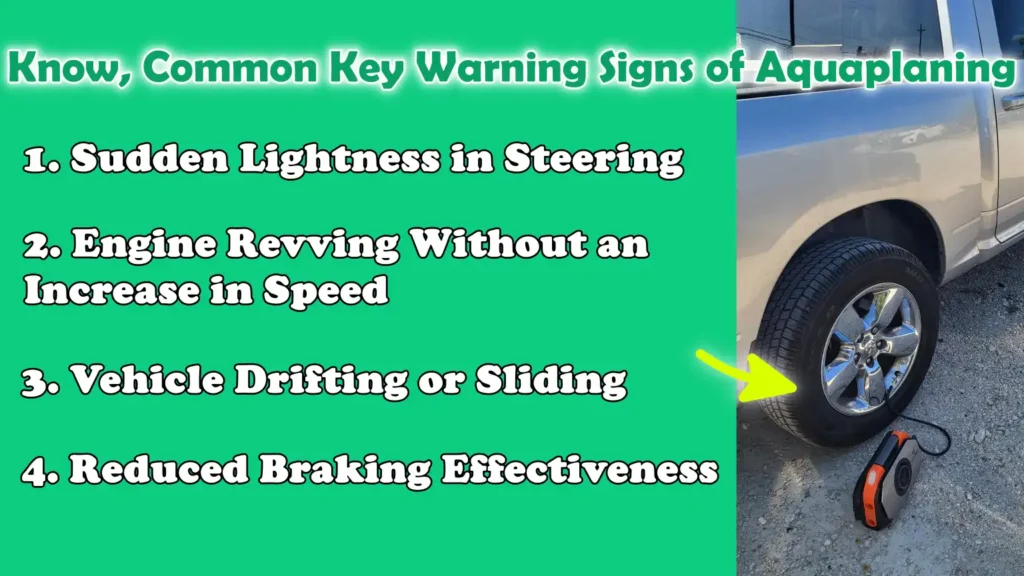
1. Sudden Lightness in Steering
One of the earliest warning signs of aquaplaning is the sensation of the steering wheel suddenly becoming light or loose.
Under normal driving conditions, the steering wheel typically offers a certain degree of resistance and feedback, as the tires maintain firm contact with the road.
When aquaplaning begins, this contact weakens and turning the steering wheel feels remarkably easy, almost as if it is no longer effectively controlling the vehicle.
This occurs because the tires are sliding over a thin layer of water instead of gripping the road surface.
This sensation of lightness is a clear indication that tire traction has diminished; In such a situation, it is crucial to remain calm, keep the steering wheel straight and avoid making any sudden movements until full control over the vehicle is regained.
2. Engine Revving Without an Increase in Speed
Another common indicator occurs when the engine suddenly begins to rev loudly, yet the vehicle’s speed does not increase as expected.
It may feel as though the vehicle is attempting to accelerate, but its actual speed remains constant.
This happens because the tires are unable to transmit the engine’s power to the road surface due to a lack of sufficient traction.
Instead, they begin to spin lightly atop the layer of water.
This sensation of lightness is precisely what one experiences on extremely slippery road surfaces.
When this occurs, rather than attempting to accelerate further, it is essential to slowly lift your foot off the accelerator and allow the tires the opportunity to regain their grip on the road.
3. Vehicle Drifting or Sliding
A very distinct and dangerous sign of aquaplaning is when the vehicle begins to drift or slide to one side, appearing to have slipped out of your control.
You may feel the vehicle sliding sideways or failing to respond to your steering inputs by moving in the intended direction.
This typically happens when driving at high speeds through standing water or potholes.
This sliding effect occurs because the tires are no longer firmly connected to the road surface; instead, they are floating on the water.
Consequently, the vehicle may feel unstable and uncontrollable.
In such a situation, it is critical to keep the steering wheel straight and refrain from making sudden turns or applying sudden brakes until the tires have successfully regained their grip on the road.
4. Reduced Braking Effectiveness
Reduced braking effectiveness is another crucial warning sign indicating that hydroplaning may be occurring.
When you depress the brake pedal, you may perceive that the vehicle is not slowing down as rapidly as you would typically expect.
This happens because brakes rely on the friction between the tires and the road; when the tires are riding on water, this friction is significantly diminished.
While the brakes themselves may be functioning correctly, their effectiveness becomes limited due to the lack of proper contact between the tires and the road surface.
Consequently, a greater distance may be required to bring the vehicle to a halt and maintaining control over the vehicle can become difficult.
In such a situation, it is safer to apply the brakes gently and allow the vehicle to slow down naturally until the tires regain their grip on the road.
How Tires Prevent Aquaplaning – The Basic Science
Tires are the only parts of a vehicle that come into contact with the road and their design is the primary reason the vehicle remains stable even on wet surfaces.
The basic science behind preventing aquaplaning is simple: the tire must displace water rapidly enough to ensure that the rubber remains in direct contact with the road.
When this contact is maintained, the vehicle can be safely steered, braked and accelerated.
When a tire fails to displace water, a thin layer forms beneath it, reducing friction, and this is precisely what causes aquaplaning.
Modern tires are meticulously designed to handle water, distribute pressure evenly and maintain grip.
However, their performance depends on the tread design, the contact patch and the tread depth.
Understanding these basic concepts helps drivers realize why tire condition and quality are so crucial for safety in wet driving conditions.
1. The Role of Tire Tread Patterns
Tire tread patterns consist of grooves and designs etched into the tire’s surface, which serve to manage water and maintain grip.
These patterns are specifically designed so that, as the wheel rotates, they channel water away from the center of the tire toward its edges.
When a tire faces a wet road, the tread acts as a system of channels that collects and expels the water, thereby allowing the rubber to remain in contact with the road surface.
Without these patterns, the tire would be unable to displace water and aquaplaning would occur easily.
Different tread designs are developed for various driving conditions; nevertheless, they all share a common objective: to enhance water-displacement capabilities and maintain traction.
The effectiveness of these patterns plays a crucial role in maintaining vehicle stability during rainy weather.
2. The Mechanics of the Contact Patch and Grip
The “contact patch” refers to that small area of the tire that is actually in contact with the road at any given moment.
Although tires appear large, this contact area is quite small, for almost every tire, it is roughly the size of a human hand.
All the grip required for driving is derived from this tiny area, making it critically important.
The weight of the vehicle presses the tire against the road, generating the friction that enables the vehicle to accelerate and brake safely.
When water accumulates beneath the tire, this contact area diminishes and grip is compromised.
If the layer of water becomes too thick, the tire may completely lose contact with the road and begin to slide.
Maintaining a strong and stable “contact patch” (the tire’s connection to the road) is essential for safe driving and this depends on proper tire design, correct tire pressure and controlled speed.
3. The Importance of “Tread Depth” – The Depth of Tire Grooves
“Tread depth” refers to the depth of the grooves (channels) cut into the tire and it is one of the most critical factors in preventing “aquaplaning” (sliding on water).
Deeper grooves provide more space to channel and displace water from beneath the tire.
As tires wear down over time, these grooves become shallower, thereby reducing their capacity to displace water.
This means that worn-out tires are significantly more likely to lose their grip on wet roads.
Even if a tire appears to be in good condition visually, insufficient tread depth can have a severely negative impact on its performance in rainy conditions.
Many safety experts recommend replacing tires before they even reach the legally mandated minimum tread depth limit, as their ability to prevent aquaplaning begins to diminish well before reaching that threshold.
Maintaining adequate tread depth facilitates better water displacement when driving in wet conditions, thereby ensuring a firm grip and enhancing overall safety.
Know, Really Important Driving Techniques to Avoid Aquaplaning
Avoiding aquaplaning depends largely on your driving style, specially on wet roads, where tire traction is already compromised.
Even if your vehicle and tires are in excellent condition, poor driving habits can cause you to lose control of your vehicle very quickly.
The primary objective when driving in the rain is to maintain continuous contact between your tires and the road; this requires minimizing the pressure exerted on the tires and avoiding any sudden maneuvers.
Safe driving techniques include handling the vehicle gently, maintaining a safe distance from other vehicles and remaining constantly alert to road conditions.
Road safety studies indicate that drivers who adapt their driving style during wet weather significantly reduce their risk of being involved in an accident.
A few simple, practical adjustments such as: reducing speed and staying alert, as it can make a significant difference in keeping your vehicle stable and safe.
1. Reduce Speed on Wet Roads
The most effective way to avoid aquaplaning is to reduce your speed, as this gives your tires more time to displace the water accumulating beneath them.
Driving at high speeds causes water to build up rapidly, creating enough pressure to lift the tires off the road surface.
When you drive at a slower speed, the tires maintain better traction with the road, thereby strengthening your control over the vehicle.
If there is a significant amount of standing water on the road, even driving at a moderate speed can prove dangerous.
Therefore, rather than rigidly adhering to your usual driving speed, it is crucial to adjust your speed according to the prevailing weather and road conditions.
Another advantage of driving at a slower speed is that it provides you with more time to react to sudden changes on the road such as: water-filled potholes or slippery patches.
2. Avoid Sudden Maneuvers
When driving on wet roads, it is crucial to avoid making any sudden movements, as any abrupt action can easily compromise the tires’ already limited grip.
Sudden steering inputs, hard braking, or sudden acceleration, all of these actions can weaken tire traction and cause them to hydroplane (slide) across the water’s surface.
To maintain vehicle balance and stability, every maneuver you execute while driving should be performed gently and with complete control.
When you turn the steering wheel smoothly and apply the brakes or accelerator gradually, the tires maintain better contact with the road surface.
Doing so reduces the likelihood of losing control of the vehicle, thereby enabling you to drive more safely, even during heavy rainfall.
3. Maintain a Safe Distance from the Vehicle Ahead
When driving on wet roads, maintaining a safe distance from the vehicle ahead is absolutely essential.
The presence of water reduces the friction between the tires and the road surface, meaning that a greater distance is required to bring the vehicle to a complete stop.
If you drive too closely to the vehicle in front of you, you may not have sufficient time to react should that vehicle suddenly slow down.
Increasing the distance between vehicles provides you with more time and space to react safely.
Experts often recommend maintaining a distance that is at least double the distance typically kept under dry driving conditions.
This simple adjustment can significantly reduce the risk of accidents.
4. Driving in the Tire Tracks of Other Vehicles
Driving in the tire tracks left by other vehicles can reduce the risk of aquaplaning, as these tracks typically contain less water.
Vehicles traveling ahead displace some of the water, thereby creating a slightly clearer path for your tires.
Driving within these tracks exposes your tires to less water, resulting in improved grip and stability.
This technique is particularly useful on highways, where water tends to accumulate in certain areas.
However, it is crucial to remain vigilant and not rely solely on this method, as road conditions can change rapidly.
5. Do Not Use Cruise Control in the Rain
It is essential to avoid using cruise control in wet conditions, as it diminishes your ability to react quickly to changes in traction.
Cruise control maintains a constant speed, which may not be safe on wet roads or amidst changing conditions.
If the vehicle begins to hydroplane, the system may attempt to increase power to maintain the set speed, a reaction that could further exacerbate the situation.
Manual driving allows you to adjust your speed instantly and respond more effectively to road conditions.
Maintaining full control over the vehicle enables you to handle unexpected situations more safely and minimizes the risk of losing traction.
How to Maintain Tire to Prevent Aquaplaning
Tire maintenance is one of the most critical factors in preventing aquaplaning, as tires are the only part of the vehicle that remains in direct contact with the road.
When tires are in good condition, they can effectively displace water and maintain a strong grip on wet surfaces.
However, when they are worn out, underinflated, or unsuitable for current conditions, their ability to handle water diminishes, thereby increasing the risk of losing control of the vehicle.
Research and safety data clearly indicate that poor tire condition is a major contributing factor to accidents on wet roads.
Fortunately, tire-related issues can be easily addressed through regular inspections and a few simple maintenance habits.
By taking proper care of your tires, you not only ensure your safety during the rainy season but also enhance your overall driving experience.
1. Regularly Check Tire Tread Depth
Regularly checking tire tread depth is essential, as the tread is responsible for displacing water from beneath the tires.
The deep grooves embedded in the tires act like channels, channeling water away so that the tire rubber remains in contact with the road surface.
As tires wear down, these grooves become shallower and less effective.
This means that water cannot be displaced quickly enough, thereby increasing the risk of aquaplaning.
Experts recommend checking tread depth frequently, particularly before the onset of the rainy season or prior to embarking on a long journey.
A simple check using a tread depth gauge or even a coin can help you determine whether your tires remain safe for continued use.
Regular inspections allow you to detect tire wear in a timely manner, enabling you to replace them before they become hazardous.
2. Maintain Correct Tire Air Pressure
Maintaining the correct air pressure in your tires is crucial to ensure proper contact between the tires and the road surface.
Tire pressure affects how the tire spreads across the road and how effectively it is able to displace water.
If the air pressure is too low, the tire becomes too soft and may fail to displace water effectively, which can negatively impact the vehicle’s stability.
Conversely, if the air pressure is too high, the “contact patch”, the portion of the tire that remains in contact with the road, shrinks; this reduces tire grip and makes it easier for the tires to lift off the road surface in the presence of water.
In both scenarios, the risk of aquaplaning increases.
By regularly checking your tire pressure and maintaining it at the level recommended by the manufacturer, you ensure balanced vehicle performance, improved control and enhanced safety, even on wet roads.
3. Choose the Right Tires
Selecting the right tires, those suited to your specific vehicle and driving conditions, plays a pivotal role in preventing aquaplaning.
Different tires are designed for different purposes and some perform significantly better than others on wet road surfaces.
Tires featuring advanced tread patterns and high-quality rubber compounds offer superior grip and water-displacement capabilities.
For instance, “all-season” tires are engineered to perform well in both dry and wet conditions, whereas certain specialized tires are designed specifically to provide enhanced traction during rainy weather.
High-quality tires generally deliver superior performance, as they are manufactured using advanced materials and precision engineering.
Selecting the right type of tires ensures that your vehicle can operate more safely and effectively on wet roads.
4. Replace Worn-Out Tires Immediately
Replacing worn-out tires in a timely manner is crucial for preventing aquaplaning.
As tires wear down, their ability to maintain grip on the road and displace water diminishes significantly.
Even if a tire still meets the legally mandated minimum tread depth, it may fail to perform adequately during heavy rainfall.
Many safety experts recommend replacing tires before they reach the legal limit to ensure superior performance in wet conditions.
Driving on worn-out tires increases stopping distances, reduces vehicle control and heightens the risk of aquaplaning.
Regular inspections and timely tire replacement help maintain proper traction and ensure that your vehicle remains safe during the rainy season.
Know, The Factors Related to Vehicle Maintenance
Vehicle maintenance plays a crucial role in preventing aquaplaning (skidding on water); even if your tires are in good condition, it is essential that other vehicle components function correctly to maintain control on wet roads.
Systems such as wheel alignment, brakes and suspension work together to ensure that the tires remain stable and maintain a strong grip on the road surface.
When any of these components malfunction, the tires’ grip on the road diminishes, particularly in wet conditions, where traction is already reduced.
Regular maintenance ensures that the vehicle responds correctly to steering inputs, braking and changes in road conditions.
Understanding how these factors affect driving can help you take better care of your vehicle and minimize the risk of losing control during rainy weather.
1. Proper Wheel Alignment
Proper wheel alignment ensures that all four tires are correctly positioned and maintain consistent contact with the road.
When wheel alignment is correct, the tires point in the right direction and wear evenly over time.
If the alignment is off, certain parts of the tires fail to make proper contact with the road surface, thereby reducing the tires’ overall traction.
This becomes even more hazardous in wet conditions, as the presence of water already compromises the tires’ grip.
Poor alignment can also cause the vehicle to pull to one side, making it difficult to control, specially when driving through standing water.
Regularly checking your wheel alignment helps maintain vehicle stability, extend tire life and improve handling on wet roads.
2. A Properly Functioning Braking System
For safe driving, specially in wet conditions, a fully functional braking system is absolutely essential.
To slow down the vehicle, brakes rely on the friction generated between the tires and the road surface.
When water makes it difficult for the tires to maintain their grip on the road, it becomes crucial for the braking system to operate efficiently so that the driver does not lose control of the vehicle.
Worn brake pads, low brake fluid levels, or faulty components can reduce braking effectiveness and increase the distance required to bring the vehicle to a halt.
Modern systems, such as the Anti-lock Braking System (ABS), help prevent the tires from locking up, thereby allowing the driver to maintain steering control even during sudden braking situations.
Regular inspection and maintenance of the braking system ensure that the vehicle can respond quickly and safely whenever the need arises.
3. Condition of the Suspension System
The suspension system helps keep the tires in constant contact with the road by absorbing shocks and maintaining balance.
A properly functioning suspension system ensures that the tires remain stable, even when driving on rough or wet roads.
If the suspension is worn out or damaged, the tires may bounce or easily lose contact with the road, thereby increasing the risk of aquaplaning.
A robust suspension system also improves the distribution of weight across the tires, helping them maintain a better grip on the road.
Regular inspection of components such as shock absorbers and springs ensures that the suspension system is functioning correctly, providing superior control and stability in all driving conditions, particularly during rainy weather.
Know, About je Road Awareness and Environmental Factors
Understanding road conditions and environmental factors is crucial for avoiding aquaplaning (skidding caused by water on the road), as even a well-maintained vehicle can lose traction if the driver fails to pay attention to their surroundings.
Wet roads do not behave identically everywhere; factors such as road design, drainage systems, traffic patterns and weather intensity determine the extent of water accumulation on the road surface.
Many accidents that occur during rainfall are not solely due to mechanical vehicle failures, but rather because drivers fail to identify hazardous areas or changing conditions in time.
By paying close attention to the road, weather and visibility, drivers can make better decisions such as: slowing down, changing lanes cautiously, or avoiding specific locations.
Awareness provides you with more reaction time and significantly reduces the likelihood of suddenly losing control.
1. Identify High-Risk Areas
Certain sections of the road carry a higher risk of water accumulation and aquaplaning.
Low-lying areas, roads with poor drainage and sections near curves or intersections often tend to collect water.
Even on highways, heavy traffic over time can lead to the formation of potholes or cracks where water begins to pool.
Bridges and elevated roadways may appear safe, but they can quickly become slippery during rainfall.
Construction zones and poorly maintained roads can also experience uneven water accumulation, making them unpredictable.
Identifying these high-risk areas in advance helps drivers reduce their speed and remain prepared, thereby significantly lowering the risk of losing traction on the road.
2. Weather Awareness
Weather conditions play a direct role in the risk of aquaplaning and understanding them enables you to drive more safely.
Light rain can make roads slippery as oil mixes with the water; conversely, heavy rain can create deeper layers of water, significantly increasing the risk of aquaplaning.
Sudden, intense downpours (torrential rain) are particularly dangerous, as they can rapidly alter road conditions within just a few minutes.
Checking the weather forecast before driving, and remaining alert to any changes that may occur during your journey, helps you adjust your speed and driving technique accordingly.
Staying informed about weather-related warnings, and, whenever possible, avoiding travel during adverse weather conditions, as it can significantly enhance safety.
3. Driving in the Rain at Night
Driving in the rain at night presents an additional challenge, as visibility is reduced and it becomes difficult to spot standing water on the road.
The headlights of other vehicles can reflect off wet surfaces, creating glare that makes it difficult to accurately judge distances and interpret road conditions.
Potholes and pools of standing water often remain invisible until it is too late to react to them.
Reduced visibility also makes it difficult to identify road markings and high-risk areas.
Driving slowly, utilizing proper lighting and exercising heightened vigilance can help you navigate these challenges.
It is essential to exercise extreme caution when driving at night during rainy weather to maintain vehicle control and avoid sudden incidents such as aquaplaning (skidding caused by water on the road).
Consider, Special Safety Tips for Hazardous Conditions
Driving in adverse weather such as: during storms, requires heightened caution, control and preparation; this is because when excessive water accumulates on the road, the risk of aquaplaning (the vehicle sliding on water) increases significantly.
In such situations, standard driving habits are often insufficient to ensure safety and drivers must rely on specialized safety techniques and a thorough understanding of their vehicle.
Heavy rain, reduced visibility and unpredictable road conditions can rapidly, sometimes within a matter of seconds, compromise a vehicle’s traction (grip on the road).
Road safety studies indicate that accident rates rise sharply during heavy rainfall due to diminished traction and reduced visibility.
Therefore, in addition to driving cautiously, it is crucial to make proper use of your vehicle’s systems and safety features.
By remaining alert, employing the correct techniques and understanding how your vehicle assists you, you can navigate hazardous conditions more safely and minimize the likelihood of losing control of your vehicle.
1. Driving During Severe Storms
Driving during a severe storm is one of the most challenging situations a driver can face, as water can accumulate rapidly on the road, thereby heightening the risk of aquaplaning.
In such conditions, it is imperative to significantly reduce your vehicle’s speed, sometimes well below the posted speed limit, to allow your tires sufficient time to displace the water.
Heavy rainfall can also severely impair visibility, making it difficult to spot other vehicles, road markings and potential hazards.
If rainfall becomes excessive and visibility drops significantly, the safest course of action is to gradually reduce your speed and, if necessary, pull over to a safe location until conditions improve.
Avoid driving through flooded areas, as the water depth may be far greater than it appears; doing so carries the risk of losing control of the vehicle or damaging the engine.
During a storm, remaining calm and driving cautiously are paramount to ensuring safety.
2. Use of Headlights and Visibility Aids
During rainfall, the proper use of headlights and other visibility aids is crucial, as they help you see the road clearly and make it easier for other drivers to spot your vehicle.
It is advisable to use low-beam headlights in the rain, as they provide effective illumination without causing glare.
High-beam headlights can reflect off raindrops and standing water on the road, thereby reducing visibility rather than improving it.
A clean windshield, properly functioning wipers and an active defogger also play a vital role in maintaining clear visibility.
In rainy weather, visibility can deteriorate rapidly due to raindrops, mist and light refraction; therefore, keeping all visibility-related systems in good working order enables you to react quickly to changing road conditions.
Good visibility is directly linked to better vehicle control and safer driving.
3. Understanding Modern Safety Features
Modern vehicles are equipped with advanced safety features designed to assist drivers in maintaining control during challenging situations, particularly on wet roads.
Systems such as the Anti-lock Braking System (ABS) prevent the wheels from locking up during braking, thereby helping the driver maintain steering control while decelerating.
Electronic Stability Control (ESC) helps detect a loss of traction and automatically adjusts braking and engine power to keep the vehicle stable.
Traction Control Systems minimize wheel spin when driving on slippery surfaces.
Although these technologies provide significant assistance, they do not completely eliminate the risk of aquaplaning.
Drivers must understand how these systems function and utilize them as aids rather than relying on them entirely.
By combining these features with cautious driving habits, one can maximize their chances of staying safe during adverse weather conditions.
Read More:
- How to Drive Safely on Ice
- How to Drive Safely in Fog
- How to Drive Safely at Night
- How to Clean Car Headlights
- How to Replace a Headlight Bulb
- How to Fix Headlight System Malfunction
Know, The Common Mistakes That Increase the Risk of Aquaplaning
Aquaplaning is often caused not merely by road conditions, but also by common driving errors that many people commit without fully grasping the associated risks.
These mistakes compromise a tire’s ability to maintain contact with the road surface, particularly when water is present on the road.
A minor lapse in judgment or a habitual error can quickly lead to a loss of control, as wet roads naturally offer less traction compared to dry surfaces.
Understanding these mistakes in simple terms can help drivers avoid them and stay safer while driving in the rain.
By correcting these behaviors, you can significantly reduce the likelihood of aquaplaning and enhance your overall control over your vehicle.
1. Driving Too Fast in the Rain
Driving at excessive speeds in rainy conditions is one of the primary causes of aquaplaning.
As speed increases, tires have less time to displace water, resulting in the formation of a layer of water beneath the tire.
This reduces contact with the road surface and heightens the risk of losing control.
Many drivers continue to drive at their normal speeds even when the roads are wet, a habit that can be extremely dangerous.
Reducing your speed allows the tires sufficient time to maintain traction, thereby improving overall safety.
Even a slight reduction in speed can make a significant difference in preventing aquaplaning.
2. Neglecting Tire Condition
Neglecting the condition of your tires is another major mistake that increases the risk of accidents.
Worn-out tires, or those with insufficient tread depth, are unable to effectively channel water away, making it easier for the tire to lose contact with the road surface.
Poor tire condition also diminishes overall grip, rendering both braking and steering less effective.
Many drivers fail to inspect their tires regularly, creating unsafe driving conditions, particularly during rainy weather.
Maintaining tires in good condition, which includes ensuring adequate tread depth and proper upkeep, is absolutely essential for safe driving.
3. Using Cruise Control
Using cruise control in wet conditions can be risky, as it reduces the driver’s direct control over the vehicle.
Cruise control maintains a constant speed, which may not be appropriate when road conditions change abruptly due to water.
If hydroplaning begins, the system may attempt to maintain speed by increasing power output, potentially exacerbating the situation.
This also slows down the driver’s reaction time, as they may not immediately perceive or respond to changes in traction.
Driving manually on wet roads provides better control and enables quicker reactions.
4. Sudden Braking or Turning
Sudden braking or sharp turning is a common mistake that makes it easy to lose control of a vehicle on wet roads.
When tires are already struggling due to reduced traction, any sudden force applied to them can completely eliminate their remaining grip.
Hard braking can cause the wheels to lock up or skid, while sharp turning can cause the vehicle to veer off course.
Driving smoothly and gradually helps maintain balance and ensures that the tires remain in contact with the road surface.
Maintaining control over the vehicle is crucial to avoid unnecessary hazards during rainy weather.
5. Driving Through Deep Potholes
Driving through deep potholes without caution can be extremely dangerous, as it is often difficult to accurately gauge the actual depth of the water.
Deep water can rapidly overwhelm a tire’s ability to displace water, leading to immediate “hydroplaning” (skidding across the water’s surface).
This can destabilize the vehicle or, if water infiltrates sensitive components, even cause damage to the engine.
Many drivers underestimate the hazards posed by water-filled potholes and drive through them at normal speeds, thereby increasing the risk of losing control of the vehicle.
Slowing down and avoiding deep water whenever possible is a simple yet effective way to stay safe.
What to Do If Your Car Aquaplanes – A Quick-Response Guide
Aquaplaning can feel sudden and terrifying, but reacting correctly during those few seconds can make a huge difference in safety.
When water causes your tires to lose contact with the road, the vehicle may stop responding normally to steering, braking and acceleration inputs.
Many accidents occur not solely because of aquaplaning itself, but because drivers panic and take sudden actions that worsen the situation.
Road safety experts emphasize that remaining calm and composed helps the tires regain contact with the road much more quickly.
The key is to minimize the pressure exerted on the tires and allow them to naturally reconnect with the road surface.
By understanding these simple yet crucial steps, you can remain in control during such situations and avoid accidents.
So, there’s even research that indicates that factors such as: tire pressure, speed and water depth actually works together to determine when a tire is about to lose the contact with the road, so that actually shows that growing role of technology in preventing accidents is huge before even they occur.[¹]
1. Stay Calm and Do Not Panic
The first and most important step when aquaplaning occurs is to remain calm and avoid panicking.
Panic can lead to sudden, impulsive actions such as: slamming on the brakes or jerking the steering wheel, which can further jeopardize the vehicle’s stability and control.
When you remain calm, you are able to think clearly and react in a composed manner.
Aquaplaning typically lasts only a few seconds; therefore, maintaining a calm mind helps you handle the situation safely until the tires regain their grip.
2. Gently Lift Your Foot Off the Accelerator
It is essential to gently lift your foot off the accelerator, as this reduces the vehicle’s speed and alleviates the pressure that is pushing the tires across the water’s surface.
As you gradually lift your foot off the accelerator, the vehicle naturally begins to slow down without losing its balance.
This makes it easier for the tires to re-establish contact with the road surface.
You should avoid abruptly releasing the accelerator or making sudden movements, as this can cause the vehicle to become unstable.
3. Keep the Steering Straight
During aquaplaning, it is crucial to keep the steering wheel steady and pointed in the direction you wish to go.
Turning the steering wheel suddenly or sharply can cause the vehicle to skid sideways or spin out.
By keeping the steering wheel straight, and making only very minor adjustments if absolutely necessary, you give the tires a chance to realign with the road once traction is regained.
This helps maintain the vehicle’s direction and stability.
4. Do Not Brake Suddenly
Avoid braking suddenly, as brakes rely on friction between the tires and the road, and during aquaplaning, this friction is already significantly reduced.
Braking hard can cause the wheels to lock up or skid, potentially worsening the situation.
Instead, allow the vehicle to slow down naturally, or, if absolutely necessary, apply the brakes very gently.
Calm and deliberate actions help prevent a complete loss of control over the vehicle.
5. Wait Until the Tires Regain Traction
Aquaplaning typically lasts only for a few moments; as the vehicle slows down, the tires gradually displace the water and reconnect with the road surface.
Rather than attempting to force control through sudden movements, it is essential to wait patiently and allow this process to occur naturally.
Once the tires regain their grip, you will feel that the steering and brakes are functioning properly again.
At that point, you can gradually regain full control of the vehicle and continue driving cautiously.
Conclusion – How to Prevent Aquaplaning
So, its true that staying in control on wet roads is not just luck, as it is the result of proper knowledge and the right driving habits as well.
The most crucial point to understand is that, for your safety, your tires must maintain direct contact with the road; if conditions are not managed correctly, water can easily disrupt this contact.
By ensuring your tires have good grip (tread), maintaining proper tire pressure and having your vehicle serviced on time, you lay a strong foundation for safe driving.
Furthermore, adjusting your speed to suit the weather, avoiding sudden steering inputs and keeping a keen eye on road and weather conditions help you optimize your vehicle’s performance in real-world situations.
Research and road safety statistics clearly demonstrate that most accidents occurring on wet roads are preventable, provided drivers adhere to these fundamental principles.
Aquaplaning can occur suddenly; however, it often provides warning signs beforehand and typically results from factors that are within one’s own control.
Understanding how and why it happens empowers you to significantly mitigate the associated risks.
A few simple habits such as: reducing your speed in the rain, avoiding standing water and maintaining a safe distance from other vehicles, as it can make a world of difference.
Even modern safety features installed in cars are designed to assist cautious driving, not to replace it.
This means that driver awareness and prudence continue to play the most pivotal role.
Ultimately, safe driving in wet weather depends on preparation and discipline.
When you respect the limits of both your vehicle and the road, the likelihood of losing control of your car is significantly reduced.
Aquaplaning is a genuine risk, but with the right information and appropriate measures, it can be easily avoided.
Now, that’s all from this guide about How to Prevent Aquaplaning, also you can ask related questions below.
Frequently Asked Questions
Q1: What is aquaplaning and why does it occur?
Answer: Aquaplaning occurs when a layer of water forms between your car’s tires and the road surface, causing the tires to lose direct contact with the road. When this happens, instead of gripping the road properly, your vehicle may begin to slide or skid. This typically happens during heavy rain or when water accumulates on the road. Tires are designed to displace water through their tread grooves; however, if the volume of water is excessive, or if the tires are worn, they may not be able to displace the water quickly enough. Consequently, the tire lifts slightly off the surface, reducing its traction and making it difficult to steer, brake, or control the vehicle.
Q2: At what speed does aquaplaning typically begin?
Answer: Under certain specific conditions, aquaplaning can begin at speeds as low as 50 to 60 km/h, specially if there is a significant amount of water on the road or if the tires are worn. At higher speeds, the risk increases significantly because the tires have less time to displace the water. However, there is no single specific speed that is safe in all situations, as factors such as water depth, tire condition and vehicle weight also play a role. This is why it is essential to always reduce your speed when driving on wet roads, even if you are already driving below the posted speed limit.
Q3: How can I tell if my car is aquaplaning?
Answer: You can usually identify that your car is aquaplaning by observing a sudden change in the vehicle’s handling. The steering may feel light or loose, almost as if it has completely lost contact with the road surface. The engine RPM (revs) may increase, but the vehicle’s speed does not rise in proportion; the car may drift slightly off course or fail to move in the direction you are steering. You may also notice that the brakes feel less effective. These signs often appear rapidly and may last only a few seconds, but they serve as a clear warning that your tires are failing to maintain proper grip on the road.
Q4: What should I do immediately if aquaplaning occurs?
Answer: If aquaplaning occurs, the most important thing is to remain calm and avoid making any sudden movements. To reduce speed, you should gradually lift your foot off the accelerator, allowing the tires a chance to reconnect with the road surface. Keep the steering wheel straight, or pointed in the direction you wish to go, and avoid making sudden turns. Do not slam on the brakes, as this could worsen the situation. Instead, allow the vehicle to slow down naturally. In most cases, traction returns within a few seconds as the tires re-establish contact with the road surface.
Q5: Can new tires completely prevent aquaplaning?
Answer: New tires can significantly reduce the risk of aquaplaning, but they cannot prevent it entirely. Even the best tires have their limitations, particularly when driving at high speeds or through deep water. New tires feature deeper tread grooves that help displace water more effectively; however, aquaplaning can still occur if the volume of water is excessive or if the vehicle’s speed is too high. This is why safe driving habits such as: reducing speed and avoiding standing water, are just as important as having good tires.
Q6: How does tire tread depth affect aquaplaning?
Answer: Tire tread depth plays a crucial role in preventing aquaplaning, as it determines how effectively the tire can displace water. Deep tread grooves help channel more water away from beneath the tire, thereby maintaining contact with the road surface. As the tread wears down, this capacity diminishes, making it easier for water to accumulate and for traction to be lost. Tires with shallow tread depth carry a significantly higher risk of aquaplaning, particularly during heavy rainfall. For safety, it is essential to inspect tires regularly and replace them before they become excessively worn.
Q7: Does tire pressure make a difference on wet roads?
Answer: Yes, tire pressure has a significant impact on your vehicle’s performance on wet roads. If the tire pressure is too low, the tire will be unable to displace water effectively, which can compromise stability. Conversely, if the pressure is too high, the “contact patch”, the area of contact between the tire and the road, shrinks, resulting in reduced grip. In both scenarios, the risk of aquaplaning increases. Maintaining the correct tire pressure recommended by the manufacturer ensures proper contact with the road and improves performance on wet surfaces.
References:
[1] Methodology for Real-Time Hydroplaning Risk Estimation Using an Intelligent Tire System: An Analytical Approach
https://www.mdpi.com/1424-8220/25/23/7299

Guys, I’m a car audio enthusiast and customization expert and I love clear sound and clean installation. Plus, I have spent years helping people build their dream audio setups. And whenever I’m working on cars, I probably listen to music and thinks about the next big upgrade.