
Written By: Don Dodi
Fact Checked By: Kristen Brown
Reviewed By: Diego Rosenberg
Literally every driver, no matter how experienced: actually faced a situation where a car suddenly loses the grip on the road and begins to skid.
Basically, a skid happens when the tires lose the traction, that means that they are no longer able to properly grip the surface, which literally reduces your ability to steer or stop the vehicle in safe way.
Plus, this is most common on the wet roads, icy surfaces, loose gravel or whenever a driver brakes or turns too suddenly.
As well as, there’s studies and road safety data across the world that shows that loss of control due to the skidding is actually a major factor in many accidents, specially during the bad weather conditions.
But, the important thing to understand that a skid does not means an accident is unavoidable: so what you do in the next few seconds you can completely change the outcome as well.
Just understand How to Control a Car in a Skid, so that you can stay calm, adjust your steering perfectly and control your speed that can help you to regain control in safe way.
Know, The Types of Car Skids
Understanding the different types of car skids is crucial, as each type is triggered by a specific cause and requires a slightly different response.
A skid occurs when the tires lose their grip on the road surface, thereby diminishing your ability to control the vehicle’s direction and speed.
This loss of traction can be caused by wet roads, loose gravel, ice, or sudden driving maneuvers such as: braking hard or turning sharply.
In real-world driving scenarios, many accidents occur because drivers fail to identify the specific type of skid they are experiencing and, consequently, react incorrectly.
By learning how each type of skid operates, you can quickly recognize what your car is doing and take the appropriate steps to regain control.
This knowledge helps you remain calm, avoid panic and make safe decisions within those critical few seconds.
1. Front-Wheel Skid – Understeer
A front-wheel skid, also known as understeer, occurs when the front tires lose their grip on the road surface.
As the front wheels are responsible for determining the vehicle’s direction, this type of skid directly impacts your ability to change course.
Even if you turn the steering wheel, the car may continue to move straight ahead instead of following the curve of the road.
This typically happens when a driver enters a turn at excessive speed or when the road surface is slippery due to rain, mud, or sand.
The tires are unable to generate the necessary traction against the road to change direction, causing the vehicle to continue moving in its forward trajectory.
This is one of the most common types of skids and is frequently observed in front-wheel-drive cars.
Understanding this phenomenon helps drivers realize that simply turning the steering wheel further will not resolve the issue; rather, reducing speed is the key to regaining control.
2. Rear-Wheel Skid – Oversteer
A rear-wheel skid, also known as oversteer, occurs when the rear tires lose their grip and begin to slide sideways.
In this situation, the rear end of the car swings outward and if not quickly brought under control, the vehicle may begin to spin.
This type of skid can be particularly alarming because the car appears to rotate unpredictably, which can disorient the driver.
This often happens during rapid acceleration, specially in rear-wheel-drive vehicles, or when making a sharp turn on a slippery surface.
Due to an imbalance in traction, the rear of the vehicle moves faster than the front, causing the car to begin “fishtailing” (swaying back and forth like a fish’s tail).
If the driver does not react correctly, the vehicle may spin out completely.
Understanding how oversteer works helps drivers realize the critical importance of steering in the direction of the skid in order to bring the vehicle back into a straight line.
3. Braking Skid
A braking skid occurs when the wheels stop rotating due to excessive or sudden braking.
When this happens, the tires begin to slide across the road surface rather than rolling over it, causing the driver to lose the ability to steer the vehicle.
This is because steering is effective only when the tires are rotating and maintaining their grip on the road surface.
Braking skids are more common in vehicles that lack advanced braking systems, or when a driver presses the brake pedal too forcefully during an emergency situation.
On wet or icy roads, even light braking can sometimes cause the wheels to lock up.
Once the wheels lock, the vehicle continues to travel in the same direction, regardless of any steering inputs provided by the driver.
This is why modern vehicles utilize Anti-lock Braking Systems (ABS) to prevent wheel lock-up and help maintain control.
Understanding this type of skid helps drivers realize the importance of applying brakes gently and in a controlled manner, rather than slamming them suddenly.
4. Acceleration Skid
An acceleration skid occurs when excessive power is applied to the wheels, causing them to spin faster than their ability to maintain traction on the road surface.
This often happens when drivers press the accelerator pedal too hard, particularly on slippery surfaces such as wet roads, ice, or loose gravel.
Instead of propelling the vehicle forward smoothly, the wheels begin to spin in place or lose their grip, causing the vehicle to become unstable.
This type of skid is frequently observed in high-performance vehicles or rear-wheel-drive cars, where engine power is transmitted directly to the rear wheels.
It can also occur when accelerating from a standstill, or when attempting to accelerate rapidly while exiting a turn.
When the wheels spin excessively, the vehicle may inadvertently slide or veer off its intended path.
Understanding acceleration skids helps drivers learn how crucial it is to apply power smoothly and maintain fluid control over the vehicle, specially in low-traction conditions.
Know, The Primary Causes of Skidding
Understanding the primary causes of skidding is essential for every driver, as skidding incidents rarely occur suddenly or without cause.
In reality, skidding is typically the result of reduced grip between the tires and the road surface, a condition often exacerbated by driver actions or the mechanical condition of the vehicle.
When tires fail to maintain proper contact with the road, the vehicle loses its balance and control.
Research and road safety studies consistently indicate that accidents involving skidding often stem from a combination of factors: poor road conditions, improper driving techniques and inadequate vehicle maintenance.
By clearly understanding these causes, drivers can not only react more effectively in the event of a skid but also take proactive preventive measures to avoid such situations entirely.
This knowledge facilitates more informed decision-making while driving, particularly in challenging conditions.
1. Road Conditions
Road conditions constitute one of the most common and critical causes of skidding, as they directly influence the degree of grip your tires can establish with the road surface.
On wet roads, typically resulting from rainfall, friction is significantly reduced; a thin layer of water forms between the tires and the road, making it easier for the tires to slip.
In more severe instances, this can lead to “hydroplaning”, a condition in which the tires lose almost complete contact with the road surface.
Snow and ice pose an even greater hazard, as they create surfaces with extremely low friction; in such conditions, losing control of the vehicle becomes very easy, even when driving at low speeds.
Oil spills or debris on the road can also render the surface slippery, particularly when mixed with rainwater.
Under all these conditions, the tires’ ability to maintain traction is compromised, significantly increasing the risk of skidding.
This is why drivers should always adjust their speed and driving style to suit the prevailing road conditions.
2. Driver Errors
Driver behavior plays a pivotal role in skidding incidents; in many cases, it is the most easily avoidable cause.
Sudden braking is a common error that can cause the wheels to lock up, resulting in the vehicle skidding rather than coming to a gradual stop.
Oversteering, that is, turning the steering wheel too abruptly, or executing sudden, sharp turns can also lead to a loss of traction, specially if the vehicle is traveling at a speed too high for the prevailing road conditions.
Driving at high speeds heightens the risk of skidding, as increased velocity reduces the time available for reaction and places greater stress on the tires, making it difficult for them to maintain their grip on the road.
Furthermore, many drivers panic in challenging situations and make sudden or jerky movements, which further diminishes their control over the vehicle.
Driving calmly and maintaining composure are the keys to preserving traction and avoiding skidding, particularly in difficult circumstances.
3. Vehicle-Related Factors
The condition of the vehicle itself also has a significant impact on the likelihood of skidding.
Worn-out tires constitute one of the major risk factors, as their reduced tread depth diminishes their ability to grip the road surface, specially on wet or slippery surfaces.
Tires are designed to displace water and maintain contact with the road surface; However, as they wear down, they lose their ability to perform this function effectively.
A faulty braking system can also increase the risk of skidding, as it may fail to distribute braking force correctly or result in uneven braking.
Improper tire pressure is another critical factor, as having either too little or too much air in the tires can compromise both the vehicle’s stability and its grip on the road.
Proper maintenance of the tires, brakes and the vehicle’s overall condition ensures that the vehicle responds correctly while driving, thereby minimizing the likelihood of losing control.
How to Identify a Skid Quickly
Identifying a skid as early as possible is one of the most crucial skills for a driver.
This is because early detection provides you with more time to react and safely regain control.
In many real-world situations, a skid does not begin with a sudden and dramatic loss of control; rather, it starts with small, subtle changes in how the car feels and responds.
Road safety studies indicate that drivers who recognize these early warning signs find it far easier to prevent a minor slip from escalating into a serious accident.
The key lies in remaining aware of how your vehicle is behaving, particularly in hazardous conditions, such as on wet roads, loose gravel, or icy surfaces.
When traction (grip on the road) begins to diminish, your car starts to provide clear signals through its steering, movement and sounds.
Understanding these signals in simple terms enables you to act quickly and correctly, a factor that can make a critical difference in maintaining control and avoiding danger.
1. Warning Signs
The early signs of a skid are typically perceived through the steering and the vehicle’s movement.
One of the most common warning signs occurs when the steering feels loose or unresponsive; this means that when you turn the steering wheel, the car does not react as expected.
This happens because the front tires are beginning to lose their grip on the road.
Another clear indication arises when the car begins to drift slightly sideways, whether you are attempting to drive straight or negotiating a turn.
This lateral movement (sideways drifting) may be minor at first, but it serves as a signal that the tires are no longer able to maintain adequate grip on the road surface.
These warning signs often manifest before a full-blown skid occurs; therefore, recognizing them early allows you to reduce your speed and smoothly adjust your driving before the situation escalates.
2. Sensory Indicators
In addition to physical sensations, your senses can also assist you during the early stages of detecting a skid.
A key indicator is the presence of unusual sounds emanating from the tires such as: a faint squealing or a sliding noise, which suggests that the tires are struggling to maintain their grip on the road.
This sound is often more pronounced on wet or slippery surfaces and should not be ignored.
Another strong indication arises when the vehicle fails to respond to your steering inputs (the direction in which you turn).
For instance, you may turn the steering wheel, yet the vehicle continues to travel straight or fails to turn as expected.
This lack of synchronization between your inputs and the vehicle’s response is a clear sign that traction (grip on the road) is diminishing.
Paying close attention to these signals enables drivers to react swiftly and take corrective measures before the vehicle’s skid becomes uncontrollable.
How to Control a Car in a Skid – Effective Method
Controlling a skid is a skill that relies on calm thinking, instinctive action and a clear understanding of how your car behaves when it loses traction (grip).
When a skid begins, the tires fail to maintain proper contact with the road, thereby diminishing your ability to steer the vehicle and control its speed.
The next few seconds are critical, as your reaction will determine whether you regain control or if the situation escalates further.
Many accidents occur not because the skid itself was inherently severe, but because drivers panic and take sudden or incorrect actions.
Road safety experts emphasize that remaining calm and taking deliberate, instinctive steps is paramount to successfully handling a skid.
By adopting a step-by-step approach, drivers can safely navigate this situation and bring the vehicle back under control without causing further instability.
1. Stay Calm and Do Not Panic
During a skid, the first and most crucial step is to remain calm and avoid panicking.
When drivers panic, they often react too quickly and too forcefully, leading to “over-correction” and a loss of control.
A calm reaction allows you to think clearly and apply the correct technique rather than making sudden, erratic movements.
Panic can cause drivers to slam on the brakes, jerk the steering wheel violently, or freeze completely, all of which increase the risk of an accident.
Staying calm enables you to maintain your focus on the road and the direction of the skid, giving you a better chance of handling the situation safely and smoothly.
2. Lift Your Foot Off the Pedal
As soon as a skid begins, it is essential to gently lift your foot off the pedal rather than taking any sudden actions.
Gradually lifting your foot off the accelerator reduces the load on the wheels, giving them an opportunity to regain traction (grip) on the road.
Furthermore, you should avoid braking abruptly, as sudden braking can cause the wheels to lock up, potentially worsening the skid, specially on slippery surfaces.
Gradually reducing your speed allows the tires to re-engage with the road surface, restoring stability to the vehicle.
This step is crucial because it prepares the vehicle to respond correctly to any steering corrections you subsequently make.
3. Steer in the Direction of the Skid
Steering correctly is one of the most effective ways to control a skid, but it must be executed with caution and a thorough understanding of the situation.
If the rear wheels begin to slip, a phenomenon also known as “oversteer”, the rear end of the car will slide out to one side; in such a scenario, you should turn the steering wheel in the same direction in which the car is sliding.
For instance, if the rear of the car slides to the right, you should turn the steering wheel to the right to guide the vehicle back into a straight line.
Doing so stabilizes the car and helps prevent it from spinning out.
Conversely, if the front wheels begin to slip, known as “understeer”, the front tires lose their grip (traction) and the car continues to travel in a straight line, even if you are turning the steering wheel.
In this situation, the correct course of action is to reduce your speed and slightly straighten the steering wheel until the wheels regain their grip.
Once traction is restored, you can gradually steer the vehicle back toward your intended direction.
Understanding the distinction between these two types of skids is essential for applying the appropriate steering techniques.
4. Avoid Overcorrection
Although steering is a crucial element in recovering from a skid, it must be executed using small, gentle adjustments to prevent overcorrection.
Overcorrection occurs when a driver turns the steering wheel too far or too abruptly, causing the car to skid in the opposite direction.
This can create a dangerous situation where the vehicle becomes uncontrollable and begins to “fishtail”, swaying back and forth.
Controlled and gentle steering inputs help maintain balance and prevent sudden changes in direction.
The objective is to gradually guide the car back to a stable state, rather than attempting to snap it back into the correct position all at once.
5. Gradually Regain Control
Once the wheels regain traction and the car begins to respond normally, it is essential to gradually regain full control.
You should slowly straighten the steering wheel and stabilize the vehicle before resuming normal driving.
At this stage, sudden acceleration or abrupt maneuvers can trigger another skid; therefore, exercising extreme caution is paramount.
Gradually returning to a normal speed and maintaining smooth control ensures that the vehicle remains stable.
This final step completes the recovery process and enables you to safely continue driving after successfully handling the skid situation.
How to Handle Skids in Various Situations
Handling a skid correctly depends largely on the type of road surface and the specific conditions in which you are driving, as different conditions affect tire grip in different ways.
The level of traction between your tires and the road can change rapidly due to water, ice, loose materials, or even the manner in which you execute a turn.
Road safety research indicates that drivers who adapt their driving style to suit current conditions are far less likely to lose control of their vehicles.
The key is to remain calm, drive smoothly and understand how each type of surface alters your car’s behavior.
By learning how to handle skids in specific situations, you can react more effectively and minimize the likelihood of an accident.
1. Skidding on Wet Roads
Skidding on wet roads is a very common occurrence, as water reduces the friction between the tires and the road surface.
A major risk in this situation is ‘hydroplaning’; this occurs when a layer of water forms between the tires and the road, causing the tires to lose almost complete contact with the road surface.
When this happens, the car may feel as though it is floating and may fail to respond properly to steering or braking inputs.
The most crucial action in this situation is to keep the steering wheel steady and avoid making any sudden movements.
Sudden braking or sharp turns can exacerbate the skid.
Gently easing off the accelerator and maintaining smooth control allows the tires an opportunity to regain contact with the road and helps restore the vehicle’s stability.
2. Skidding on Icy or Snowy Roads
Ice and snow create conditions with very low traction, making them among the most dangerous surfaces for driving.
Even at low speeds, tires may struggle to maintain their grip on the road and minor errors can quickly lead to a skid.
In these conditions, every maneuver, including steering, braking and acceleration, must be executed with extreme smoothness.
Sudden movements can easily cause tires to lose even their limited traction.
If a skid occurs on an icy or snowy road, the driver should remain calm, avoid sudden braking and make slow, controlled adjustments to the steering.
The objective is to allow the tires a chance to gradually regain their grip, rather than forcing the vehicle to change direction abruptly.
3. Sliding on Gravel or Unpaved Roads
Gravel and unpaved roads feature loose surfaces, which do not provide the same stable grip found on paved roads.
Loose particles beneath the tires can shift, reducing vehicle stability and increasing the likelihood of sliding, particularly when turning corners or making sudden maneuvers.
When driving on such surfaces, it is crucial to maintain a steady speed and exercise smooth control over the vehicle.
If the vehicle begins to slide, one should avoid sudden braking or rapid steering inputs, as these actions can exacerbate the slide.
Instead, making gradual steering adjustments and gently controlling the speed helps in maintaining the vehicle’s balance.
Understanding that the road surface itself is inherently unstable helps drivers remain cautious and avoid dangerous maneuvers, such as abrupt turns.
4. Skidding While Turning
The primary reason for skidding while turning is often entering the turn at excessive speed or making sudden movements while navigating the curve.
When a vehicle is turning, the tires are already under additional stress to maintain traction; consequently, any extra force applied such as: through braking or accelerating, as it can push them beyond their limits.
This can result in ‘understeer’ or ‘oversteer,’ depending on which tires lose their grip.
The best way to prevent such skidding is to reduce speed before entering the turn, thereby ensuring that the tires can safely handle the curve.
If the vehicle begins to skid while turning, one should avoid applying the brakes, as this can further exacerbate the loss of control.
Instead, the driver should focus on gently correcting the steering and allowing the vehicle to gradually regain its traction.
The Role of Modern Safety Systems
Modern vehicles are equipped with advanced safety systems, specifically designed to assist drivers in maintaining control of the vehicle during challenging situations, such as skidding.
Utilizing sensors, computers and automated controls, these systems detect when a car is losing traction and react far more rapidly than any human driver could.
Studies conducted on automotive safety have proven that vehicles equipped with these systems have a significantly lower probability of accidents caused by a loss of control.
However, it is crucial to understand that these technologies are not a substitute for careful driving; rather, they serve as an assistive system that functions most effectively only when the driver employs proper driving techniques.
Understanding how these systems operate helps drivers place their trust in them and react appropriately without panicking.
When utilized in conjunction with good driving habits, these safety features can significantly mitigate the risk of skidding and contribute to an overall improvement in road safety.
1. Anti-lock Braking System – ABS
The Anti-lock Braking System, commonly known as ABS, is designed to prevent the wheels from locking up during hard braking.
When a driver suddenly depresses the brake pedal, particularly on slippery road surfaces, the wheels may stop rotating and begin to slide across the surface.
Such sliding eliminates the driver’s ability to steer and control the vehicle.
ABS resolves this issue by rapidly applying and releasing the brakes multiple times per second; this action allows the wheels to continue rotating while the car simultaneously slows down.
Consequently, it enables the driver to maintain control over the vehicle, even during emergency braking situations.
In real-world driving conditions, ABS can assist in avoiding obstacles while braking, a significant advantage from a safety perspective.
When ABS is active, drivers may feel a slight vibration in the brake pedal; this is completely normal and indicates that the system is functioning correctly.
2. Electronic Stability Control – ESC
Electronic Stability Control, or ESC, is one of the most effective systems for preventing and correcting skids.
It operates by continuously monitoring the vehicle’s direction and comparing it against the steering inputs provided by the driver.
If the system detects that the car is not traveling in the direction the driver intends, it automatically initiates corrective action.
This may involve applying brakes to individual wheels and adjusting engine power to bring the vehicle back under control.
For instance, if the car begins to slide sideways, ESC can apply brakes to specific wheels to stabilize its motion.
This system proves particularly beneficial during sharp turns or on slippery surfaces, where the risk of skidding is elevated.
Safety studies have demonstrated that ESC can significantly reduce the risk of serious accidents caused by a loss of control, making it an essential feature in modern vehicles.
3. Traction Control System – TCS
The Traction Control System, or TCS, is designed to prevent excessive wheelspin when the vehicle is accelerating.
When a driver presses the accelerator too forcefully, particularly on wet, icy, or loose surfaces, the wheels may spin faster than the vehicle’s forward motion.
This results in a loss of traction (grip), causing the vehicle to skid.
TCS detects this wheel spin and automatically reduces engine power or applies the brakes to the spinning wheels to help regain traction.
This allows the vehicle to move forward smoothly without losing control.
TCS proves particularly useful when starting the vehicle from a standstill or when accelerating out of a turn, situations where traction is often compromised.
By maintaining consistent grip during acceleration, this system helps drivers avoid one of the most common causes of skidding and enhances the vehicle’s overall stability.
Know, Common Mistakes to Avoid When Handling a Skid
When a car begins to skid, the situation can turn critical in a matter of seconds and the driver’s reaction has a profound impact on the outcome.
Many accidents occur not because controlling the skid was impossible, but due to common mistakes made during those crucial moments.
These errors often stem from panic, a lack of understanding, or the human tendency to react instinctively without thinking.
However, hasty and uncontrolled reactions typically exacerbate the skid rather than correcting it.
Road safety research indicates that taking calm and measured steps is far more effective in helping the vehicle regain its traction and stability.
Understanding these common mistakes enables drivers to avoid them and react with greater safety and confidence.
By knowing what not to do, you can significantly increase your chances of properly handling a skid and preventing a serious accident.
1. Braking Hard
Braking hard during a skid is one of the most common and dangerous mistakes a driver can make.
When brakes are applied suddenly and forcefully, particularly on slippery surfaces, the wheels can lock up and stop rotating.
This causes the tires to slide across the road rather than gripping it, resulting in a complete loss of steering control over the vehicle.
Even in cars equipped with modern braking systems, sudden braking can compromise stability and make handling the skid even more difficult.
Rather than helping, this reaction often increases the distance the car travels after control has been lost.
Recognizing this mistake highlights to drivers the importance of braking gently and smoothly in order to maintain the vehicle’s traction and control.
2. Over-steering or Abrupt Movements
Over-steering, or making sudden, jerky movements with the steering wheel, as it can rapidly worsen a skid situation.
When drivers react too forcefully, they may over-steer, that is, turn the wheel too quickly in one direction, causing the car to swing violently in the opposite direction.
This creates a dangerous scenario where the vehicle transitions from one skid into another; this phenomenon is often referred to as ‘fishtailing.’
Smooth and controlled steering is essential, as it helps maintain balance and gives the tires a chance to gradually regain their grip.
Conversely, abrupt movements destabilize the vehicle and increase the risk of losing control completely.
3. Panicking and Freezing
Panicking or freezing during a skid is another common mistake that can have serious consequences.
When drivers panic, they either take sudden, incorrect actions or fail to take any action at all.
Freezing implies failing to react to the situation whatsoever, allowing the vehicle to continue sliding without any corrective input.
Panic also impairs decision-making ability, causing drivers to react out of fear rather than employing the correct techniques.
Remaining calm is crucial, as it allows you to think clearly and take the appropriate steps to regain control of the vehicle.
A calm mind helps you assess the direction of the skid and react in a controlled and effective manner.
4. Sudden Acceleration
Suddenly pressing the accelerator during a skid can exacerbate the situation, as it further reduces tire traction.
When the tires receive excessive power, particularly on slippery surfaces, they begin to spin faster than they can grip the road.
This disrupts the vehicle’s balance, causing it to become even more uncontrollable and begin to skid.
Acceleration should always be controlled and gradual, particularly when tire traction is already compromised.
Recognizing this error helps drivers understand that, in the event of a skid, the correct course of action is not to increase speed, but rather to reduce it.
5. Focusing on Obstacles Instead of Escape Routes
The direction in which a driver looks during a skid has a profound impact on the direction of the vehicle’s movement.
A common mistake is for drivers to fixate their gaze solely on obstacles such as: other vehicles, barriers, or objects lying on the road.
The result is often that the vehicle skids directly toward the very object the driver is attempting to avoid; this natural human tendency is known as “target fixation.”
Instead, drivers should focus on open spaces or safe escape routes, specifically, the precise directions in which they wish to steer the vehicle.
Focusing on an escape route makes it easier to steer in the correct direction and increases the likelihood of avoiding a collision.
Understanding this principle can make a significant difference in how effectively a driver is able to manage a skid situation.
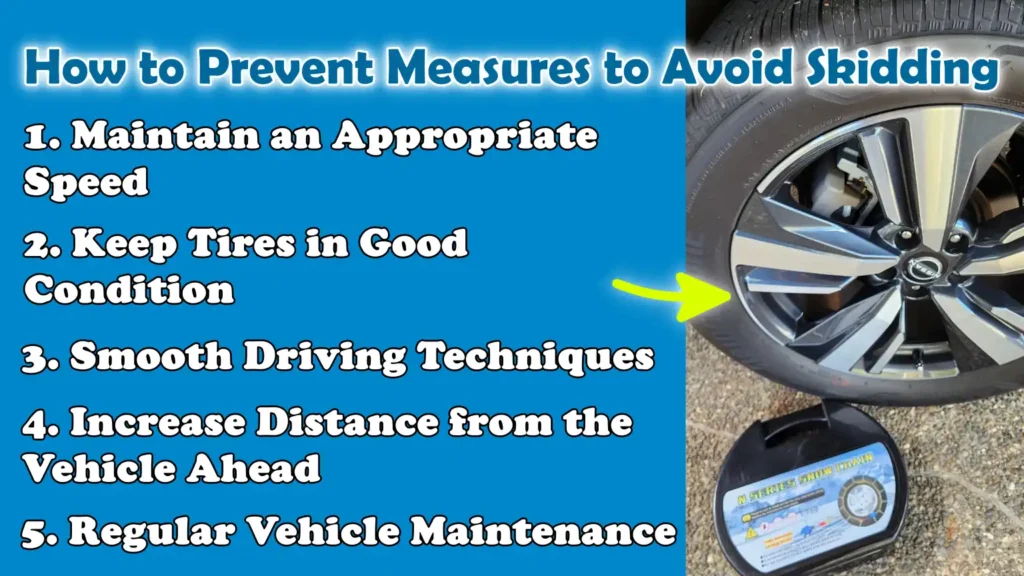
How to Prevent Measures to Avoid Skidding
Rather than attempting to regain control after a skid has occurred, it is always safer and easier to prevent the skid from happening in the first place.
Most skidding incidents occur because tire traction is compromised due to excessive speed, poor road conditions, or improper vehicle maintenance.
Road safety studies indicate that drivers who adopt basic preventive measures can significantly reduce the risk of losing control of their vehicles.
The fundamental approach involves ensuring that strong contact is maintained between the tires and the road at all times.
This can be achieved by driving cautiously, keeping the vehicle in good condition and adjusting one’s driving behavior to suit the surrounding environment.
Simple habits such as: maintaining speed control, attending to your tires and driving smoothly, as it can make a profound difference in terms of safety.
By understanding and adopting these preventive measures, drivers can avert many hazardous situations before they even arise.
1. Maintain an Appropriate Speed
Maintaining an appropriate speed is one of the most critical measures for avoiding skidding, as speed directly impacts a tire’s ability to maintain its grip on the road.
When a vehicle travels at excessive speeds, particularly on wet, icy, or uneven surfaces, the tires have less time to establish traction with the road, while the centrifugal force pushing the vehicle outward simultaneously increases.
This heightens the risk of losing control of the vehicle while braking or negotiating turns.
It is essential to adjust your speed according to road conditions, as a speed that may be safe on a dry road could prove unsafe on a wet or slippery surface.
Driving at lower speeds provides the driver with more time to react and reduces the stress placed on the tires, thereby helping them maintain better contact with the road.
2. Keep Tires in Good Condition
Tires play a crucial role in preventing skidding, as they are the only part of the vehicle that comes into contact with the road.
It is essential to maintain adequate tread depth on tires, as the grooves in the tread help displace water and maintain traction on wet surfaces.
When tires become worn, they lose this capability, significantly increasing the risk of skidding or hydroplaning.
Maintaining the correct tire pressure is equally important; under-inflated tires can compromise vehicle stability, while over-inflated tires reduce the contact area between the tires and the road.
In both instances, tire traction is diminished and the likelihood of skidding increases.
Regularly inspecting the condition of your tires ensures that the vehicle remains stable and under control across a variety of driving conditions.
3. Smooth Driving Techniques
Smooth driving techniques are vital for maintaining control over the vehicle and avoiding sudden loss of traction.
Gentle braking allows the tires to decelerate gradually without locking up, while smooth acceleration prevents wheel spin.
Gentle steering inputs help maintain the vehicle’s balance, particularly when negotiating turns.
Sudden or abrupt steering inputs can destabilize the vehicle and cause the tires to lose their grip.
Driving with a gentle touch is specially critical on slippery roads, where even a minor error can lead to the vehicle skidding.
By cultivating a habit of driving with control and consistency, drivers can minimize the stress placed on their tires and maintain optimal traction at all times.
4. Increase Distance from the Vehicle Ahead
Increasing the distance between your vehicle and the vehicle ahead is a simple yet highly effective method for preventing skidding.
On slippery surfaces, a vehicle requires a greater distance to come to a stop because tire traction is reduced.
If you are driving too close to another vehicle, you may be forced to apply sudden brakes, which significantly increases the risk of skidding.
Maintaining a greater distance from the vehicle ahead provides you with increased reaction time, allowing you to gradually reduce your speed rather than having to brake abruptly.
This extra space acts as a safety buffer, particularly during rain, snowfall, or heavy traffic conditions, where the need for sudden stops is more likely.
5. Regular Vehicle Maintenance
Regular vehicle maintenance ensures that all systems essential for safe driving are functioning correctly.
The braking system must be in good condition to bring the vehicle to a smooth, controlled stop without the wheels locking up.
The suspension system helps maintain tire contact with the road, specially on uneven surfaces, thereby preserving the vehicle’s stability.
Proper wheel alignment ensures that the tires remain oriented in the correct direction and wear evenly, thereby optimizing tire traction.
Neglecting vehicle maintenance can compromise vehicle control and heighten the risk of skidding.
Proper maintenance ensures that the vehicle responds accurately to the driver’s inputs.
Read More:
- How to Drive Safely on Ice
- How to Drive Safely in Fog
- How to Drive Safely at Night
- How to Clean Car Headlights
- How to Replace a Headlight Bulb
- How to Fix Headlight System Malfunction
Know, How to Practice and Develop The Skill
Learning to control a skid is not limited merely to understanding theory; rather, it is also about developing actual driving skills through practice.
In real-world scenarios, a skid can occur suddenly, leaving very little time to think, meaning your reaction must be instinctive and immediate.
This is why practice is so crucial, as it helps your body and mind work together seamlessly without any hesitation.
Road safety experts often point out that drivers who have practiced techniques for handling emergency situations are far more likely to remain calm and react correctly when faced with unexpected circumstances.
Skill development in driving is akin to any other activity, where repeated practice enhances confidence, control and decision-making abilities.
By practicing in a safe and controlled environment, drivers can gain a better understanding of how their vehicle behaves and learn to react instinctively without panicking.
Moreover, there’s modern vehicle technology that continues to improve the way cars handle the skidding situations by using intelligent control systems, so these systems basically monitors the road conditions and adjust the power and steering to keep the vehicle really stable even when traction is reduced, so this shows that skidding is not just about the driver skill, but also depends lot about how well the vehicle can respond to changing conditions, but there’s chances that even with the advanced systems: the driver’s understanding of skid control actually remains essential, that’s why you need to have proper knowledge about it and when you combine it with technology then it creates the best possible outcome in preventing and managing skids.[¹]
1. The Importance of Practice
The importance of practice lies in building “muscle memory” and improving reaction times, two factors that are absolutely critical during a skid.
Muscle memory implies that your body remembers the correct physical actions such as: turning the steering wheel in the right direction or lifting your foot off the pedals, without the need to consciously think about every step.
This is essential because, during a skid, there is often absolutely no time for slow deliberation or hesitation.
Practice also serves to accelerate reaction times, enabling drivers to recognize the early warning signs of a skid and respond immediately.
Studies conducted on driving behavior indicate that trained drivers react more quickly and make fewer mistakes when confronted with emergency situations.
Regular practice helps alleviate fear and anxiety, as the driver becomes familiar with how the car reacts when it loses its “traction” (its grip on the road).
This familiarity fosters confidence and facilitates more instinctive and controlled reactions.
2. Safe Practice Methods
Practicing skid control should always be conducted in a safe and controlled environment to avoid any potential risks.
It is often recommended to practice in empty parking lots, as they provide ample open space free from traffic or obstacles; this allows drivers to focus on learning without facing any hazards.
Practicing in such areas helps drivers understand how the car responds to steering, braking and acceleration under various conditions.
Professional driving courses also prove to be a highly effective method, as they offer expert guidance and structured training.
In these courses, instructors teach proper driving techniques and provide drivers with the opportunity to practice in a controlled setting, sometimes utilizing tracks specifically designed to simulate slippery surfaces.
These methods ensure that drivers can gain real-world experience without putting themselves or others at risk, thereby better preparing them to handle actual situations faced on the road.
How to Handle the Emergency Situations and Recovery
Despite excellent driving skills and quick reflexes, situations may arise where a vehicle skids so severely that maintaining complete control becomes difficult.
In such instances, the focus should not merely be on regaining control, but rather on minimizing damage and maximizing the safety of everyone involved.
Road safety studies indicate that actions taken during the final moments of losing control can significantly influence the severity of injuries and property damage.
Understanding how to react in these emergency situations helps drivers make better decisions, even under pressure.
Recovery is also a crucial part of this process; once the vehicle has stopped skidding, the driver must ensure that both the vehicle and the surrounding environment are safe before proceeding.
Staying calm, thinking clearly and acting cautiously, these three factors are essential for successfully navigating both the emergency and recovery phases.
1. When You Cannot Regain Control
When it becomes evident that you cannot fully regain control of the vehicle, your primary objective should be to minimize damage and reduce the risk to those around you.
Rather than making sudden or forceful movements, the driver should attempt to keep the vehicle as stable as possible and steer it toward a safe path.
Avoiding pedestrians is of paramount importance, as human safety must always be given the highest priority.
Furthermore, drivers should attempt to avoid major obstacles such as: large vehicles, barriers, or solid structures, as these can cause severe damage.
If a collision is inevitable, reducing speed as much as possible can help mitigate the impact of the crash.
Even in difficult circumstances, actions taken in a controlled manner can make a significant difference in the outcome and help prevent serious injuries.
2. After the Sliding Stops
Once the vehicle stops sliding and control is regained, it is crucial not to immediately resume driving without first assessing the situation.
The driver should safely pull over to the side of the road, or to another secure location, where the vehicle does not obstruct traffic.
Taking a few moments to survey the surrounding environment ensures that there are no immediate hazards, such as oncoming vehicles or unsafe road conditions.
It is also essential to check the vehicle for any visible damage, unusual noises, or changes in its performance.
Even if everything appears normal, it remains vital to take some time to calm down and regain focus before continuing the journey.
This cautious approach adopted after a slide helps ensure continued safety and prevents further complications on the road.
Conclusion – How to Control a Car in a Skid
Basically, the real test of a driver is not in the perfect conditions, but how they actually respond when control begins to slip from their hand.
Skids typically occur when tires lose their grip on the road, a situation that can arise due to weather conditions, driver behavior, or the vehicle’s mechanical condition.
The critical factor is how quickly and accurately you recognize the situation and apply the appropriate corrective measures such as: lifting your foot off the pedals, steering correctly and avoiding sudden movements.
Studies on road safety consistently demonstrate that drivers who remain calm and adopt a composed approach are far more likely to regain control of their vehicles and avoid accidents.
While modern safety systems can offer assistance, they are most effective when complemented by sound driving habits and situational awareness.
Prevention remains the most effective strategy; maintaining an appropriate speed, keeping tires in good condition and driving smoothly can significantly reduce the likelihood of a skid.
Furthermore, practicing skid control in a safe and controlled environment builds confidence and improves reaction times, making it easier to handle real-world situations.
It is also crucial to recognize that not every skid can be fully controlled; in such instances, the primary priority shifts to minimizing damage and making safe, prudent decisions.
Now, that’s all from this guide about How to Control a Car in a Skid, also you can ask all the related questions regarding this guide in the comment box.
Frequently Asked Questions
Q1: What should I do immediately if my car starts to skid?
Answer: When your car begins to skid, the very first thing you should do is remain calm and avoid panicking, as sudden reactions can worsen the situation. To reduce speed, gently lift your foot off the accelerator and avoid slamming on the brakes, specially on slippery roads. Focus on gently steering the car in the same direction in which it is skidding; this helps guide the vehicle back into a straight line. Keep your movements slow and controlled, as this gives the tires a better chance to regain their grip on the road. Most importantly, avoid making sudden, jerky movements and allow the car to stabilize gradually.
Q2: Why do cars skid on wet or slippery roads?
Answer: Cars skid on wet or slippery roads because their tires lose their grip (traction), meaning they are unable to effectively hold onto the surface. Substances such as water, ice, or loose gravel create a layer between the tires and the road, thereby reducing friction. When friction is reduced, even routine driving maneuvers such as: braking or turning, as it can cause the tires to slip. In some instances, particularly during heavy rainfall, a phenomenon known as “hydroplaning” may occur; this happens when the tires begin to float on top of the water rather than gripping the road surface. For this reason, it is crucial to drive slowly and cautiously in such conditions.
Q3: What is the difference between understeer and oversteer?
Answer: Understeer occurs when the front tires lose their grip, causing the car to continue traveling in a straight line, even though you are attempting to turn the steering wheel. This typically occurs when you enter a turn too quickly or when driving on slippery roads. Conversely, oversteer occurs when the rear tires lose their grip, causing the rear end of the car to slide sideways. This can make the car feel as though it is spinning or that its “tail” (rear section) is fishtailing. Understanding this distinction is crucial, as each type of skid requires a different corrective response to be controlled safely.
Q4: Is it safe to apply the brakes while skidding?
Answer: Applying the brakes while skidding can be risky, specially if done incorrectly. Sudden braking can cause the wheels to lock up, particularly in cars without advanced braking systems, which may exacerbate the skid and result in a loss of steering control. If your car is equipped with an Anti-lock Braking System (ABS), it helps you maintain some degree of steering control even while braking; however, brakes should always be applied firmly yet controllably, never abruptly or forcefully. In most cases, the better approach is to lift your foot off the pedal and focus on correcting the steering until the car regains traction on the road surface.
Q5: How do I safely control a rear-wheel skid?
Answer: To control a rear-wheel skid, you must steer in the same direction that the rear end of the car is sliding. For example, if the rear of the car is sliding to the right, you should gently turn the steering wheel to the right. This realigns the front and rear sections of the vehicle, thereby bringing the car back under control. It is crucial to turn the steering wheel gradually and with control rather than abruptly, as attempting to overcorrect the steering can cause the car to skid in the opposite direction.
Q6: What is hydroplaning and how can I avoid it?
Answer: Hydroplaning occurs when a layer of water forms between your tires and the road, causing the tires to lose contact with the road surface. When this happens, the car may feel as though it is floating and it may not respond properly to steering inputs or braking. To avoid hydroplaning, you should drive at reduced speeds on wet roads, keep your tires in good condition with adequate tread depth (for grip) and avoid making any sudden maneuvers. If hydroplaning does occur, gently lift your foot off the accelerator and keep the steering wheel pointed straight until the tires regain contact with the road.
Q7: Can modern cars completely prevent skidding?
Answer: Modern cars are equipped with safety systems such as: anti-lock braking, traction control and stability control, that help reduce the likelihood of skidding and improve control in challenging situations. However, these systems cannot completely prevent skidding, particularly when the driver is traveling at excessive speeds or making sudden maneuvers on slippery roads. They are designed to assist the driver, not to replace proper driving skills. This means that understanding how to control a skid remains absolutely essential today, regardless of how modern the vehicle you are driving may be.
References:
[1] Research on Anti-Skid Control Strategy for Four-Wheel Independent Drive Electric Vehicle
https://www.mdpi.com/2032-6653/12/3/150

Guys, I’m a car audio enthusiast and customization expert and I love clear sound and clean installation. Plus, I have spent years helping people build their dream audio setups. And whenever I’m working on cars, I probably listen to music and thinks about the next big upgrade.