
Written By: Don Dodi
Fact Checked By: Kristen Brown
Reviewed By: Diego Rosenberg
We all knows the importance of gear, so even with a slight delay in gear shifting can literally turn into a major transmission failure in future.
And, actually “DELAYED GEAR SHIFTING” is actually one of the commonly found transmission problem that many car owners has to experience, but very few fully understand it early on.
So, in simply terms: it happens when your vehicle actually takes longer than normal to change the gears, which is often cause you high engine RPM, sluggish acceleration or a noticeable hesitation while driving the vehicle.
Basically, this issue can affect both the vehicles be it “AUTOMATIC” & “MANUAL” cars, as it is often linked to problems such as: low or dirty transmission fluid, worn-out components or having faults in electronic control systems.
Along with this, modern vehicles actually relies heavily on precise timing between the engine and transmission, so even with a small delay that can reduce the fuel efficiency, increased engine strain and could lead to long-term damage if you ignore it.
Also, there’s research and automotive service data that clearly shows that poor transmission maintenance is one of the leading causes of having costly repairs later on, that makes early diagnosis extremely important and pocket friendly as well.
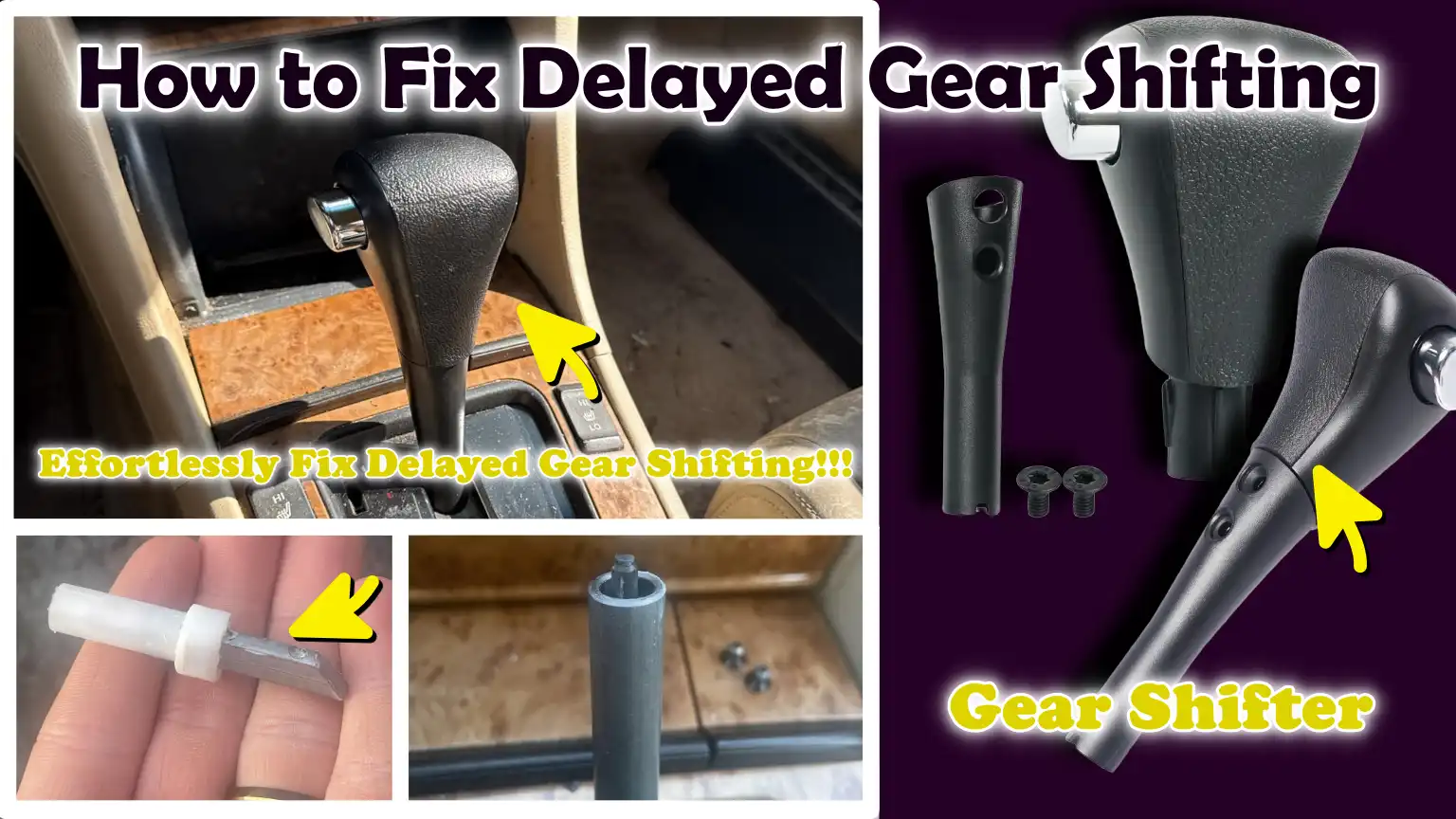
Now, with this guide you’ll learn How to Fix Delayed Gear Shifting, as you can learn about the causes of delayed gear shifting so that you can fix them with right knowledge later on.
Let’s Understand About Delayed Gear Shifting
Delayed gear shifting is a condition in which a vehicle fails to change gears at the appropriate moment, resulting in a significant lag between the increase in vehicle speed and the actual engagement of the gear.
In a properly functioning car, the transmission shifts gears very smoothly and rapidly, ensuring that the engine speed remains synchronized with current driving conditions.
However, when gear shifting is delayed, the engine’s RPM (Revolutions Per Minute) may rise higher than normal, or it may feel as though the engine has completely lost its connection to the wheels.
Understanding this issue is crucial, as the transmission is one of the most complex and expensive components of a vehicle.
Even a slight delay in gear shifting can lead to increased wear and tear on internal components, reduced fuel efficiency and, over time, major mechanical failures.
By clearly understanding what delayed gear shifting actually entails, how the transmission system operates and which warning signs to look out for, drivers can take necessary preventive measures in a timely manner and protect their vehicles from serious damage.
1. What is Delayed Gear Shifting?
Delayed gear shifting simply means that your car takes longer than usual to transition from one gear to another.
Under normal conditions, gears shift very quickly, and almost imperceptibly, allowing the vehicle to accelerate smoothly while maintaining stable engine performance.
However, when gear shifting is delayed, the engine continues to rev at high speeds before the gear finally engages, creating a sensation of hesitation or stumbling within the vehicle.
The primary difference between normal and delayed gear shifting lies in the factors of timing and smoothness; While normal shifting feels fast and seamless, delayed shifting feels slow, rough, or sluggish.
Some common examples facing in daily driving include: a delay in the vehicle’s response when you press the accelerator; the sound of the engine revving loudly before a gear shift occurs; or a slight hesitation felt when the vehicle’s speed should be increasing smoothly.
All these signs indicate that the transmission is not functioning correctly and requires attention.
2. How Does a Car’s Transmission Work?
A car’s transmission transmits power from the engine to the wheels, while also regulating the vehicle’s speed and torque to suit various driving conditions.
It achieves this by utilizing different “gear ratios,” which allow the engine to operate efficiently at both low and high speeds.
Whether the transmission is “automatic” or “manual,” precise synchronization between the transmission system and the engine is crucial for smooth gear shifting.
When this synchronization is disrupted, due to issues with transmission fluid, worn-out parts, or electronic malfunctions, the problem of delayed gear shifting can arise.
The Basics of Automatic Transmissions
In an automatic transmission, the task of changing gears is handled by a combination of mechanical, hydraulic and electronic systems.
This means the driver does not need to manually shift gears themselves.
A key component of this system is the torque converter, which replaces the clutch found in manual cars and allows the engine to continue running even when the vehicle is stationary.
Transmission fluid plays a vital role in this system, acting simultaneously as a lubricant, a coolant and a hydraulic fluid to ensure smooth gear engagement.
If the fluid level drops or the fluid degrades, it can lead to a loss of internal system pressure, resulting in delayed gear shifting.
Modern automatic cars also rely on electronic control systems; these systems utilize sensors and transmission control modules to determine when to shift gears based on the vehicle’s speed, load and throttle input.
If these electronic systems malfunction, the timing of gear shifts can be compromised, potentially resulting in clearly perceptible delays.
Basics of Manual Transmissions
In a manual transmission, the direct responsibility for shifting gears lies with the driver, who uses the clutch pedal and gear lever to execute the shift.
The clutch engages and disengages the engine from the transmission, thereby enabling gear shifts without causing damage to the internal components.
Gear synchronization is facilitated by synchronizers; these components match the rotational speeds of the gears before they engage, ensuring smooth gear transitions.
If the clutch is worn out or damaged, it may fail to completely disengage the engine, leading to delays or difficulties in shifting gears.
Driver input also plays a crucial role, as improper clutch usage or delayed shifting can manifest as a perceived lag in the transmission.
Although manual systems are mechanically simpler than automatic systems, they too can experience issues with delayed shifting due to mechanical wear or improper operation.
3. Signs and Symptoms of Delayed Gear Shifting
When gear shifting is delayed, clear warning signs often manifest, which drivers can recognize during their daily commutes.
One of the most common symptoms is that the engine RPM (engine speed) spikes excessively before a gear shift occurs; in such instances, the engine sounds louder than usual because it is forced to work harder while waiting for the transmission to engage the next gear.
Sluggish acceleration, specifically, a delay in the vehicle’s pickup, is another significant indicator; the vehicle feels slow to respond, even when the accelerator pedal is pressed firmly.
In some cases, drivers may experience gear slippage or jerking; this manifests as a sensation that the vehicle’s speed has changed abruptly or that it is struggling to remain in the correct gear.
Furthermore, if the vehicle’s onboard computer detects a transmission-related issue, the ‘Check Engine Light’ may also illuminate.
These symptoms should never be ignored, as they often point to underlying internal problems; if these issues are not accurately diagnosed and repaired in a timely manner, they can escalate into far more serious complications over time.
Know, Common Causes of Delayed Gear Shifting
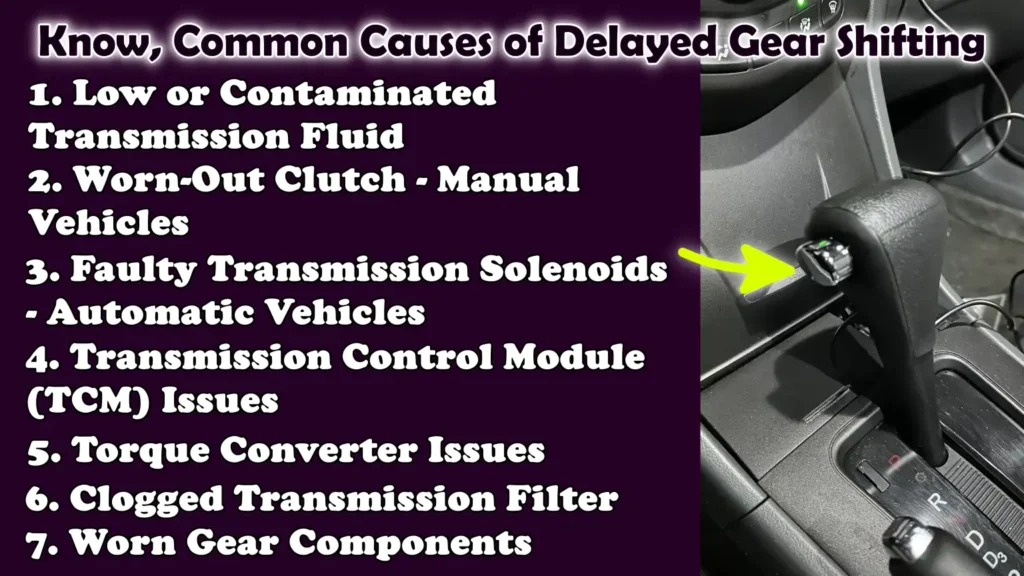
Delayed gear shifting does not occur suddenly; it is typically the result of specific mechanical, fluid-related, or electronic issues within the transmission system.
A vehicle’s transmission relies on proper lubrication, precise pressure and accurate timing to shift gears smoothly.
When any of these elements falter, the gear-shifting process becomes sluggish or erratic.
Understanding the common causes behind delayed gear shifting is crucial, as it enables drivers to identify the problem early and take appropriate action before expensive repairs or total transmission failure become inevitable.
1. Low or Contaminated Transmission Fluid
Transmission fluid plays a vital role in gear shifting, particularly in automatic vehicles, where it functions as both a lubricant and a hydraulic fluid.
It helps generate the necessary pressure to engage gears while simultaneously cooling internal components and protecting them from wear.
When the fluid level drops, the transmission cannot generate the requisite pressure to shift gears at the proper moment, resulting in delayed shifting.
Contaminated or dirty fluid, often laden with metal particles or debris, loses its ability to flow freely, thereby compromising its overall performance.
Over time, this debris can clog the transmission’s internal fluid passages and increase friction, making gear shifting slow, rough and unreliable.
Regularly checking and changing the transmission fluid is the simplest and most effective way to prevent delayed gear shifting.
2. Worn-Out Clutch – Manual Vehicles
In manual vehicles, the clutch is responsible for connecting and disconnecting the engine from the transmission during gear shifts.
When a clutch becomes worn, it fails to fully disengage the engine, making it difficult for the transmission to shift gears smoothly.
Consequently, engaging gears becomes delayed or difficult, particularly when accelerating or shifting gears rapidly.
Symptoms of a failing clutch include a loose or spongy clutch pedal, difficulty shifting gears, a burning odor, or the engine revving excessively without a corresponding increase in vehicle speed.
A worn clutch not only causes delays in gear shifting but also places undue stress on other transmission components; therefore, replacing it in a timely manner is crucial.
3. Faulty Transmission Solenoids – Automatic Vehicles
Transmission solenoids are small electronic valves that regulate the flow of transmission fluid within an automatic transmission system.
By controlling hydraulic pressure, they play a pivotal role in determining when and how gear shifts occur.
When these solenoids malfunction, or become stuck due to dirt or wear, the fluid flow becomes erratic, directly impacting the timing of gear shifts.
As a result, the transmission may hesitate before shifting, shift gears belatedly, or, in some instances, fail to engage a gear altogether.
Faulty solenoids are a common cause of delayed gear shifting in modern vehicles; accurately diagnosing them often requires the use of electronic scanning tools prior to replacement.
4. Transmission Control Module (TCM) Issues
The Transmission Control Module (TCM) is an electronic unit that manages the gear-shifting process in automatic vehicles by processing data received from various sensors.
It determines the optimal moment to shift gears based on factors such as vehicle speed, engine load and current driving conditions.
If a fault develops within the TCM such as: a wiring issue, a defective sensor, or internal damage, it can send erroneous signals to the transmission system.
Software glitches or outdated programming can also compromise its operation, leading to delayed gear shifts or a complete failure to shift gears properly.
As the TCM is responsible for precisely timing these operations, even a minor malfunction in its functioning can result in significant delays; therefore, it becomes crucial to reset, reprogram, or repair this module whenever necessary.
5. Torque Converter Issues
The torque converter is a vital component of an automatic transmission that transmits power from the engine to the transmission using fluid dynamics rather than direct mechanical contact.
It allows the vehicle to come to a complete stop without stalling the engine and facilitates smooth acceleration.
When a problem arises within the torque converter such as: internal wear or an obstruction in fluid flow, it fails to transmit power effectively.
Consequently, the vehicle experiences delayed acceleration and sluggishness during gear engagement.
Common symptoms of a failing torque converter include gear slippage, overheating, strange noises and increased fuel consumption (reduced mileage).
If these issues are not addressed in a timely manner, a torque converter failure can result in extensive damage to the transmission system.
6. Clogged Transmission Filter
The purpose of a transmission filter is to keep the fluid clean by trapping dirt, debris and metal particles.
Over time, this filter can become clogged specially if the transmission fluid is not changed regularly.
When the filter becomes clogged, it restricts the flow of fluid within the system, thereby reducing the pressure required for proper gear shifting.
This restricted flow can lead to issues such as delayed shifting, jerking sensations, or, in severe cases, a complete failure to shift gears.
A clogged filter not only impairs performance but also increases the risk of overheating, which can cause damage to internal components.
To ensure the smooth operation of the gears, it is crucial to replace the filter at scheduled intervals.
7. Worn Gear Components
Inside the transmission, there are numerous rotating components such as: gears, bearings and synchronizers, that work together to efficiently transmit power.
Over time, due to constant use, insufficient lubrication, or excessive heat, these components can become worn.
Worn gear components lose their ability to engage properly, leading to delayed or erratic gear shifting.
As early warning signs, a driver may notice issues such as grinding noises during shifting, slipping gears, or fluctuations in performance.
Prolonged wear can eventually lead to a complete transmission failure, potentially necessitating costly repairs or a complete transmission replacement.
Regular maintenance and the early detection of wear can significantly extend the lifespan of these components and prevent serious mechanical issues.
How to Diagnose Delayed Gear Shifting
Diagnosing delayed gear shifting is a crucial step before attempting any repairs, as the issue can stem from a variety of causes such as: fluid-related problems, worn components, or electronic malfunctions.
Proper diagnosis allows you to avoid unnecessary expenses and ensures that you are addressing the actual root cause of the problem, rather than merely guessing.
In modern vehicles, the transmission is a highly complex system involving both mechanical components and electronic controls; consequently, even a minor issue can adversely affect gear-shifting performance.
By adopting a clear and logical diagnostic approach, starting with simple checks and progressing to more complex methods, drivers can determine whether the problem is minor and easily fixable, or if it requires professional assistance.
1. Visual Inspection
The first and simplest step in diagnosing delayed gear shifting is a visual inspection; this often reveals issues that can be resolved quickly.
One of the most critical checks involves examining the level and condition of the transmission fluid, as the fluid plays a direct role in the gear-shifting process.
The fluid level should be at the correct mark; furthermore, in most vehicles, it should appear clear and have a light red or pink hue.
If the fluid appears dark or burnt, or emits a strong odor, it indicates that it has degraded and is no longer capable of functioning properly.
Low fluid levels can result in reduced hydraulic pressure, which, in turn, may cause delays in gear engagement.
In addition to checking the fluid level, it is also crucial to inspect for any leaks underneath the vehicle or around the transmission housing.
Leaks are often caused by worn seals or loose connections; over time, these leaks can lead to a gradual drop in the fluid level, which, if left unaddressed, as it can result in gear-shifting issues.
2. Using an OBD-II Scanner
In modern vehicles, an OBD-II scanner is an invaluable tool for diagnosing electronic or sensor-related issues.
This scanner connects to the vehicle’s onboard computer system and retrieves stored error codes whenever a malfunction is detected.
These codes provide vital information regarding potential causes for delayed gear shifting, particularly in automatic transmissions, which rely heavily on electronic controls.
Common transmission-related codes may point to issues involving solenoids, sensors, or the Transmission Control Module (TCM).
For instance, a code related to shift solenoid performance could indicate that fluid flow is not being regulated correctly, potentially leading to delays in engaging gears.
Interpreting these codes facilitates rapid problem identification and minimizes the need for trial-and-error troubleshooting, thereby making the diagnostic process more accurate and efficient.
3. Vehicle Road Testing
Road testing is an essential component of diagnosing gear-shifting delays, as it allows you to observe how the transmission performs under actual driving conditions.
During a test drive, particular attention should be paid to the speeds at which the vehicle shifts gears, whether there is any hesitation during shifts and how the engine responds as the vehicle accelerates.
Monitoring the timing of gear shifts helps determine whether the issue of delayed shifting is a persistent problem or if it occurs only under specific conditions.
Identifying patterns is also crucial, for instance, observing whether the problem manifests when the engine is cold or only after it has warmed up.
Some transmission-related issues surface only once the fluid reaches a specific operating temperature, while others become immediately apparent the moment the vehicle is started.
By carefully analyzing these patterns, it becomes easier to pinpoint the root cause of the problem and determine whether it stems from fluid flow issues, mechanical wear, or the electronic control system.
4. Professional Diagnostic Methods
When initial inspections and standard tools fail to yield a clear answer, professional diagnostic methods are required to accurately identify the root cause of the problem.
A common technique is pressure testing, which involves measuring the hydraulic pressure within the transmission to ensure it falls within the correct operating range.
Proper pressure is essential for smooth gear shifting; any deficiency or irregularity in this regard can signal internal issues, such as leaks, worn components, or clogged passages.
Another modern approach is computer diagnostics, which utilizes specialized equipment to analyze real-time data transmitted by the vehicle’s sensors and control modules.
This allows technicians to monitor the performance of the transmission system and detect faults that may not be readily apparent during initial inspections.
Professional diagnostics provide a deeper understanding of the issue and often facilitate the resolution of complex problems.
How to Fix Delayed Gear Shifting – Easy & Working Method
Addressing the issue of delayed gear shifting requires a systematic and cautious approach, as this problem can stem from a lack of routine maintenance or serve as an indicator of a more complex mechanical malfunction.
The most effective method for resolving this is to begin with the simplest and most common remedies such as: checking fluids and filters, and only proceed to more intricate repairs if the problem persists.
Many transmission-related issues are directly linked to fluid pressure, cleanliness and the proper functioning of internal components; therefore, attending to these factors often results in smoother gear shifting.
Understanding each step in detail enables drivers to take the appropriate action at the right time, avoid unnecessary repairs and enhance both the overall performance and longevity of their vehicle.
1. How to Check and Replace Transmission Fluid
Transmission fluid plays a crucial role in ensuring smooth gear shifting, as it regulates lubrication, cooling and hydraulic pressure within the system.
If the fluid level is low, dirty, or degraded, the transmission struggles to engage gears correctly, leading to delayed shifting and a negative impact on the vehicle’s performance.
Replacing old fluid with fresh, clean fluid often results in an immediate improvement in shifting speed and smoothness, particularly when the issue is caused by contamination or low pressure.
How to Check the Fluid Level
To check the transmission fluid level, the vehicle should be parked on a level surface.
For most automatic vehicles, the engine should be kept running, as this ensures an accurate reading.
The dipstick is removed, wiped clean with a cloth and reinserted to obtain a precise measurement.
The fluid level should fall within the designated range marked on the dipstick and the fluid itself should appear clear and bright rather than dark or burnt.
If the level is low, it should be topped up using the specific type of fluid recommended by the vehicle manufacturer.
Regularly checking the fluid level helps prevent issues related to delayed gear shifting and protects internal components from premature wear.
How to Change Transmission Fluid
Changing transmission fluid involves draining the old fluid and replacing it with new fluid that is appropriate for the vehicle’s specific requirements.
This task typically requires a few basic tools, such as a wrench, a drain pan, a funnel and the correct type of transmission fluid.
Safety is paramount during this process; therefore, the vehicle should be properly jacked up and adequately supported and the engine should be allowed to cool down to prevent burns.
After draining the old fluid, the system is refilled with new fluid to the correct level.
In some cases, a complete fluid flush may be performed to remove all traces of old fluid and accumulated debris.
Regular fluid changes improve gear-shifting performance, reduce wear and tear and extend the overall lifespan of the transmission.
2. How to Replace or Clean the Transmission Filter
The transmission filter keeps the fluid clean by trapping dirt, metal particles and other contaminants that could negatively impact performance.
Over time, the filter can become clogged, restricting fluid flow and reducing the hydraulic pressure necessary for smooth gear shifting.
Cleaning or replacing the filter restores proper fluid circulation and helps resolve issues related to delayed gear shifting.
This process typically involves removing the transmission pan, extracting the old filter and either installing a new filter or, if it is a reusable type, thoroughly cleaning it.
If the filter is severely clogged or if traces of contamination are visible in the fluid, replacing the filter becomes essential.
Keeping the filter clean ensures consistent performance and helps prevent future damage.
3. Repairing or Replacing the Transmission Solenoid
Transmission solenoids regulate fluid flow in automatic transmissions and play a direct role in the timing of gear shifts.
When a solenoid malfunctions, it fails to open or close properly, resulting in reduced fluid pressure and delayed gear shifting.
Identifying a faulty solenoid typically involves scanning the vehicle to detect error codes or conducting an inspection of the electrical system.
Once a defective solenoid is identified, installing a new one restores the vehicle to normal operation.
The replacement process involves accessing the transmission valve body and carefully installing the new component.
Resolving solenoid-related issues often effectively resolves problems regarding delayed gear shifting in electronically controlled transmissions.
4. How to Do Clutch Repair or Replacement – Manual Cars
In manual cars, the clutch is essential for smooth gear engagement; a worn or faulty clutch can cause delays or difficulties in shifting gears.
Signs indicating the need for a clutch replacement include clutch slippage, difficulty shifting gears, unusual noises, or a clutch pedal that feels weak.
Repairing or replacing the clutch requires removing the transmission to access the clutch assembly, which consists of the clutch plate, pressure plate and release bearing.
Although this is a complex repair, it becomes necessary when the clutch fails to function correctly.
A new clutch restores the proper connection between the engine and the transmission, enabling smooth and timely gear shifts.
5. How to Reset or Reprogram the Transmission Control Module
In modern automatic vehicles, the Transmission Control Module (TCM) manages gear shifting by processing data and controlling timing.
Occasionally, gear shift delays occur due to corrupted data within the system, software glitches, or errors in adaptive learning.
Resetting the module clears accumulated data and helps the system relearn the correct shifting patterns.
In more severe cases, reprogramming may be required to update the software and rectify any malfunctions.
This process is typically performed using specialized diagnostic tools.
If the issue stems from electronic controls rather than a mechanical fault, resetting or reprogramming the module can significantly improve gear-shifting performance.
6. How to Do Torque Converter Repair
In automatic vehicles, the torque converter serves to transmit power from the engine to the transmission; any malfunction within this component can lead to delays in acceleration and gear shifting.
Minor issues such as: fluid-related problems, as it can sometimes be resolved simply by changing the transmission fluid or by rectifying internal pressure-related issues.
However, if the torque converter has sustained internal damage or is excessively worn, it may require repair or replacement.
Symptoms such as clutch slippage, overheating, or the emission of strange noises often point to a more serious underlying internal problem.
The decision between repairing and replacing the unit depends on the severity of the damage and the overall condition of the transmission.
7. How to Do Complete Transmission Repair or Replacement
When delayed gear shifting is caused by severe internal damage such as: worn gears, faulty bearings, or a major system malfunction, a complete transmission repair or replacement may become necessary.
This is generally considered a last resort and is pursued only after all other potential solutions have been exhausted.
Transmission repair involves rebuilding the unit by replacing damaged components, whereas transmission replacement entails installing a new or remanufactured transmission unit.
Although these measures can be costly, they are essential for restoring the vehicle’s proper performance and reliability.
The decision regarding which approach to take depends on several factors, including the vehicle’s age, the extent of the damage and the total cost involved.
Properly addressing severe issues ensures the vehicle’s long-term performance and prevents recurring malfunctions.
Know, Estimated Cost of Repairing Delayed Gear Shifting
The cost of repairing delayed gear shifting depends on the root cause of the problem, the type of vehicle and how early the issue was detected.
In many cases, the problem stems from minor and inexpensive causes such as: low fluid levels or a clogged filter, but if left unaddressed, it can escalate into severe mechanical damage requiring costly repairs.
Transmission systems are complex and comprise both mechanical and electronic components; consequently, if multiple parts fail, repair costs can rise rapidly.
Understanding these varying cost levels helps drivers plan more effectively, take timely action and avoid unnecessary expenses by fixing minor issues before they evolve into major malfunctions.
1. Cost of Minor Repairs
Minor repairs are typically the least expensive and are often associated with routine maintenance.
Changing the transmission fluid is one of the most common remedies and is generally far less costly than major repairs, as it simply involves draining the old fluid and replacing it with fresh fluid.
If delayed gear shifting is caused by low or degraded fluid levels, this simple step can significantly improve gear-shifting performance.
Replacing the filter is another low-cost solution that helps restore proper fluid flow and pressure within the transmission.
As the filter traps dirt and debris, replacing it ensures that only clean fluid circulates throughout the entire system.
These minor remedies are cost-effective and highly effective specially when the problem is detected early, making them the first step in resolving issues related to delayed gear shifting.
2. Cost of Moderate Repairs
Moderate repair costs arise when specific internal components of the transmission system require repair or replacement.
Replacing a solenoid is a common example of this, particularly in automatic vehicles, where a faulty solenoid can obstruct fluid flow and cause delays in gear shifting.
This cost encompasses both the price of the parts and the labor required for their removal and installation.
In cars with manual transmissions, clutch repairs also fall into this category, as they involve removing worn components such as: the clutch plate and pressure plate, and replacing them with new ones.
Although these repairs are more expensive than routine maintenance, they remain significantly more affordable than a complete transmission overhaul.
Addressing these issues in a timely manner can restore proper gear-shifting functionality and prevent further damage.
3. Cost of Major Repairs
Major repair costs are incurred when the transmission system sustains severe internal damage.
Repairing or replacing a faulty torque converter can be a costly undertaking, as it requires extensive labor to access and involves critical components that directly impact power transfer.
In more severe cases, the entire transmission may need to be rebuilt.
This process involves completely disassembling the transmission, replacing worn or damaged parts and reassembling the unit to restore it to proper working order.
This procedure is time-consuming and requires specialized expertise, making it one of the most expensive solutions available.
Although major repairs can be expensive, they sometimes become necessary specially when a problem has been ignored for too long.
Investing in the right repairs at this stage ensures that the vehicle remains reliable for the long term and avoids frequent breakdowns.
Read More:
- How to Change a Gear Shift Knob
- How to Repair Gear Shifter Cable
- How to Replace a Transmission Mount
- How to Check Clutch Fluid Level
- How to Change Transmission Fluid
- How to Detect Transmission Problems
- How to Fix Car Transmission Slipping
How to Prevent Delayed Gear Shifting
Preventing delays in gear shifting is far easier and more cost-effective than repairing severe damage after it has occurred.
The transmission of any vehicle is designed to operate without interruption for many years; however, this depends heavily on proper maintenance, clean fluid and responsible driving habits.
Most transmission-related problems develop gradually due to negligence, excessive heat, or excessive wear and tear; this means that with a little consistent care, these issues can often be avoided.
By adhering to basic maintenance guidelines, driving the vehicle correctly and paying attention to early warning signs, drivers can keep their transmissions in good condition, ensure smooth gear shifting and significantly extend the lifespan of their vehicles.
Also, there’s study that shows that how controlling the oil pressure during the gear shifts can reduce the shock and improve the smoothness, so the findings shows that optimized pressure control significantly reduces the jerks and improves the gear transition quality, plus it also demonstrates that improper pressure control actually leads to harsh or delayed shifting, that is why issues such as: clogged filters or low fluid levels cn directly cause delayed gear shifting in real-world driving as well.[¹]
1. Regular Maintenance Tips
Regular maintenance is the most critical factor in preventing delayed gear shifting, as it keeps the transmission system clean, properly lubricated and operating at the correct pressure.
Changing the transmission fluid at scheduled intervals is essential, as the quality of the fluid naturally degrades over time due to heat and friction.
Fresh fluid maintains proper hydraulic pressure and minimizes internal wear, thereby directly ensuring a smooth gear-shifting process.
Regular inspections are equally important, as they help identify minor issues such as: leaks, worn seals, or early signs of contamination, before they escalate into major problems.
Regular servicing also allows mechanics to assess the condition of filters, sensors and other components that influence the transmission’s performance.
Consistency in maintenance not only prevents delayed gear shifting but also reduces the risk of costly repairs.
2. Driving Habits That Protect the Transmission
Driving habits have a direct impact on how well a transmission functions and how long it lasts.
Accelerating gradually is the most effective way to preserve the transmission, as sudden or rapid acceleration places excessive strain on internal components and generates significant heat.
Gradual acceleration allows the transmission to shift gears at the appropriate moments without any undue stress.
It is also crucial to avoid overloading the vehicle beyond its capacity; carrying excessive weight forces the transmission to work far beyond its intended limits, which can lead to overheating and delayed gear shifting.
Driving consistently and carefully minimizes wear and tear on the gears, clutch and other components, ensuring that the vehicle’s performance remains smooth and reliable over time.
3. Early Warning Signs to Watch For
Identifying early warning signs is essential to prevent minor gear-shifting delays from escalating into major problems.
Before serious damage occurs, subtle changes in the vehicle’s behavior often become apparent such as: slight hesitation during gear shifts, unusual noises emanating from the engine, or a mild jerk felt while driving.
Although these signs may seem minor at first, they indicate that the transmission is not operating as efficiently as it should.
Recognizing these issues in a timely manner allows for simple, immediate remedies such as: fluid changes or minor adjustments, rather than necessitating costly repairs.
By paying close attention to the vehicle’s handling and responsiveness during daily driving, drivers can take necessary action at the right moment, ensuring that the gear-shifting process remains consistently smooth and trouble-free.
When You Should Consult a Professional Mechanic
It is crucial to know when to consult a professional mechanic regarding delays in gear shifting.
This is because certain transmission-related issues cannot be resolved through standard troubleshooting methods and require specialized tools and expertise.
While routine maintenance can address minor issues, specific warning signs often point to deeper mechanical or electronic malfunctions, problems that should not be attempted without the proper knowledge.
Ignoring these signs can lead to severe damage, increased repair costs and potentially the complete failure of the transmission system.
A trained mechanic possesses the capability to accurately diagnose the problem, identify hidden faults and implement the correct repair procedures, thereby ensuring the vehicle’s long-term reliability and safety.
1. Warning Signs You Should Not Ignore
There are several warning signs that clearly indicate the need for professional assistance, signs that should never be overlooked.
If the vehicle experiences persistent delays in gear shifting, emits loud or unusual noises while changing gears, or produces strong jerks while driving, it often signals a malfunction within the transmission’s internal components or an imbalance in fluid pressure.
A burning smell is also a serious indicator, typically resulting from overheating or degraded transmission fluid; this can accelerate the wear and tear of internal parts.
If the vehicle struggles to move forward, gears are slipping, or the “Check Engine” light illuminates due to a transmission-related issue, it is a clear indication that the problem requires examination by a specialist.
These symptoms often point to complex internal issues that cannot be resolved through routine maintenance alone.
2. The Risks of Delaying Repairs
When facing gear-shifting problems, delaying repairs can significantly escalate both the severity of the issue and the associated costs.
A problem that may initially appear minor such as: low fluid levels or a faulty small component, as it can, if left unaddressed, gradually lead to major damage to internal components.
Continuing to drive despite gear-shifting delays places excessive strain on the gears, clutch and other vital parts, causing them to wear out prematurely.
The ultimate consequence of this can be a complete transmission failure, one of the most expensive repairs a vehicle can require.
Beyond the financial burden, delaying repairs can also compromise driving safety, as unpredictable gear behavior can diminish your control over the vehicle, particularly when driving in traffic or at high speeds.
3. The Benefits of Expert Diagnostics
Seeking assistance from a professional mechanic offers several key advantages that extend far beyond merely resolving common issues.
Experts utilize modern diagnostic equipment to pinpoint the root cause of a problem, whether it involves fluid pressure issues, internal wear and tear, or a malfunction within the electronic control system.
Such precise diagnostics eliminate the need for unnecessary parts replacements and ensure that the repair work is executed correctly on the very first attempt.
Professional mechanics also possess the experience to identify hidden issues that might otherwise go unnoticed during a standard inspection.
By opting for expert diagnostics, drivers can save time, minimize long-term expenses and ensure that their vehicle operates smoothly and reliably once again.
Conclusion – How to Fix Delayed Gear Shifting
Now, you can understand that how important it is to maintain the transmission as it literally improves the performance, as it protects your entire driving experience as well.
As this comprehensive guide illustrates, the proper operation of a transmission depends heavily on the condition of its fluid, the functionality of its components and the precise synchronization between its mechanical and electronic systems.
Even a slight delay in gear shifting can place excessive strain on the engine, compromise fuel efficiency and, if left unaddressed, gradually inflict damage upon internal components.
Most importantly, timely inspections and prompt action can prevent minor issues from escalating into major, costly repairs.
Simple measures such as: regularly monitoring transmission fluid levels, adhering to scheduled service intervals and adopting a smooth driving style, as it can make a significant difference in enhancing a vehicle’s overall performance and longevity.
Furthermore, recognizing when a specific issue requires expert intervention ensures that complex problems are resolved accurately and safely.
Now, that’s it from this one and you can ask more questions in the comment section below.
Frequently Asked Questions
Q1. Can I still drive my car if there is a delay in shifting gears?
Answer: Yes, even if there is a delay in shifting gears, you can continue driving for a short while; however, it is not advisable to drive for an extended period without addressing this issue. A delay in shifting gears often indicates that the transmission is not functioning correctly and continuing to drive in this condition can place excessive strain on internal components such as the gears, clutch and torque converter. Over time, this excessive strain can accelerate wear and tear, potentially leading to even more serious and costly damage down the road. In some instances, the vehicle’s behavior may also become unpredictable particularly during rapid acceleration or while overtaking other vehicles, thereby compromising safety. Rather than risking further damage, it is always best to diagnose and resolve the issue immediately.
Q2. How long does it take to fix a gear-shifting delay?
Answer: The time required to resolve a gear-shifting delay depends on the root cause of the problem. If the issue is related to low or degraded transmission fluid, it can often be resolved within a few hours by replacing the fluid and filter. However, if the problem involves components such as solenoids, the clutch, or the transmission control module, the repair process may take a full day or longer, depending on the complexity of the issue. In more severe cases such as: damage to internal transmission components or situations requiring a complete transmission rebuild, repairs may take several days to complete. The exact timeframe also depends on the availability of necessary parts and the level of expertise required for the repair.
Q3. Is a gear-shifting delay always a transmission problem?
Answer: Although a delay in shifting gears is often associated with the transmission system, it is not always limited solely to that system. In modern vehicles, the transmission operates in conjunction with the engine and the electronic control system; consequently, issues arising within these components can directly impact the gear-shifting process. For instance, faulty sensors, engine performance issues, or malfunctions within the transmission control module, all of these can lead to delays in gear shifting. Therefore, a proper diagnosis is crucial, as it helps identify whether the root cause of the problem is mechanical, fluid-related, or electronic. Understanding the underlying cause ensures that the necessary repairs are executed correctly.
Q4. Can simply changing the transmission fluid resolve the issue?
Answer: In many cases, yes; changing or topping up the transmission fluid can resolve issues related to delayed gear shifting particularly when the problem stems from low fluid levels or fluid contamination. Fresh transmission fluid helps restore proper hydraulic pressure and lubrication, factors that are absolutely essential for smooth gear shifting. However, if the problem is caused by worn components, faulty solenoids, or electronic malfunctions, simply changing the fluid may not provide a complete solution. While it may offer a temporary improvement in vehicle performance, further repairs will be required to achieve a permanent resolution to the problem. Therefore, in addition to checking the fluid, it is also essential to conduct a comprehensive evaluation of the entire transmission system.
References:
[1] Study of Shock Control of Gear-Shifting in Automatic Transmission
https://www.scientific.net/AMR.490-495.890

Guys, I’m a car audio enthusiast and customization expert and I love clear sound and clean installation. Plus, I have spent years helping people build their dream audio setups. And whenever I’m working on cars, I probably listen to music and thinks about the next big upgrade.