
Written By: Don Dodi
Fact Checked By: Kristen Brown
Reviewed By: Diego Rosenberg
So, whenever your car starts to jerk during the gear changes: then it is not random thing, as it is literally your vehicle signal there’s mechanical or electronic issue.
Literally, “GEAR SHIFTING” in a car is designed to be smooth, precise and almost unnoticeable thing, but when you start feeling jerks or sudden jolts during the gear changes, then it is time to check what is not working behind the bar.
Along with this, there’s studies in automotive engineering that shows that even minor issues such as: low or contaminated transmission fluid can reduce shifting efficiency by up to 30%, that could lead to noticeable discomfort and long-term wear as well.
And, jerking can occur in both manual and automatic vehicles and it is commonly linked to problems in the transmission system, fuel delivery, engine performance or electronic sensors as well.
Now-a-days, cars actually relies heavily on systems such as: Transmission Control Module, famously known as TCM and various other sensors that to ensure seamless gear transitions, which means even a small malfunction can actually disrupt the entire driving expeirnece.
Now, in this guide you’ll learn everything about How to Fix Jerking When Shifting Gears, so that you can understand the root cause and apply the right fixes at the right time.
Now, At First Understand About Jerking During Gear Shifting
Jerking during gear shifting refers to a condition where the vehicle fails to shift gears smoothly, resulting in a sudden jolt, vibration, or erratic movement when transitioning from one gear to another.
In a properly functioning vehicle, the gear-shifting experience should be nearly seamless, as the engine, transmission and control systems work in unison to balance speed and power.
When jerking occurs, it typically indicates that this balance has been disrupted, often due to issues such as uneven power delivery, delayed gear engagement, or worn mechanical components.
According to automotive service data, transmission-related issues are among the most common causes of driving-related complaints, particularly in vehicles that have not undergone regular maintenance.
Jerking is not merely a matter of driving comfort; it can place excessive stress on internal components such as: gears, shafts and mounts, leading to accelerated wear over time and potentially increasing repair costs.
Understanding the underlying causes of such behavior and identifying precisely when it occurs, helps drivers take timely corrective action, prevent serious damage and ensure a smooth, safe driving experience.
1. What Does “Jerking During Gear Shifting” Mean?
Jerking during gear shifting implies that, instead of a smooth and steady transition, the vehicle suddenly lurches forward, pulls backward, or begins to vibrate the moment the gear changes.
Simply put, it feels as though the vehicle is struggling to synchronize the engine speed with the wheel speed during the gear-shifting process.
Mild vibrations are typically minor and momentary; they are often caused by normal fluctuations in engine load or slight imbalances and they generally do not significantly impact driving comfort.
However, severe jerks are far more pronounced and forceful; In these instances, there is often a sudden surge or drop in speed, clearly signaling an underlying internal issue that requires attention.
Research into vehicle dynamics indicates that smooth gear shifting relies on precise timing and pressure control, particularly in automatic transmissions, and even the slightest deviation in these factors can result in jerking sensations.
If these jerks recur over time or become more intense, it is a definitive indication that components such as the clutch, transmission fluid, or sensors are not functioning correctly.
2. When Does This Typically Occur?
The issue of jerking during gear shifts can manifest under various driving conditions and recognizing these patterns makes it easier to pinpoint the root cause of the problem.
This often happens during acceleration, when the vehicle is attempting to increase its speed and shift into a higher gear, as this process requires a rapid and seamless transfer of power.
It can also occur during downshifting, particularly while decelerating, as the transmission must adjust to a lower gear and synchronize precisely with the engine speed.
Many drivers experience jerking at low speeds or in stop-and-go traffic, where frequent gear changes place increased strain on the transmission system.
Another common scenario arises when the engine is cold; at lower temperatures, both the transmission fluid and engine oil become thicker, which can delay the vehicle’s smooth operation.
As the engine warms up, the fluids flow more freely and the jerking may subside or disappear entirely; this suggests that the condition or temperature of the fluid could be a contributing factor.
Understanding when these jerks occur provides crucial clues for diagnosing the problem and resolving it effectively.
3. Types of Affected Transmissions
Jerking during gear shifts can occur in all types of transmissions; however, the underlying causes and symptoms of this issue may vary depending on the specific system utilized in the vehicle.
In cars equipped with manual transmissions, jerking is often attributed to driver input, clutch wear, or a lack of coordination between the clutch and the accelerator, as the gear-shifting process is performed directly by the driver.
In vehicles with automatic transmissions, jerking is typically linked to the quality of the transmission fluid, internal components, or the electronic control system (such as sensors and control modules), as these systems handle the gear-shifting process automatically.
In Continuously Variable Transmission (CVT) systems, which lack fixed gears and instead continuously adjust the gear ratio, jerking is less common; nevertheless, it can still occur due to belt wear, fluid-related issues, or software malfunctions.
Automotive studies indicate that automatic and CVT systems rely heavily on precise hydraulic pressure and electronic signals; consequently, even a minor fault can adversely affect the smooth operation of the vehicle.
Understanding the specific type of transmission involved facilitates the identification of the most probable cause of the malfunction.
Know, Common Causes of Jerking During Gear Shifts
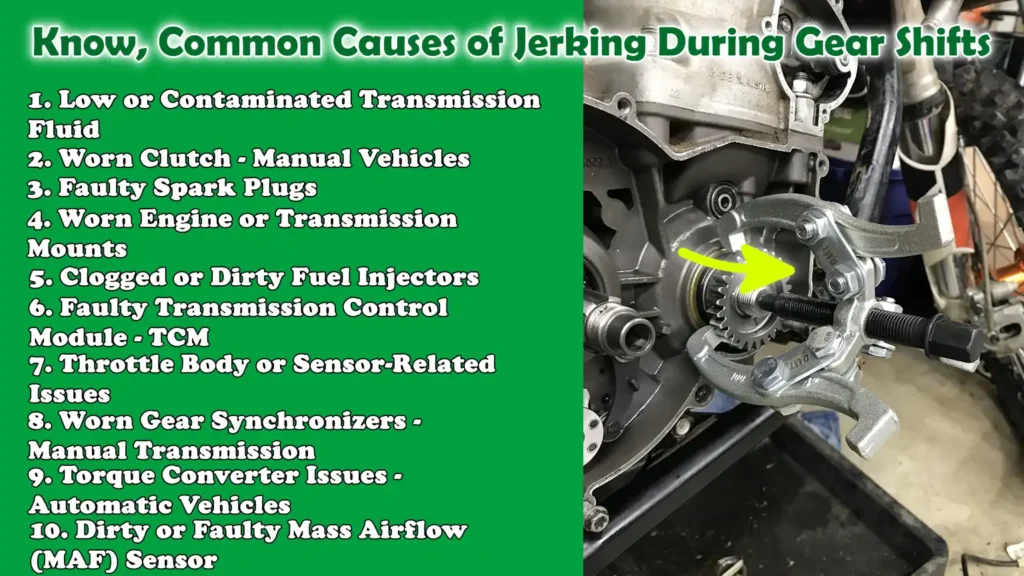
Jerking during gear shifts is rarely caused by a single, isolated issue; rather, it typically results from the combined effects of mechanical wear, fluid condition and electronic system malfunctions.
Modern vehicles rely on a precise balance between engine power, fuel delivery and transmission timing to execute smooth gear changes.
When any component of this intricate system becomes worn, contaminated, or sluggish, a distinct jerk is often felt during gear shifts.
Automotive service data indicates that a lack of maintenance, specifically neglecting fluid changes and overlooking worn components, is one of the primary causes of transmission-related problems.
Identifying the root cause of the issue is crucial, as every problem manifests differently within the vehicle; resolving the underlying internal issue restores smooth vehicle operation and helps prevent costly damage in the future.
1. Low or Contaminated Transmission Fluid
Transmission fluid plays a vital role in lubricating the vehicle’s moving parts, regulating heat and facilitating smooth gear engagement.
When the fluid level drops, or when the fluid becomes contaminated, it loses its ability to maintain the necessary hydraulic pressure and lubrication.
This can lead to delayed gear engagement or abrupt gear shifts, conditions that are often perceived as jerking sensations.
Clean fluid helps maintain consistent hydraulic pressure within the transmission, an essential prerequisite for smooth vehicle operation.
Common symptoms associated with fluid-related issues include the fluid becoming dark in color or emitting a burning odor, delayed gear engagement, engine overheating and the occurrence of strange noises while shifting gears.
Automotive maintenance studies indicate that regularly changing the transmission fluid can significantly improve shifting performance and extend the lifespan of the transmission system.
2. Worn Clutch – Manual Vehicles
In manual vehicles, the clutch serves to connect and disconnect the engine from the transmission during gear shifts.
Over time, due to constant friction, the clutch plate wears down, thereby diminishing its ability to engage gears smoothly.
When the clutch fails to establish a proper grip, it may slip or fail to transfer power effectively, resulting in jerks or hesitation during gear changes.
This issue is particularly noticeable during acceleration or while shifting gears.
Common symptoms of a worn clutch include difficulty shifting gears, a burning odor, sluggish acceleration and a clutch pedal that sits higher than usual.
Proper clutch maintenance, including timely replacement, is essential for ensuring smooth vehicle operation and preventing further damage to the transmission.
3. Faulty Spark Plugs
Spark plugs are responsible for igniting the air-fuel mixture inside the engine; their proper functioning is crucial for the engine to run smoothly.
When spark plugs become worn, fouled, or defective, they can cause the engine to misfire, meaning the engine fails to generate power consistently.
This uneven delivery of power can directly impact the smoothness of gear shifting, potentially resulting in jerks or hesitation.
An engine experiencing misfires often exhibits increased fuel consumption, rough idling (when the engine is running) and an overall decline in performance.
Replacing spark plugs at the recommended intervals ensures consistent engine power output and facilitates smoother gear shifting.
4. Worn Engine or Transmission Mounts
Engine and transmission mounts are designed to securely hold these heavy components in place while simultaneously absorbing vibrations and shocks.
When these mounts become worn, cracked, or broken, they lose their ability to properly stabilize the engine and transmission.
Consequently, excessive movement of these components becomes evident during gear shifts, manifesting as jerks or sudden jolts.
This issue is often exacerbated during rapid acceleration, braking, or the act of shifting gears.
Faulty mounts not only compromise driving comfort but, if left unaddressed, can also lead to component misalignment and place undue stress on other parts.
5. Clogged or Dirty Fuel Injectors
Fuel injectors play a crucial role in delivering the precise amount of fuel required for combustion within the engine.
When injectors become clogged or dirty, they fail to atomize and spray fuel evenly, resulting in an improper air-fuel mixture.
This imbalance can cause the engine to hesitate or generate uneven power, particularly during gear shifts, leading to a sensation of jerking.
Over time, this condition can worsen due to deposits accumulated from low-quality fuel or a lack of proper maintenance.
Its symptoms include reduced engine performance, difficulty accelerating and increased fuel consumption.
Regular cleaning of the fuel injectors helps ensure this.
6. Faulty Transmission Control Module – TCM
In modern vehicles, the Transmission Control Module (TCM) is an electronic unit responsible for determining when and how gears are shifted.
By utilizing data received from various sensors, it ensures that gear shifts occur at precisely the right moment and with the appropriate pressure.
If the TCM malfunctions or receives erroneous data, gear shifts may be delayed, occur abruptly (with a jolt), or become unpredictable; this can result in noticeable jerking sensations within the vehicle.
Electrical faults, software glitches, or defective sensors can adversely affect the TCM’s operation.
In many instances, diagnosing the issue requires scanning the vehicle’s systems to retrieve error codes; potential solutions may involve resetting, repairing, or updating the module.
7. Throttle Body or Sensor-Related Issues
The throttle body regulates the volume of air entering the engine, while sensors assist in adjusting this airflow based on current driving conditions.
If the throttle body becomes dirty or the sensors provide inaccurate readings, the engine may fail to receive the necessary volume of air.
This can lead to fluctuations in engine power, which directly impacts the transmission’s shifting behavior.
The vehicle may experience jerking sensations because the engine is not responding correctly to acceleration inputs.
Cleaning the throttle body and ensuring that the sensors are functioning properly can restore proper airflow and significantly improve the gear-shifting experience.
8. Worn Gear Synchronizers – Manual Transmission
In manual transmissions, gear synchronizers facilitate smooth gear shifting by matching the rotational speeds of the gears before they engage with one another.
When these synchronizers become worn, they are unable to properly align the gears; this can lead to grinding noises and felt jolts during gear shifts.
This issue often becomes more pronounced when gears are shifted rapidly or when engaging a specific gear.
Worn synchronizers make gear engagement more difficult and less smooth; if left unaddressed, this can lead to further damage within the transmission.
Repairing or replacing these components is crucial for ensuring the proper functioning of the gears.
9. Torque Converter Issues – Automatic Vehicles
The torque converter is a vital component of an automatic transmission, responsible for transmitting power from the engine to the transmission while also facilitating smooth gear shifts.
When the torque converter malfunctions, due to internal wear, fluid-related issues, or lock-up irregularities, it disrupts the smooth flow of power.
This often manifests as vibrations, a sensation of slipping, or jolts during acceleration or gear shifting.
As the operation of the torque converter relies heavily on transmission fluid pressure, any irregularity in this pressure can adversely affect its performance.
Addressing these issues in their early stages can prevent more severe damage to the transmission and ensure a smooth driving experience.
10. Dirty or Faulty Mass Airflow (MAF) Sensor
The Mass Airflow (MAF) sensor measures the volume of air entering the engine and assists in determining the appropriate level of fuel injection.
When this sensor becomes dirty or malfunctions, it transmits inaccurate data to the engine control system, resulting in an improper air-fuel mixture.
Consequently, the engine begins to run in either an excessively ‘rich’ (excessive fuel) or an excessively ‘lean’ (insufficient fuel) state, leading to instability in power output.
As a result, jerking or roughness may be felt during gear shifts, as the engine is unable to deliver consistent performance.
Cleaning or replacing the MAF sensor is a simple yet effective method to improve engine efficiency and restore smoothness to the gear-shifting process.
Know, Common Symptoms You Should Not Ignore
Problems with shifting gears rarely arise suddenly or without warning; in most cases, your car provides clear signals before the issue becomes severe.
These symptoms are crucial because they help you detect problems early and avoid costly repairs in the future.
Automotive studies indicate that the early detection of transmission and engine-related issues can significantly reduce repair costs and prevent damage to major components.
Many drivers overlook minor changes in their driving experience, assuming they are normal; however, even the slightest irregularity could point to an underlying mechanical or electronic fault.
Paying close attention to how your car behaves, whether during gear shifts, acceleration, or under normal driving conditions, as it can help you identify problems early and take corrective action before critical components, such as the gearbox or engine system, sustain damage.
1. Difficulty or Delay in Shifting Gears
Difficulty or delay in shifting gears means that the car takes longer than usual to engage the next gear, or requires significantly more effort to do so.
In a properly functioning system, gears should shift quickly and smoothly, often within a fraction of a second.
When a delay occurs, it typically signals issues related to transmission fluid pressure, worn components, or electronic controls.
Drivers may perceive a hesitation in the car before it moves forward or changes speed, particularly when accelerating from a standstill or picking up momentum.
This delay can place excessive strain on the transmission system and compromise driving comfort.
Over time, ignoring this symptom can lead to even more severe damage to the transmission; Therefore, prompt inspection and maintenance are crucial.
2. Sudden Jerking or Lurching of the Vehicle
Sudden jerking or lurching of the vehicle, whether forward or backward, is one of the most noticeable and uncomfortable symptoms associated with gear-shifting problems.
It feels as though the car suddenly surges forward or backward while shifting gears, even if the driver maintains consistent pressure on the accelerator.
This typically occurs when the transmission engages too abruptly or unevenly, resulting in a sudden surge of power being delivered to the wheels.
The causes of these jerks can range from irregular fuel supply or faulty sensors to internal issues within the transmission itself.
Not only does this compromise driving comfort, but it can also be unsafe, particularly in heavy traffic or while parking.
Persistent jerking is a clear indication that the vehicle requires immediate attention to prevent further damage.
3. Grinding or Strange Noises During Gear Shifting
Grinding or strange noises during gear shifting are a clear indication that something within the transmission system is not functioning correctly.
In manual cars, grinding noises often occur when gears fail to synchronize properly, typically due to worn synchronizers or improper clutch engagement.
In automatic vehicles, unusual sounds such as: whining, rattling, or humming noises, may signal fluid-related issues or the wear and tear of internal components.
These noises arise when metal parts fail to mesh correctly, which can lead to gradual damage over time.
Research in automotive repair suggests that unusual noises are often among the earliest warning signs of mechanical wear; Ignoring these issues can lead to hefty repair costs or a complete failure of the transmission system.
4. Increased Fuel Consumption
Increased fuel consumption is another significant symptom that many drivers often overlook.
When the transmission or engine is not functioning correctly, the vehicle may require more fuel to deliver the same level of performance.
Jerking during gear shifts, delayed gear engagement, or irregular engine operation, all these factors can contribute to increased fuel consumption.
This occurs because the engine is forced to work harder to compensate for the inefficient transfer of power.
Over time, this not only drives up fuel costs but also indicates that the vehicle is not operating at its full potential.
Regularly monitoring fuel consumption can help identify underlying issues and ensure timely repairs.
5. Dashboard Warning Lights
Modern vehicles are equipped with advanced sensors and monitoring systems that detect malfunctions and alert the driver via warning lights on the dashboard.
When there is an issue with the transmission, the engine, or related components, lights such as the “Check Engine” light or the transmission warning light may illuminate.
These warning lights are triggered based on error codes stored within the vehicle’s system and should never be ignored.
Even if the vehicle feels normal to drive, a warning light signals that something is not functioning correctly.
Using diagnostic tools to read these codes helps pinpoint the exact problem and guides the repair process in the right direction.
How to Fix Jerking When Shifting Gears – Easy & Effortless Method
Resolving jerks during gear shifting requires a clear and systematic approach, as this issue can be linked to various components of the vehicle such as: the transmission, engine, fuel system and electronic controls.
A well-maintained car is designed to shift gears smoothly and without excessive delay; therefore, when jerks occur, it generally indicates that one or more components are not functioning correctly.
Automotive maintenance data suggests that regular inspections, along with the timely replacement of fluids and wear-and-tear parts, as it can prevent most issues related to gear shifting.
By following a step-by-step method, drivers can pinpoint the root cause of the problem, implement the appropriate solution and restore a smooth driving experience.
Understanding each step in simple terms makes the process more manageable, whether you are performing basic maintenance yourself or determining when professional assistance is required.
1. Check and Replace Transmission Fluid
Transmission fluid is one of the most critical elements for facilitating the gear-shifting process, as it provides lubrication, cooling and hydraulic pressure within the transmission system.
To check the fluid, the vehicle should be parked on level ground and the engine must be warm, as this ensures an accurate reading.
In many vehicles, the fluid level can be monitored using a dipstick and its condition can be assessed by observing its color and odor.
Healthy transmission fluid is typically red or pink and clear, whereas degraded fluid appears dark and may emit a burnt smell.
If the fluid level is low, topping it up with the specific type of fluid recommended by the manufacturer can improve gear-shifting performance.
If the fluid has become dirty or degraded, a complete fluid replacement (flushing) is often necessary to remove contaminants and restore the system to proper working order.
Regularly changing the fluid, typically performed every 30,000 to 60,000 kilometers, depending on the vehicle, helps prevent jerking and extends the lifespan of the transmission.
2. Inspect and Replace the Clutch – Manual Cars
In manual cars, the clutch plays a crucial role in facilitating the gear-shifting process; it serves to engage and disengage the engine from the transmission.
To inspect the clutch, drivers can pay attention to the feel of the pedal and how the vehicle responds during gear changes.
A worn-out clutch often feels loose, engages at a high position, or slips during acceleration.
When the clutch does not engage smoothly, jerking may occur, resulting in uneven power transfer.
If these symptoms appear, it generally indicates that the clutch plate is worn out and requires replacement.
Clutch components typically last between 50,000 and 100,000 kilometers, depending on your driving habits; replacing them in a timely manner ensures that gear shifting remains smooth and controlled.
3. Replace Spark Plugs
Spark plugs are responsible for igniting the air-fuel mixture inside the engine and their condition has a direct impact on engine performance.
When spark plugs become worn or fouled, they can misfire, resulting in poor power delivery and noticeable jerks during gear shifts.
Common signs indicating the need to replace spark plugs include: rough engine operation (rough idling), sluggish acceleration, increased fuel consumption and difficulty starting the engine.
In most vehicles, spark plugs require replacement every 20,000 to 50,000 kilometers, depending on the specific type of plug used.
Replacing them in a timely manner ensures consistent engine power, which is crucial for smooth and stable gear shifting.
4. Clean the Fuel Injectors
Fuel injectors are responsible for delivering a precise amount of fuel into the engine to ensure proper combustion.
Over time, deposits can accumulate inside the injectors, hindering their ability to effectively atomize and spray fuel.
This leads to incomplete combustion, engine hesitation and noticeable jerks during acceleration or gear shifts.
Fuel additives, which are poured directly into the fuel tank, as it can be used to clean fuel injectors; this is a simple DIY method, provided that the buildup is minor.
However, if the injectors are severely clogged, having them professionally cleaned using specialized equipment is a more effective solution.
Regular cleaning of the injectors enhances engine efficiency, restores performance and helps prevent gear-shifting issues caused by improper fuel delivery.
5. Inspect the Engine and Transmission Mounts
Engine and transmission mounts are designed to securely hold these components in place and absorb vibrations generated while the vehicle is in motion.
To identify worn-out mounts, drivers should watch for excessive engine movement, unusual vibrations, or knocking sounds that occur when shifting gears or accelerating.
Upon visual inspection, worn mounts may exhibit cracks, wear, or separation in their rubber components.
When mounts deteriorate, the engine and transmission may move more than usual, potentially causing a jarring sensation during gear shifts.
Replacing worn mounts restores stability and reduces the strain on other components, resulting in a smoother driving experience.
6. Scanning and Resetting the Transmission Control Module
In modern vehicles, the Transmission Control Module (TCM) governs how and when gears are shifted; it utilizes data received from various sensors to ensure that the entire process operates smoothly.
If a fault develops within the system, gear shifts may be delayed or occur abruptly.
By using an OBD scanner tool, drivers or technicians can retrieve error codes stored within the vehicle’s system.
These codes provide crucial information regarding the root cause of the problem.
In some instances, simply resetting the module after addressing minor faults is sufficient to restore the vehicle to normal operation.
However, if the issue is more complex, further diagnostics or a software update may be required.
Regular scanning helps detect hidden problems early on and ensures that the transmission system continues to function correctly.
7. Throttle Body Cleaning
The throttle body regulates the volume of air entering the engine, which directly impacts how the engine responds to acceleration inputs.
Over time, carbon deposits can accumulate inside the throttle body, obstructing airflow and causing irregular engine response.
This can result in a jerky sensation during gear shifts, as the engine does not receive the precise amount of air it requires.
Cleaning the throttle body involves using a suitable cleaner to remove dirt and deposits, while also ensuring that the valve can rotate without any obstruction.
This process improves airflow, sharpens engine response and facilitates smoother gear shifting.
8. Replacing or Cleaning the MAF Sensor
The Mass Airflow (MAF) sensor measures the volume of air entering the engine and assists in maintaining the correct air-fuel mixture.
When this sensor becomes dirty or malfunctions, it transmits inaccurate data to the engine control system, leading to improper fuel combustion and irregular power delivery.
This can result in jerking sensations during gear shifts.
Extreme caution must be exercised when cleaning the MAF sensor, utilizing a cleaner specifically designed for sensitive electronic components.
If the issue persists even after cleaning, the sensor may need to be replaced.
Keeping the MAF sensor in good condition ensures accurate readings and helps maintain smooth engine performance.
9. Addressing Torque Converter Issues
In automatic vehicles, the torque converter serves to transmit power from the engine to the transmission and facilitates a smooth gear-shifting process.
Torque converter malfunctions such as: internal wear or issues related to fluid pressure, as it can lead to problems like slipping, vibrations, or jerking.
Diagnosing these issues often requires inspection by a professional, as this component is highly complex and situated deep within the transmission system.
In some cases, simply changing the transmission fluid can resolve minor issues; however, if the damage is more severe, repairs or a complete replacement of the component may be necessary.
Addressing torque converter-related problems promptly ensures a smooth delivery of power and protects the transmission from further damage.
10. Updating or Fixing Software-Related Issues – Modern Cars
Modern vehicles rely heavily on Electronic Control Units such as: the Engine Control Unit and Transmission Control Module, to manage their performance and gear-shifting processes.
Software glitches or outdated programming can disrupt the shifting mechanism, resulting in jerking or delayed responsiveness.
Manufacturers frequently release updates to enhance system performance and rectify known issues.
Keeping the software updated ensures that the vehicle operates with the latest improvements and precise control settings.
In some instances, resetting the system after repairs can also help restore the vehicle to normal operation.
Keeping the vehicle’s software up to date is a crucial step in maintaining a smooth and reliable gear-shifting experience.
Know, Solutions of Manual vs Automatic
Jerking during gear shifts can occur in both manual and automatic vehicles; however, the approach to diagnosing and resolving this issue differs significantly, as these two systems operate on fundamentally different principles.
In manual cars, the driver directly controls gear shifts using the clutch and gear lever, meaning that both the vehicle’s mechanical condition and the driver’s shifting technique play crucial roles.
In automatic cars, the gear-shifting process is governed by hydraulic systems and electronic modules; consequently, issues are often linked to fluid pressure, internal components, or sensors.
Automotive studies indicate that repairing problems associated with manual transmissions is often simpler and less expensive due to the fewer electronic components involved; conversely, repairing automatic transmissions can be more complex given the advanced nature of their systems.
Understanding these distinctions helps drivers select the appropriate repair strategy and avoid unnecessary expenses, while ensuring the vehicle’s performance remains smooth and reliable.
1. Solutions for Manual Transmissions
In vehicles equipped with manual transmissions, resolving issues involving jerking during gear shifts primarily focuses on the clutch system, gear synchronizers and the driver’s shifting technique.
The smooth engagement and disengagement of the clutch are essential for proper gear shifting; therefore, if the clutch is worn out or improperly adjusted, it can disrupt power transmission and result in jerking.
Replacing a worn clutch, or adjusting the clutch cable or hydraulic system, as it can significantly improve the gear-shifting process.
Gear synchronizers are also critical components, as they synchronize the speeds of the gears before they engage; When these components become worn, shifting gears can result in friction and jerking.
Repairing or replacing these parts restores proper gear alignment and ensures smooth gear shifting.
Driving technique also plays a crucial role; if the clutch is released abruptly, or if there is a lack of coordination between the clutch and the accelerator, jerking may occur, even if the vehicle is mechanically in perfect condition.
Learning to release the clutch gradually and shifting gears at the correct engine speed reduces strain on the transmission and ensures a smooth driving experience.
2. Solutions for Automatic Transmissions
In vehicles equipped with automatic transmissions, addressing issues related to jerking during gear shifts requires focusing on the condition of the transmission fluid, the torque converter and the electronic control system.
Transmission fluid is critical, as it provides lubrication and regulates hydraulic pressure.
When the fluid becomes dirty or its level drops, it can lead to delayed shifting or jerking.
Regularly checking the fluid level and changing it at the recommended intervals ensures the vehicle operates smoothly.
The torque converter plays a vital role in transmitting engine power; if it malfunctions, jerking or vibrations may be felt while accelerating or shifting gears.
To restore the vehicle’s performance, it often becomes necessary to repair or replace a faulty torque converter.
Electronics are also an integral part of automatic transmissions, as systems such as the Transmission Control Module and various sensors regulate the timing and pressure of gear shifts.
Faulty sensors, wiring issues, or outdated software can all contribute to shifting irregularities; Identifying these issues typically requires the use of diagnostic scanning tools and sometimes, software updates are also necessary.
Proper maintenance of fluids, mechanical components and electronic systems ensures that the automatic transmission continues to operate efficiently and without interruption for an extended period.
Read More:
- How to Fix Delayed Gear Shifting
- How to Change a Gear Shift Knob
- How to Repair Gear Shifter Cable
- How to Replace a Transmission Mount
Know, Difference Between DIY Repair vs Professional Repair
When faced with the issue of jerking while shifting gears, one of the most critical decisions is determining whether the problem can be resolved at home or if it requires professional assistance.
Modern vehicles feature a blend of easily serviceable components and highly intricate systems; therefore, the appropriate course of action depends on the root cause of the problem.
Car owners with some mechanical aptitude and the right tools often handle routine maintenance tasks themselves, whereas issues involving the transmission or electronic systems typically necessitate diagnosis by a specialist.
Automotive repair statistics indicate that taking timely action, even if it involves nothing more than a preliminary self-inspection, as it can prevent minor issues from escalating into major, costly repairs.
Understanding your limitations and knowing when to seek professional help not only saves money but also prevents further damage to the vehicle and ensures safe driving.
1. When You Can Fix It Yourself
Many common causes of jerking during gear shifts can be resolved through simple maintenance tasks that do not require extensive mechanical expertise.
Checking and topping up the transmission fluid is one of the simplest and most effective remedies, as low fluid levels or contaminated fluid are primary culprits behind shifting irregularities.
Cleaning components such as the throttle body or mass airflow sensor can also improve engine responsiveness and reduce jerking.
Replacing spark plugs is another straightforward task that helps maintain optimal engine performance.
These repair tasks are generally low-risk and can be accomplished with the aid of basic tools and proper guidance.
Performing regular maintenance at home not only enhances driving comfort but also helps identify potential issues before they escalate into major problems.
2. When to Visit a Mechanic
Some issues related to gear shifting are more complex and require professional tools, specialized knowledge and a thorough diagnostic examination.
Problems such as internal transmission defects, worn-out gear synchronizers, a failing torque converter, or malfunctions within the electronic control module cannot be easily diagnosed or repaired at home.
Resolving these issues often necessitates disassembling specific components of the transmission system or utilizing advanced diagnostic equipment to read fault codes and analyze system performance.
In such instances, delaying professional repairs can lead to further damage to the vehicle and significantly increase the overall repair costs.
Consulting a qualified mechanic ensures that the problem is accurately identified and repaired using the correct procedures, thereby enhancing the vehicle’s reliability and preventing recurring issues.
3. Estimated Repair Costs
The cost of repairing issues related to jerky gear shifting can vary significantly depending on the root cause of the problem and the type of vehicle.
Low-cost solutions typically involve tasks such as replacing spark plugs, cleaning sensors, or topping up fluids, procedures that are relatively inexpensive and quickly restore the vehicle’s smooth performance.
Mid-range repairs may involve cleaning fuel injectors, replacing mounts, or performing a transmission fluid flush; while these require more labor and expense, they remain a worthwhile investment.
High-cost repairs typically involve major components such as: clutch replacement, torque converter repair, or a complete transmission overhaul, which can be expensive due to their complexity and the extensive labor required.
Automotive service reports indicate that addressing issues in their early stages can significantly reduce repair costs, as fixing minor problems is far less expensive than repairing major mechanical failures.
Understanding this cost spectrum helps drivers plan their vehicle maintenance and make informed decisions regarding necessary repairs.
How to Prevent and Maintain Gears
Preventing jolts during gear shifts is always easier and less expensive than repairing them after they have escalated into a serious problem.
Most issues related to the transmission and engine develop gradually over time; these are often caused by a lack of maintenance, poor driving habits, or the use of low-quality fluids.
Automotive service research indicates that regular maintenance can extend the lifespan of a transmission system by thousands of kilometers and significantly reduce the likelihood of sudden breakdowns.
Smooth gear shifting relies on proper lubrication, accurate data from sensors and stable mechanical components, all of which require consistent care.
By adopting a few simple and practical maintenance habits, drivers can avoid sudden malfunctions, improve fuel efficiency and enjoy a comfortable and reliable driving experience for the long term.
Also, there’s scientific analysis of gear failures that reveals that many jerking symptoms arise form the physical wear inside the transmission, so this shows how importance of timely inspection and replacement of worn out parts to maintain smooth gear engagement and prevent costly breakdowns.[¹]
1. Regular Transmission Servicing
Regular transmission servicing is one of the most critical steps in preventing jolts during gear shifts.
Transmission fluid not only lubricates internal components but also regulates temperature and hydraulic pressure, two factors that are essential for smooth gear shifting.
Over time, this fluid can degrade and lose its effectiveness, leading to difficulties or delays in gear shifting.
Depending on the type of vehicle, scheduling transmission servicing at regular intervals, often between every 30,000 and 60,000 kilometers, helps ensure that the system continues to function correctly.
Regular inspections also allow for the early detection of leaks or wear and tear, thereby minimizing the risk of major damage and maintaining consistent vehicle performance.
2. Good Driving Habits
An individual’s driving style has a direct impact on the smoothness of gear shifting and the longevity of the vehicle’s components.
Sudden acceleration, hard braking and rapid gear shifting place immense strain on the transmission system, which can eventually lead to issues such as jerking during gear changes.
Accelerating gradually and smoothly allows the transmission to shift gears more naturally and minimizes wear and tear on internal components.
In manual cars, maintaining proper clutch control and shifting gears at the right moment are crucial for ensuring smooth gear transitions.
Adopting a calm and controlled driving style not only makes the journey more comfortable but also helps extend the lifespan of the vehicle’s critical components.
3. Timely Replacement of Wear-and-Tear Parts
Many vehicle components such as: the clutch, spark plugs and filters, are designed to undergo wear and tear over time; therefore, they require replacement at regular intervals.
Neglecting these parts can adversely affect the vehicle’s performance and lead to issues like jerking during gear shifts.
For instance, worn-out spark plugs can cause engine misfires, while a worn clutch prevents the efficient transfer of engine power.
Timely replacement of these parts ensures that the engine and transmission continue to operate without interruption.
Adhering to the maintenance schedule recommended by the manufacturer is a reliable method for determining the appropriate time to inspect or replace these components.
4. Use of High-Quality Fuel and Fluids
The quality of the fuel and fluids used in a vehicle plays a pivotal role in its overall performance.
Low-quality fuel can lead to the accumulation of deposits in the engine and fuel injectors, thereby disrupting the combustion process and compromising power delivery.
Similarly, the use of incorrect or low-quality transmission fluid can lead to inadequate lubrication and difficulties in shifting gears.
High-quality fuels and fluids, particularly those recommended by the manufacturer, help keep internal systems clean, enhance performance and ensure the vehicle operates smoothly.
Consistent use of high-quality products minimizes the likelihood of dirt accumulation, wear and tear and performance-related issues over time.
5. Periodic Vehicle Diagnostics
Modern vehicles are equipped with sophisticated electronic systems that monitor performance and detect potential issues proactively.
Periodic diagnostic checks, conducted using scanning tools, can uncover hidden problems whose symptoms have not yet clearly manifested.
These checks can identify early signs of sensor malfunctions, electronic glitches, or mechanical wear, issues that, if left unaddressed, could lead to problems such as jerky gear shifts.
Regular diagnostics, even when the vehicle appears to be running perfectly, provide vital insights and facilitate preventive maintenance.
This proactive approach ensures that minor issues are resolved before they escalate into major, costly problems.
Common Mistakes During Fixing Jerking When Shifting Gears
Many issues related to jerky gear shifting are not caused by sudden mechanical failures; rather, they escalate because drivers ignore early warning signs or commit minor errors that gradually damage the transmission system.
Automotive maintenance studies indicate that most major transmission repairs could have been avoided had early symptoms been addressed in a timely manner.
Modern vehicles are designed with precision engineering, where even minor errors such as: using the wrong fluid or neglecting scheduled servicing, as it can disrupt the delicate balance between the engine and the transmission.
Understanding these common mistakes helps drivers protect their vehicles, minimize repair costs and ensure smooth performance over the long term.
1. Ignoring Early Warning Signs
One of the most common, and costly, mistakes is ignoring early warning signs, such as a slight jolt during gear shifts, a delay in gear engagement, or a subtle vibration while shifting gears.
These initial symptoms typically indicate underlying issues developing within the transmission, the engine, or their associated sensors.
When left unaddressed, these minor issues gradually escalate into serious problems and can lead to the failure of major components.
For instance, if a minor fluid-related issue is not rectified immediately, it can eventually cause damage to the internal gears.
By paying attention to early changes in driving dynamics, drivers can resolve problems before they evolve into expensive and complex repairs.
2. Using the Wrong Transmission Fluid
Using the incorrect type of transmission fluid is a serious error that can have a direct impact on gear-shifting performance.
Every vehicle is engineered to operate with a specific type of fluid, one possessing the precise viscosity and chemical properties required by its systems.
If the incorrect fluid is used, it can lead to reduced lubrication, compromised hydraulic pressure and rough shifting or shifting failures.
In some instances, the wrong fluid can even damage seals and internal components.
Consistently using the fluid recommended by the manufacturer ensures optimal performance, protects internal parts and maintains smooth shifting operations over time.
3. Aggressive Driving Habits
Aggressive driving habits such as: speeding, hard braking and abrupt shifting, place immense strain on the transmission and engine systems.
These actions force the transmission to work harder than necessary, accelerating wear and tear on critical components such as the clutch, gears and mounts.
Over time, this can result in rough shifting, gear slippage and an overall decline in vehicle performance.
Driving in a relaxed and controlled manner allows the transmission to shift more naturally and minimizes unnecessary stress.
Consistent, smooth driving not only enhances comfort but also significantly extends the lifespan of the vehicle’s mechanical components.
4. Delaying Repairs
Delaying necessary repairs is another major error that frequently leads to more severe and costly problems.
When a vehicle exhibits symptoms such as: jerking during gear shifts, it typically indicates that one or more components are already under strain or have begun to deteriorate.
Ignoring these issues allows the damage to spread to other interconnected systems, thereby increasing the complexity and cost of repairs.
For instance, a minor sensor malfunction or a fluid-related issue, if left unaddressed, as it can eventually cause significant damage to the transmission.
Timely repairs ensure that minor issues are resolved immediately, thereby preventing long-term damage and maintaining the vehicle’s safe and reliable performance.
Conclusion – How to Fix Jerking When Shifting Gears
So, when you fix those “GEAR SHIFTING” problems early on then it is not just about repair work, as it literally provide long-term protection for your entire vehicle system.
In most cases, this problem develops gradually, stemming from worn-out components, improper maintenance, the use of incorrect fluids, or delayed repairs.
Principles of automotive engineering dictate that modern vehicles rely on a precise balance between engine performance, transmission pressures and electronic control systems, meaning that even the slightest disruption can compromise the gear-shifting process.
When drivers understand this intricate interplay, they are able to identify issues early on and take the necessary steps before any major damage occurs.
Simple measures such as: keeping the transmission fluid clean, replacing worn parts in a timely manner and adopting a smooth driving style, as it can significantly reduce shifting jolts and enhance the vehicle’s overall performance.
Regular inspections and timely diagnostics also help uncover hidden issues that might otherwise go unnoticed during normal driving.
Ultimately, addressing gear-shifting jolts is not just a matter of comfort; it is crucial for preserving the integrity of the transmission system, improving fuel efficiency and extending the vehicle’s lifespan.
Now, that’s it from this guide about How to Fix Jerking When Shifting Gears, now if you still have questions then comment for more information.
Frequently Asked Questions
Q1: Why does a car jerk when shifting gears?
Answer: There can be several reasons why a car jerks while shifting gears, often related to the engine, transmission, or fuel system. The most common causes include low or dirty transmission fluid, a worn-out clutch in manual cars, faulty spark plugs, clogged fuel injectors, or defective engine mounts. In modern vehicles, electronic issues such as: a malfunctioning transmission control module or sensors, as it can also trigger this jerking sensation. When these systems fail to function correctly, the transfer of power between the engine and the wheels becomes inefficient, resulting in a sudden jerk during gear shifts.
Q2: Is jerking during gear shifts a serious problem?
Answer: Yes, if left unaddressed, jerking during gear shifts can evolve into a serious problem. Initially, it may seem like a minor annoyance, but it typically serves as an indicator that something within the vehicle is not functioning properly. If ignored, this issue can lead to further damage to the transmission system, increased fuel consumption and higher repair costs. In some instances, continuing to drive with this problem can cause damage to critical components such as the gearbox or torque converter; therefore, it is crucial to have the vehicle inspected in a timely manner.
Q3: Can low transmission fluid cause jerking?
Answer: Yes, low transmission fluid is one of the most common causes of jerking during gear shifts. The function of transmission fluid is to lubricate components, regulate heat and maintain hydraulic pressure within the transmission system. When the fluid level drops or the fluid becomes degraded, it is unable to perform these functions effectively. Consequently, gear shifts may be delayed or fail to engage properly, resulting in a noticeable jerk. This issue can often be resolved or even prevented, by simply checking the fluid level and maintaining it at the proper mark.
Q4: Why does my car jerk more at low speeds?
Answer: Cars often jerk more at low speeds because the engine and transmission are constantly and rapidly shifting gears. At lower speeds, the system must rapidly synchronize between varying power levels; consequently, even a minor irregularity in fuel delivery, clutch engagement, or sensor readings becomes highly noticeable. This effect is further amplified when the vehicle is stuck in stop-and-go traffic, where the load on the transmission fluctuates repeatedly, thereby making underlying issues even more apparent.
Q5. Can spark plugs cause jerking during gear shifts?
Answer: Yes, faulty or worn-out spark plugs can indirectly cause jerking during gear shifts. The function of spark plugs is to ignite the fuel-air mixture within the engine. If they are not functioning correctly, the engine may misfire or generate irregular power output. This inconsistent power delivery affects the smoothness of the transmission’s gear shifts, resulting in noticeable jerking sensations. Replacing spark plugs at regular intervals helps maintain stable engine performance and ensures smoother gear shifting.
Q6. How can I fix gear-shifting jerks at home?
Answer: Some simple causes of gear-shifting jerks can be resolved at home, provided they are related to basic maintenance. Checking and topping up the transmission fluid, cleaning the throttle body, or using a fuel injector cleaner are some common DIY (Do-It-Yourself) methods. In manual cars, refining your driving technique and utilizing the clutch correctly can also help minimize jerking. However, if the issue stems from internal transmission damage or is related to the electronic systems, it is essential to have the vehicle repaired by a professional.
Q7. Can driving style affect the ease of shifting gears?
Answer: Yes, driving style has a profound impact on how smoothly gears shift. Aggressive driving such as: sudden acceleration, abrupt braking and forceful gear shifting, places excessive strain on the transmission system. Over time, this can lead to jerking and accelerate the wear and tear of components. Conversely, gradual acceleration, gentle gear shifting and steady driving allow the transmission to operate more efficiently and reduce the likelihood of jerking.
References:
[1] Transmission Gear Failure Causes and the Remedies -A Review
https://www.researchgate.net/publication/378212769_Transmission_Gear_Failure_Causes_and_the_Remedies_-A_Review

Guys, I’m a car audio enthusiast and customization expert and I love clear sound and clean installation. Plus, I have spent years helping people build their dream audio setups. And whenever I’m working on cars, I probably listen to music and thinks about the next big upgrade.