
Written By: Don Dodi
Fact Checked By: Kristen Brown
Reviewed By: Diego Rosenberg
Basically, most of the accidents only happens because of driver actually fail to see what is happening around them, not because driver cannot drive, that’s why mirror actually plays a key role to fix that problem effectively.
Without a doubt, using mirrors while driving is actually one of the most important safety skills and every driver must learn this in correct way.
Basically, mirrors are not just for seeing what is behind your car, as they literally to help you to stay aware of everything happening around you including: vehicles approaching from the sides, fast-moving traffic on highways and any potential dangers in your blind spots as well.
So, when you properly use the mirrors then it can significantly reduces these risks as it gives you more time to react and make safe decisions.
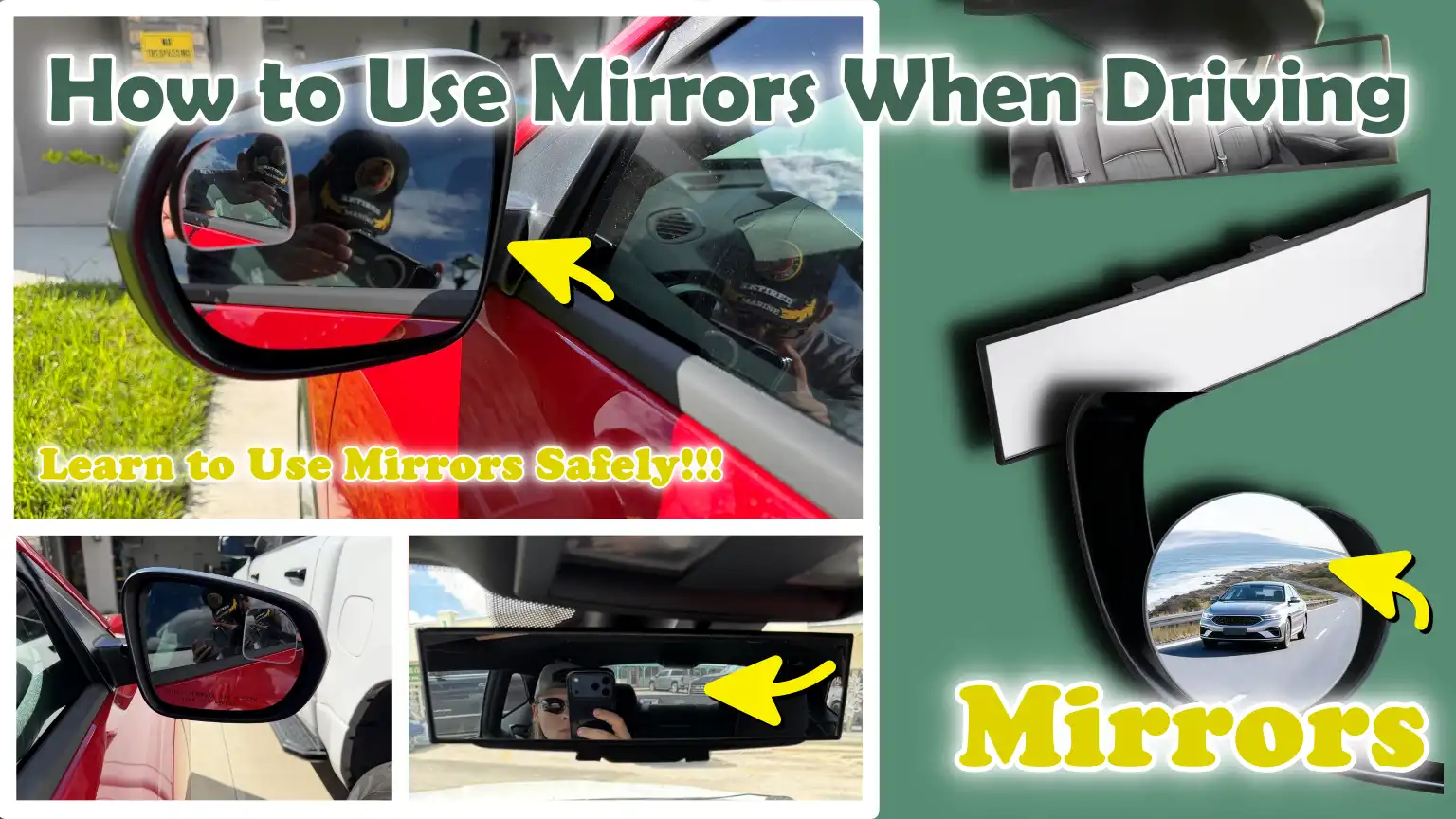
Now, in this guide you’ll learn How to Use Mirrors When Driving, so that you can protect yourself, your passengers and everyone else on the road.
Know, The Types of Mirrors in a Vehicle
Vehicle mirrors are among the most critical safety components, as they assist the driver in viewing areas that are not visible through the windshield.
A standard vehicle typically features three main types of mirrors: one interior rearview mirror and two exterior side mirrors.
Each of these mirrors is designed to provide a view of specific areas surrounding the vehicle.
Collectively, these mirrors work to provide the driver with a nearly complete view of the traffic behind and alongside the vehicle, although some small “blind spots” may still remain.
Understanding the specific function and importance of each mirror enables the driver to make better decisions, react more quickly and operate the vehicle more safely under all types of driving conditions.
1. Rearview Mirror – Interior Mirror
The rearview mirror is mounted inside the vehicle, positioned centrally and directly above the windshield.
Its primary purpose is to provide the driver with a clear and wide view of the road directly behind the vehicle.
The surface of this mirror is flat, meaning it depicts the distance of objects more accurately than the side mirrors do.
Therefore, it is invaluable for determining how closely another vehicle is approaching from behind you.
It allows you to keep an eye on rear traffic without having to turn your head.
This enables you to maintain your focus on the road ahead while simultaneously remaining aware of what is happening behind you.
This becomes particularly crucial when you are slowing down, coming to a stop, or driving in congested traffic, as it allows you to observe whether a vehicle is approaching too rapidly from the rear.
The rearview mirror is crucial when changing lanes or overtaking another vehicle; it helps you verify that the road behind you is completely clear before you take any action.
Many modern vehicles feature a ‘night mode’ or ‘auto-dimming’ function integrated into this mirror.
This feature reduces the glare from other vehicles’ headlights at night, thereby improving visibility and reducing eye strain.
2. Side Mirrors – Wing Mirrors
Side mirrors, also known as ‘wing mirrors’, are mounted on both sides of the vehicle.
They are designed to provide a view of areas that the rearview mirror cannot capture.
These mirrors are slightly convex in shape.
This means they offer a wider field of view, but objects appearing in them look smaller and more distant than they actually are.
Consequently, many side mirrors bear the warning: “Objects in mirror are closer than they appear.”
Side mirrors are essential for monitoring activity in the lanes adjacent to your vehicle and they are particularly critical when changing lanes, turning, or overtaking.
When adjusted correctly, they help minimize ‘blind spots’ (areas around the vehicle that are not directly visible) and provide you with better awareness of surrounding traffic.
However, due to their shape, drivers must learn to accurately judge distances; for maximum safety, the use of mirrors should always be supplemented by a quick glance over the shoulder to check the immediate surroundings.
Left-Side Mirror
The left-side mirror is located on the driver’s side of the vehicle and is one of the most frequently used mirrors while driving.
This helps the driver keep an eye on vehicles approaching from behind on the same side, as well as those traveling in the adjacent lane.
This mirror is crucial when changing lanes to the left, making turns, or merging into traffic, as it provides a clear view of surrounding vehicles that might not be visible in the rearview mirror.
It also assists the driver in maintaining correct lane positioning by allowing them to reference road markings and the side of their vehicle.
Regularly checking the left-side mirror ensures that you remain aware of vehicles approaching rapidly from behind, particularly on highways, where traffic moves at high speeds.
Right-Side Mirror
The right-side mirror is located on the passenger side of the vehicle and helps reveal areas that are often difficult for the driver to view directly.
This mirror proves invaluable when changing lanes to the right, overtaking slower-moving vehicles and parking, particularly in tight spaces.
Due to its positioning, it plays a crucial role in identifying vehicles, cyclists, or obstructions present on the passenger side.
It is also helpful when reversing the vehicle, as it enables the driver to see the curb, the roadside, or surrounding objects more clearly.
As this mirror provides a wide field of view, objects reflected in it may appear smaller than they actually are; therefore, drivers must exercise caution when judging distances and should always double-check before taking any action.
3. Blind Spot Mirrors – Optional
Blind spot mirrors are small, round, convex mirrors typically affixed to the corners of the side mirrors to provide an even broader view of the area surrounding the vehicle.
Their primary objective is to minimize “blind spots”, those areas that remain invisible in standard mirrors and frequently contribute to accidents, particularly during lane changes.
These mirrors assist drivers in identifying vehicles traveling in close proximity to their own, vehicles that might otherwise go unnoticed.
They are particularly beneficial for novice drivers who are still honing their ability to judge distances; furthermore, they prove highly useful when driving on highways, where traffic moves at high speeds and vehicles often travel in close formation.
Although blind spot mirrors significantly enhance visibility, they should be used merely as an additional aid, they should not be considered a substitute for properly adjusting mirrors or for the habit of performing “shoulder checks.”
Now, Let’s Understand About The Blind Spots
Blind spots are one of the most critical concepts related to safety that every driver must thoroughly understand, as they are a major contributing factor to many road accidents.
Although modern vehicles are equipped with multiple mirrors, there remain certain areas surrounding the vehicle that cannot be directly viewed through any of these mirrors.
These hidden areas may harbor other vehicles, motorcycles, cyclists, or even pedestrians.
If a driver is unaware of their presence, dangerous situations can arise, particularly when changing lanes or making a turn.
Understanding where blind spots are located and how to properly manage them can significantly enhance a driver’s situational awareness and overall safety on the road.
1. What Are Blind Spots?
Blind spots are those areas surrounding your vehicle that remain invisible to you through your rearview or side mirrors, regardless of how perfectly those mirrors have been adjusted.
These blind spots occur because mirrors have a limited field of view and cannot fully cover every direction.
Consequently, another vehicle could be in very close proximity to yours yet remain completely invisible in any of your mirrors.
Attempting to change lanes or make a turn without first confirming that these areas are clear can be extremely dangerous.
Blind spots are particularly hazardous because they create a false sense of security; a driver may assume that the road ahead or to the side is clear, when in reality, it is not.
Therefore, relying solely on your mirrors is insufficient.
Drivers must always remain vigilant and bear in mind that something may be hidden within these unseen areas.
2. Common Blind Spot Areas
The most common blind spots are located at the rear corners of the vehicle, precisely outside the field of vision of both the rearview mirror and the side mirrors.
These areas are typically situated slightly behind the driver, on either side.
When other vehicles are traveling in adjacent lanes, they often remain hidden within these specific zones.
Another significant blind spot exists in the adjacent lane, particularly when another vehicle is traveling parallel to yours and at the same speed.
In such instances, that vehicle may occasionally appear in your mirrors or vanish from sight, making it difficult to track.
Larger vehicles, such as trucks and buses, have even larger blind spots; however, smaller vehicles are not entirely immune to this issue either.
Understanding the locations of these common “blind spots” (unseen zones) helps drivers exercise greater caution and avoid making sudden maneuvers without first conducting a proper check.
3. How Mirrors Help Reduce Blind Spots
Mirrors play a crucial role in minimizing blind spots; however, they can only do so effectively if they are properly adjusted and utilized correctly.
Adjusting side mirrors to their optimal position, for instance, angling them slightly outward rather than having them show the immediate side of the car, as it can significantly reduce the size of blind spots and expand the field of vision.
This enables drivers to spot vehicles approaching from behind or from the side much sooner.
Nevertheless, even the most optimal mirror settings cannot completely eliminate blind spots; therefore, it remains essential to perform a quick “shoulder check” in conjunction with using the mirrors.
A “shoulder check” involves briefly turning your head to look over your shoulder, typically when changing lanes or making a turn, to ensure that no vehicle is hidden in your blind spot.
By regularly utilizing mirrors and performing these brief checks in conjunction with them, drivers can significantly reduce the risk of missing crucial information and make safer decisions on the road.
How to Properly Adjust Your Mirrors
Properly adjusting your mirrors is one of the simplest, yet most effective steps for enhancing driving safety; after all, even the best mirrors are of little use to you if they are set at the wrong angle.
Many drivers make the mistake of angling their mirrors too far inward, towards their own vehicle, thereby failing to properly view the section of the road they are actually capable of seeing.
Correctly adjusting your mirrors expands your field of vision, minimizes blind spots and provides you with more time to react to other vehicles.
When mirrors are properly adjusted, they work in tandem to provide a wider and clearer view of the traffic behind and alongside your vehicle, enabling you to drive with greater confidence and make safer decisions.
1. Adjusting the Rearview Mirror
The rearview mirror should be adjusted to provide a clear and complete view of the road directly behind your vehicle, as seen through the rear window.
To do this, you should sit in your normal driving position and continue adjusting the mirror until you can see the entire rear window without turning your head.
The objective is to maximize your view of the area directly behind you, while also ensuring that the image remains centered and steady.
This mirror is flat, which means it depicts distances more accurately than the side mirrors; Therefore, it is invaluable for gauging how closely another vehicle is approaching from behind you.
A properly adjusted rearview mirror helps you monitor traffic, react to vehicles approaching from the rear and make safer decisions when slowing down or changing lanes.
At night, if available, utilizing the mirror’s dimming feature can reduce headlight glare and make driving more comfortable.
2. Adjusting the Left-Side Mirror
The left-side mirror should be adjusted to cover the area immediately outside your vehicle, while minimizing the view of your own car within the mirror itself.
While seated normally in the driver’s seat, you should lean your head slightly toward the window and then adjust the mirror so that you can just barely see the edge of your vehicle.
This method provides a wider view of the adjacent lane, rather than wasting space by displaying your own car.
The mirror’s angle should be tilted slightly outward to allow you to spot vehicles approaching from behind that are entering your blind spot.
Proper adjustment of the left mirror is crucial for changing lanes, turning and merging into traffic, as it enables you to spot other vehicles quickly and react more safely.
3. Adjusting the Right-Side Mirror
The right-side mirror should be adjusted in a similar manner; however, as it is located at a slightly greater distance from the driver, the adjustment procedure differs slightly.
You can lean your head toward the center of the car and then adjust the mirror so that only a very small portion of your vehicle is visible.
This expands the field of vision and provides a better view of the area on the passenger side.
The objective here is to ensure that the field of view provided by the rearview mirror and the side mirrors does not overlap excessively, so that each mirror displays a distinct section of the road.
This expanded scope helps you identify vehicles, cyclists, or obstacles that may be positioned to your right, particularly when you are changing lanes, overtaking another vehicle, or parking.
As side mirrors are slightly convex, objects may appear smaller than they actually are; therefore, it is crucial to exercise caution when estimating distances.
4. The Optimal Method for Adjusting Mirrors
The primary goal of correctly adjusting mirrors is to minimize “blind spots”, those areas surrounding the vehicle that are not visible in the mirrors, as much as possible.
This is achieved by ensuring that all mirrors function in concert, rather than each mirror simply displaying the exact same view.
If the mirrors are adjusted correctly, any vehicle approaching from behind will first appear in the rearview mirror, then gradually transition into the side mirror and finally enter your peripheral vision directly without ever dropping out of sight.
This continuity of visibility confirms that your mirrors are set up correctly.
Before you begin driving, it is essential to verify your mirror angles by observing surrounding vehicles or objects and to make minor adjustments as needed.
No matter how carefully mirrors are adjusted, blind spots cannot be completely eliminated; therefore, in addition to utilizing your mirrors, it remains absolutely essential to periodically turn your head and look back over your shoulder.
When to Use Your Mirrors While Driving
Knowing when to use your mirrors is just as important as knowing how to adjust them, because safe driving depends on your constant awareness of what is happening around your vehicle at all times.
Mirrors are not meant to be glanced at only occasionally; they should be used regularly, as a habit, while driving.
Proper mirror usage provides you with advance information about other vehicles, enabling you to make smooth and safe decisions rather than taking sudden or risky maneuvers.
By learning the right times to check your mirrors, you can improve your reaction speed, reduce driving-related stress and avoid hazardous situations in both city traffic and on highways.
1. Before Starting the Vehicle
Even before you begin driving, it is essential to check all your mirrors to ensure they are correctly positioned and provide a clear field of view.
Sit in your normal driving position and quickly check your rearview mirror and both side mirrors to verify that you can see the road behind and to the sides of your vehicle without having to turn your head excessively.
This quick check helps you identify if a mirror has shifted or been knocked out of place, something that can easily happen if someone else has driven the vehicle recently.
Starting your journey with properly adjusted mirrors ensures that you have full visibility right from the start, thereby reducing the likelihood of overlooking critical details on the road.
2. While Driving on a Straight Road
While driving on a straight road, many drivers focus solely on what lies ahead; however, regularly checking your mirrors is equally important for maintaining awareness of surrounding traffic.
A good driving habit is to adopt a “scanning pattern,” in which you glance at your mirrors every few seconds without taking your eyes off the road for too long.
This helps you keep track of vehicles approaching from behind, vehicles traveling in adjacent lanes and any changes in traffic conditions.
Regularly checking your mirrors allows you to anticipate the actions of other drivers, giving you ample time to react calmly and safely rather than having to make sudden, split-second decisions.
3. Before Changing Lanes
Before changing lanes, it is crucial to use your mirrors correctly to avoid collisions.
The proper procedure involves first checking your mirrors to assess traffic conditions, then activating your turn signal to alert other drivers, followed by a quick glance over your shoulder to ensure no vehicle is hidden in your “blind spot” (areas not visible in the mirrors) and only then merging into the new lane.
This step-by-step approach ensures that you have complete awareness of everything around you and that other drivers understand your intentions.
Vehicles can remain hidden in blind spots even when the mirrors appear clear; therefore, an additional visual check is essential.
Adopting this routine every time you change lanes significantly reduces the risk of accidents.
4. While Turning or Negotiating Curves
When making turns or negotiating curves, side mirrors become particularly important, as they help you spot vehicles, cyclists, or pedestrians that may be in close proximity to your car.
Before making a turn specially at intersections, you should quickly check the corresponding side mirror to ensure that the path is clear.
This is particularly important in congested areas, where two-wheelers and pedestrians may pass very close to your vehicle and are not easily visible from the front.
Proper use of mirrors while turning prevents collisions with others and helps you navigate intersections and corners more easily and safely.
5. While Reversing
Mirrors are extremely useful when reversing a vehicle; however, for maximum safety, they should always be used in conjunction with direct observation.
The rearview mirror provides a view of the area directly behind you, while the side mirrors help you keep an eye on the sides of the vehicle and any nearby obstacles such as: walls, curbs, or other vehicles.
Nevertheless, mirrors cannot always provide a completely clear view of everything specially objects that are very close by; therefore, it is also essential to turn your head and look behind you whenever necessary.
By combining the use of mirrors with direct observation, you gain better control over the vehicle and significantly reduce the likelihood of colliding with anything while reversing.
6. While Overtaking
It is crucial to use your mirrors carefully while overtaking, as this maneuver requires you to move from one lane to another and then safely return to your original lane.
Before overtaking, you should check your rearview mirror to ensure that no vehicle is approaching rapidly from behind and then check your side mirrors to confirm that the adjacent lane is clear.
This helps you determine whether it is safe to pull out and pass the other vehicle.
While overtaking, it is also essential to maintain a safe distance and continuously monitor your mirrors to remain aware of the surrounding traffic.
The proper use of mirrors during overtaking helps prevent hazardous situations and ensures that the maneuver is completed smoothly and safely.
Know, The Techniques for Using Mirrors for Safe Driving
The proper use of mirrors is not limited merely to casting an occasional glance at them; rather, it involves cultivating a consistent habit that keeps you aware of everything happening around your vehicle.
Skilled drivers integrate the use of mirrors into their routine as a natural and regular practice, thereby ensuring that they are never caught off guard by the sudden movements of other vehicles.
By adopting a few simple mirror-usage techniques, you can improve your reaction time, make better decisions and significantly reduce the likelihood of a collision.
These techniques are easy to learn and, with practice, evolve into instinctive habits that greatly enhance overall driving safety and confidence.
1. The Mirror-Scan Routine
The mirror-scan routine is a simple yet highly effective habit that involves regularly checking your mirrors, typically every 5 to 8 seconds, while driving.
This does not imply staring at the mirrors for extended periods; instead, it entails casting quick, brief glances at them to remain aware of the traffic moving behind and alongside you.
By doing so, your brain continuously updates its information regarding surrounding vehicles, their speeds and their relative positions.
This helps you identify whether a vehicle is approaching rapidly, changing lanes, or closing in too closely.
Maintaining this level of situational awareness enables you to react at the precise moment, rather than resorting to sudden or risky maneuvers.
Over time, this routine becomes second nature to you, helping you feel a greater sense of control over your driving environment.
2. Simultaneous Use of Mirrors and Signals
Using mirrors in conjunction with turn signals is a fundamental technique for safe and smooth driving.
Before executing any maneuver such as: changing lanes or making a turn, you must first assess the surrounding traffic conditions by checking your mirrors.
Subsequently, you use your turn signals to inform other drivers of your intentions, thereby giving them ample time to react.
This coordination between checking mirrors and signaling fosters clear communication on the road and minimizes misunderstandings among drivers.
It also prevents sudden maneuvers, which are among the leading causes of accidents.
When you adhere to this proper sequence, your actions become more predictable and safer for everyone around you.
3. Head-Turning Technique/Shoulder Check in Conjunction with Mirrors
Although mirrors reveal a significant portion of the road, they do not capture everything; for this reason, they are insufficient on their own.
There are always small “blind spots”, areas invisible to the driver, where other vehicles or objects may remain hidden, particularly along the sides of your car.
Therefore, alongside the use of mirrors, it is crucial to cultivate the habit of turning your head to take a quick look, a technique also known as a “shoulder check.”
A shoulder check involves briefly turning your head to look backward over your shoulder while changing lanes or performing a specific maneuver.
This simple practice helps ensure that no other vehicle is lurking in your blind spots.
By utilizing both your mirrors and the technique of turning your head to look, in combination, you can gain a far better view of your surroundings and significantly reduce the risk of overlooking something important.
How to Use Mirror in Different Driving Conditions
The application of mirrors is not uniform across all situations, as factors such as road conditions, lighting, weather and traffic density can all impact your visibility and the speed at which you must react.
A driver who knows how to adapt their mirror usage to suit different conditions can remain safer and more confident on the road.
Visibility may be compromised during periods of darkness, rain, fog, or heavy traffic, making it imperative to use mirrors with even greater caution and precision.
By adjusting your mirror usage to suit your specific driving situation, you can enhance your situational awareness, anticipate sudden hazards and make safe driving decisions in any environment.
1. Night Driving
Driving at night reduces visibility and makes the proper use of mirrors more challenging, as the intense glare from the headlights of vehicles traveling behind you reflects into your mirrors.
In particular, the rearview mirror often directs this bright light directly into your eyes, which can make it even more difficult to see clearly.
To address this issue, most cars are equipped with a ‘night mode’ or ‘dimming feature’ on the rearview mirror, which reduces the intensity of this glare and softens the light.
Utilizing this feature protects your eyes and allows you to clearly observe the traffic approaching from behind.
It is essential to check your mirrors with even greater diligence at night, as accurately judging the speed and distance of other vehicles is difficult in low-light conditions.
Keeping your mirrors clean and properly adjusted significantly improves your visibility, making night driving much safer.
2. Driving in Heavy Traffic
In heavy traffic, vehicles travel in close proximity to one another and conditions can change very rapidly; therefore, constantly monitoring your mirrors becomes absolutely essential.
You should check your mirrors frequently to stay aware of how surrounding vehicles are moving, particularly those traveling behind or alongside you.
Doing so allows you to anticipate sudden braking, lane changes, or vehicles attempting to merge into your lane.
By keeping a keen eye on surrounding traffic, you can maintain a safe distance and avoid making sudden, abrupt reactions.
Proper mirror usage in heavy traffic helps you remain calm and prepared, thereby reducing the likelihood of collisions caused by sudden maneuvers.
3. Driving on Highways
When driving on a highway, vehicle speeds are considerably higher; this means that vehicles approach and pass one another very quickly, far more rapidly than on city streets.
Consequently, the use of mirrors becomes even more critical, as you have very little time to react.
Regularly checking your mirrors keeps you informed about vehicles approaching rapidly from behind or those traveling in adjacent lanes.
It also aids in maintaining safe lane discipline, ensuring that you remain within your designated lane and change lanes only when it is safe to do so.
Proper mirror usage ensures that you do not obstruct the path of fast-moving vehicles and allows you to overtake safely when necessary.
On the highway, the habit of checking your mirrors correctly helps you make decisions easily and in a timely manner, a practice that is crucial for safety when driving at high speeds.
4. Driving in Rain or Fog
Rain and fog can significantly reduce visibility, causing mirrors to appear less clear and, at times, making it difficult to use them effectively.
Water droplets, dust, or condensation on the mirror surfaces can obstruct your line of sight and obscure critical details.
Therefore, keeping your mirrors clean is essential; whenever possible, utilize features such as “heated mirrors,” or, when it is safe to do so, wipe them clean yourself.
In such conditions, you should also adjust your driving technique: reduce your vehicle’s speed and check your mirrors more attentively and frequently.
Specific techniques designed to enhance visibility such as: focusing on shapes, lights and movement rather than solely on individual objects, as it can help you better perceive your surroundings.
During rain or fog, the proper use of mirrors ensures that you remain aware of nearby vehicles, thereby minimizing the risk of accidents caused by reduced visibility.
Know, The Common Mistakes to Avoid When Using Mirrors
Many drivers assume that merely having mirrors is sufficient; however, the reality is that poor mirror usage habits are a major contributing factor to road accidents.
Mirrors are effective only when used at the right time, in the correct manner and with full diligence.
Even a minor error in mirror usage can compromise your situational awareness and heighten the risk of a collision, particularly in heavy traffic or while driving at high speeds.
By understanding and avoiding common mistakes related to mirror usage, you can enhance your driving awareness, react more swiftly to potential hazards and make safer decisions on the road.
1. Failing to Check Mirrors Frequently
One of the most common mistakes drivers make is failing to check their mirrors frequently while driving.
When mirrors are neglected for extended periods, the driver remains unaware of what is transpiring behind and alongside their vehicle.
This lack of information can lead to hazardous situations such as: failing to notice a rapidly approaching vehicle or overlooking a car preparing to overtake.
Checking your mirrors regularly is crucial, as traffic conditions change rapidly; staying updated on your immediate surroundings enables you to react calmly and safely.
When mirrors are not utilized frequently, drivers may be forced to make sudden, last-minute decisions, thereby increasing the risk of accidents.
2. Improper Mirror Adjustment
Improperly adjusted mirrors can create large “blind spots” and reduce the visible area of the road.
Many drivers adjust their mirrors in such a way that they primarily reflect their own vehicle, thereby limiting their view of surrounding traffic.
This error diminishes the effectiveness of the mirrors and can hide vehicles traveling in close proximity to your car.
Therefore, proper mirror adjustment is crucial, as it expands your field of vision and enables you to identify other vehicles more quickly.
When mirrors are correctly positioned, they work in tandem to provide a wider and clearer view, allowing you to make safer driving decisions.
3. Relying Solely on Mirrors
Another serious error is relying exclusively on mirrors and failing to “check over your shoulder”, that is, neglecting to turn your head to look behind you.
Although mirrors offer a wide field of view, they cannot capture everything; small “blind spots” inevitably remain where other vehicles may be hidden.
Failing to check over your shoulder means you could overlook a vehicle traveling very close to your car, particularly when changing lanes.
Combining the use of mirrors with a brief turn of the head provides you with a more comprehensive awareness of your immediate surroundings.
Drivers who rely solely on their mirrors may feel confident, but this false sense of security can lead to dangerous mistakes.
4. Staring at Mirrors for Too Long
While checking your mirrors is essential, staring at them for an extended period can be dangerous.
When a driver spends too much time focusing on their mirrors, their attention is diverted from the road ahead, where most immediate hazards typically appear.
Balance is essential for safe driving: mirrors should be checked quickly and briefly, allowing you to gather necessary information without shifting your focus away from the road ahead.
Staring at mirrors for extended periods can delay your reaction to sudden events such as: a vehicle braking in front of you or a pedestrian crossing the road.
Glancing at mirrors briefly and in a controlled manner helps you maintain your full attention on the act of driving.
5. Neglecting Side Mirrors While Turning
Failing to check your side mirrors while turning is a common mistake that can pose a serious risk to cyclists, motorcyclists and pedestrians.
When you make a turn, particularly in congested areas, there may be people or vehicles moving alongside your car that are not visible through the front windshield.
Side mirrors help you identify these nearby individuals or vehicles on the road, ensuring that your path is clear before you execute the turn.
Neglecting to check them can lead to accidents, specially in urban environments where two-wheelers and pedestrians are prevalent.
The proper use of side mirrors while turning safeguards other road users and contributes to a smoother, safer flow of traffic.
Read More:
- How to Use ABS Brakes Properly
- How to Brake Safely on Steep Roads
- How to Drive Uphill Safely
- How to Drive Safely in Strong Winds
- How to Prevent Aquaplaning
- How to Drive Safely on Ice
- How to Drive Safely in Fog
Know, The Tips for Improving Mirror Usage Skills
Improving mirror usage is not something that happens overnight; it is a skill that develops over time through practice, awareness and the adoption of the right habits.
Many drivers understand how mirrors work, yet they fail to use them consistently or effectively, thereby diminishing their ability to remain aware of the traffic surrounding them.
The good news is that enhancing your mirror skills is entirely possible, provided you follow a few practical steps and practice them regularly.
By building strong habits, mastering the correct techniques and maintaining composure while driving, you can significantly boost your situational awareness, reaction time and overall safety on the road.
As well as, there’s study that clearly proves that poor observation is actually leading cause of accidents and that’s why using mirrors properly can significantly reduce that kind of risks as it helps drivers to stay aware of surrounding traffic before making decisions as well.[¹]
1. Practice Checking Your Mirrors Regularly
The most effective way to improve your mirror usage is to practice checking them regularly until it becomes a natural, instinctive habit.
This involves glancing at your mirrors frequently while driving, rather than only when you need to take a specific action.
By repeating this action every few seconds, your brain automatically begins to track what is happening behind and alongside your vehicle.
Over time, this habit enables you to identify changes in traffic conditions much more rapidly such as: vehicles approaching quickly or vehicles merging into adjacent lanes.
With consistent practice, using your mirrors becomes second nature, significantly enhancing your ability to make safe, timely decisions without panic.
2. Take Driving Lessons or Seek Professional Training
Taking proper driving lessons or undergoing professional training can make a profound difference in how effectively you utilize your mirrors.
Trained instructors can teach you the correct techniques for adjusting mirrors, checking them at the appropriate moments, signaling and integrating these actions with other safety procedures such as: the “shoulder check.”
Many drivers develop bad habits over time and professional guidance helps in correcting these errors.
Learning from experts also boosts confidence and ensures that you adhere to safe driving practices grounded in real-world experience and established safety standards.
3. Utilize Advanced Mirror Features
Modern vehicles are often equipped with advanced mirror features that, when used correctly, make driving safer and easier.
Auto-dimming mirrors reduce headlight glare at night, allowing you to see clearly without straining your eyes.
Wide-angle mirrors provide a broader field of view, enabling you to see a larger area surrounding your vehicle and thereby minimizing blind spots.
Some cars also feature blind spot warning systems, which alert you when another vehicle is situated in a hidden zone.
While these features are highly beneficial, they should always be utilized as supplementary aids, rather than as substitutes for the fundamental habits of properly checking and paying close attention to your mirrors.
4. Stay Calm and Focused
Remaining calm and focused while driving is essential for the proper use of mirrors.
Panic or stress can cause drivers to make sudden maneuvers without adequately checking their mirrors, thereby increasing the risk of an accident.
When you remain calm, you are more likely to follow the correct sequence of checking your mirrors, signaling and making sound decisions.
Driving with full concentration also helps you interpret the information received from your mirrors quickly and accurately, enabling you to react in a controlled and measured manner.
By maintaining a calm and alert mindset, you can utilize your mirrors more effectively and handle various driving situations with confidence and safety.
The Importance of Mirrors in Road Safety
Vehicle mirrors are among the most critical safety tools in any automobile, as they assist drivers in maintaining awareness of everything occurring in their immediate surroundings, not merely what lies ahead.
Safe driving relies heavily on visual perception and situational awareness; mirrors make it possible to monitor traffic moving behind and alongside the vehicle without the need to constantly turn one’s head.
According to road safety guidelines issued by organizations such as the National Highway Traffic Safety Administration and the World Health Organization, inadequate visibility is one of the leading causes of road accidents worldwide.
Mirrors help mitigate this issue by providing drivers with continuous updates regarding nearby vehicles, other road users and changing traffic conditions.
When utilized correctly and consistently, mirrors improve reaction times, minimize the need for sudden maneuvers and make the act of driving smoother and more controlled.
They also aid in better estimating distances and speeds, a crucial factor in situations involving lane changes, turns, overtaking and reversing.
Recognizing the significance of mirrors encourages drivers to utilize them more effectively and to cultivate safe driving habits over time.
1. Prevention of Collisions and Accidents
Mirrors play a direct role in preventing collisions by enabling drivers to identify potential hazards before they escalate into serious incidents.
By regularly checking their mirrors, a driver can detect rapidly approaching vehicles, cars merging into adjacent lanes, or traffic slowing down behind them.
This early warning provides ample time to react safely, thereby avoiding the need for sudden or risky maneuvers.
Many accidents, particularly those occurring while changing lanes or overtaking, happen because drivers neglect to check their mirrors properly or overlook crucial information.
The correct use of mirrors helps drivers avoid such situations by keeping them informed about surrounding traffic at all times.
2. Enhancing Driver Awareness
Driver awareness entails understanding what is happening in every direction around the vehicle and mirrors are indispensable for cultivating this awareness.
While the forward view reveals what lies ahead, mirrors complete the full picture by showing what is occurring behind and on both sides.
This comprehensive information empowers drivers to make better decisions such as: when to slow down, change lanes, or maintain a safe distance from other vehicles.
When drivers use their mirrors regularly, they are less likely to be caught off guard by the sudden maneuvers of other road users.
This boosts confidence and makes the driving experience smoother and more controlled.
3. Aiding Defensive Driving Techniques
Defensive driving is an approach to driving in which the driver remains constantly alert, anticipates potential hazards in advance and takes proactive measures to avoid those dangers before they materialize.
Mirrors play a vital role in safe driving, as they assist drivers in anticipating the movements of other vehicles.
For instance, if a vehicle is observed approaching rapidly from behind, the driver may decide to postpone a lane change or reduce their speed to avoid a collision.
Mirrors also play a crucial role in maintaining a safe distance and planning one’s next move in advance.
When mirrors are used in conjunction with other safe driving habits such as: signaling and performing a “shoulder check”, they foster a proactive approach to driving; this significantly reduces the risk of accidents and makes the roads safer for everyone.
Conclusion – How to Use Mirrors When Driving
Now, you have clearly understood why safe driving is not just about the moving forward, but it is about the understanding everything happening around you and that’s where mirrors make that awareness actually possible in easy way.
While driving, mirrors provide continuous updates on what is happening behind and alongside your vehicle, enabling you to make better and safer decisions.
When utilized correctly, they help you anticipate potential hazards in advance, avoid sudden changes in traffic conditions and remain fully aware of your immediate surroundings.
Many accidents occur due to a driver’s inability to see clearly; however, this risk can be significantly mitigated by cultivating the firm habit of regularly checking and correctly utilizing one’s mirrors.
It is also crucial to remember that mirrors are most effective when employed in conjunction with proper techniques such as: correct adjustment, frequent visual checks, signaling and performing shoulder checks.
Driving conditions may vary, but the need to remain aware of one’s surroundings remains constant and mirrors play a pivotal role in maintaining this awareness.
By consistently practicing these skills, any driver can boost their confidence, maintain better control over their vehicle and enhance their overall safety.
Now, that’s all about this guide from How to Use Mirrors When Driving, also you can comment for more info.
Frequently Asked Questions
Q1: How should you properly use your mirrors while driving?
Answer: The proper way to use your mirrors while driving is to check them regularly and make it a habit, rather than checking them only when you need to make a turn or change lanes. You should glance at your rearview and side mirrors every few seconds so that you remain aware of what is happening behind and alongside your vehicle. Before changing lanes, turning, or overtaking another vehicle, you should first check your mirrors, then signal and simultaneously perform a quick “shoulder check” to ensure that no other vehicle is present in your “blind spots.” While using your mirrors, your primary focus should remain on the road ahead, enabling you to make sound and safe decisions at all times.
Q2: How often should you check your mirrors while driving?
Answer: While driving, you should check your mirrors every 5 to 8 seconds; however, these glances should be quick and brief so that your primary focus remains on the road ahead. This regular checking helps you keep track of surrounding vehicles, their speeds and their positions. By doing so, you can anticipate changes in traffic conditions in advance such as: a vehicle approaching rapidly from behind or merging into your lane. This habit enhances your “situational awareness” and provides you with more time to react safely, thereby avoiding the need for sudden and abrupt maneuvers.
Q3: Why are mirrors essential for safe driving?
Answer: Mirrors are essential because they enable you to see those areas surrounding your vehicle that you cannot view directly, specifically, the areas behind and on both sides of the vehicle. Without mirrors, you wouldn’t even realize if another vehicle is driving too close to you or approaching rapidly. Mirrors help prevent accidents by providing you with advance information about traffic conditions, enabling you to make safer decisions. They also enhance your situational awareness and facilitate “defensive driving”, which means remaining constantly alert and prepared for potential hazards on the road.
Q4: What are “blind spots,” and how can you check for them?
Answer: “Blind spots” are areas surrounding your vehicle that are not visible in your mirrors, even if you have adjusted your mirrors correctly. These areas are typically located along the rear sides of your vehicle. To check for blind spots, you must perform a “shoulder check”; this means that before changing lanes or making a specific turn, you should briefly turn your head to look over your shoulder. This helps ensure that no other vehicle is hidden in those areas. Mirrors help minimize blind spots, but they cannot eliminate them entirely, which is why performing a “shoulder check” is always essential.
Q5: How should side mirrors be adjusted correctly?
Answer: Side mirrors should be adjusted in such a way that they show more of the road and less of your own vehicle. You should angle them slightly outward to maximize your field of vision. When seated in your normal driving position, you should see only a very small portion of your own vehicle in the mirrors. This helps reduce blind spots and provides you with a wider view of the surrounding lanes. Proper adjustment ensures that vehicles approaching from behind remain clearly visible in your mirrors and do not suddenly disappear from view.
Q6: Can mirrors completely eliminate blind spots?
Answer: No, mirrors cannot completely eliminate blind spots because their field of view is limited. Even when mirrors are adjusted correctly, there always remain small areas that remain invisible. Therefore, in addition to using your mirrors, performing a “shoulder check” (looking over your shoulder) is also crucial. By utilizing both methods together, you can view almost the entire area surrounding your vehicle and minimize the risk of overlooking something important.
Q7: What is the “Mirror-Signal-Maneuver” technique?
Answer: The “Mirror-Signal-Maneuver” technique is a safe driving practice used before performing any action such as: changing lanes or making a turn. First, you check your mirrors to assess the surrounding traffic conditions. Next, you use your turn signals to communicate your intentions to other drivers. Then, you quickly perform a “shoulder check” to ensure that no vehicle is present in your blind spots; and finally, you smoothly execute your maneuver. This systematic approach helps prevent accidents and ensures that other road users clearly understand your actions.
References:
[1] National Highway Traffic Safety Administration (NHTSA), National Motor Vehicle Crash Causation Survey
https://crashstats.nhtsa.dot.gov/Api/Public/ViewPublication/811059

Guys, I’m a car audio enthusiast and customization expert and I love clear sound and clean installation. Plus, I have spent years helping people build their dream audio setups. And whenever I’m working on cars, I probably listen to music and thinks about the next big upgrade.