
Written By: Don Dodi
Fact Checked By: Kristen Brown
Reviewed By: Diego Rosenberg
Busy streets actually demands smarter parking decisions, not just speed.
This is really common thing to park on the busy streets, but the risk is never the less, specially in the urban areas where traffic, pedestrians and limited space all come together at the same time.
And, on the crowded streets: even a small mistake such as: turning the wheel too early, stopping suddenly or missing a cyclists in your mirror; can lead to the accidents, traffic disruption or costly repairs as well.
Also, you need to understand the thing is: safe parking is not all about just fitting your car into that damn space, as it requires proper awareness, patience, proper signalling and control of your vehicle at the low speeds.
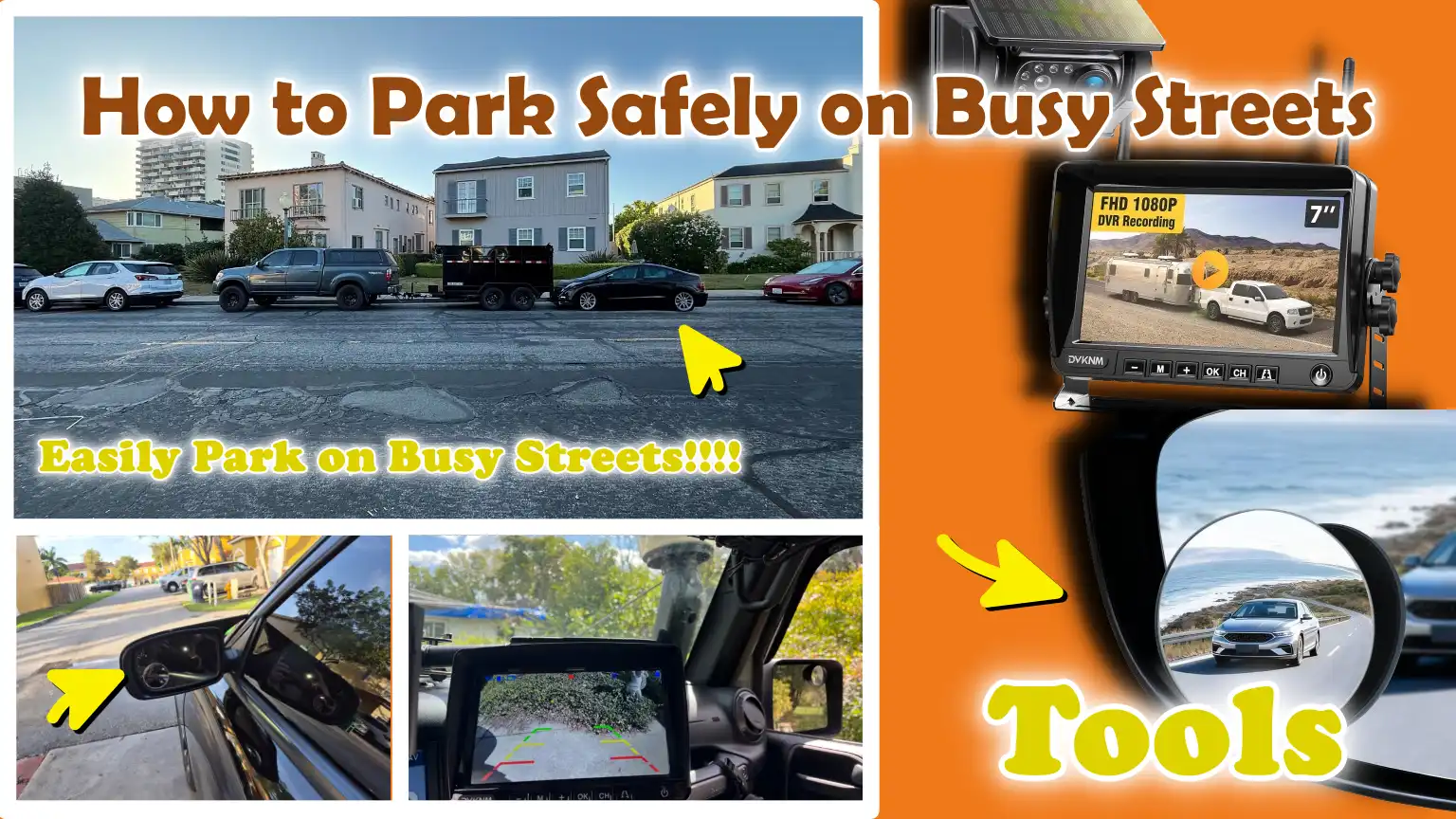
Now, with this guide you’ll learn How to Park Safely on Busy Streets so that you can improve the safety by applying proven techniques and avoiding common mistakes.
Let’s Understand About the Risks of Parking on Busy Roads
Parking on busy roads involves more than just finding an empty spot; it entails navigating a confluence of risks simultaneously.
In high-traffic areas, drivers must contend with moving vehicles, pedestrians, limited space and fluctuating visibility, all at the same time.
Research by the National Highway Traffic Safety Administration indicates that the majority of low-speed collisions occur during parking and maneuvering, particularly in congested urban environments.
Mistakes frequently arise in such situations because drivers are in a hurry, distracted, or lack a precise awareness of their immediate surroundings.
A thorough understanding of these risks empowers drivers to remain vigilant, make sound decisions and avoid unnecessary accidents, damage, or stress.
1. High Traffic Flow
On busy roads, the flow of vehicles is continuous, creating pressure on drivers to act quickly while parking.
This constant stream of traffic reduces the time available to accurately judge distances, speeds and spatial clearances.
Drivers following behind may become impatient, thereby heightening stress levels and prompting hasty decisions, one of the primary causes of parking errors.
When traffic is heavy, even a slight delay or a sudden maneuver can disrupt the traffic flow and create hazardous situations, such as rear-end collisions or sudden braking incidents.
Remaining calm, decelerating gradually and planning one’s parking strategy in advance are all essential elements for driving safely in high-traffic environments.
2. Pedestrian Activity
Busy roads are often characterized by a high volume of pedestrian traffic; pedestrians may suddenly cross the street or walk in close proximity to parked vehicles, making the act of parking even more challenging and hazardous.
Pedestrians may suddenly emerge from behind parked cars, through gaps between vehicles, or from the vicinity of sidewalks, creating “blind spots”, areas that do not immediately catch a driver’s attention.
This places an even greater responsibility on the driver to remain fully alert and to carefully check all mirrors and their surroundings before maneuvering the vehicle.
According to safety data from the Centers for Disease Control and Prevention (CDC), pedestrian-related incidents are a major concern in urban traffic environments, particularly at low speeds, where drivers may not feel the need to be quite as vigilant.
Maintaining full concentration and driving at lower speeds helps prevent accidents and ensures the safety of everyone in the vicinity.
3. Limited Parking Space
One of the primary challenges faced on busy streets is the scarcity of available space, which often compels drivers to park their vehicles in tight spots between other cars.
These narrow spaces increase the likelihood of minor collisions such as: scratches, dents, or bumper damage, specially when a driver misjudges distances or angles.
Limited space also makes vehicle maneuvering more difficult, requiring greater control over both steering and speed.
Many parking-related damages occur because drivers attempt to squeeze their vehicles into spaces that are too small, or because they try to park too quickly.
Taking a moment to properly assess whether a space is suitable for parking and then parking slowly and with control, can significantly reduce the risk of damage.
4. Visibility Challenges
On busy streets, visibility is often impaired by parked vehicles, poor lighting conditions, or adverse weather such as rain or fog.
Large vehicles such as: vans or trucks, as it can obstruct a driver’s line of sight, making it difficult to spot oncoming traffic, cyclists, or pedestrians.
At night or in dimly lit areas, judging distance and movement becomes even more challenging, thereby increasing the risk of errors while parking.
Weather conditions can also affect visibility through the windshield as well as the vehicle’s traction, making it even harder to maintain precise control over the vehicle.
Consequently, drivers must rely more heavily on their mirrors, lights and keen observation skills and are compelled to drive at reduced speeds to ensure they can safely react to any sudden or unexpected situations.
How to Prepare Before Parking
Preparing before parking is one of the most crucial steps for staying safe on busy roads; yet, many drivers overlook it and make hasty parking decisions.
Proper preparation provides you with more time to think clearly, reduces stress and helps you avoid sudden or risky maneuvers that could lead to accidents.
Safety guidelines from the National Highway Traffic Safety Administration emphasize that careful planning and maintaining awareness of your surroundings before executing any maneuver significantly reduce the likelihood of low-speed collisions.
When drivers take a few extra seconds to check traffic, signal correctly and control their speed, they create a safer environment, not only for themselves but also for other drivers and pedestrians.
Preparing in advance also simplifies the parking process, ensures that the vehicle is parked correctly and minimizes disruptions to the flow of traffic.
1. Scan Your Surroundings in Advance
Scanning your surroundings in advance means identifying a parking space before you actually reach it, rather than making a sudden, last-minute decision.
This habit gives you ample time to determine whether a specific spot is suitable for your vehicle and provides the opportunity to plan how to park safely.
When drivers wait too long, and then suddenly slow down or stop the moment they spot a space, it can cause confusion among other drivers and increase the risk of rear-end collisions.
Scanning the area ahead also helps you identify critical surrounding factors, such as nearby pedestrians, cyclists, road signs, or any obstructions that could impact your parking maneuver.
By remaining alert and planning ahead, you reduce pressure and make safer, more controlled decisions.
2. Use Turn Signals Correctly
On busy roads, using turn signals correctly is a simple yet effective way to communicate your intentions to other drivers.
Signaling in advance gives vehicles following you ample time to slow down, change lanes, or adjust their speed without panic.
When signals are not used, or are used too late, it creates confusion, often leading to sudden braking or risky overtaking maneuvers.
Giving clear signals also helps pedestrians and cyclists anticipate your next move, thereby creating a safer environment for everyone.
The consistent and timely use of turn signals is one of the easiest ways to prevent misunderstandings and minimize accidents while parking.
3. Decelerate Gradually
Decelerating gradually while preparing to park is crucial, as it allows you to maintain control over your vehicle and react to changing conditions.
Sudden braking can startle drivers following you and increase the risk of a collision, specially in heavy traffic.
Slowing down gradually and smoothly gives you more time to scan your surroundings, judge distances and position your vehicle accurately.
It also helps maintain a consistent flow of traffic, which is vital on busy roads where sudden interruptions can lead to traffic jams or accidents.
Maintaining control over your vehicle’s speed is a fundamental requirement for safe and proper parking.
4. Maintain a Safe Distance
Maintaining a safe distance from the vehicle ahead is essential, as it provides you with sufficient space to maneuver into a parking spot without feeling rushed or causing an obstruction.
When you drive too closely, you are unable to maneuver your vehicle properly and may be forced to make sudden or sharp turns, which is an unsafe practice.
Maintaining a proper distance also provides a clearer view of the road and surrounding conditions, enabling you to make more informed decisions.
This extra space acts as a safety buffer, making parking easier and reducing the risk of colliding with other vehicles or disrupting the flow of traffic.
How to Choose the Right Parking Spot
Selecting the right parking spot is a crucial step that directly impacts your safety, the condition of your vehicle and the flow of surrounding traffic.
Many parking-related issues do not arise during the act of parking itself, but rather stem from a driver choosing an inappropriate or unsafe location.
An ideal parking spot should offer ample space for maneuvering, provide clear visibility of the surroundings and be situated in a safe area that does not obstruct traffic or pedestrians.
According to guidelines from the National Highway Traffic Safety Administration (NHTSA), making a deliberate decision before parking can significantly reduce the incidence of low-speed collisions and minor vehicle damage.
Spending a few seconds to assess the available space, location and road conditions can help you avoid stress, fines and accidents, thereby making the entire parking process much smoother and safer.
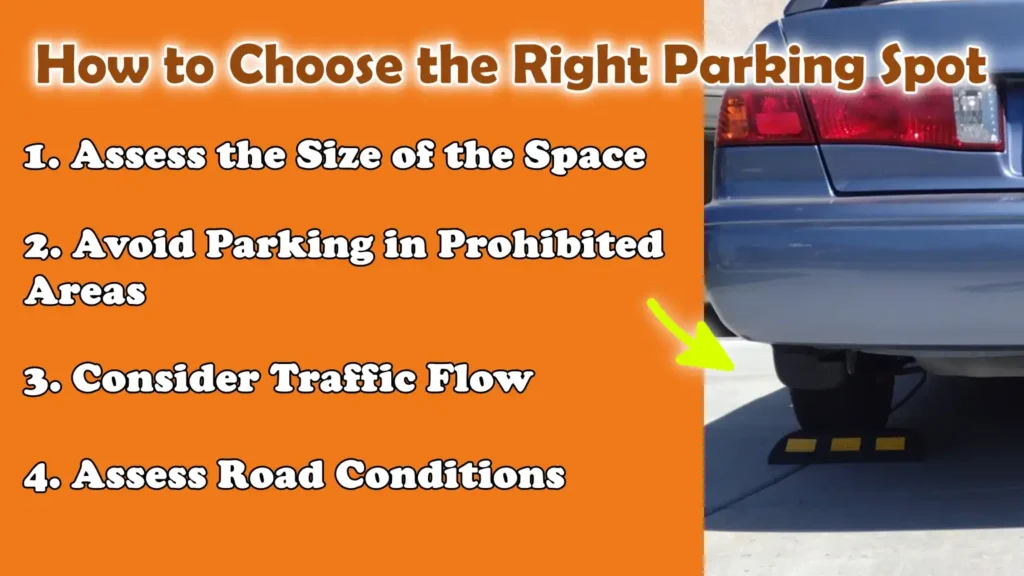
1. Assess the Size of the Space
Accurately assessing the dimensions of a parking space is essential, as it determines whether you can park safely without damaging your own vehicle or those belonging to others.
The space must be sufficiently long and wide to allow your vehicle to enter with ease, settle into the correct position and exit without difficulty.
If a spot appears too small, attempting to force your vehicle into it increases the risk of colliding with adjacent vehicles or the curb.
When drivers fail to accurately gauge the amount of space required, their vehicles often sustain minor scratches and dents.
Rather than struggling to squeeze into a tight spot, it is always preferable to choose a slightly larger space, one that allows for easy maneuvering.
Accurately assessing the available space enhances your control and minimizes the risk of errors.
2. Avoid Parking in Prohibited Areas
Avoiding parking in prohibited areas is essential not only for safety reasons but also for complying with traffic regulations and avoiding fines.
Parking near fire hydrants, bus stops, intersections, or areas clearly designated as ‘No-Parking Zones’ can obstruct emergency services, disrupt public transportation, or create hazardous conditions for other road users.
Parking is prohibited in these locations because they are critical for maintaining the flow of traffic and ensuring safety.
Parking in such areas may result in fines, vehicle towing, or, if visibility is obstructed or the roadway is blocked, even lead to accidents.
Before selecting a parking spot, always check road signs, pavement markings and local regulations to ensure that you are parking legally and responsibly.
3. Consider Traffic Flow
Considering traffic flow means choosing a parking spot that does not obstruct the normal movement of vehicles on the road.
Parking near sharp turns, narrow lanes, or high-traffic areas can make the act of parking itself more difficult and increase the risk of accidents.
When traffic is moving rapidly or unpredictably, accurately judging time and space becomes challenging.
Parking your vehicle in a quieter, less congested section of the road allows you to park without pressure, thereby reducing the likelihood of obstructing or slowing down other drivers.
Choosing the right location contributes to both your own safety and the smooth flow of traffic on the road.
4. Assess Road Conditions
Assessing road conditions is a step that is often overlooked, yet it plays a crucial role in ensuring safe parking.
If the road surface is uneven, sloped, or deteriorated due to potholes, it can impact both your vehicle’s handling while driving and its stability after parking.
On a slope, if the vehicle is not properly secured, there is a risk of it rolling away; conversely, on uneven ground, judging distances and vehicle alignment can be difficult.
Poor road conditions can also compromise tire traction, particularly in wet or slippery weather.
Whenever possible, by choosing a stable and level surface, you can maintain better control over your vehicle while parking and ensure that it remains secure even after you have left.
How to Park Safely on Busy Streets – Easy Parallel Parking Guide
Parallel parking is one of the most essential driving skills, particularly on busy streets where space is limited and traffic flows continuously.
It requires careful vehicle control, accurate spatial judgment and a keen awareness of one’s surroundings.
Many minor accidents occur during parallel parking because drivers rush or misjudge distances; therefore, adopting a clear, step-by-step approach is crucial.
Guidelines from the National Highway Traffic Safety Administration suggest that driving slowly and with control, combined with the proper use of mirrors, as it can significantly reduce parking errors.
When executed correctly, parallel parking allows you to safely stow your vehicle without disrupting traffic flow or causing damage to your car.
By understanding each step and practicing patiently, drivers can enhance their precision, reduce stress and confidently park in tight spaces, even in congested urban environments.
1. Align Your Vehicle Correctly
The first step in parallel parking is to align your vehicle precisely alongside the car parked immediately in front of the empty space where you intend to park.
Your vehicle should be positioned parallel to that car, maintaining a small, safe distance between the two.
Proper alignment is critical because it establishes the correct angle for reversing into the parking spot.
If your vehicle is positioned too far away or is not aligned straight, the entire parking process becomes significantly more difficult, increasing the risk of colliding with the curb or adjacent vehicles.
By taking a moment at the very beginning to position your vehicle correctly, the subsequent steps become much smoother and easier to control.
2. Reverse Slowly
When parking, reversing slowly is crucial for maintaining control over your vehicle and remaining aware of your surroundings.
As you begin to reverse, you must turn the steering wheel in the appropriate direction to guide your vehicle correctly into the parking space.
Moving slowly provides you with ample time to check your mirrors, monitor the position of nearby vehicles and correct your angle if necessary.
Utilizing your mirrors and rearview camera (if available) helps you see blind spots, areas that are not directly visible.
Reversing too quickly diminishes your ability to correct errors and increases the risk of colliding with another vehicle or the curb.
Maintaining control and reversing at a steady pace is the key to safe and precise parking.
3. Adjust Your Position
Once your vehicle is mostly inside the parking space, the next step is to fine-tune its position to ensure it is aligned straight and centered within the spot.
This involves straightening the steering wheel and moving slightly forward or backward as needed.
Proper adjustment ensures that your car is parallel to the curb and maintains an equal distance from the vehicles parked in front of and behind it.
If the car is not parked straight, exiting the spot later may become difficult and it could also inconvenience other drivers.
Taking a moment to correct minor misalignments ensures that your car is parked correctly and safely.
4. Maintain Proper Distance
Maintaining an appropriate distance from the vehicles parked in front of and behind you is essential for both safety and convenience.
Leaving sufficient space ensures that neither you nor other drivers face any difficulty when maneuvering vehicles into or out of their parking spots.
If you park too closely, the risk of minor collisions increases when someone attempts to maneuver their vehicle out of that spot.
Conversely, leaving excessive space on a busy street can reduce the availability of parking spots for other drivers.
Maintaining the correct distance ensures that your car is parked safely while also making the most efficient use of limited parking space.
How to Park in Angle and Perpendicular Parking on Busy Streets
In urban areas such as: shopping streets, designated parking lanes and certain curbside locations, angle and perpendicular parking are common methods.
In these settings, rather than parking parallel to the curb, drivers position their vehicles within marked spaces.
These methods can be easier than parallel parking, as they do not require the same degree of precise steering control when maneuvering the vehicle into the spot.
However, they also present their own set of hazards, particularly on busy streets characterized by a constant flow of vehicular and pedestrian traffic.
Drivers often face visibility challenges when backing out of these spaces and must remain constantly alert to vehicles passing behind them.
According to safety guidelines issued by the National Highway Traffic Safety Administration (NHTSA), many minor collisions occur when drivers attempt to enter or exit these parking spaces without checking their surroundings adequately.
Understanding when to utilize these methods, and how to execute each step with caution, helps minimize risks, safeguard your vehicle and maintain the smooth flow of traffic.
1. When to Use These Methods
Angle and perpendicular parking methods should be employed only in locations where they are clearly delineated by markings and specifically designated for this purpose.
These areas are typically found within dedicated parking zones along busy streets, in commercial districts, or in parking lots where vehicles are expected to be parked in a specific alignment.
Utilizing these methods in the appropriate locations ensures that your vehicle fits correctly within the designated space and does not obstruct the flow of traffic.
Attempting to use these methods in areas not designed for them can lead to confusion, lane obstruction, or an increased risk of accidents.
Choosing the appropriate parking method based on road markings and the layout of the area is the first, and most crucial, step toward safe parking.
2. Safely Entering a Parking Space
To safely maneuver a vehicle into an angled or perpendicular parking space, it is essential to signal clearly and drive at a controlled speed.
Signaling well in advance before turning into the space is critical so that other drivers can anticipate your intentions and adjust their speed or position accordingly.
Gradually reducing your speed allows you to maintain control over the vehicle and provides ample time to spot nearby pedestrians, cyclists, or other passing vehicles.
Busy streets often experience sudden activity and people may pass behind or alongside your vehicle without any warning.
By remaining alert, utilizing your mirrors and driving slowly, you can easily park your vehicle in the designated spot without any mishaps or hazards.
3. Carefully Exiting a Parking Space
Exiting an angled or perpendicular parking space is often more challenging than entering it, as your line of sight is frequently obstructed while backing out onto a busy street.
Vehicles, cyclists, or pedestrians may approach from any direction and they may not always anticipate that a car is about to suddenly back out.
Reversing slowly gives you more time to assess your surroundings and react safely.
To ensure the path is clear, it is vital to carefully check your mirrors and blind spots both before and while maneuvering the vehicle backward.
Taking your time and remaining fully alert helps prevent collisions, allowing you to merge back into traffic smoothly and safely.
How to Use The Mirrors and Technology
The proper utilization of mirrors and modern vehicle technology can significantly enhance parking safety, particularly on busy streets where space is limited and traffic flows continuously.
Many parking-related errors occur because drivers are unable to clearly perceive their immediate surroundings, specially within “blind spots” (unseen zones) that remain invisible during direct observation.
Safety research and driver guidelines issued by the National Highway Traffic Safety Administration indicate that the correct use of mirrors and driver-assistance systems can substantially reduce low-speed collisions and minor property damage.
Although technologies such as cameras and sensors provide additional support, it is crucial to remember that these tools serve merely as aids and are not a substitute for the habit of careful visual observation.
When drivers combine the proper use of mirrors with technological assistance, they gain enhanced situational awareness, greater control and increased confidence while maneuvering their vehicles in tight parking spaces.
1. Proper Mirror Adjustment
Proper mirror adjustment serves as the foundation of safe parking, as it helps minimize blind spots and provides a clearer, more comprehensive view of the area surrounding your vehicle.
Side mirrors should be adjusted to display a wide view of the road behind and alongside you, rather than focusing solely on your own vehicle.
This broader perspective reduces the size of areas invisible to the naked eye, enabling you to identify nearby vehicles, cyclists, or pedestrians with greater ease.
The rearview mirror should provide a clear and unobstructed view of the area directly behind your vehicle.
When mirrors are not adjusted correctly, drivers may overlook critical details, thereby increasing the risk of colliding with obstacles or other vehicles.
Taking a few seconds to properly adjust your mirrors before driving can make a significant difference in terms of safety.
2. Using the Rearview Camera
A rearview camera is a useful tool that simplifies parking, particularly in tight spaces where direct visibility is difficult.
It displays a clear image of the area behind your vehicle, helping you estimate distances and alignment more accurately.
This is specially beneficial when backing into small parking spots or when obstacles are positioned too low to be easily spotted using mirrors alone.
However, drivers should not rely solely on the camera, as it cannot capture everything surrounding the vehicle, particularly objects located at the periphery.
Combining the camera’s view with the habit of checking your mirrors and looking directly at your surroundings provides a more comprehensive understanding of your immediate environment and minimizes the margin for error.
3. Parking Sensors and Alerts
Parking sensors and alert systems are designed to detect nearby objects and warn the driver when the vehicle is getting too close to something.
These systems typically provide audio or visual signals that increase in intensity as the distance decreases; this helps drivers react quickly and avoid collisions.
Sensors prove particularly useful in congested areas, where obstacles may be in close proximity and difficult to accurately judge.
They can detect objects such as other vehicles, walls, or pillars that might not otherwise be clearly visible.
While these alerts are highly helpful, drivers must still remain fully alert and should not rely exclusively on them.
Using sensors in conjunction with careful visual assessment makes the parking experience safer and more reliable.
Know, Common Parking Safety Tips
Safely parking a vehicle on busy streets requires not only good driving skills but also the right mindset and an awareness of common hazards.
Many parking-related accidents occur because drivers are in a hurry, distracted, or feel pressured by other vehicles in their immediate vicinity.
Safety guidelines from the National Highway Traffic Safety Administration indicate that human factors such as: stress, distraction and inattention, are the primary causes of low-speed collisions that occur during parking maneuvers.
These risks are further amplified on busy streets, where there is a high volume of vehicles, cyclists and pedestrians, all of whom may move unpredictably at any moment.
By staying focused, avoiding distractions and paying close attention to small details, drivers can avoid most common parking errors and help create a safer environment for everyone.
1. Stay Calm Under Pressure
Maintaining composure is crucial when parking on a busy street, as other drivers may be impatient and attempt to rush you.
This external pressure can lead to hasty and careless decisions, often resulting in errors such as: misjudging distances or colliding with nearby vehicles.
It is essential to disregard the impatient behavior of others and focus entirely on parking your vehicle safely and correctly.
Taking your time, moving slowly and maintaining full control over your vehicle helps minimize errors and makes the parking process smoother.
Rather than attempting to rush through the maneuver, it is always safer to proceed calmly and steadily.
2. Avoid Distractions
Avoiding distractions is paramount, as even a few seconds of inattention while parking can lead to an accident.
Activities such as using a mobile phone, adjusting vehicle controls, or taking your eyes off the road can prevent you from noticing critical elements in your surroundings such as: nearby vehicles or pedestrians.
According to the Centers for Disease Control and Prevention, distracted driving is a major safety concern that significantly increases the risk of accidents, even when the vehicle is traveling at low speeds.
Parking demands your undivided attention, as you are maneuvering a vehicle into a confined space amidst constant surrounding activity.
By focusing your full attention solely on the task of parking, you can react more quickly and park your vehicle safely.
3. Watch Out for Cyclists and Motorcyclists
Compared to larger vehicles, cyclists and motorcyclists are more difficult to spot, specially on busy roads, where they often weave through narrow gaps between cars.
They may approach rapidly from behind or from the side; if left unnoticed, they could be placed in danger when you turn into or back into a parking space.
Due to their smaller size and speed, the risk of accidents involving them increases during parking maneuvers.
Before moving their vehicle, drivers should carefully check their mirrors and “blind spots” (areas around the vehicle that are not visible in the mirrors) to ensure that no cyclists or motorcyclists are present nearby.
Exercising extra caution around them helps prevent serious accidents and makes the roads safer for everyone.
4. Exercise Caution When Opening Doors
Exercising caution when opening doors is crucial for avoiding an incident commonly referred to as a “dooring accident.”
This occurs when a car door is opened directly into the path of a passing cyclist or another vehicle.
Such accidents can result in serious injuries and property damage, particularly on busy roads where space is limited.
Drivers and passengers should always check their mirrors, and also look over their shoulders, before opening a door to ensure that the path is clear.
Taking this simple step can prevent sudden collisions and help keep both vehicle occupants and other road users safe.
How to Park at Night or in Bad Weather
Extra caution is required when parking at night or in adverse weather conditions, as visibility is reduced during such times and road conditions are often less stable.
In low-light or poor weather situations, judging distances, identifying obstacles and spotting pedestrians or moving vehicles becomes significantly more difficult.
Safety statistics from the National Highway Traffic Safety Administration indicate that accidents occur at a significantly higher rate in darkness or low-visibility conditions, even when vehicles are traveling at low speeds; this is because drivers are unable to react quickly to things they cannot clearly see.
Rain, fog, or darkness can also reduce tire traction, making it even more challenging to maintain control of the vehicle.
These factors underscore the importance of slowing down, utilizing proper lighting and remaining fully alert.
By adjusting your driving technique to suit current conditions, you can significantly mitigate risks and park safely, even in challenging environments.
1. Use Headlights Effectively
When parking at night or in low-light conditions, the most crucial way to enhance visibility is to use your headlights effectively.
Headlights help you clearly see the road, the parking space and any obstacles surrounding your vehicle.
They also make your vehicle more visible to other drivers and pedestrians, thereby reducing the likelihood of sudden maneuvers or collisions.
Proper use of headlights ensures that you can judge distances and available space with greater accuracy, a critical factor when maneuvering in tight spots.
Keeping your headlights switched on and clean helps you maintain better control and situational awareness while parking.
2. Select Well-Lit Areas
Choosing a well-lit location for parking is essential for both safety and security.
Good lighting makes road markings, nearby vehicles and pedestrians easily visible, helping you park with greater precision and avoid errors.
It also enables other drivers to clearly understand your maneuvers, thereby reducing confusion and risk.
Furthermore, well-lit areas are generally safer for both you and your vehicle, as the likelihood of theft or damage is lower.
Parking in a bright and visible spot enhances situational awareness and contributes to creating a safer environment overall.
3. Exercise Extra Caution in Rain or Fog
Exercising extra caution when parking in rainy or foggy conditions is paramount, as these factors affect both visibility and vehicle control.
Rain can make roads slippery, increasing stopping distances and reducing tire traction, which makes precise maneuvering more difficult.
Fog can severely limit your visibility, making it challenging to identify obstacles or moving vehicles in time.
According to safety data from the Federal Highway Administration, wet roads and reduced visibility are leading causes of many traffic accidents.
Maintaining a reduced speed, using your vehicle’s lights correctly and driving in a slow and controlled manner help ensure safety.
In such conditions, acting with patience and prudence allows you to park your vehicle safely without losing control or causing an accident.
What are the Legal and Safety Considerations
In the United States, understanding legal and safety regulations when parking on busy streets is crucial, as these laws are designed to maintain traffic flow and ensure clear passage for pedestrians and emergency services.
Many drivers focus solely on fitting their vehicle into an available space; however, disregarding parking laws can result in fines, towing, or even the creation of hazardous situations.
Guidelines from the National Highway Traffic Safety Administration (NHTSA) indicate that strict adherence to traffic regulations plays a vital role in preventing accidents and maintaining order on the roads.
Although parking regulations may vary slightly from city to city, most adhere to certain common principles such as: observing clear signage, utilizing designated spaces and maintaining specific distances from certain locations.
By understanding and diligently following these rules, drivers can avoid penalties and ensure that their vehicles are parked safely and legally.
1. Understanding Parking Signs and Regulations
Parking signs and curbside markings provide clear instructions regarding where and when you may park; ignoring these signs is one of the most common mistakes drivers make.
Signs may indicate time limits, permit requirements, designated loading zones, or complete prohibitions on parking during specific hours.
Curbside colors are also significant, as they often indicate whether parking is permitted, restricted, or prohibited.
For instance, a red curb typically signifies that parking is prohibited at all times, while other colors, depending on local regulations, may indicate short-term parking limits or spaces designated for specific uses.
Reading and understanding these signs before parking helps drivers avoid confusion, fines and hazardous situations such as: obstructing traffic lanes or blocking the path of emergency vehicles.
2. Parking Distance Regulations
Parking distance regulations are established to maintain safety and visibility on the road, particularly near critical locations such as intersections, crosswalks and fire hydrants.
In most parts of the United States, drivers are required to maintain a minimum specified distance from these areas to ensure that other vehicles and pedestrians have clear visibility and sufficient space to proceed safely.
For instance, parking too close to an intersection can obstruct the view of turning vehicles, while parking near a fire hydrant can delay emergency services in the event of a fire.
These parking distance regulations are not arbitrary; they have been carefully designed to mitigate risks and improve traffic flow.
Adhering to these rules helps create a safer environment for all road users.
3. Avoiding Fines and Towing
Avoiding fines and having your vehicle towed begins with complying with all local parking regulations and paying close attention to small details before leaving your vehicle unattended.
Many vehicles receive citations or are towed because drivers often overlook signs, exceed time limits, or park in restricted zones.
In urban areas, regulations are often strictly enforced and even a minor oversight can result in a fine.
Checking for signs, verifying designated time limits and ensuring that your vehicle is parked in an authorized location, all these steps can help you avoid unnecessary expenses and inconveniences.
Taking a few extra moments to check that you have parked your vehicle correctly not only saves you money, but also ensures that your vehicle does not create problems for others or obstruct the flow of traffic.
Know, The Common Parking Mistakes to Avoid
Parking on busy streets often becomes a risky endeavor, not because drivers lack skill, but because, under pressure, they commit minor, avoidable errors.
These mistakes can lead to minor collisions, disrupt the flow of traffic, or create unsafe conditions for pedestrians and other drivers.
Data and safety guidelines from the National Highway Traffic Safety Administration indicate that the majority of low-speed collisions occur during parking and maneuvering, particularly in congested areas where caution and precision are paramount.
Understanding the most common parking errors helps drivers identify risky behaviors and correct them before any damage or accidents occur.
By remaining vigilant and avoiding these mistakes, drivers can park more safely, reduce stress and ensure the safety of their own vehicles as well as that of others on the road.
Not only this, there’s research that clearly shows that the commonly used “pull-in and back-out” method has a higher crash risk in compared to the “back-in and pull-out” method, also the data from the North Carolina crash reports revels that nearly 90% of the serious parking-related injuries occurred while drivers were backing out of spaces, where visibility is also limited, that shows how poor visibility and delayed reaction time literally increases the risk during parking that’s why you need to choose safer parking methods such as: reversing into a space as it can significantly reduces the risks on the busy streets where visibility and reaction time are crucial thing.[¹]
1. Parking Too Close to Other Vehicles
Parking too close to other vehicles is a common mistake that can make it difficult, for both you and other drivers, to pull into or back out of a parking space.
When there is insufficient space between vehicles, even the slightest movement can result in issues such as scratches, dents, or broken mirrors.
Limited space also heightens stress levels, as the margin for error becomes extremely narrow while parking or exiting a spot.
Maintaining a safe and adequate distance facilitates easier maneuvering and reduces the risk of accidental collisions.
Keeping a proper distance is essential not only for convenience but also for avoiding unnecessary damage.
2. Obstructing Traffic Flow
Traffic flow is obstructed when a vehicle is parked in a manner that hinders the normal movement of traffic, for instance, by stopping in a narrow lane or taking an excessive amount of time to park without properly positioning the vehicle.
This can lead to delays, frustrate other drivers and even increase the risk of collisions as other vehicles attempt to maneuver around the obstruction.
On busy roads, maintaining a smooth and continuous flow of traffic is crucial; any interruption to this flow can instantly trigger a traffic jam.
Parking efficiently, and selecting a spot that does not impede traffic, plays a vital role in maintaining safety and order on the road.
3. Neglecting Blind Spots
Neglecting blind spots is a serious error that can lead to accidents, particularly when other vehicles, cyclists, or pedestrians are present nearby.
Blind spots are those areas surrounding your vehicle that you cannot see directly through your mirrors; failing to check these areas before maneuvering your vehicle can result in a collision.
Many drivers rely solely on their mirrors, but this is insufficient to ensure full visibility.
Briefly turning your head to check the areas that remain invisible in your mirrors is essential for safe parking.
Being aware of blind spots helps you identify hidden hazards and avoid dangerous situations.
4. Misjudging the Size of the Space
Misjudging the dimensions of a parking space often makes maneuvering the vehicle difficult and increases the risk of colliding with surrounding objects or other vehicles.
A driver may perceive a space as sufficiently large, yet in reality, it may prove to be too small for their vehicle; this necessitates frequent or sudden adjustments to the vehicle’s position.
This not only wastes time but also increases the likelihood of making errors.
Choosing a space that allows for easy entry and exit is a safer and more practical approach.
Accurately assessing the size of a parking space enhances vehicle control and reduces stress during the parking process.
5. Forgetting to Signal
Forgetting to signal is a minor yet significant error that can lead to confusion and heighten the risk of accidents.
Turn signals are used to communicate one’s intentions to other drivers; without them, others will be unaware of whether you intend to slow down or park.
This can result in incidents such as sudden braking, improper overtaking, or rear-end collisions.
Signaling at the appropriate moment allows surrounding traffic to adjust smoothly and safely.
Providing clear information through signals is an essential component of safe driving and parking on congested roads.
How to Safely Exit a Parking Space
Exiting a parking space onto a busy road is often more hazardous than entering one, as your visibility is limited and traffic is already in motion around you.
Many minor collisions occur during this process when drivers move too quickly or fail to pay adequate attention to their surroundings.
According to safety guidelines from the National Highway Traffic Safety Administration, careful observation, clear signaling and moving at a slow speed are the key factors in preventing parking-related accidents.
When you exit a parking space, you are re-entering the flow of moving traffic; this means you must be fully aware of vehicles, cyclists and pedestrians approaching from various directions.
Taking a few extra seconds to follow the correct procedures can significantly reduce risk, keep your vehicle safe and ensure that your return to the road is both smooth and secure.
1. Check Mirrors and Blind Spots
Checking your mirrors and blind spots before exiting a parking space is the first and most critical step.
Mirrors help you spot vehicles approaching from behind, but they do not reveal everything, particularly the areas immediately adjacent to the sides of your vehicle.
Blind spots may hide cyclists, motorcyclists, or pedestrians who are moving quickly and may not be immediately visible.
Briefly turning your head to check these hidden areas ensures that your path is clear.
This simple action can prevent serious accidents and provides you with a clear understanding of when it is safe to proceed.
2. Signal Before Moving
Signaling before you move is essential, as it alerts other drivers to your intention to leave the parking space.
Without a signal, nearby vehicles will be unable to anticipate your intended movement and may continue driving without slowing down, thereby increasing the risk of a collision.
Using your turn signals early gives others ample time to spot you and adjust their speed or position accordingly.
Clear communication through signals helps create a safer and more predictable environment on busy roads.
3. Overtake or Pull Out Gradually
Overtaking or pulling out gradually allows you to maintain full control over your vehicle and react immediately to any changes occurring around you.
Moving too quickly diminishes your ability to stop in time should another vehicle or pedestrian suddenly cross your path.
A slow and steady pace affords you more time to observe your surroundings and make minor adjustments if necessary.
It also signals other road users to exercise caution, prompting them to remain more alert regarding your actions.
Maintaining control over your speed is paramount to avoiding sudden and hazardous situations.
4. Yielding to Passing Traffic
Yielding to passing traffic means allowing cars, cyclists and pedestrians to pass ahead of you before you fully enter a lane.
As you are merging into the flow of existing traffic, it is your responsibility to wait until a safe gap becomes available for you to proceed.
Attempting to force your way into traffic can create dangerous situations, such as collisions or forcing other drivers to brake suddenly.
By exercising patience and waiting for the right opportunity, you ensure that you merge smoothly and safely back into the flow of traffic from a stationary position.
Read More:
- How to Drive in Heavy Traffic Safely
- How to Drive on Highways Safely
- How to Merge Lanes Safely
- How to Overtake Safely
- How to Use Turn Signals Properly
- How to Fix Turn Signals on a Car
- How to Check Blind Spot While Driving
- How to Use Mirrors When Driving
- How to Use ABS Brakes Properly
- How to Brake Safely on Steep Roads
- How to Drive Uphill Safely
- How to Drive Safely in Strong Winds
- How to Prevent Aquaplaning
Great Tips for New Drivers
Learning to park safely on busy streets can seem daunting for new drivers, as it requires a combination of vehicle control, spatial awareness and quick decision-making.
Many new drivers struggle, not because parking is impossible, but because they lack practice and confidence in real-world traffic conditions.
Guidelines from the National Highway Traffic Safety Administration indicate that new drivers are more prone to making errors during low-speed maneuvers such as: parking, particularly in congested areas.
The good news is that parking is a skill that improves rapidly with the right techniques and consistent practice.
By starting with simple spots, utilizing straightforward methods and gradually building confidence, new drivers can learn to park accurately and safely without excessive stress or anxiety.
1. Practice First in Low-Traffic Areas
Practicing in low-traffic areas is the most effective way for new drivers to master parking skills, as it allows them to avoid the pressure of moving vehicles and impatient drivers.
Empty parking lots, quiet residential streets, or open spaces provide an opportunity to focus on steering, vehicle positioning and speed control without distractions.
In such settings, you can comfortably gain an understanding of how your vehicle handles and how much space it requires.
This type of practice helps build foundational skills and reduces anxiety, making it easier to handle more challenging situations later on.
Starting in a calm environment establishes a strong foundation for safe parking in busier, more congested locations.
2. Use Reference Points for Parking
Using reference points is a simple yet effective technique for enhancing accuracy when parking.
Reference points are visual markers such as: the position of another vehicle, the edge of the road, or lane lines, that help you estimate distances and angles.
By learning when to turn the steering wheel or when to stop the vehicle based on these points, drivers can make the parking process more predictable and consistent.
This approach reduces reliance on guesswork and helps avoid common errors, such as turning the steering wheel too early or too late.
With practice, these reference points become second nature, making parking significantly easier and more precise.
3. Build Confidence Gradually
Building confidence gradually is crucial, as jumping too quickly into difficult parking situations can lead to mistakes and frustration.
Confidence stems from repeated practice and successful experiences, rather than from forcing yourself into stressful situations.
As you hone your skills in simpler environments, you can gradually progress toward busier streets and tighter parking spaces.
Each successful attempt boosts your comfort level and alleviates your anxiety.
Maintaining patience and allowing yourself ample time to learn ensures steady progress, helping you become a safe and confident driver.
Conclusion – How to Park Safely on Busy Streets
Now, you have clearly understood that safe parking is not always how fast you finish it, but how carefully you do it.
Many accidents, particularly low-speed collisions, occur precisely during the act of parking, often because drivers rush, feel pressured, or fail to adequately observe their immediate surroundings.
Safety guidelines from the National Highway Traffic Safety Administration emphasize that driving with caution, even at slow speeds, plays a pivotal role in preventing damage and injuries.
Throughout this comprehensive guide, it becomes evident that safe parking hinges on a few simple yet effective habits: planning ahead, selecting an appropriate spot, utilizing turn signals, checking blind spots and proceeding slowly with complete control.
While busy streets may seem intimidating, drivers can navigate them safely if they remain calm and adhere to a clear, systematic approach rather than acting impulsively.
From the initial preparation for parking to the final exit from a parking space, every step contributes to mitigating risks and enhancing the safety of everyone on the road.
By regularly practicing these techniques, drivers can boost their confidence, avoid common errors and transform a potentially stressful task into a smooth and controlled process.
Now, you can still ask related questions below this guide.
Frequently Asked Questions
Q1. Why is parking on busy streets considered risky?
Answer: Parking on busy streets is risky because multiple things are happening simultaneously such as: moving vehicles, pedestrians, cyclists and a scarcity of space. Drivers often face pressure from oncoming traffic behind them, leading them to make hasty decisions and commit errors. According to the National Highway Traffic Safety Administration, many minor accidents occur during parking and maneuvering because drivers fail to pay adequate attention to their surroundings or misjudge distances. Given the low visibility, tight spaces and constant activity, remaining calm and fully alert while parking becomes absolutely essential.
Q2. What is the safest way to park on a busy street?
Answer: The safest way to park on a busy street is to prepare in advance, signal clearly and proceed slowly while maintaining complete control over your vehicle. First, you should scan the road ahead to identify a suitable parking spot and then use your turn signals to communicate your intentions to other drivers. Gradually reducing your speed eliminates the need for sudden braking, thereby avoiding confusion for the drivers following you. While parking, always check your mirrors and “blind spots” (areas of the vehicle not directly visible) and maneuver the car using small, controlled movements. Rather than rushing, taking your time and prioritizing precision is the true key to safe parking.
Q3. How can I find a good parking spot on a crowded street?
Answer: Finding a good parking spot requires a keen eye and patience. You should look for a space that is large enough for your vehicle and situated in a location where it does not obstruct the flow of traffic or pose a safety hazard. Avoid parking at intersections, sharp bends, or in areas with heavy pedestrian traffic. Before selecting a spot, it is also crucial to check for any posted parking signs or regulations. The ideal parking spot is one that allows you to maneuver your vehicle in and out with ease, without having to force it into an overly tight space or disrupt the flow of traffic.
Q4. What common mistakes do drivers typically make while parking?
Answer: Among the most common mistakes are parking too close to other vehicles, failing to signal, forgetting to check ‘blind spots,’ and attempting to park in spaces that are too small for the vehicle. Many drivers also rush due to pressure from other vehicles, which impairs their decision-making abilities and causes them to lose control of their vehicle. Another common error is failing to pay adequate attention to one’s surroundings, particularly regarding pedestrians and cyclists. These minor errors can result in scratches, dents, or even accidents. To avoid these mistakes, you should exercise patience, remain vigilant and make proper use of your mirrors and turn signals.
Q5. How important is it to check mirrors and blind spots while parking?
Answer: Checking mirrors and blind spots is absolutely essential, as it helps you view those areas surrounding your vehicle that are not directly visible. While mirrors provide a good view of the sides and rear of the vehicle, they do not reveal everything, specifically those adjacent areas where cyclists or pedestrians may be present. Turning your head for a moment to check your blind spots ensures that nothing remains hidden from your view. By utilizing both methods, checking your mirrors and looking directly, simultaneously, you gain a comprehensive awareness of your surroundings and significantly reduce the risk of accidents.
Q6. Should I use a rearview camera and parking sensors?
Answer: Yes, using a rearview camera and parking sensors makes parking safer and easier, specially in tight spaces. These devices help you detect obstacles and estimate distances more accurately. A rearview camera shows you what is behind your vehicle, while sensors alert you when you get too close to an object. However, it is not advisable to rely solely on these technologies. You should still use your mirrors and carefully check your surroundings, as cameras and sensors cannot detect everything.
Q7. How can I stay calm when other drivers are waiting behind me?
Answer: Staying calm in such situations is crucial, as succumbing to pressure can lead to mistakes. You should focus solely on your own driving and disregard any impatient drivers waiting behind you. Remember that taking a few extra seconds to park safely is far better than rushing and potentially damaging your vehicle or causing an accident. Moving at a slow and steady pace demonstrates your confidence and control. When most drivers observe that you are parking carefully, they, too, tend to adjust their behavior.
References:
[1] Safety effects of parking maneuvers
https://www.sciencedirect.com/science/article/abs/pii/S1369847819308812

Guys, I’m a car audio enthusiast and customization expert and I love clear sound and clean installation. Plus, I have spent years helping people build their dream audio setups. And whenever I’m working on cars, I probably listen to music and thinks about the next big upgrade.