
Written By: Don Dodi
Fact Checked By: Kristen Brown
Reviewed By: Diego Rosenberg
The funny thing which most people don’t know early is that PARALLEL PARKING is actually one of the top 3 reasons that people fail in their driving test on the first attempt.
Other than this, parallel parking is really valuable driving skills that every car owner must learn: and it will be really beneficiery specially for those who often have to park their vehicles in the limited or tight spaces.
And according to the U.S. Department of Transportation, there are more than 63% of the drivers actually avoid certain destinations literally because of the difficulty of finding or fitting into a parking space: which again proves the why parallel parking remains one of the most failed sections in driving tests worldwide as well.
Actually parallel parking demands more awareness about car dimensions, turning radius and precise steering control as well unlike the angled or perpendicular parking which is relatively easy.
Now, the thing is a well-executed parallel park not only prevents the accidents and curb the damage but also it helps to reduce the traffic congestion, as improper attempts can actually block the road for others as well.
Because many drivers actually fear parallel parking, which is why this guide tells you all about How to Parallel Park, so that you can practice with step-by-step guidance and techniques you can literally improve the accuracy and confidence as well.
How to Do Proper Preparation Before Parking
1. Finding the right parking space
The first step in parallel parking is choosing a space large enough for your car.
Driving experts generally recommend that the parking space be at least one and a half times the length of your vehicle.
This extra space allows you to safely maneuver your car without risking scratching it or colliding with vehicles in front or behind it.
Studies by the National Highway Traffic Safety Administration (NHTSA) show that many minor accidents in urban areas occur because drivers try to squeeze into spaces that are too small.
By taking just a few seconds to find the right size space, you can greatly reduce the chances of your car or someone else’s being hit.
2. Using your turn signal
Once you’ve found the right spot, the next step is to let other drivers know what you plan to do.
Turning on your signal isn’t just a matter of courtesy, it’s a legal requirement in many areas.
According to traffic safety reports, about 50% of accidents involving lane changes and parking are caused by drivers not using their indicators.
By signaling in advance, you warn the vehicle behind you to slow down and give you space.
This one simple task makes the whole process easier and safer for both you and the vehicles around you.
3. Checking Mirrors and Blind Spots
Before you begin the actual parking process, it’s important to carefully check your mirrors and blind spots.
Pedestrians, cyclists and even other vehicles can come by quickly, specially on busy city streets.
Research shows that blind spot mistakes cause thousands of avoidable accidents each year.
By looking over your shoulder and checking both side mirrors, you ensure the space is clear and safe.
This quick check takes only a second but can prevent serious accidents or near misses.
Safe drivers should never skip this step because awareness of your surroundings is the foundation of good driving.
How to Position Your Car
1. Parking next to the car in front
The first step in positioning your car is to pull over and stop next to the car in front of the parking spot.
This step is important because it lays the foundation for the entire process.
If you start at the wrong angle or too far ahead, you will often have difficulty getting into the spot without making several corrections.
Driving instructors often recommend aligning your car so that both vehicles are next to each other and roughly parallel.
This position gives you a clear path to reverse into the spot, as well as enough control to smoothly adjust the steering.
2. Leaving the right space
When you park next to a parked car, it is important to leave about two to three feet of space between your car and their car.
This distance may seem like a bit much, but it is important to create enough space for your car to back into the spot.
If you park too close to another car, your wheels won’t have enough room to turn and you may bump into them or have difficulty turning your car properly.
On the other hand, if you park too far away, your car may move randomly on the road and obstruct traffic while backing out.
According to driving school guidelines, maintaining this two to three foot gap is the ideal balance for both safety and efficiency.
3. Aligning the rear bumper
Before you start backing out, check that your car’s rear bumper is aligned with the rear bumper of the car next to you.
This alignment serves as a visual reference point, making it easier to estimate how much space is behind you and ensuring that you don’t pull into the space too early.
Many driving test examiners use this bumper alignment as an important check point to see if learners understand the situation correctly.
By keeping your bumper in line, you create the best possible angle to easily maneuver your car into a parking spot without unnecessary adjustments.
How to Start the Car
1. Shifting into reverse gear
The first step to begin parallel parking is putting your car into reverse.
This will back your car into the parking space.
It’s important to do this slowly and thoughtfully, as sudden movements can make the car difficult to control.
According to traffic safety studies, most minor parking accidents occur when drivers reverse too quickly without fully assessing their space.
Reversing also signals to your brain and body that you’re about to drive a controlled car, helping you stay focused and precise throughout the process.
2. Backing off while turning the steering wheel
After shifting into reverse, begin moving slowly backward by turning your steering wheel sharply toward the curb.
This motion begins to turn your car into the parking space.
The sharp turn is necessary to fit your car into a space that’s often narrower than it looks.
Research from driving schools shows that controlled, slow turns improve accuracy and reduce the chance of colliding with nearby vehicles.
If you turn too quickly or too late, your car’s alignment may be thrown off and you may have to make multiple adjustments.
Slow and steady speed enables the vehicle to follow the natural curve of the parking spot, making the parking process easier and less stressful.
3. Mirrors and Surroundings Checking
When you begin to reverse, constantly check your mirrors and look over your shoulder to keep an eye on the movements around you.
This step is important because pedestrians, cyclists or other vehicles may appear unexpectedly, specially on busy city streets.
Studies by the National Highway Traffic Safety Administration (NHTSA) emphasize that constant visual awareness is one of the most effective ways to prevent accidents while parking.
By frequently scanning your mirrors and blind spots, you can adjust your steering in real-time, avoid obstacles and ensure your car enters the parking spot safely and correctly.
How to Back Into Place
1. Straightening the wheel
When your front bumper goes above the rear of the car in front, it’s time to straighten the steering wheel.
This adjustment enables your car to back straight into the parking lot without hitting the car in front.
According to driving instructors, the easiest and most reliable way to straighten the steering wheel is to bring it into motion using your front bumper as a reference point.
Timing is important here because turning too early or too late can throw your car out of alignment or cause it to hit the curb.
Straightening the wheel at the right time ensures that your car moves on a smooth path into the parking lot and is ready for the next step.
2. Backing halfway
After straightening, continue backing until your car is about halfway into the parking lot.
This midpoint is important because it helps you form the right angle for turning your front steering wheel.
Research from professional driving schools shows that reaching the midpoint before adjusting the steering reduces the need for repeated corrections.
By moving slowly and carefully during this step, you maintain full control of your vehicle and maintain adequate space without hitting nearby cars or the pavement.
Practicing this step repeatedly can help drivers develop a natural sense of distance and space, making parallel parking much easier over time.
3. Turning the wheel in the opposite direction
When your car is halfway in, turn the steering wheel in the opposite direction so that your front leans toward the pavement.
This step aligns your vehicle parallel to the pavement and also completes the entry into the space.
Turning the wheel at the right time is important because it prevents the front of your vehicle from pushing too far off the road or the car in front.
Driving experts recommend making this adjustment slowly and keeping an eye on your mirrors and surroundings to ensure a smooth finish.
Following this step correctly will allow your car to sit comfortably in the space, giving you and other drivers enough room to move over safely.
How to Straight the Vehicle Comfortably
1. Front and rear adjustments
Once your car is almost completely parked in the parking spot, it is important to make small adjustments by moving it slightly backwards and forwards if needed.
This ensures that the vehicle is correctly aligned and fits comfortably in the space.
Driving experts emphasize that small adjustments at this stage prevent damage to both your car and nearby vehicles.
Taking your time and going slowly can help you understand how your car reacts to steering changes, improving control and confidence in parallel parking.
2. Centering the car
After making small adjustments, focus on keeping your car centered between the vehicles in front and behind.
It is important to stay centered so that your car does not stick out too much or get too close to nearby vehicles.
According to traffic safety guidelines, if cars are centered incorrectly, they are more likely to collide with other vehicles passing by or cause inconvenience to other drivers.
Making sure your car is centered also makes it easier to back out of the spot and reduces the risk of hitting other vehicles.
3. Maintain the proper distance from the sidewalk
Finally, make sure your car is parked a safe distance from the sidewalk, usually between 12 and 18 inches or about 30 to 45 centimeters.
Most driving schools and road safety officials recommend this distance because it keeps your car close enough to the sidewalk to not obstruct traffic, but not so close that your tires or rims hit the sidewalk.
Staying within this range also prevents damage to tires and makes it easier to back out of the parking spot.
The proper distance from the sidewalk is a key indicator of a well-executed parallel parking.
How to Perform Final Adjustments and Checks
Even, there’s study that designed an truly automated system by using sensors and trajectory tracking and they found out that accurate positioning errors could be reduced to as low as 2.25 cm, so that shows that precise steering and controlled movement of the vehicle are literally the critical for having successful parking.[¹]
1. Straightening your wheels
The first step to perfecting parallel parking is to make sure your wheels are perfectly straight.
Straight wheels prevent your car from rolling unexpectedly and make it easier to back out of the spot later.
Traffic safety experts say that leaving the wheels bent when parking, specially on slopes, increases the risk of accidents or damaged tires.
Straightening the wheels also gives a neat and professional look, which is often checked during driving tests as a sign of proper parking technique.
2. Making sure your car is parallel
After adjusting the wheels, check that your car is parallel to the curb and not jutting out into the road.
Proper parallel alignment is important for the safety of both your car and other road users.
Studies have shown that cars jutting out of parking spaces in busy urban areas can increase the risk of minor collisions by more than 60%.
Standing outside your car or using your mirrors to confirm parallel positioning ensures your car is correctly aligned and fully contained within the space.
3. Checking for Obstructions
Before finalizing parking, make sure your car is not blocking driveways, fire hydrants, crosswalks or other restricted areas.
Parking in these areas can result in fines, towing and pose a danger to pedestrians and emergency vehicles.
According to road safety rules, even minor obstructions can threaten traffic flow and safety.
Take a moment to check to make sure your parking is legal, safe and considerate of others.
4. Applying the Parking Brake
Finally, put your car in park and apply the parking brake.
Applying the parking brake prevents the vehicle from rolling, specially on sloped roads and adds an extra layer of safety.
Traffic officials always recommend applying the parking brake, even on flat surfaces, as this reduces the strain on the transmission and improves the vehicle’s long-term safety.
This final step completes the parallel parking process and ensures that your car is safe and ready for you to return.
Know, Common Mistakes During Parallel Park to Avoid
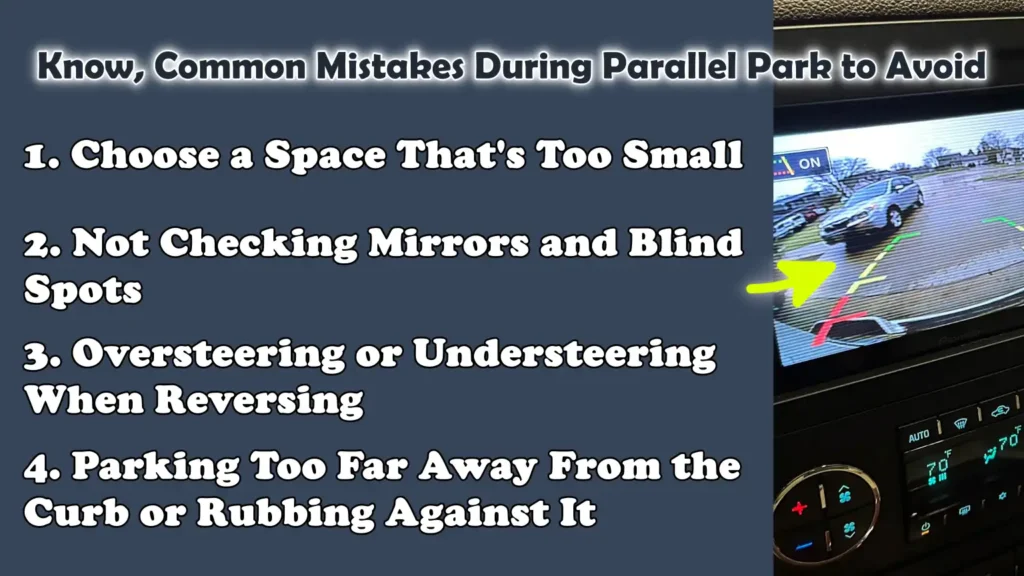
1. Choose a Space That’s Too Small
One of the most common mistakes drivers make is trying to park in a space that’s too small for their vehicle.
According to traffic studies, a major cause of minor collisions and injuries in urban areas is trying to fit into a tight space.
Choosing a space that’s at least one and a half times the length of your car provides enough room to move safely.
Taking a few extra seconds to find the right size space reduces stress, prevents damage and ensures that your parking is more likely to be successful on the first try.
2. Not Checking Mirrors and Blind Spots
Failing to check mirrors and blind spots before and while parking is another common mistake.
Pedestrians, cyclists and other vehicles can approach quickly and ignoring them can lead to accidents or near misses.
Research by the National Highway Traffic Safety Administration (NHTSA) shows that blind spot-related accidents cause thousands of accidents each year.
Constantly checking your mirrors and looking over your shoulder ensures that you are aware of your surroundings and can adjust safely at any time.
3. Oversteering or Understeering When Reversing
Many drivers struggle with turning the steering wheel too much or too little when entering a parking lot.
Oversteering causes the front of the car to go too far into the road, while understeering causes the car to go at an awkward angle or too far away from the curb.
Professional driving instructors insist that controlled, gradual steering adjustments make parking smooth and precise.
Practicing the correct timing and degree of wheel movement can greatly reduce the risk of hitting the curb or nearby vehicles.
4. Parking Too Far Away From the Curb or Rubbing Against It
A common mistake is either parking too far away from the curb or allowing the tires to rub against it.
Parking too far away can cause your car to come into the traffic lane, creating a hazard for other drivers.
On the other hand, rubbing against the curb can damage your tires, rims and suspension over time.
Driving schools recommend maintaining a distance of about 12 to 18 inches (30 to 45 centimeters) from the edge of the road.
Maintaining this distance ensures that your vehicle is safe, in good condition and follows road rules.
Read More:
- How to Park Safely on Busy Streets
- How to Drive in Heavy Traffic Safely
- How to Drive on Highways Safely
- How to Merge Lanes Safely
- How to Overtake Safely
- How to Use Turn Signals Properly
- How to Fix Turn Signals on a Car
- How to Check Blind Spot While Driving
- How to Use Mirrors When Driving
- How to Use ABS Brakes Properly
- How to Brake Safely on Steep Roads
- How to Drive Uphill Safely
- How to Drive Safely in Strong Winds
- How to Prevent Aquaplaning
Know, Some Practice Tips for Easy & Fast Learning
1. Start in an empty parking lot
The best way to learn parallel parking is to practice in an empty parking lot, where cones or markers are used to simulate cars.
This controlled environment allows you to focus on steering, positioning and spatial awareness without the stress of traffic or pedestrians.
Studies from driving schools show that students who practice in safe, obstacle-free areas develop confidence and muscle memory quickly, making actual parking easier and safer.
Repeated practice in a calm environment helps drivers understand the size of their vehicle and the space needed to park efficiently.
2. Go Slow for Better Control
Speed is one of the most common challenges when learning parallel parking.
Driving too fast while attempting this maneuver increases the risk of hitting the sidewalk or nearby vehicles.
Traffic safety experts emphasize that parallel parking is based on control, precision and patience rather than speed.
Driving slowly allows you to make gradual adjustments, respond to obstacles and maintain a steady angle when entering a parking spot.
Practicing slowly and steadily develops skill and confidence, eventually allowing you to drive the car smoothly even in real conditions.
3. Use reference points
Using reference points in and around your car is an essential tip for successful parallel parking.
Points such as the rear bumper, side mirrors, or the position of curbs serve as visual guides that help you estimate distances and angles more accurately.
Driving instructors teach that identifying these marks makes it easier to know when to start turning, straighten the wheels, or adjust your car’s position.
By relying on these reference points, beginners can significantly reduce the number of corrections needed and drive the car with more precision and stability.
Conclusion – How to Parallel Park
So, now at this time you have clearly understood the basic science and why you need to develop the control, confidence and proper awareness on the road, rather than just fitting into that damn spot.
From selecting the right spot and positioning the vehicle correctly, to carefully maneuvering into the space and making final necessary adjustments, by adopting the proper techniques, drivers can avoid common errors and safeguard both their own vehicle and those parked nearby.
Practicing in a safe environment, paying close attention to mirrors and specific reference points and proceeding slowly and deliberately, all these factors contribute to building muscle memory and control.
Studies indicate that drivers who consistently practice parallel parking see an improvement of over 70% in their accuracy and confidence, making driving in urban areas significantly less stressful.
Also, you can ask all the related questions from this guide about How to Parallel Park, so that you can clear your doubts quickly.
Frequently Asked Questions
Q1. What is parallel parking and why is it important?
Answer: Parallel parking is a method of parking a vehicle parallel to the pavement, usually in a space between two cars. It is important because it allows drivers to park safely on busy streets where angled or perpendicular parking is not possible. Mastering parallel parking increases driving confidence, reduces the risk of minor accidents and is a required skill in most driving tests. Proper parallel parking ensures that your car does not obstruct traffic and that you park legally and safely.
Q2. How do I know if a parking space is wide enough for my car?
Answer: The parking space should be at least one and a half times the length of your car. This extra space gives you room to maneuver when reversing without hitting cars in front or behind. If the space is too small, it can be difficult to enter it without adjusting several times, increasing the risk of a scratch or collision. Always check the length of the space before trying to park.
Q3. What is the best way to position your car before reversing?
Answer: Before you start reversing, position your car about two to three feet away from the car in front of you in the parking lot. Align your rear bumper with the rear bumper of the car next to you. This position helps create the correct angle for easy entry into the space. The correct position reduces the need for frequent adjustments and makes the move more safe and precise.
Q4. How do I know when to start turning the steering wheel?
Answer: When your front bumper is above the rear of the car in front, it’s time to start straightening the steering wheel when reversing. When your car is about halfway across the parking lot, turn the steering wheel in the opposite direction so that your front is facing the curb. Using reference points such as the rear bumper or side mirrors helps you determine the right time to turn the wheel correctly.
Q5. How close to the curb should I park?
Answer: The recommended distance from the curb is about 12 to 18 inches, or about 30 to 45 centimeters. This distance keeps your car close enough to not obstruct traffic, but also far enough away that the tires or rims don’t hit the pavement. Maintaining this distance ensures that your car is safe, in the correct position and follows road rules.
Q6. What are some common mistakes beginners make when parallel parking?
Answer: Some common mistakes include choosing too small a space, not checking mirrors and blind spots, oversteering or understeering when backing out and parking too far from the pavement or in a scratched spot. Avoiding these mistakes requires careful observation, slow and controlled speed and using reference points to guide your car. Regular practice reduces mistakes and builds confidence.
Q7. ow can I practice parallel parking safely?
Answer: Start practicing in an empty parking lot using cones or markers to simulate cars. Focus on steering control, position and awareness of distances. Move slowly and thoughtfully to develop muscle memory. Using reference points on your car and the surrounding environment, such as the rear bumper and side mirrors, helps you develop accuracy. Gradually, as your confidence grows, you can practice on quieter streets before moving into busier areas.
Q8. How long does it take to master parallel parking?
Answer: The time it takes to master parallel parking depends on practice and personal learning speed. Many drivers see significant improvement after just a few sessions of practice in a controlled environment. Studies conducted by driving schools show that constant, focused practice leads to more than a 70% increase in accuracy and confidence. Patience and repetition are key factors in becoming proficient.
Q9. Is parallel parking tested in driving exams?
Answer: Yes, parallel parking is a required skill in most driving exams around the world. Examiners pay attention to correct positioning, control, use of mirrors, alignment with edges and safety precautions. Showing confidence during the test and following the correct steps is important to pass this part of the driving test.
Q10. Why do experienced drivers still sometimes struggle with parallel parking?
Answer: Even experienced drivers can find parallel parking in tight or unusual spaces challenging. Stress, narrow lanes or poor visibility can make it more difficult. However, difficulties can be greatly reduced by following the correct steps, keeping calm and practising reference points. Parallel parking is a skill that improves with practice and awareness, regardless of experience.
References:
[1] Parallel Parking System Design with Fuzzy Logic Control
https://www.researchgate.net/publication/353798008_Parallel_Parking_System_Design_with_Fuzzy_Logic_Control

Guys, I’m a car audio enthusiast and customization expert and I love clear sound and clean installation. Plus, I have spent years helping people build their dream audio setups. And whenever I’m working on cars, I probably listen to music and thinks about the next big upgrade.