
Written By: Don Dodi
Fact Checked By: Kristen Brown
Reviewed By: Diego Rosenberg
Actually it is really common challenge on the road to eliminate the Hidden Dangers that Blind Spots causes.
So, these are basically hidden areas around your vehicle that cannot be seen normally or directly through your mirrors.
And according to the NHTSA: The blind spots are actually the leading cause of lane-change and merging accidents and numbers are in the thousands of crashes every year in the United States alone.
As well as, a passenger vehicle on average has two major blind spots: On the Each Side of the Car and they can easily hide the other cars behind them such as: motorcycles and pedestrians which makes them really dangerous and scary.
Yes, now-a-days modern cars comes with Blind Spot Monitoring System, buy you should not blindly rely only on technology as it can be really risky, as we all knows that no system is 100% foolproof.
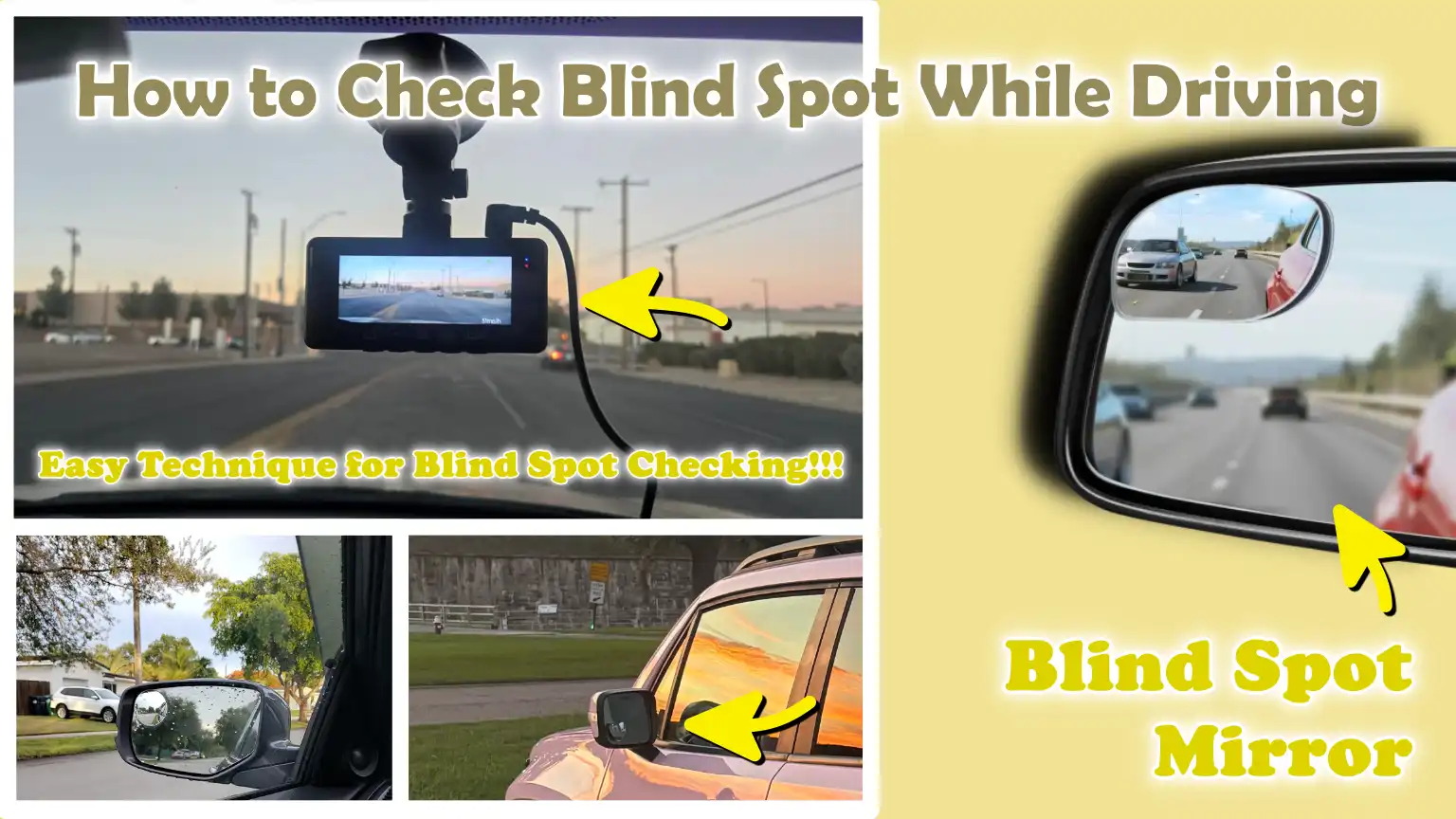
Now, this guide is actually shows you How to Check Blind Spot While Driving so that you can easily prevent any possible collisions and ensure safer driving for yourself and everyone out there.
Now, At First Understand About the Blind Spots
1. Location of Blind Spots in Different Vehicles
Every vehicle has blind spots, but their size and location can vary depending on the type of vehicle.
In a standard passenger car, the most common blind spots are located on both the left and right rear sides.
These areas typically extend diagonally backward from the driver’s shoulders toward the rear of the car.
In larger vehicles, such as trucks and buses, blind spots are significantly larger and are often referred to as “No-Zones.”
For instance, a truck has a large blind spot on its right side that can span several lanes; another blind spot exists directly behind the trailer, where smaller vehicles can disappear completely; and due to the truck’s height, there is also a small blind spot located directly in front of the vehicle.
Conversely, motorcycles face a heightened risk because they can easily become hidden within another driver’s blind spot; therefore, it is crucial for both motorcyclists and car drivers to exercise extra caution.
2. Distinctions Between Left, Right and Rear Blind Spots
The blind spot on the left side is generally smaller and easier to check because the driver is seated on that side; a simple glance over the shoulder is usually sufficient.
However, the blind spot on the right side is larger and more hazardous because it lies further away from the driver’s primary line of sight.
This makes changing lanes to the right a riskier maneuver, particularly in heavy traffic or when overtaking slower-moving vehicles.
The rear blind spot is located directly behind the vehicle, an area where objects or smaller cars remain invisible to the driver, even when utilizing the rearview mirror.
This poses a particular danger when reversing the vehicle, merging into another lane, or driving in stop-and-go traffic.
Compared to small cars, SUVs, vans and pickup trucks have larger blind spots at the rear; therefore, backup cameras and sensors prove to be extremely useful in these vehicles.
3. Limitations of Mirrors
Although mirrors are essential tools for maintaining awareness of one’s surroundings, they cannot completely eliminate blind spots.
The rearview mirror shows only what is directly behind the vehicle, while side mirrors display adjacent lanes; however, they fail to reveal those areas situated just outside their specific angles.
Even when mirrors are adjusted correctly, there will always remain certain sections of the road that remain invisible.
Many drivers mistakenly assume that wide-angle or convex mirrors can completely cover blind spots; however, rather than entirely eliminating these hidden areas, such mirrors merely reduce their size.
This is precisely why relying solely on mirrors is insufficient.
To properly check for blind spots, it is crucial that, before making any maneuver, you always turn your head to look directly, thereby ensuring that the lane is clear.
Do, Pre-Driving Preparations
1. Proper Mirror Adjustment – Side Mirrors and Rearview Mirror
One of the most crucial steps before driving is properly adjusting your mirrors.
In the rearview mirror, you should have a clear, centered view of the road directly behind your vehicle.
You should be able to see the maximum possible portion of the rear window without having to turn your head.
Side mirrors often present the greatest challenge, as many drivers adjust them too far inward, thereby creating large “blind spots” on both sides.
Experts, including those from the Society of Automotive Engineers (SAE), recommend the “Blindspot and Glare Elimination” (BGE) method.
This involves adjusting your side mirrors outward just enough so that the edge of your vehicle is barely visible in them.
By doing so, the side mirrors capture everything that the rearview mirror misses; together, they cover a significantly larger area.
When mirrors are adjusted correctly, the size of blind spots is drastically reduced, making lane changes and merging into traffic much safer.
2. Correct Seating Position in the Driver’s Seat
The way you sit in your seat has a direct impact on your ability to identify blind spots and utilize your mirrors effectively.
You should sit upright, keeping your back firmly pressed against the backrest of the seat and ensure that both your hands can comfortably reach the steering wheel.
Your seat height should be adjusted to provide a clear, unobstructed view over the dashboard, while simultaneously allowing you to maintain a full view of your mirrors.
If the seat is positioned too far back, turning your shoulders to check your surroundings may prevent you from clearly seeing your blind spots; conversely, if the seat is positioned too far forward, you may experience physical strain or discomfort while driving.
Proper seating posture not only reduces fatigue during long journeys but also improves your reaction time during sudden maneuvers or emergency situations.
Nowadays, many vehicles are equipped with adjustable seats and steering columns; therefore, taking a few minutes to properly adjust your seating position before starting the vehicle is a good habit that proves highly beneficial from a safety perspective.
3. Why It Is Important to Know Your Vehicle’s Blind Spots
Blind spots vary in every vehicle depending on its specific design, size and structure.
Smaller cars typically have smaller blind spots, whereas SUVs, vans and pickup trucks, due to their height and build, have significantly larger blind spots.
Trucks and buses possess the largest blind spots, often referred to as “No-Zones”; within these areas, smaller vehicles can completely disappear from the driver’s line of sight.
Knowing exactly where your vehicle’s blind spots are helps you anticipate potential hazards before they arise.
An easy way to check this is to ask someone to walk slowly around your stationary vehicle while you remain seated in the driver’s seat, noting exactly when they disappear from your view in the mirrors.
This exercise helps you identify the precise areas that require a quick glance over your shoulder to check.
By being aware of these areas before you begin driving, you are far better prepared to change lanes, overtake and merge into traffic safely.
How to Check Blind Spot While Driving – Easy & Effective
1. First, Check Your Mirrors: The Rearview and Side Mirrors
Before changing lanes or merging into another lane, the first step is to check your mirrors.
Start with the rearview mirror to gauge the traffic behind you, then use your side mirrors to look for vehicles approaching from either side.
This quick check helps you create a mental map of your surroundings and estimate the speed of other vehicles.
Many accidents occur because drivers look directly toward their blind spots without first checking their mirrors, causing them to miss fast-approaching vehicles.
Proper use of mirrors lays the foundation for changing lanes safely.
2. Signal Your Intentions: Always Signal Before Changing Lanes
Once you have checked your mirrors, the next step is to use your turn signal.
Signaling is not merely a matter of courtesy; it is also a crucial safety measure.
It alerts surrounding drivers to your intentions and gives them time to adjust their speed or position.
According to studies by the Society of Automotive Engineers, millions of accidents occur every year due to a failure to signal.
By signaling early, ideally at least three seconds before changing lanes, you reduce the likelihood of startling other drivers and minimize the risk of a collision.
3. Take a Quick Glance Over Your Shoulder: Turn Your Head Briefly To Check for Blind Spots
After signaling, you should take a quick glance over your shoulder.
This involves briefly turning your head in the direction you intend to move to check the blind spot that your mirrors cannot reveal.
This task should take no more than a single second and you must keep your hands firmly on the steering wheel to ensure that your vehicle does not drift out of its lane.
Looking over your shoulder is the only safe way to verify that no car, motorcycle, or cyclist is lurking in that unseen area.
Skipping this step is one of the primary causes of side-swipe accidents that occur while changing lanes.
4. Maintain Lane Discipline: Do Not Let Your Vehicle Drift Out of Its Lane While Checking
When checking your blind spots, it is crucial to keep your vehicle steady and centered within its lane.
Many drivers inadvertently drift out of their lane the moment they take their eyes off the road, even if only for a split second.
To prevent this, maintain a light yet firm grip on the steering wheel and avoid turning your head too far.
Practicing this skill in areas with light traffic will help you become more comfortable checking your blind spots without losing control of your lane positioning.
5. Re-Check Your Mirrors: Ensure the Space Is Clear Before Changing Lanes
Before moving into the adjacent lane, perform a final check of your mirrors to confirm that the space is clear.
Traffic conditions can change rapidly; a vehicle that was well behind you just moments ago may now have moved into the exact spot you intend to occupy.
This final mirror check serves as a safety net, ensuring that you possess the most up-to-date information before executing a lane change.
Only after confirming this should you smoothly guide your vehicle into the new lane.
Know, Common Mistakes While Checking Blind Spots to Avoid
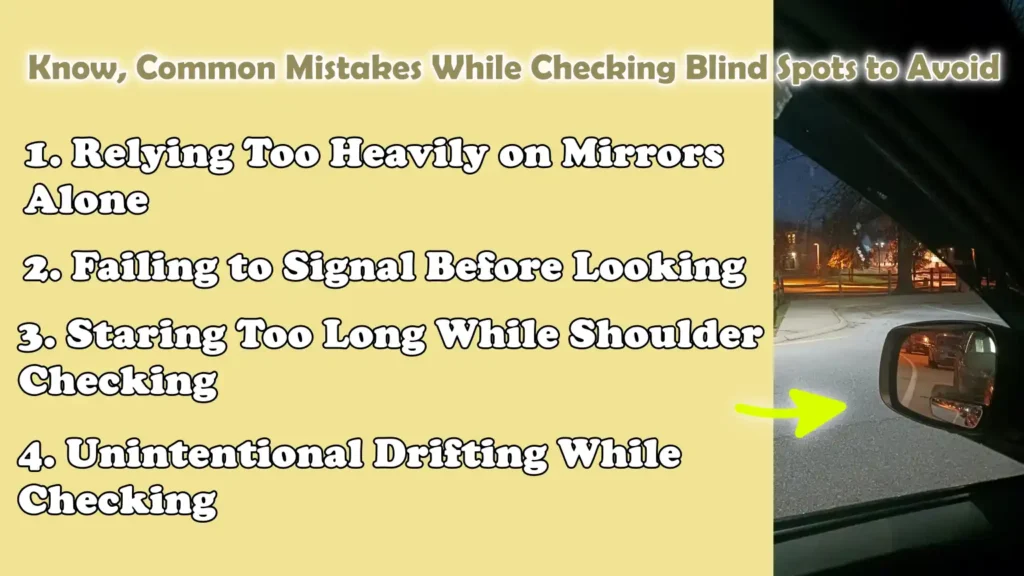
1. Relying Too Heavily on Mirrors Alone
One of the biggest mistakes drivers make is assuming that mirrors alone are sufficient to see every vehicle surrounding them.
Even if your mirrors are properly adjusted, they still cannot reveal the entire area along the sides of your car and directly behind it.
The Insurance Institute for Highway Safety (IIHS) has found that many side-impact collisions occur because drivers believe their mirrors indicate that the lane is completely clear.
While mirrors help you see most things, they invariably leave certain critical “blind spots” undetected.
Therefore, to maintain full awareness of your surroundings, it is essential to cultivate the habit of performing a “shoulder check” in addition to checking your mirrors.
2. Failing to Signal Before Looking
Another common mistake is forgetting to activate your turn signal before performing a shoulder check or changing lanes.
Failing to signal prevents other drivers from anticipating your next move, thereby increasing the risk of a sudden collision.
According to traffic safety studies, the failure to use turn signals contributes to approximately two million accidents in the U.S. each year.
Developing the habit of signaling first gives surrounding drivers time to slow down, adjust their position, or make room for you, making your maneuver significantly safer.
You should always signal before checking your blind spots so that your intentions are clearly communicated in advance.
3. Staring Too Long While Shoulder Checking
Although checking your blind spots is crucial, some drivers make the mistake of keeping their heads turned for too long.
This creates a dangerous situation, as your eyes are diverted from the road ahead for a few moments.
At high speeds on a highway, even a momentary lapse in attention, for as little as two seconds, as it can lead to severe consequences; while your eyes are off the road, your vehicle can travel a distance equivalent to the length of a football field.
Checking your blind spots should take less than a second, a mere glance is sufficient to confirm whether the lane is clear.
Staring for too long increases the risk of having to brake suddenly or failing to react to obstacles ahead.
4. Unintentional Drifting While Checking
It is quite common among new drivers for their vehicle to drift slightly off course when they turn their heads to check their blind spots.
This typically occurs because the driver turns their body too much or loosens their grip on the steering wheel.
Even a slight deviation in your vehicle’s path can steer you into the path of another vehicle or create an unsafe driving situation.
To avoid this, practice keeping both hands firmly on the steering wheel even as you cast a quick glance over your shoulder.
Over time, this will become a habit, helping you maintain lane discipline while remaining fully aware of your blind spots.
Read More:
- How to Use Mirrors When Driving
- How to Use ABS Brakes Properly
- How to Brake Safely on Steep Roads
- How to Drive Uphill Safely
- How to Drive Safely in Strong Winds
- How to Prevent Aquaplaning
- How to Drive Safely on Ice
- How to Drive Safely in Fog
Follow, Additional Safety Tips
1. Use of Blind Spot Monitoring Technology
Many modern vehicles come equipped with blind spot monitoring systems.
Utilizing sensors and cameras, this system detects vehicles that are not visible to the driver.
When another vehicle enters the blind spot zone, the system alerts the driver via a warning light illuminated on the side mirror or an audible beep.
While these systems add an extra layer of safety, they should never replace the habit of checking mirrors and physically turning to look over one’s shoulder.
Technology can occasionally fail due to adverse weather conditions, sensor malfunctions, or unusual traffic situations.
Drivers who utilize blind spot monitoring as a backup tool, rather than as their primary safety measure, are the ones who benefit most from this safety feature.
2. Adjusting Mirrors Using the “BGE Method” – Eliminating Blind Spots and Glare
A proven method for minimizing blind spots is to adjust your mirrors according to the BGE (Eliminating Blind Spots and Glare) method, developed by the Society of Automotive Engineers.
This method involves setting the rearview mirror to frame the entire rear window, while the side mirrors are angled outward just enough so that their fields of view no longer overlap with that of the rearview mirror.
With this configuration, the side mirrors pick up vehicles precisely as they are exiting the rearview mirror’s field of view, thereby revealing areas that would otherwise remain hidden.
Research indicates that employing the BGE method significantly reduces blind spots and lowers the likelihood of accidents occurring during lane changes.
3. Cultivating the Habit of Frequently Checking Mirrors
Even if you are not changing lanes, developing the habit of checking your mirrors every few seconds significantly enhances your awareness of your immediate surroundings.
By regularly glancing at your rearview and side mirrors, you can keep track of the position and speed of nearby vehicles.
This habit helps you anticipate which vehicles might be entering your blind spots and prepares you to drive safely.
Traffic safety experts recommend that while driving on highways and before approaching intersections or merging into lanes, you should make it a habit to check your mirrors every 5 to 8 seconds.
Maintaining this constant vigilance allows you to react immediately to sudden changes in the flow of traffic.
4. Maintaining a Safe Distance Between Vehicles to Minimize Risk
Dealing with blind spots involves not only being aware of your immediate surroundings but also maintaining a safe distance from the vehicles traveling ahead of you.
If you drive too closely to the vehicle in front of you, your reaction time is significantly reduced.
Furthermore, this increases the likelihood that a vehicle, hidden within another driver’s blind spot, might suddenly merge into your lane.
Traffic safety studies often recommend the “three-second rule”; according to this rule, under normal driving conditions, you should maintain a distance of at least three seconds from the vehicle ahead of you.
In adverse weather conditions or when driving at high speeds, this distance should be increased to five or six seconds.
Maintaining an appropriate distance from other vehicles provides you with sufficient time to check your mirrors, scan your blind spots and easily adjust your position without having to apply sudden brakes or make abrupt turns.
Have Full Situational Awareness
Not only this, according to the Traffic Injury Prevention journal it shows that blind spot monitoring systems are really important during the lane-change: and vehicles which are actually equipped with these systems actually saw 14% decrease in lane-change collision.[¹]
1. Checking Blind Spots in Heavy Traffic
Checking blind spots becomes even more critical when driving in heavy traffic, where vehicles frequently change lanes and the spacing between cars is minimal.
In congested areas, motorcycles, small cars, or fast-moving vehicles can easily hide within blind spots, potentially appearing right alongside you without warning.
Studies by the Federal Highway Administration indicate that rear-end collisions and sideswipes increase during peak traffic hours; this often occurs because drivers fail to adequately monitor their blind spots.
In such situations, frequently checking your mirrors, along with performing a quick over-the-shoulder check, helps you remain aware of vehicles that may be unexpectedly shifting positions around you.
2. Exercising Extra Caution When Overtaking Motorcycles and Bicycles
Motorcyclists and cyclists are among the most vulnerable road users, as their smaller size makes them particularly difficult to spot within blind spots.
According to the National Highway Traffic Safety Administration (NHTSA), approximately 40% of motorcycle accidents involving other vehicles occur when the other driver is changing lanes.
Identifying motorcyclists can also be challenging during rainy weather or when driving in the vicinity of large vehicles.
When overtaking, it is essential to carefully check both mirrors and blind spots, signal well in advance and maintain adequate clearance between vehicles.
Overtaking safely not only helps prevent collisions but also provides riders with the necessary space to adjust their position if needed.
3. The Challenges of Driving at Night and Checking for Blind Spots
Driving at night reduces visibility, making the task of checking for blind spots even more difficult.
Headlights, glare reflecting off shiny surfaces and the inability to accurately judge distances, all these factors create difficulties in identifying vehicles present within blind zones.
Even properly adjusted mirrors may fail to reveal a dark-colored car or a motorcycle without bright headlights.
According to a report by the Insurance Institute for Highway Safety (IIHS), the likelihood of fatal accidents occurring at night is three times higher than during the day; one contributing factor to this is poor lighting or reduced visibility.
To mitigate these risks, drivers should increase their following distance from the vehicle ahead, frequently check their mirrors to assess their surroundings and, when changing lanes at night, exercise extra caution while performing a “shoulder check” (turning one’s head to look behind).
4. Operating Large Vehicles with Extensive ‘Blind Spots’
Large vehicles such as: SUVs, vans, buses and trucks, possess significantly larger ‘blind spots’ (unseen areas) compared to smaller passenger cars.
For instance, a truck driver faces a blind spot directly behind the trailer that can extend for over 200 feet; furthermore, there are large blind spots on both sides of the vehicle, as well as a smaller blind spot directly in front.
These areas are often referred to as “No-Zones,” and cars situated within these zones are virtually invisible to the truck driver.
Drivers of large vehicles must exercise additional caution to compensate for these blind spots; they should check their mirrors frequently and turn their heads to expand their field of vision.
Conversely, drivers of small cars should avoid lingering in the blind spots of larger vehicles, as doing so significantly increases the risk of an accident.
Being aware of these inherent differences in vehicle design enables drivers to make necessary adjustments to their behavior, allowing them to share the road safely with one another.
Conclusion – How to Check Blind Spot While Driving
You should not ignore the blind spots as they can cause the massive consequences when you ignore them.
Actually you need to be aware about checking the blind spots at consciously as it is really one of the easiest habits a driver can adopt, yet it plays the biggest role in preventing accidents.
Research from the National Highway Traffic Safety Administration (NHTSA) shows that there are about 840,000 lane changing and lane changing accidents in the United States each year, many of which are linked to blind spot mistakes.
Although mirrors, blind spot monitoring systems and backup cameras are valuable tools, none of these can fully replace the combination of proper mirror adjustment, signaling, frequent checking and a glance over the shoulder.
By making these steps a habit, drivers create an invisible safety net around their vehicle, protecting not only themselves but also other road users such as motorcyclists, cyclists and pedestrians who are most at risk.
Safe driving doesn’t mean reacting at the last moment, but anticipating what you can’t see.
The more drivers understand blind spots and practice checking them correctly, the more confident and safe they feel while driving.
Ultimately, road safety is based on small, consistent habits and checking blind spots is one of the most powerful habits a driver can practice every day.
Now, you can comment down below for more information.
Frequently Asked Questions
Q1: What is a ‘blind spot’ while driving?
Answer: A blind spot is an area surrounding your vehicle that you cannot see directly through your mirrors. Even if your mirrors are adjusted correctly, there remain certain areas along the sides and slightly behind your vehicle that remain invisible. Another car, a motorcycle, or a cyclist can easily hide within these blind spots. That is why it is essential to perform a “shoulder check”, looking over your shoulder, when changing lanes or merging into traffic.
Q2: Where are blind spots located in a vehicle?
Answer: In most passenger cars, blind spots are located directly behind the driver’s shoulders, on both the left and right sides of the vehicle. These spots extend diagonally outward and can hide nearby vehicles. In larger vehicles such as: SUVs, vans and trucks, blind spots are even larger. For instance, trucks have significant blind spots behind the trailer and directly in front of the driver’s cab (the front end), areas where the driver cannot see smaller vehicles. Motorcycles and bicycles can disappear completely within these zones, significantly increasing the risk of accidents involving them.
Q3: Why are mirrors alone not sufficient for checking blind spots?
Answer: Mirrors are essential for safe driving, but they cannot cover every angle. The rearview mirror only shows what is directly behind you and the side mirrors show the lanes adjacent to you; however, neither of these can fully reveal the hidden areas along the sides of your vehicle. Even wide-angle or convex mirrors, while they can reduce blind spots to some extent, as it cannot eliminate them entirely. This is why relying solely on mirrors can be risky. A quick glance over your shoulder ensures that you can spot objects that are not visible in your mirrors.
Q4: How should I properly check for blind spots while driving?
Answer: The safest way to check for blind spots is to adopt a simple routine. First, assess the surrounding traffic by checking your rearview and side mirrors. Next, signal your intentions so that other drivers are aware that you are about to change lanes or merge into traffic. Then, quickly turn your head to look over your shoulder in the direction you wish to move, performing a “shoulder check” to scan for blind spots. Keep your hands steady on the steering wheel to ensure your vehicle does not drift out of its lane. Finally, just before turning or changing lanes, take one last glance at your mirrors. This entire process takes only a few seconds and significantly reduces the risk of an accident.
Q5: How should I adjust my mirrors to minimize blind spots?
Answer: A highly effective method for this is the “Blindspot and Glare Elimination” (BGE) technique. Using this method, you adjust your rearview mirror so that it frames the entire rear window. Then, you angle your side mirrors outward just enough so that their field of view does not overlap with that of the rearview mirror. In this way, as soon as a vehicle exits the field of view of your rearview mirror, it immediately becomes visible in one of your side mirrors. Although this technique helps reduce blind spots, it does not eliminate them entirely; therefore, performing a “shoulder check” remains essential.
Q6: Are blind spot monitoring systems reliable?
Answer: Modern vehicles often feature blind spot monitoring technology, which utilizes sensors or cameras to detect vehicles present in your blind zones. These systems typically alert you via indicator lights on the side mirrors or through audible warnings. While these are helpful tools that can reduce accidents, they are not entirely infallible. Sensors may fail to function correctly in adverse weather conditions, heavy rain, or unusual traffic situations. The safest approach is to utilize these systems as a backup, while simultaneously maintaining the habit of regularly checking your mirrors and performing shoulder checks.
Q7: Why is it essential to signal before checking your blind spots?
Answer: Signaling is crucial because it alerts other drivers to your intended actions before you actually execute them. If you perform a shoulder check without signaling first, drivers in your vicinity will be unaware of your intention to change lanes. This can lead to confusion and sudden reactions, potentially resulting in accidents. By signaling in advance, you give surrounding drivers time to adjust their speed or position, making the maneuver smoother and safer.
Q8: What common mistakes do drivers typically make when checking blind spots?
Answer: Among the most common errors are relying solely on mirrors, forgetting to signal before initiating a maneuver, keeping one’s head turned for too long and inadvertently allowing the vehicle to drift while checking. Each of these mistakes compromises safety. For instance, spending too much time on a shoulder check diverts your attention from the road ahead, while even a slight drift during a quick glance can cause your vehicle to veer into an adjacent lane. Avoiding these mistakes requires practice to ensure that the vehicle remains on its intended path.
References:
[1] Cicchino JB. Effects of blind spot monitoring systems on police-reported lane-change crashes.
https://pubmed.ncbi.nlm.nih.gov/29927678/

Guys, I’m a car audio enthusiast and customization expert and I love clear sound and clean installation. Plus, I have spent years helping people build their dream audio setups. And whenever I’m working on cars, I probably listen to music and thinks about the next big upgrade.