
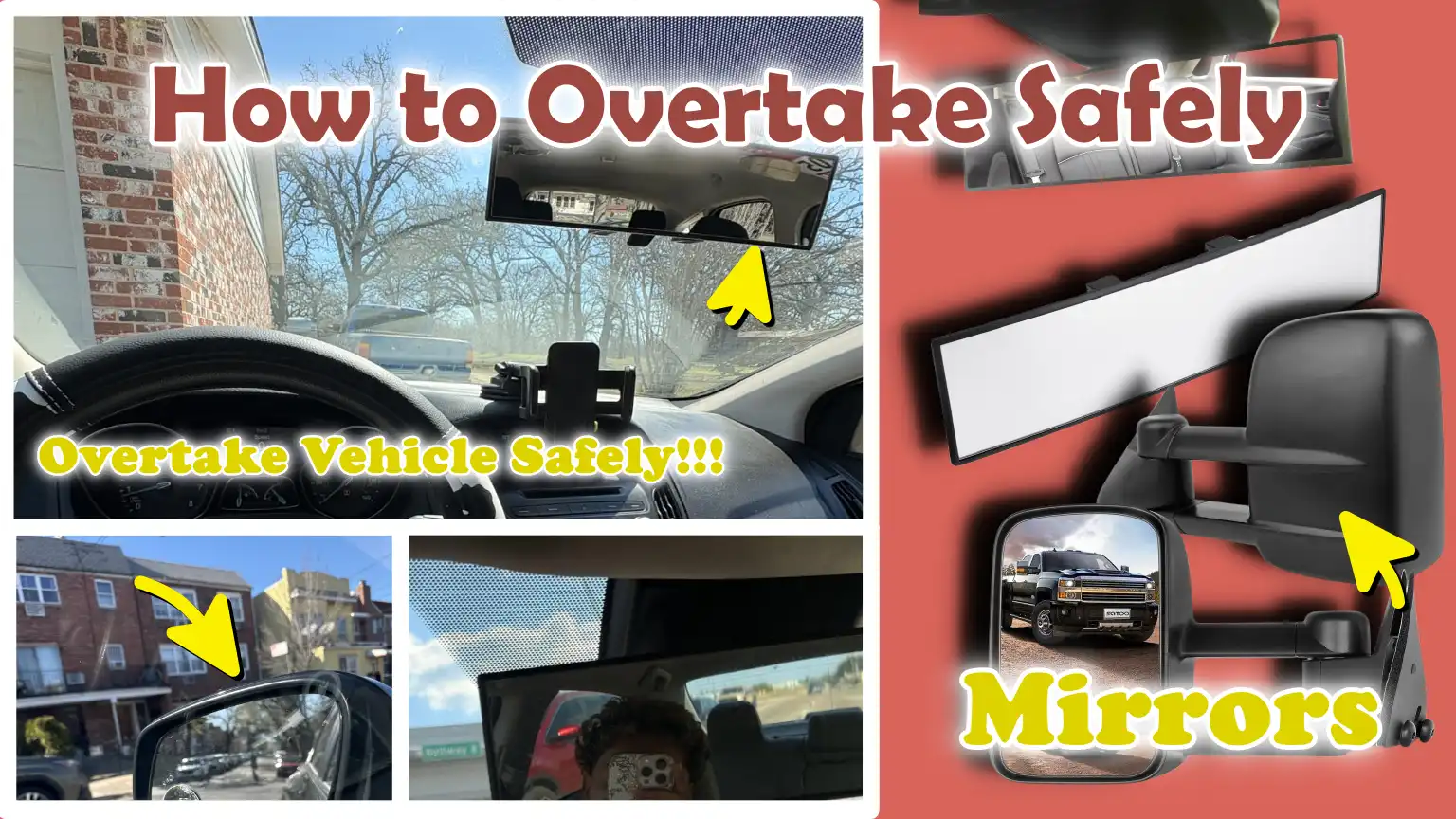
Written By: Don Dodi
Fact Checked By: Kristen Brown
Reviewed By: Diego Rosenberg
Most of the dangerous overtakes doesn’t happen because of the high speed, but the poor judgement and lack of visibility is actual culprit here.
So, overtaking is one of the most common driving actions, but even though this it is also one of the most risky when done incorrectly.
As a large number of serious road accidents happens during the overtaking, specially on the single-lane roads where drivers misjudges the speed of oncoming vehicles or just underestimate the distance needed to pass safely.
Also, safe overtaking requires clear visibility, proper timing, good judgement and full attention to the road.
Plus, to ensure everything driver must check mirrors, blind spots, road markings and traffic conditions before making any move here.
Not only this, even a small mistake such as: overtaking on a curve or without signalling can lead to the dangerous situations within seconds.
That’s why, we have come up with this guide about How to Overtake Safely so that you can protect yourself, passengers and others on the road while making driving smoother and more controlled as well.
Know, When You Should Overtake
Overtaking should only be undertaken when it is clearly necessary and when conditions permit you to execute the maneuver safely, without endangering yourself or others.
Numerous road safety studies indicate that improper overtaking is a major cause of serious accidents, particularly on two-lane roads where vehicles travel in opposing directions.
Safe overtaking requires accurate judgment of speed, distance and timing, as well as a comprehensive awareness of the road ahead.
Drivers should never view overtaking as a routine or impulsive act; rather, it should be regarded as a deliberate decision based on the specific conditions prevailing at that moment.
The fundamental principle is straightforward: overtake only when there is a clear justification for doing so and when all safety parameters are in your favor.
1. Situations Where Overtaking Becomes Necessary
Overtaking becomes necessary when you find yourself stuck behind a vehicle traveling significantly slower than the general flow of traffic such as: a heavily laden truck, a tractor, or a vehicle ascending an incline at a reduced speed.
Such a necessity may also arise if a vehicle ahead has stalled due to a mechanical failure, or if there is an obstruction on the road such as: debris or ongoing construction work, that is blocking your lane.
In such situations, remaining stuck behind for an extended period can disrupt the flow of traffic and increase the risk of sudden braking incidents or traffic congestion.
However, even in these scenarios, the decision to overtake must be made with great caution; you must ensure that there is ample clear space to pass and that there is no immediate threat from oncoming traffic.
2. Safe Road Conditions for Overtaking
Safe overtaking is possible only when road conditions facilitate clear visibility and allow for easy vehicle control.
Straight roads are the safest because they provide the opportunity to spot oncoming traffic from a distance and assess whether there is sufficient time to overtake.
Favorable weather conditions such as: clear skies and dry roads, enhance tire traction and visibility, making the overtaking process more predictable and manageable.
Light traffic is also a crucial factor, as it reduces pressure and ensures ample space to safely merge back into one’s lane.
Conversely, when visibility is compromised due to fog, rain, or road curves, judging distance and speed becomes difficult; in such circumstances, attempting to overtake can instantly prove hazardous.
3. Legal and Road Regulations
Adherence to traffic laws and road regulations is paramount for safe overtaking, as these rules are specifically designed to prevent accidents and maintain order on the road.
Drivers must always pay close attention to road markings such as: broken lines, which generally permit overtaking and solid lines, which clearly indicate that overtaking is prohibited.
Designated overtaking zones are often established in areas with clear visibility and minimal hazards; drivers should strictly utilize these specific zones whenever possible.
It is also essential to use turn signals to signal one’s intentions and to ensure that overtaking is executed on the correct side, a requirement that depends on the specific driving regulations of the country in question.
Disregarding these legal mandates not only heightens the risk of accidents but may also result in fines.
Therefore, attempting to overtake without strictly adhering to the applicable rules is both unsafe and illegal.
Understand, When You Should Not Overtake
Knowing when not to overtake is just as important as knowing how to overtake safely.
Many serious road accidents occur because drivers attempt to overtake in situations where visibility, space, or control is limited.
A successful overtake requires a clear view of the road ahead, sufficient distance to complete the maneuver and the ability to anticipate the actions of other road users.
When any of these conditions are not met, the risk of an accident, particularly a head-on collision, which is often severe, increases significantly.
Drivers must understand that refraining from overtaking in an unsafe manner is a hallmark of good judgment and responsible driving.
The decision not to overtake in risky situations can prevent sudden emergencies and ensure the safety of everyone on the road.
1. Blind Corners and Hills
Overtaking on blind corners or hills is extremely dangerous because you cannot see what is approaching from the opposite direction.
On a winding road or near the crest of a hill, your line of sight is obstructed; this means that an oncoming vehicle may be much closer than you anticipate.
Even if you accelerate rapidly, you may still lack the time or space required to safely return to your lane.
Head-on collisions frequently occur in such situations because drivers assume the road is clear, when in reality, it is not.
For this reason, one should always avoid overtaking in locations where visibility is restricted due to the layout of the road.
2. Near Intersections and Crossings
Intersections and crossings are high-risk zones, as vehicles may enter the roadway from various directions at any moment.
Drivers emerging from side roads may turn abruptly, stop suddenly, or maneuver unpredictably, making it unsafe for a nearby vehicle to attempt an overtake.
Your attention may be divided between the act of overtaking and monitoring cross-traffic, thereby increasing the likelihood of overlooking critical details.
Furthermore, the vehicle traveling ahead of you may slow down or turn without providing adequate warning.
Due to these unpredictable scenarios, attempting to overtake near intersections significantly heightens the risk of side-impact collisions and multi-vehicle pile-ups.
3. Pedestrian Crossings and School Zones
Extra caution is required within pedestrian crossings and school zones, as individuals, particularly children, may suddenly step onto the roadway.
When you attempt to overtake a vehicle in these areas, the very vehicle you are passing may obstruct your view of pedestrians, making it difficult to react in a timely manner.
Children often behave less predictably and may not fully comprehend traffic-related hazards, thereby further compounding the risk.
Vehicles traveling ahead of you may slow down or come to a complete halt to yield to pedestrians; attempting to overtake in such situations can lead to serious accidents.
For safety reasons, one should always refrain from overtaking in areas characterized by heavy pedestrian activity.
4. During Adverse Weather Conditions
Adverse weather conditions such as: rain, fog, or dust storms, significantly reduce visibility and render road surfaces slippery.
Under these conditions, it becomes difficult to accurately estimate the speed and distance of other vehicles, factors that are absolutely critical for executing a safe overtake.
Wet or uneven roads can compromise tire traction, thereby increasing the likelihood of a vehicle skidding or losing control while changing lanes.
Fog and heavy rain can obscure oncoming traffic until there is insufficient time left to react safely.
As overtaking relies on clear visibility and stable vehicle control, it should be avoided whenever weather conditions render driving uncertain or unpredictable.
5. When Road Markings Prohibit Overtaking
Road markings are designed to guide drivers and indicate where it is safe to overtake, and where it is not.
Solid lines on the road typically signal that overtaking is prohibited, as the area has been deemed hazardous, often due to poor visibility, curves, or heavy traffic.
Disregarding these markings can place you directly in the path of oncoming vehicles or create confusion for other drivers.
Traffic regulations are based on careful planning and safety studies; therefore, adhering to them helps minimize accidents.
Respecting “No-Overtaking Zones” (areas where overtaking is prohibited) is a simple yet crucial way to ensure safe driving habits.
How to Overtake Safely – Easy Steps
Safe overtaking is not a single, isolated action; rather, it is a sequence of deliberate steps that must be executed in the correct order.
Research on road safety indicates that most accidents related to overtaking occur because drivers omit one or more of these steps such as: failing to check ‘blind spots’ (areas around the vehicle that are not directly visible) or misjudging distances.
Executing a proper overtake requires undivided attention, confident vehicle control and clear coordination with other road users.
From scanning the road ahead to safely returning to one’s lane, every step plays a crucial role in mitigating risks.
When performed correctly, the act of overtaking should appear as a controlled and calculated maneuver, not as a hasty or uncertain one.
Understanding and consistently adhering to each step can significantly reduce the likelihood of a collision and make the entire driving experience safer.
1. Assess the Situation
Before attempting to overtake, it is absolutely essential to carefully assess the entire situation ahead.
This involves evaluating your line of sight down the road, checking for any oncoming traffic and determining whether there is sufficient space available to complete the maneuver safely.
You should also monitor the speed of the vehicle ahead and compare it with your own speed to determine whether overtaking is necessary and, indeed, feasible.
A proper assessment helps you avoid making risky decisions and ensures that you only attempt to overtake when you have ample time and distance to do so safely.
2. Check Your Mirrors Thoroughly
The step of checking your mirrors is crucial, as it helps you understand what is happening behind your vehicle.
You must check your rear-view mirror and both side mirrors to ensure that no other vehicle is already attempting to overtake you or approaching you rapidly.
Skipping this step can lead to dangerous situations where two vehicles attempt to occupy the same space at the same time.
Proper use of mirrors provides you with a comprehensive overview of the surrounding traffic, enabling you to make safer decisions.
3. Check Your ‘Blind Spots’
Even after checking your mirrors, certain areas around your vehicle remain hidden, these are known as ‘blind spots.’
By glancing over your shoulder, you can check these areas and ensure that no other vehicle, particularly a motorcycle or a small car, is traveling directly alongside you.
Many accidents occur because drivers rely solely on their mirrors and overlook their ‘blind spots’ (the areas not visible in the mirrors).
Taking a moment to look directly over your shoulder can help prevent serious side-impact collisions.
4. Signal Your Intentions in Advance
Using your turn indicators before overtaking is essential for clear communication with other drivers.
Signaling in advance gives the vehicles traveling ahead of and behind you ample time to understand your intentions and, if necessary, adjust their speed or position.
Without proper signaling, other drivers cannot anticipate your maneuvers, thereby increasing the risk of confusion and sudden reactions.
Clear communication is a fundamental aspect of safe driving and helps maintain a smooth flow of traffic.
5. Ease Out of Your Lane
When you initiate the overtaking process, you should ease out of your lane in a smooth and controlled manner.
Sudden or abrupt movements can destabilize your vehicle and startle other drivers, thereby increasing the risk of losing control or causing panic.
Changing lanes gradually keeps the vehicle stable and allows you to maintain full control over it throughout the entire process.
Smooth movements also afford you more time to react should you face unexpected situations.
6. Accelerate Decisively
Once you have moved into the overtaking lane, it is crucial to accelerate with confidence and maintain a steady increase in speed.
Taking too long to overtake means spending an excessive amount of time in the opposing lane, which is the most hazardous part of the entire process.
However, this acceleration must remain controlled and within safe limits to ensure that you do not lose control of the vehicle.
A swift and decisive overtake minimizes risk and enables you to return to your original lane promptly.
7. Maintain a Safe Distance While Overtaking
When overtaking, you should maintain a safe distance from the vehicle you are passing.
Driving too closely can limit your field of vision and reduce your ability to react if the other driver suddenly changes their speed or direction.
Maintaining an appropriate distance also helps prevent side-swipes, specially when overtaking larger vehicles, which may have a wider profile or whose movements can be difficult to anticipate.
Maintaining the correct distance ensures better vehicle control and makes the overtaking maneuver safer.
8. Safely Return to Your Lane
After successfully overtaking a vehicle, you must ensure there is sufficient space before returning to your original lane.
A general rule of thumb is to wait until you can clearly see the entire front of the overtaken vehicle in your rear-view mirror.
Returning too soon may force the other driver to brake suddenly or leave a dangerously small gap between the two vehicles.
Returning safely ensures that both vehicles remain at a comfortable distance from one another and helps maintain a smooth flow of traffic.
9. Switch Off Your Indicator Once Complete
Once the overtaking maneuver is complete and you have safely returned to your lane, it is crucial to switch off your indicator.
Leaving the signal on can confuse other drivers, leading them to believe you are about to execute another maneuver.
Providing clear and precise signals helps prevent misunderstandings and enhances coordination on the road.
This final step ensures that the entire overtaking process has been completed correctly and safely.
Know, The Important Safety Tips for Overtaking
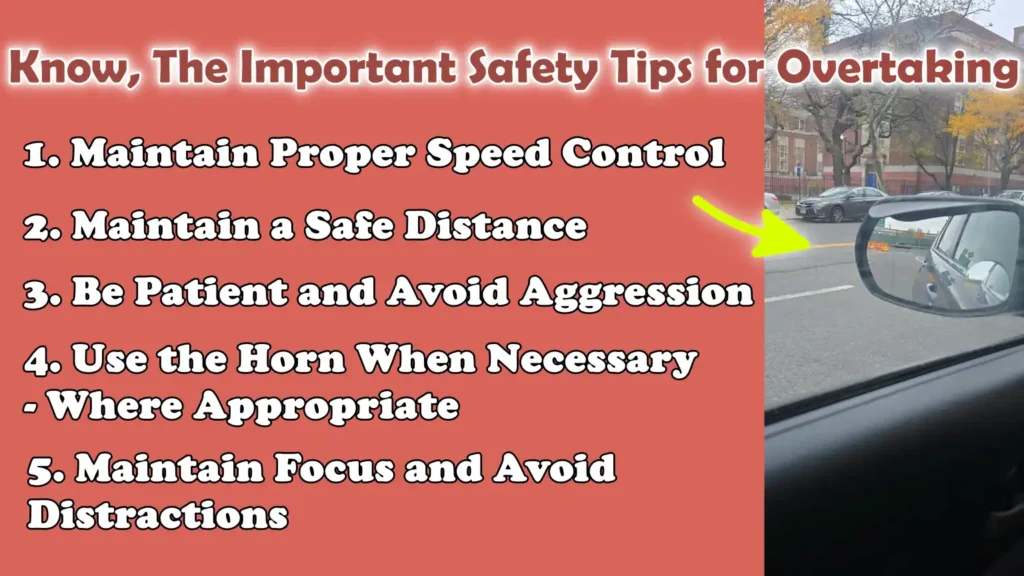
Safe overtaking involves not merely taking specific steps, but also maintaining good driving habits and a positive mindset at all times.
Various road safety reports indicate that human factors such as: impatience, distraction and poor judgment, are the primary causes of accidents that occur during overtaking maneuvers.
Even on well-constructed roads, a slight lapse in speed control or attention can instantly transform a routine maneuver into a hazardous situation.
Rather than taking unnecessary risks, skilled drivers prioritize maintaining a consistent speed, remaining highly vigilant and maintaining complete control over their vehicle.
By adhering to specific safety protocols, drivers can make the act of overtaking smoother, more deliberate and safer for everyone on the road.
1. Maintain Proper Speed Control
Maintaining the correct speed while overtaking is crucial, as both excessive speed and insufficient speed can significantly heighten the associated risks.
Driving too fast diminishes your ability to react effectively to sudden changes such as: an oncoming vehicle or the slowing down of the vehicle ahead.
Conversely, overtaking too slowly forces you to spend an extended period in the adjacent lane, which is arguably the most hazardous phase of the entire process.
The objective is to accelerate at a controlled and steady pace, enabling you to overtake swiftly without compromising your vehicle’s stability.
Maintaining proper control over your speed ensures that you retain full command of your vehicle and can complete the overtaking maneuver safely.
2. Maintain a Safe Distance
Before initiating an overtake, maintaining a safe distance from the vehicle ahead provides you with a clearer view of the road and grants you additional time to make critical decisions.
Driving too closely to the vehicle ahead can obstruct your field of vision; consequently, you may fail to spot oncoming traffic or road hazards in time to react safely.
Maintaining an appropriate distance also provides you with the opportunity to easily build up speed before pulling out to overtake.
Furthermore, maintaining a safe distance reduces the risk of having to apply sudden brakes should the vehicle ahead slow down abruptly.
This simple habit enhances your decision-making abilities and renders the entire overtaking process safer and more controlled.
3. Be Patient and Avoid Aggression
Patience is one of the most essential attributes of a safe driver, particularly when overtaking.
Many accidents occur because drivers become frustrated when stuck behind a slow-moving vehicle and attempt to overtake without a proper plan.
Aggressive maneuvers such as: attempting to force one’s way through tight spaces or reacting impulsively, as it can lead to serious errors.
Safe overtaking requires a calm mind and the patience to wait for the right opportunity, rather than taking the step in haste.
By exercising patience and avoiding aggressive behavior, you minimize risks and make better decisions on the road.
4. Use the Horn When Necessary – Where Appropriate
In certain situations, using the horn can be helpful, specially on narrow roads or in rural areas where visibility is limited.
A brief, controlled honk can signal to the driver ahead that you intend to overtake, thereby reducing the likelihood of them suddenly turning or changing lanes.
However, the horn must be used responsibly, not to display impatience or to pressure other drivers.
Excessive use can confuse or annoy other motorists and create unnecessary tension.
When used correctly, it serves as a useful communication tool that enhances safety during overtaking maneuvers.
5. Maintain Focus and Avoid Distractions
Maintaining complete focus while overtaking is crucial, as it is a high-risk maneuver that demands split-second decision-making and precise vehicle control.
Distractions such as: mobile phones, conversations, or adjusting in-cabin controls, as it can divert your attention at the precise moment when you can least afford it.
Even a momentary lapse in concentration can slow your reaction time and increase the risk of an accident.
Staying focused means keeping your eyes fixed on the road, keeping your hands poised on the controls and remaining fully aware of your immediate surroundings.
This level of concentration ensures that you can react instantly to any unexpected situation and complete the overtaking maneuver safely.
Know, How to Overtake With Different Types of Vehicles
The method of overtaking vehicles on the road is not uniform, as every type of vehicle behaves differently in terms of its size, speed, stability and visibility.
Road safety studies indicate that many accidents occurring during overtaking maneuvers happen when drivers treat all vehicles identically and fail to make the necessary adjustments to their driving technique.
Large vehicles obstruct visibility and require more space, whereas smaller or less stable vehicles may swerve unpredictably.
Understanding these differences helps drivers make better decisions, maintain safe distances and mitigate risks while overtaking.
By adopting a cautious and flexible approach tailored to each specific type of vehicle, driving becomes smoother and more controlled in real-world traffic conditions.
1. Overtaking Large Vehicles – Trucks/Buses
Large vehicles, such as trucks and buses, present unique challenges due to their size and limited visibility.
These vehicles have large “blind spots” (areas invisible to the driver) along their sides, behind them and sometimes even in front; this means the driver may not be able to see your vehicle at all.
Furthermore, they take longer to accelerate and may also take longer to slow down, making it difficult to anticipate their movements.
When overtaking, it is essential to leave extra space and avoid driving alongside them for extended periods.
You should overtake swiftly yet safely; ensure that you have a clear view of the road ahead before proceeding.
Merging back into your lane immediately after passing a large vehicle can be dangerous, as large vehicles require a greater distance to come to a stop; therefore, return to your lane only when there is a sufficiently safe gap to do so.
2. Overtaking Two-Wheeled Vehicles
Two-wheeled vehicles such as: motorcycles and bicycles, are inherently less stable than four-wheeled vehicles and may suddenly change direction due to road conditions or the rider’s balance.
They are also more susceptible to the effects of wind, uneven surfaces and sudden obstacles, which can cause them to wobble unpredictably.
When overtaking a two-wheeled vehicle, it is essential to maintain extra clearance to avoid putting pressure on the rider.
Passing too closely can startle the rider or disrupt their balance, thereby increasing the risk of an accident.
Drivers should also bear in mind that two-wheeled vehicles are smaller and can be difficult to spot, particularly in “blind spots”; therefore, extra caution is required throughout the entire overtaking maneuver.
3. Overtaking Slow-Moving Vehicles
Slow-moving vehicles such as: tractors, handcarts, or heavily laden vehicles, often travel at very low speeds and may not always adhere to standard traffic regulations.
These vehicles may occasionally turn or change lanes abruptly without any clear signal, particularly in rural areas or in traffic environments that are less organized.
When overtaking such vehicles, drivers must remain alert and be prepared for sudden movements.
Before attempting to pass, it is crucial to observe the vehicle carefully and ensure that the road ahead is completely clear.
Exercising patience and leaving ample space helps prevent sudden reactions and ensures a safe overtaking process.
4. Overtaking Multiple Vehicles Simultaneously
Overtaking multiple vehicles in a single maneuver is one of the most hazardous driving tasks, as it demands significantly more time, greater distance and a high degree of precise judgment.
Each additional vehicle increases the distance required for overtaking, while also extending the time spent in the opposing lane, where the risk of colliding with oncoming traffic is highest.
Drivers must carefully assess whether the road ahead is sufficiently clear to allow them to complete the entire maneuver without haste.
Misjudging this can lead to hazardous situations where there is insufficient space to safely return to one’s original lane.
Given the heightened risks involved, attempting to overtake multiple vehicles should only be undertaken when conditions are absolutely safe; indeed, in many instances, it is preferable to overtake only one vehicle at a time.
Know, How to Overtake on Different Types of Roads
Your overtaking techniques should vary depending on the type of road you are driving on, as there can be significant differences in speed limits, traffic patterns, visibility and road width.
Road safety data consistently indicates that drivers who fail to adapt their behavior to current road conditions face a higher risk of being involved in an accident.
A maneuver that might be safe on a wide, controlled highway could prove extremely dangerous on a narrow or congested road.
Understanding how different road environments affect visibility, reaction time and vehicle control helps drivers make safer decisions.
By tailoring your overtaking strategy to the specific road environment, you minimize risks and enhance overall driving safety.
1. Highways and Expressways
Highways and expressways are designed for high speeds and uninterrupted traffic flow; while this may make overtaking easier in some instances, it can also make decision-making and planning more challenging.
As vehicles travel at high and consistent speeds, drivers must accurately assess speed differentials and distances before attempting to overtake.
At high speeds, even a minor error can quickly escalate into a dangerous situation, as reaction times are significantly reduced.
Lane discipline is paramount and, in accordance with traffic regulations, overtaking is typically executed within designated lanes.
Drivers should check their mirrors carefully, signal well in advance and execute the overtake smoothly without making sudden lane changes.
Given the high speeds involved, remaining alert and planning every maneuver in advance is absolutely essential for safety.
2. Single-Lane Roads
Single-lane roads are among the most dangerous environments for overtaking, as they involve a direct head-on face with oncoming traffic.
To overtake, a driver must temporarily enter the lane designated for oncoming traffic, thereby significantly increasing the risk of a head-on collision.
Accurately judging distance and speed is crucial, as opportunities to overtake are often fleeting.
Visibility plays a pivotal role; an overtaking maneuver should only be attempted when the road ahead is completely clear for a substantial distance.
Any hesitation or delay while overtaking can pose a grave danger.
Given these inherent risks, drivers must exercise extreme caution and should only attempt to overtake when they are absolutely certain that doing so is safe.
3. Urban Roads
Urban roads present heightened challenges due to the presence of pedestrians, traffic signals, parked vehicles and frequent stops.
Traffic flow is less predictable and vehicles may change lanes or come to a sudden halt without specific warning.
In such scenarios, overtaking requires not only keeping a close watch on the vehicle immediately ahead but also maintaining a vigilant awareness of the entire surrounding environment.
Drivers must remain alert to pedestrians crossing the road, vehicles turning at intersections and sudden obstructions.
Although speeds in urban areas are generally lower, the sheer volume of potential hazards is significantly higher, demanding heightened concentration and superior vehicle control.
In many instances, it is safer to simply refrain from overtaking in congested urban areas, unless doing so is clearly necessary and safe.
4. Rural and Narrow Roads
Rural and narrow roads are often characterized by their limited width, poor road surfaces and restricted visibility; All these factors make overtaking quite difficult.
These roads may feature sharp turns, uneven surfaces and sudden obstacles such as: animals, slow-moving vehicles, or pedestrians, that appear without any warning.
In many instances, there is very little room to maneuver and drivers must rely entirely on extreme vigilance and patience.
Trees, hills, or bends can obstruct visibility, making it difficult to anticipate oncoming traffic.
For these very reasons, extreme caution must be exercised when overtaking on rural and narrow roads, and such a maneuver should be attempted only when a clear and safe opportunity presents itself.
Know, The Common Mistakes to Avoid When Overtaking
Many accidents related to overtaking occur not due to a lack of skill, but rather due to minor, recurring mistakes that drivers often overlook.
Road safety studies indicate that human error plays a significant role in accidents, particularly when drivers make hasty decisions or disregard basic safety rules.
Overtaking is, by its very nature, a risky maneuver, as it requires you to enter another lane, often into the path of oncoming traffic, leaving very little margin for error.
Even a slight misjudgment can escalate into a dangerous situation within a matter of seconds.
Understanding these common mistakes and actively avoiding them can significantly enhance safety, reduce driving-related stress and empower drivers to make better decisions on the road.
Along with this, there’s study about why safe overtaking actually requires patience and proper judgement rather than urgency, as it clearly shows that rushing decisions during overtaking increases crash risk, as it reinforces the importance of waiting for clear visibility and sufficient distance before attempting to pass another vehicle as well.[¹]
1. Misjudging the Speed of Oncoming Traffic
One of the most dangerous mistakes made while overtaking is misjudging the speed and distance of oncoming vehicles.
Drivers may believe they have ample time to pass, but vehicles approaching from the opposite direction can arrive much faster than anticipated, specially on open roads.
This miscalculation often leads to near-misses or the need for sudden braking, thereby increasing the risk of a head-on collision.
The human eye can sometimes underestimate the speed of objects at a distance; therefore, exercising extra caution is absolutely essential.
If you harbor even the slightest doubt as to whether you have sufficient time to overtake safely, it is always best to wait.
2. Overtaking Without Signaling
Failing to use a turn indicator before overtaking is a common mistake that creates confusion for other drivers.
Without a signal, vehicles traveling behind you cannot anticipate your intentions and they may attempt to overtake at the exact same moment.
Drivers ahead of you, unaware of your plans, may also change their direction or speed, thereby increasing the risk of a sudden collision.
Signaling is a simple yet crucial method for clearly communicating your actions on the road.
The proper use of indicators makes it easier for others to anticipate your next move, giving other drivers the opportunity to react safely.
3. Returning to Your Lane Too Soon After Overtaking
Returning to your lane too quickly after overtaking is another risky behavior that reduces the safe distance between vehicles.
If you immediately merge back into your lane, right in front of the vehicle you just overtook and without leaving sufficient space, you may force that driver to brake suddenly to avoid a collision.
This can trigger a chain reaction, particularly in heavy traffic, that may affect multiple vehicles.
A safe practice is to wait until you can clearly see the entire front of the vehicle you just overtook in your rearview mirror; only then should you merge back into your lane.
Maintaining an appropriate distance ensures a smooth flow of traffic and reduces the likelihood of accidents.
4. Overtaking from the Wrong Side
Overtaking from the wrong side is both dangerous and, in most cases, a violation of traffic regulations.
It catches other drivers off guard, as they typically expect to be overtaken only from a specific side, in accordance with standard road rules.
This sudden maneuver can create confusion and elicit abrupt reactions from other drivers, thereby increasing the risk of a collision.
Furthermore, the available space on the “wrong” side may be limited, or visibility may be obstructed, making this maneuver even more hazardous.
Adhering to the correct side for overtaking is essential to maintain order and predictability on the road.
5. Hesitating While Overtaking
Hesitating while overtaking can be just as dangerous as being overly hasty, as it causes you to spend an excessive amount of time in the riskiest phase of the maneuver.
When a driver lacks confidence, whether due to a delay in accelerating the vehicle or in the decision-making process, they remain in the oncoming lane for longer than necessary.
This increases the risk of exposure to oncoming traffic and reduces the margin of safety.
Once the overtaking maneuver has commenced, it is crucial to make a clear and confident decision that is executed smoothly and decisively.
If you are not fully confident in your ability to successfully complete the overtake, it is best not to attempt it at all.
Learn, Defensive Driving Techniques for Safe Overtaking
Defensive driving is a smart and cautious approach that helps drivers stay safe by thinking ahead and remaining prepared for potential hazards, particularly when overtaking.
Research on road safety indicates that many accidents could be avoided if drivers anticipated problems before they occurred, rather than merely reacting to them at the last moment.
Overtaking is one of the most challenging situations where defensive driving becomes crucial, as it requires you to leave your lane and rely on the behavior of other drivers.
A defensive driver remains constantly alert, maintains a safe distance and avoids taking unnecessary risks, even when the road appears clear.
By employing a few simple yet effective techniques such as: anticipating the actions of other drivers, maintaining a safe escape route and adhering to road signage, drivers can minimize uncertainty and execute overtakes in a safer, more controlled manner.
1. Anticipating the Behavior of Other Drivers
Anticipating the actions of other drivers is a vital component of safe overtaking, as not all drivers behave in the same manner or exercise the same level of caution.
A vehicle traveling ahead may suddenly slow down, change lanes, or make a turn without any clear warning, specially in congested or mixed-traffic environments.
Furthermore, if drivers behind you fail to grasp your intentions, they may attempt to overtake at the very same moment you are doing so.
By observing vehicle movements, changes in speed and their positioning on the road, you can often predict what other drivers are about to do.
This enables you to make better decisions and avoid sudden complications.
Being prepared for the unexpected ensures that you remain vigilant, thereby significantly reducing the risk of accidents while overtaking.
2. Maintaining Safe Escape Routes
‘Maintaining safe escape routes’ means ensuring that, while overtaking, you always have a safe alternative available to avoid danger should something go wrong.
For instance, if a vehicle suddenly approaches from the opposite direction or the vehicle ahead accelerates, you should have sufficient space to either return to your original lane or slow down safely.
Drivers who leave no margin for error often find themselves trapped in dangerous situations from which there is no safe exit.
Maintaining an appropriate distance, avoiding forcing your way into tight spaces and refraining from rushing the overtaking process, all these practices help in creating such safe alternatives.
Having a safe escape route gives you greater control over the situation, enabling you to react calmly rather than resorting to sudden or unsafe maneuvers.
3. Understanding Road Signs and Markings
Road signs and markings provide vital information that assists drivers in making safe decisions while overtaking.
They are placed after a careful analysis of road conditions, traffic patterns and accident risks.
Signs may warn of upcoming curves, intersections, or areas with limited visibility, while road markings such as: solid lines, clearly indicate where overtaking is prohibited.
Ignoring these signs increases the likelihood of inadvertently becoming trapped in dangerous situations.
By paying close attention to these visual cues, drivers can better discern when it is safe to overtake and when it is not.
Adhering to road signs and markings is a simple yet effective way to enhance safety and avoid unnecessary risks.
Read More:
- How to Use Turn Signals Properly
- How to Fix Turn Signals on a Car
- How to Check Blind Spot While Driving
- How to Use Mirrors When Driving
- How to Use ABS Brakes Properly
- How to Brake Safely on Steep Roads
- How to Drive Uphill Safely
- How to Drive Safely in Strong Winds
- How to Prevent Aquaplaning
Conclusion – How to Overtake Safely
Now, you have understood that: safest overtake is not the fastest one, but the one that is carefully planned and completed without any risk.
Research into driving behaviors and accident reports highlights a clear fact: most accidents associated with overtaking stem not from a lack of driving skill, but from misjudgment, poor visibility and haste.
Safe overtaking relies on a few simple yet effective principles, such as clear visibility, maintaining a safe distance, controlled speed and undivided attention.
Drivers who proceed in a systematic manner, adhere to traffic regulations and remain composed even under pressure are far less likely to find themselves in hazardous situations.
It is also crucial to remember that overtaking is not necessary in every situation; sometimes, the safest option is simply to wait.
“Defensive driving” habits such as: anticipating risks in advance, maintaining a margin for error and reading the road ahead, as it can make a significant difference in safety outcomes.
By consistently adopting these habits, drivers not only ensure their own safety but also contribute to making the roads safer for everyone.
Now, you can ask more questions regarding this guide about How to Overtake Safely.
Frequently Asked Questions
Q1. What does “overtaking” mean in the context of driving?
Answer: Overtaking means passing another vehicle that is traveling at a slower speed than you and moving in the same direction. It typically involves moving into an adjacent lane, increasing your speed and then returning to your original lane after safely passing the other vehicle. This is a common driving maneuver, but it should always be executed with caution, as it carries inherent risks, particularly when you are entering a lane that is also being used by other vehicles.
Q2. When is it considered safe to overtake another vehicle?
Answer: Overtaking is considered safe when you have a completely clear and unobstructed view of the road ahead; when no other vehicles (oncoming traffic) are approaching from the opposite direction; and when you have sufficient space available to complete the maneuver without having to rush. The road should be straight, traffic should be light and weather conditions should allow for clear visibility. Furthermore, you must be fully confident that you can complete the overtaking process quickly and safely, without forcing any other driver to react suddenly to your actions.
Q3. Why is overtaking considered risky?
Answer: Overtaking is considered risky because it often requires you to leave your lane and move into another, sometimes even into the path of oncoming traffic. During this process, your degree of control over the situation is somewhat diminished, as you become heavily dependent on the behavior of other drivers and the available space on the road. If you misjudge speed or distance, or if another driver makes an unexpected maneuver, the risk of a serious accident, particularly a head-on collision, increases significantly.
Q4. How can I accurately estimate the correct distance required for overtaking?
Answer: To accurately estimate the necessary distance, you must ensure that the road ahead of you remains completely clear for a sufficient stretch, long enough for you to safely overtake the vehicle in front and return to your lane. A good rule of thumb is to attempt an overtake only when you can clearly see that no vehicle is approaching you from the opposite direction for a duration of several seconds. If you have any doubts, or if the gap between two vehicles appears too narrow, waiting is always the safer option rather than taking the risk.
Q5. What factors should I check before overtaking?
Answer: Before overtaking, you should check your rear-view and side mirrors to ensure that no other vehicle is approaching from behind. Additionally, you should turn your head slightly to check your “blind spots” (those parts of the road not visible in the mirrors) to ensure that no vehicle is hidden there. At the same time, you must keep your eyes focused on the road ahead, assess the traffic situation and look out for any signs, curves, or obstructions on the road that could make overtaking unsafe.
Q6. Is it necessary to use turn indicators while overtaking?
Answer: Yes, using turn indicators is absolutely essential, as it signals your intention to overtake to other drivers. This gives them ample time to adjust their speed or position, thereby reducing confusion. Without signaling, other drivers cannot anticipate your maneuvers, which can lead to dangerous situations. Signaling clearly on the road is a vital part of safe driving.
Q7. Why should I avoid overtaking on curves or hills?
Answer: Curves and hills obstruct your view of the road ahead, meaning that you cannot clearly see vehicles approaching from the opposite direction. Even if the road appears clear, another vehicle may be approaching from the opposite direction without your knowledge. This makes overtaking extremely dangerous in such areas and significantly increases the risk of a head-on collision.
References:
[1] Investigating the influence of time pressure on overtaking maneuvers and crash risk
https://www.sciencedirect.com/science/article/abs/pii/S1369847821002035

Guys, I’m a car audio enthusiast and customization expert and I love clear sound and clean installation. Plus, I have spent years helping people build their dream audio setups. And whenever I’m working on cars, I probably listen to music and thinks about the next big upgrade.