
Written By: Don Dodi
Fact Checked By: Kristen Brown
Reviewed By: Diego Rosenberg
So, at first when you back your vehicle into a close parking space then it may feel a difficult one, but it actually gives you better control and visibility as you learned it with right approach.
Without a doubt, reverse parking is one of the most important driving skills as large number of minor vehicle accidents happens at the low speeds, specially in the parking areas where visibility is actually limited and space is tight as well.
Also, there’s even safety studies that consistently shows that drivers have better control of their vehicle when they move slowly in reverse, that’s why backing into a parking space often makes it way more easier and safer to exist later on with a clear forward view of traffic, obstacles and pedestrians as well.
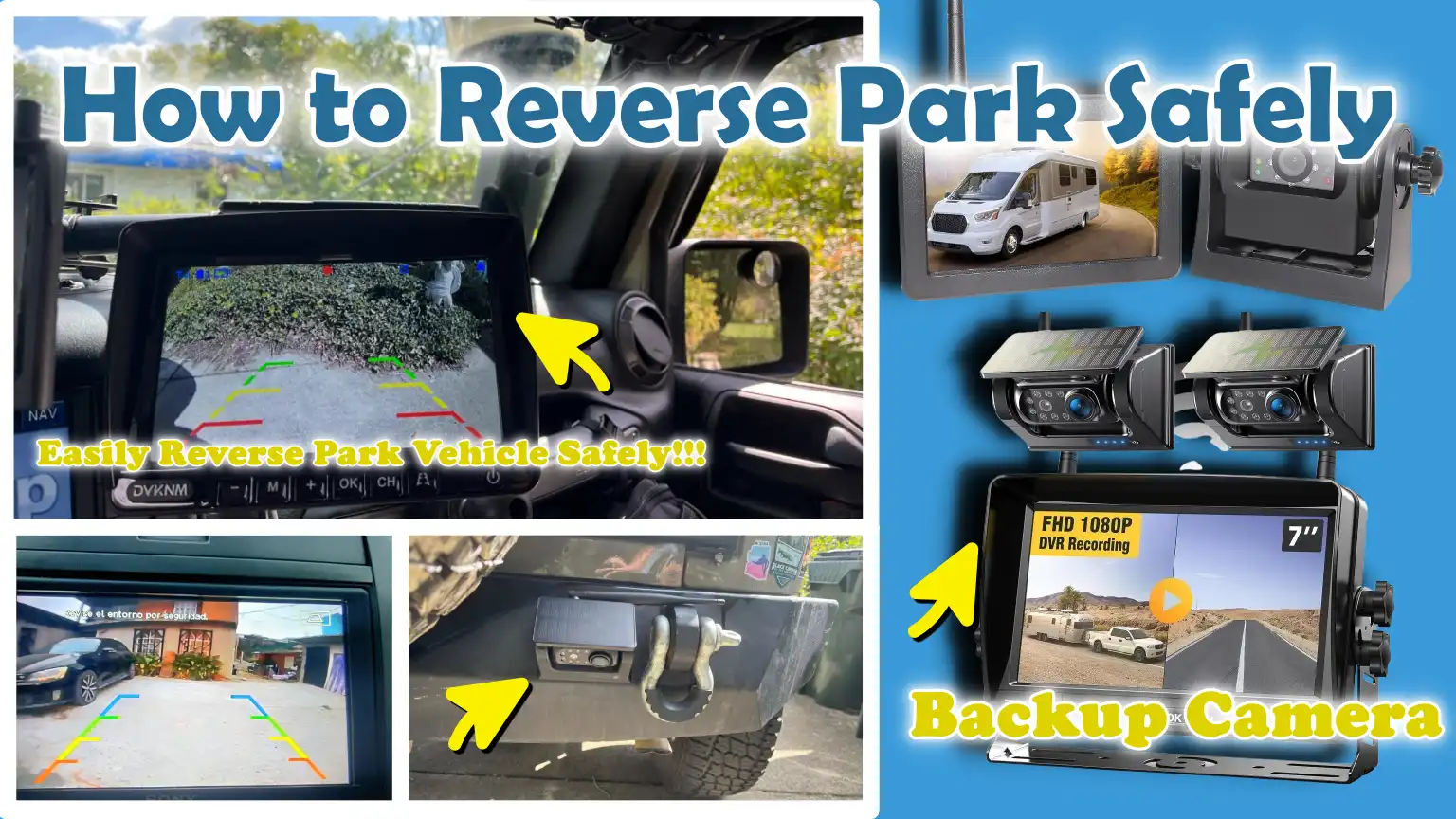
Now-a-days, modern vehicles do come with rearview cameras and parking sensors, that actually assists the driver: so that you can have better assistance, but at the end of the day you have to observe, use the mirror and carefully steer till the parking.
Now, in this guide you’ll learn How to Reverse Park Safely so that you can easily reduce that stress and have controlled parking technique.
Know, The Real Importance of Reverse Parking Safety
Reverse parking safety is crucial because many driving risks occur in confined spaces, where drivers have limited visibility and less time to react.
In parking lots, residential areas and congested streets, vehicles operate in close proximity to one another, often with pedestrians nearby, thereby increasing the likelihood of low-speed collisions.
When executed correctly, reverse parking encourages the driver to proceed slowly, maintain full control over the vehicle and carefully monitor their surroundings using mirrors and direct observation.
It also facilitates a safer exit later on, as driving forward out of a parking space provides a wider and clearer view of surrounding traffic.
This subtle shift in approach reduces stress, improves decision-making capabilities and helps prevent common errors that could result in scratches or dents to the vehicle, or even lead to more serious accidents.
Over time, practicing safe reverse parking enhances situational awareness and makes daily driving both easier and safer.
1. Reduces the Risk of Accidents
Reverse parking primarily reduces the risk of accidents because it compels the driver to operate the vehicle at a very low speed while simultaneously helping them maintain full control over the vehicle.
At lower speeds, if an unexpected obstruction suddenly appears such as: a pedestrian, another vehicle, or a physical barrier, drivers have more time to react.
This controlled pace makes it easier to make steering adjustments and to correct errors before they escalate into serious accidents.
Another major safety benefit is that once a vehicle has been successfully reverse-parked, the driver can exit the parking space by driving forward, thereby gaining a significantly better view of the road ahead.
The ability to look forward is always clearer than blindly backing out into traffic, specially in busy parking areas where cars, motorcycles and pedestrians move about unpredictably.
This combination of maneuvering in slowly and exiting with a clear line of sight significantly reduces the likelihood of collisions.
2. Improves Traffic Flow
Reverse parking also helps improve traffic flow, particularly in busy areas where numerous vehicles are entering and exiting parking spaces.
When drivers park head-first into a spot, they often have to perform additional maneuvers to position their vehicle correctly; this can force other vehicles to stop and cause unnecessary delays.
Conversely, reverse parking typically allows a vehicle to be parked with greater precision in a single, continuous motion, provided, of course, that it is executed correctly.
Even more importantly, exiting the parking space becomes faster and safer, as the driver can merge directly into the flow of traffic while maintaining a full view of their surroundings.
This minimizes the hesitation and confusion that often cause traffic to slow down within parking lots.
Consequently, reverse parking not only benefits the driver but also makes movement easier and smoother for everyone else in the vicinity.
3. Boosts Driver Confidence
Learning to reverse-park significantly boosts a driver’s confidence, as it strengthens their command over the vehicle and enhances their spatial awareness of the surrounding environment.
Drivers begin to develop an intuitive understanding of how their vehicle handles in tight spaces, the amount of clearance required to execute turns and how to accurately gauge distances by effectively utilizing their mirrors and vision.
These skills are indispensable for navigating real-world driving scenarios where space is limited and precision is paramount.
For novice drivers, mastering reverse parking helps overcome fear and hesitation; for experienced drivers, it further refines their precision and consistency.
As confidence grows, drivers become capable of making quicker, safer decisions without becoming flustered.
This not only enhances their parking proficiency but also has a positive impact on their overall driving performance in challenging situations.
What are the Types of Reverse Parking
Reverse parking is not merely a single method, but rather a collection of distinct techniques employed in various real-world scenarios, depending on road design, space availability and traffic conditions.
Each type of reverse parking is designed to assist drivers in parking their vehicles safely and efficiently, while simultaneously facilitating vehicle control and providing clear visibility of the surrounding environment.
Understanding these various methods is crucial, as every parking situation is unique; utilizing the correct technique minimizes the risk of errors, saves time and enhances safety.
Whether you are parking on a busy street, inside a shopping mall, or within a commercial parking facility, mastering the appropriate reverse parking technique enables you to park with confidence and precision, even when space is extremely limited.
1. Reverse Parallel Parking
Reverse parallel parking is utilized when you need to park your car along the side of a road, specifically between two other vehicles; this is a very common occurrence on urban streets where space is at a premium.
In this method, the driver maneuvers the vehicle backward into a tight space, carefully turning the steering wheel to align the car parallel to the curb.
This type of parking demands excellent vehicle control, precise timing and an accurate judgment of distance, as the available space is often quite restricted.
It is generally considered one of the most challenging parking techniques; however, it also offers several significant safety advantages.
Once the vehicle is parked, the driver can easily merge back into traffic by driving forward, as they have a clear and unobstructed view of the road ahead.
This reduces “blind spots” (areas of the vehicle that are not visible to the driver) and makes it easier to safely merge back into the flow of traffic.
Over time, practicing reverse parallel parking improves accuracy and drivers feel more comfortable when parking in tight spaces.
2. Reverse Perpendicular Parking
Reverse perpendicular parking is used when a vehicle needs to be parked in a space situated at a 90-degree angle to the road; this is commonly observed in parking lots, shopping centers and malls.
In this method, the driver maneuvers the vehicle straight backward into a designated parking slot, which is often situated between two painted lines or other parked vehicles.
Compared to parallel parking, this method is generally considered easier because the parking space is typically wider and more clearly defined, making it simpler to position the vehicle correctly.
Another advantage of backing a vehicle into a parking space is that exiting the spot later is safer, as the driver can drive out facing forward, providing a clear view of their surroundings, rather than having to back out blindly.
This is particularly beneficial in busy parking areas with heavy pedestrian and vehicular traffic.
Due to its simplicity and safety benefits, reverse perpendicular parking is recommended for both new and experienced drivers.
3. Reverse Angle Parking
Reverse angle parking is utilized when vehicles need to be parked in spaces that are positioned at an angle, typically between 30 and 60 degrees.
This type of layout is frequently found in commercial parking areas and on certain types of streets.
In this method, the driver maneuvers the vehicle backward into the angled parking space.
Compared to parallel parking, this technique often requires less effort on the steering wheel, allowing the vehicle to fit into the space with considerably greater ease.
The primary advantage of reverse angle parking is that it enables drivers to exit the spot easily by driving forward, as they have a clear view of the path ahead.
This enhances safety and minimizes potential complications in congested areas.
It also aids in maintaining a continuous flow of traffic, as vehicles can enter and exit parking spaces more smoothly.
This type of parking is particularly beneficial in high-traffic zones, as it offers improved visibility and safety alongside ease of use.
How to Prepare Before Reverse Parking
Proper preparation before reverse parking is one of the most critical steps to ensure safety and precision, as most parking errors occur when drivers rush or fail to carefully observe their surroundings.
Parking areas often feature moving vehicles, pedestrians, stationary obstacles and limited space; this means that a driver should gather as much information as possible before initiating the reverse parking maneuver.
Thorough preparation helps the driver plan their vehicle’s path, select the correct angle and avoid making sudden corrections, thereby preventing confusion or collisions.
By spending a few extra seconds observing their surroundings, making necessary adjustments and signaling, drivers can mitigate risks, enhance control and make the entire reverse parking process smoother and more predictable.
1. Check Your Surroundings
Checking your surroundings is paramount, as the ability to see directly ahead is significantly reduced during reverse parking; consequently, drivers must rely heavily on their situational awareness both before and during the reversing process.
This involves keeping an eye out for pedestrians who may be walking behind the vehicle, other vehicles approaching from either side and obstacles such as posts, curbs, or uneven terrain.
Utilizing side mirrors and the rearview mirror provides a clear view of what is happening around the vehicle; however, it is equally important to glance over your shoulder to check for “blind spots”, areas that are not fully visible in the mirrors.
Studies on parking safety indicate that many low-speed collisions are caused by overlooking these blind spots.
Therefore, utilizing mirrors in conjunction with looking directly behind provides a more comprehensive view of the surrounding environment.
Carefully checking the surroundings before reversing helps prevent sudden accidents and enables the driver to maneuver with confidence.
2. Adjust Mirrors Correctly
Properly adjusting the mirrors is crucial for accurate and safe reverse parking, as mirrors serve as the primary means for the driver to monitor their surroundings and maintain the correct direction while reversing.
Side mirrors should be adjusted such that they display both the side of the vehicle and the ground or curb; this aids in positioning the vehicle correctly within the parking space.
The rearview mirror helps in estimating the distance from objects located behind the vehicle, making it easier to stop at the right moment and preventing the vehicle from getting too close to any obstacles.
If mirrors are not adjusted correctly, they can create “blind spots”, areas that remain invisible, or lead to misjudgments of distance; this significantly increases the risk of colliding with nearby objects.
Taking a few moments to properly adjust the mirrors provides a better sense of the surrounding space, simplifies the driving process and ensures that the vehicle is parked exactly where you intend it to be.
3. Use Turn Indicators
Using turn indicators before reverse parking is essential, as it signals the driver’s intentions to other road users; this minimizes confusion and enhances overall safety.
When a driver signals in advance, surrounding vehicles understand that the vehicle is about to slow down and is preparing to reverse into a specific spot; this gives them ample time to adjust their speed or maintain a safe distance.
This practice is particularly crucial in congested parking areas or on roads where multiple vehicles are traveling in close proximity to one another.
Without proper signaling, other drivers may attempt to overtake or close in, thereby increasing the likelihood of a collision.
The clear and timely use of turn indicators fosters a safe environment by ensuring that everyone in the vicinity is aware of the driver’s intended next move.
4. Speed Control
Maintaining control over speed is one of the most critical aspects of reverse parking; driving at a slow pace allows for better vehicle control, provides ample time to react and facilitates more precise maneuvering.
The vehicle should always be driven at a very low speed and this speed should be regulated primarily by applying gentle pressure to the brakes, rather than by using the accelerator to increase momentum.
At low speeds, minor steering errors can be easily corrected, thereby preventing the vehicle from deviating off course.
In vehicles equipped with a manual transmission, maintaining control over the clutch is equally important, as it helps keep the vehicle’s speed steady and smooth, thereby preventing sudden jerks or engine stalling.
Proper coordination between the clutch and the brakes allows the driver to inch the vehicle forward gradually when necessary, a technique that proves particularly useful in tight spaces.
Maintaining a slow and steady pace enhances precision, reduces stress and significantly minimizes the risk of accidents.
How to Reverse Park Safely – Easy to Follow
Reverse parking becomes significantly easier and safer when broken down into clear, sequential steps; this is because each action builds upon the previous one, helping the driver maintain complete control over the vehicle.
Many parking errors occur when drivers skip steps, rush through the process, or make sudden turns without properly checking their surroundings.
By adopting a systematic approach, drivers can enhance their precision, reduce stress and avoid common mistakes such as: colliding with nearby objects or failing to align the vehicle correctly.
This method emphasizes moving slowly, constantly monitoring the surrounding environment and making minor adjustments, all of which are essential for safe and effective reverse parking in any situation.
1. Position Your Vehicle Correctly
The first step is to position your vehicle correctly before reversing, as starting from the right spot makes the entire parking process much easier and more precise.
The vehicle should be positioned directly alongside, or slightly ahead of, the designated parking space, depending on the specific type of parking maneuver being performed.
It is crucial to maintain a safe distance from already parked vehicles to ensure there is ample room to turn the steering wheel and to eliminate any risk of collision.
Correctly positioning the vehicle at the outset minimizes the need for repeated adjustments later on and helps establish a clear path for reversing the vehicle into the designated parking spot.
2. Engage Reverse Gear
Once the vehicle is correctly positioned, the next step is to engage the reverse gear and prepare to back up slowly.
The driver should keep their foot on the brake pedal at all times to maintain control over the vehicle’s speed and to ensure that the vehicle can be brought to an immediate halt if necessary.
Driving slowly is crucial, as it provides ample time to observe the surroundings and execute minor, precise adjustments to the steering.
Reversing suddenly or rapidly increases the risk of losing control of the vehicle and misjudging distances, potentially leading to a collision.
Reversing slowly and with control forms the foundation of safe parking.
3. Turning the Steering Wheel
Turning the steering wheel at the right moment and in the correct direction is a vital component of reverse parking, as it determines the vehicle’s trajectory into the parking space.
The direction in which you turn the steering wheel depends on the specific type of parking maneuver you are performing such as: parallel, perpendicular, or angled parking.
Steering adjustments should always be executed gradually and with control, rather than abruptly or rapidly; sudden steering inputs can cause the vehicle to turn too sharply, preventing it from aligning correctly within the designated space.
By making small, gradual adjustments to the steering, the driver can maintain the vehicle’s balance and control, thereby ensuring that the vehicle is parked accurately in the intended spot.
4. Monitoring All Angles
When reversing, it is essential to continuously monitor all angles surrounding the vehicle to remain aware of any changes in the immediate environment.
This involves checking the side mirrors and rearview mirror, as well as performing quick over-the-shoulder glances to check for blind spots (areas not directly visible).
If the vehicle is equipped with a rearview camera, it can serve as an additional aid in judging distances; however, it should not be considered a substitute for direct visual observation.
Maintaining constant vigilance allows the driver to identify pedestrians, moving vehicles, or obstacles in advance and react safely.
When parking at low speeds, careful observation and accurate judgment constitute the most effective method for avoiding accidents.
5. Straightening the Vehicle
As the vehicle enters the parking space, the driver should straighten the steering wheel so that the car aligns correctly within the designated lines or boundaries of the spot.
This step ensures that the vehicle is parked centrally and squarely, leaving ample clearance on both sides.
Proper alignment is essential not only for a neat parking job but also to facilitate easy door opening and to leave adequate space for adjacent vehicles.
Making gradual adjustments to the steering while reversing helps guide the vehicle into a straight and balanced position.
6. Final Adjustments
Once the vehicle is largely settled in its spot, some final adjustments may be required to refine the parking position.
This may involve moving the vehicle slightly forward or backward to further straighten it or to establish an equal distance from neighboring cars.
These minor adjustments are common practice and ensure that the vehicle is parked safely and neatly within the designated space.
Taking a moment to make these adjustments minimizes the risk of any inconvenience or damage when entering or exiting the vehicle later on.
Proper parking technique demonstrates the driver’s excellent command over the vehicle.
Know, Basic Safety Tips for Reverse Parking
In reverse parking, safety relies not on speed or shortcuts, but on awareness, patience and consistently good habits.
Most parking-related incidents occur at low speeds; nevertheless, they result in damage, injury, or stress because drivers often underestimate the importance of careful observation and maintaining control.
A safe approach to reverse parking involves taking full responsibility for checking your surroundings, utilizing available equipment correctly and maneuvering the vehicle at a slow, controlled speed.
These safety tips are grounded in real-world driving scenarios where space is limited, visibility is restricted and the sudden movement of people or vehicles is commonplace.
By adopting these simple yet effective strategies, drivers can significantly mitigate risks, enhance precision and make reverse parking a smooth and confident experience.
1. Always Check for Blind Spots
Checking for blind spots is crucial, as mirrors alone cannot reveal every area surrounding the vehicle.
There are always small zones along the sides and rear of the vehicle where objects or people remain invisible in the mirrors, particularly when you are reversing at an angle.
Therefore, in addition to using mirrors, drivers should always perform a quick visual check of their surroundings by looking over their shoulder.
Checking for blind spots becomes even more critical in parking areas, where pedestrians, children, or small objects may suddenly appear behind the vehicle.
Relying solely on mirrors increases the risk of overlooking these hazards, whereas combining mirror usage with direct visual checks provides a more comprehensive and safe view of the immediate environment.
2. Use Technology Wisely
Modern vehicles are often equipped with parking sensors and rearview cameras.
These are highly useful tools for reverse parking; However, these devices should be used merely as aids, rather than as substitutes for the driver’s own situational awareness.
Sensors can provide warnings by detecting objects and cameras can display the view behind the vehicle; nevertheless, they may not always detect every minute detail or react instantly to rapidly changing conditions.
For instance, small objects, uneven terrain, or fast-moving pedestrians may not always be clearly visible.
Drivers must always exercise their own judgment in conjunction with the use of these devices and should also rely on mirrors and direct visual checks.
When used correctly, technology enhances accuracy and confidence; yet, safe parking ultimately depends entirely on the driver’s attention and control.
3. Avoid Rushing
When reverse parking, avoiding haste is one of the simplest yet most effective safety measures, as rushing often leads to poor decision-making and errors.
When drivers rush, they may overlook essential checks, turn the steering wheel too abruptly, or misjudge distances and available space.
Reverse parking is a task that requires a calm and steady approach; taking a few extra seconds can prevent costly mistakes.
Moving slowly provides ample time to observe, think and correct the vehicle’s positioning.
A patient approach not only enhances safety but also makes the parking experience smoother and more precise.
4. Be Alert to Pedestrians
It is crucial to remain alert to pedestrians while reverse parking, as people are often less predictable than vehicles and may walk behind a car without realizing that it is reversing.
This is particularly common in congested areas, such as shopping centers, residential neighborhoods and busy streets.
Children, in particular, can move quickly and, due to their small stature, may not be visible in rearview mirrors.
Drivers should always assume that someone might be behind their vehicle and should proceed slowly while constantly keeping an eye on their surroundings.
Paying close attention to the movements of pedestrians helps prevent accidents and ensures a safe environment for everyone.
5. Practice Regularly
Regular practice is essential for mastering reverse parking, as it helps drivers gradually develop better vehicle control, the ability to accurately judge spatial distances and confidence.
Through repeated practice, drivers learn to estimate distances more precisely, understand how their vehicle responds to steering inputs and become adept at maneuvering even in tight spaces.
Practice also helps in overcoming fear and hesitation, common causes of errors among new drivers.
Over time, reverse parking transforms from a stressful task into a natural and intuitive process.
Consistent practice in various settings such as: empty parking lots and moderately congested areas, helps in developing strong and reliable driving skills.
Know, Common Mistakes While Reversing the Vehicle for Park
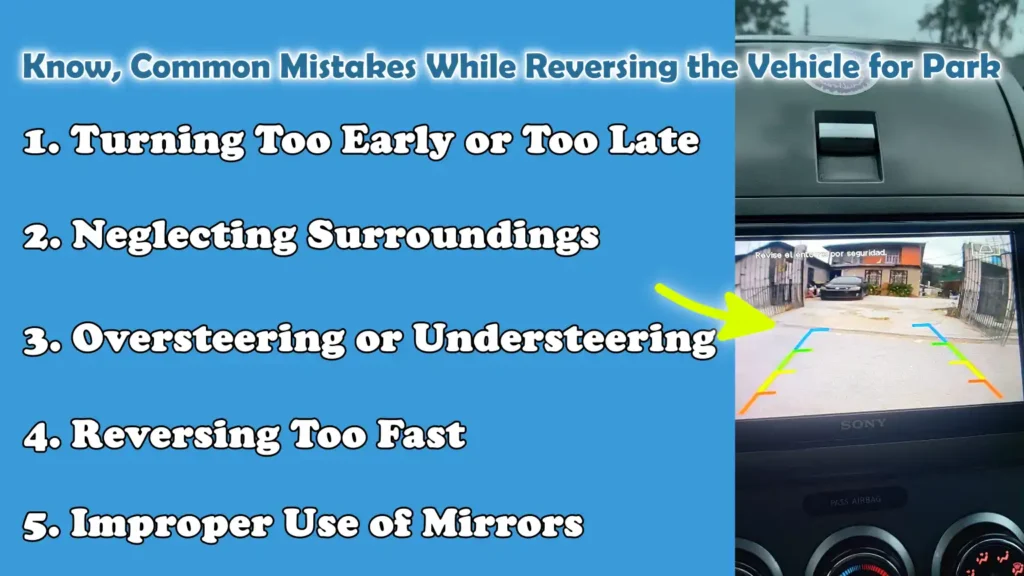
Mistakes in reverse parking typically do not occur because the task itself is inherently difficult, but rather because minor errors in timing, observation, or vehicle control can instantly alter the car’s positioning within a confined space.
As there is very little room to correct errors within a parking spot, even a slight misjudgment can throw off the vehicle’s alignment, necessitating repeated adjustments or risking collisions with surrounding objects.
Understanding the most common mistakes helps drivers identify what is going wrong and how to prevent it.
By focusing on precise timing, comprehensive situational awareness, smooth steering inputs, slow speeds and the proper use of mirrors, drivers can avoid unnecessary stress while reverse parking and significantly improve both safety and accuracy.
1. Turning Too Early or Too Late
Turning the steering wheel at the wrong moment is one of the most common errors and it directly impacts how the vehicle enters the parking space.
If a driver turns too early, the vehicle may veer too far to one side, increasing the risk of colliding with another car or the curb.
Conversely, if the turn is initiated too late, the vehicle may fail to fit properly into the space, resulting in poor alignment or leaving the car protruding outward.
Precise timing is crucial, as successful reverse parking depends on guiding the vehicle at the correct angle.
Learning exactly when to begin turning, based on the vehicle’s position and distance, facilitates a smooth and accurate entry into the parking spot.
2. Neglecting Surroundings
Neglecting one’s surroundings significantly increases the risk of collision, as parking areas are dynamic environments featuring moving vehicles, pedestrians and fixed obstacles.
When drivers fail to check their mirrors, blind spots, or the immediate vicinity of their vehicle, they may overlook critical details such as: a pedestrian walking behind them, an approaching vehicle, or an object situated near the roadway.
This lack of situational awareness often heightens the risk of sudden braking, panic, or accidents.
Remaining vigilant and continuously monitoring one’s surroundings ensures that the driver can react promptly and make safe decisions throughout the entire reverse parking process.
3. Oversteering or Understeering
Oversteering and understeering are common errors that impact how effectively a vehicle aligns itself within a parking space.
Oversteering occurs when the steering wheel is turned too sharply, causing the vehicle to pivot rapidly at an angle and veer excessively to one side.
Understeering occurs when the wheel is not turned sufficiently; this results in a turning arc that is too wide, preventing the vehicle from entering the parking space correctly.
In both scenarios, the vehicle ends up in an awkward position, requiring additional effort to straighten it out.
It is crucial to turn the steering wheel smoothly and with control, as this allows the driver to gradually guide the vehicle in the correct direction while maintaining balance during the reversing maneuver.
4. Reversing Too Fast
Reversing at excessive speed diminishes the driver’s ability to react promptly and correct errors in a timely manner.
Reverse parking should always be executed at a very slow speed, as tight spaces require precise control and careful observation.
When a vehicle moves too quickly, it becomes difficult to judge distances, make steering adjustments, or stop safely in the event of a sudden obstruction.
Reversing rapidly increases the risk of colliding with nearby vehicles, curbs, or other obstacles.
Maintaining a slow speed allows the driver to retain control over the vehicle, think clearly and take appropriate action.
5. Improper Use of Mirrors
Failure to use mirrors correctly prevents a driver from accurately judging distances and spatial relationships, a major cause of errors during parking.
Mirrors provide essential information regarding the vehicle’s position relative to its surroundings; however, it is crucial to check them regularly and utilize them correctly.
If a driver checks the mirrors only occasionally, or misinterprets the images reflected within them, it becomes difficult to gauge the vehicle’s distance from other cars or boundaries.
The proper use of mirrors involves checking them frequently, understanding the angles of reflection and cross-referencing the images seen in the mirrors with direct visual observation.
This helps the driver maintain proper alignment while parking and avoid unnecessary collisions with surrounding objects.
How to Reverse Parking in Different Situations
Reverse parking is not always performed under ideal conditions; several factors such as: visibility, available space and their impact on vehicle control, as it can make this process significantly more challenging.
Drivers often face situations involving low light, limited space, uneven surfaces, or heavy congestion caused by pedestrians and other vehicles; each of these scenarios requires slight adjustments to one’s technique.
Adapting to these specific circumstances is crucial; while the fundamental steps of reverse parking remain consistent, it becomes essential to heighten one’s vigilance, speed control and awareness of the immediate surroundings.
By modifying their driving technique to suit the ambient environment, drivers can maintain safety, avoid common errors and handle even the most difficult parking situations with confidence.
1. Parking at Night
Extra caution is required when parking at night, as low light conditions make it difficult to accurately judge distances, clearly identify obstacles and spot pedestrians.
Even with the aid of streetlights or the vehicle’s own headlights, shadows and glare can interfere with depth perception and create “blind spots.”
Therefore, drivers should rely on adequate illumination, utilizing both headlights and reverse lights, and proceed at a very slow pace to allow themselves sufficient time to assess their surroundings.
Frequently checking mirrors and pausing briefly at intervals can help improve visibility.
Moving slowly also gives the eyes time to adjust to changing light conditions, making it easier to identify objects and avoid collisions.
2. Parking in Limited Spaces
Parking in tight spaces requires precise vehicle control and careful steering, as the margin for error is extremely narrow.
In such situations, even a slight misjudgment of angles or speed can result in the vehicle being positioned incorrectly or colliding with nearby vehicles or obstacles.
Rather than making sweeping turns by aggressively turning the steering wheel, drivers should make very small, gradual adjustments; this facilitates easy and trouble-free parking of the vehicle within the designated space.
Maintaining a very low vehicle speed ensures better control and makes it easier to bring the vehicle to an immediate halt if necessary.
Throughout the parking process, frequently checking mirrors and making minor corrections helps ensure that the vehicle is positioned correctly within the available space, thereby avoiding any unnecessary stress.
3. Parking on Slopes
Parking on a slope introduces an additional layer of difficulty, as gravity influences the vehicle’s movement, particularly when reversing.
Whether the vehicle is facing uphill or downhill, if not properly controlled, it may roll faster than anticipated.
Therefore, it is crucial to engage the handbrake whenever necessary to keep the vehicle stationary, specially when coming to a halt or maneuvering into the final parking position.
For vehicles equipped with a manual transmission, selecting the appropriate gear and carefully modulating the clutch ensures that the vehicle moves forward at a steady pace without any sudden jerks.
Drivers should proceed slowly and remain prepared to stop at any moment.
Maintaining complete control over the vehicle on a slope minimizes the risk of it inadvertently rolling backward or forward, thereby ensuring that the vehicle remains secure once parked.
4. Parking in Crowded Areas
Parking in crowded areas requires a great deal of caution and patience, as other vehicles and pedestrians are constantly moving about nearby.
Drivers may feel pressured by other vehicles waiting behind them; if this pressure is not handled calmly, haste can lead to errors.
When reverse parking, it is crucial to maintain focus, use indicators clearly and disregard external pressure.
It is essential to constantly monitor your surroundings, as people and vehicles may suddenly approach from various directions.
Moving slowly and taking ample time to park ensures that the maneuver is executed safely and correctly, regardless of how crowded the area may be.
In such situations, exercising patience not only enhances safety but also improves your overall vehicle control and decision-making abilities.
Read More:
- How to Parallel Park
- How to Park Safely on Busy Streets
- How to Drive in Heavy Traffic Safely
- How to Drive on Highways Safely
- How to Merge Lanes Safely
- How to Overtake Safely
- How to Use Turn Signals Properly
- How to Fix Turn Signals on a Car
- How to Check Blind Spot While Driving
- How to Use Mirrors When Driving
- How to Use ABS Brakes Properly
- How to Brake Safely on Steep Roads
- How to Drive Uphill Safely
- How to Drive Safely in Strong Winds
- How to Prevent Aquaplaning
Know, Some Benefits of Mastering Reverse Parking
Mastering reverse parking offers both safety and practical benefits in daily driving, particularly in areas where space is limited and traffic flow is unpredictable.
Parking lots and urban streets are common sites for low-speed accidents, as drivers often have limited visibility and less time to react.
Reverse parking helps resolve this issue by allowing drivers to enter a space slowly and carefully and subsequently exit with a clear, forward-facing view.
This improves decision-making, mitigates risks and renders the parking process more controlled and efficient.
Over time, this also boosts confidence and reduces the stress that many drivers experience when parking in challenging situations.
Not only this, there’s study that clearly shows that reverse parking is not just a convenience but a proven safety strategy as well, so by reversing into a well controlled space instead of reversing into moving traffic: the drivers significantly reduces the risk of collisions, that makes it really important technique for safer driving.[¹]
1. Enhanced Safety for Drivers and Pedestrians
Reverse parking enhances safety by enabling drivers to exit a parking space moving forward, thereby providing them with a wider and clearer view of their surroundings.
When drivers back out of a space, their field of vision is restricted, making it difficult to spot pedestrians, cyclists, or approaching vehicles in time.
Conversely, by backing into a space, drivers execute the more complex maneuvers associated with parking at a slow and controlled speed.
This significantly reduces the likelihood of sudden collisions.
It also safeguards pedestrians, particularly in congested areas where people may inadvertently walk behind vehicles.
2. Reduced Stress While Parking
Reverse parking alleviates stress by making the parking experience more predictable and manageable.
Many drivers feel pressured while parking, specially in busy areas where other vehicles are waiting.
When practiced regularly, reverse parking becomes a routine procedure requiring fewer adjustments and less guesswork.
Drivers no longer have to struggle with awkward angles when exiting, often the most stressful part of the process.
This sense of control and preparation helps drivers remain calm and confident, even in tight or busy parking situations.
3. Enhanced Vehicle Control in Limited Spaces
Reverse parking improves vehicle control by teaching drivers how to maneuver their cars in tight and confined spaces.
It develops critical skills such as precise steering, accurate distance estimation and smooth speed control.
While reversing slowly, drivers learn how subtle adjustments to the steering wheel affect the vehicle’s movement, enabling them to make better corrections.
These skills are invaluable not only for parking but also for driving on narrow streets, in heavy traffic, or in complex road conditions.
Over time, this enhances one’s ability to handle a vehicle with greater precision and efficiency.
4. Essential Driving Skill for Urban Environments
In today’s urban environment, reverse parking is an essential skill, as parking spaces are often scarce and traffic is constant.
Urban parking areas are frequently congested, streets are narrow and pedestrian activity is high; therefore, drivers must be extremely precise and vigilant.
Reverse parking helps drivers adapt to these conditions by making the parking process more controlled, which, in turn, makes exiting the space safer.
It also improves traffic flow, as vehicles can exit parking spots more quickly and easily without causing obstructions to other motorists.
In today’s driving landscape, mastering reverse parking is not merely helpful, it is absolutely essential for safe and efficient driving.
Conclusion – How to Reverse Park Safely
So, in the modern driving, where space is already really limited and movement is really constant, that’s why reverse parking becomes a actual smart and necessary habit to learn.
In everyday driving, situations frequently arise where space is limited, visibility is poor and pedestrians or other vehicles may move unpredictably.
In such scenarios, reverse parking offers a distinct advantage, as it allows the driver to maneuver slowly into a spot and then exit while facing fully forward, a process that is invariably safer and easier to manage.
This straightforward approach helps mitigate the risk of low-speed collisions, which account for a significant portion of common vehicle damage.
By understanding the correct techniques, avoiding common errors and adapting to varying circumstances, drivers can transform reverse parking into a simple and reliable process.
Skills such as the proper use of mirrors, precise steering timing, speed control and situational awareness combine to enhance both accuracy and safety.
Over time, consistent practice further reinforces these capabilities, making the act of parking less stressful and more instinctive.
Also, you can ask related questions below this guide.
Frequently Asked Questions
Q1. What is reverse parking and why is it important?
Answer: Reverse parking means maneuvering your vehicle into a parking space by backing in, rather than driving in forward-first. This is important because it provides you with better control over the vehicle while entering the space and it is safer when exiting, as you can drive forward while maintaining a clear view of the road ahead. This reduces the likelihood of accidents, particularly in crowded parking areas where visibility is often limited.
Q2. Is reverse parking safer than forward parking?
Answer: Yes, in most situations, reverse parking is considered safer. When you back your vehicle into a parking space, you execute the most difficult part of the maneuver, entering the space, slowly and cautiously. Later, when you exit, you drive forward, which gives you a wider and clearer view of traffic, pedestrians and potential obstacles. This helps prevent sudden collisions, which often occur when drivers back out of parking spaces without adequate visibility.
Q3. Why do people find reverse parking difficult?
Answer: Many people find reverse parking difficult because it requires simultaneously managing steering, mirror usage and speed control. It also involves judging distances and angles, which can be confusing for beginners. However, with regular practice and a gradual learning approach, it becomes much easier and more natural over time.
Q4. How can I quickly improve my reverse parking skills?
Answer: You can improve your reverse parking skills by practicing in a quiet, open area such as: an empty parking lot. Focus on moving slowly, utilizing your mirrors correctly and making small, precise adjustments to the steering. Regular practice helps you understand how your vehicle handles and boosts your confidence, which is the key to improvement.
Q5. What is the most common mistake made during reverse parking?
Answer: One of the most common mistakes is turning the steering wheel either too early or too late, which prevents the vehicle from straightening out properly within the parking space. Other common errors include failing to pay adequate attention to the surrounding environment, driving too fast and not utilizing the mirrors correctly. By avoiding these mistakes, you can significantly improve the precision of your parking.
Q6. Should I rely entirely on parking sensors and cameras?
Answer: Parking sensors and rearview cameras are extremely helpful tools, but you should not rely exclusively on them. They are designed to assist you, not to replace your own judgment and situational awareness. You should always check your mirrors and physically look around your surroundings to ensure there are no blind spots or hidden obstacles.
References:
[1] Safety effects of parking maneuvers
https://www.sciencedirect.com/science/article/abs/pii/S1369847819308812

Guys, I’m a car audio enthusiast and customization expert and I love clear sound and clean installation. Plus, I have spent years helping people build their dream audio setups. And whenever I’m working on cars, I probably listen to music and thinks about the next big upgrade.