 Skip to content
Written By: Don Dodi
Fact Checked By: Kristen Brown
Reviewed By: Diego Rosenberg
You need to understand that: your vehicle’s simple camera can help you to prevent one of the most common driving mistakes.
As, this lane assist features is really important safety technologies in modern vehicles, specially as now-a-days the road traffic continues to increase and driver distraction remains a leading cause of accidents during the journey.
Basically, these systems are the part of advanced driver-assistance technology which is also known as ADAS and it is designed to help the drivers to stay safely within their lane by using those cameras to read road markings in real time.
Plus, in the United States, there’s data from the NHTSA that shows that a thousands of crashes each year are linked to the unintentional lane departures, which is the exact type of risk lane assist actually build to reduce.
So, when you use it correctly, then these features such as: lane departure warning and lane keeping assist actually provide the timely alerts or gentle steering support to prevent drifting, specially during the long drives or moments of reduced attention as well.
Now, in this guide you’ll learn How to Use Lane Assist Features so that you can understand how to properly use these features, when to actually relies on them and where their limits are can make a really significant difference by improving safety during journey.
What Are Lane Assist Features?
Lane assist features are advanced safety technologies integrated into modern vehicles that help drivers maintain their proper position within their lane and reduce the risk of inadvertently drifting into an adjacent lane.
These systems fall under a broader category known as Advanced Driver-Assistance Systems (ADAS).
They primarily function by utilizing a forward-facing camera, typically mounted near the windshield, to detect lane markings on the road.
In many vehicles, these systems can recognize both solid and broken lines and they track the vehicle’s position relative to these markings in real time.
Studies conducted by the National Highway Traffic Safety Administration (NHTSA) indicate that lane departure is a major contributing factor to serious highway accidents; consequently, these features are designed to serve as an additional layer of safety rather than as a replacement for the driver.
They are particularly beneficial during long journeys, while traveling on highways and in situations where driver fatigue or distraction may be a concern.
By issuing alerts or providing subtle steering assistance, lane assist features help drivers make timely corrections to their course, thereby making the driving experience smoother, safer and more controlled.
1. Know About the Lane Assist
Lane assist is a suite of safety systems that continuously monitors a vehicle’s position within its lane and helps prevent it from inadvertently drifting out of that lane.
These systems operate by analyzing road markings and detecting when the vehicle begins to drift out of its lane without an active turn signal, an indication that the lane departure was likely unintentional.
When such an event occurs, the system responds either by issuing a warning to the driver or by providing corrective steering assistance, depending on the specific features equipped in the vehicle.
It is crucial to understand that Lane Assist is designed to assist the driver, not to take complete control of the vehicle; this means that the driver must always remain alert, keep their hands on the steering wheel and be prepared to take action at any moment.
2. Types of Lane Assist Systems
Lane Assist systems come in various forms and each system operates in a slightly different manner to enhance both safety and driving comfort.
Although they all focus on keeping the vehicle within its lane, they differ in the methods they employ to assist the driver.
Some systems provide warnings only, while others can help maintain the vehicle’s position within the correct lane by making subtle steering corrections.
Understanding these different types of systems helps drivers utilize this technology more effectively, while also dispelling misconceptions regarding what the system can, and cannot, do in actual driving situations.
Lane Departure Warning – LDW
Lane Departure Warning is the most basic type of Lane Assist system and its primary function is to alert the driver when the vehicle begins to drift out of its lane without the turn signal being activated.
It does not take control of the vehicle itself; instead, it provides a clear warning through audio signals, dashboard messages, or vibrations in the steering wheel or seat.
This feature is particularly effective in preventing accidents caused by driver distraction such as: checking a phone or experiencing fatigue during long drives.
By providing a timely warning, LDW gives the driver the opportunity to correct the vehicle’s trajectory before the situation becomes hazardous.
Lane Keeping Assist – LKA
Lane Keeping Assist takes safety a step further; it not only warns the driver but also makes subtle steering adjustments to guide the vehicle back into its lane.
When the system detects that the vehicle is drifting out of its lane, it automatically applies minor steering corrections to ensure the vehicle remains aligned with the lane markings.
This assistance is typically very intuitive and gentle, designed to support the driver without causing any disruption or discomfort.
However, the driver must still keep their hands on the steering wheel and maintain full control of the vehicle, as this system is not capable of automatically handling all driving situations.
Lane Centering Assist – LCA
Lane Centering Assist is a more advanced version of Lane Assist; rather than merely correcting the vehicle after it has drifted out of its lane, it actively helps maintain the vehicle’s position precisely in the center of the lane.
This system continuously monitors the vehicle’s position within the lane and makes constant, minute steering adjustments to maintain a balanced position between the lane markings.
It is often used in conjunction with Adaptive Cruise Control, particularly on highways, to enhance the driving experience.
While it can significantly reduce driver effort and fatigue, it still requires the driver’s full attention, as the system may not function effectively in situations where lane markings are unclear or where there are sharp curves.
Know, How Lane Assist Systems Work?
Lane assist systems operate by combining cameras, sensors and smart software.
They continuously monitor the vehicle’s position on the road and help keep it safely within lane boundaries.
Most modern vehicles are equipped with a forward-facing camera, typically mounted near the windshield.
This camera scans the road ahead and instantly identifies lane markings.
The system rapidly analyzes this visual data multiple times per second.
This allows it to determine the vehicle’s precise position relative to the lane lines and detect whether the vehicle is unintentionally drifting out of its lane.
According to safety research by the Insurance Institute for Highway Safety, when used correctly, these systems can significantly reduce certain types of accidents, particularly on highways, where lane markings are typically clear and consistent.
Subsequently, the system determines whether to issue a warning to the driver or provide slight steering assistance; the specific action taken depends on the particular lane assist system installed in the vehicle.
Although this technology is highly advanced, it is designed to assist the driver, not to replace them.
This means that drivers must always remain alert and be prepared to take full control of the vehicle at any moment.
1. Sensors and Cameras
Lane assist systems primarily rely on a forward-facing camera.
This camera continuously monitors the road ahead and identifies lane markings, such as white or yellow lines.
The camera is typically mounted behind the windshield, near the rearview mirror, to ensure it has a clear view of the road ahead.
In some vehicles, additional sensors such as: radar or infrared, may be utilized to further enhance detection capabilities, particularly in low-light conditions or when visibility is poor.
The camera captures images of the road and identifies patterns that correspond to lane markings.
This system continues to function even when lane markings are slightly worn or faded.
However, it performs optimally when lane markings are clearly visible.
Consequently, its performance may be slightly reduced under adverse conditions such as heavy rain, fog, snowfall, or poor road surfaces.
2. Software and Algorithms
Once the camera captures an image of the road, advanced software processes this information.
To accomplish this, it utilizes algorithms specifically trained to recognize lane boundaries and pinpoint the vehicle’s precise position within those boundaries.
In operation, this process runs continuously and at high speed.
This enables the system to react almost instantaneously if the vehicle begins to drift out of its lane.
The software also monitors factors such as vehicle speed, steering angle and the use of turn signals.
This allows it to distinguish whether a lane change is intentional or if the vehicle has inadvertently drifted out of its lane.
If no turn signal is detected and the vehicle begins to drift, the system identifies this as a potential hazard and prepares to intervene.
This intelligent decision-making capability makes the lane assist system both effective and accurate during real-world driving scenarios.
3. Steering and Alert Systems
When the system detects that the vehicle is drifting out of its lane, it responds, depending on the specific type of lane assist feature installed in the vehicle, either by issuing an alert or by providing steering assistance.
In standard systems, the driver receives a warning via audible signals, dashboard messages, or vibrations in the steering wheel or seat; this serves as an immediate reminder to correct the vehicle’s trajectory.
In more advanced systems, the vehicle gently corrects its steering to guide itself back into its lane; This is executed without any sudden or abrupt movements.
These adjustments to the steering are designed to feel natural and helpful rather than intrusive.
However, if the driver does not keep their hands on the steering wheel, many systems issue further warnings or even deactivate to ensure safety.
This combination of alerts and assistance helps drivers remain vigilant at all times, react promptly and maintain better control over their vehicle.
How to Activate Lane Assist Features
Activating lane assist features is the first and most crucial step toward effectively utilizing this safety technology.
The activation process may vary slightly depending on the vehicle’s make and model.
In most modern vehicles, lane assist is integrated into the ‘Advanced Driver-Assistance Settings.’
These settings are designed to be easily and quickly accessible to the driver, allowing them to enable them before commencing their journey.
According to guidelines from the National Highway Traffic Safety Administration (NHTSA), drivers should thoroughly understand how to properly activate and verify these systems before relying on them.
This is essential because incorrect configuration or a lack of information can compromise the effectiveness of these systems.
Many vehicles automatically save the settings used during the previous drive, while others require these settings to be reactivated every time the vehicle is started.
It is also vital to keep an eye on the indicators displayed on the dashboard; these indicators confirm that the system is active and ready to operate.
Doing so ensures that the feature is functioning correctly before you begin driving.
Taking a few moments to properly activate lane assist can make a significant difference in terms of safety and driving confidence.
1. Locate the Controls
Lane assist controls are typically positioned in locations where the driver can easily see and identify them.
These locations may include the dashboard, buttons mounted on the steering wheel, or the infotainment system menu.
In many vehicles, there is a dedicated button featuring a lane icon; this allows the driver to quickly toggle lane assist on or off without having to navigate through multiple screens.
In other vehicles, this feature may be found within the ‘Vehicle Settings’ menu.
These controls are often located within sections labeled “Driver Assistance,” “Safety,” or “Driving Aids.”
Knowing the location of these controls is crucial because, when the need arises, the driver can quickly adjust the system.
This proves particularly useful when driving on highways or embarking on long journeys, situations where Lane Assist offers the greatest benefit.
2. Activating the System
Once you have located the controls, activating the system is generally a straightforward process.
It typically involves simply pressing a specific button or navigating through the vehicle’s settings menu to select the feature.
Once activated, most vehicles display a specific symbol or message on the instrument cluster.
This serves as confirmation that Lane Assist is active and ready to operate.
Some systems only become fully active once certain specific conditions are met, for instance, if the vehicle is traveling above a certain speed, or if lane markings on the road are clearly visible.
This means that the driver may need to begin driving the vehicle manually before receiving assistance from the system.
Before relying on the system, it is always essential to verify that it is, in fact, active.
If the system is switched off, it will neither issue any warnings nor provide any steering assistance.
3. Adjusting Sensitivity Settings
In many modern vehicles, drivers can determine how the Lane Assist system operates by adjusting its sensitivity and level of assistance via the settings menu.
These options may include modifying how quickly the system issues warnings, the degree of steering assistance provided, or the format in which alerts are delivered such as: through audio cues, vibrations, or visual signals.
Adjusting these settings allows the system to be tailored to the driver’s personal preferences and driving style, making it more effective and less distracting.
For instance, some drivers may prefer receiving early warnings for enhanced safety, while others might opt for lower sensitivity to avoid frequent alerts on narrow roads.
Taking a moment to properly configure these settings ensures that the lane assist system functions in a manner that provides assistance to the driver without causing any confusion or inconvenience.
How to Use Lane Assist Features While Driving
To use Lane Assist effectively while driving, it is crucial to understand that this system is designed to assist the driver, not to replace them.
It functions best when utilized in conjunction with attentive and responsible driving habits.
These systems continuously monitor lane positioning and can issue warnings or make subtle steering corrections; however, to operate safely, they rely heavily on the driver’s active engagement.
Research by the Insurance Institute for Highway Safety indicates that driver-assistance features are most effective when drivers remain fully engaged in the task of driving, rather than becoming entirely dependent on the system.
Lane Assist performs optimally on highways and roads with clear lane markings; its effectiveness may be diminished in adverse weather conditions or when road lines are indistinct.
To use it correctly, drivers should view it as an additional layer of safety, one that helps mitigate minor errors caused by fatigue or distraction, while simultaneously maintaining full control of the vehicle at all times.
1. Maintain Proper Hand Positioning
When utilizing Lane Assist features, one of the most critical rules is to keep your hands on the steering wheel at all times, even when the system is actively providing steering assistance.
Most vehicles are designed to detect whether or not the driver’s hands are on the steering wheel; if hands are not detected, the system will issue a warning or may even deactivate itself for safety reasons.
This is because Lane Assist is not capable of handling every conceivable driving scenario such as: sudden obstacles, sharp turns, or complex traffic situations.
By maintaining the correct hand position, a driver can react instantly to any sudden event and work in tandem with the system’s subtle steering inputs to maneuver the vehicle with ease and safety.
2. Drive Only in Lanes with Clearly Marked Lines
Lane assist systems rely on clear road markings to function correctly; this means they perform best on roads where the lines are distinct, well-painted and easily discernible.
Highways and well-constructed urban roads typically provide the most favorable conditions for these systems.
If lane markings are faded, obscured by snow, or difficult to see due to rain or glare, the system may struggle to accurately detect the correct lane position and will be unable to provide reliable assistance.
Drivers must always remain aware of these limitations and avoid relying on the system in situations where lane markings are unclear; in such instances, they must maintain full control of the vehicle.
3. Use Turn Signals Correctly
The proper use of turn signals is crucial when driving with lane assist, as the system utilizes this input to interpret the driver’s intentions.
When a turn signal is activated, the system recognizes that the driver is intentionally changing lanes and typically suspends warnings or steering corrections during that maneuver.
If a driver changes lanes without signaling, the system may interpret this as an unintentional lane departure and may issue an alert or attempt to steer the vehicle back into the lane.
The correct use of turn signals not only improves communication with other drivers on the road but also ensures that the lane assist system operates smoothly and without interruption.
4. Monitor System Alerts
Paying close attention to system alerts and dashboard feedback is an essential part of using Lane Assist safely and effectively.
These alerts may include visual indicators, audible warnings, or vibrations designed to alert the driver to lane departure, indicate the system’s operational status, or signal that the feature is no longer active.
Ignoring these warnings can diminish the safety benefits provided by the system and may lead to hazardous situations if the driver assumes the system is active when, in reality, it is disengaged.
By consistently monitoring these alerts, drivers can stay informed about the system’s performance and respond promptly when necessary, thereby ensuring a safer and more controlled driving experience.
Understand, When to Use Lane Assist Features
Lane assist features are most effective when utilized in appropriate driving conditions, specifically in environments where the system can clearly identify lane markings and provide reliable assistance.
These systems are designed to mitigate the risk of unintentional lane departure, a common cause of serious road accidents, particularly at high speeds.
According to safety data from the National Highway Traffic Safety Administration (NHTSA), accidents related to lane departure are more likely to occur on high-speed roadways and during periods of prolonged, continuous driving; consequently, lane assist proves particularly beneficial in such scenarios.
When used correctly, these features help drivers maintain better lane positioning, minimize minor steering errors and reduce mental fatigue.
However, it is crucial to remember that their effectiveness depends on road conditions, visibility and driver alertness; therefore, they should be utilized only when the surrounding environment facilitates the system’s proper operation.
1. Highway Driving
Highway driving represents one of the most ideal scenarios for utilizing lane assist features, as these roadways typically feature clear and consistent lane markings, enabling the system to accurately identify lane boundaries.
At high speeds, even a momentary lapse in attention can quickly escalate into a dangerous situation; for this very reason, lane assist provides invaluable assistance by alerting the driver or gently correcting the vehicle’s trajectory.
Highway driving often entails extended periods behind the wheel, during which driver alertness may diminish over time, and lane assist helps mitigate this risk by serving as an additional layer of situational awareness.
When utilized on highways, this system can contribute to a smoother and more stable driving experience, particularly when used in conjunction with cruise control.
2. In Light to Moderate Traffic
Lane Assist also proves beneficial in light to moderate traffic conditions, where vehicles are moving continuously and lane markings are clearly visible.
In these situations, the system assists drivers in maintaining proper lane discipline and mitigates minor steering errors caused by distractions or repetitive driving motions.
It also reduces the need for constant minor corrections, thereby making the driving experience feel less fatiguing over time.
However, in heavy or stop-and-go traffic, the system may not function as effectively, as frequent lane changes and unpredictable vehicle movements can limit its utility; therefore, drivers must always remain fully alert.
3. Long Road Trips
During long road trips, Lane Assist proves particularly useful by reducing mental strain and helping drivers maintain a consistent position within their lane over extended periods.
Prolonged driving can lead to fatigue, delayed reaction times and diminished concentration, factors that collectively increase the risk of the vehicle inadvertently drifting out of its lane.
When the vehicle begins to stray from its path, Lane Assist intervenes by providing timely alerts or offering gentle steering assistance, thereby giving the driver a few extra moments to react.
While it cannot serve as a substitute for adequate rest or proper breaks, it functions as a supportive safety feature; when used responsibly, it makes long-distance driving both more comfortable and more controlled.
Read More:
- How to Drive with Adaptive Cruise Control
- How to Park on a Hill
- How to Reverse Park Safely
- How to Parallel Park
- How to Park Safely on Busy Streets
- How to Drive in Heavy Traffic Safely
- How to Drive on Highways Safely
- How to Merge Lanes Safely
- How to Overtake Safely
- How to Use Turn Signals Properly
- How to Fix Turn Signals on a Car
- How to Check Blind Spot While Driving
- How to Use Mirrors When Driving
- How to Use ABS Brakes Properly
- How to Brake Safely on Steep Roads
- How to Drive Uphill Safely
- How to Drive Safely in Strong Winds
- How to Prevent Aquaplaning
When Not to Rely on Lane Assist
Lane Assist features are helpful, but they are not designed to function perfectly in every situation.
Therefore, knowing when not to rely on them is just as important as knowing when to use them.
These systems rely heavily on clear lane markings, good visibility and predictable road layouts to function correctly.
When these conditions are not met, the system may issue false warnings, fail to respond, or stop working entirely without specific notification.
Safety guidelines from the National Highway Traffic Safety Administration emphasize that driver-assistance features have certain limitations and drivers must always remain fully alert and prepared to take manual control of the vehicle.
Over-reliance on Lane Assist in challenging situations can create a false sense of security, potentially increasing risks rather than reducing them.
Understanding these limitations helps drivers make better decisions and ensures they utilize the system only when it can genuinely contribute to safe driving.
1. Poor Road Conditions
Lane Assist systems rely on visible lane markings to determine the vehicle’s precise position; consequently, poor road conditions can significantly impact their accuracy.
When lane lines are faded, worn, obscured by dirt, or poorly painted, the system’s cameras may struggle to identify them correctly.
In such situations, the system may fail to recognize actual lane boundaries or may not activate at all.
This can result in missed warnings or incorrect steering assistance.
Drivers should exercise particular caution on rural roads, older highways, or poorly maintained routes where lane markings are unclear; Rather than expecting guidance from the system, drivers should rely entirely on their own judgment and manual control.
2. Adverse Weather Conditions
Weather plays a crucial role in the effectiveness of lane assist systems, as the cameras responsible for detecting lane markings require a clear view of the road.
Rain, fog, snow, or even the glare of bright sunlight can obstruct or impair the camera’s field of view, making it difficult for the system to function correctly.
For instance, heavy rain can blur lane lines, snow can obscure them completely and fog can reduce visibility to a level where the system becomes unable to reliably identify any markings.
Under these conditions, the system may cease to operate or may provide delayed or erroneous responses.
Drivers should always assume that lane assist may not be reliable in adverse weather and should instead focus entirely on manual control and cautious driving.
3. Construction Zones
Construction zones constitute one of the most challenging environments for lane assist systems, as lane markings in these areas are often temporary, indistinct, or subject to frequent changes.
In many instances, these zones may feature multiple overlapping lines, traffic cones, or altered lane configurations, which can confuse the system’s cameras and software.
Consequently, the system may misidentify the correct lane or issue unnecessary alerts and steering inputs.
As navigating through construction zones often requires split-second decision-making and heightened vigilance, relying on lane assist in such situations can be unsafe.
If the system does not function properly, drivers should switch it off or disregard it and instead focus their full attention on the road, road markings and surrounding traffic to maintain safe control of the vehicle.
Know, Some Safety Tips for Using Lane Assist
Lane Assist features can enhance safety, but they are most effective only when drivers use them responsibly and understand their limitations.
These systems are designed to mitigate minor errors such as: unintentional lane drift, not to take complete control of the vehicle.
Real-world safety guidelines from the National Highway Traffic Safety Administration clearly state that full driver attention is required at all times when using Advanced Driver-Assistance Systems.
Many accidents involving such features occur when drivers assume that the system will handle everything, a belief that is entirely mistaken.
To function correctly, Lane Assist relies on clear lane markings, good visibility and active driver input.
By adhering to simple yet essential safety rules, drivers can utilize this technology as a helpful tool while retaining full responsibility for driving, thereby ensuring a safer and more controlled journey.
1. Do Not Mistake It for Autonomous Driving
Lane Assist should never be mistaken for a self-driving system, as it lacks the capability to make complex decisions or handle every conceivable situation faced on the road.
It can assist in keeping the vehicle within lane boundaries only under specific, favorable conditions; it cannot detect every hazard, obstruction, or sudden change that may arise on the road.
For instance, it may fail to react appropriately to sharp curves, faded or absent lane markings, or sudden obstructions in the path ahead.
Drivers must understand that this system has limited capabilities and is designed to serve as an aid, not to replace human judgment.
Mistaking it for an autonomous driving system can lead to delayed reactions and create unsafe situations.
Therefore, full control of the vehicle must always remain with the driver.
2. Remain Alert at All Times
Maintaining alertness while using Lane Assist is one of the most critical safety habits, as this system relies on the driver to monitor the road and react immediately when necessary.
Although the system can provide warnings or offer minor steering assistance, it cannot anticipate every situation in advance or react with complete precision under all circumstances.
It is particularly crucial for the driver to remain vigilant when driving at high speeds, navigating through changing traffic patterns, or during sudden, unexpected events.
If the driver becomes distracted or ceases to pay attention, the benefits of Lane Assist are significantly diminished.
Maintaining focus ensures that if the system fails to react, or if a sudden hazard arises, the driver can immediately resume full control of the vehicle.
3. Regularly Check the System Status
Checking the system status before and during a drive helps ensure that Lane Assist is functioning correctly and is ready to provide assistance.
Most vehicles display an icon or message on the dashboard indicating whether the system is active, inactive, or temporarily unavailable.
Drivers should cultivate the habit of regularly glancing at these indicators, particularly before entering a highway or embarking on long-distance journeys.
Occasionally, the system may deactivate automatically, due to unclear lane markings, adverse weather conditions, or sensor malfunctions, and the driver may remain unaware of this until they check the display.
Staying informed about the system’s status helps prevent confusion and ensures that the driver does not rely on a feature that is currently non-operational.
4. Keep Cameras Clean
Lane assist systems rely heavily on cameras and sensors; therefore, keeping these components clean is essential for their proper functioning.
The front-facing camera, typically mounted near the windshield, requires a clear view of the road to accurately detect lane markings.
Dirt, dust, mud, water spots, or even snow can obstruct or impair the camera’s field of view, thereby compromising the system’s ability to function correctly.
In such instances, the system may issue erroneous warnings or cease functioning entirely.
Regularly cleaning the windshield and checking for any obstructions ensures that the system performs as intended and provides reliable assistance while driving.
Know, Common Mistake While Using Lane Assist Feature to Be Safe on Road
Lane assist features are designed to enhance safety; however, if drivers make common mistakes while using them, these features can become less effective, or even dangerous.
These systems rely on active driver engagement, clear road conditions and a proper understanding of how they function.
Safety findings from the Insurance Institute for Highway Safety indicate that driver-assistance technology yields the greatest benefits when drivers remain actively engaged and utilize these systems as supplementary tools rather than as substitutes for their own vigilance.
Many problems arise not because the system itself fails, but because drivers misunderstand its intended purpose or overlook its inherent limitations.
By avoiding specific errors such as: over-reliance on the system, ignoring warnings, or using the system in inappropriate conditions, drivers can ensure that lane assist functions exactly as intended, thereby genuinely enhancing safety rather than creating a hidden hazard.
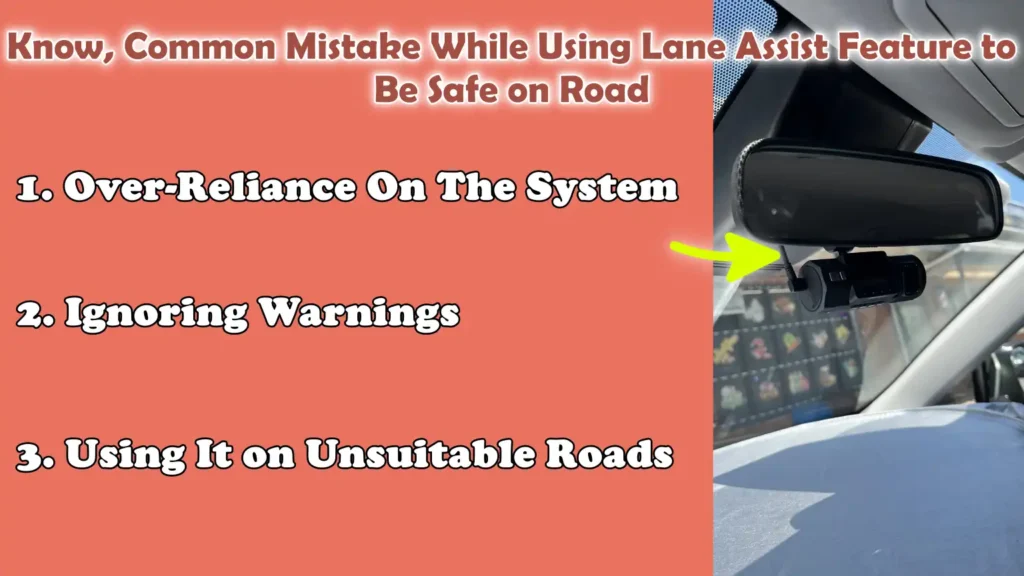
1. Over-Reliance On The System
Over-reliance on lane assist is one of the most common and dangerous mistakes drivers make, as it can lead to reduced situational awareness and delayed reactions.
Some drivers may begin to place excessive trust in the system, assuming it will invariably keep the vehicle in the correct lane, even when road conditions are complex or changing rapidly.
However, lane assist cannot handle every situation such as: faded lane markings, sharp curves, or sudden obstacles.
When drivers become overly dependent on the system, they may cease actively monitoring the road ahead; this significantly increases the risk of an accident should the system malfunction or fail to respond correctly.
Maintaining full attention and viewing the system as a backup aid, rather than the primary means of control, is essential for safe driving.
2. Ignoring Warnings
Ignoring system warnings is another serious error that can diminish the safety benefits of lane assist features.
These warnings are designed to immediately alert the driver when the vehicle is drifting out of its lane, when the system is no longer active, or when immediate attention is required.
Warnings may take the form of audible alerts, dashboard messages, or vibrations and each type is intended to effectively capture the driver’s attention.
If these warnings are ignored or misinterpreted, the driver may fail to correct the vehicle’s position in a timely manner, potentially leading to unsafe situations.
Responding immediately to every warning ensures that the system can work in tandem with the driver to prevent potential hazards.
3. Using It on Unsuitable Roads
Using lane assist on roads where it is inappropriate can cause confusion and render its performance unreliable.
These systems are designed to function optimally on roads with clear markings such as: highways or major urban thoroughfares, where lane lines are clearly visible.
On roads where markings are faded, lanes are narrow, heavy construction work is underway, or road edges are undefined, the system may be unable to accurately detect the vehicle’s lane position.
In such situations, it may issue false warnings or attempt to make unnecessary steering corrections; rather than assisting the driver, it may serve as a distraction.
Understanding where this system performs best, and avoiding its use in unsuitable conditions, helps ensure a safer and more controlled driving experience.
Know, The Benefits of Using Lane Assist Features
Lane assist features offer clear and practical benefits; when utilized correctly, they make daily driving safer, more comfortable and more controlled.
These systems are designed to mitigate human errors such as: unintentional lane drifting, delayed reactions and minor steering mistakes, which can lead to serious accidents, particularly at high speeds.
Safety research conducted by the Insurance Institute for Highway Safety indicates that lane-departure prevention systems can significantly reduce certain types of accidents, specially on highways where vehicles travel at consistent speeds and lane markings are clearly visible.
By continuously monitoring lane positioning and providing timely warnings or subtle steering assistance, lane assist helps drivers maintain better control over their vehicles.
While it cannot replace safe driving habits, it adds an extra layer of safety that helps minimize risks, enhance driver alertness and make the driving experience, whether for short commutes or long-distance journeys, much more effortless.
As well as, there’s studies about the lane assist system that shows that these kinds of features actually can reduce the serious crash such as: head-on and sideswipe collisions, also experts gives important to these systems as these are literally designed to assist the driver, but not to replace them; as it makes the proper understanding and usage really important for achieving maximum safety benefits.[¹]
1. Improving Road Safety
The primary benefit of lane assist features is the improvement of road safety, as these systems help prevent unintentional lane departures, a major cause of serious accidents.
Even a slight deviation from one’s lane can result in collisions with other vehicles, roadside objects, or oncoming traffic, particularly when traveling at high speeds.
Lane assist instantly detects such errors and either alerts the driver or gently corrects the steering to guide the vehicle back to its proper position.
This proactive response can prevent hazardous situations from developing in the first place, thereby making driving safer for both the driver and other road users.
By minimizing the potential for human error, Lane Assist plays a crucial role in reducing the risk of accidents.
2. Reduction in Driver Fatigue
Lane Assist features also help in mitigating driver fatigue, particularly during long journeys or extended periods of highway driving, when maintaining a consistent position within a lane can become tiring over time.
Making constant, minor steering adjustments requires sustained attention and physical effort, which can lead to mental and physical exhaustion after several hours of driving.
Lane Assist alleviates this burden by assisting the driver in maintaining a stable position within the lane, thereby making the task of driving easier and less stressful.
While it does not eliminate the need to take breaks or rest, it provides significant assistance in making long-distance travel more manageable and less fatiguing.
3. Improvement in Lane Discipline
Another significant benefit of Lane Assist is the improvement of lane discipline, as the system encourages drivers to remain centered within their designated lane.
Whenever the vehicle begins to drift out of its lane, the system provides feedback or applies gentle corrections, helping drivers cultivate better habits and maintain proper positioning over time.
This is particularly beneficial in heavy traffic or on multi-lane roads, where maintaining the correct lane is essential to ensure the smooth flow of traffic and the safety of all road users.
Improved lane discipline not only reduces the risk of accidents but also creates a more orderly and predictable driving environment for everyone on the road.
Know, What are the Limitations of Lane Assist Systems
Lane Assist Systems are helpful tools for safety; however, they also have specific limitations that every driver should understand before relying on them.
These systems are designed to assist in keeping the vehicle within lane boundaries; nevertheless, they can neither handle every driving scenario nor make the complex decisions that a human driver can.
Their performance depends on factors such as road quality, visibility and traffic patterns, meaning they may not always operate with complete accuracy.
Safety guidelines issued by the National Highway Traffic Safety Administration (NHTSA) emphasize that Advanced Driver-Assistance Systems still require the driver’s full attention, as they cannot replace human judgment and situational awareness.
By acknowledging these limitations, drivers can operate with greater confidence and utilize these systems in a safer, more controlled manner, ensuring that this technology remains a beneficial aid rather than becoming a potential source of risk.
1. Reliance on Lane Markings
Lane Assist Systems rely heavily on clearly visible lane markings to accurately determine the vehicle’s position; consequently, their effectiveness is directly linked to how clearly the system’s cameras can detect those markings.
If lane lines are faded, obscured by dirt, snow, or water, or painted incorrectly, the system will be unable to recognize them accurately.
In such situations, the system may fail to issue warnings, provide false alerts, or cease functioning entirely.
This reliance on lane visibility constitutes one of the most significant limitations of these systems and drivers must always remain aware that, in the absence of clear road markings, the system may fail to function correctly.
2. Limited Capability in Challenging Conditions
Lane assist systems may face difficulties in challenging driving scenarios where the road layout is neither straightforward nor predictable.
For instance, sharp curves, merging lanes, intersections and areas where multiple lane markings overlap can confuse the system’s cameras and software.
In such situations, the system may fail to accurately identify the correct lane or may issue unnecessary steering inputs or alerts.
Challenging environments often demand split-second decision-making and full driver control; consequently, one should never rely entirely on a lane assist system in such circumstances.
Drivers must be able to recognize when the system is not functioning correctly and be prepared to take full control of the vehicle without hesitation.
3. The Necessity of Driver Supervision
One of the primary limitations of lane assist systems is that they invariably require active driver supervision and cannot serve as a substitute for the driver’s own responsibility.
Even when the system is providing steering assistance, the driver must keep their hands on the steering wheel, remain alert and maintain a continuous watch on the road ahead.
Most vehicles are designed to detect whether the driver is actively engaged in the driving process; if the driver fails to provide any input, the vehicle will issue a warning or deactivate the system.
This requirement is essential because the system alone cannot handle unexpected events, sudden hazards, or complex traffic situations.
Understanding this limitation ensures that drivers remain fully engaged in the driving process and utilize Lane Assist as a helpful tool, rather than as a substitute for safe driving practices.
Understand, About the Future of Lane Assist Technology
The future of lane assist technology is focused on making driving safer, more precise and more supportive.
This will be achieved through improved software, smarter vehicles and enhanced road infrastructure.
Lane assist is already a crucial component of Advanced Driver-Assistance Systems (ADAS) and as vehicles progress toward higher levels of automation, it is expected to play an even more significant role.
Automakers and safety organizations are continuously refining how these systems recognize lane markings, interpret road conditions and respond to driver behavior.
According to data from the Insurance Institute for Highway Safety (IIHS), advancements in driver-assistance technology have already yielded substantial safety benefits and future developments aim to further reduce accidents.
These advancements will not eliminate the need for drivers in the foreseeable future; however, when utilized responsibly by drivers, they will make driving more reliable, minimize human error and collectively create a safer driving environment.
1. Integration with Autonomous Driving
Lane assist is considered a pivotal step toward fully autonomous driving, as it already fulfills one of the core functions essential for self-driving vehicles: maintaining the vehicle’s correct position within its lane.
As technology continues to evolve, lane assist systems are being integrated with other features such as: adaptive cruise control, automatic braking and traffic monitoring, to create more advanced driving systems.
These interconnected systems can handle multiple tasks simultaneously, such as keeping the vehicle centered in its lane while also maintaining a safe distance from other vehicles.
Although fully autonomous vehicles are still in the developmental phase and require rigorous safety testing, Lane Assist provides a robust foundation by helping vehicles perceive and navigate the road environment with greater precision.
2. AI and Enhanced Accuracy
Advancements in Artificial Intelligence are expected to significantly improve the functionality of Lane Assist systems, making them more accurate, faster and more capable of handling complex situations.
AI enables these systems to learn from vast amounts of driving-related data, allowing them to recognize lane markings even when they are faded, partially obscured, or affected by varying lighting conditions.
It also enhances the system’s ability to interpret road patterns, anticipate vehicle movements and react more intuitively to changes.
With the aid of advanced AI, Lane Assist systems will be able to minimize false alerts, provide more precise steering assistance and operate more reliably across a wide range of real-world driving scenarios.
3. Smarter Road Infrastructure
The future of Lane Assist technology is not limited solely to improving vehicles; it also extends to enhancing the roads upon which these vehicles travel.
Smarter road infrastructure involves clearer and more durable lane markings, improved signage and the integration of digital systems capable of communicating directly with vehicles.
These improvements make it easier for Lane Assist systems to accurately identify lanes and function more reliably across diverse environments.
In some regions, efforts are already underway to standardize road markings and enhance visibility to better support modern driving technologies.
As roads and vehicles continue to evolve in tandem, Lane Assist systems will become even more effective, making the driving experience safer and more connected for everyone.
Conclusion – How to Use Lane Assist Features
Now, you can say that with the technology, you can be really enhance the comfort and safety in real means.
They play a significant role in mitigating common errors, such as unintentional lane drifting and delayed reactions.
When utilized correctly, these systems can enhance road safety, reduce driver fatigue and make long-distance driving more stable and comfortable.
However, their true value is realized only when both their capabilities and limitations are fully understood.
Lane assist is most effective when road markings are clearly visible, weather conditions are favorable and the driver remains fully alert and in control.
It is neither a self-driving system nor a substitute for human judgment, situational awareness, or the ability to make split-second decisions in critical situations.
By learning how to properly activate, utilize and monitor these features, drivers can transform lane assist, often perceived merely as a misunderstood convenience, into a powerful safety tool.
As technology continues to evolve, incorporating advanced sensors, smarter software and improved road infrastructure, lane assist is poised to become even more precise and reliable.
Now, that’s all about this guide on How to Use Lane Assist Features, also you can ask all the unsolved queries in comment section below.
Frequently Asked Questions
Q1. What are lane assist features in a car?
Answer: Lane assist features are safety systems found in modern vehicles that help drivers properly keep their car centered within its designated lane. These systems utilize a camera, typically mounted near the windshield, to detect lane markings on the road. If the car begins to drift out of its lane without the turn signal being activated, the system either alerts the driver or gently assists in steering the vehicle back into the correct position. These features are designed to mitigate accidents caused by minor driving errors, particularly during long journeys or when a driver’s attention momentarily wavers. However, these features cannot replace the driver and should always be used solely as an assistive tool.
Q2. How do you turn on lane assist in a car?
Answer: Activating lane assist typically depends on the specific vehicle model; however, in most cars, it can be enabled using a button located on the dashboard, on the steering wheel, or within the vehicle’s internal settings menu. Some cars feature a specific icon, often resembling lane markings, that makes it easy to identify the controls for this system. Once activated, an indicator light or icon illuminates on the dashboard, confirming that the system is active. In some vehicles, the system only begins to function once the car reaches a specific speed and when lane markings become clearly visible. Before relying fully on this system, it is always essential to consult the vehicle’s owner’s manual to ensure that the system is properly configured.
Q3. Are lane assist and self-driving the same thing?
Answer: Lane assist and self-driving capabilities are not the same thing and they should never be used interchangeably. Lane Assist is merely an assistive feature designed to help keep the car centered within its lane; it does not take full control of the entire driving process. Drivers must always keep their hands on the steering wheel, remain alert and be prepared to take full control of the vehicle at any moment. Self-driving systems, which are still in the development and testing phases, aim to automate most driving tasks, whereas Lane Assist focuses exclusively on maintaining the car’s correct position within its lane. Understanding this distinction between the two is crucial for safe driving.
Q4. When should the Lane Assist feature be used?
Answer: Lane Assist should primarily be used on roads where lane markings are clearly visible, such as highways and well-maintained urban roads. It is particularly beneficial during long journeys, as it helps reduce driver fatigue and assists in keeping the car centered within its lane. It also performs well in light-to-moderate traffic conditions, where the driving environment is relatively stable. Using this system under the appropriate conditions ensures that it functions correctly and provides effective assistance. However, it should always be used with the driver’s full attention, rather than as a substitute for active driving.
Q5. When should you not use Lane Assist?
Answer: You should not rely on Lane Assist in situations where road conditions or visibility are poor. This includes roads where lane markings are faded or indistinct, as well as conditions involving heavy rain, fog, snowfall, or construction zones, where lane lines may be confusing or temporary. In such situations, the system may fail to accurately detect lane markings, potentially issuing false warnings or ceasing to function altogether. It is crucial for drivers to understand that this system has certain limitations and in such circumstances, they must rely entirely on their own control and judgment.
Q6. Can Lane Assist completely prevent accidents?
Answer: Lane Assist cannot prevent every accident, but it can reduce the risk of certain types of collisions, specifically those caused by unintentional lane changes. It functions as an early warning system or provides gentle steering support to help the driver correct errors before they become dangerous. However, it cannot detect every hazard or react fully in all situations. Safe driving still relies primarily on the driver’s attention, awareness and ability to make quick decisions. Lane Assist merely adds an additional layer of safety.
References:
[1] Advanced driver assistance
https://www.iihs.org/research-areas/advanced-driver-assistance

Guys, I’m a car audio enthusiast and customization expert and I love clear sound and clean installation. Plus, I have spent years helping people build their dream audio setups. And whenever I’m working on cars, I probably listen to music and thinks about the next big upgrade.
