
Written By: Don Dodi
Fact Checked By: Kristen Brown
Reviewed By: Diego Rosenberg
Now-a-days, many drivers actually uses the Adaptive Cruise Control to reduce the stress during the long highway journeys, as this smart feature actually uses the sensors to “SEE” the road ahead and then responds to the moving vehicles in real time.
It is the advanced driver-assistance features in the modern vehicles, which is designed to make the driving safer, smoother and less tiring: specially on the highways.
Not only this, it is different from the traditional cruise control that simply holds a fixed speed, as the adaptive cruise control literally uses the radar sensors and cameras mounted on the front of the vehicle that continuously monitors the traffic ahead and the automatically adjusts your speed to maintain a actual safe following distance.
And, according to the NHTSA research the system that assist with the speed and distance control can significantly reduces the driver fatigue and helps to lower the risk of rear-end collisions as well when it is used in proper way.
Along with this, it is really important first to understand that adaptive cruise control is not a self-driving system: as it still requires full driver attention and control at all the times.
So, in this guide you’ll learn How to Drive with Adaptive Cruise Control and learn when to use it, how this particular technology works in real life and about the limitations as well.
Now, Let’s Understand How Adaptive Cruise Control Works
Adaptive Cruise Control is a smart driving feature that helps your car maintain a steady speed while simultaneously keeping a safe distance from the vehicle traveling ahead of you.
It operates by continuously monitoring the road ahead and making subtle adjustments to your speed without requiring constant input from you on the accelerator or brakes.
Unlike basic cruise control, which merely maintains a fixed speed, this system reacts to traffic conditions in real-time; it slows down when the vehicles ahead reduce their speed and accelerates again once the road clears.
This makes driving easier, specially on highways, and helps reduce driver fatigue.
However, drivers must still remain alert and be prepared to take manual control of the vehicle at any moment, as this is an assistance system, not a fully autonomous driving system.
1. The Core Technology Behind This System
The core technology behind Adaptive Cruise Control relies on a combination of radar sensors, cameras and an onboard computer, which work together to interpret what is happening on the road.
Radar sensors, typically mounted on the front of the car, emit signals that bounce back after striking objects ahead, allowing the system to measure their distance and speed.
Cameras assist in identifying vehicles, lane markings and sometimes even pedestrians, thereby adding an extra layer of situational awareness.
The onboard computer processes all this information in real-time to determine how the vehicle should respond.
When a vehicle appears ahead, the system calculates its distance and speed and then automatically adjusts your car’s speed to maintain a safe following distance.
These adjustments occur smoothly through controlled acceleration and braking, enabling the car to follow the natural flow of traffic without any sudden movements.
2. Key Features of Adaptive Cruise Control
Adaptive Cruise Control incorporates several significant features that make driving easier and safer.
One of the primary features is automatic acceleration and deceleration, which allows the car to increase or decrease its speed based on traffic conditions without requiring driver input.
Another key feature is the maintenance of a pre-set distance, wherein the driver can select the desired gap to maintain from the vehicle ahead and the system will consistently uphold that distance.
In more advanced systems, ‘stop-and-go’ functionality enables the car to come to a complete halt in slow-moving traffic and then resume moving forward once traffic begins to flow again; this feature proves highly useful in heavily congested areas.
Some vehicles also integrate Adaptive Cruise Control with Lane-Keeping Assist, ensuring that the vehicle remains centered within its lane while simultaneously adjusting its speed; this results in a more supportive and controlled driving experience.
How to Prepare to Use Adaptive Cruise Control
Before using Adaptive Cruise Control, it is essential to prepare properly to ensure you operate the system safely and correctly.
This feature is designed to assist your driving, but it is most effective when you understand how it works and when it is appropriate to use it.
Spending a few minutes checking your vehicle, familiarizing yourself with its controls and selecting the right driving conditions can make a significant difference in both safety and comfort.
Many drivers make mistakes simply because they activate the system without fully understanding it, which can lead to confusion or delayed reactions.
By preparing in advance, you ensure that the system functions as expected and that you maintain full control over the vehicle at all times.
1. Check Vehicle Compatibility
The first step is to determine whether your vehicle is actually equipped with Adaptive Cruise Control, as this feature is not standard on all vehicles.
You can typically verify this by consulting your vehicle’s owner’s manual, checking the infotainment system settings, or examining the dashboard display; it may be labeled as “Adaptive Cruise Control” or a similar designation.
In many vehicles, a small sensor or radar unit will also be visible on the front grille, serving as a key component of this system.
It is also important to understand that Adaptive Cruise Control systems come with varying levels of technological sophistication.
Basic systems can adjust speed to maintain a safe following distance but may deactivate at very low speeds, whereas more advanced systems feature “stop-and-go” capabilities and can operate seamlessly even in slow-moving traffic.
Knowing which type of system is installed in your vehicle helps you set realistic expectations and utilize this feature more effectively.
2. Understanding Your Vehicle’s Controls
Before utilizing the Adaptive Cruise Control system on the road, it is crucial to understand its controls.
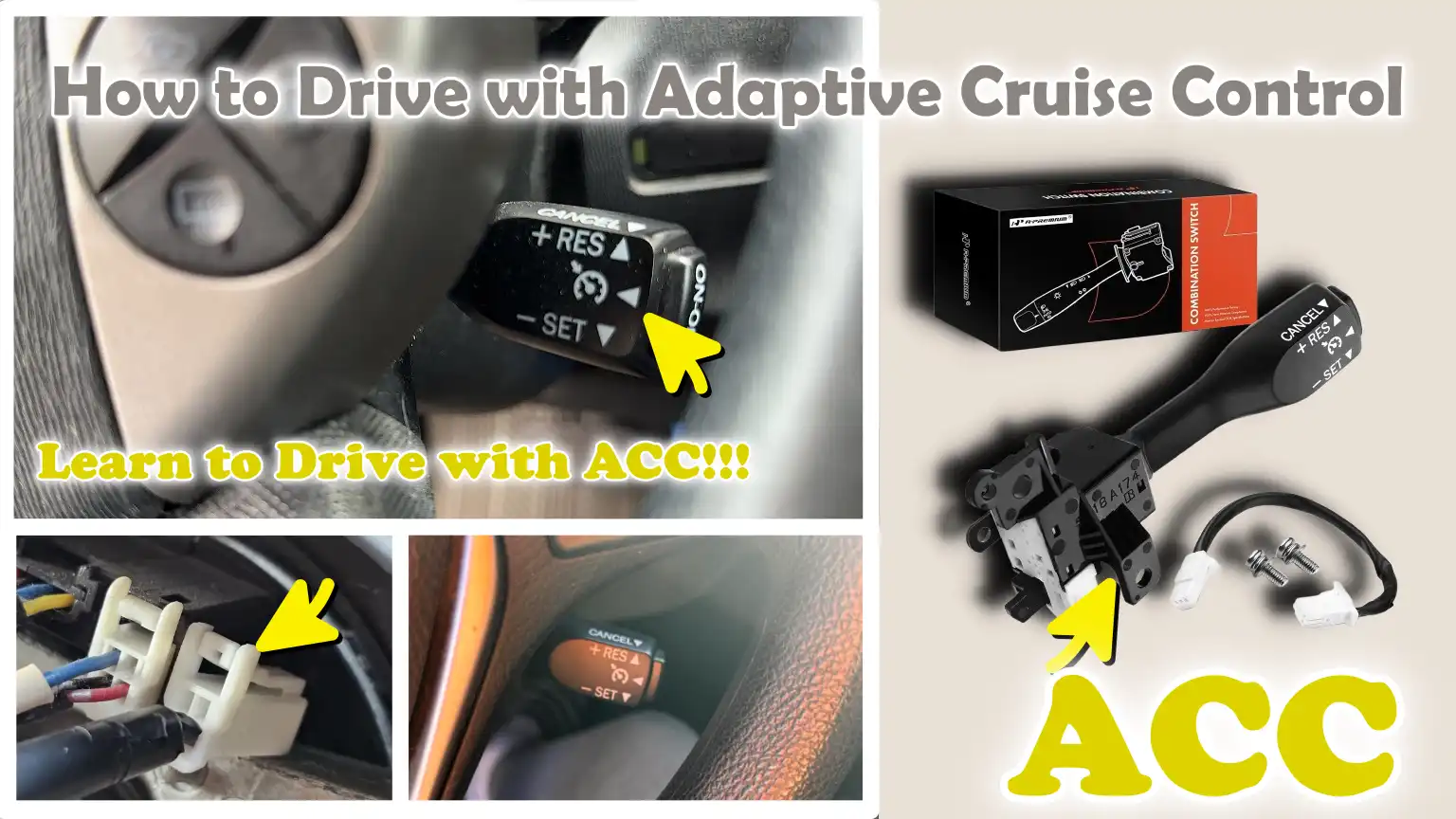
In most vehicles, these controls are located on the steering wheel, or occasionally on a stalk behind it, allowing you to activate the system, set your desired speed and adjust the distance from the vehicle ahead.
The buttons are typically clearly labeled, although their exact layout may vary depending on the specific vehicle model.
When the system is active, icons and indicators appear on the instrument cluster, displaying your set speed, the presence of a vehicle ahead and the selected distance.
Understanding the meaning of these icons is essential, as they provide immediate feedback regarding the system’s current operational status.
If you fail to correctly interpret these indicators, you may overlook critical changes in the system’s status or warnings while driving.
3. Ideal Driving Conditions for Use
Adaptive Cruise Control performs best when driving conditions are stable and predictable, particularly on highways and long, open roads where traffic flows continuously.
In such scenarios, the system can seamlessly adjust speed and maintain a safe distance from other vehicles without interruption, making the driving experience more comfortable and less fatiguing.
However, it is not suitable for all driving conditions.
Heavy rain, fog, snow, or dust can obstruct the sensors and compromise their ability to accurately detect other vehicles, thereby affecting the system’s performance.
The system is also less effective in areas featuring sharp curves, complex intersections, or highly unpredictable traffic patterns.
By utilizing this system only under appropriate conditions, you ensure its reliable operation and can safely enjoy its benefits.
How to Drive with Adaptive Cruise Control – Easy Method
Driving with Adaptive Cruise Control becomes significantly easier and safer when you follow the correct steps and understand how the system operates in real-time.
This feature is designed to assist you by regulating your speed and maintaining a safe following distance; however, it still relies on your situational awareness and timely intervention.
Proper utilization can reduce fatigue, particularly during long highway journeys, and help you maintain a smoother, more consistent driving pace.
Nevertheless, every step, from activating the system to monitoring and adjusting it, plays a crucial role in ensuring that the system functions as intended and that you retain full control of the vehicle at all times.
1. Activating the System
To begin using Adaptive Cruise Control, you must first activate the cruise control system itself; this is typically accomplished via a dedicated button located on the steering wheel or dashboard.
Once the system is active, and if your vehicle offers both standard and Adaptive options, you may need to specifically switch it to Adaptive mode.
Upon activation, a specific icon or message will appear on the instrument cluster, confirming that the system is now ready for use.
It is essential to activate the system only when driving at a steady speed on a suitable road (such as a highway) where traffic flow is predictable.
Proper activation ensures that the system can begin monitoring the road ahead and respond appropriately to other vehicles in your vicinity.
2. Setting Your Desired Speed
Once the system has been activated, the next step is to set your desired cruising speed.
This is typically accomplished by accelerating the vehicle to your desired speed and then pressing the ‘Set’ button.
Selecting a safe speed is crucial and this choice should always be guided by prevailing road conditions, traffic flow and the posted speed limits.
Once set, the system will endeavor to maintain this speed until it detects a slower-moving vehicle ahead.
You can also adjust the speed while driving by utilizing the control buttons; these buttons allow you to increase or decrease your speed in small increments.
These adjustments provide flexibility, enabling you to adapt to changing traffic conditions without having to deactivate the system.
3. Setting the Distance to the Vehicle Ahead
Adaptive Cruise Control allows you to select your preferred following distance from the vehicle ahead, a critical safety feature.
Most systems offer various distance settings, typically categorized as short, medium, or long.
Maintaining a longer distance provides more reaction time and is generally safer, particularly at higher speeds; conversely, a shorter distance may feel more convenient in light traffic, but it requires the driver to remain more vigilant.
The system automatically adjusts your vehicle’s speed to maintain the selected distance, slowing down when traffic slows and accelerating when the road ahead clears.
Choosing the appropriate distance setting has a direct impact on both your safety and your driving comfort.
4. Monitoring the System While Driving
Although Adaptive Cruise Control automatically manages your speed and following distance, you must always keep your hands on the steering wheel and maintain your full attention on the road.
This system provides visual, and sometimes audible, alerts on the instrument cluster to keep you informed of its operations, such as the detection of a vehicle ahead or the adjustment of your speed.
It may also issue warnings if it is unable to function correctly due to poor visibility or sensor obstructions.
It is crucial to pay close attention to these alerts, as they help you understand when the system is active and when you may need to manually take control of the vehicle.
Remaining vigilant ensures that you can react immediately to sudden situations that the system might not be able to handle entirely on its own.
5. Adjusting or Disabling the System
When using Adaptive Cruise Control, you can manually adjust or disable the system at any time to suit your needs.
You can increase or decrease the set speed using the control buttons without completely turning off the system; this is particularly useful when traffic conditions change.
If you need to take full manual control, pressing the brake pedal or the ‘Cancel’ button will immediately deactivate the system.
Most vehicles also feature a ‘Resume’ button, allowing you to return to your previously set speed once it is safe to do so.
Learning how to easily adjust or disable the system is essential for maintaining control over the vehicle in all situations and ensuring safe driving.
Know, Safety Tips for Using Adaptive Cruise Control
Adaptive Cruise Control can make driving more comfortable and controlled; however, safety always depends on how well the driver understands and utilizes the system.
This feature is designed to assist in managing speed and distance, not to replace the driver.
Using it safely entails remaining aware of your surroundings, understanding how the system operates and being prepared to take action whenever necessary.
Many accidents involving driver-assistance systems occur because drivers place excessive reliance on the technology and cease paying attention.
By adhering to proper safety guidelines, you can utilize Adaptive Cruise Control as a helpful tool while retaining full control and responsibility for the vehicle.
1. Remaining Alert at All Times
It is crucial to understand that Adaptive Cruise Control is not a self-driving system and cannot make complex decisions in the way a human driver can.
Although it can regulate speed and maintain a safe following distance, it cannot fully interpret road conditions, traffic signals, or sudden hazards.
Therefore, drivers must remain alert at all times, keep their hands on the steering wheel and keep their eyes firmly fixed on the road.
In safe driving, the driver’s responsibility always remains paramount and no automated system can ever substitute for human judgment.
Remaining alert enables you to react immediately should the system fail to respond correctly, or if a sudden situation arises such as: another vehicle abruptly cutting in front of you or an obstruction appearing on the road.
2. Understanding the System’s Limitations
Adaptive Cruise Control has certain limitations that every driver should be aware of before utilizing the system.
Some systems may struggle to detect stationary objects, particularly if a vehicle ahead stops abruptly, or if a fixed obstruction is present on the road.
The system may face difficulties on sharp curves or steep inclines, where sensors might fail to clearly track vehicles or accurately estimate distances.
Furthermore, adverse weather conditions such as: heavy rain, fog, or snow, as it can interfere with sensors and diminish their object-detection capabilities, potentially leading to reduced performance or a temporary deactivation of the system.
Understanding these limitations helps you avoid over-reliance on the system and ensures that you are prepared to take manual control whenever necessary.
3. Adhering to Safe Driving Practices
Even when using Adaptive Cruise Control, it remains crucial to adhere to safe driving practices at all times.
You must always maintain an appropriate following distance from the vehicle ahead, commensurate with your speed and current road conditions, even if the system is automatically regulating the vehicle’s speed.
Maintaining a safe distance provides you with additional time to react to sudden changes in traffic flow.
You should also remain prepared to apply the brakes or alter the vehicle’s direction at any moment, particularly in situations where the system may not be able to react quickly enough.
Staying prepared and alert ensures that you can safely handle unexpected events and continue driving with confidence while utilizing this beneficial technology.
Know, Some Mistakes to Avoid Them While Using Adaptive Cruise Control
Adaptive cruise control is designed to make driving easier; however, many drivers misuse it because they do not fully understand how it operates.
These errors can diminish the system’s safety benefits and even increase the risk of accidents.
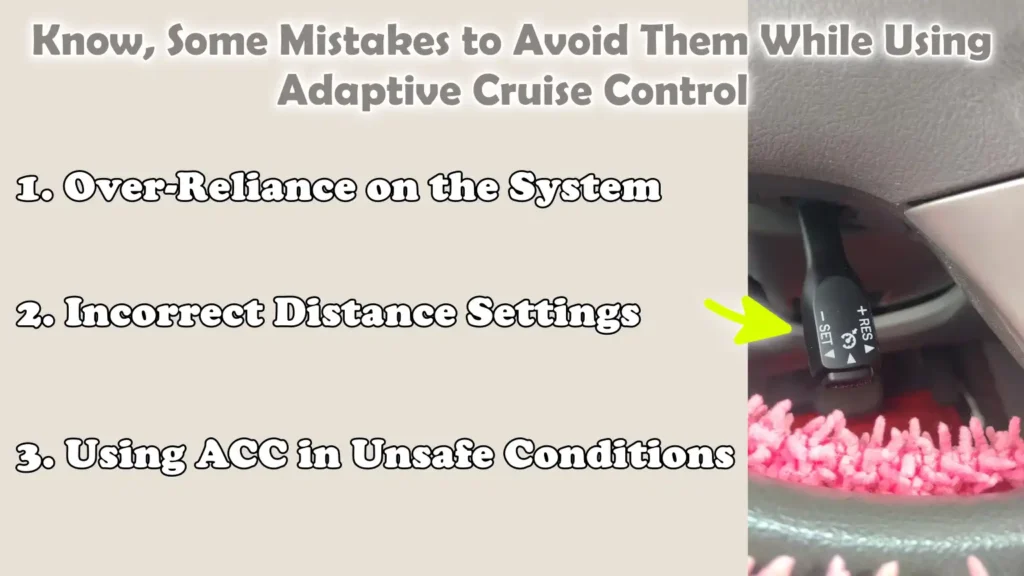
The most common issues involve over-reliance on the technology, failing to adjust settings correctly and using the system in situations where it is inappropriate.
Understanding these mistakes in simple terms can help you avoid them and utilize the system in a way that genuinely enhances both safety and comfort.
By remaining aware of these common errors, you can make better decisions and maintain full control over your vehicle at all times.
1. Over-Reliance on the System
One of the biggest mistakes drivers make is relying too heavily on adaptive cruise control and assuming that the car can automatically handle all driving situations.
In reality, this system is designed merely to assist in managing speed and distance; it cannot fully comprehend the complexities of real-world road conditions.
When drivers stop paying attention or divert their focus from the road, they become unable to react quickly should an unexpected event occur.
Ignoring road conditions such as: sudden changes in traffic flow, road hazards, or aggressive drivers, as it can lead to dangerous situations.
This system cannot replace human judgment; therefore, for safe operation, it is essential to remain vigilant and actively engaged in the task of driving at all times.
2. Incorrect Distance Settings
Another common mistake is selecting an inappropriate following-distance setting for the prevailing driving conditions.
Setting the distance too short, particularly at high speeds, leaves you with insufficient reaction time if the vehicle ahead suddenly slows down.
This significantly increases the risk of rear-end collisions, particularly on highways where vehicle speeds are high.
Conversely, failing to adjust the following distance to account for weather conditions such as: rain or fog, as it can also be hazardous, as stopping distances increase substantially on wet or slippery roads.
Selecting the appropriate distance setting based on speed, traffic density and weather conditions helps maintain a safe buffer and enables the system to operate more effectively.
3. Using ACC in Unsafe Conditions
Adaptive Cruise Control (ACC) is not suitable for all driving environments and using it in inappropriate situations constitutes a serious error.
In urban traffic, where vehicles frequently stop, turn, or change lanes abruptly, the system may be unable to react quickly enough to unpredictable movements.
It may also struggle in construction zones, where lane configurations change constantly and workers or obstructions may appear suddenly.
In areas with heavy pedestrian traffic, constant human vigilance is required, a level of attention that this system cannot provide.
Adaptive Cruise Control should be utilized only in stable and predictable conditions such as: on open highways, to ensure it functions reliably and contributes to safe driving, rather than creating an additional hazard.
Know, Some Benefits of Using Adaptive Cruise Control
Adaptive Cruise Control offers several significant benefits that, when utilized correctly, enhance both the driving experience and road safety.
This system is designed to assist drivers by automatically regulating the vehicle’s speed and maintaining a safe distance from other vehicles, thereby reducing the need for constant manual intervention.
By automating routine tasks such as: adjusting speed in moving traffic, it allows drivers to devote greater attention to the road and their immediate surroundings.
In many modern vehicles, this feature is included as part of an advanced safety package, as it helps streamline the driving process and minimize abrupt changes.
Once drivers understand how to use it correctly, Adaptive Cruise Control can make driving in everyday situations less stressful, more efficient and safer.
1. Enhanced Driving Comfort
A primary benefit of Adaptive Cruise Control is the increased comfort it provides while driving, particularly during long-distance journeys on highways.
The repetitive motions of constantly applying the accelerator and brakes can lead to fatigue over time; however, this system alleviates such physical strain by automatically adjusting the vehicle’s speed in response to traffic conditions.
This helps reduce driver fatigue, allowing you to remain more comfortable and focused during extended periods of driving.
It also eliminates the need for frequent manual speed adjustments, resulting in a smoother and more consistent driving experience.
Consequently, drivers often enjoy a less stressful and more enjoyable journey, specially in traffic conditions where the system can operate effectively.
2. Improved Road Safety
Adaptive Cruise Control also contributes to improved road safety by helping to maintain a consistent and safe distance from the vehicle traveling ahead.
This is crucial, as many accidents, particularly rear-end collisions, occur due to sudden braking and insufficient distance between vehicles.
This system continuously monitors traffic and adjusts the vehicle’s speed to maintain a safe distance, thereby reducing the likelihood of a collision.
By reacting swiftly to changes in traffic flow, it helps prevent situations where a driver might otherwise react too late.
However, it remains essential for drivers to stay alert and be prepared to take manual control of the vehicle, as this system is designed to assist with safe driving, not to replace the driver’s responsibilities.
3. Fuel Efficiency
Another significant benefit of Adaptive Cruise Control is fuel efficiency, which stems from a smoother and more controlled driving experience.
Sudden acceleration and hard braking can increase fuel consumption; however, this system mitigates the impact of such habits by gradually adjusting the vehicle’s speed.
By maintaining a consistent speed and avoiding unnecessary braking, the vehicle utilizes fuel more efficiently over time.
This is particularly advantageous when driving on highways, where maintaining a steady speed plays a pivotal role in conserving fuel.
Consequently, drivers may experience reduced fuel consumption and less wear and tear on the vehicle’s braking system, making Adaptive Cruise Control a feature that is both economical and practical.
Understand, When Not to Use Adaptive Cruise Control?
Adaptive Cruise Control is highly beneficial under the right conditions; however, there are specific situations where it should not be used, as it may fail to function correctly or safely.
This system relies on sensors, cameras and clear road conditions to detect vehicles and adjust speed.
When these conditions are not ideal, the system may react belatedly or inaccurately.
Understanding when not to use Adaptive Cruise Control is just as important as knowing how to use it.
Avoiding these situations helps prevent confusion, minimizes risk and ensures that you maintain full control of the vehicle even when the system is unable to provide reliable assistance.
1. Adverse Weather Conditions
Adaptive Cruise Control should not be used during adverse weather conditions such as: heavy rain, snowfall, or fog, as these conditions can interfere with the system’s sensors.
Radar and cameras require a clear view of the road to accurately detect other vehicles; however, water, accumulated snow, or fog can obstruct or degrade this view.
When this occurs, the system may fail to accurately detect vehicles or be unable to react in a timely manner.
In some instances, if the system detects that sensor visibility has become severely compromised, it may automatically deactivate.
It is safer to drive the vehicle manually under these conditions, as this allows you to react based on actual visibility and road conditions rather than relying on limited sensor input.
2. Complex Traffic Situations
Adaptive Cruise Control is not well-suited for complex traffic situations, particularly in densely populated urban areas where traffic flow is unpredictable.
When driving in the city, vehicles often come to sudden stops, change lanes abruptly, or make sudden turns, actions that can confuse the system or cause it to react with a delay.
On roads requiring frequent stops, characterized by traffic signals and sharp turns, drivers need to remain constantly vigilant and possess the ability to make split-second decisions, a task that automated systems cannot fully handle.
In such environments, using Adaptive Cruise Control can make the driving experience uncomfortable or even unsafe.
In these situations, it is preferable to drive the vehicle manually, allowing you to react immediately to changing traffic conditions.
3. Poor Road Conditions
Poor road conditions constitute another scenario where the use of Adaptive Cruise Control should be avoided.
Rain, snow, or loose gravel can render the road surface slippery, thereby compromising tire traction.
Under such circumstances, it becomes difficult for the system to safely regulate the vehicle’s speed.
Uneven roads or potholes can also adversely affect how the vehicle responds to automated acceleration and braking commands.
Furthermore, sharp turns and winding mountain roads demand precise steering and absolute control over speed, capabilities that lie beyond the scope of this system.
Sensors may fail to accurately track surrounding vehicles at locations where the road ahead is obscured (blind corners); additionally, the system is unable to properly adjust speed to account for steep inclines or descents.
In such situations, driving manually provides you with superior control, enabling you to handle the vehicle with greater safety and confidence.
Read More:
- How to Park on a Hill
- How to Reverse Park Safely
- How to Parallel Park
- How to Park Safely on Busy Streets
- How to Drive in Heavy Traffic Safely
- How to Drive on Highways Safely
- How to Merge Lanes Safely
- How to Overtake Safely
- How to Use Turn Signals Properly
- How to Fix Turn Signals on a Car
- How to Check Blind Spot While Driving
- How to Use Mirrors When Driving
- How to Use ABS Brakes Properly
- How to Brake Safely on Steep Roads
- How to Drive Uphill Safely
- How to Drive Safely in Strong Winds
- How to Prevent Aquaplaning
Know, Advanced Features in Modern Adaptive Cruise Control Systems
Modern Adaptive Cruise Control (ACC) systems have become far more advanced compared to their earlier versions, offering smarter and more responsive driving assistance.
These systems are now part of a larger suite of driver-assistance technologies that work in concert to enhance safety, comfort and efficiency.
Equipped with improved sensors, faster processors and sophisticated software, newer systems can handle more complex scenarios such as: stop-and-go traffic, maintaining proper lane positioning and adapting to changing road conditions.
While these features make driving easier, drivers must still remain vigilant and be prepared to take full control of the vehicle at any moment.
Understanding these advanced capabilities enables drivers to utilize them more effectively and safely in real-world driving situations.
1. Stop-and-Go Capability
One of the most useful advanced features is the “stop-and-go” capability, which allows the system to remain active even in situations involving slow speeds or heavy traffic.
In this mode, the vehicle can automatically decelerate and come to a complete halt when traffic stops and subsequently resume moving forward once traffic begins to flow again.
This eliminates the need for constant braking and acceleration during traffic jams, making the driving experience less fatiguing and significantly more comfortable.
The system carefully regulates the vehicle’s speed, even at very low velocities, to maintain a safe following distance from the vehicle ahead.
However, in some vehicles, resuming forward motion after coming to a complete stop may require the driver to press a specific button or lightly tap the accelerator pedal, depending on how long the vehicle has remained stationary.
2. Integration with Driver Assistance Systems
In modern vehicles, Adaptive Cruise Control is often integrated with other driver assistance systems to provide a more comprehensive driving support experience.
A common feature is ‘Lane-Keeping Assist,’ which helps keep the vehicle centered within its lane by making subtle adjustments to the steering.
When paired with Adaptive Cruise Control, the vehicle becomes capable of simultaneously managing both its speed and its lane position, particularly on highways.
Another significant integration relates to ‘collision avoidance systems’; if a potential collision is detected, these systems can alert the driver or automatically apply the brakes.
These integrated systems create a more supportive driving environment; however, they still rely on the driver remaining alert and maintaining control of the vehicle at all times.
3. AI and Smart Predictive Driving
Nowadays, many modern systems utilize advanced software and Artificial Intelligence to enable Adaptive Cruise Control to respond more effectively to traffic conditions.
These systems can analyze patterns within the flow of traffic and anticipate how vehicles ahead will move; this allows the car to adjust its speed more smoothly and proactively.
For instance, if the system detects that traffic ahead is slowing down, it can begin gradually reducing its speed rather than waiting for a sudden change.
This predictive behavior helps make the driving experience feel more natural and reduces the need for sudden braking or acceleration.
Over time, these smart systems continuously improve, making Adaptive Cruise Control more efficient and responsive; however, it remains essential for the driver to maintain supervision and make the final decisions.
Learn, Some Tips for Mastering Adaptive Cruise Control
Mastering Adaptive Cruise Control requires understanding, practice and constant attention to how the system behaves during real-world driving.
Although this feature is designed to make driving easier, it functions best when the driver is fully aware of its capabilities and limitations.
Learning how it responds to varying speeds, traffic patterns and road conditions helps you utilize it more smoothly and safely.
Over time, the proper use of Adaptive Cruise Control can make driving more comfortable, reduce stress and provide a more controlled driving experience.
The key lies in gradually acclimating yourself to the system, while always remaining alert and ready to take manual control whenever necessary.
Also, the research from the NHTSA shows that adaptive cruise control literally reduces the driver workload and actually improves the comfort during the highway driving, but many drivers still misunderstand how the system actually works, so that’s why you need to learn the correct use of adaptive cruise control as it is really important for both safety and efficiency of use as well.[¹]
1. Practice in Low-Traffic Conditions
The best way to begin using Adaptive Cruise Control is to practice in low-traffic conditions, where the environment is simple and predictable.
Open highways with light traffic are ideal for this purpose, as they allow you to focus on how the system adjusts speed and maintains distance without interruption.
In these settings, you can safely observe how your vehicle reacts when another car merges into your lane or changes its speed ahead of you.
This helps you understand the timing of acceleration and braking, responses that may feel different to you compared to manual driving.
Practicing in a calm environment builds a strong foundation and boosts your confidence without any added pressure.
2. Gradually Increase Usage
Once you become comfortable with the system, it is important to gradually increase the frequency and variety of situations in which you use it.
Rather than immediately relying on this feature in busy or complex traffic, begin by using it more frequently in situations with which you are familiar and which remain under your control.
As your confidence grows, you can start utilizing it in moderate traffic conditions as well, while remaining fully alert at all times.
This gradual approach helps you better understand how the system handles various driving scenarios such as: fluctuating speeds and changing traffic flows.
Building confidence over time ensures that you remain in control at all times and avoid any sudden complications while using this feature.
3. Regular Vehicle Maintenance
Regular vehicle maintenance plays a crucial role in ensuring that the Adaptive Cruise Control system functions correctly and reliably.
This system relies on sensors and cameras, typically mounted on the front of the vehicle, to detect traffic and measure distances.
If these sensors become dirty, obstructed, or damaged, the system may fail to operate properly or could provide inaccurate readings.
Keeping these components free of dust, mud, snow, or any other debris helps maintain the system’s accurate performance.
Adhering to a regular service schedule is also essential for the timely identification and resolution of any technical issues.
Proper maintenance ensures that the system remains reliable and continues to assist in safe driving.
Conclusion – How to Drive with Adaptive Cruise Control
So, in today’s fast-moving world, having a system that can literally adjust the speed and also maintain the safe distance in automatic way is really enhances the convenience and comfort during journey.
It operates through a combination of sensors, cameras and intelligent software that automatically adjusts your vehicle’s speed and maintains a safe distance from the traffic ahead, thereby significantly reducing the effort required during long journeys.
Not only does this help alleviate driver fatigue, but it also ensures a smoother and more consistent driving style, playing a crucial role in minimizing the need for sudden braking and enhancing overall road safety.
However, it is vital to remember that Adaptive Cruise Control is not a self-driving system and cannot serve as a substitute for human judgment or situational awareness.
Real-world driving scenarios often present unpredictable situations such as: sudden lane changes, adverse weather conditions, road hazards and complex traffic patterns, where the driver’s active control and split-second decision-making abilities remain absolutely essential.
Understanding how this system functions, the conditions under which it performs best and the situations where its use should be avoided is the key to maximizing its benefits.
When utilized on highways or in steady traffic conditions, Adaptive Cruise Control can significantly enhance comfort, efficiency and safety.
Furthermore, avoiding common pitfalls such as: becoming overly reliant on the system, using incorrect settings, or engaging it in inappropriate situations, ensures that it remains a helpful tool rather than a potential hazard.
By practicing regularly, properly maintaining your vehicle and remaining vigilant at all times, you can utilize Adaptive Cruise Control with complete confidence and responsibility.
Simply put, it is a powerful aid that makes driving easier; however, the driver’s role in safe and smart driving remains paramount.
Now, that’s it from this guide about How to Drive with Adaptive Cruise Control, also you can ask questions below.
Frequently Asked Questions
Q1. What is Adaptive Cruise Control and how does it work?
Answer: Adaptive Cruise Control is a smart driving feature that helps your car maintain a set speed while simultaneously keeping a safe distance from the vehicle traveling ahead of you. It utilizes radar sensors and cameras, typically mounted on the front of the car, to detect other vehicles on the road. When traffic slows down, the system automatically reduces your speed; conversely, when the road clears, it accelerates back up to your selected speed setting. This process occurs seamlessly, eliminating the need to repeatedly manually control the accelerator or brakes, thereby making driving easier, specially on highways.
Q2. Are Adaptive Cruise Control and self-driving the same thing?
Answer: No, Adaptive Cruise Control and self-driving are not the same thing. It is merely a driver-assistance feature designed to aid in speed control and distance maintenance. The driver must remain alert at all times, keep their hands on the steering wheel and be prepared to take full control of the vehicle at any moment. This system cannot interpret all road conditions, traffic signals, or sudden hazards in the same way that a human driver can.
Q3. When should I use Adaptive Cruise Control?
Answer: Adaptive Cruise Control is best used on highways or long, open roads where the flow of traffic moves at a relatively consistent speed. In such situations, the system can operate smoothly and maintain a uniform distance between vehicles. It is particularly beneficial during long-distance journeys, as it reduces the need for frequent speed adjustments and helps minimize driver fatigue.
Q4. When should I not use Adaptive Cruise Control?
Answer: You should avoid using Adaptive Cruise Control in situations where driving conditions are difficult or unpredictable. This includes areas with heavy city traffic, roads involving frequent stopping and turning, construction zones and areas with high pedestrian activity. It should also not be used during adverse weather conditions such as: heavy rain, fog, or snowfall, as such conditions can affect the sensors and compromise the system’s accuracy.
Q5. How do I turn on Adaptive Cruise Control?
Answer: To turn on Adaptive Cruise Control, you typically activate the cruise control system by pressing a button located on the steering wheel or dashboard. Subsequently, once you have reached a steady speed, you set your desired cruising speed. In some vehicles, you may need to switch from the standard cruise control mode to the adaptive mode. An indicator light or message on the dashboard will confirm that the system has been activated.
Q6. Can Adaptive Cruise Control bring the vehicle to a complete stop?
Answer: In many modern vehicles, advanced Adaptive Cruise Control systems feature a ‘stop-and-go’ function. This means that if traffic comes to a halt, the vehicle can slow down and come to a complete stop; similarly, when traffic begins to move again, the vehicle will resume driving. However, in some vehicles, after the vehicle has come to a complete stop, the driver may need to press a button or lightly tap the accelerator to resume driving.
Q7. How does this system maintain a safe distance?
Answer: This system allows you to select a ‘following distance’, that is, the amount of space to maintain between your vehicle and the vehicle traveling ahead of you. Once you have selected a distance level, the system automatically adjusts your speed to maintain that predetermined distance. If the vehicle ahead slows down, your vehicle will also slow down; conversely, if that vehicle accelerates or moves out of the lane, your vehicle will gradually return to the speed you initially set.
References:
[1] Use of Advanced In-Vehicle Technology by Young and Older Early Adopters: Survey Results on Adaptive Cruise Control Systems
https://www.nhtsa.gov/sites/nhtsa.gov/files/811070.pdf

Guys, I’m a car audio enthusiast and customization expert and I love clear sound and clean installation. Plus, I have spent years helping people build their dream audio setups. And whenever I’m working on cars, I probably listen to music and thinks about the next big upgrade.