
Written By: Don Dodi
Fact Checked By: Kristen Brown
Reviewed By: Diego Rosenberg
So, when you have to park on hill then it is not that you just have to stop your car, but you need to actually handle the gravity in safe way.
Because, there’s no doubt that roads with the slopes actually uses the gravity against your vehicle, which literally means that even a small mistake can cause the car to roll forward or backward unexpectedly.
Even, NHTSA shows that unattended vehicle movement is a real risk factor in many parking-related accidents and specially more on the inclines.
That’s why, it is really important to use the correct techniques such as: turning your wheels in the right direction, using the parking brake in perfect way and select the right gear which is again strong recommended as well.
Don’t just relies only on the parking brake, as you need to use combination of brakes with correct wheel positioning that literally adds an extra layer of safety and that’s what you’ll learn in this guide about How to Park on a Hill.
Know, The Importance of Learning to Park on a Hill
Learning to park on a hill is not merely a fundamental driving skill; it is also a crucial safety measure that safeguards individuals, vehicles and the entire traffic environment.
When a vehicle is parked on an incline, gravity naturally attempts to pull it downward; this means that even a minor error such as: failing to turn the wheels correctly or failing to engage the brakes properly, as it can cause the vehicle to roll away unexpectedly.
Such incidents can lead to serious accidents, damage to nearby vehicles, or injury to pedestrians.
Understanding the correct technique grants the driver complete control over their vehicle, even when the engine is turned off.
This boosts drivers’ confidence in navigating real-world scenarios, such as parking on busy streets, in narrow lanes, or on steep inclines.
Parking correctly on a hill mitigates risks, enhances situational awareness and ensures that the vehicle remains stable and secure at all times.
1. Safety of the Driver and Others
Parking correctly on a hill plays a pivotal role in ensuring the safety of both the driver and those in their immediate vicinity.
If a vehicle is not properly secured, it may begin to move without warning, particularly on steep slopes, thereby creating the potential for collisions or injuries.
By turning the wheels in the appropriate direction and engaging the parking brake in conjunction with the correct gear, drivers can effectively prevent any unintended movement of the vehicle.
This seemingly minor, yet critical step creates a physical barrier that prevents the vehicle from rolling into traffic or toward pedestrians.
It also reduces the likelihood of chain-reaction accidents in congested areas, where an uncontrolled vehicle could collide with other parked cars.
Properly parking a vehicle on a hill ensures that it remains exactly where it was left, thereby safeguarding not only the driver but also everyone in the immediate vicinity.
2. Relevance from a Legal and Driving Test Perspective
Learning how to park on a hill is often considered an essential skill in driving tests, as it demonstrates that the driver maintains control over the vehicle and possesses an understanding of road safety.
Many traffic regulations explicitly mandate that drivers must exercise appropriate precautions when parking on an incline such as: engaging the parking brake and positioning the wheels correctly.
Failure to comply with these regulations can result in fines or penalties in many jurisdictions, as improper parking can create hazardous conditions on public roads.
During driving tests, examiners assess whether a driver can safely handle real-world scenarios, including hill parking, to ensure they are prepared to drive responsibly.
Learning and applying these rules not only aids in passing the test but also contributes to maintaining safe driving habits over the long term.
3. Protecting Your Vehicle
Parking correctly on a hill also helps protect your vehicle from unnecessary damage and wear and tear.
When a vehicle is not properly parked on an incline, it places additional strain on the transmission system and braking components, potentially accelerating their wear over time.
For instance, relying solely on the parking brake without engaging the appropriate gear can place excessive stress on the braking system, while positioning the vehicle incorrectly can exert unnecessary pressure on the transmission, particularly in automatic vehicles.
By employing the correct techniques such as: selecting the proper gear and turning the wheels in the appropriate direction, the vehicle’s weight is safely distributed, thereby minimizing mechanical strain.
This not only extends the lifespan of the vehicle’s essential components but also saves you from expensive repair bills.
Simply put, parking correctly on a hill keeps both your vehicle and your wallet safe.
Now, Let’s Understand Different Hill Parking Scenarios
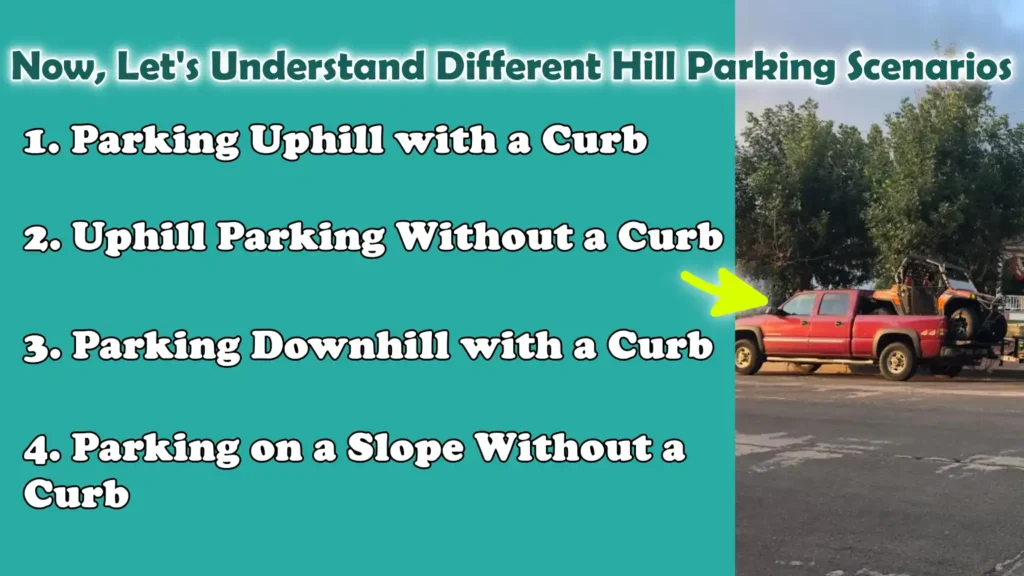
Parking on a hill is not uniform across all situations; understanding these distinct scenarios helps drivers make safer decisions in real-world conditions.
The direction of the slope, the presence or absence of a curb and the angle of the road, all these factors alter how a vehicle behaves once parked.
Gravity constantly exerts a downward pull on the vehicle along the slope; however, how you position your wheels and secure the vehicle determines whether it remains safely anchored in place or begins to slide.
Many drivers make mistakes because they apply a single, generic approach to every situation, whereas each hill parking scenario requires a slightly different technique.
By thoroughly understanding these scenarios, drivers can react appropriately, mitigate risks and ensure that their vehicle remains stable and secure at all times.
1. Parking Uphill with a Curb
Parking uphill with a curb means that the front of your vehicle is facing upward on a sloping road and there is a raised edge or sidewalk running along the side of the road.
This scenario is very common in residential areas, urban streets and zones with pedestrian walkways.
In this situation, the curb acts as a physical safety barrier; however, it is effective only if the wheels are turned in the correct direction.
By turning the wheels away from the curb, if the brakes were to fail, the vehicle would slowly roll backward until it came to rest against the curb, thereby preventing it from rolling further down the road.
Conversely, if the wheels are not positioned correctly, the vehicle could roll backward into oncoming traffic, creating a hazardous situation.
Therefore, proper wheel positioning is crucial, as it utilizes the roadside curb as an additional safety support.
2. Uphill Parking Without a Curb
Uphill parking without a curb occurs when the road slopes upward, but there is no raised edge, or curb, present to assist in stopping the vehicle; this is common on rural roads, highways, or in open areas.
The risk is higher in this scenario because there is no physical barrier to prevent the vehicle from rolling backward.
If the vehicle is not properly secured, it could roll backward into oncoming traffic or down the slope, potentially leading to serious accidents.
In this situation, proper vehicle positioning becomes absolutely essential for safety.
Drivers should turn their wheels in such a way that, even if the vehicle were to move, it would roll away from the road, thereby minimizing the risk of collision with other vehicles.
Furthermore, in this scenario, the correct application of the parking brake and the selection of the appropriate gear become even more critical, as these serve as the primary means of keeping the vehicle stationary.
3. Parking Downhill with a Curb
Parking downhill with a curb implies that the front of the vehicle is facing down the slope and a curb is present along the roadside.
In this situation, gravity naturally pulls the vehicle forward; consequently, if the vehicle is not properly secured, the risk of it rolling down the slope increases significantly.
Here, the curb once again acts as a safety safeguard, but only if the wheels have been turned in the correct direction.
Turning the wheels toward the curb ensures that, should the vehicle begin to move, the front tire will make contact with the curb, thereby preventing the vehicle from rolling any further.
In this scenario, precise wheel alignment is critical, as even a minor error could allow the vehicle to roll unchecked down the incline.
Engaging the parking brake, selecting the appropriate gear and positioning the wheels correctly, together, these actions create multiple layers of safety.
4. Parking on a Slope Without a Curb
Parking on a slope without a curb presents one of the most hazardous situations, as the front of the vehicle faces down the incline; should it begin to move, there is no physical barrier present to halt it.
This scenario is frequently faced on open roads, steep gradients, or in areas where curbs are absent.
Gravity exerts a powerful downward pull on the vehicle; consequently, even the slightest lapse in braking or securing the vehicle can trigger uncontrolled movement.
Given these heightened risk factors, exercising extra caution is absolutely essential.
Drivers should carefully turn their wheels toward the side of the road so that, even if the vehicle does roll, it drifts away from, rather than into, oncoming traffic.
Furthermore, the parking brake must be engaged firmly and the appropriate gear selected to add an additional layer of safety.
This combination of measures helps mitigate risks and ensures that the vehicle remains as secure as possible, even in the absence of a curb.
Know, How to Prepare Before Parking
Making the right preparations before parking on a hill is one of the most crucial steps in ensuring your vehicle’s safety and maintaining complete control over it.
Many parking errors do not occur during the final moments of bringing the vehicle to a halt, but rather because the driver failed to prepare adequately in advance.
On a slope, gravity is already working against the vehicle; therefore, any sudden movement, improper positioning, or lapse in attention can quickly escalate into a dangerous situation.
Taking a few moments to scan the road ahead, position your vehicle correctly and regulate your speed makes a significant difference in preventing accidents.
Proper preparation helps you select the best parking spot, avoid disrupting the flow of traffic and minimize stress while parking.
It also enables you to act calmly and confidently, rather than making hasty decisions, which is particularly important on busy or narrow streets.
By prioritizing proper preparation, drivers can ensure that parking on a hill remains a smooth, safe and deliberate maneuver every time.
1. Assessing Your Surroundings
Carefully assessing your surroundings before parking on a hill helps you understand the immediate environment and avoid sudden hazards.
You should keep a close watch on the flow of traffic to gauge the speed at which other vehicles are traveling and determine whether it is safe to slow down and come to a stop.
Furthermore, it is essential to remain alert for pedestrians, as people may be walking along the roadside, particularly in residential or congested areas.
The width of the road also plays a crucial role; on narrow streets, precise positioning is vital to ensure that your vehicle does not obstruct the path of other passing traffic.
The steepness of the incline is another crucial factor, as on steeper hills, gravity exerts greater force on your vehicle.
This means you must exercise extra caution when applying the brakes and positioning your wheels correctly.
By keeping all these points in mind, you can select a safe parking spot and avoid situations that could lead to accidents or create difficulties during the parking process.
2. Use of Mirrors and Signals
The proper use of mirrors and signals ensures that you remain fully aware of your vehicle’s immediate surroundings and that other drivers can understand your intentions.
Mirrors help you spot vehicles approaching from behind or from the side, which is particularly vital when you are slowing down to park on an incline.
Adjusting your mirrors correctly provides a clear field of view without requiring excessive head movement, thereby helping you maintain your focus and balance while driving.
Turn signals are equally important, as they alert other drivers that you are about to park, giving them ample time to slow down or safely maneuver around you.
Without signaling, other drivers will be unable to anticipate your movements, which can lead to confusion or accidents.
Providing clear signals via indicators and utilizing mirrors effectively makes the entire parking process safer and more controlled.
3. Controlling Speed and Positioning
For safe parking on a hill, it is essential to control your speed and position your vehicle correctly before coming to a stop.
Gradually reducing your speed allows you to maintain full control over the vehicle and avoid sudden braking, an action that can be hazardous on a slope.
When you approach the parking space at a controlled speed, you are able to align your vehicle precisely parallel to the curb or the edge of the road.
Maintaining an appropriate distance from the curb is crucial; being too far away increases the risk of the vehicle rolling, whereas being too close can damage the tires or make it difficult to pull out later.
Having comfortable and steady control over your vehicle allows you to stop it precisely where you intend, without any unnecessary adjustments.
Maintaining the correct speed and positioning simplifies the final stages of parking and ensures that your vehicle is parked safely and securely on the incline.
How to Park on a Hill – Beginner Friendly Guide
Adopting a clear, step-by-step approach to parking on a hill is essential, as the incline alters your vehicle’s behavior even after the engine has been switched off.
The primary objective is to control the vehicle in such a way that, should a mechanical failure occur such as: brake failure, the car does not roll away and pose a hazard.
This is achieved through a combination of three specific actions: proper wheel positioning, correct application of the parking brake and selecting the appropriate gear.
Each scenario, whether parking uphill or downhill and regardless of the presence of a curb, requires a slightly different technique.
By following the correct steps in the proper sequence, you maintain full control over the vehicle, minimize risks and ensure that your car remains stable and secure at all times.
With regular practice, these steps become second nature, making parking on a hill a safe and stress-free experience.
1. Parking Uphill Against a Curb
When parking uphill against a curb, first bring your vehicle to a complete stop right alongside the curb, while maintaining full control over the brakes.
Once stopped, turn your steering wheel away from the curb so that your front wheels are angled slightly toward the roadway.
This positioning is crucial because, should the vehicle begin to roll backward, the front tire will gently make contact with the curb as it moves rearward, thereby bringing the vehicle to a halt.
Once the wheels are correctly positioned, slowly ease your foot off the brake pedal, just enough to allow the vehicle to settle gently against the curb without any sudden jolt.
Finally, to secure the vehicle, firmly engage the parking brake and then select the appropriate gear such as: first gear in a manual transmission vehicle, or the ‘Park’ mode in an automatic transmission vehicle.
The combination of these steps ensures that even if one system fails, the positioning of the curb and the wheels will serve as a backup safety mechanism.
2. Parking on a Slope Without a Curb
When parking on a hilly road where no curb is present, extra caution is required, as there is no solid physical barrier to prevent the vehicle from rolling backward.
To begin, bring the vehicle to a gentle stop and hold it steady using the brakes.
Next, turn your steering wheel away from the roadside and toward the center of the road, so that if the vehicle were to roll, it would move away from the flow of traffic rather than into it.
Should the vehicle begin to slide, this simple adjustment could prevent a major accident.
Once the wheels are correctly positioned, engage the parking brake firmly to secure the vehicle in place.
To add another layer of safety, it is also essential to engage the appropriate gear such as: first gear or “Park” mode.
As there is no curb in this scenario, the safety of the vehicle relies entirely on your preparedness and proper technique; therefore, every step must be executed with care.
3. Parking on a Slope With a Curb
When parking on a slope adjacent to a curb, the force of gravity pulls the vehicle downward; therefore, your primary objective must be to prevent the vehicle from rolling further down the incline.
After bringing the vehicle to a complete stop directly alongside the curb, turn the steering wheel toward the curb so that the front wheels are angled in that direction.
Next, gently ease off the brake pedal, allowing the vehicle to creep forward slowly until the front tire makes contact with the curb.
This contact acts as a physical barrier, effectively preventing the vehicle from rolling any further.
Once the tire is firmly resting against the curb, engage the parking brake firmly to lock the vehicle in place.
Finally, select the appropriate gear such as: Reverse in a manual car or Park mode in an automatic vehicle.
This method utilizes both the curb and the braking system in tandem to secure the vehicle and prevent it from rolling down the incline.
4. Parking on a Slope Without a Curb
Parking on a slope without a curb is one of the most hazardous situations, as there is no physical barrier to stop the vehicle and gravity constantly pulls it downward.
To begin, bring the vehicle to a controlled and steady stop.
Next, turn the steering wheel toward the side of the road so that, even if the vehicle begins to slide, it drifts away from, rather than into, oncoming traffic.
Parking in this manner significantly reduces the risk of a collision.
Once the wheels are properly positioned, firmly engage the parking brake, as this is the primary force that keeps the vehicle anchored in place.
You should also engage the appropriate gear to add an extra layer of safety such as: ‘Reverse’ in a vehicle with a manual transmission, or ‘Park’ mode in an automatic vehicle.
As there is no curb to support the vehicle, it is absolutely essential that you follow all these steps with the utmost care to ensure the vehicle remains safe and stable while parked on the slope.
How to Properly Use Gears and Parking Brakes
To safely park a vehicle on a hilly slope, the simultaneous and correct application of the appropriate gear and the parking brake is of paramount importance.
This is because it provides your vehicle with multiple layers of security.
When a vehicle is stationary on a slope, gravity constantly attempts to pull it downward.
Therefore, relying on a single system such as: the brakes alone, is insufficient.
The parking brake functions by locking the rear wheels, while the transmission creates internal resistance within the engine or gearbox to prevent the vehicle from shifting forward or backward.
When utilized correctly, these two systems work in tandem to bear the vehicle’s weight, thereby minimizing the risk of mechanical failure.
This also safeguards critical vehicle components, as excessive strain placed on a single system over time can lead to premature wear and tear.
Understanding how gears and brakes interact enables drivers to keep their vehicles stable, prevent sudden rolling and ensure safety in every parking scenario within hilly terrain.
1. For Vehicles with Manual Transmissions
In manual cars, engaging the correct gear after parking is crucial.
This is because, should the vehicle attempt to shift from its position, the engaged gear helps prevent the wheels from rotating.
When parking a vehicle on an uphill slope, drivers should typically engage ‘First Gear.’
Conversely, when parking on a downhill slope, ‘Reverse Gear’ is generally utilized.
This practice is adopted because these specific gears create resistance in opposing directions, thereby helping to counteract the vehicle’s natural tendency to move under the influence of gravity.
Engaging a gear is essential as it establishes a mechanical link between the engine and the wheels.
If the vehicle begins to roll, the resistance provided by the engine helps to slow down or completely halt this movement.
However, simply engaging a gear is not sufficient on its own.
Therefore, to ensure complete safety, one should always use the parking brake in conjunction with the gear.
When utilized correctly, these two methods work together to keep the vehicle stationary while simultaneously reducing the strain placed on each other.
This also aids in maintaining the transmission system in good condition over the long term.
2. For Vehicles with Automatic Transmissions
In automatic cars, the “Park” or “P” mode is designed to lock the transmission and prevent the wheels from rotating.
However, when parking a vehicle on an incline, one should not rely solely on this method.
Inside the transmission, there is a small component known as the ‘Parking Pawl.’
The function of this component is to hold the vehicle securely in place.
Yet, if the entire weight of the vehicle rests solely on this component, particularly on a steep incline, it can become strained or sustain damage over time.
For this very reason, it is crucial to use the parking brake even in automatic vehicles.
The correct procedure is to first bring the vehicle to a complete stop, firmly engage the parking brake and only then shift the gear into “Park” mode; doing so distributes the vehicle’s weight between the brakes and the transmission.
This reduces the stress placed on the vehicle’s internal components and enhances safety.
Utilizing both systems simultaneously ensures greater vehicle stability, prevents the vehicle from shifting out of position and helps avoid costly mechanical issues in the future.
Read More:
- How to Reverse Park Safely
- How to Parallel Park
- How to Park Safely on Busy Streets
- How to Drive in Heavy Traffic Safely
- How to Drive on Highways Safely
- How to Merge Lanes Safely
- How to Overtake Safely
- How to Use Turn Signals Properly
- How to Fix Turn Signals on a Car
- How to Check Blind Spot While Driving
- How to Use Mirrors When Driving
- How to Use ABS Brakes Properly
- How to Brake Safely on Steep Roads
- How to Drive Uphill Safely
- How to Drive Safely in Strong Winds
- How to Prevent Aquaplaning
Know About the Rules for Wheel Direction – Explained in Simple Terms
Understanding the correct direction for your wheels when parking on a hill is one of the simplest yet most effective safety techniques available to a driver.
The fundamental principle is to turn your wheels in such a way that, should the vehicle begin to move, it does not drift into traffic but instead comes to a safe stop or steers away from danger.
Many drivers may initially find this confusing; however, when explained in simple terms, it becomes easy to remember and apply in real-life situations.
Wheel direction serves as a backup safety system, particularly in instances where the parking brake or transmission gear fails.
By utilizing the vehicle’s natural momentum and the contours of the road or curb, this technique controls the direction in which the vehicle will travel.
Mastering this technique boosts a driver’s confidence and significantly reduces the likelihood of accidents caused by an uncontrolled, runaway vehicle.
1. An Easy Trick for Remembering Wheel Direction
A simple way to remember the correct wheel direction is to ask yourself: If the vehicle were to start moving, in which direction would you want its front end to go?
When parking uphill (facing upward), turn your wheels away from the curb; this ensures that if the vehicle rolls backward, the front tire will make contact with the curb, thereby halting the vehicle’s backward momentum.
When parking downhill (facing downward), turn your wheels toward the curb; this ensures that if the vehicle rolls forward, the front tire will immediately strike the curb, preventing the vehicle from moving any further.
If there is no curb present, you should position your wheels in such a way that the vehicle rolls away from the road, rather than drifting into the flow of traffic.
This simple mental approach helps drivers make quick and correct decisions without having to memorize complex rules.
2. How Correct Wheel Positioning Prevents a Vehicle from Rolling
Correct wheel positioning plays a crucial role in preventing a vehicle from rolling, as it alters the direction the vehicle will take should gravity begin to pull it down the slope.
When the wheels are aligned straight, the vehicle can roll unimpeded in the direction of the slope, a situation that can be extremely dangerous.
However, when the wheels are turned correctly, they steer the vehicle onto a safe path.
For instance, if a curb is present, turning the wheels in a specific manner ensures that the tires make contact with the curb, thereby bringing the vehicle to an immediate halt.
If no curb is present, the wheels steer the vehicle away from traffic, thereby minimizing the risk of a collision.
This method functions as a physical control system that remains effective even when the vehicle is turned off; thus, it provides an additional layer of safety beyond the brakes and gears.
3. Real-Life Examples for Better Understanding
In real-world scenarios, correct wheel positioning can make a significant difference in preventing accidents.
For example, if a car is parked on a slope along a busy road with its wheels turned toward the curb, even if the brakes were to fail, the car would roll only a short distance before its tires struck the curb, bringing it to a stop.
Conversely, if the wheels are not turned correctly, that same car could roll directly into oncoming traffic, potentially resulting in a serious accident.
In another scenario, on a quiet road lacking a sidewalk, turning the wheels away from the road ensures that, even if the car were to start moving, it would veer off the road rather than colliding with other vehicles traveling on it.
These real-life situations demonstrate how a simple action such as: turning the wheels correctly, as it can provide robust protection and keep both the driver and others safe.
Know, The Common Mistakes During Parking on a Hill to Avoid
When parking a vehicle on a hill, even minor errors can pose a serious safety risk, as gravity constantly exerts its force upon the vehicle.
Many drivers assume that parking is complete the moment the vehicle comes to a halt; however, true safety depends on correctly executing several essential steps.
Neglecting these steps can result in the vehicle rolling away, causing damage to surrounding property, or creating a hazard for other road users.
Most common mistakes stem from a lack of knowledge or overconfidence, particularly when drivers are in a hurry or mistakenly believe that the parking brake alone is sufficient.
Understanding these errors and their potential consequences helps drivers avoid them and cultivate safe parking habits.
By focusing on proper technique, drivers can significantly reduce the likelihood of accidents and ensure that their vehicle remains stable when parked on any incline or decline.
1. Incorrect Wheel Direction
Failing to turn the wheels in the correct direction is one of the most common and dangerous mistakes made when parking on a hill.
The orientation of the wheels determines the vehicle’s trajectory should it begin to move; if the wheels are left straight or turned in the wrong direction, the vehicle could roll uncontrollably down the slope.
This could result in the vehicle drifting into moving traffic, colliding with another vehicle, or injuring pedestrians.
For instance, on a sloping street bordered by a curb, if the wheels are not turned toward the curb, the vehicle will not come to a stop should it begin to roll forward.
Positioning the wheels correctly acts as a backup safety system; therefore, neglecting this step removes a crucial layer of safety and heightens the risk of accidents.
2. Relying Solely on the Parking Brake
Many drivers rely exclusively on the parking brake; however, this can be dangerous, particularly on steep inclines or if the braking system is not functioning optimally.
The parking brake operates by locking the wheels in place; nevertheless, over time, its components may wear out or its grip may weaken.
If the brake fails or slips even slightly, the vehicle may begin to roll.
For this reason, experts recommend utilizing both the parking brake and the appropriate gear simultaneously, as this distributes the load between the two systems and provides an additional layer of safety.
Relying on a single system increases the likelihood of failure and places undue strain on the braking system, which can lead to long-term damage.
3. Parking Too Far from the Curb
Parking a vehicle too far from the curb poses another hazard, as the curb is then unable to serve as an effective protective barrier.
When a vehicle is parked correctly, that is, positioned flush against the curb, the curb can arrest the tires and hold the vehicle in place, even if it shifts slightly; however, if the distance is excessive, the vehicle may roll a considerable distance before colliding with anything.
This increases the risk of the vehicle gaining momentum, which can result in damage or an accident.
Parking too far from the curb also compromises vehicle control and a portion of the vehicle may protrude into the roadway, thereby creating an obstruction for other drivers.
Proper parking, specifically, positioning the vehicle directly alongside the curb, provides greater stability and allows the curb to effectively fulfill its role as a protective barrier.
4. Failure to Check Surroundings
Failing to check one’s surroundings, both before and while parking, as it can pose a risk to both the driver and others.
Before stopping a vehicle on a hill, drivers must be aware of nearby vehicles, pedestrians, cyclists and road conditions.
If proper attention is not paid, a driver may park in a location that obstructs traffic, endangers pedestrians, or causes confusion among other road users.
For instance, if the vehicle were to roll even slightly, a passing pedestrian could be startled by this sudden movement.
Checking mirrors, carefully observing the surroundings and using turn signals, all these measures help prevent such situations.
Maintaining awareness of one’s surroundings ensures that parking is executed safely and responsibly, thereby posing no threat to others.
Know, Safety Tips for Parking on a Hill
Parking safely on a hill relies on caution, proper technique and small yet essential safety habits that mitigate risks in real-world situations.
As gravity constantly pulls the vehicle downward, drivers must take specific precautions to ensure that the vehicle remains completely secure even after they have left.
Simple actions such as: checking the brakes, positioning the wheels correctly and remaining aware of road conditions, as it can prevent serious accidents.
These safety tips are grounded in practical driving experience and are utilized by seasoned drivers to prevent the vehicle from rolling backward, sustaining damage, or posing a hazard to others.
Taking these steps every time you park on an incline fosters good habits and ensures that your vehicle remains stable in both routine and challenging conditions.
And, there’s research by the NHTSA that shows that safe vehicle handling is also important even if car stops moving completely, as with the proper parking techniques, specially on the slopes: it literally plays a really important role that prevents any possible accidents caused by the unintended vehicle movement, that’s why it is really important to use correct methods such as: wheel positioning, brake engagement and gear selection while parking on the hill.[¹]
1. Always Double-Check That the Brake Is Engaged
After parking on a hill, it is crucial to verify that the parking brake is fully engaged and is firmly holding the vehicle in place.
Drivers sometimes apply the brake too lightly or assume it is functioning without verifying it, habits that can prove dangerous.
A good practice is to slowly release the foot brake after engaging the parking brake to ensure that the vehicle does not move.
This simple check confirms that the braking system is effectively holding the vehicle in position.
Double-checking the brake adds an extra layer of confidence and reduces the likelihood of sudden, unintended vehicle movement, particularly on steep inclines where the pull of gravity is strongest.
2. Use Wheel Chocks on Steep Slopes When Necessary
In areas with extremely steep slopes, or when parking your vehicle for an extended period, the use of wheel chocks can provide an additional layer of safety.
Wheel chocks are small blocks placed against the tires to prevent the vehicle from rolling.
They are particularly useful on steep inclines, when carrying heavy loads, or in uneven parking areas.
Although most drivers do not use them for routine daily parking, their use is common in professional settings, where they can be highly effective in keeping a vehicle securely stationary.
This extra precaution creates a robust physical barrier and enhances overall safety.
3. Avoid Sudden Movements While Parking
When parking on a hill, smooth and controlled movements are essential.
Sudden braking, abrupt steering, or sudden acceleration can destabilize the vehicle or cause it to slide unexpectedly specially on sloped surfaces.
Moving gradually allows the driver to maintain full control over the vehicle and make precise adjustments to position it correctly.
This also places less strain on the vehicle’s braking and transmission systems.
By driving slowly and at low speeds, drivers can park with greater precision and safety, thereby avoiding unnecessary hazards.
4. Exercise Caution in Adverse Weather
Weather conditions such as rain, snow, or ice can make parking in hilly terrain significantly more difficult and hazardous, as they reduce tire traction and increase the risk of the vehicle sliding.
On wet or icy surfaces, it becomes extremely difficult for the parking brake and tires to securely hold the vehicle in place.
In such situations, drivers should exercise extra caution, firmly engaging the parking brake, positioning the wheels at the correct angle and selecting a safe location to park the vehicle.
During adverse weather, visibility of surrounding objects can be impaired, making it difficult to obtain a clear view of the immediate environment.
By remaining vigilant and adjusting your driving technique to suit the prevailing weather conditions, you can help ensure safe and secure parking, even in challenging situations.
How to Safely Exit a Parking Space on a Hill
Exiting a parking space on a hill requires just as much caution as parking there, as the vehicle is already situated on an incline; if this procedure is not executed correctly, gravity could cause the vehicle to slide suddenly.
Many accidents do not occur while parking, but rather when drivers attempt to resume driving without maintaining proper control.
The key principle here is to remain calm, proceed slowly and follow a specific sequence to prevent the vehicle from rolling backward unexpectedly.
Utilizing the correct coordination between the brakes, gears and accelerator helps in maintaining balance and control.
Drivers must also remain fully alert to their surroundings, as other vehicles or pedestrians may be in the vicinity.
Exiting in a safe and controlled manner ensures safety, prevents damage and helps the driver maintain complete confidence while driving on an incline.
1. Preparing to Move
Before driving off, it is crucial to prepare properly by checking your mirrors and carefully assessing your immediate surroundings.
This helps you identify whether any other vehicles, cyclists, or pedestrians are approaching, a step that is particularly vital on narrow or congested roads.
Once you have confirmed that it is safe to proceed, the driver should slowly release the parking brake while keeping the foot brake engaged to prevent the vehicle from sliding suddenly.
Releasing the brakes in this controlled manner allows the driver to gauge how the vehicle is reacting to the incline.
Proper preparation minimizes the likelihood of panic or taking sudden, impulsive actions, thereby ensuring that the vehicle begins to move forward in a safe and predictable manner.
2. Moving Forward on a Slope
When exiting a parking space and moving uphill on a slope, the primary challenge is to prevent the vehicle from rolling backward due to gravity.
In manual cars, this requires careful coordination between the clutch and the accelerator; the driver slowly releases the clutch while simultaneously applying gentle pressure to the accelerator to move the vehicle forward smoothly.
In automatic cars, the driver should engage ‘Drive mode’ and, while carefully releasing the brake, apply gentle pressure to the accelerator.
The objective is to ensure that the vehicle moves forward smoothly and steadily without rolling backward.
Maintaining precise control over the pedals ensures vehicle stability and prevents unnecessary strain on the vehicle’s components.
Practicing this technique boosts drivers’ confidence, enabling them to navigate uphill slopes safely.
3. Descending a Slope
Descending a slope is generally easier than ascending it; however, maintaining careful control remains essential to prevent the vehicle’s speed from accelerating excessively.
Once preparations for departure are complete, the driver should slowly release the brake and allow the vehicle to move forward in a controlled manner.
The brakes may be applied gently, or the accelerator lightly pressed, to maintain balance and direction.
Keeping the speed low and steady is crucial to avoid sudden stops or collisions, particularly in congested or narrow areas.
A controlled speed ensures that the vehicle remains stable and easy to handle while descending the slope, thereby making the exit from the parking space safe and smooth.
Learn, The Practical Tips for Beginners
Learning to park on a hill may seem daunting at first, but with the right techniques and consistent practice using simple methods, it becomes quite easy and natural over time.
Beginners often face difficulties because hill parking requires coordination, spatial judgment and an understanding of how a vehicle responds under the influence of gravity.
The fundamental principle is to start slowly, focus on basic controls and gradually build your skills rather than jumping directly into challenging situations.
Through regular practice and proper guidance, drivers can boost their confidence and minimize errors.
These practical tips are designed to help beginners learn safely, avoid common mistakes and cultivate good driving habits that will serve them well in real-world situations.
1. Practice on Gentle Slopes First
For beginners, it is crucial to start practicing on gentle slopes, as this significantly reduces the level of difficulty and risk.
On a gentle incline, the force of gravity is less intense, giving the driver more time to react and understand how the vehicle behaves.
This makes it easier to acquire essential skills such as: brake control, precise wheel placement and proper gear selection, without experiencing panic or stress.
Practicing in a safe, low-traffic environment allows beginners to maintain better focus and make necessary adjustments without feeling pressured.
Once a driver feels comfortable on gentle slopes, they can gradually progress to steeper hills with greater confidence and control.
2. Learn Under Supervision, If Possible
Learning under the supervision of an experienced driver or instructor can make a significant difference in mastering the nuances of hill parking.
A knowledgeable guide can provide step-by-step instructions, correct errors in real-time and explain the rationale behind specific maneuvers.
This helps prevent the formation of bad habits that could prove dangerous in real-world situations.
Supervision also fosters a sense of safety and confidence, particularly among beginners, who may feel anxious when driving on inclines.
With proper guidance, the learning process becomes faster, clearer and more effective.
3. Build Confidence Through Repeated Practice
Confidence in hill parking stems from repeated practice and real-world experience.
The more frequently a driver practices the correct techniques, the more natural and intuitive the process becomes.
Repeated practice improves coordination between braking, steering and gear shifting, elements that are crucial for safe hill parking.
It also helps alleviate fear and hesitation, enabling the driver to remain calm and composed in various situations.
Over time, consistent practice builds “muscle memory,” making it easier to handle even challenging inclines without stress.
This continuous improvement is the key to becoming a confident and safe driver.
Conclusion – How to Park on a Hill
Yes, when you learn to park safely even on the hill then this small skill actually gives you edge on the overall road safety and makes you really responsible driver as well.
By taking the correct steps such as: properly angling your wheels, firmly engaging the parking brake and selecting the appropriate gear, you establish multiple layers of safety that work in tandem to prevent your vehicle from unexpectedly shifting from its position.
This is crucial because, on an incline, even a minor oversight can lead to the vehicle rolling away, causing an accident, or inflicting damage upon your car and those in your immediate vicinity.
By recognizing the distinctions between parking uphill and downhill, whether a curb is present or not, you prepare yourself to react correctly in any real-world scenario.
Simple habits such as: surveying your surroundings, maintaining control over your speed and double-checking your brakes, as it can make a significant difference in ensuring everyone’s safety.
Over time, through consistent practice and heightened awareness, these actions become second nature, enabling you to park with complete confidence even in challenging situations.
So, that’s it from this guide about How to Park on a Hill, even you can ask more questions below.
Frequently Asked Questions
Q1. What is the correct way to park a car on a hill?
Answer: The correct method for parking a car on a hill involves performing three essential actions simultaneously to ensure your vehicle remains completely secure. First, you should position your car in a suitable spot along the side of the road or near the curb. Second, you must turn your wheels in the appropriate direction, specifically, either toward or away from the curb, depending on whether you are facing uphill or downhill. Third, you must firmly engage the parking brake and select the correct gear such as: first gear or reverse gear in a manual car, or the “Park” mode in an automatic car. Together, these steps prevent your vehicle from rolling away, even if one of the individual systems were to fail.
Q2. Why is it important to turn the wheels when parking on a hill?
Answer: Turning the wheels is crucial because it dictates the direction your car will take if it begins to roll. If the wheels are positioned correctly, the car will either come to a halt against the curb or roll away from the flow of traffic, thereby minimizing the risk of accidents. Conversely, if the wheels are not turned correctly, the vehicle could roll straight down the road, potentially endangering other drivers and pedestrians. This simple step adds an extra layer of safety, reinforcing the effectiveness of the parking brake and gear selection.
Q3. Should I always use the parking brake when parking on a hill?
Answer: Yes, you should always use the parking brake when parking on a hill. The parking brake is designed to keep the vehicle stationary by locking the wheels in place. However, it should not be relied upon as the sole safety measure. It is most effective when used in conjunction with correctly positioned wheels and the appropriate gear selection. Adopting all these methods in combination ensures maximum safety and reduces the strain placed on any single system.
Q4. Is the procedure for parking a car on a hill different for manual and automatic vehicles?
Answer: Yes, there is a slight difference between manual and automatic cars when parking on a hill. In manual cars, it is crucial to engage either first gear or reverse gear to prevent the vehicle from moving. In automatic cars, you should utilize the “Park” mode, which locks the transmission. However, in both cases, the parking brake should always be applied, as it provides an additional layer of safety and reduces the stress on the transmission system.
Q5. What happens if I do not turn my wheels correctly?
Answer: If you do not turn your wheels correctly, your car could roll uncontrollably down the slope in the event of brake failure or a loss of traction. This can lead to accidents, damage to nearby vehicles, or injury to pedestrians. Correct wheel positioning serves as a backup safety measure; therefore, neglecting it eliminates a critical level of safety protection.
Q6. How close to the curb should I park when parking on a hill?
Answer: You should park close enough to the curb that if the vehicle were to shift even slightly, your tire would make gentle contact with it. Parking too far from the curb diminishes its ability to stop the vehicle, whereas parking too close could damage your tires or make it difficult to maneuver the car back into position. Maintaining the correct distance ensures that the curb acts as a safety barrier without causing any damage to your vehicle.
References:
[1] Vehicle Safety Research
https://www.nhtsa.gov/vehicle-safety-research?book=&combine=&name=&page=6

Guys, I’m a car audio enthusiast and customization expert and I love clear sound and clean installation. Plus, I have spent years helping people build their dream audio setups. And whenever I’m working on cars, I probably listen to music and thinks about the next big upgrade.