 Skip to content
Written By: Don Dodi
Fact Checked By: Kristen Brown
Reviewed By: Diego Rosenberg
So, yes with the simple change in hand position you can literally improve your control, reduce hand fatigue and make your driving much more safer in instant way than other things.
Because, there’s research and modern road safety guidelines that shows that how you hold your steering wheel actually plays a important role in how safely and effectively you control a vehicle.
As well as, there’s even NHTSA and AAA Foundation for Traffic Safety research that shows that proper hand placement literally improves the steering accuracy, reduces the reaction time and helps the drivers to maintain the stability during the sudden maneuvers as well.
And, the widely recommended thing is 9 and 3 o’clock hand position is not just the random suggestion out there, as it is specially designed to give you the maximum control also it reduces the risk of any possible injury if the airbag deploys.
Other than this, there’s incorrect habits such as: driving with just one hand or gripping it too tightly that can actually limit the control and increase the chances of oversteering or delayed reactions as well.
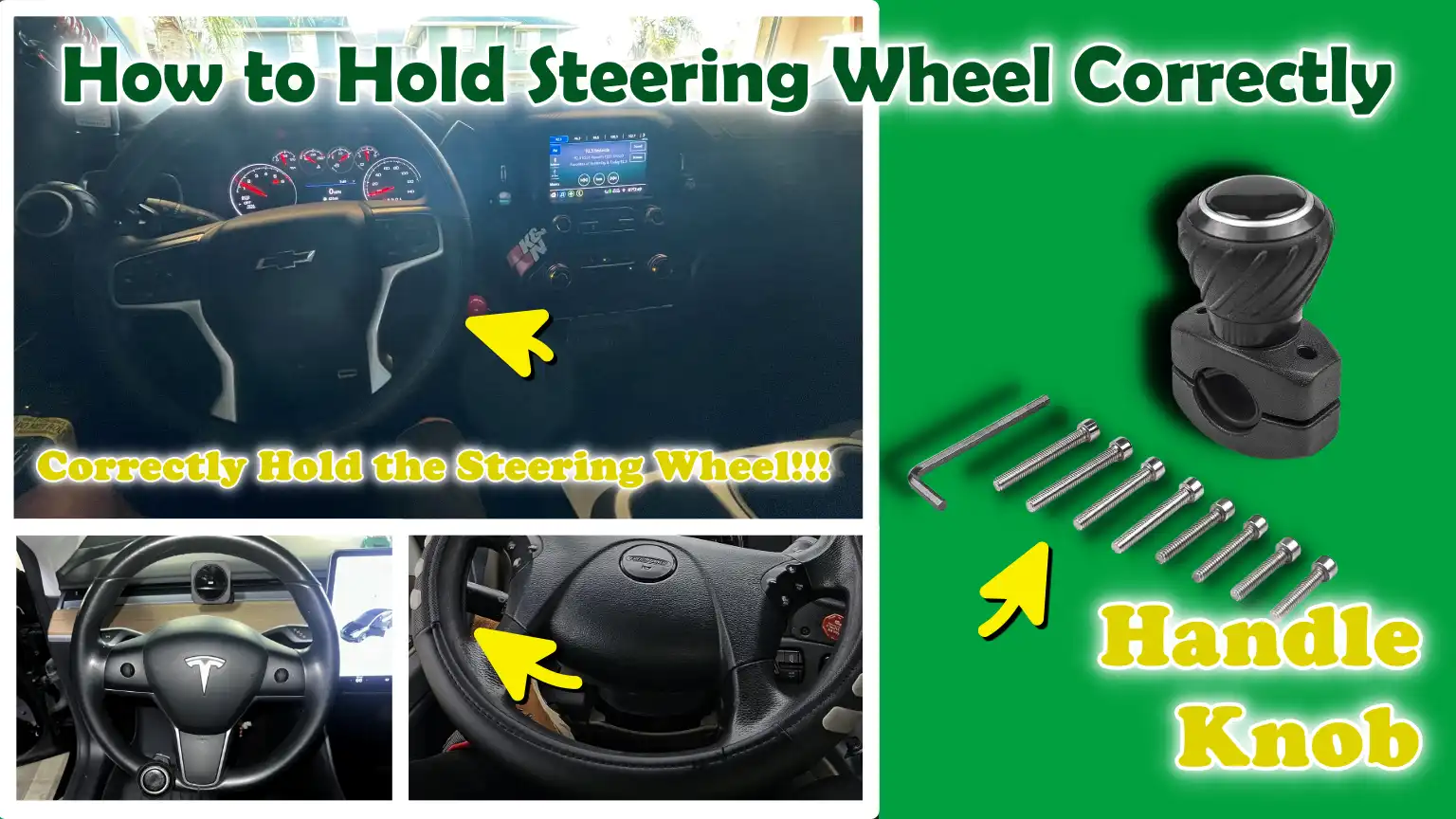
That’s why, in this guide you’ll learn How to Hold Steering Wheel Correctly so that you can apply the correct technique and have the significantly position difference in your overall driving safety and confidence as well.
Know, Why Holding the Steering Wheel Correctly Is Really Important?
The way you hold the steering wheel has a direct impact on how well you can control your car, how quickly you can react and how safe you remain on the road.
Road safety organizations such as: the National Highway Traffic Safety Administration and the AAA Foundation for Traffic Safety, emphasize that proper hand placement is a important component of safe driving, as it enables the driver to maintain vehicle balance and react appropriately in both normal and emergency situations.
Many drivers underestimate the importance of this simple habit; however, even a slight error in grip can lead to delayed reactions, compromised control and unnecessary physical strain.
Holding the steering wheel correctly keeps your hands balanced, ensures your movements remain fluid and keeps your body free of tension, all of which collectively enhance your overall driving performance.
Whether you are navigating city traffic, traveling at high speeds on a highway, or facing challenging road conditions, holding the steering wheel correctly ensures that you remain confident, comfortable and in complete control of your vehicle at all times.
1. Enhanced Vehicle Control
Holding the steering wheel correctly provides you with significantly better control over your vehicle, particularly when making turns, changing lanes, or facing sudden hazards on the road.
When your hands are positioned correctly such as: in the commonly recommended “9 and 3” position, you are able to turn the steering wheel with greater ease and precision.
This allows you to navigate curves in the road more naturally and avoid sudden or jerky movements that could upset the vehicle’s balance.
In emergency situations such as: avoiding an obstacle or executing a sudden lane change, proper hand positioning allows you to turn the steering wheel more rapidly and with greater control, which can significantly aid in preventing accidents.
A good grip also enhances steering precision; this means your vehicle responds exactly as you intend, without any delay or unnecessary overcorrection.
This level of control becomes even more critical when driving at high speeds, where even a minor steering error can have severe consequences.
2. Enhanced Safety
Holding the steering wheel correctly significantly boosts your safety by reducing the likelihood of losing control of the vehicle during sudden or hazardous situations.
When your hands are positioned correctly, you can react more swiftly to unexpected events such as: another vehicle braking suddenly, pedestrians crossing the road, or slippery road conditions.
A balanced grip ensures that both your hands are ready to take action at all times; this improves your reaction time and enables you to make safer decisions instantly.
Modern vehicle safety systems, including airbags, are designed with proper hand positioning in mind, as incorrect hand placement can increase the risk of injury should an airbag deploy.
By keeping your hands in the correct position and maintaining a firm grip on the steering wheel, you mitigate the risks of oversteering, drifting out of your lane, or panicking during an emergency.
Overall, a proper grip on the steering wheel is a simple yet effective safety habit that protects both you and others on the road.
3. Reduction in Driver Fatigue
Maintaining a proper grip on the steering wheel also helps alleviate physical strain on your body, making driving more comfortable, specially during long journeys.
When you grip the steering wheel too tightly or position your hands awkwardly, it places unnecessary pressure on your arms, shoulders and wrists, which can lead to fatigue and discomfort over time.
A proper grip keeps your hands in a relaxed position while still maintaining control, allowing your muscles to function naturally without any undue exertion.
This reduces fatigue and enables you to maintain your concentration for longer periods, a important factor for safe driving.
A comfortable hand position also improves your overall body posture, preventing stiffness and making long journeys less stressful.
By minimizing physical strain, a proper grip on the steering wheel not only enhances comfort but also helps you remain alert and attentive throughout the entire journey.
Use Standard Hand Positions on the Steering Wheel
Understanding the standard hand positions on the steering wheel is important, as it directly impacts how safely and easily you can control your vehicle.
Modern driving guidelines emphasize positions that offer superior balance, quicker reaction times and enhanced safety, particularly in light of the advanced systems found in today’s vehicles, such as airbags and power steering.
Safety organizations like the National Highway Traffic Safety Administration (NHTSA) and the AAA Foundation for Traffic Safety recommend specific hand positions that enable drivers to maintain full control over the vehicle while simultaneously minimizing the risk of injury.
These positions are grounded in the natural biomechanics of the human body, that is, how the body moves and reacts, ensuring that steering maneuvers can be executed with ease, precision and minimal fatigue.
Choosing the correct hand position is not merely a matter of comfort; it is essential for optimizing reaction times, maintaining vehicle stability and ensuring safety in both routine driving scenarios and emergency situations.
1. The 9 and 3 O’Clock Position – Recommended
In modern vehicles, the “9 and 3 o’clock” position is considered the safest and most effective method for gripping the steering wheel.
In this position, your hands are placed on the left and right sides of the steering wheel, mirroring the positions of the 9 and 3 numerals on a clock face.
This hand placement allows you to apply equal force with both hands, thereby maintaining maximum control and balance over the vehicle during steering maneuvers.
It facilitates smooth turning and rapid vehicle corrections without requiring you to lose your grip or cross your hands excessively.
A primary reason for recommending this position in modern-day driving is that it works most effectively in conjunction with contemporary airbag systems; in this position, your hands remain clear of the upper section of the steering wheel, precisely the area from which the airbag deploys with great force.
This significantly reduces the risk of injury to your hands or arms in the event of a collision.
Overall, the “9 and 3 o’clock” position offers the optimal balance of control, safety and comfort for everyday driving.
2. The “8 and 4 o’clock” Position – Comfort-Oriented Driving
The “8 and 4 o’clock” position provides a more relaxed hand placement, a technique often adopted during long-distance driving or highway travel.
In this configuration, your hands rest slightly lower on the steering wheel, thereby reducing tension in your shoulders and arms.
This allows you to drive comfortably for extended periods, particularly when road conditions are smooth and do not necessitate frequent or sudden steering adjustments.
Although this position still offers a substantial degree of control, it is slightly less responsive than the “9 and 3 o’clock” position, as your hands are positioned at a slightly greater distance from the steering wheel’s most effective pivot points.
Nevertheless, when executed correctly, specifically, with both hands maintaining a firm grip on the steering wheel, it is considered safe for stable driving conditions.
The primary advantage of this position is its ability to mitigate fatigue, enabling drivers to remain comfortable and focused during long journeys without placing unnecessary strain on their muscles.
3. The “10 and 2 o’clock” Position – The Traditional Method
For many years, the “10 and 2 o’clock” position was taught as the standard method for hand placement, particularly during an era when modern safety systems had not yet become commonplace.
In this position, your hands are placed toward the upper section of the steering wheel, precisely where the ’10 and 2′ marks appear on a clock face.
Although this grip offers excellent leverage when turning the vehicle, it is less favored in modern cars, primarily due to safety concerns associated with airbags.
Should an airbag ever deploy, the forceful impact could send your hands flying upward, posing a risk of injury to your arms, wrists, or face.
Furthermore, this position can lead to increased arm fatigue, as it requires holding your hands at a higher elevation compared to other grips, a posture that is not particularly natural for prolonged driving.
While some individuals may still utilize this position in specific situations or out of habit, most driving experts now recommend keeping your hands in a lower, more balanced position such as: the ‘9 and 3 o’clock’ position, to ensure greater safety and comfort in modern vehicles.
How to Hold Steering Wheel Correctly – Easy & Perfect Hand Placement
Holding the steering wheel correctly is not merely a matter of comfort; it is a vital component of safe and controlled driving.
The way your hands rest on the wheel directly impacts how quickly and accurately you can react to road conditions, particularly in sudden situations, such as avoiding an obstacle or executing a sharp turn.
Road safety organizations like the National Highway Traffic Safety Administration (NHTSA) and the AAA Foundation for Traffic Safety emphasize that a proper grip, correct thumb placement and a balanced hand position collectively enhance vehicle control, reduce fatigue and minimize the risk of injury.
Adopting the correct technique ensures that your hand and arm movements remain fluid and natural, while also helping you stay calm and focused during both short commutes and long-distance journeys.
Even a minor adjustment in how you hold the steering wheel can make a significant difference in your overall driving performance and safety.
1. Grip Technique
The correct grip technique involves holding the steering wheel firmly enough to maintain control of the vehicle, yet not so tightly that your hands become stiff or fatigued.
A firm-but-relaxed grip allows you to sense the vehicle’s movements and respond smoothly without overreacting.
Gripping the wheel too tightly creates tension in your arms and shoulders, which can lead to fatigue over time and slow down your reaction speed.
Conversely, holding the wheel too loosely can compromise your control over the vehicle specially on rough roads or when performing sudden maneuvers.
The objective here is to keep your hands steady while allowing them the freedom to make small, natural adjustments, thereby enabling the vehicle to respond smoothly to your inputs.
This balance helps you maintain excellent precision and comfort, particularly during long journeys, when maintaining consistent control is paramount.
2. Correct Thumb Placement
Correct thumb placement may seem like a minor detail, but it plays a significant role in both safety and comfort.
Your thumbs should rest lightly on the outer rim of the steering wheel, rather than being tightly wrapped around the inner side.
This positioning allows your hands to move freely while still maintaining a firm grip on the wheel.
A primary reason for adopting this technique is to ensure safety in the event of an airbag deployment, as airbags deploy with immense force in the blink of an eye, within a mere fraction of a second.
If your thumbs are wrapped around the inner side of the wheel, the explosive force of the deploying airbag can violently thrust them backward, significantly increasing the risk of injury.
Keeping your thumbs on the outer rim of the wheel mitigates this risk and allows your hands to move more naturally while turning the wheel.
Furthermore, it promotes a comfortable grip, thereby enhancing both your overall driving comfort and your control over the vehicle.
3. Hand Balance
Hand balance refers to the equal utilization of both hands to control the steering wheel, a practice essential for maintaining stability and precision while driving.
When both hands apply equal pressure, steering becomes more intuitive and predictable, ensuring that the vehicle responds exactly as you intend.
Conversely, if one hand is applied with significantly more force than the other, it can create an imbalance in steering, potentially leading to minor errors that could prove dangerous at high speeds or in emergency situations.
Maintaining a balanced hand position ensures that you are prepared to react instantly, as both hands are already positioned to safely control the vehicle.
This balance minimizes the likelihood of over-steering or losing control and ensures that your movements remain controlled and stable.
Maintaining proper hand balance is one of the simplest, yet most effective, ways to enhance your driving safety and confidence.
Know, Some Steering Techniques While Driving
And, if you use the proper steering techniques while driving is just as important as holding the steering wheel correctly, as it determines how easily and safely you can control your vehicle in various situations.
Modern driving guidelines from organizations such as the National Highway Traffic Safety Administration and the AAA Foundation for Traffic Safety indicate that proper steering methods help drivers maintain vehicle balance, avoid overcorrection and react more effectively in emergency situations.
Different techniques are utilized for different scenarios such as: routine driving, sharp turns, or low-speed maneuvering.
The primary objective is always to maintain control over the vehicle while keeping one’s hands in safe and effective positions on the steering wheel.
By understanding when and how to apply each steering technique, drivers can enhance their driving precision, minimize physical exertion and drive with greater confidence in both routine and challenging conditions.
1. The Push-Pull Steering Method
The push-pull steering method is one of the safest and most highly recommended techniques for everyday driving, as it keeps your hands in a stable and controlled position at all times.
In this method, one hand pushes the steering wheel upward, while the other hand slides downward and pulls the wheel in the desired direction.
This coordinated movement allows you to turn the steering wheel smoothly without crossing your hands over one another or losing your grip.
It aids in maintaining balance and ensures that your hands remain close to the recommended positions such as: the 9 and 3 o’clock positions, thereby improving your overall control over the vehicle.
This technique is particularly useful during moderate turns and in general driving situations, as it minimizes the risk of sudden or jerky movements.
It also helps prevent fatigue, as your hands move naturally and remain in a relaxed position, making it easier to maintain control over the vehicle for extended periods.
2. Hand-over-Hand Steering
Hand-over-hand steering is a technique employed when you need to execute sharp or tight turns such as: when making a U-turn, parking, or driving on narrow roads.
In this method, one hand crosses over the other, enabling the steering wheel to be rotated through a much larger arc, something that would not be possible using the standard push-pull technique alone.
This allows the vehicle to be turned at sharper angles and provides superior control in situations requiring rapid and significant changes in direction.
Although effective, this method must be used with great caution to avoid losing control of the vehicle or becoming disoriented.
Drivers should keep their movements fluid and controlled, ensuring that they never completely release their grip on the steering wheel at any point.
It is also important to return your hands immediately to a balanced position once the turn is complete.
When executed correctly, the “hand-over-hand” technique provides the necessary maneuverability to navigate tight spaces while simultaneously maintaining safety and control.
3. One-Handed Steering – When Permitted
In certain limited situations, steering with one hand may be permissible, for instance, when shifting gears, adjusting vehicle controls, or reversing at very low speeds.
In such situations, using just one hand for a brief period allows you to attend to other necessary tasks without bringing the vehicle to a complete halt.
However, driving with only one hand for an extended duration is not advisable, as it diminishes your ability to react quickly and control the vehicle effectively.
With only one hand on the steering wheel, your steering precision is compromised, making it difficult to execute rapid or precise corrections during emergency situations.
This increases the risk of losing control, particularly at high speeds or in challenging road conditions.
For safe driving, both hands should remain on the steering wheel whenever possible, as this ensures maximum stability, superior balance and the ability to react swiftly to any unexpected situations on the road.
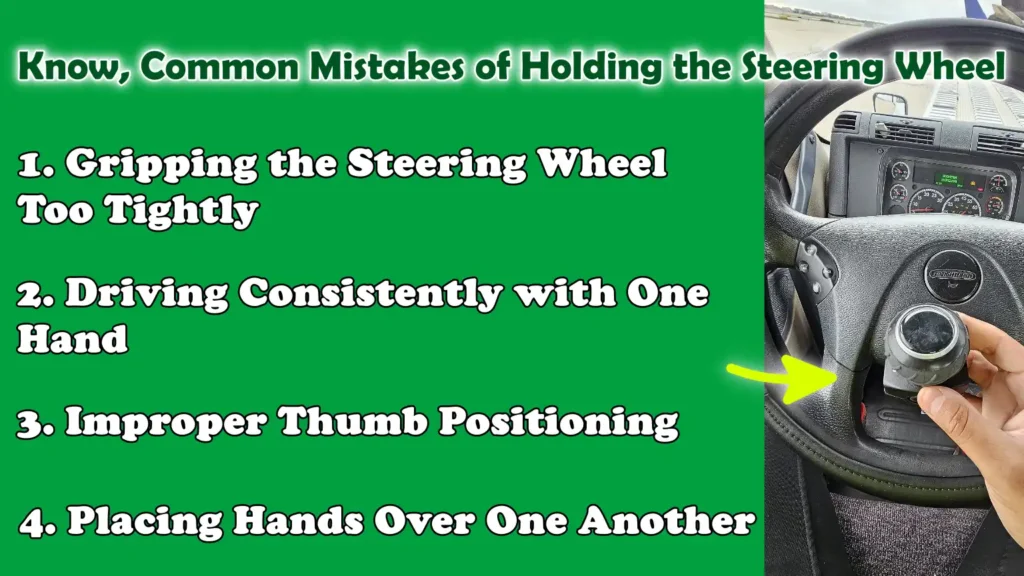
Know, Common Mistakes of Holding the Steering Wheel
Many drivers pay close attention to speed, traffic regulations and road conditions, yet they often overlook subtle steering habits that can surreptitiously compromise safety and control.
Avoiding common errors when gripping and turning the steering wheel is important, as even a minor oversight can impact the speed and precision of your reactions during critical moments.
Road safety organizations such as: the National Highway Traffic Safety Administration and the AAA Foundation for Traffic Safety, note that poor steering habits are linked to delayed reactions, reduced vehicle control and increased driver fatigue.
While these errors may seem trivial during routine driving, they can become hazardous during sudden braking, sharp turns, or emergency situations.
By recognizing and correcting these habits, drivers can enhance their vehicle control, reduce physical strain and make their overall driving experience safer and more comfortable.
1. Gripping the Steering Wheel Too Tightly
Gripping the steering wheel too tightly is a very common mistake that many drivers make inadvertently.
When you grip the steering wheel with excessive force, it creates tension in your hands, arms and shoulders, which can lead to premature fatigue, particularly during long journeys.
This tight grip also diminishes your ability to execute fluid and precise movements, as your muscles become rigid, thereby slowing down your steering responses.
Rather than allowing for natural, subtle adjustments, a tight grip often results in over-steering or jerky movements, which can destabilize the vehicle.
A relaxed yet firm grip is far more effective, as it enables you to “feel” the road and react naturally without any unnecessary physical exertion.
Keeping your hands in a comfortable position ensures you feel at ease and improves your reaction time in both normal and emergency situations.
2. Driving Consistently with One Hand
Driving with only one hand at all times may seem comfortable or convenient, but it significantly reduces your control over the vehicle.
With only one hand on the steering wheel, your ability to execute quick and precise maneuvers is limited specially in sudden situations, such as avoiding an obstacle or reacting to changes in traffic.
This habit also makes it difficult to maintain a straight line of travel, particularly at high speeds or on uneven roads.
In emergency situations, using both hands allows you to apply balanced force and make rapid corrections, which can help prevent accidents.
Consistently driving with one hand increases the risk of delayed reactions and loss of vehicle control, making it less safe compared to using both hands.
For maximum safety and stability, both hands should remain on the steering wheel whenever possible.
3. Improper Thumb Positioning
Improper thumb positioning is another mistake that can compromise both safety and comfort.
Many drivers tightly wrap their thumbs around the inner rim of the steering wheel, believing this provides a firmer grip; however, this can actually be dangerous.
In the event of a collision, airbags deploy with great force; if your thumbs are positioned on the inner side of the wheel, they can be violently thrust backward, thereby increasing the risk of injury.
The correct thumb positioning involves resting them lightly on the outer rim of the steering wheel; this allows your hands to move freely and safely.
This position also helps you maintain a comfortable grip and enhances your ability to handle the steering wheel with ease.
Placing your thumbs in the correct position is a simple yet essential step that protects your hands and improves your overall control over the vehicle.
4. Placing Hands Over One Another
Placing your hands over one another while steering is another common mistake that can diminish your control over the vehicle and slow down your reaction time.
When your hands overlap, your range of motion becomes restricted, making it difficult to make rapid steering corrections when necessary.
This can be particularly dangerous when you are negotiating a turn or facing an emergency situation that demands quick and precise control.
Overlapping hands can also lead to confusion regarding hand positioning, potentially resulting in delayed steering responses or incorrect inputs.
Instead, utilizing proper techniques such as: “push-pull steering”, keeps your hands in a balanced position and prevents them from unnecessarily crossing over one another.
Keeping your hand movements clear and controlled ensures that you are prepared to react swiftly in any situation, thereby boosting both your safety and your confidence behind the steering wheel.
Read More:
- How to Adjust Car Seat for Proper Driving Position
- How to Use Lane Assist Features
- How to Drive with Adaptive Cruise Control
- How to Park on a Hill
- How to Reverse Park Safely
- How to Parallel Park
- How to Park Safely on Busy Streets
- How to Drive in Heavy Traffic Safely
- How to Drive on Highways Safely
- How to Merge Lanes Safely
- How to Overtake Safely
- How to Use Turn Signals Properly
- How to Fix Turn Signals on a Car
- How to Check Blind Spot While Driving
- How to Use Mirrors When Driving
- How to Use ABS Brakes Properly
- How to Brake Safely on Steep Roads
- How to Drive Uphill Safely
- How to Drive Safely in Strong Winds
- How to Prevent Aquaplaning
How to Adjust Your Driving Position for Better Grip
Your driving position directly impacts how effectively you can grip and control the steering wheel.
Even minor adjustments can significantly improve safety, comfort and reaction times.
Experts and safety organizations such as: the National Highway Traffic Safety Administration and the AAA Foundation for Traffic Safety, point out that a proper driving position helps drivers maintain better control over the vehicle while simultaneously reducing physical strain.
When your seat, steering wheel and body posture are correctly aligned, your arms can move naturally and freely, allowing you to steer with precision without any unnecessary effort.
Conversely, an improper driving position can make steering feel heavy, reduce your visibility and slow down your reaction speed in critical situations.
By correctly adjusting your position, you create a balanced and comfortable setup that facilitates safe driving during both short and long journeys.
1. Seat Position
Seat position serves as the foundation for proper driving control, as it determines how easily you can reach and grip the steering wheel.
You should sit at a distance that allows your hands to reach the steering wheel comfortably, without any strain or without fully locking your elbows.
Sitting too close can restrict the movement of your arms and legs, while sitting too far away will prevent you from steering quickly and precisely.
The correct seat position also ensures clear visibility of the road, mirrors and dashboard, all of which are absolutely essential for safe driving.
Your hips should be firmly seated against the backrest and your legs should have a slight bend when reaching for the pedals.
This balanced posture helps you remain stable and maintain full control over both steering and braking.
When your seat is adjusted correctly, your hands naturally fall into the proper position on the steering wheel, making it easier to maintain a secure grip.
2. Steering Wheel Adjustment
Adjusting the steering wheel is equally important, as it directly impacts how your hands interact with the wheel.
Most modern vehicles feature both ’tilt’ (up-and-down) and ‘telescopic’ (in-and-out) adjustment capabilities, allowing you to set the steering wheel to its ideal height and distance.
The steering wheel should be positioned approximately 10 to 12 inches away from your chest; this provides sufficient clearance for airbag deployment while also ensuring effortless control over the steering.
If the steering wheel is positioned too close, the risk of injury in the event of a collision increases; conversely, if it is too far away, you will be unable to steer quickly or effectively.
Adjust the steering wheel’s height so that you can clearly view the instrument panel without the wheel obstructing your line of sight.
A correctly adjusted steering wheel allows you to position your hands comfortably such as: at the 9 and 3 o’clock positions, thereby helping you maintain superior control while driving and reducing physical fatigue.
3. Body Posture
Proper body posture plays a important role in maintaining a firm and effective grip on the steering wheel.
Your back should be straight and supported by the seat, while your shoulders should remain relaxed rather than tense.
This posture facilitates the free movement of your arms and helps prevent fatigue during long journeys.
Your elbows should maintain a slight bend, allowing you to steer with ease without stiffening your joints or hunching over excessively.
If your arms are held too straight, it can reduce flexibility and slow down your reaction time; conversely, if your arms are bent too sharply, it may restrict your range of motion.
Maintaining proper body alignment also enhances your overall balance and stability, making it easier to handle the vehicle in various driving situations.
Correct body posture not only improves comfort but also ensures that your steering movements remain controlled, precise and safe at all times.
Understand, About Special Situations and Their Respective Steering Control
Driving conditions are not always uniform and changing circumstances require varying levels of steering control and situational awareness.
In normal driving, minor errors may not appear particularly serious; however, in challenging situations such as: driving at high speeds, navigating poor road surfaces, or during emergencies, the manner in which you grip and turn the steering wheel becomes paramount.
Road safety organizations, such as the National Highway Traffic Safety Administration (NHTSA) and the AAA Foundation for Traffic Safety, emphasize that maintaining proper steering control during special situations can prevent the loss of vehicle control and significantly reduce the likelihood of accidents.
A firm grip, smooth steering inputs and the ability to remain calm are key factors that help drivers safely navigate sudden and unexpected situations.
Understanding how to adapt your steering technique to specific conditions enables you to maintain control of the vehicle, ensure your safety and that of others and drive with greater confidence even in challenging environments.
1. High-Speed Driving
When driving at high speeds, even a slight adjustment to the steering can have a significant impact on the vehicle’s direction; therefore, maintaining a firm grip on the steering wheel and making only minimal adjustments is absolutely essential.
At higher speeds, the vehicle becomes far more sensitive to steering inputs; turning the steering wheel suddenly or abruptly can upset the vehicle’s balance or cause it to veer out of its lane.
Keeping your hands steady and in the correct position such as: the “9 and 3 o’clock” position, helps you make necessary adjustments smoothly and with control, without the need for excessive corrections.
Maintaining a relaxed yet firm grip on the steering wheel prevents unnecessary muscle tension, ensuring that steering inputs are executed smoothly and without any sudden jerks.
Furthermore, it is important to keep your focus ahead and to make gradual, minor adjustments rather than rapid, sweeping changes.
Maintaining balance at high speeds relies on calm and precise steering, which minimizes risk and ensures that the vehicle remains stable on the road.
2. Driving on Poor or Slippery Roads
When driving on poor, uneven, or slippery roads, it is essential to control the steering with extreme caution to avoid losing tire traction or control of the vehicle.
In such situations, turning the steering wheel suddenly or abruptly can cause the tires to lose their grip, particularly on wet, icy, or loose surfaces like gravel.
The primary strategy is to maintain a firm grip on the steering wheel and make gradual, smooth adjustments to ensure the tires remain in contact with the road.
‘Over-correcting’: which is turning the wheel too sharply in response to a minor deviation that can exacerbate the situation, potentially causing the vehicle to skid or veer out of its lane.
Keeping both hands on the steering wheel and remaining calm helps you react more precisely to changes in the road surface.
By employing controlled and gradual movements, you can maintain stability and drive safely, even in challenging conditions.
3. Emergency Situations
Emergency situations demand quick thinking and precise steering; however, remaining calm is just as important as reacting swiftly.
When sudden obstacles, unexpected halts, or hazardous road conditions arise, your ability to turn the steering wheel, rapidly yet in a controlled manner, as it can help prevent accidents.
Rather than making large, uncontrolled movements out of panic, it is important to keep your hands steady and gently guide the vehicle in the correct direction.
Proper hand positioning enables you to react instantly without shifting your grip, thereby saving precious time.
Panic-driven reactions often lead to over-steering or a loss of vehicle control, which can further exacerbate the danger of the situation.
By staying focused, utilizing both hands and executing controlled movements, you can handle emergency situations more effectively and maintain vehicle stability while avoiding hazards.
What are the Benefits of Holding the Steering Wheel Correctly
Holding the steering wheel correctly may seem like a minor detail, but it offers significant benefits that directly enhance your safety, comfort and overall driving experience.
Experts and safety organizations such as: the National Highway Traffic Safety Administration (NHTSA) and the AAA Foundation for Traffic Safety, point out that proper hand placement allows drivers to maintain better control over the vehicle, react more quickly to changing road conditions and minimize the likelihood of sudden errors.
When your hands are positioned correctly and your grip is balanced, your steering becomes more intuitive and precise, ensuring that the vehicle remains stable at all times.
This also supports your body posture and reduces unnecessary physical strain, making the act of driving less fatiguing.
Over time, this simple habit improves driving proficiency and helps you remain calm and confident behind the wheel, even in challenging situations.
Not only this, there’s detailed research that found out that drivers naturally adopt 3-main steering styles such as: hand-crossing which is 52%, non-crossing that is 30% and asymmetric styles which is 17% all-together, with many drivers they just frequently uses one hand or crossing hands during the turns, but the study clearly shows that these are the habits that can literally create the safety risks, specially with the modern airbags as incorrect hand placement may interfere with the safe deployment of steering wheel air-bags that’s why correct steering techniques are important for both control and injury prevention as well.[¹]
1. Enhanced Road Safety
The most significant benefit of holding the steering wheel correctly is enhanced road safety.
Proper hand placement ensures that both hands are ready to react instantly, a capability that is important during unexpected situations such as sudden braking, facing road obstructions, or navigating sharp turns.
A balanced grip helps prevent over-steering or loss of vehicle control, particularly at high speeds or in difficult driving conditions.
It also works in conjunction with modern safety systems, such as airbags, thereby reducing the risk of injury in the event of a collision.
When your hands are positioned correctly, your movements become more controlled and precise, thereby reducing the likelihood of accidents and ensuring greater safety for both you and others on the road.
2. Increased Confidence While Driving
Adopting proper steering technique naturally boosts your confidence while driving, as you gain a greater sense of control over the vehicle.
When your hands are in the right position and your grip is firm, the vehicle responds exactly as you expect it to, further strengthening your trust in your own driving abilities.
This confidence proves particularly beneficial in situations such as navigating heavy traffic, taking turns, or driving on unfamiliar roads.
As you experience smoother and more predictable steering, your anxiety diminishes and you feel more composed.
Over time, this confidence enables you to handle various driving scenarios with ease and helps you remain calm even when facing unexpected challenges.
3. Improved Reaction Time
Holding the steering wheel correctly improves your reaction time, as your hands are already positioned optimally to act swiftly.
In emergency situations, even a split-second delay can make a significant difference.
If both your hands are in the correct position, you can react instantly without needing to adjust your grip.
This allows you to turn the steering wheel more quickly and precisely, whether to avoid a hazard or to correct the vehicle’s direction.
Proper hand positioning also minimizes unnecessary movements, making your actions more direct and effective.
A faster reaction time translates to better control and a higher probability of avoiding dangerous situations on the road.
4. Reduced Physical Strain
Holding the steering wheel correctly also reduces the physical strain placed on your body, making the driving experience more comfortable, particularly during long journeys.
When your hands are positioned correctly and your grip remains relaxed, it prevents the accumulation of unnecessary tension in your arms, shoulders and wrists.
This reduces fatigue and allows you to maintain your focus for extended periods without discomfort.
Proper hand positioning also ensures correct posture, keeping your body balanced and stress-free while driving.
By minimizing physical tension, you not only enhance your comfort but also maintain superior control and alertness, qualities that are absolutely essential for safe and effective driving.
Conclusion – How to Hold Steering Wheel Correctly
So, there are many drivers they just look for any advanced techniques, but in reality the foundation of having safe driving often lies in the mastering the basics of holding the steering wheel in correct way.
Many drivers focus on speed, traffic regulations, or vehicle features, but true control always begins with how your hands interface with the vehicle.
Proper hand positioning, a balanced grip and correct steering techniques enable you to react more quickly, maneuver with ease and maintain stability in both routine and emergency situations.
Safety organizations such as: the National Highway Traffic Safety Administration and the AAA Foundation for Traffic Safety, consistently emphasize that seemingly minor habits, such as holding the steering wheel correctly, can significantly mitigate risks on the road.
When your hands are in the correct position, your reaction time improves, your movements become more precise and the likelihood of losing control of the vehicle decreases.
Beyond safety, proper steering habits also enhance your overall driving experience.
They reduce physical strain on your body, help you remain comfortable during long journeys and enable you to maintain focus without unnecessary fatigue.
Over time, these small adjustments build confidence and make driving feel more natural and controlled.
Whether you are a novice driver just learning the basics or an experienced driver looking to refine your skills, adopting the habit of holding the steering wheel correctly is a practical step with far-reaching benefits.
Now, you can ask related queries in the comment seciton of this guide.
Frequently Asked Questions
Q1. What is the safest way to hold the steering wheel?
Answer: The safest way to hold the steering wheel is to position your hands at the 9 and 3 o’clock positions; this means your left hand should be on the left side of the wheel and your right hand on the right side. This position provides you with the best balance and control because both hands can apply equal force when turning. It also allows you to make quick and easy adjustments without excessive hand-crossing. Safety organizations, such as the National Highway Traffic Safety Administration, recommend this position because it works effectively with modern airbag systems and reduces the risk of injury during an accident. Overall, this hand position helps you maintain complete control over the vehicle in both normal driving and emergency situations.
Q2. Why is the 9 and 3 position better than the 10 and 2 position?
Answer: The 9 and 3 position is considered superior to the traditional 10 and 2 position, particularly for reasons of safety and comfort. In modern cars, airbags deploy from the center of the steering wheel with immense force; if your hands are positioned too high, as they would be in the 10 and 2 position, they could be violently propelled upward, potentially causing injury to your hands or face. The 9 and 3 position keeps your hands lower and safer. It also offers better control because your hands remain in a more comfortable and balanced position, making steering movements feel more natural and fluid. Over time, this position reduces fatigue and enhances your ability to react quickly while driving.
Q3. How firmly should I hold the steering wheel?
Answer: You should hold the steering wheel with a firm yet comfortable grip. This means your grip should be firm enough to maintain proper control over the wheel, yet not so tight that your muscles become tense or rigid. If you grip the steering wheel too tightly, it can lead to strain in your hands and shoulders, causing fatigue and diminishing your ability to execute smooth, fluid movements. Conversely, if your grip is too loose, you may lack adequate control, particularly on rough roads or when making sudden turns. The optimal approach is to keep your hands relaxed while maintaining a tactile connection with the vehicle’s movements, allowing you to react naturally and instinctively.
Q4. Is it acceptable to drive with only one hand on the steering wheel?
Answer: Driving with one hand is appropriate only in specific situations such as: when shifting gears, adjusting controls, or reversing the vehicle at low speeds. However, this should not be your standard driving habit. Using only one hand compromises your control and makes it difficult to react quickly in an emergency. Keeping both hands on the steering wheel facilitates more precise driving and allows you to make rapid corrections should any unexpected incident occur. For safe and stable driving, it is always best to keep both hands on the steering wheel whenever possible.
Q5. Where should I place my thumbs on the steering wheel?
Answer: Your thumbs should rest lightly on the outer rim of the steering wheel, rather than being tightly wrapped around the inner side. This positioning allows your hands to move freely and helps maintain a comfortable grip. Wrapping your thumbs around the inside of the wheel can be dangerous; If the airbag deploys, the force of its expansion can violently thrust your hands backward, potentially causing injury to your thumbs. Keeping your thumbs positioned on the outside of the wheel mitigates this risk and allows you to steer with greater ease and control. This is a minor adjustment, yet it plays a significant role in ensuring both safety and comfort.
Q6. What common mistakes do people typically make when holding the steering wheel?
Answer: Many drivers inadvertently make minor errors, such as gripping the wheel too tightly, driving with only one hand for extended periods, positioning their hands incorrectly, or excessively crossing their hands over one another while turning. These habits can compromise control, delay reaction times and increase driver fatigue. For instance, gripping the wheel too tightly causes muscle strain, whereas driving with only one hand hinders your ability to react quickly. Furthermore, improper hand placement increases the risk of injury in the event of an accident. By avoiding these mistakes and adopting proper techniques, you can significantly enhance both your safety and your overall driving proficiency.
References:
[1] Steering wheel hand position in low-speed maneuvers
https://www.sciencedirect.com/science/article/abs/pii/S1369847813000788

Guys, I’m a car audio enthusiast and customization expert and I love clear sound and clean installation. Plus, I have spent years helping people build their dream audio setups. And whenever I’m working on cars, I probably listen to music and thinks about the next big upgrade.
