 Skip to content
Written By: Don Dodi
Fact Checked By: Kristen Brown
Reviewed By: Diego Rosenberg
Basically, the biggest risk on the road is not just the traffic, but how people actually reacting to it.
Because, aggressive driving is really annoying and it is serious safety threat that literally contributes to the large number of road crashes every year.
As well as, according to the NHTSA the behaviors such as: speeding, tailgating, unsafe lane changes and running red lights actually plays a major role in traffic accidents and fatalities.
Not only this, many drivers actually don’t realizes that even small reactions such as: honking back, making eye contact or showing frustration have capability to escalate a situation into the “ROAD RAGE”.
That’s why, in this guide you’ll learn How to Deal with Aggressive Drivers , so that you can avoid conflict and have safe journey ahead.
Now, Understand About the Aggressive Drivers
Aggressive drivers are individuals who allow emotions such as anger, stress, or impatience to dominate their driving, often turning ordinary traffic situations into dangerous ones.
Research by the National Highway Traffic Safety Administration indicates that risky behaviors such as: speeding, driving too close to another vehicle (tailgating) and changing lanes unsafely, are primary causes of accidents and injuries.
What makes aggressive driving particularly dangerous is how quickly it can escalate; even minor actions such as: blocking a lane or driving slowly in front of someone, as it can trigger intense emotional reactions.
Many aggressive drivers do not intentionally plan to behave this way; instead, they react impulsively, causing their attention to waver and increasing the likelihood of errors.
Understanding why people behave this way helps you remain vigilant, avoid provoking them and respond in a calm and safe manner.
1. Causes of Aggressive Driving
Aggressive driving often stems from everyday pressures that accumulate over time.
Work-related stress, personal problems, or prolonged periods of driving can leave drivers feeling tense and impatient, thereby impairing their decision-making abilities.
Time pressure is also a significant factor, as individuals running late are more likely to speed, take risks and react angrily to delays.
Heavy traffic and congested roads can further exacerbate frustration, particularly when drivers feel trapped or unable to move freely.
Some individuals may also possess personality traits that make them more prone to intense reactions, such as having a short fuse or struggling to regulate their emotions.
In some instances, the consumption of alcohol or narcotics also plays a role, as it diminishes self-control, slows down reaction times and heightens risky behavior.
Collectively, all these factors can induce a driver to behave aggressively, even in situations where problems would not typically arise.
2. Common Types of Aggressive Drivers
Aggressive drivers may manifest their behavior in various ways; however, their objective is typically the same: to move forward quickly or to vent their frustration, often with little regard for safety.
‘Tailgaters’ drive excessively close to other vehicles, leaving very little time to react and significantly increasing the risk of a rear-end collision.
‘Speeders’ drive well above the posted speed limit, making it difficult for them to maintain control of their vehicle and react to sudden changes in traffic conditions.
‘Lane weavers’ constantly switch lanes in an attempt to overtake other vehicles, often without signaling properly, thereby confusing other drivers and creating hazardous situations.
Those prone to ‘Road Rage’ take their aggression a step further; they attempt to confront or intimidate others, sometimes even stopping their vehicles to engage in arguments.
Drivers who engage in excessive honking or verbal aggression express their anger by blaring their horns, shouting, or making gestures, behaviors that can rapidly escalate tension on the road.
Recognizing these behaviors early on helps you maintain a safe distance and avoid becoming entangled in a confrontation.
3. Warning Signs to Watch Out For
There are several clear warning signs that can help you identify an aggressive driver before a situation turns dangerous.
Sudden braking or unexpected changes in speed often indicate that the driver is reacting emotionally rather than driving calmly and sensibly.
Excessive honking or repeatedly flashing headlights is another sign of impatience or anger, specially when done repeatedly and without any apparent reason.
Unsafe lane changes such as: cutting someone off too closely or failing to use turn signals, demonstrate a disregard for other drivers.
Hand gestures, shouting, or visible signs of anger inside the vehicle are sure indicators that the driver may behave unpredictably.
By paying attention to these early warning signs, you can maintain a safe distance, remain alert and avoid actions that might further escalate the situation, thereby keeping yourself safe and in control.
The Risks of Engaging with Aggressive Drivers
Engaging with aggressive drivers is one of the most dangerous mistakes anyone can make on the road, as it can quickly escalate a stressful situation into a serious threat to safety.
Research on road safety, including findings from the National Highway Traffic Safety Administration, indicates that risky behaviors such as speeding, tailgating and reacting in anger are directly linked to accidents and injuries.
When two drivers react emotionally toward one another, their focus shifts away from safe driving, thereby increasing the likelihood of errors.
Even minor actions such as: making eye contact, honking back in response, or displaying your frustration, as it can exacerbate the situation in a matter of seconds.
The simple truth is this: aggressive drivers are already in an emotionally volatile state and any reaction from you can make the situation even worse.
Choosing not to engage with them is not a sign of weakness; it is a prudent decision that safeguards your physical safety, your legal standing and your mental well-being.
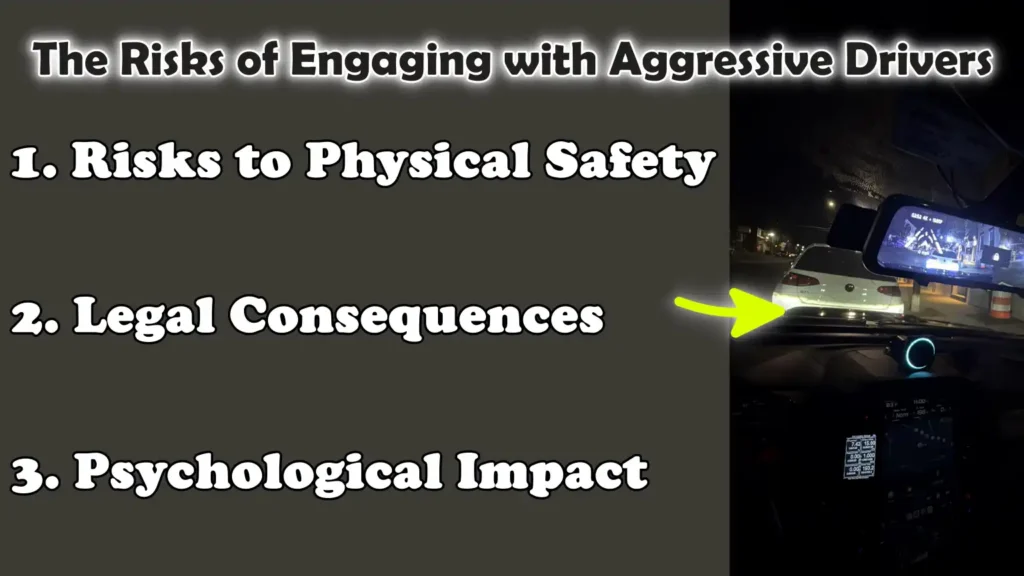
1. Risks to Physical Safety
The greatest danger associated with engaging with aggressive drivers is the increased likelihood of an accident.
When drivers operate their vehicles in anger, they often speed, brake abruptly, or change lanes unsafely, actions that reduce reaction time and compromise vehicle control.
If you react in kind, the risks escalate even further, as neither driver is then operating their vehicle with a clear and rational mindset.
Behaviors such as tailgating another vehicle, suddenly cutting off another car, or attempting to “teach someone a lesson” can easily lead to rear-end collisions or a complete loss of vehicle control.
In more severe cases, these situations can escalate into physical confrontations, where drivers may attempt to block your path, force you to stop, or even exit their vehicles to confront you.
These situations are unpredictable and can turn dangerous very rapidly.
Remaining calm and maintaining a safe distance from the other vehicle is the surest way to avoid harm.
2. Legal Consequences
Many drivers do not realize that reacting to an aggressive driver can lead to legal complications.
If an accident occurs and both drivers were operating their vehicles aggressively, liability for the accident may be shared between both parties, regardless of which driver initiated the altercation.
This means you could face fines, penalties, or an increase in your insurance premiums.
In some instances, actions such as sudden braking (brake-checking), tailgating, or making intimidating gestures may be legally deemed as negligent or reckless driving.
Law enforcement agencies (the police) do not focus solely on who started the dispute; rather, they place greater emphasis on the driver’s conduct.
Therefore, if you retaliate, you may be held liable for your actions.
Avoiding confrontations not only protects you from accidents but also spares you from legal entanglements that can have far-reaching consequences.
3. Psychological Impact
Dealing with angry drivers can also have a detrimental effect on your mental and emotional well-being, particularly if such incidents occur frequently or if their severity escalates.
Having someone yell at you on the road, tailgate you closely, or pressure you can heighten your anxiety and stress, leaving you feeling unsafe or uncomfortable while driving.
Over time, repeated exposure to such situations can erode your confidence and intensify your fears, particularly for new or less experienced drivers.
In more severe instances, a traumatic incident can become deeply ingrained in your memory, causing you to experience lingering stress or hesitation whenever you get behind the wheel.
This emotional impact can distract you while driving and impair your decision-making abilities, thereby increasing future risks.
Learning to remain calm and avoid confrontations not only ensures your physical safety but also enables you to maintain a clear and confident mindset while driving.
Learn, Some Immediate Steps to Ensure Safety
When you face an aggressive driver, your primary priority must always be safety, not proving your point or reacting impulsively out of emotion.
Road safety research conducted by the National Highway Traffic Safety Administration indicates that most accidents are not caused solely by poor road conditions, but rather by human reactions and poor judgment during stressful moments.
This means that your reaction in the next few seconds can either mitigate the danger or significantly escalate the situation.
Aggressive drivers often anticipate a reaction; when they receive one, their behavior can quickly become even more volatile.
By remaining calm, maintaining a safe distance and making prudent decisions while driving, you can minimize risks and prevent a stressful confrontation from escalating into a serious accident.
A few simple measures such as: slowing down, avoiding eye contact and maintaining full control of your vehicle, as it can make a significant difference in keeping you safe.
1. Stay Calm and Avoid Reacting
Remaining calm is one of the most essential skills for dealing with aggressive drivers, as emotions can easily overwhelm you and lead to poor decision-making.
When you feel angry or threatened, your body reacts by accelerating your heart rate and impairing your cognitive abilities, effects that can negatively impact your driving performance.
Taking slow, deep breaths and shifting your focus back to the road, rather than on the other driver, as it can help you maintain self-control.
Reminding yourself that reaching your destination safely is far more important than reacting to someone else’s behavior can also help to diffuse your anger.
Even minor adjustments such as: slightly loosening your grip on the steering wheel and keeping your full attention focused on driving, as it can help you remain steady and calm.
Maintaining control over your emotions enables you to make safer and more rational decisions in the moment.
2. Do Not Engage or Retaliate
Getting involved with an aggressive driver almost always escalates the situation, as it further inflames their anger and provokes them to react even more aggressively.
Simple actions such as: making eye contact, shaking your head, honking back, or making hand gestures, as it can be perceived as a challenge and may make their behavior even more hostile.
Arguing, or attempting to “teach them a lesson” by blocking their path or slowing them down, can quickly steer the situation toward a dangerous outcome.
Angry drivers are often already agitated or frustrated and any reaction on your part can further intensify the severity of their anger.
The safest approach is to completely ignore their behavior and focus your entire attention solely on your own driving.
Refraining from reacting is a highly effective way to prevent the situation from deteriorating further.
3. Maintain Distance
Creating distance between yourself and an angry driver is one of the safest and most effective measures you can take.
Maintaining distance provides you with more time to react and reduces the likelihood of being directly affected by their behavior.
You can do this safely by changing lanes, gradually slowing down, or allowing the angry driver to pass you.
It is crucial to avoid sudden braking, as this can increase the risk of a collision, specially if that driver is following closely behind your vehicle.
By giving them space, you remove yourself from their direct path and minimize the potential for a confrontation.
The objective here is not to engage in a confrontation with them, but rather to steer clear of their path and ensure your own safety.
4. Adhere to the Principles of Defensive Driving
Defensive driving entails always being prepared for unexpected situations and making decisions that minimize risk.
Maintaining a safe distance provides you with more time to react should an aggressive driver suddenly make an erratic maneuver.
Remaining alert and constantly scanning your surroundings helps you identify dangerous behavior in advance.
Anticipating what an aggressive driver might do next such as: suddenly changing lanes or speeding, enables you to safely adjust your position on the road.
Defensive driving means always staying one step ahead and avoiding situations before they turn dangerous.
This approach helps you maintain control even when others are driving unpredictably.
5. Use Your Vehicle Wisely
If you use your vehicle wisely during a stressful situation, it can serve as a safe haven for you.
Keeping your car doors locked and windows rolled up reduces the risk of direct confrontation, specially if an aggressive driver attempts to approach you.
Avoid stopping in any deserted or secluded area where assistance is unavailable.
If you must stop, choose a crowded and well-lit location where other people are present nearby.
Remaining inside your vehicle and refraining from engaging in conversation is safer than stepping out or attempting to confront the other driver.
By utilizing your vehicle effectively, you remain safe and in control of the situation until the difficult moment has passed.
Defensive Driving Techniques for Safety
Defensive driving is the most effective method for preventing problems associated with aggressive drivers before they even arise.
Rather than merely reacting to the actions of others, it emphasizes situational awareness, sound judgment and a calm temperament.
Research by the National Highway Traffic Safety Administration indicates that the majority of road accidents are linked to human behavior, specifically factors such as inattention, poor decision-making and risk-taking.
This implies that by refining your approach to observing, thinking about and acting on the road, you can significantly reduce the likelihood of becoming involved in a dangerous situation.
Defensive driving does not mean driving slowly or being overly cautious; rather, it involves remaining alert, respecting other drivers and avoiding actions that could escalate conflicts.
By consistently adhering to these techniques, you minimize your personal risk and contribute to making the roads safer for yourself and everyone around you.
1. Maintain Situational Awareness
Maintaining situational awareness means that while driving, you must constantly remain conscious of what is happening in your immediate surroundings.
This involves regularly checking your mirrors, keeping your eyes focused on the road ahead and paying close attention to the behavior of other drivers.
By continuously scanning your surroundings, you can identify any unusual or hazardous behavior such as: a car suddenly accelerating or changing lanes without warning, before it evolves into a threat.
Anticipating potential hazards in advance provides you with more time to react safely, whether that entails slowing down, changing lanes, or increasing the distance between your vehicle and others.
When drivers remain aware, they are less likely to be caught off guard by sudden changes, which reduces panic and enhances their decision-making capabilities.
This habit transforms the act of driving, even in heavy traffic situations, into a more controlled and predictable experience.
2. Avoid Provoking Aggressive Drivers
Many aggressive situations on the road stem from minor incidents that are misunderstood or perceived as obstructions to someone’s path.
By avoiding such behaviors, you can prevent problems before they even begin.
Refraining from blocking the passing lane, specially on highways, helps alleviate frustration among drivers who wish to travel at higher speeds.
Using turn signals clearly and at the appropriate time allows others to understand your intentions and react safely.
Avoiding sudden braking or abrupt lane changes prevents confusion and reduces the likelihood of antagonizing other drivers.
These simple habits demonstrate respect for the shared space on the road and make your driving more predictable.
When your actions are smooth and clear, other drivers are less likely to feel challenged or irritated.
3. Practice Patience and Courtesy
Patience and courtesy play a crucial role in maintaining safety and tranquility while driving.
Yielding the right of way when necessary, even if, technically, the right of way belongs to you, as it can prevent unnecessary tension and mitigate risks.
Allowing other drivers to merge into traffic with ease helps maintain the flow of traffic and prevents angry reactions.
Treating others with respect, even if they make a mistake, keeps your focus centered on safety rather than emotions.
Driving is a shared activity and small acts of courtesy can prevent major conflicts.
When you exercise patience, you give yourself more time to think clearly and make better decisions.
This approach not only protects you but also contributes to creating a safer and more cooperative driving environment for everyone.
What to Do in High-Risk Situations
High-risk situations, particularly those involving aggressive drivers, as it can develop very rapidly.
In such instances, your primary objective should be to ensure your safety by remaining calm and making sound decisions.
Safety research conducted by the National Highway Traffic Safety Administration indicates that when drivers panic or react emotionally, the likelihood of accidents and injuries increases significantly.
During these critical moments, your focus should not be on proving a point or retaliating against the other driver, but rather on mitigating the danger and safely extricating yourself from the situation.
Simple measures such as: carefully slowing down, avoiding direct confrontation and steering toward safe areas, as it can make a profound difference.
Knowing in advance how to react helps you maintain control, no matter how stressful or unpredictable the situation may seem.
1. If Someone Is Driving Too Close Behind You (Tailgating)
Tailgating, the act of driving too closely behind another vehicle, is a common yet dangerous situation, as it reduces the safe braking distance required to come to a stop.
The best approach is to remain calm and avoid making sudden, abrupt reactions.
Safely moving aside such as: changing lanes when the path is clear, allows the aggressive driver to pass and alleviates the immediate pressure from behind.
If changing lanes is not possible, gradually slowing down can help increase the distance between your vehicle and the car ahead, thereby giving you more time to react without having to apply sudden brakes.
It is crucial to avoid slamming on your brakes, as this can lead to a rear-end collision and may further escalate the other driver’s anger.
By remaining calm and maintaining a safe distance, you minimize the risk and prevent the situation from deteriorating further.
2. If Someone Is Following You
If you suspect that another driver is intentionally following you, it is crucial to take the situation seriously and exercise extreme caution.
You should never drive directly to your home, as this could reveal your location and place you at even greater risk.
Instead, head toward a busy public area such as: a well-lit street, a crowded parking lot, or a police station, where other people are present and assistance is available.
Remaining in populated areas reduces the likelihood of a direct confrontation and enhances your safety.
If the situation persists or feels threatening, contacting emergency services is a prudent and responsible step.
Rather than attempting to engage with the driver, focusing on reaching a safe location ensures your personal safety.
3. If a Confrontation Occurs While Stopped
If you are stopped and an aggressive driver approaches your vehicle, your car becomes your primary means of protection.
Keeping your windows rolled up and your doors locked creates a physical barrier, thereby minimizing the risk of direct physical contact.
It is essential to avoid any form of interaction, including making eye contact, gesturing, or speaking, as this can escalate tensions and worsen the situation.
Remaining calm and focused allows you to react quickly should the need arise.
If it becomes safe to proceed, for instance, when traffic begins to move or the path clears, be prepared to drive away without hesitation.
In such situations, remaining inside your vehicle and avoiding a direct confrontation is the safest option.
4. If an Incident Escalates
When a situation takes a turn for the worse, your absolute priority must always be to create distance and safely exit the area.
Attempting to argue with, block, or challenge another driver significantly heightens the danger and can lead to serious consequences.
By focusing on disengaging rather than getting involved in a confrontation, you maintain control over the situation and minimize the risk of harm.
In some instances, sounding your car horn can attract the attention of bystanders; this may help de-escalate the other person’s aggressive behavior and alert others to the situation.
Heading toward a crowded or well-lit area also enhances safety.
Most importantly, remain calm, think clearly and take steps that ensure your safety rather than further escalating the conflict.
When and How to Report Aggressive Drivers
Reporting aggressive drivers is a crucial step toward improving road safety, particularly when their behavior endangers others.
While reporting is not necessary in every situation, knowing when and how to do so correctly can help prevent future harm.
Most importantly, safety should be prioritized above all else; direct confrontations should be avoided and accurate information should be shared with authorities so they can take appropriate action.
Also, there’s government data that clearly shows that the real-world impact of aggressive driving is really concerning thing specially when it involves speeding. Because, NHTSA shows that speeding alone caused over 11,000 deaths in single year and was involved in nearly one-third of all fatal crashes, so these numbers actually shows that why it is really important to avoid aggressive behavior and to maintain the safe driving habits at all the times.[¹]
1. When Reporting Becomes Necessary
Reporting becomes necessary when a driver’s behavior goes beyond ordinary mistakes and poses a clear threat to others on the road.
This includes situations where a driver is repeatedly driving aggressively such as: tailgating (driving too closely behind another vehicle), weaving erratically through traffic at high speeds, or running traffic signals.
Reporting becomes even more critical when there are signs of intimidation or attempts to cause harm such as: trying to force another vehicle off the road or aggressively pursuing another driver.
These actions heighten the risk of serious accidents and may indicate that the driver has lost control of their vehicle.
Recognizing these situations helps you understand when it is necessary to involve authorities rather than simply ignoring the driver’s behavior.
2. How to Safely Gather Information
If you decide to report an aggressive driver, the information you provide can help authorities take more effective action; However, this information must be gathered safely so that you do not put yourself at risk.
A basic description of the vehicle, including its color, make and model, as it can aid in its identification.
Noting down the license plate number, provided it can be done quickly and safely, further enhances the accuracy of the report.
Remembering the location and time of the incident is also helpful, as it assists authorities in understanding where and when the behavior occurred.
Nevertheless, your primary focus should always remain on safe driving; you should never chase or attempt to pursue another driver solely for the purpose of gathering information.
Providing incomplete information can still be useful, provided it is accurate and was gathered without incurring any risk.
3. How to Report
Once you have safely gathered the necessary information, the report should be filed through the appropriate channels.
The most direct method for reporting serious or immediate threats is to contact local authorities or emergency services, particularly if the situation is ongoing or poses an immediate danger.
In many regions, Highway Patrol services or traffic helplines are also available for reporting such incidents.
These systems are designed to handle matters related to road safety and when provided with clear and accurate information, they are able to take action more swiftly.
Reporting in a calm and clear manner helps authorities better understand the situation and take appropriate measures.
By following the correct procedures, you contribute to making the roads safer without putting yourself in harm’s way.
Know, Long-Term Strategies for Safe Driving
Ensuring long-term safety on the road is not a one-time task; rather, it is a matter of consistent habits, heightened awareness and the prudent use of available resources.
Research from the National Highway Traffic Safety Administration indicates that most accidents are linked to human behavior, specifically factors such as inattention, risky decision-making and emotional reactions.
This implies that by consistently refining your driving over time, you can significantly reduce the likelihood of finding yourself in hazardous situations, including faces with aggressive drivers.
Long-term strategies focus on acquiring superior driving skills, managing your emotions before they influence your driving and leveraging technology to stay informed and safe.
As these practices become an integral part of your daily routine, driving becomes safer, more predictable and far less stressful.
1. Improve Your Driving Habits
Improving your driving habits is one of the most effective ways to ensure your safety in all driving conditions.
Enrolling in a “defensive driving course” can help you gain a better understanding of real-world hazards, sharpen your reaction time and learn to handle unexpected situations with composure.
These courses often employ research-backed methodologies to teach drivers how to avoid collisions and minimize errors.
Regularly conducting a self-assessment of your performance is also crucial, as it allows you to reflect on your driving behavior and identify specific areas for improvement.
For instance, by paying close attention to habits such as speeding, braking too late, or driving distractedly, you can correct these behaviors before they escalate into dangerous situations.
Over time, these improved habits lead to greater vehicle control, clearer thinking and the ability to make safer decisions on the road.
2. Manage Personal Stress
Managing stress is a fundamental component of safe driving, as your emotional state directly impacts how you react and respond while behind the wheel.
Allowing extra time when planning your trips can alleviate the pressure of running late, a common cause of aggressive behavior.
When drivers are in a hurry, they are more likely to take risks and react negatively to delays.
It is also crucial to avoid driving when you are angry, fatigued, or emotionally distressed, as these conditions diminish your ability to concentrate and slow down your decision-making process.
Notably, fatigue can affect reaction times in much the same way that alcohol intoxication does.
By remaining calm and well-rested, you enhance your capacity to think clearly and react safely to any situation that may arise on the road.
3. Use Technology for Safety
Modern technology, when utilized correctly, can play a helpful role in enhancing driving safety.
Dashcams provide a clear record of events on the road, which can prove invaluable in the event of accidents or disputes; furthermore, they can also serve as an incentive to drive more cautiously.
Navigation apps help drivers avoid heavy traffic, road closures and high-risk areas, thereby reducing stress and minimizing the likelihood of facing aggressive drivers.
Some apps even provide real-time alerts regarding potential hazards, allowing you to be prepared in advance.
By using these tools wisely, you can make better decisions, stay informed and reduce uncertainty while driving.
When technology is combined with good habits and a calm mindset, it can contribute to safer and more confident driving in the long run.
Read More:
- How to Prevent Drowsy Driving
- How to Avoid Distracted Driving
- How to Hold Steering Wheel Correctly
- How to Adjust Car Seat for Proper Driving Position
- How to Use Lane Assist Features
- How to Drive with Adaptive Cruise Control
- How to Park on a Hill
- How to Reverse Park Safely
- How to Parallel Park
- How to Park Safely on Busy Streets
- How to Drive in Heavy Traffic Safely
- How to Drive on Highways Safely
- How to Merge Lanes Safely
- How to Overtake Safely
- How to Use Turn Signals Properly
- How to Fix Turn Signals on a Car
- How to Check Blind Spot While Driving
- How to Use Mirrors When Driving
- How to Use ABS Brakes Properly
- How to Brake Safely on Steep Roads
- How to Drive Uphill Safely
- How to Drive Safely in Strong Winds
- How to Prevent Aquaplaning
The Role of Law Enforcement Agencies and Regulations
Law enforcement agencies and traffic regulations play a crucial role in curbing aggressive driving and ensuring that roads remain safe for everyone.
Governments enact traffic laws to establish clear guidelines for safe conduct and it is the responsibility of police officers to enforce these regulations on the roads.
Research by the National Highway Traffic Safety Administration indicates that the strict enforcement of traffic laws such as: speed limits and safe driving regulations, as it can lead to a reduction in accidents and save lives.
When drivers are aware that dangerous behavior carries real consequences, they are more likely to adhere to the rules.
Regulations also help define what constitutes aggressive or reckless driving, thereby enabling authorities to take action when an individual endangers others.
Alongside enforcement, education and awareness programs help drivers understand the importance of safe conduct, creating a balanced approach that incorporates regulations, penalties and information.
1. Traffic Laws Against Aggressive Driving
Traffic laws targeting aggressive driving are designed to deter dangerous behaviors and hold drivers accountable for their actions.
Aggressive driving is often legally defined as a combination of risky maneuvers, such as speeding, tailgating (driving too closely behind another vehicle), changing lanes unsafely, running red lights or ‘stop’ signs, or disregarding the “right of way” of other road users.
In many jurisdictions, these actions can result in fines, penalty points on one’s driving record, increased insurance premiums and, in severe cases, driver’s license suspension or even imprisonment.
Precise definitions and penalties may vary by country or state; However, the fundamental objective remains the same: to mitigate risks and ensure the safety of all road users.
Law enforcement officials utilize these laws to curb dangerous drivers and prevent situations from escalating further.
Understanding these regulations helps drivers realize that aggressive behavior is not only unsafe but also illegal and costly.
2. Public Awareness Campaigns
Public awareness campaigns play another crucial role in reducing aggressive driving by educating the public before problems even arise.
Governments and safety organizations conduct campaigns to inform drivers about the dangers of “road rage,” the importance of maintaining composure and the impact of their actions on others.
These campaigns often employ real-life examples, statistics and simple messages to ensure that the information is easily understood and retained.
Driver education programs, including training courses and licensing systems, also instill safe driving habits and emotional self-control right from the start.
When individuals are aware of the risks and consequences involved, they are more likely to make better decisions while driving on the road.
Over time, these efforts contribute to fostering a culture of responsible driving, wherein safety becomes a shared responsibility among all drivers.
Conclusion – How to Deal with Aggressive Drivers
So, on the road your reaction really matters more than the situation itself, so behave like a mature one.
Research by the National Highway Traffic Safety Administration consistently demonstrates that human behavior is one of the primary causes of road accidents; this implies that the decisions you make while driving have a profound impact on the outcome.
Aggressive drivers may attempt to rush, intimidate, or provoke you, but responding with patience, maintaining a safe distance and remaining alert can prevent situations from escalating into danger.
A few simple habits such as: staying calm, avoiding confrontation, maintaining proper spacing and adhering to the principles of “defensive driving”, as it can significantly mitigate your risk.
It is also crucial to remember that reaching your destination safely is far more important than reacting emotionally in the heat of the moment.
Over time, cultivating good driving habits, managing stress and understanding how to navigate high-risk situations will transform you into a more confident and responsible driver.
Also, you can comment down below for more information about this guide on How to Deal with Aggressive Drivers.
Frequently Asked Questions
Q1. What is aggressive driving and how does it differ from road rage?
Answer: Aggressive driving occurs when a driver operates a vehicle in a dangerous and unsafe manner such as: speeding, tailgating (driving too close to another vehicle), abruptly changing lanes, or disregarding traffic laws. These behaviors are often driven by impatience or frustration; if left unchecked, they can lead to accidents. Road rage is a more severe matter, as it involves intense anger and, at times, violent behavior such as: shouting, making threats, or attempting to physically harm another driver. Simply put, aggressive driving is a dangerous style of driving, whereas road rage is an intense emotional outburst that can escalate into violence. Understanding this distinction helps you react more calmly and prevents the situation from worsening.
Q2. What should I do immediately if I face an aggressive driver?
Answer: The most important thing is to remain calm and focus on your own driving. You should avoid reacting in any way such as: honking, staring, or making gestures, as this can further provoke the other driver’s anger. Try to create distance by slowing down slightly or safely changing lanes to allow the aggressive driver to pass. Keep your attention focused on the road and be prepared to react to any sudden maneuvers. The goal is to exit the situation as quickly and safely as possible, without getting involved in a confrontation.
Q3. Is it safe to respond to or confront an aggressive driver?
Answer: No, it is not safe to confront an aggressive driver, as a tense situation can quickly turn dangerous. Even minor actions such as: arguing, making direct eye contact, or blocking their path, as it can further escalate their behavior. Aggressive drivers are often already highly emotional and any reaction from you could provoke them to respond even more aggressively. Rather than attempting to correct or challenge them, it is always best to ignore their behavior and prioritize your own safety.
Q4. How can I identify if a driver is becoming aggressive?
Answer: There are several clear signs that can help you identify an aggressive driver early on. These include driving too close to your vehicle (tailgating), sudden acceleration or braking, frequent lane changes without signaling, excessive honking, or flashing headlights. You may also observe the driver making hand gestures or shouting. These behaviors indicate that the driver is angry and may act unpredictably. Recognizing these signs early allows you to take action and create distance before the situation escalates into something more dangerous.
Q5. What should I do if someone is tailgating me?
Answer: If someone is tailgating you, you should remain calm and avoid braking suddenly, as this could lead to a collision. The safest approach is to move into another lane, provided it is safe to do so, to allow the other driver to pass. If changing lanes is not possible, you can gradually reduce your speed to increase the distance between your vehicle and the car ahead; this gives you more time to react. Most importantly, do not react emotionally; instead, focus on creating space to ensure safe driving.
Q6. What should I do if an aggressive driver is following me?
Answer: If you suspect that a driver is following you, do not drive directly to your home or to a secluded location. Instead, proceed to a crowded, well-lit location where other people are present such as: a public area or a police station. This reduces the risk of a direct confrontation and enhances your safety. If you feel that you are in danger, you should contact emergency services and clearly explain the situation to them. Remaining inside your vehicle and avoiding direct contact is the safest course of action.
Q7. Should I report aggressive drivers to the police?
Answer: Yes, if a driver’s behavior is dangerous or intimidating, you should definitely report them to the police. Filing a report helps authorities take action and can prevent future accidents. However, your safety comes first; therefore, file a report only if it is safe for you to do so. If possible, try to remember details such as the vehicle’s model, color, license plate number and location; however, never attempt to chase a driver solely for the purpose of gathering information.
References:
[1] NHTSA, Speeding
https://www.nhtsa.gov/risky-driving/speeding

Guys, I’m a car audio enthusiast and customization expert and I love clear sound and clean installation. Plus, I have spent years helping people build their dream audio setups. And whenever I’m working on cars, I probably listen to music and thinks about the next big upgrade.
